Knight-Ridder Unveils Tablet Prototype to Shield Print From Extinction
Matt Novak
Newspapers will avoid becoming roadkill on the information superhighway because porting familiar editorial layouts to interactive digital tablets preserves reader trust while unlocking multimedia and commerce.
AI-assisted summary of Tablet Newspaper (1994) — original source. Check the original for full context.
Source published:
Key ideas
- Knight-Ridder's Information Design Lab developed a functioning electronic tablet newspaper prototype in 1994, anticipating sub-two-pound mobile reading slates by roughly the year 2000. (2:18)
- Director Roger Fidler framed media evolution through 'mediamorphosis,' introducing a 'bridge of familiarity' that retained multi-column print layouts and page-turning metaphors to eliminate the need for software user manuals. (2:18)
- The prototype demonstrated advanced interactive media, including touch-to-expand stories that eliminated editorial 'news holes,' dynamic typography scaling, voice-narrated animated maps, and slow-motion sports video replays. (4:30)
- Fidler explicitly rejected the Silicon Valley view of news as a fungible commodity, instead preserving distinct publication brands alongside three-dimensional interactive advertisements that functioned as digital storefronts. (6:47)
Detailed notes
## Background Published on YouTube by Matt Novak on April 23, 2011, after originally being uploaded to Google Video in May 2007, this video presents an archival look at the newspaper of the future from 1994. The presentation showcases the work of Knight-Ridder's Information Design Lab and their early prototype for an electronic reading tablet.
## TL;DR In 1994, Roger Fidler and Knight-Ridder's Information Design Lab developed a comprehensive vision for a lightweight electronic tablet designed to bridge traditional print journalism into the digital age. Guided by the principle of 'mediamorphosis,' the project rejected the idea that newspapers were doomed to become roadkill on the information superhighway, arguing instead that print conventions would naturally evolve. The prototype demonstrated interactive touch-based storytelling, expandable articles freed from print news holes, interactive multimedia maps, sports video replays, and customizable personal profiles. It also reimagined commercial advertising as interactive storefronts and envisioned location-independent distribution using portable electronic memory cards.
## Atmosphere & style The presentation carries an earnest, visionary, and deeply thoughtful tone that stands in stark contrast to typical Silicon Valley tech disruption narratives. Roger Fidler speaks with quiet, deliberate conviction, balancing reverence for centuries of journalistic print heritage with a measured enthusiasm for the emergent digital frontier. Watching the demonstration feels like peering into an uncannily prescient time capsule, where modern tablet computing and digital media consumption are mapped out with astonishing accuracy through the nostalgic, blocky aesthetic of mid-1990s computing.
## Bulletin - [02:18](https://www.youtube.com/watch?v=JBEtPQDQNcI&t=138s) Knight-Ridder's Information Design Lab developed a functioning electronic tablet newspaper prototype in 1994, anticipating sub-two-pound mobile reading slates by roughly the year 2000. - [02:18](https://www.youtube.com/watch?v=JBEtPQDQNcI&t=138s) Director Roger Fidler framed media evolution through 'mediamorphosis,' introducing a 'bridge of familiarity' that retained multi-column print layouts and page-turning metaphors to eliminate the need for software user manuals. - [04:30](https://www.youtube.com/watch?v=JBEtPQDQNcI&t=270s) The prototype demonstrated advanced interactive media, including touch-to-expand stories that eliminated editorial 'news holes,' dynamic typography scaling, voice-narrated animated maps, and slow-motion sports video replays. - [06:47](https://www.youtube.com/watch?v=JBEtPQDQNcI&t=407s) Fidler explicitly rejected the Silicon Valley view of news as a fungible commodity, instead preserving distinct publication brands alongside three-dimensional interactive advertisements that functioned as digital storefronts.
## Key takeaways - [00:06](https://www.youtube.com/watch?v=JBEtPQDQNcI&t=6s) The Information Design Lab was founded in Boulder, Colorado, in 1992 to engineer the transition from mechanical printing presses to digital distribution. - [00:06](https://www.youtube.com/watch?v=JBEtPQDQNcI&t=6s) Roger Fidler coined the term 'mediamorphosis' to describe how legacy communication forms survive by adapting across 10-to-15-year technological cycles. - [02:18](https://www.youtube.com/watch?v=JBEtPQDQNcI&t=138s) The electronic tablet was conceptualized as an under-two-pound dedicated consumption device offering display contrast and legibility comparable to ink on paper. - [02:18](https://www.youtube.com/watch?v=JBEtPQDQNcI&t=138s) The 'bridge of familiarity' design strategy preserved print conventions like columns and page turns so users could navigate the device instinctively without manuals. - [04:30](https://www.youtube.com/watch?v=JBEtPQDQNcI&t=270s) Digital delivery freed journalism from physical 'news holes,' allowing touched headlines to expand into complete, unedited long-form dispatches. - [04:30](https://www.youtube.com/watch?v=JBEtPQDQNcI&t=270s) Interactive reporting integrated synchronized multimedia, such as boundary-shifting historical maps with spoken voiceovers and video replays with user-controlled frame freezing. - [04:30](https://www.youtube.com/watch?v=JBEtPQDQNcI&t=270s) Dynamic typographical resizing addressed visual accessibility without breaking the visual integrity of newspaper column layouts. - [06:47](https://www.youtube.com/watch?v=JBEtPQDQNcI&t=407s) Personal profile utilities automated topic filtering, generated custom abstract pages, and enabled early electronic clipping and story sharing. - [06:47](https://www.youtube.com/watch?v=JBEtPQDQNcI&t=407s) Fidler disputed the tech industry's commodity information model, arguing that reader loyalty relies heavily on institutional trust, distinctive typography, and editorial voice. - [08:57](https://www.youtube.com/watch?v=JBEtPQDQNcI&t=537s) Advertising was conceptualized as a three-dimensional storefront window, enabling readers to transition from a surface ad into video spots, catalog browsing, and two-way commerce. - [08:57](https://www.youtube.com/watch?v=JBEtPQDQNcI&t=537s) Integrated text-to-speech synthesizers provided hands-free audio playback for mobile commuters. - [11:15](https://www.youtube.com/watch?v=JBEtPQDQNcI&t=675s) Memory cards and networked public data kiosks were envisioned to decouple local newspaper delivery from physical geography for traveling readers. - [11:54](https://www.youtube.com/watch?v=JBEtPQDQNcI&t=714s) The project directly challenged the prediction that print organizations were doomed 'dinosaurs' destined to become roadkill on the information superhighway.
## Detailed walkthrough ### [00:06](https://www.youtube.com/watch?v=JBEtPQDQNcI&t=6s) The Knight-Ridder Information Design Lab and "Mediamorphosis"
For more than five centuries, ink on paper reigned supreme as the ideal vehicle for the written word, but the rapid digitization of the late twentieth century began challenging that hegemony. In Boulder, Colorado, Knight-Ridder established the Information Design Lab (IDL) in the fall of 1992 under the direction of Roger Fidler. Bringing together an interdisciplinary team of journalists, graphic designers, software technologists, and media researchers, the lab set out to engineer the bridge between traditional print journalism and the coming electronic frontier. Demonstrations inside the lab showcase early experiments in digital layout, such as front-page infographics that animate when clicked, leading the reader straight into an expanded narrative.
Roger Fidler views this historical shift not as an isolated disruption of the daily broadsheet, but as part of a sweeping, unified evolution across all human communication. He coined the term "mediamorphosis" to describe how older media adapt and survive by morphing in response to emergent technological pressures and cultural shifts over ten-to-fifteen-year cycles. With digital telecommunications and computing power continuously driving down the economic cost of publishing, Fidler envisioned digital paper replacing mechanical presses. The IDL operates primarily as a visionary media think tank, convening industry leaders to craft five-, ten-, and twenty-year forecasts for the future of news gathering and distribution.
As Roger Fidler observed regarding this historical shift across communication systems: “All forms of media that we know today will be transformed over the next 10, 15 years.”
- The Information Design Lab was founded in Boulder, Colorado, in the fall of 1992. - Fidler coined the conceptual term "mediamorphosis" several years prior to frame the evolutionary trajectory of media. - The lab targets long-range scenarios for newspaper organizations spanning 5, 10, and 20 years.
---
[02:18](https://www.youtube.com/watch?v=JBEtPQDQNcI&t=138s) Designing the Portable Tablet and the "Bridge of Familiarity"
Central to the IDL's research is the electronic tablet—a lightweight form factor under active development by major global consumer electronics firms. Conceptualized as an entirely new computing category slated to enter daily domestic life around the turn of the century, these portable slates are designed to weigh less than two pounds. Crucially, they aim to deliver display contrast and visual clarity matching physical ink on paper while seamlessly weaving together text, high-resolution graphics, audio tracks, and full-motion video. While desktop computers remain workhorses for information creation, the tablet is conceived purely for consumption: reading, watching, and listening on the go.
The core design philosophy at Boulder hinges on what Fidler terms the "bridge of familiarity." Throughout technological history, novel communication forms invariably borrow the visual conventions and behavioral metaphors of their predecessors before establishing an independent identity. Rather than forcing consumers to master arcane software commands or study thick user manuals, the tablet newspaper mimics the intuitive physical architecture of print: multi-column page spreads, clear section dividers, and natural page-turning gestures. By keeping the interface instantly recognizable, digital enhancements can add value without alienating lifelong print readers.
Roger Fidler underscored the necessity of intuitive design over technical complexity: “We don't want to have to issue people manuals to read their newspaper; you already know how to read a newspaper, you know how to turn pages, pull out a section, find things that are interesting to you.”
```mermaid flowchart TD accTitle: The Bridge of Familiarity Transition accDescr: Diagram illustrating the evolution from print newspaper conventions to the electronic tablet. subgraph Print["Print Tradition"] P1["Physical Page Turns"] P2["Multi-Column Grid"] P3["Section Pullouts"] end subgraph Bridge["Bridge of Familiarity"] B1["Familiar Metaphors"] B2["No User Manual Needed"] end subgraph Digital["Digital Enhancements"] D1["Multimedia Layering"] D2["Two-Way Interactivity"] D3["On-Demand Depth"] end Print --> Bridge Bridge --> Digital ```
- Target specifications for the electronic tablet: under 2 pounds, highly portable, with screen readability rivaling ink on paper. - Anticipated timeline for mainstream consumer adoption: around the turn of the century (circa 2000).
---
[04:30](https://www.youtube.com/watch?v=JBEtPQDQNcI&t=270s) Interactive Storytelling: Multimedia, Scalable Type, and Video Replays
A guided tour of the IDL prototype reveals a surface appearance nearly identical to a traditional printed newspaper, yet freed from physical mechanical constraints. In conventional publishing, editors trim articles to fit fixed editorial "news holes" mandated by page geometry and advertising quotas. On the tablet, touching a headline—such as an in-depth dispatch on the war in Bosnia—instantly expands the text into its complete, unedited form. The narrative expands past the written word into multimedia cartography: touching an accompanying territory map triggers spoken narration and animated boundary lines explaining the historical Balkan divisions formerly united under Yugoslavia.
Beyond narrative depth, the interface tackles physical accessibility and athletic reporting. Readers with impaired vision can dynamically enlarge typography to a comfortable reading size without breaking layout integrity. In the sports section, written accounts are augmented by synchronized multimedia. An article covering a dramatic baseball play integrates embedded audio commentary and full-motion video replays. Readers are not bound by the fleeting constraints of network television broadcasts; they can replay an outfield throw at will, freeze individual frames, or watch the runner get tagged out at home plate in slow motion.
As the narrator emphasized regarding the end of print layout restrictions: “What you read is no longer limited to the physical constraints of the printing press and production process; a story is edited for content and completeness, not for news hole.”
- Stories expand on demand via direct touch, eliminating news hole cutbacks. - Multimedia features include animated geopolitical maps with integrated voiceover narration. - Sports coverage integrates embedded video with user-controlled slow motion, frame advance, and instant replay. - Typography can be dynamically enlarged for accessibility.
---
[06:47](https://www.youtube.com/watch?v=JBEtPQDQNcI&t=407s) Personalization, Digital Clipping, and Brand Identity
The IDL prototype balances broad editorial curation with personalized automation. Through a dedicated personal profile utility, readers can configure automated filters that monitor incoming editions for specific topical interests, corporate announcements, or targeted retail sales. The tablet presents a global index where matching articles and display advertisements are automatically highlighted, alongside an abstract page compiling tailored article summaries. Readers can browse these custom digests and jump instantly into the full text, or clip individual stories and transmit them electronically to friends—mirroring the habit of clipping newspaper clippings for the refrigerator, but done entirely over the wire.
Crucially, Fidler challenges the Silicon Valley orthodoxy that news is a fungible commodity best disaggregated into raw information feeds. Many contemporary technologists assumed that users would prefer algorithmic aggregation untethered from journalistic institutions. Fidler counters that reader engagement relies profoundly on institutional trust, aesthetic coherence, and editorial identity. Readers identify with publications like *The New York Times*, *The Wall Street Journal*, or *The Philadelphia Inquirer* through distinctive typography, layout structure, and established editorial voice, developing a loyal relationship akin to an enduring personal friendship.
Roger Fidler firmly rejected the commodity model of digital journalism: “Many of the technologists who have been pursuing these objectives assume that information is simply a commodity and people really don't care where that information comes from as long as it matches their set of personal interests; I disagree with that view.”
- Personal profile screen scans editions to highlight relevant stories, ads, and index abstracts. - Digital clipping feature allows readers to save articles locally or email them directly to colleagues and friends. - Design preserves masthead typography, layout quirks, and branded identities of publications like *The New York Times*, *The Wall Street Journal*, and *The Philadelphia Inquirer*.
---
[08:57](https://www.youtube.com/watch?v=JBEtPQDQNcI&t=537s) Advertising in Three Dimensions and Ubiquitous Accessibility
Advertising in the Knight-Ridder vision is not an intrusive afterthought, but an essential civic and economic pillar that subsidizes rigorous journalism while delivering valuable community intelligence. Rather than treating ads as flat, static rectangular space, the electronic tablet conceptualizes commercial messages in three dimensions. In standard print, an advertisement is a two-dimensional surface that requires readers to write down phone numbers or visit a store later. On the tablet, the initial print-like display serves merely as an inviting storefront window.
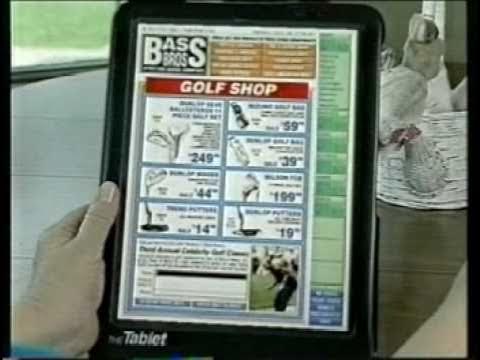
Tapping an advertisement opens an interactive electronic doorway directly into the merchant's dedicated digital showroom. Readers can view an on-demand fifteen-to-twenty-second video commercial, browse product catalogs, make dinner reservations, or purchase merchandise directly through built-in two-way telecommunications. When readers are on the move or unable to look at the screen, integrated text-to-speech synthesizers can read news copy aloud. Looking toward distribution, the lab imagines network-connected kiosks stationed in public venues, allowing commuters to rapidly download fresh morning editions onto their handheld tablets wherever their travels take them.
Roger Fidler explained the spatial shift in digital commercial design: “In the electronic world, we're really dealing with a three-dimensional world; the advertising on the surface pages that you browse just like a newspaper today are, in a sense, the storefront window.”
- Print ads function as two-dimensional surfaces, whereas tablet ads act as three-dimensional storefronts leading to video spots and catalogs. - Hardware incorporates two-way data exchange for transactional e-commerce, inquiries, and reservations. - Accessibility options include integrated speech synthesis ("Read story") for hands-free audio consumption. - Public data kiosks are envisioned as physical download hubs for mobile tablet updating.
[11:15](https://www.youtube.com/watch?v=JBEtPQDQNcI&t=675s) Portable Distribution and Reimagining the Newspaper
The vision for the tablet hinges on flexible electronic distribution, where publications are downloaded directly onto small electronic memory cards that slot right inside the device. This format breaks the geographic limitations of traditional physical delivery. If an executive or traveler is conducting business far away in Miami but calls Denver home, they no longer have to sacrifice access to their community; they can still have their hometown paper delivered electronically every single morning wherever they wake up.
```mermaid flowchart LR accTitle: Electronic Newspaper Distribution Concept accDescr: Flow showing how digital newspaper editions are transferred onto electronic cards and inserted into tablets for remote reading. subgraph Content ["Content Delivery"] A["Hometown Publication (e.g. Denver)"] --> B["Electronic Data Card"] end subgraph Device ["Reader Access"] B --> C["Tablet Device"] C --> D["Remote Reading (e.g. in Miami)"] end ```
The researchers and developers working in the laboratory view their project as a historic turning point for journalism rather than an isolated gadget experiment. Describing the team as deeply creative, energetic, and passionately committed to the future of the press, the speaker emphasizes that their core mission is to leverage and build upon the proven institutional strengths of traditional newspapers instead of discarding everything to start from scratch.
- Electronic storage cards slot directly into the tablet to load daily editions. - Readers traveling anywhere in the country can access their local hometown coverage without geographic delays. - Development focuses on modernizing existing publishing foundations rather than replacing news organizations.
[11:54](https://www.youtube.com/watch?v=JBEtPQDQNcI&t=714s) Defying the "Roadkill" Prediction on the Information Superhighway
The project directly confronts the prevailing skepticism in the tech world that traditional media is doomed. While widespread conventional wisdom treats print organizations as relics, the team adamantly rejects that fatalistic forecast. As the speaker explains: “There are many people who believe that that newspapers are dinosaurs and that they're going to become the uh the roadkill on the information Super Highway in the not too distant future uh we believe exactly the opposite uh we believe that newspapers in fact can evolve into a new form of media that blends the old familiar aspects of a newspaper with the new technologies that are emerging so that uh you have the ability to read and browse and scan as we do today um at the same time being able to uh interact with the newspaper to interact with advertisers through your newspaper in ways that are are not possible in print media today.”
Rather than suffering extinction, the paper is envisioned as undergoing an evolutionary leap. By preserving the human-scale layout, casual browsing, and scanning comfort that readers have relied on for generations, the digital tablet augments the experience with digital interactivity. This allows readers to engage directly with news items and establish active connections with commercial advertisers—capabilities that static ink on paper could never deliver.
## Notable quotes > [02:18](https://www.youtube.com/watch?v=JBEtPQDQNcI&t=138s) We don't want to have to issue people manuals to read their newspaper; you already know how to read a newspaper, you know how to turn pages, pull out a section, find things that are interesting to you. — Roger Fidler
> [00:06](https://www.youtube.com/watch?v=JBEtPQDQNcI&t=6s) All forms of media that we know today will be transformed over the next 10, 15 years. — Roger Fidler
> [08:57](https://www.youtube.com/watch?v=JBEtPQDQNcI&t=537s) In the electronic world, we're really dealing with a three-dimensional world; the advertising on the surface pages that you browse just like a newspaper today are, in a sense, the storefront window. — Roger Fidler
## Mentioned Knight-Ridder, Information Design Lab, Roger Fidler, The New York Times, The Wall Street Journal, The Philadelphia Inquirer
## Video description http://www.paleofuture.com/blog/2007/5/14/tablet-newspaper-1994.html
This video was originally uploaded to Google Video on May 13, 2007.
Looking at the newspaper of the future from 1994.
[Source](https://www.youtube.com/watch?v=JBEtPQDQNcI)