Gates Backs Nuclear Startup TerraPower to Eliminate Carbon Emissions
TED
Global warming will continue until net emissions reach zero, requiring breakthrough energy technologies that undercut fossil fuel prices rather than subsidies that hurt the poor.
AI-assisted summary of Innovating to zero! | Bill Gates — original source. Check the original for full context.
Source published:
Key ideas
- Stopping planetary warming requires driving global carbon emissions completely to zero, as atmospheric carbon dioxide accumulates cumulatively rather than stabilizing under partial reductions. (2:06)
- Using the framework CO2 = P × S × E × C, Bill Gates demonstrates that population, services, and efficiency cannot drop to zero, leaving clean energy innovation (reducing carbon intensity to zero) as the only viable path to avoid catastrophic climate change. (3:57)
- Current worldwide battery manufacturing capacity can store less than 10 minutes of total global energy demand, creating a critical storage bottleneck for intermittent renewable energy sources like wind and solar. (12:01)
- Gates is backing TerraPower to build a traveling wave reactor capable of burning depleted uranium (U-238) and existing nuclear waste, unlocking fuel reserves capable of powering the United States for hundreds of years. (13:20)
- Gates advocates prioritizing fundamental energy R&D—recommending an additional $10 billion per year in the U.S.—over heavy premature deployment subsidies, warning that artificially inflating energy prices severely harms the world's poorest two billion people. (26:02)
Detailed notes
## Background Published by TED on YouTube on February 20, 2010, this presentation features Bill Gates at TED2010 outlining his vision for the future of global energy. The talk details the urgent necessity of technological "miracles" to avert climate catastrophe, explains his backing of a novel traveling wave nuclear reactor, and sets a target of reaching zero global carbon emissions by 2050.
## TL;DR Bill Gates presents the foundational climate identity (CO2 = P × S × E × C), demonstrating that because population, economic services, and basic energy efficiency cannot drop to zero without exacerbating global poverty, the carbon intensity of energy itself must fall to near zero. He evaluates the limitations of existing clean energy solutions—including land footprint and battery storage constraints for intermittent renewables—and calls for hundreds of radical, high-risk innovation efforts. Gates specifically highlights TerraPower's traveling wave reactor, which utilizes depleted uranium waste to generate centuries of clean power without continuous refueling. Ultimately, he argues that the world must drastically increase fundamental energy R&D so that zero-emission power becomes significantly cheaper than incumbent fossil fuels, rendering decarbonization an undeniable economic choice.
## Atmosphere & style The presentation is marked by Gates' signature analytical pragmatism and technocratic optimism, breaking an existential planetary crisis down into simple, dispassionate algebra and engineering realities. He balances serious warnings about the vulnerability of the global poor with deadpan humor, playfully releasing live fireflies into the audience as a clean energy counterpart to his earlier malaria mosquito demonstration. The subsequent Q&A with TED curator Chris Anderson feels candid, intellectually rigorous, and focused on hard trade-offs, delivering an earnest plea for human ingenuity backed by immense venture and government research capital.
## Bulletin - [02:06](https://www.youtube.com/watch?v=JaF-fq2Zn7I&t=126s) Stopping planetary warming requires driving global carbon emissions completely to zero, as atmospheric carbon dioxide accumulates cumulatively rather than stabilizing under partial reductions. - [03:57](https://www.youtube.com/watch?v=JaF-fq2Zn7I&t=237s) Using the framework CO2 = P × S × E × C, Bill Gates demonstrates that population, services, and efficiency cannot drop to zero, leaving clean energy innovation (reducing carbon intensity to zero) as the only viable path to avoid catastrophic climate change. - [12:01](https://www.youtube.com/watch?v=JaF-fq2Zn7I&t=721s) Current worldwide battery manufacturing capacity can store less than 10 minutes of total global energy demand, creating a critical storage bottleneck for intermittent renewable energy sources like wind and solar. - [13:20](https://www.youtube.com/watch?v=JaF-fq2Zn7I&t=800s) Gates is backing TerraPower to build a traveling wave reactor capable of burning depleted uranium (U-238) and existing nuclear waste, unlocking fuel reserves capable of powering the United States for hundreds of years. - [26:02](https://www.youtube.com/watch?v=JaF-fq2Zn7I&t=1562s) Gates advocates prioritizing fundamental energy R&D—recommending an additional $10 billion per year in the U.S.—over heavy premature deployment subsidies, warning that artificially inflating energy prices severely harms the world's poorest two billion people.
## Key takeaways - [00:16](https://www.youtube.com/watch?v=JaF-fq2Zn7I&t=16s) Energy access and affordability are directly tied to poverty reduction, as modern living standards historically stem from precipitous drops in electricity costs. - [02:06](https://www.youtube.com/watch?v=JaF-fq2Zn7I&t=126s) The atmosphere responds to the cumulative accumulation of carbon dioxide, which means reducing emissions by 50% or 75% will fail to stop ongoing temperature increases. - [03:57](https://www.youtube.com/watch?v=JaF-fq2Zn7I&t=237s) The climate equation (CO2 = P × S × E × C) mandates that to reach net-zero emissions, carbon output per unit of energy (C) must reach zero, as population and basic services must expand to lift billions out of poverty. - [03:57](https://www.youtube.com/watch?v=JaF-fq2Zn7I&t=237s) Aggressive energy efficiency improvements can yield three- to six-fold reductions across sectors, but fundamental thermodynamic limits in industrial processes prevent efficiency alone from solving climate change. - [07:09](https://www.youtube.com/watch?v=JaF-fq2Zn7I&t=429s) Transforming the energy landscape requires 'energy miracles'—transformative technological breakthroughs comparable to the microprocessor or the Internet—developed on a strict, rapid timeline. - [08:37](https://www.youtube.com/watch?v=JaF-fq2Zn7I&t=517s) Only five primary clean energy avenues can operate at global scale: fossil fuels with carbon capture and storage (CCS), nuclear fission, and renewable power across wind, solar, and hydro/other sources. - [12:01](https://www.youtube.com/watch?v=JaF-fq2Zn7I&t=721s) Global battery production holds under 10 minutes of worldwide energy consumption, necessitating roughly a 100-fold leap in battery technology to support a fully renewable grid beyond a 20% to 30% share. - [13:20](https://www.youtube.com/watch?v=JaF-fq2Zn7I&t=800s) TerraPower's traveling wave reactor utilizes supercomputer simulations to burn uranium-238 (depleted uranium) instead of standard uranium-235, utilizing existing stockpiles and legacy waste without refueling for up to 60 years. - [15:18](https://www.youtube.com/watch?v=JaF-fq2Zn7I&t=918s) Achieving an 80% global emissions reduction by 2050 requires advanced economies and major emitters to reach 100% zero-carbon electricity, preserving remaining emissions capacity for basic agriculture in developing nations. - [18:52](https://www.youtube.com/watch?v=JaF-fq2Zn7I&t=1132s) Commercializing breakthrough reactor technology requires navigating capital-intensive phases, scaling from tens of millions for simulation to several billion dollars for a first demonstration plant. - [23:13](https://www.youtube.com/watch?v=JaF-fq2Zn7I&t=1393s) Uranium carries roughly one million times the energy density of coal per unit, offering uniquely compact land use if issues of cost, radiation safety, and waste are engineered effectively. - [23:13](https://www.youtube.com/watch?v=JaF-fq2Zn7I&t=1393s) Geoengineering should remain an active area of research as an emergency Plan B to buy 20 to 30 years of buffer time if clean energy innovation lags or climate tipping points accelerate. - [24:40](https://www.youtube.com/watch?v=JaF-fq2Zn7I&t=1480s) Climate change mirrors the delayed crisis dynamic of HIV/AIDS, making societal response difficult because actions taken today carry consequences only recognized decades later. - [24:40](https://www.youtube.com/watch?v=JaF-fq2Zn7I&t=1480s) The most effective counter to climate skepticism is economic parity, engineering zero-carbon power that is simply cheaper than coal and natural gas. - [26:02](https://www.youtube.com/watch?v=JaF-fq2Zn7I&t=1562s) Prematurely subsidizing non-competitive clean technologies is inefficient compared to funding fundamental R&D, and policies that arbitrarily inflate energy costs disproportionately harm vulnerable populations.
## Detailed walkthrough ### [00:16](https://www.youtube.com/watch?v=JaF-fq2Zn7I&t=16s) Energy, Climate, and Poverty
Bill Gates acknowledges that addressing energy and climate might seem unexpected given his full-time philanthropy at the Bill & Melinda Gates Foundation, where his daily focus is centered on inventing and delivering vaccines and seeds for the poorest two billion people on Earth. Yet, as he explains, energy and climate matter more to these impoverished communities than to anyone else. A destabilized climate directly threatens their fragile environments; shifting rainfall patterns—either overwhelming floods or severe droughts—ruin crops, catalyzing starvation, uncertainty, and social unrest.
Simultaneously, economic progress is fundamentally tethered to the cost of energy. Historically, the coal-powered Industrial Revolution and the dramatic twentieth-century decline in electricity costs made modern civilization possible, unlocking refrigeration, air conditioning, and advanced materials for the wealthy world. To uplift the global poor, making energy drastically cheaper is imperative, but any new expansion must respect an existential ecological boundary. As Gates emphasizes when weighing levers for global development: “In fact, if you could pick just one thing to lower the price of to reduce poverty, by far you would pick energy.”
- The foundation's primary mission targets the poorest two billion people through agricultural tools and healthcare innovations. - Modern living standards in industrialized nations are direct products of sustained declines in the price of electricity. - A future energy strategy must aim to make power twice as cheap while operating under an absolute carbon constraint.
---
[02:06](https://www.youtube.com/watch?v=JaF-fq2Zn7I&t=126s) The Road to Zero: Why Reductions Aren't Enough
The relationship between carbon emissions and global warming follows a direct, cumulative logic: aggregate carbon dioxide emissions produce rising global temperatures, triggering extreme weather and collapsing ecosystems that cannot adapt fast enough to rapid environmental shifts. While minor scientific uncertainties remain regarding exact feedback loops and localized impacts, the broader outcomes will be catastrophic. Gates notes that he repeatedly pressed climate scientists on whether global society could merely curb emissions by 50% or 75%, but the physics of atmospheric accumulation dictate that warming continues until net additions halt entirely.
To illustrate the nature of the challenge, Gates contrasts climate targets with normal engineering compromises, noting that this is not like a twelve-foot truck trying to scrape beneath a ten-foot bridge. The world generates more than 26 billion tons of carbon dioxide every year. That footprint is distributed unevenly, averaging roughly 20 tons per American, less than one ton per citizen in poor nations, and an overall global average of five tons per person. Because emissions continue an upward trajectory punctuated only by economic downturns, the global energy apparatus must shift from steep increases directly down to zero. Gates summarizes the scientific consensus on the emissions threshold: “And the answer is, until we get near to zero, the temperature will continue to rise.”
```mermaid flowchart TD accTitle: The Cumulative Climate Mechanism accDescr: Flowchart tracking how annual carbon emissions accumulate into rising temperatures, ecosystem collapse, and human disruption.
subgraph Emissions["Global Activity"] A["Annual CO2 Emissions<br/>(26+ Billion Tons/Year)"] end
subgraph Atmosphere["Atmospheric Impact"] B["Atmospheric CO2 Accumulation"] C["Global Temperature Rise"] end
subgraph Impacts["Consequences"] D["Weather Extremes & Droughts"] E["Natural Ecosystem Collapses"] F["Starvation, Unrest & Instability"] end
A --> B B --> C C --> D C --> E D --> F E --> F ```
- Annual global carbon dioxide output exceeds 26 billion metric tons. - Per capita emissions: roughly 20 tons per American, under 1 ton per person in developing countries, and approximately 5 tons globally. - Partial reductions fail to stop planetary warming because emissions accumulate in the atmosphere over time.
---
[03:57](https://www.youtube.com/watch?v=JaF-fq2Zn7I&t=237s) The Four-Factor Equation: CO2 = P × S × E × C
To understand how global net emissions can reach zero, Gates breaks the problem down into a mathematical identity containing four multiplying factors: population ($P$), services consumed per person ($S$), the energy required per service ($E$), and the carbon emitted per unit of energy ($C$). Basic arithmetic dictates that for the final product to equal zero, at least one of the multiplying terms must fall to near zero.
```mermaid flowchart LR accTitle: Gates Climate Equation accDescr: The four multiplying components that determine total global CO2 emissions.
P["P<br/>(Population)"] --> Mult["×"] S["S<br/>(Services / Person)"] --> Mult E["E<br/>(Energy / Service)"] --> Mult C["C<br/>(CO2 / Energy Unit)"] --> Mult Mult --> Zero["CO2 Emissions<br/>Target: ZERO"] ```
Examining each factor reveals structural limits to reduction: 1. **Population ($P$):** The global population sits at 6.8 billion and is tracking toward 9 billion. Improvements in reproductive healthcare, basic healthcare, and vaccines could bend this growth curve downward by 10% to 15%, leaving an overall factor increase of approximately 1.3. 2. **Services ($S$):** Basic amenities—food, clothing, heating, and lighting—must dramatically expand if global poverty is to be eradicated. Gates displays a photograph of children reading their school assignments under outdoor municipal streetlights because their homes lack electricity. As living standards improve globally, services per person will more than double. 3. **Efficiency ($E$):** Energy efficiency per service provides genuine opportunities for reduction. Innovations in lighting, building insulation, and automobile design can lower energy demands substantially—in some cases by up to 90%. However, core industrial activities such as air transit and fertilizer production have far tighter thermodynamic limits. Even under optimistic assumptions, efficiency gains will at best reduce demand by a factor of three to six. 4. **Carbon Intensity ($C$):** Multiplying optimistic projections for population, expanded services, and aggressive efficiency gains only scales total annual emissions from 26 billion down to roughly 13 billion tons. Consequently, the only term capable of forcing the equation to zero is the carbon intensity of energy itself. Gates highlights the algebraic reality confronting policymakers: “Probably, one of these numbers is going to have to get pretty near to zero.”
---
[07:09](https://www.youtube.com/watch?v=JaF-fq2Zn7I&t=429s) The Urgency of "Energy Miracles"
Because fossil fuels like coal and natural gas produce carbon dioxide when burned, eliminating carbon intensity ($C$) requires building an entirely clean global energy infrastructure. Gates asserts that this transformation demands genuine "energy miracles." By "miracle," Gates clarifies that he does not mean an impossible event, but rather transformative technical achievements like the microprocessor, the personal computer, and the Internet—technologies that transformed global society from scratch. The critical difference with climate change is that the world cannot passively wait for breakthroughs to happen serendipitously; research and deployment must be driven at full speed against a rigid deadline.
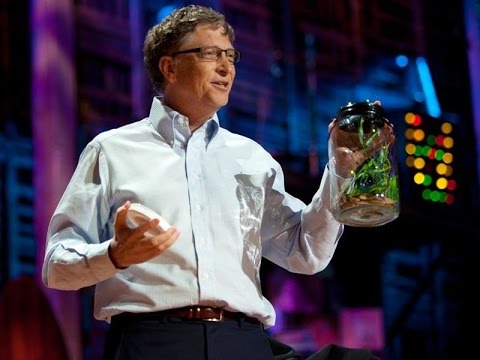
Injecting humor into the presentation, Gates recalls his appearance from the previous year, when he opened a jar of mosquitoes on stage to visceral audience engagement regarding malaria. Seeking an analogous visual metaphor for clean energy, he unscrews a jar and releases live fireflies onto the stage, deadpanning that they do not bite and may not even leave their container. He warns that flashy, gimmicky notions cannot replace the serious work ahead; solving the carbon equation demands technologies that deliver unbelievable scale and absolute reliability. Gates frames the temporal challenge: “This is a case where we actually have to drive at full speed and get a miracle in a pretty tight timeline.”
- Past technological miracles—such as computing hardware and internet networks—developed without an absolute planetary deadline. - Gimmick solutions cannot substitute for primary power generation that satisfies planetary scale and reliability requirements.
---
[08:37](https://www.youtube.com/watch?v=JaF-fq2Zn7I&t=517s) Evaluating the Five Big Energy Paths
Looking across the technological landscape, Gates isolates five primary avenues capable of operating at the massive scale required to displace carbon emissions: fossil fuels paired with carbon capture and storage (CCS), nuclear power, and three distinct renewable sources (wind, solar, and hydro/other renewables). While he notes that niche solutions such as geothermal, tidal, biofuels, and nuclear fusion may contribute on the margins, only the five primary options can move the core metrics. None can be abandoned prematurely, despite the steep engineering and operational barriers each one presents.
For coal and natural gas, achieving zero emissions requires capturing the flue gas, liquefying it under pressure, and sequestering it underground permanently. While experimental facilities achieve 60% to 80% capture rates, scaling to 100% is exceptionally complex. Furthermore, long-term geological integrity presents a serious challenge: society must guarantee the containment of waste volumes billions of times larger than those produced by nuclear power.
Nuclear fission avoids carbon emissions, but faces three formidable headwinds: high capital costs within heavily regulated environments, safety and anti-proliferation concerns regarding human error and fissile materials, and lingering public anxiety regarding long-term radioactive waste storage.
Finally, Gates evaluates the renewable options, pointing out their shared physical liabilities: - **Low Energy Density:** Unlike centralized power plants, renewables require massive footprints—a dynamic Gates characterizes as "energy farming," consuming thousands of times more land area per unit of output. - **Intermittency:** Neither sunlight nor wind is continuous or fully predictable, meaning power must be supplied during extended generation lulls. - **Transmission and Geopolitical Risk:** High-resource harvesting areas are often situated far from population centers or across sovereign borders, creating infrastructure dependencies and energy security risks. - **Electrical Storage Limits:** To illustrate the magnitude of the storage gap, Gates notes that he inventoried the collective manufacturing capacity of all existing batteries worldwide—spanning automobiles, laptops, mobile phones, and flashlights—to compare it directly against the baseline daily electrical appetite of human civilization.
Gates emphasizes the absolute scale demanded of any serious energy contender: “And although there's many directions that people are seeking, I really only see five that can achieve the big numbers.”
[12:01](https://www.youtube.com/watch?v=JaF-fq2Zn7I&t=721s) The Intermittency Hurdle and the Need for Hundreds of Breakthroughs
Reflecting on the limits of energy storage, Bill Gates notes that current global battery manufacturing capacity is woefully inadequate, being capable of storing less than 10 minutes of the world's total energy demand. Moving intermittent renewable sources like wind and solar past a 20 to 30 percent threshold of overall energy usage demands dramatic technological advances, and relying on them for 100 percent would require what he calls an “incredible miracle battery.” Instead of relying solely on existing tools, the world needs a massive breakthrough—something a factor of 100 better than present options.
Rather than looking for a singular centralized effort like the Manhattan Project, Gates urges a strategy characterized by immense breadth, where hundreds of companies pursue radical solutions across all five zero-carbon paths. He welcomes bold, high-risk approaches, noting that many will seem eccentric or unfeasible at first glance. Pointing to fellow entrepreneurs, Gates highlights Bill Gross's work with concentrated solar thermal at eSolar and Vinod Khosla’s investments across dozens of clean-energy startups as models of the innovation ecosystem needed to bring about these critical discoveries.
- Current worldwide battery manufacturing capacity stores under 10 minutes of total energy. - Intermittent sources can operate without enormous storage up to about 20% to 30% penetration, but 100% reliance requires a 100x leap in battery technology. - Gates urges that each of the five clean energy paths should have at least 100 separate teams or companies exploring solutions. - Gates summarizes the need for high-risk ventures bluntly: “A lot of them, you'll look at and say, 'They're crazy.' That's good.”
```mermaid flowchart TD accTitle: Battery Storage Limits vs Breakthrough Requirements accDescr: Diagram illustrating current battery capacity limitations compared to the breakthrough needed for deep clean grid penetration. subgraph Current["Current State"] A["Current Global Battery Fleet"] -->|"Stores < 10 minutes"| B["Total Worldwide Energy Demand"] C["Intermittent Renewables (Wind/Solar)"] -->|"Viable up to"| D["20% - 30% Grid Share"] end subgraph Need["Innovation Requirement"] E["100% Intermittent Grid"] -->|"Demands"| F["100x Battery Breakthrough / 'Miracle Battery'"] G["Hundreds of Companies"] -->|"Explore parallel paths"| H["Radical Breakthroughs"] end ```
---
[13:20](https://www.youtube.com/watch?v=JaF-fq2Zn7I&t=800s) TerraPower and the Traveling Wave Reactor
Turning to nuclear energy, Gates explains that innovation within the sector had effectively stalled decades ago, leaving promising concepts unexplored. Alongside Nathan Myhrvold, Gates is backing TerraPower, a nuclear venture pursuing a traveling wave reactor. Conventional nuclear reactors burn only the rare uranium-235 isotope—which accounts for less than one percent of mined uranium—while discarding the remaining 99 percent as depleted uranium waste. TerraPower reverses this paradigm by designing a reactor capable of burning the abundant uranium-238.
This concept was historically dismissed because early physicists lacked the computational tools to prove it could operate stably. Modern supercomputers have finally enabled scientists to simulate the complex physics and identify the necessary materials. Operating like a slow-burning candle or log, the reactor breeds its own fuel as the reaction progresses. It can run directly on depleted uranium tails stored at sites like Paducah, Kentucky, or on spent fuel sitting in cooling pools and dry casks at existing commercial nuclear plants, solving both fuel availability and waste disposal at the same time.
```mermaid flowchart LR accTitle: Traveling Wave Reactor Fuel Cycle accDescr: Flowchart showing how depleted uranium and reactor waste are utilized in a traveling wave reactor to generate power. subgraph Input["Fuel Sources"] U238["Depleted Uranium (U-238) / Existing Nuclear Waste"] Sea["Seawater Extraction (Long-term)"] end subgraph Reactor["TerraPower Traveling Wave Reactor"] Log["'Candle' Core: Breeds and Burns U-238 In Situ"] end subgraph Output["Results"] Power["Hundreds of Years of Clean Power"] Waste["Dramatically Reduced Final Waste Volume"] end Input --> Log Log --> Output ```
- Traditional nuclear reactors consume only the ~1% of uranium that is U-235, leaving behind the remaining 99% (U-238) as depleted uranium waste. - Depleted uranium stored at a single facility in Kentucky contains enough potential energy to power the entire United States for hundreds of years. - Gates notes that inexpensive uranium extraction from seawater could provide enough fuel for the lifetime of the planet. - Describing the design logic behind TerraPower's fuel cycle, Gates explains: “The idea of TerraPower is that, instead of burning a part of uranium -- the one percent, which is the U235 -- we decided, 'Let's burn the 99 percent, the U238.'”
---
[15:18](https://www.youtube.com/watch?v=JaF-fq2Zn7I&t=918s) The Innovation Report Card and the Ultimate 50-Year Wish
To measure global progress, Gates outlines a dual-track report card covering interim targets for 2020 and long-term targets for 2050. The ultimate objective remains an 80 percent global reduction in greenhouse gas emissions by 2050. Because the remaining 20 percent will be consumed by difficult-to-decarbonize sectors in developing economies—such as basic agriculture, alongside ongoing transitions in cement and forestry—developed nations and major economies like China must completely decarbonize their electricity grids. The 2020 intermediate benchmark must evaluate near-term efficiency measures while prioritizing whether the pipeline of innovative breakthroughs, pilot demonstrations, and regulatory modernizations is advancing at full speed.
Praising books like Al Gore's *Our Choice* and David MacKay's *Sustainable Energy — Without the Hot Air* for providing rigorous frameworks, Gates reflects on the singular importance of clean energy. He emphasizes that if granted only one wish over the next 50 years—above choosing a president or selecting a life-saving vaccine—he would choose the development of a zero-carbon energy source that costs half as much as current fossil fuels. To realize this goal, he calls on international climate gatherings to pivot from merely negotiating emission targets to funding energy research and development, combined with strong market mechanisms like carbon taxes or cap-and-trade systems.
- The 2050 target requires an 80% total emissions cut; poor countries will need the remaining 20% budget for agriculture and basic development, requiring rich nations to achieve completely zero-carbon electricity. - The 2020 report card measures both efficiency cuts and measurable innovation milestones (startups funded, pilot plants built, and regulatory paths established). - Gates stresses the low baseline of public R&D spending and urges countries to use summits like Copenhagen to expand innovation budgets alongside carbon pricing mechanisms. - Underscoring his priorities, Gates declares: “If you gave me only one wish for the next 50 years -- I could pick who's president, I could pick a vaccine, which is something I love, or I could pick that this thing that's half the cost with no CO2 gets invented -- this is the wish I would pick.”
---
[18:52](https://www.youtube.com/watch?v=JaF-fq2Zn7I&t=1132s) Q&A with Chris Anderson: Engineering and Deploying TerraPower
Following the presentation, TED curator Chris Anderson joins Gates on stage to explore the real-world mechanics and business case for TerraPower. Gates outlines the capital required across different phases of the project: the initial supercomputer modeling, software design, and recruitment of world-class scientists cost tens of millions of dollars; testing material durability in an operating Russian test reactor will bring costs into the hundreds of millions; but the truly difficult hurdle is securing several billion dollars, regulatory approvals, and a host site to construct the first full-scale commercial demonstration reactor.
```mermaid flowchart TD accTitle: TerraPower Capital and Development Stages accDescr: Progressive stages of investment and deployment required for TerraPower's traveling wave reactor. S1["Phase 1: Supercomputing & Staff"] -->|"Tens of Millions"| S2["Phase 2: Materials Testing (Russian Reactor)"] S2 -->|"Hundreds of Millions"| S3["Phase 3: First Demonstration Plant & Licensing"] S3 -->|"Several Billion Dollars"| S4["Phase 4: Commercial Scale Deployment"] ```
Anderson asks whether the reactor behaves like a subterranean column that gradually burns downward. Gates confirms the metaphor, contrasting it with conventional reactors that require regular refueling and constant physical handling of volatile assemblies. The TerraPower reactor functions like a solid 60-year fuel log that sits sealed underground without human intervention, utilizing existing reactor waste as its startup feed and drastically shrinking the volume of leftover material. Gates reports ongoing discussions with officials in Russia, India, China, and the United States Department of Energy. Because global climate targets leave approximately 20 years to invent and another 20 years to fully deploy zero-carbon energy at scale, multiple breakthrough concepts—including modular and liquid-fueled designs—must advance in parallel.
- Modeling and talent acquisition for TerraPower cost tens of millions of dollars; nuclear materials testing requires hundreds of millions; building the initial demonstration reactor requires several billion dollars. - The reactor core operates continuously without refueling for up to 60 years, eliminating the mechanical risks and human errors involved in frequent fuel cycling. - Feedstock for the reactor consists of legacy nuclear waste currently stored in cooling pools and dry-cask storage at conventional plant sites. - Emphasizing the urgent window dictated by climate science, Gates states: “Well, we need -- for one of these high-scale, electro-generation things that's very cheap, we have 20 years to invent and then 20 years to deploy.”
[23:13](https://www.youtube.com/watch?v=JaF-fq2Zn7I&t=1393s) The Energy Density of Uranium and Geoengineering as a Plan B
Reflecting on the fundamental advantages of advanced nuclear energy, Bill Gates observes that nuclear physics offers an unmatched energy density advantage over fossil fuels, noting that an atom of uranium holds roughly a million times the energy contained in a molecule of coal. Because of this massive disparity, if engineers can successfully master the primary engineering challenges—managing radiation, mitigating capital costs, and shrinking the overall footprint—nuclear power operates in an environmental category entirely of its own. As Gates summarizes the upside, “And so, if you can deal with the negatives, which are essentially the radiation, the footprint and cost, the potential, in terms of effect on land and various things, is almost in a class of its own.”
TED curator Chris Anderson then pushes on worst-case scenarios, asking what humanity must do if clean energy breakthroughs fail to materialize in time and whether emergency interventions will be required to stabilize planetary temperatures. Gates draws an analogy to human health, likening the planetary crisis to a person who has spent decades overeating and suddenly finds themselves on the brink of an imminent heart attack: at that stage, lifestyle adjustments are no longer enough, and emergency surgical intervention becomes unavoidable. In climate terms, that emergency fallback is geoengineering—deliberate planetary-scale interventions designed to reflect sunlight or artificially delay atmospheric warming by twenty to thirty years while society gets its energy systems in order.
Gates acknowledges the fierce moral hazard debate surrounding geoengineering, where critics argue that researching emergency fallbacks induces complacency—much like a patient who refuses to diet because they assume heart surgery will bail them out later. Gates rejects the idea of abandoning research out of fear, insisting that humanity cannot afford to be caught unprepared. In his view, maintaining a viable Plan B is essential risk management: “I'm not sure that's wise, given the importance of the problem, but there's now the geoengineering discussion about: Should that be in the back pocket in case things happen faster, or this innovation goes a lot slower than we expect?”
- **Energy Density Comparison**: A single uranium fuel unit delivers roughly one million times the energy yield of a comparable unit of coal. - **Geoengineering Lifespan**: Atmospheric intervention techniques are estimated to buy approximately 20 to 30 years for decarbonization deployment. - **The Heart Attack Metaphor**: Emergency geoengineering equates to open-heart surgery for a patient suffering acute consequences after years of unchecked overconsumption.
[24:40](https://www.youtube.com/watch?v=JaF-fq2Zn7I&t=1480s) Climate Skeptics, Delayed Consequences, and the Power of Price
When Chris Anderson asks how Gates would distill an argument to convince climate skeptics that they are wrong, Gates clarifies that skepticism is not a uniform perspective, though genuinely scientific rebuttals are vanishingly rare. He points out that hypotheses proposing strong negative feedback loops—such as cloud formations neutralizing carbon warming—rest on extraordinarily improbable assumptions with perhaps a one-in-a-million chance of being accurate. Instead, the real challenge in motivating climate action lies in human psychology and temporal delay, which Gates likens to the early response to HIV/AIDS: “The main problem we have here -- it's kind of like with AIDS: you make the mistake now, and you pay for it a lot later.”
Because people are confronted with pressing day-to-day crises, asking them to endure immediate, tangible economic pain for the sake of avoiding distant and somewhat uncertain future catastrophes runs counter to typical human behavior. Gates notes that the Intergovernmental Panel on Climate Change (IPCC) projections do not even represent the absolute worst-case possibilities; yet comfortably off individuals in the developed world frequently review those forecasts and conclude the consequences are manageable. For Gates, that very band of severe, fat-tail uncertainty is precisely why aggressive decarbonization is mandatory.
Gates' ultimate vision for circumventing ideological and political gridlock is pragmatic economics: rather than relying on moral appeals or regulatory penalties, the world must invent clean technologies that simply outcompete incumbent fossil fuels on price. If a zero-emission energy source costs less than coal or natural gas, the debate vanishes. Gates humorously acts out the response of a converted skeptic who buys into clean technology purely for the savings: “OK, I don't care that it doesn't put out CO2, I kind of wish it did put out CO2. But I guess I'll accept it, because it's cheaper than what's come before.”
```mermaid flowchart TD accTitle: Climate Innovation and Risk Strategy accDescr: Flowchart illustrating the primary R&D deployment path against market skepticism versus emergency geoengineering contingencies.
subgraph Primary["Primary Strategy: Economic Parity"] RD["Scale Energy R&D\n(Targeted High-Risk Innovation)"] --> Cheaper["Produce Ultra-Low-Cost Clean Power\n(Advanced Nuclear, Renewables, Storage)"] Cheaper --> Market["Overcome Skeptic Resistance\n(Cheaper than Fossil Fuels)"] Cheaper --> Equity["Protect Lowest Economic Quintiles\n(Bottom 2 Billion)"] end
subgraph Contingency["Contingency Path: Planetary Insurance"] Warming["Warming Accelerates or Innovation Lags"] --> Geo["Geoengineering Research\n(Buys 20–30 Years Buffer)"] end ```
[26:02](https://www.youtube.com/watch?v=JaF-fq2Zn7I&t=1562s) Prioritizing R&D Over Subsidies and Protecting the Global Poor
Chris Anderson asks how Gates answers the critique popularized by Bjørn Lomborg, which claims that pouring trillions into carbon mitigation diverts critical resources away from pressing human development priorities like eradicating malaria and lifting populations out of poverty. Gates rejects the premise that research conflicts with development budgets, pointing out that federal investments in fundamental energy research are relatively modest in the grand scheme. If an economy like the United States were to spend an additional $10 billion per year on energy R&D, that expenditure would not detract from humanitarian aid or global health initiatives.
The real misallocation of capital, Gates argues, occurs when governments spend massive sums subsidizing uncompetitive, non-economic energy installations before the underlying technology is ready. Unless a technology is right at the threshold of the learning curve and near-term market viability, heavily subsidizing it in the field amounts to waste. More dangerously, if environmental policy relies on artificially inflating the price of fossil fuels to force adoption, the wealthiest can absorb the cost effortlessly while vulnerable populations bear the brunt: “If the trade-off you get into is, 'Let's make energy super expensive,' then the rich can afford that. I mean, all of us here could pay five times as much for our energy and not change our lifestyle. The disaster is for that two billion.”
Gates observes that even Lomborg's stance has evolved away from hardline contrarianism toward demanding serious R&D funding, having realized that pure skepticism is an increasingly indefensible position. Gates closes with an impassioned plea to dramatically scale up innovation budgets, remarking: “The R&D piece -- it's crazy how little it's funded.” Anderson concludes the session to enthusiastic audience applause, expressing the hope of the entire TED hall that Gates' clean-energy breakthrough wish will become reality.
- **Proposed R&D Uplift**: Gates suggests an increase of approximately $10 billion annually in U.S. clean energy R&D funding. - **Economic Inequity of Price Hikes**: While affluent citizens could comfortably pay five times more for power without altering their lifestyles, exorbitant energy costs would devastate the world's two billion poorest people. - **Premature Subsidies vs. Fundamental Research**: Large subsidies for uncompetitive technologies waste capital, whereas true breakthroughs permanently alter the cost structure of zero-carbon generation.
## Notable quotes > [00:16](https://www.youtube.com/watch?v=JaF-fq2Zn7I&t=16s) If you could pick just one thing to lower the price of to reduce poverty, by far you would pick energy. — Bill Gates
## Mentioned Bill Gates, Melinda Gates, Bill & Melinda Gates Foundation, Chris Anderson, Nathan Myhrvold, TerraPower, Bill Gross, eSolar, Vinod Khosla, Al Gore, David MacKay, Our Choice, Sustainable Energy — Without the Hot Air, Bjørn Lomborg, Intergovernmental Panel on Climate Change (IPCC), United States Department of Energy
## Video description http://www.ted.com At TED2010, Bill Gates unveils his vision for the world's energy future, describing the need for "miracles" to avoid planetary catastrophe and explaining why he's backing a dramatically different type of nuclear reactor. The necessary goal? Zero carbon emissions globally by 2050.
TEDTalks is a daily video podcast of the best talks and performances from the TED Conference, where the world's leading thinkers and doers give the talk of their lives in 18 minutes. TED stands for Technology, Entertainment, Design, and TEDTalks cover these topics as well as science, business, development and the arts. Closed captions and translated subtitles in a variety of languages are now available on TED.com, at http://www.ted.com/translate. Watch a highlight reel of the Top 10 TEDTalks at http://www.ted.com/index.php/talks/top10
Follow us on Twitter http://www.twitter.com/tednews
Checkout our Facebook page for TED exclusives https://www.facebook.com/TED
[Source](https://www.youtube.com/watch?v=JaF-fq2Zn7I)