Physicist Petit Confirms Putin Nuclear Arms Bypass US Missile Shields
Jean-Pierre PETIT
Russia's new strategic arsenal is scientifically viable and neutralizes American missile defense networks by operationalizing abandoned 1960s US concepts for nuclear ramjets and magnetohydrodynamic propulsion.
AI-assisted summary of Putin's new Russian MHD weapons explained (1st part) — original source. Check the original for full context.
Source published:
Key ideas
- Physicist Jean-Pierre Petit analyzes Russian President Vladimir Putin's March 2018 address, concluding that the strategic weapons unveiled—including the antipodal Sarmat missile, nuclear-powered cruise missile, and nuclear underwater drone—are scientifically and technically viable. (0:00)
- The 200-ton RS-28 Sarmat utilizes an antipodal trajectory across the South Pole at roughly 60 miles altitude, effectively bypassing northern-oriented US early warning radars and Ground-Based Midcourse Defense interceptors. (11:48)
- Russia's nuclear-powered cruise missile revives the principles of America's 1950s Project Pluto ramjet, utilizing a miniaturized ceramic core the size of a soccer ball to achieve virtually infinite range at supersonic speeds without radiation shielding penalties. (18:56)
- The unmanned Poseidon underwater drone resolves the paradox of high speed and total acoustic silence by substituting mechanical screws with magnetohydrodynamic (MHD) boundary-layer wall accelerators, potentially enabling speeds of thousands of kilometers per hour. (33:36)
Detailed notes
## Background Published on YouTube by French physicist Jean-Pierre Petit on May 21, 2018, this presentation provides scientific and technical commentary on the next-generation strategic weaponry unveiled by Russian President Vladimir Putin in March 2018. As outlined in the video description, the lecture focuses on the antipodal Sarmat missile, an infinite-range nuclear-powered supersonic cruise missile, and an autonomous underwater drone propelled by nuclear power and magnetohydrodynamics (MHD).
## TL;DR Drawing on his career as an MHD research physicist, Jean-Pierre Petit analyzes the technical mechanics behind Russia's strategic weapons arsenal in the context of nuclear deterrence and historical military doctrines. He explains how the heavy RS-28 Sarmat missile can bypass northern missile defense radars via a low-altitude South Pole trajectory, and demonstrates how a compact nuclear ramjet resurrects the United States' Cold War-era Project Pluto to enable virtually unlimited supersonic flight. Petit then evaluates the deep-diving Poseidon drone submarine, concluding that its simultaneous high speed and acoustic silence cannot function via mechanical screws, but can be fully realized through MHD boundary-layer Lorentz-force accelerators that eliminate drag and cavitation entirely.
## Atmosphere & style The presentation carries the ambiance of an intense, intimate whiteboard lecture led by an outspoken elder physicist reflecting on decades of classified and unclassified science. Petit speaks with dry wit, scientific precision, and cold geopolitical realism, punctuating fluid mechanics explanations with biting historical observations about human folly in warfare. The resulting experience feels cerebral yet quietly alarming, as abstract equations and textbook propulsion diagrams starkly connect to the terrifying reality of megaton coastal tsunamis and unstoppable nuclear vectors.
## Bulletin - [00:00](https://www.youtube.com/watch?v=Jn8b3E9oUHY&t=0s) Physicist Jean-Pierre Petit analyzes Russian President Vladimir Putin's March 2018 address, concluding that the strategic weapons unveiled—including the antipodal Sarmat missile, nuclear-powered cruise missile, and nuclear underwater drone—are scientifically and technically viable. - [11:48](https://www.youtube.com/watch?v=Jn8b3E9oUHY&t=708s) The 200-ton RS-28 Sarmat utilizes an antipodal trajectory across the South Pole at roughly 60 miles altitude, effectively bypassing northern-oriented US early warning radars and Ground-Based Midcourse Defense interceptors. - [18:56](https://www.youtube.com/watch?v=Jn8b3E9oUHY&t=1136s) Russia's nuclear-powered cruise missile revives the principles of America's 1950s Project Pluto ramjet, utilizing a miniaturized ceramic core the size of a soccer ball to achieve virtually infinite range at supersonic speeds without radiation shielding penalties. - [33:36](https://www.youtube.com/watch?v=Jn8b3E9oUHY&t=2016s) The unmanned Poseidon underwater drone resolves the paradox of high speed and total acoustic silence by substituting mechanical screws with magnetohydrodynamic (MHD) boundary-layer wall accelerators, potentially enabling speeds of thousands of kilometers per hour.
## Key takeaways - [01:38](https://www.youtube.com/watch?v=Jn8b3E9oUHY&t=98s) Human warfare functions as a recurring thermodynamic-like dissipative process driven by geopolitical imbalances, often reignited when leadership promises clean, rapid victories via technological breakthroughs. - [04:20](https://www.youtube.com/watch?v=Jn8b3E9oUHY&t=260s) Global-range strike platforms and preemptive WMD delivery date back to World War II, exemplified by Imperial Japan's I-400 mega-submarines carrying Aichi M6A Seiran strike planes for biological warfare operations. - [09:36](https://www.youtube.com/watch?v=Jn8b3E9oUHY&t=576s) The unilateral US withdrawal from the Anti-Ballistic Missile (ABM) Treaty in 2002 destabilized Cold War deterrence, driving Russia to develop asymmetric weapons capable of neutralizing missile defense umbrellas. - [11:48](https://www.youtube.com/watch?v=Jn8b3E9oUHY&t=708s) The RS-28 Sarmat's 10-ton payload capacity can field 10 heavy warheads, penetration decoys, or up to 24 Avangard hypersonic glide vehicles approaching from southern polar corridors. - [18:56](https://www.youtube.com/watch?v=Jn8b3E9oUHY&t=1136s) Chemical supersonic cruise missiles suffer from extreme fuel penalties limiting range to roughly 300 miles, whereas a compact nuclear heat source uncouples operational reach from fuel mass. - [22:04](https://www.youtube.com/watch?v=Jn8b3E9oUHY&t=1324s) America's Project Pluto demonstrated static 600 MW thermal nuclear ramjets using ceramic fuel channels (BeO, UO2, ZrO2), a concept made vastly more compact by modern high-density enrichment and electronics. - [22:04](https://www.youtube.com/watch?v=Jn8b3E9oUHY&t=1324s) Unmanned military systems eliminate the heavy radiation shielding that previously doomed manned nuclear aircraft projects like the Convair B-36. - [31:12](https://www.youtube.com/watch?v=Jn8b3E9oUHY&t=1872s) Standard underwater propulsion encounters viscous skin friction and form drag due to water's high density, imposing an operational ceiling of roughly 50 to 70 knots on conventional torpedoes. - [31:12](https://www.youtube.com/watch?v=Jn8b3E9oUHY&t=1872s) While Soviet VA-111 Shkval supercavitating torpedoes achieve 200–300 knots by enclosing the hull in a vapor bubble, collapsing cavities generate deafening acoustic signatures incompatible with stealth. - [33:36](https://www.youtube.com/watch?v=Jn8b3E9oUHY&t=2016s) Applying crossed electric and magnetic fields creates a Lorentz force directly within conductive seawater, accelerating the boundary layer to flatten velocity gradients and completely eliminate shear drag and acoustic noise. - [35:12](https://www.youtube.com/watch?v=Jn8b3E9oUHY&t=2112s) Stewart Way's 1966 wall accelerator geometry employs periodic superconducting wiring and alternating electrodes to confine magnetic fields strictly against the hull, leaving no external magnetic signature for detection. - [39:33](https://www.youtube.com/watch?v=Jn8b3E9oUHY&t=2373s) Marine MHD drives require magnetic field strengths exceeding 10 tesla to overcome Joule heating dissipation and low seawater conductivity, a threshold previously verified by tests at the Francis Bitter Magnet Laboratory. - [42:41](https://www.youtube.com/watch?v=Jn8b3E9oUHY&t=2561s) Detonating multi-hundred-megaton thermonuclear warheads delivered by deep-diving MHD drones along continental shelves could unleash tsunamis hundreds of meters high against coastal population centers. - [45:13](https://www.youtube.com/watch?v=Jn8b3E9oUHY&t=2713s) Direct rocket-driven pulsed MHD generators seeded with cesium powder offer an alternative method for generating massive, short-duration electrical bursts directly in single-use torpedo exhaust nozzles.
## Detailed walkthrough ### [00:00](https://www.youtube.com/watch?v=Jn8b3E9oUHY&t=0s) Introduction and Jean-Pierre Petit's Background in MHD Research
The presentation opens with an examination of the landmark address delivered by Russian President Vladimir Putin on March 1, 2018, in which he unveiled an arsenal of sophisticated, next-generation strategic weaponry. While Western observers, particularly within the United States, immediately condemned these systems as a severe threat to international security, French physicist Jean-Pierre Petit approaches the subject through a scientific and technical lens. Petit introduces himself and his credentials, noting that during the 1960s and 1970s, he led research on magnetohydrodynamic (MHD) electrical generators. Displaying archival photographs of his former laboratory, he points to a shock tube—a specialized pneumatic gun designed to blast high-velocity, high-temperature, high-pressure plasma bursts through strong magnetic fields to generate pulses of electrical power lasting tens of microseconds. Petit explains that the core focus of his scientific career was finding methods to suppress and cancel turbulent plasma instabilities under these extreme regimes.
```mermaid flowchart LR accTitle: MHD Shock Tube Generator Operation accDescr: Diagram showing how a high-energy shock tube fires plasma through a magnetic field to generate electrical power. subgraph ShockTube["Shock Tube Driver"] A["High-Pressure Burst"] --> B["High-Velocity Plasma"] end subgraph MHDChannel["MHD Interaction Zone"] B --> C["Magnetic Field B"] C --> D["Plasma Instability Cancellation"] end subgraph Output["Power Output"] D --> E["Microsecond Electric Pulse"] end ```
---
[01:38](https://www.youtube.com/watch?v=Jn8b3E9oUHY&t=98s) The Dissipative Nature of War and the Blitzkrieg Illusion
Stepping back from direct technical analysis, Petit reflects on the fundamental mechanisms that generate warfare. Drawing an analogy to thermodynamics and fluid mechanics, he suggests that just as atmospheric pressure differentials between distant regions inevitably resolve through violent, dissipative storms, human wars function as recurrent, natural dissipative processes sparked by geopolitical, economic, and sociological tensions. The First World War bogged down into years of horrific attrition where heavy artillery inflicted catastrophic human and material devastation on both sides. Yet, merely twenty-one years later, Adolf Hitler convinced the German populace to march into another global conflict.
Petit emphasizes how easily populations can be seduced into forgetting past butcheries when military leaders promise an entirely new paradigm of warfare. Hitler marketed the *Blitzkrieg*—a “lightning war” engineered to secure massive territorial and strategic gains with minimal casualties by leveraging superior technological and mechanical power. Initial campaigns in Poland, Czechoslovakia, and France appeared to validate this illusion, prompting jubilant crowds to hail Hitler as a military genius upon his return to Berlin. However, once the campaigns in Britain and the Soviet Union stalled and Allied strategic bombing flattened German cities, the devastating reality became undeniable. Reflecting on this bitter historical turn, Petit remarks: “Once the German towns were gone bird by English and American airplanes it was too late to say oh I'm sorry I think that the lighting war was not such a good idea.”
---
[04:20](https://www.youtube.com/watch?v=Jn8b3E9oUHY&t=260s) Preemptive Strikes and Mass Destruction: Japan's I-400 and Unit 731
The evolution of modern total war advanced significantly in 1941, when Imperial Japan operationalized two foundational doctrines: the preemptive strike and weapons of mass destruction. Petit highlights the attack on Pearl Harbor as an effort to neutralize the United States Navy before it could mount an offensive. Concurrently, Japan developed biological warfare capabilities through Unit 731, established in Manchuria under the command of General Shiro Ishii—a program secretly planned and organized fifteen years before open hostilities commenced. To deliver these catastrophic pathogens directly to the American mainland, Admiral Isoroku Yamamoto devised the *Sen-Toku* I-400 class mega-submarine.
Measuring as the largest non-nuclear submarines ever constructed, each I-400 vessel was equipped with a watertight cylindrical hangar housing three folding-wing Aichi M6A Seiran strike aircraft, launched via an onboard compressed-air catapult. Analyzing technical documents captured by the US military in 1945, Petit scrutinizes the claims regarding aircraft turnaround times: - Assembly with dual pontoons required roughly 45 minutes. - Assembly without pontoons took a mere 15 minutes. - Catapult carriages engaged directly with the fuselage structure rather than the float pontoons.
Petit dismisses the conventional narrative that the Seiran was designed to land on water alongside the submarine to be hoisted back aboard by an external crane during combat missions. He argues that surfacing near hostile coastal waters at night, assembling the craft, catapulting it, and lingering to recover it with a crane was operationally absurd. In reality, the Seiran was designed as a one-way, non-return chemical and biological delivery vehicle, with the jettisonable pontoons used solely for testing. Yamamoto planned a fleet of 18 such submarines carrying 54 biological strike planes capable of circumnavigating the globe to unleash pandemics across American cities. The plan was averted only because Imperial Japan ran out of structural steel and raw materials late in the war. Through this historical case, Petit demonstrates that global-range strike platforms and mass casualty weapons are not twenty-first-century innovations.
---
[09:36](https://www.youtube.com/watch?v=Jn8b3E9oUHY&t=576s) Nuclear Deterrence and the Breakdown of the ABM Treaty
Turning to contemporary strategic dynamics, Petit notes the existence of roughly 9,000 active nuclear warheads worldwide. Extrapolating from the horrific environmental and human damage caused by conventional depleted-uranium munitions, he underscores that even a single modest 100-kiloton device represents several times the destructive yield of the Hiroshima bomb. Despite this staggering destructive capacity, Petit paradoxically frames the situation as reassuring: direct major-power war has remained functionally impossible for seventy-three years due to the balance of terror and Mutually Assured Destruction (MAD).
```mermaid flowchart TD accTitle: Breakdown of Strategic Nuclear Balance accDescr: Flowchart tracing the shift from the ABM Treaty to Russian asymmetric strategic weapons development. subgraph ColdWar["Cold War Stability"] A["1972 ABM Treaty"] --> B["Mutually Assured Destruction (MAD)"] end subgraph USAction["US Shift"] C["Post-9/11 Threat Doctrine"] --> D["2002 US Withdrawal from ABM Treaty"] D --> E["Global ABM Deployments & Space Defense"] end subgraph RussianResponse["Asymmetric Countermeasures"] E --> F["Russian Fears of Neutralized Deterrent"] F --> G["Development of South-Pole Trajectories & Hypersonic Weapons"] end B -.->|"Destabilized by"| D ```
This equilibrium began unraveling following the attacks on the American homeland in September 2001. In response, President George W. Bush announced in 2002 that the United States would unilaterally withdraw from the 1972 Anti-Ballistic Missile (ABM) Treaty to construct a global missile defense shield against rogue actors. This move immediately raised alarms in Moscow, where planners feared American interceptors—and potential space-based weapons capable of blinding satellites—would nullify Russia's nuclear deterrent. Washington dismissed these concerns, assuring Moscow that the missile shield was directed solely against rogue states like Iran. Recalling Ronald Reagan’s earlier rhetoric regarding the Strategic Defense Initiative, Petit quips: “Remember what Ronald Reagan said at United Nations all space lasers are designed to destroy flying saucer not Russian satellites but you know how the Russian are there are suspicious by Nature you can't dim frankly with them.”
---
[11:48](https://www.youtube.com/watch?v=Jn8b3E9oUHY&t=708s) Ballistic Trajectories and the Antipodal Sarmat Missile
Petit details the mechanical vulnerabilities inherent to classic intercontinental ballistic missiles (ICBMs). During launch, an ICBM relies on a rocket boost phase lasting under two minutes; however, this phase produces a colossal infrared plume that is instantaneously detected by space-based early-warning satellites. Following burnout, the missile follows an unpowered ballistic arc along a geodesic great circle connecting launch and target points:
| Parameter | Standard Polar ICBM Trajectory | Fractional Orbital / Antipodal Trajectory | |:--- |:--- |:--- | | **Primary Route** | Over the North Pole (shortest great-circle arc) | Over the South Pole (longer antipodal arc) | | **Max Trajectory Altitude**| ~800 miles (high parabolic arc) | ~60 miles (shallow, circular suborbital path) | | **Early Warning Time** | Maximum warning via high-altitude radar tracking | Minimal warning; stays below radar horizon until late | | **Fuel / Energy Demand** | Minimum solid-propellant expenditure | Much higher propellant load and terminal velocity | | **ABM Interception Risk**| High (flies straight into US Northern Early Warning/ABM radar grid) | Low (completely bypasses northern-oriented defenses) |
Because traditional Russian ICBMs had an operational range of roughly 7,000 miles, their trajectories invariably passed over the Arctic, leading the United States to concentrate its Ground-Based Midcourse Defense (GMD) radar and interceptor sites along northern corridors like Alaska and California. To neutralize this architecture, Russia developed the heavy liquid-fueled RS-28 Sarmat missile. Weighed down by a massive propellant fraction needed to reach the energy thresholds of a low-altitude 60-mile suborbital path, this 200-ton rocket can fly along an antipodal trajectory across the South Pole, approaching North America from unprotected southern vectors. The Sarmat boasts a 10-ton payload capacity configured to carry: - 10 heavy thermonuclear warheads weighing one ton each. - A combination of warheads, active decoys, and radar-penetration aids. - Up to 24 Avangard hypersonic glide vehicles capable of agile high-speed maneuvers.
---
[15:49](https://www.youtube.com/watch?v=Jn8b3E9oUHY&t=949s) Putin's Nuclear-Powered Infinite-Range Cruise Missile
The presentation shifts to the most radical strategic system revealed in Putin’s speech: cruise missiles powered by onboard nuclear propulsion. While standard ballistic missiles trace predictable elliptical arcs through space, this new class of weapon circumvents the ballistic paradigm altogether, rendering established midcourse interceptor architectures irrelevant.
Petit includes Vladimir Putin’s own words from the broadcast describing the strategic logic: “We've developed a new strategic weapons that don't use ballistic trajectory at all which means that missile defense will be useless against it this is what I'm going to tell you about now this new kind of weapon promising weapon systems that Russia has developed using new unique technology designed by our engineers.” The Russian design integrates a miniaturized, ultra-compact nuclear power plant into an airframe comparable in dimensions to conventional cruise missiles like the Russian Kh-101 or the American BGM-109 Tomahawk. Unconstrained by chemical fuel supplies, the weapon possesses effectively infinite global operational range and can fly low-altitude, unpredictable routing profiles to skirt terrain and evade all existing air and missile defense networks.
[17:02](https://www.youtube.com/watch?v=Jn8b3E9oUHY&t=1022s) Putin's Nuclear-Powered Cruise Missile Announcement
The presentation opens with recorded footage of Russian President Vladimir Putin addressing the Federal Assembly, detailing a breakthrough strategic weapon designed to bypass global interception networks. Putin asserts that traditional missile defense barriers are rendered obsolete by this system, noting that late in 2017, the Russian Federation conducted a successful test launch at its central proving ground. This test validated a cruise missile powered by an onboard nuclear power unit that achieved its designated altitude and flight profile. Consequently, Russia announced the commencement of industrial-scale manufacturing for this entirely new category of strategic weapon: an intercontinental missile propelled by a nuclear reactor.
```mermaid flowchart LR accTitle: Operational Concept of the Nuclear-Powered Cruise Missile accDescr: Sequence diagram illustrating ground launch, booster separation, and infinite-range cruise. subgraph Launch["Launch Phase"] A["Ground / Naval Launcher"] --> B["Solid Rocket Booster"] B --> C["Booster Ejection & Reactor Startup"] end subgraph Flight["Cruise Phase"] C --> D["Ramjet Air Intake (Mach 3.6)"] D --> E["Reactor Core Heat Exchanger"] E --> F["Nozzle Expansion & Thrust"] F --> G["Maneuvering Flight (Unlimited Range)"] end ```
The accompanying video demonstration depicts the weapon navigating terrain and altering its flight path arbitrarily across the globe, looping around defense arrays rather than following a predictable ballistic trajectory. Because it relies on a nuclear thermal source rather than a finite reserve of chemical fuel, its operational radius is virtually boundless. Putin underlines the unprecedented nature of the capability, declaring:
> “As you understand, this is unheard of and nobody else has such a system in the world.”
He observes that while rival nations may attempt to duplicate the technology in the years ahead, Russian engineers will have advanced to newer defense concepts by the time foreign equivalents emerge.
---
[18:56](https://www.youtube.com/watch?v=Jn8b3E9oUHY&t=1136s) Subsonic vs. Supersonic: The Legacy of Project Pluto
Analyzing Putin's claims, Dr. Jean-Pierre Petit examines the aerodynamic and propulsion constraints of cruise missiles. Standard systems like the American BGM-109 Tomahawk carry an operational range of roughly 1,500 miles while flying strictly at subsonic speeds. Flying supersonically with conventional chemical kerosene engines burns fuel at a prohibitive rate, which sharply compresses operational reach. While supersonic anti-ship cruise missiles exist—such as the P-700 Granit carried by Soviet-designed Oscar-class (Kursk) submarines—their folding wings and massive propulsion units were tailored to burst toward carrier strike groups at the expense of endurance, capping their practical engagement range at roughly 300 miles.
With a compact nuclear heat source, however, fuel mass ceases to dictate operational range. Dr. Petit argues that the Russian weapon is almost certainly supersonic:
> “I think that the Russian missile is supersonic in effect: why do you limit the velocity if you have as much energy as you want from your nuclear reactor?”
He contextualizes this breakthrough by tracing its lineage back to the United States between 1955 and 1961 under Project Pluto. Pluto aimed to build a Supersonic Low-Altitude Missile (SLAM)—a low-flying, unpiloted ramjet running without combustion fuel. Instead of mixing jet fuel with compressed air, Pluto’s ramjet ingested atmospheric air at Mach 3.6, compressed it via shockwave deceleration to 21 bars while raising its temperature to 500 °C, and then routed it directly through a nuclear reactor core. Superheated to 1,200 °C inside the reactor, the expanding air blasted out through an exhaust nozzle to produce sustained supersonic thrust. The original American SLAM concept was an imposing 26-meter-long, 26-ton behemoth equipped with vacuum-tube avionics and designed to fly across hostile territory delivering two-megaton thermonuclear warheads before cruising indefinitely to contaminate the ground below.
---
[22:04](https://www.youtube.com/watch?v=Jn8b3E9oUHY&t=1324s) Reactor Design, Shielding, and Operation of a Nuclear Ramjet
Dr. Petit contrasts the early post-World War II attempts to design crewed nuclear aircraft—such as testing modified Convair B-36 Peacemaker and B-29 airframes—with an unmanned missile. Manned nuclear aviation foundered on the severe weight penalty of heavy lead, water, or tungsten shields required to shield the aircrew from neutron and gamma radiation. In an unmanned cruise missile, this problem vanishes entirely:
> “When we deal with unmanned aircraft, with nobody aboard, all those problems disappear.”
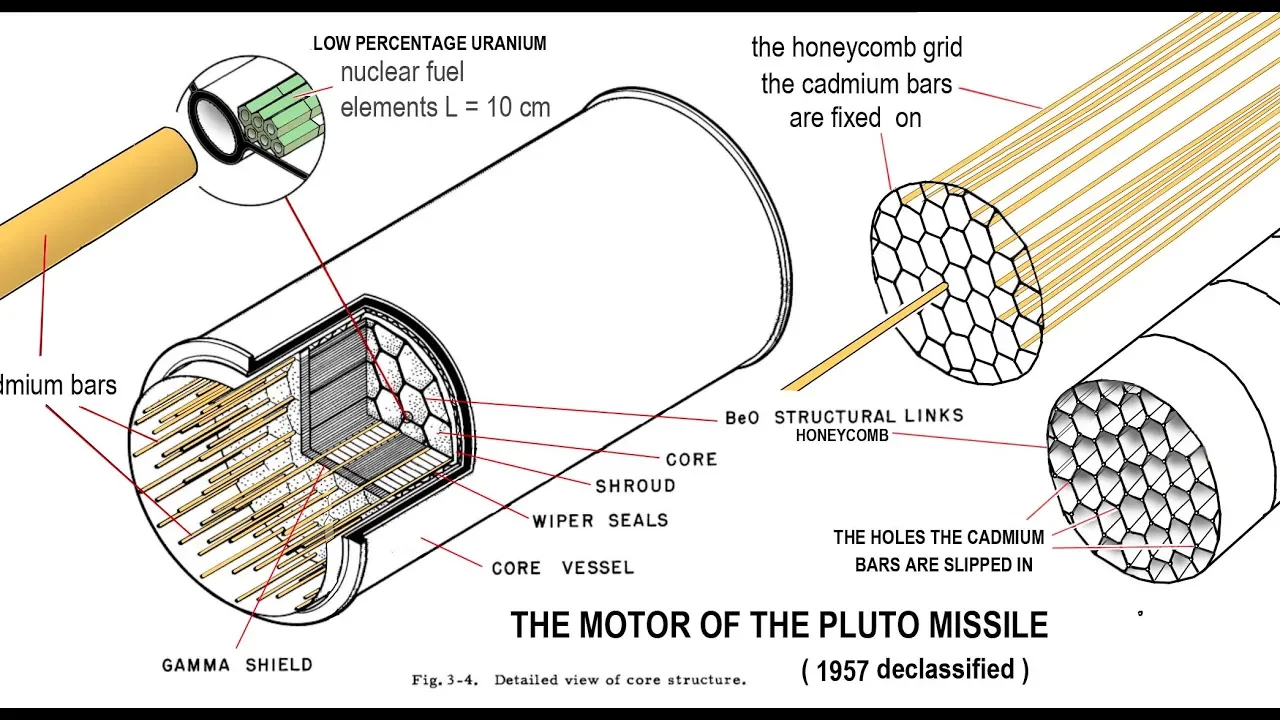
Before firing, an unactivated reactor produces minimal radiation. The fission chain reaction is safely suppressed using neutron-absorbing cadmium control rods. While Project Pluto’s Tory reactor was a massive one-cubic-meter cylinder displacing tons, advances in modern nuclear materials enable a contemporary reactor core to measure roughly the volume of a football.
```mermaid flowchart TD accTitle: Nuclear Ramjet Reactor Thermal Cycle accDescr: Diagram of air entering inlet, heating through ceramic core, and exhausting out the nozzle. subgraph Intake["Inlet Conditioning"] I1["Ambient Air Intake (Mach 3.6)"] --> I2["Conical Shock Compression: 21 bars, 500 °C"] end subgraph Core["Nuclear Core Heating"] I2 --> C1["Hexagonal Ceramic Tube Bundles (BeO, UO2, ZrO2)"] C1 --> C2["Core Heat Absorption: 1,200 °C"] end subgraph Exhaust["Nozzle Dynamics"] C2 --> E1["Expansion Through Convergent-Divergent Nozzle"] E1 --> E2["High-Velocity Jet Exhaust Thrust"] end ```
The flight sequence begins on a launcher with cadmium control rods inserted into the core. A solid rocket booster accelerates the missile from a standstill up to its ramjet operating regime around Mach 3.6. Simultaneously, protective aerodynamic inlet caps eject, the cadmium rods withdraw, and prompt criticality initiates inside the core. The incoming ram air passes through hundreds of tightly packed hexagonal ceramic fuel channels composed of beryllium oxide, uranium oxide, and zirconium oxide. At the Nevada Proving Grounds, the Americans tested this architecture extensively in the late 1950s using the static Tory II-A and Tory II-C engines. High-pressure air reservoirs fed the reactor for up to 300 seconds at a thermal power output of 600 megawatts, verifying the viability of an air-breathing nuclear ramjet before intercontinental ballistic missiles rendered Project Pluto obsolete. Dr. Petit concludes that Russia has resurrected this half-century-old American concept using modern materials, compact electronics, and lightweight reactor construction.
- Project Pluto ran from 1955 until its cancellation in 1964. - Static tests achieved 600 MW thermal output using stored preheated, compressed air (500 °C at 21 bars). - Tory fuel elements were fabricated from extruded ceramic tubes (BeO + $\text{UO}_2$ + $\text{ZrO}_2$) bundled into 38-tube hexagonal assemblies. - Modern high-density enriched cores allow equivalent thermal performance inside a footprint the size of a soccer ball.
---
[28:16](https://www.youtube.com/watch?v=Jn8b3E9oUHY&t=1696s) The Intercontinental Nuclear Drone Submarine
The focus shifts next to Vladimir Putin's announcement of an unmanned, nuclear-powered underwater drone—later known as the Poseidon / Status-6 oceanic multipurpose system. In his speech, Putin describes an autonomous submersible capable of cruising at extreme oceanic depths across intercontinental ranges. Putin claims its cruising speed drastically exceeds that of any operational attack submarine, modern homing torpedo, or surface combatant, while remaining invulnerable to detection and acoustic interception.
Putin highlights the tactical versatility of the system, asserting it can be fitted with conventional or high-yield thermonuclear payloads to eliminate coastal fortifications, naval bases, and carrier strike groups. A compact, high-output marine reactor completed testing in December 2017. According to Putin, this reactor is roughly one-hundredth the volume of a standard nuclear submarine power plant while yielding higher shaft-equivalent power.
Dr. Petit identifies a stark hydrodynamic paradox within Putin's claims, summarizing the listed specifications: 1. Deep-submergence capability. 2. Unprecedented high-speed cruising. 3. A reactor 100 times smaller than standard naval reactors yet more powerful. 4. Total acoustic silence.
He questions how these engineering traits could possibly coexist, exclaiming:
> “Silent! No kidding! All that together, how is it possible?”
If the drone relied on a conventional propeller or pump-jet as depicted in the official Russian briefing animations, driving an underwater hull at extreme speeds would create massive cavitation and acoustic noise, making silent operation impossible. This leaves only two possibilities: either the official presentation is active disinformation, or the propulsion system operates on physical principles radically different from mechanical propulsion.
---
[31:12](https://www.youtube.com/watch?v=Jn8b3E9oUHY&t=1872s) Limitations of Conventional Torpedoes and the Supercavitating Shkval
To explain why mechanical underwater propulsion hits an absolute speed ceiling, Dr. Petit examines fluid resistance. Water has a density approximately 1,000 times greater than air, creating intense viscous skin friction and form drag on submerged bodies. During World War II, standard naval torpedoes were restricted to roughly 40 knots (around 70 km/h) over a practical run of 1 to 2 kilometers, requiring a full minute or more to reach their target. Modern heavyweight torpedoes with advanced guidance and high-energy chemical propellants have stretched engagement ranges to 50 kilometers, but typical speeds remain pegged around 50 knots, with brief sprint bursts reaching only 60 to 70 knots (100–120 km/h).
In 1977, the Soviet Union breached this barrier by deploying the VA-111 Shkval supercavitating rocket torpedo. The Shkval achieved speeds of 200 to 300 knots by isolating its hull from liquid water entirely:
```mermaid flowchart LR accTitle: Supercavitation Physics on the VA-111 Shkval accDescr: Nose gas generator expelling hot gas to create a steam bubble, enclosing the rocket hull. A["Forward Gas Generator / Nose Cavitator"] -->|"Ejects Hot Rocket Exhaust"| B["Forms Gas/Vapor Bubble"] B --> C["Hull Enclosed in Vapor Cavity"] C -->|"Friction Drops Drastically"| D["Solid Rocket Motor Accelerates to 200–300 Knots"] ```
By venting high-pressure rocket exhaust through a specialized nose cavitator nozzle, the weapon vaporizes the surrounding water and wraps itself in an envelope of gas and steam. Because the torpedo moves through low-density vapor rather than liquid, frictional drag collapses. Steering is managed by thrust-vectoring guide vanes and control wires spooled from the aft hull. Dr. Petit notes that while supercavitation produces dramatic underwater velocities, it creates a deafening acoustic signature: rocket combustion and collapsing vapor cavities create enormous noise detectable across ocean basins. A supercavitating drone could never be described as silent, confirming that Putin’s weapon must rely on an alternative mechanism.
---
[33:36](https://www.youtube.com/watch?v=Jn8b3E9oUHY&t=2016s) Magnetohydrodynamic (MHD) Propulsion and Boundary Layer Control
Dr. Petit points to magnetohydrodynamics (MHD) as the physical solution to the high-speed underwater stealth paradox. Popularized in Tom Clancy's 1984 novel *The Hunt for Red October* and its subsequent film adaptation starring Sean Connery, the concept of a propeller-less, silent submarine is rooted in genuine physics dating back to Stuart Way’s foundational 1966 patent on electromagnetic marine propulsion.
When an object travels through a viscous fluid, drag originates primarily within the boundary layer—the thin sheet of fluid directly contacting the vehicle’s skin. Because fluid molecules adhere to the hull surface, the relative velocity at the wall drops to zero. This velocity gradient causes a continuous transfer of negative momentum into the hull, generating tangential shear stress and skin-friction drag.
By applying crossed electric ($\vec{E}$) and magnetic ($\vec{B}$) fields within the electrically conductive seawater, an electromagnetic Lorentz force ($\vec{J} \times \vec{B}$) can be applied directly to the fluid inside the boundary layer:
> “Now we introduce a force field acting on the boundary layer due to electromagnetic force: if this force field produces a constant velocity profile, there is no gradient, there is no momentum transfer, no total shear force, the drag is annihilated.”
```mermaid flowchart TD accTitle: MHD Boundary Layer Modification accDescr: How crossed electric and magnetic fields suppress boundary layer gradients to eliminate drag and noise. subgraph Conventional["Classical Hydrodynamics"] C1["Zero Velocity at Wall"] --> C2["Steep Velocity Gradient"] C2 --> C3["Viscous Shear & Friction Drag"] C3 --> C4["Boundary Layer Turbulence & Noise"] end subgraph MHD["MHD Field Application"] M1["Electrically Conductive Seawater"] --> M2["Crossed E and B Fields"] M2 --> M3["Lorentz Force (J x B) Accelerates Boundary Layer"] M3 --> M4["Flat Velocity Profile (Gradient = 0)"] M4 --> M5["Zero Shear Drag & Silent Laminar Flow"] end ```
By accelerating the boundary layer to match the ambient flow velocity, velocity gradients drop to zero. Momentum loss vanishes, drag is eliminated, and the vehicle glides through the sea without turbulence or pressure fluctuations. Increasing the electromagnetic force further accelerates the fluid beyond the free-stream velocity, transforming the entire hull surface into a silent, solid-state electromagnetic thruster that operates without propellers, moving parts, cavitation, or acoustic noise.
[35:12](https://www.youtube.com/watch?v=Jn8b3E9oUHY&t=2112s) Stewart Way's Wall Accelerator and Periodic Field Geometry
Jean-Pierre Petit reviews the core physics of fluid acceleration: by the action-reaction principle, accelerating the fluid eliminates drag and drives the body forward. Consequently, reaching extreme velocities requires moving the fluid within the thin boundary layer surrounding a submarine or an aircraft. Re-examining the patent of American physicist Stewart Way, Petit explains the design of his wall accelerator:
```mermaid flowchart LR accTitle: Wall Accelerator Cell Architecture accDescr: Periodic superconducting wires and alternating electrodes generate Lorentz forces parallel to the hull.
subgraph Geometry["Boundary Layer Configuration"] direction TB W["Superconducting Wires<br>(Embedded in liquid He)"] -->|"Generates periodic B-field"| B["Concentrated B-Field<br>(Doubled near wall, drops off rapidly)"] E["Alternating Electrodes<br>(Linear strips)"] -->|"Alternating polarity"| J["Current Density J<br>(≤ 1 A/cm² to prevent electrolysis)"] end
subgraph Force["Lorentz Force Generation"] direction TB B --> L["Lorentz Force:<br>F = J × B"] J --> L L --> Prop["Unidirectional Thrust Vectors<br>(Parallel to wall, cancels drag)"] end ```
The system uses yellow wires to generate a magnetic field displaying a periodic pattern from one cell to the next, with the field reversing direction across adjacent cells. At points indicated in red, field intensity is doubled compared to that produced by an isolated wire. Crucially, the magnetic field drops rapidly to zero away from the wall; at a distance roughly equal to the spacing between two wires, its value becomes almost negligible. This configuration concentrates both the magnetic field and magnetic energy tightly against the hull.
Parallel sets of linear green electrodes have alternating polarities. Moving from cell to cell, both the magnetic field direction and the current density vector reverse simultaneously. Applying the right-hand rule shows that the resulting electromagnetic Lorentz force ($\mathbf{J} \times \mathbf{B}$) creates vectors that run parallel to the wall, oriented continuously in the same direction. Stewart Way noted in his 1966 patent that the wiring should be fabricated from superconducting material submerged in liquid helium.
- Stewart Way built and demonstrated a 3-meter-long working model in Santa Barbara during the 1960s. - Way's original design made only a portion of the submarine hull active, leaving the remainder passive and generating induced drag because he did not fully unify propulsion with complete drag cancellation. - A conventional rudder and tail fins are unnecessary on an MHD submarine; steering and pitch can be controlled simply by modulating the Lorentz force intensity across different sections of the hull. - Petit notes: “Way would have given a better efficiency to his MHD submarine if the whole hull would have been covered by his wall accelerator system.”
---
[39:33](https://www.youtube.com/watch?v=Jn8b3E9oUHY&t=2373s) Efficiency Limits, Seawater Conductivity, and the Yamato 1
Examining Way's experimental setup, Petit highlights its severe efficiency constraints:
- Way generated his magnetic field with batteries, yielding around 150 gauss (0.015 tesla). - His model moved at just 40 cm/s. - Lorentz force scales with magnetic field $B$ and current density $J$. - Current density in seawater is capped at roughly $1\text{ A/cm}^2$ to prevent water electrolysis. - Seawater has poor electrical conductivity, causing heavy thermal dissipation via the Joule effect. - Efficiency—the ratio of hydrodynamic propulsive power to total electrical power consumed (including Joule losses)—amounted to roughly one-millionth in Way's prototype.
Turning to historical developments, Petit discusses the Japanese experimental ship *Yamato 1*, launched in 1992. Propelled by Faraday MHD thrusters, the vessel still experienced passive hull drag. It utilized superconducting magnets producing 4 tesla with an electrical current of 2,000 amperes, achieving a speed of 8 knots and a thrust of roughly 1 metric ton.
Petit illustrates the physics using a boat propeller analogy: electric current corresponds to propeller rotational speed (RPM), while magnetic field strength corresponds to the pitch of the blades. When the magnetic field is too weak, the motor spins blades with an almost flat pitch angle: “so you don't move so much and you heat the water of the lake.” In the same way, the *Yamato 1* ended up primarily heating seawater rather than generating efficient thrust. Calculating efficiency thresholds under fixed current densities reveals that an effective marine MHD propulsion drive requires magnetic field strengths of at least 10 tesla.
- During the 1990s, the Francis Bitter Magnet Laboratory conducted marine MHD propulsion experiments using 8-tesla fields. - Japanese and Chinese research teams have pursued projects targeting 15-tesla field strengths. - Petit remarks with sarcasm on the stance of his own country: “France, as usual, has chosen careful watching and waiting position.”
---
[42:41](https://www.youtube.com/watch?v=Jn8b3E9oUHY&t=2561s) Putin's Unmanned Nuclear MHD Submarine and Megaton Tsunami Warheads
Evaluating the strategic weapon systems announced by the Russian leadership, Petit states his assessment bluntly:
> “To sum up, I would say that President Putin tell the truth on scientific and technical ground: it is perfectly possible to build an unmanned submarine propelled by nuclear energy.”
Because the craft is an unmanned, fully submerged missile system, it requires no heavy radiation shielding for human operators, enabling a compact hull geometry. Unactivated nuclear reactors emit negligible radiation prior to startup. Furthermore, MHD flow control has been known since the 1970s to suppress boundary-layer turbulence completely, rendering the vessel noiseless. Because the magnetic field remains confined to a thin boundary layer and falls to zero outside, the vehicle leaves no external magnetic signature for airborne or naval magnetic anomaly detectors (MAD) to track.
Equipped with a comprehensive MHD wall accelerator, such a drone submarine would combine extreme agility with speeds outperforming conventional cavitation torpedoes like the Russian Shkval:
- Petit projects: “I think such craft could cruise at several thousand kilometers per hour.” - The craft can support massive payloads, potentially armed with thermonuclear warheads in the several-hundred-megaton range. - Detonating a warhead of that yield along a continental shelf could generate tsunamis hundreds of meters tall to destroy coastal metropolises such as New York or San Francisco. - Confronting this devastation, Petit reflects: “Well, this is horrible, but nuclear weapons must be horrible—it's a key of the deterrence.” - Petit concludes that Russian engineers took scientific and technical foundations laid by American researchers over half a century earlier and brought them to operational maturity.
---
[45:13](https://www.youtube.com/watch?v=Jn8b3E9oUHY&t=2713s) Rocket-Driven Pulsed MHD Generators and Hypersonic Outlook
Nuclear reactors are not the only method for generating immense bursts of onboard electrical power. Petit explains that rocket combustion energy can be converted directly into electricity via explosive or pulsed, self-excited MHD generators. He notes that such systems have been deployed in Siberia for geophysical probing. Because MHD accelerators and MHD generators share the same reversible physical principles, the exhaust nozzle of a rocket-powered torpedo can be converted into an onboard generator:
```mermaid flowchart LR accTitle: Rocket-Powered MHD Generator Mechanism accDescr: Rocket exhaust seeded with cesium drives an MHD nozzle generator to power hull drag cancellation.
A["Solid/Liquid Rocket Motor"] --> B["Combustion Gas Flow<br>(~3,000 °C in nozzle)"] C["Cesium Powder Seeding"] -->|"Increases ionization & conductivity"| B B --> D["MHD Generator in Nozzle<br>(Faraday/Hall configuration)"] D -->|"Pulsed high-power electricity"| E["Hull Wall Accelerator"] E --> F["Turbulence & Drag Cancellation"] ```
Seeding propellant with cesium powder boosts electrical conductivity at nozzle temperatures approaching 3,000 °C. Petit concedes that extreme thermal conditions give the nozzle a short operational lifespan, but notes that torpedoes are single-use disposable weapons where long service life is irrelevant. Such technologies remain heavily classified.
Wrapping up the first part of the lecture series, Petit signs off by previewing the next video, which will cover Russian hypersonic cruise missiles flying between Mach 10 and Mach 20.
## Notable quotes > [42:41](https://www.youtube.com/watch?v=Jn8b3E9oUHY&t=2561s) Well, this is horrible, but nuclear weapons must be horrible—it's a key of the deterrence. — Jean-Pierre Petit
> [18:56](https://www.youtube.com/watch?v=Jn8b3E9oUHY&t=1136s) I think that the Russian missile is supersonic in effect: why do you limit the velocity if you have as much energy as you want from your nuclear reactor? — Jean-Pierre Petit
> [42:41](https://www.youtube.com/watch?v=Jn8b3E9oUHY&t=2561s) President Putin tell the truth on scientific and technical ground: it is perfectly possible to build an unmanned submarine propelled by nuclear energy. — Jean-Pierre Petit
## Mentioned Vladimir Putin, Jean-Pierre Petit, Adolf Hitler, Shiro Ishii, Isoroku Yamamoto, Unit 731, I-400 class submarine, Aichi M6A Seiran, George W. Bush, Ronald Reagan, Anti-Ballistic Missile (ABM) Treaty, RS-28 Sarmat, Avangard, Kh-101, BGM-109 Tomahawk, P-700 Granit, Project Pluto, Tory II-A, Tory II-C, Poseidon / Status-6, VA-111 Shkval, Tom Clancy, The Hunt for Red October, Stewart Way, Yamato 1, Francis Bitter Magnet Laboratory
## Video description Scientific and technical comments about the new Russian weapons. The antipodal Sarmat missile. The infinite range nuclear-powered supersonic missile. The nuclear and MHD propelled unmanned submarine. To promote scientific analysis from Dr. Petit : https://www.paypal.me/JeanPierrePETIT
[Source](https://www.youtube.com/watch?v=Jn8b3E9oUHY)