Notch Codes Minicraft Ore Drops, Farming Loops in Ludum Dare Sprint
simme337
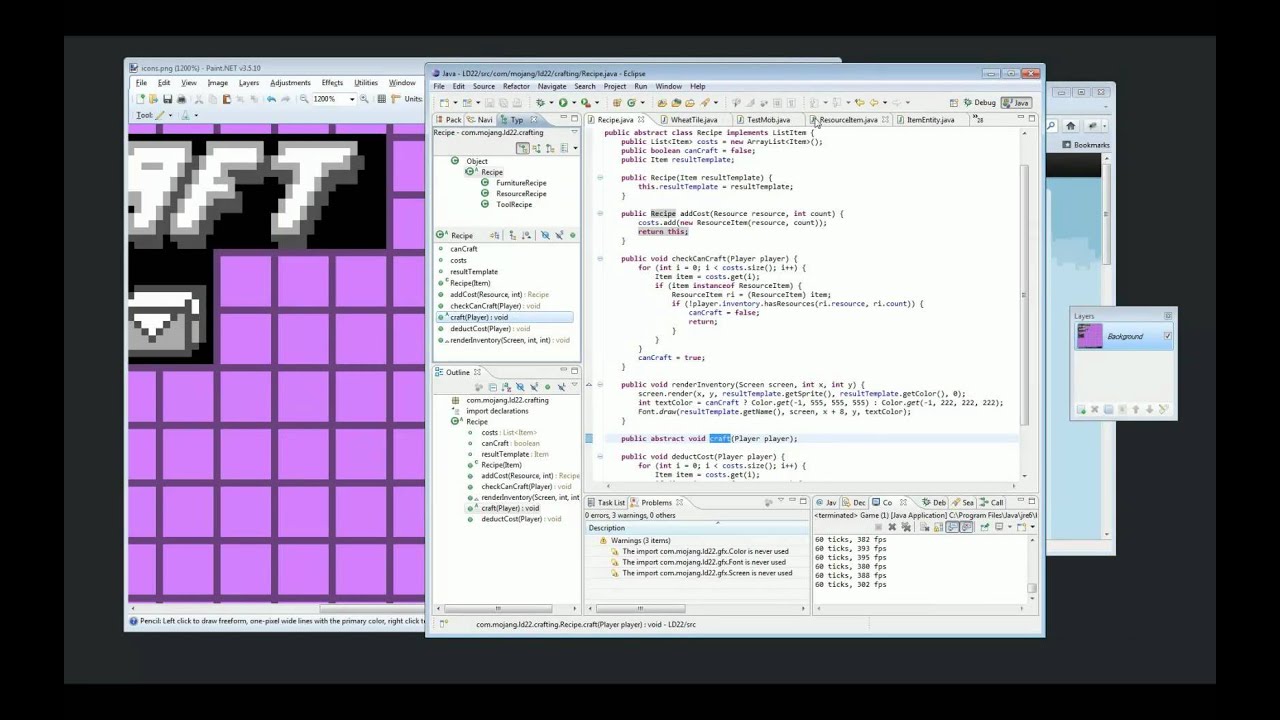
Persson rebalances crop pacing and integrates ore generation mechanics in real time to establish core progression for his Ludum Dare build.
AI-assisted summary of Notch Coding Minicraft! — original source. Check the original for full context.
Source published:
Key ideas
- During the Ludum Dare 22 challenge, Markus "Notch" Persson live-streamed development of his 2D game Minicraft, focusing on real-time balance tweaks such as slowing down farm tile growth rates. (0:00)
- Notch targeted core progression mechanics by implementing logic for ore spawning, allowing players to discover minerals necessary for tool crafting. (5:00)
- The coding session shows the integration of inventory drop mappings and debugging asset lookups, including locating specific item sprites like apples. (15:00)
Detailed notes
## Background Published on YouTube by simme337 on December 19, 2011, this video captures Markus "Notch" Persson during a live coding session. According to the video description, it features footage of Notch creating his game Minicraft for the Ludum Dare challenge, with all credit directed to Notch.
## TL;DR Markus "Notch" Persson works through the development of his Ludum Dare 22 entry, Minicraft, focusing on balancing and core resource systems. He begins by adjusting crop growth pacing before writing logic to ensure players can find and mine ore in the world. As the session progresses, Notch integrates resource drop tables with player inventory slots and troubleshoots asset definitions, pausing to search for missing item references such as an apple sprite.
## Atmosphere & style The session carries a low-key, intimate game-jam atmosphere, pairing Notch's quiet, reflective problem-solving with an energetic background soundtrack from the Lazy Rich Show. The mood is steady and pragmatic, punctuated by intermittent stream donation alerts, Notch's polite acknowledgments, and occasional muttered self-corrections as bugs surface. It feels like a relaxed, unfiltered window into a developer's workflow, where routine asset hunting and code testing unfold in real time.
## Bulletin - [00:00](https://www.youtube.com/watch?v=MhQ70O1MiXc&t=0s) During the Ludum Dare 22 challenge, Markus "Notch" Persson live-streamed development of his 2D game Minicraft, focusing on real-time balance tweaks such as slowing down farm tile growth rates. - [05:00](https://www.youtube.com/watch?v=MhQ70O1MiXc&t=300s) Notch targeted core progression mechanics by implementing logic for ore spawning, allowing players to discover minerals necessary for tool crafting. - [15:00](https://www.youtube.com/watch?v=MhQ70O1MiXc&t=900s) The coding session shows the integration of inventory drop mappings and debugging asset lookups, including locating specific item sprites like apples.
## Key takeaways - [00:00](https://www.youtube.com/watch?v=MhQ70O1MiXc&t=0s) Notch streams his live development process for Minicraft during the Ludum Dare 22 game jam competition. - [00:00](https://www.youtube.com/watch?v=MhQ70O1MiXc&t=0s) Balancing early crop progression is addressed immediately after Notch observes farm tiles growing too rapidly. - [00:00](https://www.youtube.com/watch?v=MhQ70O1MiXc&t=0s) The livestream features electronic dance music sets from the Lazy Rich Show alongside periodic viewer donation acknowledgments. - [05:00](https://www.youtube.com/watch?v=MhQ70O1MiXc&t=300s) Notch identifies ore discovery and generation as the primary next development step to build out progression loops. - [05:00](https://www.youtube.com/watch?v=MhQ70O1MiXc&t=300s) Map generation logic and class structures are updated directly to place mineral deposits across world tiles. - [10:00](https://www.youtube.com/watch?v=MhQ70O1MiXc&t=600s) Drop handling and inventory slot mapping logic are refined to connect harvested tiles with player items. - [15:00](https://www.youtube.com/watch?v=MhQ70O1MiXc&t=900s) Notch works through item definitions and asset sheets to locate missing food items and icons, including the apple sprite. - [15:00](https://www.youtube.com/watch?v=MhQ70O1MiXc&t=900s) The session concludes with real-time troubleshooting and debugging of unexpected execution errors in the newly integrated drop code.
## Detailed walkthrough ### [00:00](https://www.youtube.com/watch?v=MhQ70O1MiXc&t=0s) Initial Gameplay Tweaks and Livestream Atmosphere
During a live coding session for his Ludum Dare 22 entry *Minicraft*, Markus "Notch" Persson focuses intently on game balance and mechanic adjustments while streaming to viewers. Early on, he notices an issue with crop pacing, remarking to himself and the stream, “Farm tile seems to grow a bit too fast.” Electronic dance music—featuring vocal loops of “and the beat goes on”—fills the background as Notch alternates between monitoring the game window, acknowledging donations or chat messages with periodic “Thank you” responses, and organizing his thoughts.
As he tests the build, he momentarily loses track of his immediate plan before getting back on track, muttering, “What was I going to test? Oh yeah.” He continues running the game loop, watching the tiles update, and preparing the next batch of features while keeping an eye on both the code editor and his live audience.
[05:00](https://www.youtube.com/watch?v=MhQ70O1MiXc&t=300s) Working on Ore Spawning Mechanics
The background stream audio transitions into a set from the Lazy Rich Show (“This is the Lazy Rich Show in the mix, live and direct”), providing an energetic soundtrack while Notch codes. Despite the upbeat music and regular automated alert tones prompting him to say “Thank you” to the stream's supporters, Notch maintains his concentration on core resource progression for the 2D game.
He articulates his next major development objective, noting, “Okay, I need to be able to find ore.” Introducing ore generation and harvesting is crucial for player progression, as gathering raw materials allows crafting tools to dig deeper or craft better equipment. He navigates through his classes and map generation code to implement the necessary logic for placing mineral deposits within the world tiles.
[10:00](https://www.youtube.com/watch?v=MhQ70O1MiXc&t=600s) Radio Wrap-Up and Integrating Resources
As Notch continues coding, the radio guest mix winds down. The host closes out the broadcast by thanking Revolver for the guest mix, reminding listeners to check out the website archives, and announcing an upcoming guest mix by Spencer & Hill for the following month before launching into outro tracks.
Unfazed by the shifting music, Notch keeps testing the new additions. He verifies where items and tile drops are handled, muttering aloud as he checks his code structure: “Yeah, let's put it in here, is it?” He works to ensure the new resource drops properly map to inventory slots and world interactions, balancing gameplay logic directly in real time.
- Radio broadcast plug mentioned: check out `radio.lazy-rich.com` for track listings and previous show archives. - Guest mix credit announced on the music stream: Revolver, with next month's guest slated as Spencer & Hill.
[15:00](https://www.youtube.com/watch?v=MhQ70O1MiXc&t=900s) Debugging and Item Lookups
In the final stretch of the recorded session, Notch runs into minor hurdles while setting up assets and item references. While sorting through his sprite sheets, item definitions, and variables, he tries locating specific icons or food items, asking aloud, “Where's... Where's Apple?”
After a brief pause, he continues inspecting his source files to link up the ore and drop logic: “Yes. Okay, let's see here... or...” He runs into a small bug or unexpected result, letting out an “Oh, no” as he spots an error in the execution, before settling back into the rhythm of debugging against the closing music.
## Mentioned Markus "Notch" Persson, Minicraft, Ludum Dare 22, The Lazy Rich Show, Revolver, Spencer & Hill
## Video description This is some minutes of notch when he making his game minicraft for the Ludum Dare challenge
all credits goes to notch
[Source](https://www.youtube.com/watch?v=MhQ70O1MiXc)