DEA Returns $86,900 to Veteran as Lawsuit Targets Nevada Cash Seizures
Institute for Justice
Federal adoption programs drive local police to confiscate roadside cash without criminal charges because agencies receive up to 80 percent kickbacks from seized funds.
AI-assisted summary of Watch Cops Seize Combat Vet's Life Savings [RARE FOOTAGE] — original source. Check the original for full context.
Source published:
Key ideas
- Nevada Highway Patrol pulled over retired Marine Stephen Lara for an alleged minor following-distance violation, subjected him to an interdiction interrogation, and seized his life savings of $86,900 without filing any criminal charges or issuing a ticket. (0:12)
- Officers seized the cash specifically for federal 'adoption' by the DEA, which utilizes the equitable sharing program to return up to 80% of forfeited funds directly back into the seizing police department's budget. (4:34)
- Although Lara provided legitimate bank withdrawal receipts, a highway patrol sergeant dropped the bag of cash on the roadside dirt to manufacture a K-9 alert as justification for the confiscation. (7:46)
- After holding the money past federal deadlines, the DEA agreed within 24 hours of a federal lawsuit by the Institute for Justice to return all $86,900, while a parallel state lawsuit challenges the constitutionality of federal adoptions in Nevada. (11:36)
Detailed notes
## Background Published by the Institute for Justice on YouTube on November 30, 2021, this video documents the roadside seizure of combat veteran Stephen Lara's life savings by the Nevada Highway Patrol. The accompanying description details how Lara was stripped of $86,900 via the federal "adoption" process and equitable sharing program, leading to a successful federal lawsuit and an ongoing state constitutional challenge to eliminate the profit motive in roadside asset forfeitures.
## TL;DR While driving through Nevada to visit his daughters, retired U.S. Marine Stephen Lara was pulled over under the pretext of following a truck too closely and consented to a vehicle search. Despite Lara's full cooperation, clean record, and legitimate bank withdrawal receipts, troopers deployed a drug-sniffing canine on his cash and seized $86,900 to route it through the DEA's federal adoption program for an equitable sharing budget payout. Stranded roadside with only a property receipt, Lara endured months of federal inaction until the Institute for Justice intervened with a lawsuit that forced the return of his funds. The video uses Lara's harrowing experience to expose the systemic abuses of civil asset forfeiture and calls for its total abolition.
## Atmosphere & style The presentation evokes a chilling, surreal tension by juxtaposing the polite, conversational tone of the officers with the predatory reality of a state-sanctioned taking. Watching the raw bodycam footage creates a deep sense of vulnerability and indignation as a cooperative, decorated veteran is systematically stripped of his financial security on a desert highway. The narrative evolves from roadside helplessness into focused resolve, turning personal outrage into a broader crusade against an unjust legal system.
## Bulletin - [00:12](https://www.youtube.com/watch?v=MkeS_0NQUZs&t=12s) Nevada Highway Patrol pulled over retired Marine Stephen Lara for an alleged minor following-distance violation, subjected him to an interdiction interrogation, and seized his life savings of $86,900 without filing any criminal charges or issuing a ticket. - [04:34](https://www.youtube.com/watch?v=MkeS_0NQUZs&t=274s) Officers seized the cash specifically for federal 'adoption' by the DEA, which utilizes the equitable sharing program to return up to 80% of forfeited funds directly back into the seizing police department's budget. - [07:46](https://www.youtube.com/watch?v=MkeS_0NQUZs&t=466s) Although Lara provided legitimate bank withdrawal receipts, a highway patrol sergeant dropped the bag of cash on the roadside dirt to manufacture a K-9 alert as justification for the confiscation. - [11:36](https://www.youtube.com/watch?v=MkeS_0NQUZs&t=696s) After holding the money past federal deadlines, the DEA agreed within 24 hours of a federal lawsuit by the Institute for Justice to return all $86,900, while a parallel state lawsuit challenges the constitutionality of federal adoptions in Nevada.
## Key takeaways - [00:12](https://www.youtube.com/watch?v=MkeS_0NQUZs&t=12s) Stephen Lara was stopped by the Nevada Highway Patrol outside Reno under the pretext of an educational campaign regarding following distance behind commercial trucks. - [02:37](https://www.youtube.com/watch?v=MkeS_0NQUZs&t=157s) Despite complying fully with officers, admitting he had cash, and consenting to a vehicle search, Lara was subjected to an escalating highway interdiction interrogation. - [05:54](https://www.youtube.com/watch?v=MkeS_0NQUZs&t=354s) Carrying large sums of cash is entirely legal in the United States, which the questioning officer explicitly acknowledged during the stop. - [04:34](https://www.youtube.com/watch?v=MkeS_0NQUZs&t=274s) Officers discovered $86,900 in bundled currency alongside legitimate bank withdrawal receipts documenting Lara's historical withdrawals. - [04:34](https://www.youtube.com/watch?v=MkeS_0NQUZs&t=274s) Federal 'adoption' allows state law enforcement to bypass state-level statutory protections by transferring seized assets to federal agencies like the DEA under civil forfeiture rules. - [04:34](https://www.youtube.com/watch?v=MkeS_0NQUZs&t=274s) Under the federal equitable sharing program, local police departments receive kickbacks of up to 80% of the seized cash, creating a strong institutional profit motive for roadside seizures. - [07:46](https://www.youtube.com/watch?v=MkeS_0NQUZs&t=466s) A patrol sergeant bypassed the junior officer's reservations and insisted on running a drug-sniffing K-9 past the open bag of cash on the dirt shoulder to create probable cause. - [07:46](https://www.youtube.com/watch?v=MkeS_0NQUZs&t=466s) Drug dog alerts on currency are unreliable indicators of crime because scientific studies show between 67% and 100% of circulating U.S. paper money carries detectable narcotic traces. - [07:46](https://www.youtube.com/watch?v=MkeS_0NQUZs&t=466s) Left stranded on the highway with only a paper receipt and a DEA contact number, Lara had to borrow $1,000 from his brother just to purchase fuel and food to see his daughters. - [11:36](https://www.youtube.com/watch?v=MkeS_0NQUZs&t=696s) The DEA held Lara's funds indefinitely, ignoring a six-month statutory deadline requiring the agency to return the money, charge him with a crime, or initiate forfeiture proceedings. - [11:36](https://www.youtube.com/watch?v=MkeS_0NQUZs&t=696s) The DEA agreed to return 100% of Lara's seized money within 24 hours after the Institute for Justice filed a federal lawsuit and The Washington Post made media inquiries. - [11:36](https://www.youtube.com/watch?v=MkeS_0NQUZs&t=696s) The Institute for Justice filed a companion lawsuit in Nevada state court seeking to declare federal adoptions unconstitutional under Nevada's protections against unreasonable seizures. - [12:39](https://www.youtube.com/watch?v=MkeS_0NQUZs&t=759s) Most victims of roadside civil asset forfeiture cannot afford private counsel or navigate convoluted administrative procedures, resulting in default government confiscations without any proof of a crime.
## Detailed walkthrough ### [00:12](https://www.youtube.com/watch?v=MkeS_0NQUZs&t=12s) The Traffic Stop and Public Information Pretext
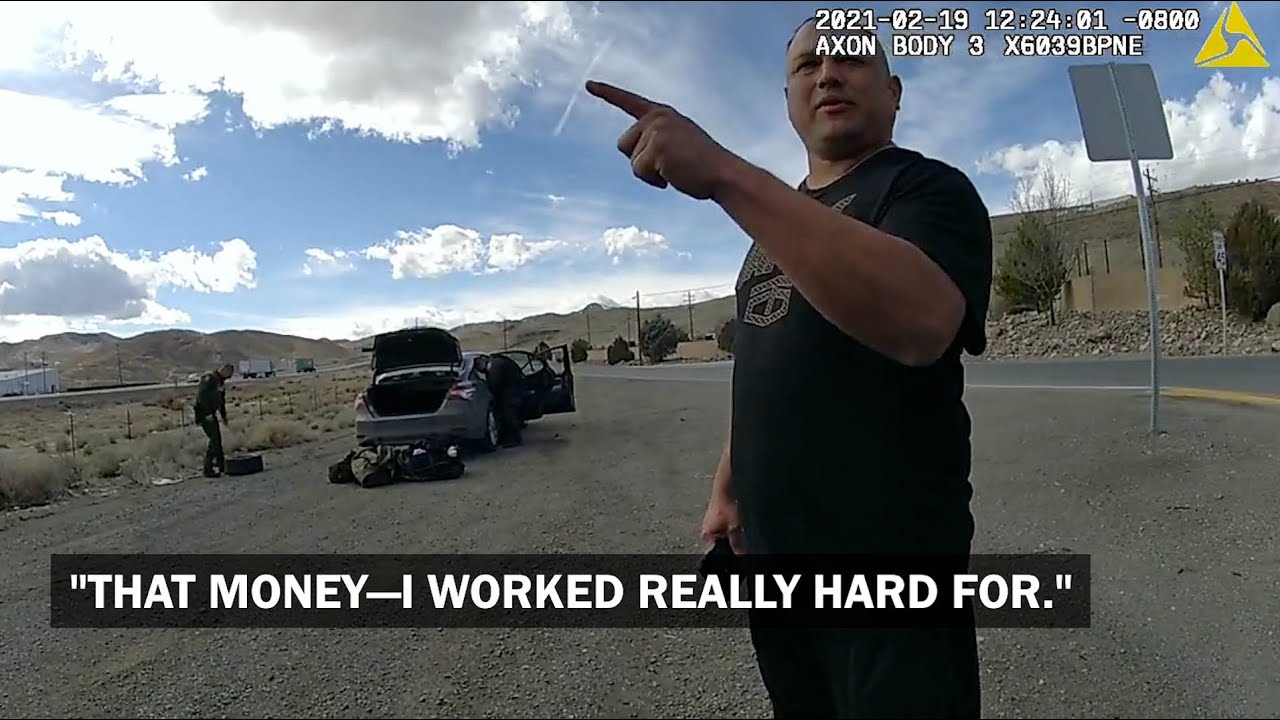
On February 19, 2021, Stephen Lara, a retired U.S. Marine, was traveling west outside Reno, Nevada, on his regular trip to visit his two teenage daughters in a small California town just over the state line. Driving a rental car due to mechanical issues with his own vehicle, Stephen was pulled over by an officer of the Nevada Highway Patrol. The officer claimed that Stephen had committed a traffic infraction by following a red-and-blue semi-truck too closely, alleging a following distance of less than a second.
The initial tone of the stop was disarmingly polite. The patrolman assured Stephen that he had stopped him as part of a educational enforcement campaign: “The reason I'm stopping with a special enforcement campaign going on we're trying to educate drivers about violations they may not realize they're committing but we're seeing a big increase in crashes out here.” The officer praised Stephen’s speed and caution, stating, “First of all, John, your driving—you drive great, you're driving really slow, it appears that you're driving trying to drive safely under the speed limit, I appreciate that.” He maintained that he merely wanted to discuss following distance behind commercial vehicles. Stephen was ordered out of the vehicle, not suspecting that the stop was an interdiction trap.
- Stephen Lara was not arrested, charged with any crime, or even issued a traffic citation. - Through a public records request, the Institute for Justice secured both body camera and dashcam recordings documenting the entire stop through to the bank deposit.
---
[02:37](https://www.youtube.com/watch?v=MkeS_0NQUZs&t=157s) Interdiction Interrogation and Vehicle Search
Once Stephen was standing outside the vehicle, the officer shifted into an interrogation routine aimed at sizing him up and looking for inconsistencies in his story. Noting Stephen's athletic build and clothing, the officer asked, “You a fighter?” to which Stephen noted his background: “Well, I've got a lot of training, I'm a retired Marine.” The officer peppered him with rapid-fire questions covering his family, what his daughters do, whether he had prior arrests, where he had worked in Texas, and where he planned to buy a house.
```mermaid flowchart TD accTitle: Progression of Roadside Interdiction Stop accDescr: Sequence of events from the initial traffic stop pretext to the search of the vehicle. A["Traffic Stop: Alleged Following Distance Violation"] --> B["Friendly Pretext: Public Education Campaign"] B --> C["Personal Interrogation: Marine Background & Travel Plans"] C --> D["Interdiction Query: Firearms, Contraband & Large Currency"] D --> E["Consent Given: Stephen Consents to Search Car"] ```
The officer then dropped the pretext of safe driving and admitted his actual operational role: “Part of my job out here is I do what's called highway interdiction. I look for people that are smuggling contraband through our state across the country—weapons, humans, drugs, illicit currency, things like that.” He pressed Stephen on whether there were firearms, explosives, or narcotics inside. When asked if there was any large amount of U.S. currency, Stephen was completely honest, volunteering that he was carrying well over $10,000. When the officer asked for permission to search the vehicle, Stephen immediately agreed. Stephen later reflected on his mindset: “I didn't want to come across as being non-cooperative or combative, so I did what I felt was right and I was very honest, very forthcoming, I was also very respectful and I just wanted to make their job as easy as possible so that i could be on my way to spend time with my children.”
- Stephen openly confirmed the presence of his savings rather than attempting to conceal it. - Although he had a constitutional right to refuse the vehicle search, Stephen consented to avoid any appearance of guilt or friction.
---
[04:34](https://www.youtube.com/watch?v=MkeS_0NQUZs&t=274s) Equitable Sharing and the Federal Adoption Incentive
While searching the vehicle, the officer discovered Stephen's money bundled in a Ziploc sandwich bag along with bank receipts showing historical withdrawals. The officer stepped away to call a Drug Enforcement Administration (DEA) agent named Shane: “If I'm still searching a car, but a big bundle of money says probably at least a hundred thousand.” This call reveals the structural motivation behind the seizure: civil forfeiture through federal "adoption" and the federal equitable sharing program.
```mermaid flowchart LR accTitle: Federal Equitable Sharing Money Flow accDescr: Chart illustrating how seized roadside funds are routed through the DEA and returned to local police budgets. subgraph S1["Roadside Action"] A["Nevada Highway Patrol seizes cash"] end subgraph S2["Federal Adoption"] B["DEA adopts seizure under federal law"] C["Bypasses Nevada state property protections"] end subgraph S3["Equitable Sharing Payout"] D["Up to 80% kicked back to NHP budget (~$70,000)"] end A --> B B --> C C --> D ```
Under this federal statutory framework, when state or local law enforcement seizes assets, federal agencies can "adopt" the seizure and pursue civil forfeiture under federal statutes. This sidesteps state-level statutory protections that require criminal convictions or place higher burdens of proof on the government. In exchange, the seizing agency receives up to an 80 percent kickback of the forfeited proceeds for its own budget. In Stephen's situation, turning over his $86,900 nest egg meant the Nevada Highway Patrol stood to gain nearly $70,000 directly into its department coffers. Nationally, federal agencies funneled $334 million to state and local police in equitable sharing payouts during 2019 alone.
---
[05:54](https://www.youtube.com/watch?v=MkeS_0NQUZs&t=354s) Legitimate Explanations Versus Adoption Plans
The officer admitted during his questioning that possessing cash is completely legal: “I'm a vet, he's a vet, you're a vet—it's not illegal to carry currency.” When Stephen explained his deep distrust of banks—a sentiment reinforced by recent neighborhood burglaries—the officer conceded, “I understand why you don't trust banks, especially in this day and age right now.” Stephen insisted, “I have nothing to hide from you.”
The officer then called his highway patrol sergeant, describing the situation as an unusual scenario: “This is a—it's a strange one, but not a strange one. Consents to a search, said there's money up there, we located what he says is a hundred thousand dollars, it's in a Ziploc sandwich baggie... there's a bunch of bank receipts and stuff in there as well.” While on the line, the officer interrupted his supervisor to take an incoming call from DEA Agent Shane. About 20 minutes later, the arriving Highway Patrol sergeant hopped on a phone call with Shane, who apologized for being unable to drive out to the highway in person. The sergeant dismissed any difficulty, assuring the DEA agent: “No issues, it's too easy to do an adoption, you know we contacted you, so I think everything's going to be okay, and I'll text you a money count, I forget, it'll probably be a couple hours.” Despite lacking any criminal evidence or probable cause, the officers had already resolved to process the cash through federal adoption.
---
[07:46](https://www.youtube.com/watch?v=MkeS_0NQUZs&t=466s) The K-9 Sniff and Roadside Seizure
The sergeant approached Stephen to interrogate him again about his financial habits, and Stephen repeated that his decision was rooted in personal distrust: “That's just my reasoning, it's my personal thing.” The sergeant then conferenced in private with the junior officer, asking, “What are your thoughts, Chris?” The junior officer hesitated, noting the exculpatory evidence: “It's odd, but it's not packed... and he's answering the questions, there's receipts here.” Despite the legitimate bank receipts and Stephen’s transparent answers, the sergeant pushed forward, insisting, “I would like to put the dog on the currency, man.”
```mermaid flowchart TD accTitle: Dog Sniff Pretext Workflow accDescr: Diagram of the procedure used by officers to justify seizing Stephen Lara's currency with a K-9 alert. A["Legitimate Bank Withdrawal Receipts Shown"] --> B["Sergeant Rejects Receipts & Orders K-9 Sniff"] B --> C["Sergeant Drops Open Ziploc Bag of Cash on Dirt Roadside"] C --> D["K-9 Signals 'Positive Alert'"] D --> E["NHP Claims Probable Cause for Narcotics Connection"] E --> F["Cash Confiscated & Transferred to DEA"] ```
The sergeant took the open Ziploc bag of cash and dropped it directly onto the dirt shoulder, less than 40 yards from Stephen's vehicle, running a narcotics-detection canine past it until the dog produced an alert. Although scientific studies demonstrate that between 67% and 100% of circulating U.S. paper currency carries detectable trace residues of narcotics—meaning a K-9 alert does not substantiate an illegal drug link—the sergeant seized on the alert as the pretext he required. He returned to Stephen to announce that the cash was being confiscated: “I'm gonna tell you guys what's gonna happen, okay? We're gonna seize it today, but that doesn't mean we're the final judgment on it, it's gonna go through the DEA, okay? So the DEA will contact you and the DEA will provide you with a means to fight it, you're gonna have to provide your pay stubs, you're gonna have to provide your other receipts and stuff like that.”
- Stephen had to phone his brother from the roadside to wire him $1,000 so he could buy fuel and food to complete his trip to visit his daughters. - After an ordeal lasting roughly ninety minutes, Stephen was handed a mere property receipt featuring a phone number for the DEA agent.
---
[11:36](https://www.youtube.com/watch?v=MkeS_0NQUZs&t=696s) Aftermath and Legal Challenges
Holding a paper receipt in place of his life savings of $86,900, Stephen was left bewildered on the side of the road, asking, “This is all I get here?” to which the officer answered, “That's what you get, yes sir, you're going to get notice in the mail as well at that address, okay.” Stephen later spoke about the chilling realization of how vulnerable regular people are to state-sanctioned taking: “I find it even more so concerning that if this could happen to me as a combat veteran who served overseas in Iraq and Afghanistan, this could happen to anybody.”
Under federal law, the DEA had an obligation to either charge Stephen with a crime, commence a civil forfeiture action against the property, or return the money within a six-month statutory deadline. The agency did none of these things, keeping the $86,900 indefinitely. On August 30, 2021, the Institute for Justice filed a federal lawsuit against the DEA on Stephen’s behalf. Within twenty-four hours—and facing urgent inquiries from *The Washington Post*—the DEA surrendered and agreed to return every dollar of Stephen's savings. However, Stephen and IJ did not stop there; they proceeded with a parallel state constitutional lawsuit against the Nevada Highway Patrol. The state lawsuit challenges the legality of federal adoptions in Nevada under the state constitution's guarantees against unreasonable seizures without probable cause, seeking to dismantle the perverse financial incentives that fuel roadside civil forfeiture once and for all.
[12:39](https://www.youtube.com/watch?v=MkeS_0NQUZs&t=759s) The Flaws of Civil Forfeiture and the Call for Abolition
Although Stephen Lara ultimately recovered his seized life savings, his resolution remains an extreme exception rather than the norm in civil asset forfeiture cases. Because Stephen secured legal representation from the Institute for Justice, he was able to challenge the seizure and force the government to return his money. The vast majority of people targeted by roadside forfeitures do not have access to dedicated public interest litigators. Stripped of their funds during traffic stops, these individuals are frequently left without the financial means to retain private defense counsel, forcing them to confront an arcane legal system entirely on their own.
Without legal representation, ordinary citizens must attempt to navigate Byzantine statutory deadlines and complicated administrative procedures just to ask for a hearing. When victims cannot afford a lawyer or decipher the convoluted bureaucracy, agencies retain the seized cash and assets by default. The narrator underscores the inherent injustice of this mechanism, observing: “Most victims of forfeiture don't have a public interest law firm like IJ to take their case and if they cannot afford an attorney and cannot figure out how to navigate convoluted forfeiture processes on their own the government walks away with their property without ever having to prove any crime.” The segment concludes with an urgent demand for legislative and judicial action, declaring: “This highway robbery must end it is time to abolish civil forfeiture.”
```mermaid flowchart TD accTitle: The Civil Forfeiture Trap vs Representation accDescr: A flow diagram contrasting the path of typical civil forfeiture victims against those with pro bono legal representation.
subgraph Seizure["Roadside Seizure"] A["Driver stopped and cash seized"] end
subgraph TypicalPath["Typical Victim Outcome"] B["Cannot afford attorney"] --> C["Must navigate complex legal rules alone"] C --> D["Deadlines missed or claims abandoned"] D --> E["Government keeps property without proving a crime"] end
subgraph IJPath["Representation by IJ"] F["Public interest firm files federal & state lawsuits"] F --> G["Government surrenders and returns full funds"] end
A -->|"No representation"| B A -->|"Secures legal backing"| F ```
- Most forfeiture victims lack the resources to retain private counsel and cannot obtain pro bono aid from public interest firms like the Institute for Justice. - When individuals cannot navigate administrative forfeiture rules, law enforcement agencies routinely keep seized cash by default without ever filing criminal charges or proving guilt in court. - The Institute for Justice characterizes roadside asset seizures without criminal charges as state-sanctioned highway robbery that must be abolished.
## Notable quotes > [11:36](https://www.youtube.com/watch?v=MkeS_0NQUZs&t=696s) I find it even more so concerning that if this could happen to me as a combat veteran who served overseas in Iraq and Afghanistan, this could happen to anybody. — Stephen Lara
> [12:39](https://www.youtube.com/watch?v=MkeS_0NQUZs&t=759s) This highway robbery must end it is time to abolish civil forfeiture. — Narrator
## Mentioned Stephen Lara, Glenn Rigdon, Shane, Nevada Highway Patrol, Drug Enforcement Administration, Institute for Justice, The Washington Post, Reno, Nevada, Lubbock, Texas, California, Iraq, Afghanistan
## Video description Stephen Lara did everything right. But, as subscribers of our YouTube channel know well, even innocent people aren’t safe from civil forfeiture.
Stephen is a 39-year-old retired Marine from Lubbock, Texas. He is a devoted father of two teenage daughters and, once a month, he drives from Texas to see them in California, where they live with their mother. Eager to be closer after spending the pandemic in Texas caring for his elderly parents, he has been shopping for a home near the California-Nevada border.
https://ij.org/case/nevada-civil-forfeiture/
In February 2021, Stephen was making his usual trip west through Reno when he was pulled over by the Nevada Highway Patrol for supposedly following a tractor-trailer too closely.
The officer complimented Stephen’s driving, thanked him for observing the speed limit, and explained that NHP was “conducting a public information campaign” to help drivers avoid danger. Confident that the officer was only there to help, Stephen cooperated with his escalating investigation, even volunteering that he was carrying a large amount of cash.
Ninety minutes later, Stephen had been robbed of his life savings—$86,900—which he carried with him after a spate of robberies in his parents’ neighborhood. The officer who pulled Stephen over wanted to let him go; he was overruled by NHP Sergeant Glenn Rigdon, who ordered the money seized specifically so that it could be “adopted” by the U.S. Drug Enforcement Administration.
“Adoption” is a process by which federal law enforcement agencies can take over a seizure by state and local law enforcement. If the federal government is successful in forfeiting the property, its “equitable sharing” program guarantees the state or local agency that seized the property up to 80% of the proceeds for use in the agency’s budget.
In Stephen’s case, the DEA sat on his life savings for months, ignoring the legal deadlines requiring it to charge Stephen with a crime, begin a civil forfeiture case against his property, or return the money within six months of seizure. The DEA did none of those things. So, on August 30, IJ sued it in federal court on Stephen’s behalf.
Early the morning of September 1, the agency announced it would return all of Stephen’s money. In less than 24 hours, it had learned of our lawsuit, answered hard questions from The Washington Post, and committed to reviewing its policies for federal adoptions.
When we learned he would be getting his money back (filled with joy), he told us, “This isn’t over.”
And it isn’t. At the same time we filed in federal court, we also filed a major constitutional challenge in state court. Our state case aims to make federal adoptions impossible in Nevada as violations of the state constitution’s guarantees of reasonable seizures supported by probable cause and due process of law—not based on mere suspicion or for the financial benefit of the seizing agency. If we are successful, it will be the first time a state court has struck down federal adoptions. And a victory will take the profit motive out of roadside seizures.
Filmed with a Canon C70 with a 50mm 1.2 lens. Aputure 300d, 120d, and amaran.
[Source](https://www.youtube.com/watch?v=MkeS_0NQUZs)