DraftKings, FanDuel Face Gambling Crackdown as States Target Loophole
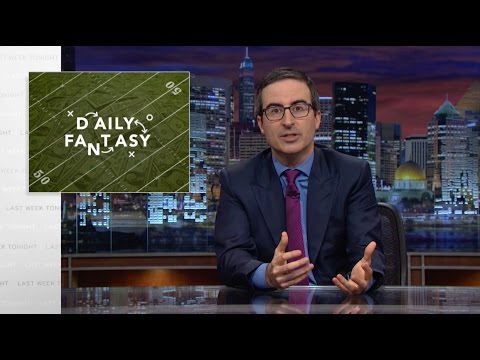
LastWeekTonight
Daily fantasy platforms exploit an outdated federal loophole to run de facto sports gambling, luring casual depositors into contests where algorithmic professionals capture nearly all profits.
AI-assisted summary of Daily Fantasy Sports: Last Week Tonight with John Oliver (HBO) — original source. Check the original for full context.
Source published:
Key ideas
- Daily fantasy sports platforms DraftKings and FanDuel saturated 2015 television airwaves with ads every 90 seconds, despite studies showing the top 1.3% of players captured 91% of total profits. (0:01)
- Major media conglomerates and sports leagues hold deep financial stakes in daily fantasy operators, including equity investments from Fox, Comcast, Time Warner, MLB, and the NBA, alongside an ESPN marketing deal valued at $250 million. (2:00)
- State regulators and lawmakers challenged daily fantasy's legal standing in late 2015, with Nevada ruling it gambling and New York's Attorney General taking action to halt operations as illegal betting. (3:54)
- Daily fantasy operators justify their operations via an exemption in the 2006 Unlawful Internet Gambling Enforcement Act (UIGEA), even though the bill's author, Jim Leach, condemned their use of the carve-out. (6:48)
Detailed notes
## Background Published on YouTube by LastWeekTonight on November 16, 2015, this segment examines the massive boom of daily fantasy sports. According to the show's description, daily fantasy sites insist they are not gambling enterprises despite seeming awfully 'gamblish,' prompting a look at what their ubiquitous advertisements would look like if they were actually truthful.
## TL;DR John Oliver investigates the rapid ascent of daily fantasy giants DraftKings and FanDuel, scrutinizing their aggressive ad blitzes and extensive financial ties to major media networks and sports leagues. The segment examines how these companies exploit a 2006 federal statutory loophole by framing their contests as 'games of skill' to bypass state sports betting bans. In reality, the format mirrors online poker, with sophisticated, algorithm-driven players capturing over 90% of all profits while the vast majority of casual fans consistently lose money. Oliver concludes that daily fantasy is undeniably gambling and warrants proper regulatory oversight and honest advertising rather than backdoor legalization.
## Atmosphere & style The piece delivers John Oliver's characteristic blend of biting satire, manic comedic energy, and thorough journalistic critique. The pacing moves briskly from exasperated mockery of repetitive commercials to a meticulously structured dismantling of corporate and regulatory hypocrisy, punctuated by vivid metaphors about pet doors and Russian entertainment syndicates. Watching the segment feels like an entertaining yet sobering wake-up call, transitioning from lighthearted sports humor to an incisive expose on consumer exploitation, ultimately capped off by a bleakly hilarious parody commercial of marital and financial ruin.
## Bulletin - [00:01](https://www.youtube.com/watch?v=Mq785nJ0FXQ&t=1s) Daily fantasy sports platforms DraftKings and FanDuel saturated 2015 television airwaves with ads every 90 seconds, despite studies showing the top 1.3% of players captured 91% of total profits. - [02:00](https://www.youtube.com/watch?v=Mq785nJ0FXQ&t=120s) Major media conglomerates and sports leagues hold deep financial stakes in daily fantasy operators, including equity investments from Fox, Comcast, Time Warner, MLB, and the NBA, alongside an ESPN marketing deal valued at $250 million. - [03:54](https://www.youtube.com/watch?v=Mq785nJ0FXQ&t=234s) State regulators and lawmakers challenged daily fantasy's legal standing in late 2015, with Nevada ruling it gambling and New York's Attorney General taking action to halt operations as illegal betting. - [06:48](https://www.youtube.com/watch?v=Mq785nJ0FXQ&t=408s) Daily fantasy operators justify their operations via an exemption in the 2006 Unlawful Internet Gambling Enforcement Act (UIGEA), even though the bill's author, Jim Leach, condemned their use of the carve-out.
## Key takeaways - [00:01](https://www.youtube.com/watch?v=Mq785nJ0FXQ&t=1s) Daily fantasy sports condensed traditional season-long office pools into hyper-accelerated daily or weekly cash contests against strangers. - [02:00](https://www.youtube.com/watch?v=Mq785nJ0FXQ&t=120s) Media networks and sports leagues formed extensive financial partnerships with fantasy platforms, driving viewership for low-interest games while creating conflicts of interest. - [03:54](https://www.youtube.com/watch?v=Mq785nJ0FXQ&t=234s) DraftKings and FanDuel insist their services are legal entertainment products rather than gambling, despite common-sense definitions and public admissions from figures like Joe Namath. - [03:54](https://www.youtube.com/watch?v=Mq785nJ0FXQ&t=234s) DraftKings' international gambling license in the UK and site SEO tags featuring 'betting' directly undermine its public claim of being fundamentally distinct from gambling. - [06:48](https://www.youtube.com/watch?v=Mq785nJ0FXQ&t=408s) Operators rely on the 2006 UIGEA carve-out for fantasy sports to skirt federal gambling prohibitions, a use former Congressman Jim Leach termed 'sheer chutzpah.' - [06:48](https://www.youtube.com/watch?v=Mq785nJ0FXQ&t=408s) To evade state anti-gambling statutes, daily fantasy firms aggressively emphasize the 'game of skill' defense, even astroturfing protests with their own corporate employees. - [10:48](https://www.youtube.com/watch?v=Mq785nJ0FXQ&t=648s) The daily fantasy ecosystem is dominated by professional players utilizing advanced algorithms and statistical models, leaving 85% of casual baseball players with net losses. - [10:48](https://www.youtube.com/watch?v=Mq785nJ0FXQ&t=648s) Advertising campaigns promise easy riches to everyday sports fans, masking the reality that top-tier analytical players monopolize nearly all payouts. - [12:46](https://www.youtube.com/watch?v=Mq785nJ0FXQ&t=766s) The industry faces a legal paradox: highlighting skill protects against gambling laws but alienates casual spenders, while the model closely mirrors online poker, which is widely outlawed. - [12:46](https://www.youtube.com/watch?v=Mq785nJ0FXQ&t=766s) DraftKings deliberately targeted traditional bettors by serving as a primary presenting sponsor for the World Series of Poker broadcast. - [14:52](https://www.youtube.com/watch?v=Mq785nJ0FXQ&t=892s) De facto nationwide legalization of sports betting should not occur through unintended loopholes without proper consumer protections and state regulations.
## Detailed walkthrough ### [00:01](https://www.youtube.com/watch?v=Mq785nJ0FXQ&t=1s) The Relentless Ad Blitz and the Shift to Daily Fantasy
John Oliver opens by introducing daily fantasy sports as “the most addictive thing you can do on your phone other than perhaps cocaine.” Anyone owning a television in late 2015 could hardly escape the aggressive marketing blitz from industry leaders DraftKings and FanDuel. The commercials relentlessly hammered viewers with promises of fast payouts, zero season-long commitments, and invitations to cash oversized novelty checks using hyper-specific promotional codes like "TROT," "YOUTUBE60," "CLEAN6," and "BANG9." Oliver quips that these codes provide an illusion of elite access, “like you've just joined an elite supper club whose password is BANG9.” At peak volume, the two rival companies were saturating television airwaves with a national commercial every 90 seconds, a frequency Oliver notes is only necessary if your target audience consists of “sports-loving goldfish.”
The segment contrasts traditional season-long fantasy sports with the daily format. Traditional leagues typically involve an office pool where co-workers chip in $20 apiece, draft players for an entire season, and inevitably lose to Janice in accounting—a coworker who does not even care about sports. Daily fantasy radically alters that dynamic by operating on hyper-condensed timelines ranging from a single week down to a single day. Users can pay entry fees anywhere from 25 cents to thousands of dollars and play against total strangers. As Oliver describes it, daily fantasy is the same as season-long fantasy only in the way “a nice mug of tea is the same as a nice baggie of heroin”—both provide warmth, but one is vastly more intense.
[02:00](https://www.youtube.com/watch?v=Mq785nJ0FXQ&t=120s) Financial Entanglements: Media Networks and Sports Leagues
Daily fantasy companies did not simply purchase ad slots; they established deep financial ties throughout the major television networks and sports leagues. Broadcasters frequently found themselves running segments about daily fantasy while having direct financial stakes in the platforms. Oliver catalogs how deeply integrated these ties had become across media and professional athletics:
```mermaid flowchart TD accTitle: Financial Ties in Daily Fantasy Sports accDescr: Diagram illustrating financial investments and partnerships between media conglomerates, sports leagues, and daily fantasy operators.
subgraph Operators["Daily Fantasy Platforms"] DK["DraftKings"] FD["FanDuel"] end
subgraph Media["Media Conglomerates"] FOX["21st Century Fox (Equity)"] --> DK ESPN["ESPN ($250M Marketing Deal)"] --> DK NBC["Comcast / NBC Sports (Equity)"] --> FD TW["Time Warner / CNN / HBO (Equity)"] --> FD end
subgraph Leagues["Sports Leagues & Franchises"] MLB["Major League Baseball (Equity)"] --> DK NFL_O["Patriots & Cowboys Owners (Equity)"] --> DK NBA["NBA (Equity)"] --> FD NFL_T["28 of 32 NFL Teams (Sponsorships)"] --> Operators end ```
The scale of corporate involvement touches nearly every stakeholder: - NBC Sports Group and Comcast hold equity stakes in FanDuel. - 21st Century Fox holds an ownership stake in DraftKings. - Time Warner (the parent company of CNN and HBO) invested heavily in FanDuel, prompting Oliver to acknowledge: “HBO is a subsidiary of Time Warner, which means that this joke about being compromised is in a sense brought to you by FanDuel.” - ESPN entered into an exclusive two-year marketing agreement with DraftKings reportedly valued at $250 million. - Major athletic institutions joined in: the NBA acquired an equity stake in FanDuel, Major League Baseball bought into DraftKings, 28 of the 32 NFL teams established sponsorship deals with one of the two platforms, and NFL franchise owners Robert Kraft (New England Patriots) and Jerry Jones (Dallas Cowboys) became direct DraftKings investors.
For leagues and television networks, daily fantasy offered an irresistible incentive: it drove viewership for matchups that would otherwise draw minimal public interest, such as the Tampa Bay Buccaneers playing the Jacksonville Jaguars on a rainy Thursday night. Oliver jokes that nobody would tune into such a game merely to witness the majesty of Tampa Bay kicker Connor Barth—except perhaps Barth's mother, and even she might DVR it because Thursday night is *Scandal* on ABC.
[03:54](https://www.youtube.com/watch?v=Mq785nJ0FXQ&t=234s) The Gambling Question: Regulators, Athletes, and "100% Legal" Claims
This close commercial partnership between major sports leagues and fantasy operators represents a dramatic departure from sports leagues' historic opposition to gambling. While unlicensed sports betting is illegal in the vast majority of states, daily fantasy services insist they do not facilitate gambling. However, as Pro Football Hall of Fame quarterback Joe Namath bluntly observed in an interview when asked if playing daily fantasy constitutes gambling: “I think you have to pay, and do they win something? They do. It's gambling, okay?” Oliver notes that if Namath—a man who famously wore a floor-length fur coat to the Super Bowl—can discern the truth, regulators can too.
The legal pushback against daily fantasy accelerated rapidly in late 2015: - In October 2015, the Nevada Gaming Control Board ruled that daily fantasy sports constitute gambling under state law, effectively requiring operators to obtain a casino gaming license to operate. - In November 2015, New York State Attorney General Eric Schneiderman took direct action to halt operations of DraftKings and FanDuel within the state, declaring them illegal gambling operations. - DraftKings prominently branded its platform as "100% legal" on its website—a claim Oliver likens to a yogurt clerk offering reassurance that their frozen dessert is legal, which only inspires suspicion.
Despite the platforms' public messaging, their own actions and digital footprints undercut their defense. When a FanDuel executive was asked about the company's nature on camera, he rejected the term: “Every time that you talk to our users, what comes through loud and clear is the fact that we're an entertainment product.” Oliver counters that traditional gambling is also entertaining, “until of course you're down 15 grand to a Russian entertainment syndicate.” Furthermore, DraftKings applied for and obtained an official gambling license to operate in the United Kingdom, and the Nevada Attorney General uncovered that DraftKings had embedded search-engine optimization tags repeatedly featuring the word "betting" throughout its site.
[06:48](https://www.youtube.com/watch?v=Mq785nJ0FXQ&t=408s) The UIGEA Doggy Door and the "Game of Skill" Defense
To justify their operations in the United States, daily fantasy operators lean heavily on the Unlawful Internet Gambling Enforcement Act of 2006 (UIGEA). A representative for DraftKings framed their entire business model around this carve-out: “Right now, of course, fantasy sports, being a game of skill, is carved out of UIGEA and permissible in most states in the U.S. I just think under the current law right now, it's very obvious that this fits within skill gaming.” Oliver highlights the absurdity of this defense by comparing the 2006 statutory carve-out to an innocent pet door:
> “It was meant to be a very small exception, but through that small carve-out, two multi-billion dollar businesses have emerged. It's like those lawmakers built a doggy door for a beloved pooch, and then daily fantasy came bursting through like a pack of wolves saying, ‘We are dogs! It's a doggy door, right? That's for us, we're legally dogs! Woof!’”
The principal author of that 2006 legislation, former Iowa Congressman Jim Leach, publicly voiced outrage at how his bill was being repurposed. As reported on the news, former lawmaker Jim Leach stated that it was “sheer chutzpah for the daily fantasy sports sites to pretend the law makes them legal.” Oliver points out that the UIGEA never legalized fantasy sports; it merely stated they were not prohibited under that specific federal act, leaving state gambling statutes fully intact. Under most state laws, activities qualify as illegal gambling if they depend primarily on chance rather than skill.
Consequently, daily fantasy companies have mounted an aggressive public campaign to repeat the word "skill" at every opportunity. When DraftKings and FanDuel mobilized a street demonstration outside the New York Attorney General’s office, crowd members repeatedly chanted "Game of skill!" However, reporters on the scene uncovered that roughly 100 of the 250 demonstrators blocking the sidewalk were actually FanDuel employees who had walked downstairs from their headquarters in Union Square. Oliver concludes that if a company is trying to prove it is not a shady gambling outfit, it probably shouldn't stack the deck by astroturfing its own rallies. He notes that while daily fantasy does indeed require skill, it may require far more than regular customers realize—pointing to summer study findings revealing that the top 1.3% of players pocketed 91% of all the profits.
[10:48](https://www.youtube.com/watch?v=Mq785nJ0FXQ&t=648s) The 1% and the Algorithm Advantage
A staggering 85% of daily fantasy baseball players lost money during the first half of the season. John Oliver observes that this failure rate is extraordinary compared to normal life, joking that in the general population, the breakdown is roughly 40% losers, 40% jerks, 14% weirdos, 5% decent human beings, and then Beyoncé. To illustrate who actually thrives in the top 1% of earners, Oliver highlights high-stakes player Cory Albertson, who raked in over $200,000 playing daily fantasy sports in a single year. Albertson does not rely on casual sports fandom; instead, he spends hours every day analyzing custom, homemade algorithms tracking thousands of up-to-the-minute statistics, deep projection spreadsheets, and stadium-by-stadium wind and weather patterns.
```mermaid flowchart TD accTitle: The Daily Fantasy Ecosystem Paradox accDescr: Flowchart illustrating how daily fantasy marketing collides with the statistical reality of algorithmic dominance.
subgraph Marketing ["Marketing Narrative"] A["FanDuel & DraftKings Ads"] --> B["'Anybody Can Play, Anybody Can Win'"] B --> C["Casual Sports Fans Deposit Cash"] end
subgraph Reality ["Statistical Reality"] D["Algorithm Nerds & Pros"] --> E["Track Hourly Wind, Weather & Micro-Stats"] E --> F["Top 1% Capture Bulk of Payouts"] C --> G["85% of Casual Players Lose Money"] G --> F end ```
The reality is that daily fantasy sports are dominated by mathematical experts armed with intricate spreadsheets, which Oliver quips is thrilling news only for those who felt *Moneyball* was far too exciting and needed to be considerably more boring. This dynamic directly contradicts the central marketing claim propagated in DraftKings and FanDuel advertisements: the promise that daily fantasy is an accessible game where any ordinary fan can jump in and take home life-changing wealth. Oliver dismisses this pitch, arguing that “to say anyone can succeed on daily fantasy is a bit like saying that I could be the next James Bond.” While technically within the boundaries of mathematical possibility, it remains a wildly unrealistic fantasy for everyday participants.
- 85% of daily fantasy baseball participants operated at a net loss in the first half of the baseball season. - Top-tier player Cory Albertson cleared over $200,000 in fantasy sports earnings in a single year by running algorithms tracking detailed player metrics and localized weather. - DraftKings and FanDuel commercials frame the contests as open to everyone, despite the top 1% monopolizing nearly all financial payouts.
---
[12:46](https://www.youtube.com/watch?v=Mq785nJ0FXQ&t=766s) The Online Poker Parallel and the Legal Paradox
Daily fantasy operators find themselves trapped in a precarious legal dilemma: under American gambling statutes, proving that a contest relies on skill strengthens their defense against anti-gambling laws, yet advertising high skill requirements alienates casual sports fans who fuel the entry fees. Furthermore, the closest legal and operational analogue for an online blend of skill and chance is poker—an activity that most U.S. states treat unambiguously as gambling. Rather than distancing themselves from online poker, daily fantasy executives have openly drawn parallels between the two formats, pointing out their matching payout structures, head-to-head options, and large-scale tournament models.
Oliver jokes that daily fantasy and poker are virtually indistinguishable to the public eye, like alligators and crocodiles, or Amy Adams and Isla Fisher. The crossover is personal as well: Cory Albertson honed his predictive skills as a professional poker player before pivoting his career into daily fantasy contests. Oliver points out that when an industry attracts the identical personnel and relies on the identical analytical skillset, the underlying nature of the game is undeniable. DraftKings removed any lingering ambiguity regarding its target demographic by serving as a primary presenting sponsor for the World Series of Poker broadcast. Oliver summarizes the company's transparent pitch: “They’re basically saying if you love gambling, you’ll love DraftKings for completely unrelated reasons.”
- Under existing U.S. gambling legislation, establishing that a contest is skill-based aids legal survival, but damages consumer appeal to the mass public. - Online poker, which relies on a similar blend of mathematical skill and probability, is legally categorized as gambling across most states. - DraftKings served as a title sponsor for the telecast of the World Series of Poker main event.
---
[14:52](https://www.youtube.com/watch?v=Mq785nJ0FXQ&t=892s) De Facto Legalization and an Honest Parody Commercial
Oliver argues that daily fantasy meets every rational standard of gambling. While acknowledging that there is nothing inherently wrong with sports gambling if the public enjoys it, he insists that society should not accept backdoor nationwide legalization simply because two private entities exploited an ambiguous statutory loophole. Oliver stresses: “Gambling enterprises, wherever they are legal, are regulated to protect people, and that's going to need to happen here.” Until comprehensive consumer protections and oversight are implemented, he suggests that fantasy companies replace their deceptive promotional campaigns with brutally honest advertising.
The show concludes with an extended parody commercial illustrating the domestic collapse of a daily fantasy user and his furious spouse. While the husband insists he plays an authentic "skills-based entertainment product," his wife points out that he has developed an outright gambling addiction. In the sketch: - One player admits he turned $35 into $2 million, then into $40, and ultimately into zero dollars. - A high-roller boasts of winning $784,000 against ordinary fans, followed immediately by a math nerd with a master's degree in statistics bragging about calculating earned run averages to the 20th decimal point. - The deluded husband screams that he is a "winner" because he claimed a $6.18 prize, despite spending $1,200 on entries and another $188 at Kinko's to print out a giant novelty check payable to "Big Winner, Your F---ing Husband." - When the husband claims daily fantasy is completely above board because it is supported by the NFL, his wife retorts, asking when the NFL has ever been linked to anything shady. - The husband attempts to defend his hobby by asserting that it cannot be gambling because his winnings depend on professional athletes' performances, only to realize mid-sentence that he has simply recited the textbook definition of sports betting.
The segment ends as the couple despairs over an impending pregnancy, wonders if they can afford a "super divorce," and prompts viewers to sign up using promo codes such as "GAMBLING," "OBVIOUSLY GAMBLING," and "EXPLOITING A LEGAL LOOPHOLE BUT BY ANY COMMON SENSE DEFINITION THIS IS GAMBLING."
## Notable quotes > [14:52](https://www.youtube.com/watch?v=Mq785nJ0FXQ&t=892s) Gambling enterprises, wherever they are legal, are regulated to protect people, and that's going to need to happen here. — John Oliver
> [03:54](https://www.youtube.com/watch?v=Mq785nJ0FXQ&t=234s) Every time that you talk to our users, what comes through loud and clear is the fact that we're an entertainment product. — FanDuel executive
## Mentioned John Oliver, DraftKings, FanDuel, 21st Century Fox, ESPN, NBC Sports Group, Comcast, Time Warner, CNN, HBO, Major League Baseball, NBA, NFL, Robert Kraft, Jerry Jones, Tampa Bay Buccaneers, Jacksonville Jaguars, Connor Barth, Joe Namath, Nevada Gaming Control Board, Eric Schneiderman, Unlawful Internet Gambling Enforcement Act of 2006, Jim Leach, Cory Albertson, Beyoncé, Moneyball, Amy Adams, Isla Fisher, World Series of Poker, Kinko's
## Video description Daily fantasy sports sites claim they are not gambling enterprises, but they seem awfully…gamblish. If only their ads were more truthful.
Connect with Last Week Tonight online... Subscribe to the Last Week Tonight YouTube channel for more almost news as it almost happens: www.youtube.com/user/LastWeekTonight
Find Last Week Tonight on Facebook like your mom would: http://Facebook.com/LastWeekTonight
Follow us on Twitter for news about jokes and jokes about news: http://Twitter.com/LastWeekTonight
Visit our official site for all that other stuff at once: http://www.hbo.com/lastweektonight
[Source](https://www.youtube.com/watch?v=Mq785nJ0FXQ)