Aggressive Maneuvers for Autonomous Quadrotor Flight
TheDmel
AI-assisted summary of Aggressive Maneuvers for Autonomous Quadrotor Flight — original source. Check the original for full context.
Source published:
Key ideas
- Researchers at the University of Pennsylvania's GRASP Lab have achieved high-precision autonomous quadrotor flight, demonstrating continuous single, double, and triple flips with immediate hover recovery. (0:00)
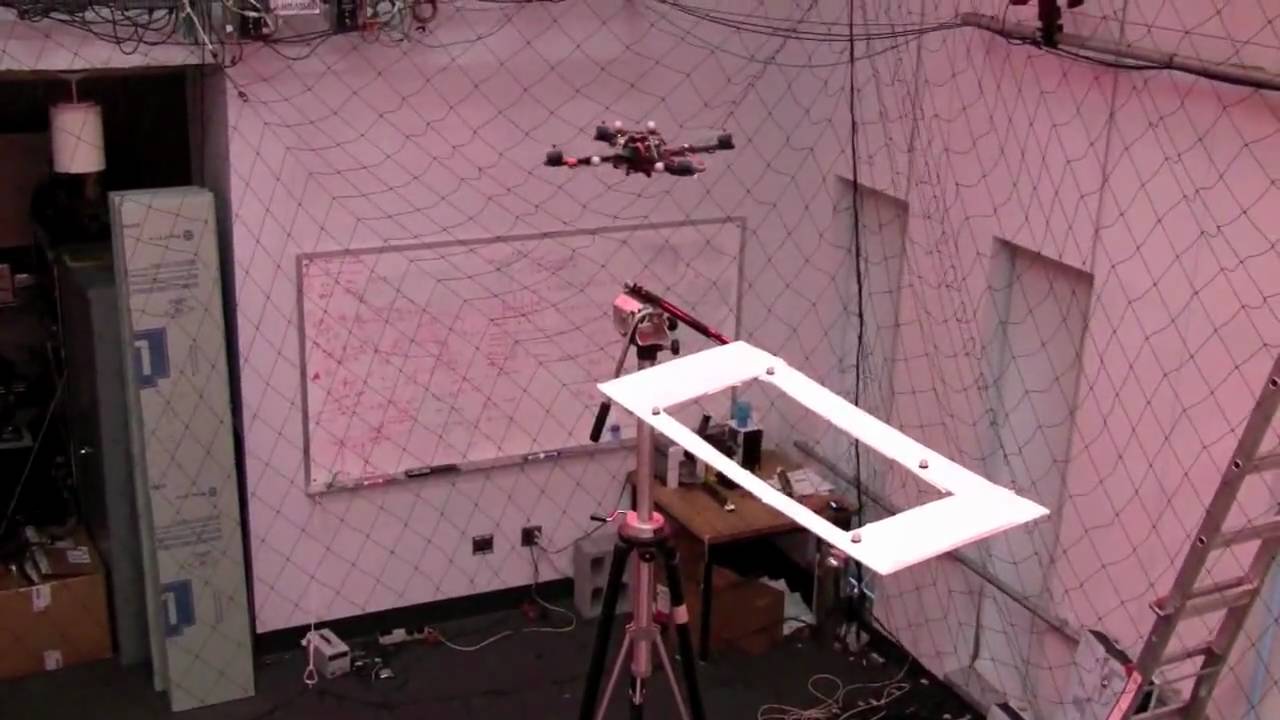
- A generalized trajectory planning framework enables the quadrotor to navigate narrow, angled apertures with less than 3 inches of clearance on all sides by dynamically adjusting its velocity and pitch. (0:13)
- The control methodology successfully facilitates autonomous perching on both steeply inclined walls and completely inverted ceiling surfaces using Velcro-assisted landing gear. (0:55)
Detailed notes
## Background Published on YouTube by channel TheDmel on May 21, 2010, this video documents robotics research conducted at the University of Pennsylvania's GRASP Lab. The description details the control of precise, aggressive maneuvers for a small autonomous unmanned aerial vehicle (UAV), featuring mid-air flips, navigation through narrow windows, and surface perching.
## TL;DR Researchers at the GRASP Lab demonstrate an autonomous quadrotor helicopter capable of executing highly aggressive flight trajectories using an onboard IMU and a 20-camera Vicon motion capture system for state estimation. The vehicle reliably carries out single, double, and triple mid-air flips before returning to stable hover. Utilizing a generalized trajectory generation method, the drone pitches at steep angles to dart through narrow tilted window openings with under three inches of clearance, weaves past other hovering vehicles, and navigates horizontal slots. Finally, equipped with Velcro landing pads, the quadrotor performs dynamic perching maneuvers to secure itself onto inclined walls and fully inverted overhead surfaces.
## Atmosphere & style The presentation carries the understated, clinical confidence characteristic of seminal early-2010s robotics lab demonstrations. A calm, direct voiceover systematically narrates each trial over the whirring hum of miniature high-rpm propellers and the sharp mechanical snaps of sudden trajectory changes. Watching the craft dart, slice through narrow slits, and stick upside-down creates a brisk, mesmerizing sense of futuristic precision where razor-thin margins of error are handled effortlessly.
## Bulletin - [00:00](https://www.youtube.com/watch?v=MvRTALJp8DM&t=0s) Researchers at the University of Pennsylvania's GRASP Lab have achieved high-precision autonomous quadrotor flight, demonstrating continuous single, double, and triple flips with immediate hover recovery. - [00:13](https://www.youtube.com/watch?v=MvRTALJp8DM&t=13s) A generalized trajectory planning framework enables the quadrotor to navigate narrow, angled apertures with less than 3 inches of clearance on all sides by dynamically adjusting its velocity and pitch. - [00:55](https://www.youtube.com/watch?v=MvRTALJp8DM&t=55s) The control methodology successfully facilitates autonomous perching on both steeply inclined walls and completely inverted ceiling surfaces using Velcro-assisted landing gear.
## Key takeaways - [00:00](https://www.youtube.com/watch?v=MvRTALJp8DM&t=0s) The GRASP Lab at the University of Pennsylvania developed advanced autonomous flight capabilities for a small quadrotor helicopter. - [00:00](https://www.youtube.com/watch?v=MvRTALJp8DM&t=0s) Precise state estimation is achieved by fusing high-frequency data from an onboard IMU with spatial tracking from an external 20-camera Vicon system. - [00:00](https://www.youtube.com/watch?v=MvRTALJp8DM&t=0s) The quadrotor executes aggressive, high-speed autonomous maneuvers, including single, double, and triple flips in mid-air. - [00:00](https://www.youtube.com/watch?v=MvRTALJp8DM&t=0s) The vehicle immediately recovers to a stable hover after completing rapid, multi-rotation aerobatic flips. - [00:13](https://www.youtube.com/watch?v=MvRTALJp8DM&t=13s) A generalized trajectory planning and control framework allows the vehicle to fly to any spatial position with arbitrary velocity and pitch angles. - [00:13](https://www.youtube.com/watch?v=MvRTALJp8DM&t=13s) The quadrotor dynamically aligns its attitude and velocity vectors to pass through highly constrained, angled window cutouts. - [00:13](https://www.youtube.com/watch?v=MvRTALJp8DM&t=13s) During window penetration maneuvers, the quadrotor operates with less than 3 inches of clearance on all sides of its rotor tips. - [00:13](https://www.youtube.com/watch?v=MvRTALJp8DM&t=13s) The system's high-precision trajectory tracking is demonstrated by navigating closely between other hovering quadrotors. - [00:13](https://www.youtube.com/watch?v=MvRTALJp8DM&t=13s) The vehicle successfully performs dynamic vertical ascents and descents through tight horizontal slots. - [00:55](https://www.youtube.com/watch?v=MvRTALJp8DM&t=55s) The control framework is applied to enable autonomous perching on non-horizontal structures. - [00:55](https://www.youtube.com/watch?v=MvRTALJp8DM&t=55s) The quadrotor uses Velcro strips on its landing gear to secure itself to target surfaces upon contact. - [00:55](https://www.youtube.com/watch?v=MvRTALJp8DM&t=55s) The drone demonstrates successful autonomous perching on a steeply inclined wall panel. - [00:55](https://www.youtube.com/watch?v=MvRTALJp8DM&t=55s) The platform executes an aggressive loft maneuver to successfully perch on a completely inverted overhead ceiling panel.
## Detailed walkthrough ### [00:00](https://www.youtube.com/watch?v=MvRTALJp8DM&t=0s) High-Speed Flips and Precise State Estimation
The demonstration opens by highlighting advanced autonomous flight capabilities developed for a small quadrotor helicopter at the University of Pennsylvania's GRASP Lab. To achieve the extreme precision necessary for dynamic aerobatics, the platform relies on an external motion capture infrastructure paired with vehicle sensors. As the narrator explains: “We use a 20 camera Vicon system and an onboard IMU for State estimation.” By fusing high-frequency orientation data from the internal inertial measurement unit (IMU) with high-accuracy spatial tracking from the 20-camera Vicon rig, the system calculates precise position and attitude estimates in real time.
With this robust state estimation in place, the quadrotor executes high-speed, aggressive rotational maneuvers without manual intervention. The video demonstrates the autonomous vehicle performing sharp, rapid single, double, and triple flips in mid-air, recovering stable hovering flight immediately after completing the full rotations.
- **State Estimation Setup:** An onboard IMU combined with an external tracking array of 20 Vicon cameras. - **Aerobatic Maneuvers:** Autonomous execution of single, double, and triple continuous flips.
```mermaid flowchart LR accTitle: Quadrotor State Estimation and Control Loop accDescr: Tracking setup feeding into flight control for aggressive flips and trajectory navigation. subgraph Sensing["Sensing & Estimation"] Vicon["20-Camera Vicon System"] IMU["Onboard IMU"] StateEst["Real-Time State Estimator"] end subgraph Control["Control & Execution"] Planner["Trajectory Generation Method"] Maneuvers["Aggressive Flight Maneuvers"] end Vicon --> StateEst IMU --> StateEst StateEst --> Planner Planner --> Maneuvers ```
[00:13](https://www.youtube.com/watch?v=MvRTALJp8DM&t=13s) Navigating Narrow Apertures and Multi-Vehicle Formations
Building beyond simple acrobatic rotations, the researchers created a generalized trajectory planning and control framework for aggressive, high-speed flight. The narrator describes the scope of this approach: “We developed a method for flying to any position in space with any reasonable velocity or pitch angle.” This capability allows the vehicle to align its attitude and velocity vectors dynamically to pass through constrained obstacles that would be impassable in level flight.
The vehicle employs this method to shoot cleanly through narrow rectangular window cutouts oriented at various steep angles. In these window-penetration demonstrations, margins of error are razor-thin: “Here there's less than 3 in of clearance on all sides of the quadrotor.” The vehicle pitches sharply to slice through the tilted opening without touching the edges. This high degree of trajectory tracking is further showcased as the vehicle navigates between other quadrotors hovering in close proximity, and dynamically ascends and descends through tight horizontal slots.
- **Spatial Control Range:** Capable of driving the craft to any spatial point with arbitrary viable velocity and pitch orientation. - **Window Penetration Clearance:** Less than 3 inches of clearance separating the rotor tips from the frame on all sides. - **Complex Geometries:** Penetration of angled vertical apertures, ascending/descending through narrow horizontal slots, and dynamic weaving between other static quadrotors.
[00:55](https://www.youtube.com/watch?v=MvRTALJp8DM&t=55s) Autonomous Perching on Inclined and Inverted Surfaces
The control methodology is subsequently applied to autonomous perching maneuvers on various non-horizontal structures. By outfitting the landing gear on the underside of the quadrotor with Velcro and mounting corresponding Velcro pads onto target surfaces, the drone can secure itself against surfaces at severe angles using purely kinetic positioning and pitch adjustments.
The video shows the quadrotor aggressively pitching upward toward a slanted wall panel to demonstrate “perching on an inclined surface.” Immediately following this, the platform tackles an even more demanding configuration: executing an aggressive loft maneuver to catch and secure itself to an overhead ceiling panel, culminating in a successful demonstration “on an inverted surface.”
- **Attachment Mechanism:** Velcro strips fixed to the bottom of the quadrotor landing gear and the target surface. - **Perching Configurations Demonstrated:** Dynamic adhesion to angled, inclined surfaces as well as completely upside-down, inverted overhead surfaces.
## Notable quotes > [00:13](https://www.youtube.com/watch?v=MvRTALJp8DM&t=13s) We developed a method for flying to any position in space with any reasonable velocity or pitch angle. — Narrator
## Mentioned University of Pennsylvania, GRASP Lab, Vicon, TheDmel
## Video description Control of precise aggressive maneuvers with an autonomous quadrotor helicopter. This is a small autonomous Unmanned Aerial Vehicle (UAV). Demonstrations of flips, flight through windows, and quadrotor perching are shown. Work done at the GRASP Lab, University of Pennsylvania.
[Source](https://www.youtube.com/watch?v=MvRTALJp8DM)