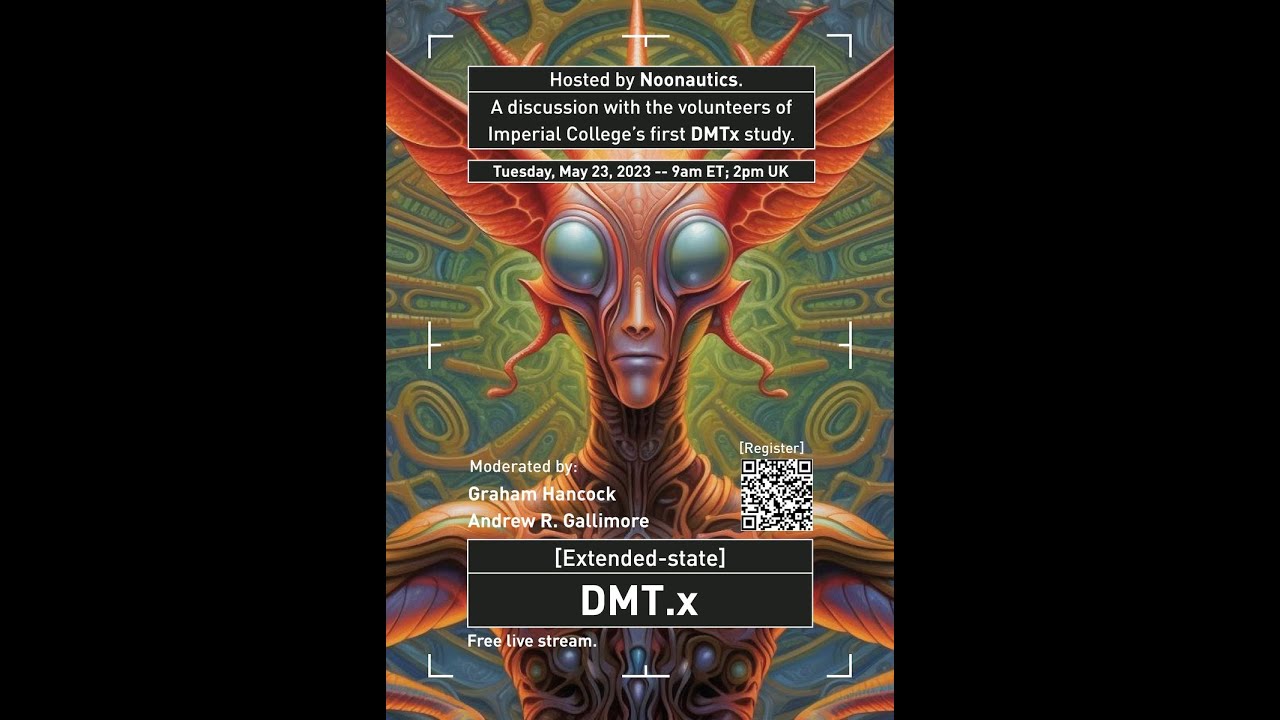
Imperial College London executed a groundbreaking extended-state DMT (DMTx) trial using continuous intravenous infusion models formalized by Dr. Andrew Gallimore and Dr. Rick Strassman, prolonging the breakthrough state for structured exploration. (6:40)
Participants developed somatic control and motor agency across repeated infusions, with some gaining the ability to stand, walk, and navigate the breakthrough space as an augmented reality overlay. (83:47)
University of Michigan research and Nicholas Glynos's doctoral work identified endogenous DMT concentrations in mammalian frontal and parietal cortices comparable to monoamines like dopamine and serotonin, prompting Dr. Strassman to propose DMT acts as a neurochemical 'reality thermostat.' (135:02)
Researchers and participants proposed empirical double-blind protocols—such as having independent, isolated subjects ask discarnate entities an identical unannounced question—to scientifically test the objective reality of the DMT realm. (131:37)
Detailed notes
## Background
Published on YouTube by Noonautics on May 23, 2023, this video presents an unprecedented panel discussion moderated by Graham Hancock, Dr. Andrew Gallimore, and Dr. Rick Strassman. According to the page description, the event gathers research subjects from Imperial College London's groundbreaking extended DMT (DMTx) trial to compare entity encounters, explore alternate realms, and frame their journeys alongside modern scientific frontiers like SETI.
## TL;DR
The panel convenes research participants Carl Hayden Smith, Jack Allocca, Alexander Beiner, and Anton Bilton alongside pioneering researchers to dissect the subjective realities of extended-state intravenous DMT infusions. The discussion explores the clinical pharmacokinetic architecture of continuous infusions, the recurring phenomenology of autonomous entities and hyperdimensional languages, and post-session ripples such as waking synchronicities and animist worldview shifts. Addressing ontological debates, the speakers weigh materialist reductionism against panpsychism and simulation frameworks, while contrasting individual coping strategies from strict agnosticism to sacred reverence. Ultimately, the panelists chart future horizons for DMT research, debating double-blind validation protocols, wearable automated micro-pumps, and the neurochemical role of endogenous DMT in regulating our baseline sense of reality.
## Atmosphere & style
The discussion carries the reverent, high-stakes excitement of an early space mission debrief, oscillating between rigorous neuropharmacological inquiry and boundary-pushing metaphysical wonder. Hancock, Gallimore, and Strassman anchor the discourse with steady academic authority, allowing the psychonaut volunteers to unpack intense, disorienting ontological encounters with candid humility. The mood blends analytical sobriety and cosmic awe, punctuated by grounded self-awareness, dark clinical humor, and earnest debates about the ethical responsibilities of mapping hyperspace.
## Bulletin
- [06:40](https://www.youtube.com/watch?v=Myq_Hc_39aI&t=400s) Imperial College London executed a groundbreaking extended-state DMT (DMTx) trial using continuous intravenous infusion models formalized by Dr. Andrew Gallimore and Dr. Rick Strassman, prolonging the breakthrough state for structured exploration.
- [01:23:47](https://www.youtube.com/watch?v=Myq_Hc_39aI&t=5027s) Participants developed somatic control and motor agency across repeated infusions, with some gaining the ability to stand, walk, and navigate the breakthrough space as an augmented reality overlay.
- [02:15:02](https://www.youtube.com/watch?v=Myq_Hc_39aI&t=8102s) University of Michigan research and Nicholas Glynos's doctoral work identified endogenous DMT concentrations in mammalian frontal and parietal cortices comparable to monoamines like dopamine and serotonin, prompting Dr. Strassman to propose DMT acts as a neurochemical 'reality thermostat.'
- [02:11:37](https://www.youtube.com/watch?v=Myq_Hc_39aI&t=7897s) Researchers and participants proposed empirical double-blind protocols—such as having independent, isolated subjects ask discarnate entities an identical unannounced question—to scientifically test the objective reality of the DMT realm.
## Key takeaways
- [01:14](https://www.youtube.com/watch?v=Myq_Hc_39aI&t=74s) Dr. Rick Strassman confirmed a lack of subjective and physiological tolerance to DMT in human subjects, laying the groundwork for continuous intravenous infusion protocols.
- [23:00](https://www.youtube.com/watch?v=Myq_Hc_39aI&t=1380s) The DMTx methodology allows researchers to titrate intensity, move beyond initial ontological shock, and facilitate structured narrative experiences and memory consolidation.
- [09:22](https://www.youtube.com/watch?v=Myq_Hc_39aI&t=562s) Trial participants employed rigorous psychological and physical preparations, including ascetic diets, meditation, and sexual abstinence, to stabilize their mental frameworks prior to dosing.
- [44:00](https://www.youtube.com/watch?v=Myq_Hc_39aI&t=2640s) Periodic verbal rating prompts from clinicians functioned as anchors to consensus time, making true unanchored time dilation difficult to isolate.
- [48:00](https://www.youtube.com/watch?v=Myq_Hc_39aI&t=2880s) Participants reported an elevated frequency of highly improbable waking synchronicities and precognitive insights during intervals between infusion sessions.
- [55:41](https://www.youtube.com/watch?v=Myq_Hc_39aI&t=3341s) Graham Hancock posited three competing ontological hypotheses for entity encounters: freestanding alternate dimensions, transgenerational genetic archives encoded on DNA, or complex neural hallucinations.
- [01:09:50](https://www.youtube.com/watch?v=Myq_Hc_39aI&t=4190s) Imperial College enforced strict non-disclosure between participants during trials to prevent psychological contagion, cultural priming, and preconceived expectations about entity forms.
- [01:17:31](https://www.youtube.com/watch?v=Myq_Hc_39aI&t=4651s) Entity encounters showed dose-dependent characteristics, ranging from discrete humanoid or elf-like figures at lower tiers to non-dual unitive spaces or indifferent robotic matrices at peak saturation.
- [01:31:14](https://www.youtube.com/watch?v=Myq_Hc_39aI&t=5474s) Challenging psychedelic experiences were framed by panelists not as 'bad trips' to be avoided, but as difficult psychological lessons and confrontations with hard truths.
- [01:33:15](https://www.youtube.com/watch?v=Myq_Hc_39aI&t=5595s) Extended DMT demonstrated an overview effect similar to space travel, dissolving trivial personal anxieties against a vast transpersonal canvas.
- [01:40:27](https://www.youtube.com/watch?v=Myq_Hc_39aI&t=6027s) Panelists warned against using DMTx as an escapist 'biochemical Netflix,' insisting that psychological insights must translate into actionable, utilitarian change in physical waking life.
- [02:13:13](https://www.youtube.com/watch?v=Myq_Hc_39aI&t=7993s) Future DMTx administration models may shift from sudden bolus injections to gradual ramped infusions to reduce acute breakthrough anxiety.
- [02:18:08](https://www.youtube.com/watch?v=Myq_Hc_39aI&t=8288s) Dr. Rick Strassman invoked the concept of the 'active intellect' to suggest DMT acts as an imaginative key unlocking access to a universal repository of collective knowledge.
- [02:18:08](https://www.youtube.com/watch?v=Myq_Hc_39aI&t=8288s) Panelists emphasized the necessity of ethical vigilance and reverent intentionality to safeguard advanced consciousness-altering technologies from political abuse and commercial exploitation.
## Detailed walkthrough
### [00:00](https://www.youtube.com/watch?v=Myq_Hc_39aI&t=0s) Introduction to the Panel and Mission of Noonautics
The event opens with an introduction from the co-founders of Noonautics, who explain that their organization is a non-profit dedicated to exploring breakthrough technologies and advancing psychedelic research. Their current operational focus centers on Daniel McQueen's DMTx project in Colorado, for which Noonautics serves as the fiscal sponsor. They note that they have recently begun accepting donations to fund the construction of a legal, state-of-the-art research institute utilizing extended-infusion DMT technology.
Today's session highlights participants from Imperial College London's groundbreaking extended-state DMT clinical study, explicitly directing the discussion toward the phenomenon of DMT entity encounters. Serving as moderators for the conversation are two prominent figures in the space: author and researcher Graham Hancock, and Dr. Andrew Gallimore, who co-developed the foundational pharmacokinetic model for extended-state DMT alongside Dr. Rick Strassman. Viewers watching the live broadcast are encouraged to submit questions through the chat for an upcoming Q&A segment at the end of the panel, before handing over hosting duties to Dr. Gallimore.
- Focus project: Daniel McQueen's DMTx project in Colorado
- Primary research featured: Imperial College London's extended-state DMT trial
- Core topic: Phenomenology and encounters with DMT entities
[01:14](https://www.youtube.com/watch?v=Myq_Hc_39aI&t=74s) Dr. Rick Strassman on Tolerance and the Origins of DMTx
Taking the floor, Dr. Andrew Gallimore sets out the roadmap for the event, choosing to begin introductions with the man whose historical work laid the foundation for the entire field nearly thirty years prior: Dr. Rick Strassman, who conducted the first large-scale human DMT research in the modern era. Strassman details the original psychopharmacological puzzle that sparked the extended-state concept—namely, whether humans could develop tolerance to DMT. Animal models suggested they could not; a historical cat study showed that giving DMT every two hours for 21 days resulted in cats responding normally without tolerance even after three continuous weeks. Similarly, a National Institute of Mental Health (NIMH) human trial administering intramuscular DMT twice daily across five days observed zero tolerance.
```mermaid
flowchart TD
accTitle: Development of Extended DMT Infusion Concept
accDescr: Historical tolerance findings leading up to the Strassman and Gallimore pharmacokinetic model.
subgraph ToleranceStudies["Tolerance Research"]
A["Cat Studies: 21 Days q2h"] --> C["No Tolerance Observed"]
B["NIMH Human Trial: 2x/Day for 5 Days"] --> C
D["Strassman Dose Challenge: 4 Full Doses q30m"] --> C
end
subgraph TheoreticalModel["Continuous Infusion Concept"]
C --> E["Strassman: 'DMT: The Spirit Molecule' Proposal"]
E --> F["Gallimore: Target-Controlled Infusion (TCI) Modeling"]
F --> G["2016 Gallimore & Strassman Paper (Frontiers)"]
end
```
To probe whether very closely spaced dosing could trigger tolerance, Strassman designed a challenge in his own clinical research by administering a full dose every half-hour, four times in a single morning. Psychological effects remained completely intact across all administrations, confirming that tolerance did not develop. In the concluding sections of his book, *DMT: The Spirit Molecule*, Strassman speculated that a continuous intravenous infusion could serve as a valuable platform to study the state with far greater precision and potentially offer clinical utility by enabling researchers to titrate the depth of intoxication up or down according to therapeutic needs. Years later, Gallimore reached out to Strassman to formalize this concept; Gallimore engineered the target-controlled infusion protocol while Strassman contributed the clinical applications, resulting in their landmark 2016 paper in *Frontiers in Pharmacology*.
> “In the DMT book, *The Spirit Molecule*, toward the end of the book, I suggest maybe a continuous infusion would be a means by which the state could be studied more carefully and also might have some therapeutic relevance because you could turn up and turn down the state of intoxication depending on the need of the patient or the client at that time.” — *Dr. Rick Strassman*
[04:29](https://www.youtube.com/watch?v=Myq_Hc_39aI&t=269s) Technical Hiccups and Graham Hancock on Entity Encounters
Gallimore attempts to acknowledge Dr. David Luke as one of the world's leading experts on DMT, but technical difficulties and audio dropouts interrupt his stream. After checking the connection and switching to a secondary network line, Gallimore introduces his co-moderator, author and researcher Graham Hancock. Hancock reflects on his deep-seated intrigue regarding entity contacts within the DMT landscape. He shares a personal anecdote, explaining that his fascination originated during an Ayahuasca ceremony when a distinct entity appeared to him and directly communicated the entire storyline for a full-length novel. Hancock notes his immense curiosity to hear the firsthand reports of the volunteers who spent prolonged periods inside the DMT state.
> “Ever since an entity appeared to me during a series of Ayahuasca sessions and gave me the plot for an entire novel, since then I've found it fascinating, and I'm really intrigued to hear what the volunteers have got to report.” — *Graham Hancock*
[06:40](https://www.youtube.com/watch?v=Myq_Hc_39aI&t=400s) Acknowledging Imperial College and Introducing Carl Hayden Smith
Gallimore addresses the translation of the theoretical 2016 model into living clinical science. He makes clear that while his and Strassman's original target-controlled intravenous infusion model provided the theoretical proof-of-principle framework, it was not directly human-ready. Gallimore offers full credit to the Imperial College London team—specifically praising lead researcher Dr. Christopher Timmermann and PhD student Lisa Luan, who spearheaded the trial—for refining the protocol and executing the actual extended-state DMT studies. He emphasizes that while he and Rick lit the initial spark, the true courage belongs to the clinical team and the eleven brave volunteers who stepped into the trial.
Gallimore then introduces the first panelist, cognitive scientist Carl Hayden Smith, referred to as "Subject Zero"—the very first human subject to receive an extended continuous DMTx infusion. Carl explains his background spanning 25 years of research in cognitive science, perceptual science, and neuroscience, investigating how technology intersects with human learning and perception. He views substances like DMT not simply as drugs, but as advanced technological tools for expanding perceptual faculties, mentioning his prior research across the dissociative spectrum with ketamine analogues as well as classical entheogens.
[09:22](https://www.youtube.com/watch?v=Myq_Hc_39aI&t=562s) Alexander Beiner on Bringing Back Information
Gallimore turns to Alexander Beiner, author, cultural commentator, and a director of the Breaking Convention psychedelic conference. Beiner outlines his enduring interest in psychedelics: interrogating the original 1960s countercultural promise to see whether altered states can yield actionable intelligence to change the terrestrial world, albeit through a more nuanced, modern lens.
Beiner describes his primary motivation for enrolling in the trial as an epistemological quest: exploring whether an individual can navigate alternate realities and return with valuable, translatable information—whether regarding novel social systems, creative concepts, or deeply personal psychological breakthroughs. He views entity contact within the sustained DMT environment as one of the primary conduits through which such information transfer might occur, noting that his experiences inside the Imperial trial delivered on that premise across several fronts.
> “So yes, I suppose my interest has always been in terms of psychedelics: how we can gain information from those experiences and apply them directly to changing the world we live in.” — *Alexander Beiner*
[10:55](https://www.youtube.com/watch?v=Myq_Hc_39aI&t=655s) Jack Allocca on Pharmacology and Navigating the DMT State
Gallimore introduces the next panelist, Jack Allocca, a pharmacologist and engineer with extensive experience in the psychedelic arena dating back to 2008. Allocca recounts his early laboratory career administering various psychedelics to animals to measure alterations in sleep architecture, followed by a PhD in neuroscience from the University of Melbourne. His multidisciplinary work sits at the intersection of consciousness science, sleep research, cross-species wild animal psychedelic pharmacology, and artificial intelligence engineering. He runs a technology company focused on data analytics for consciousness research, which actively collaborated with the Imperial College team to process data for the DMTx trial.
In addition to his empirical and academic credentials, Allocca emphasizes his extensive personal exploration, having systematically split-tested dozens—if not nearly a hundred—different psychoactive molecules and altered-state techniques over the years. For him, stepping up as an extended DMT subject was a logical progression unifying his academic, technical, and experiential investigations. He highlights that standard DMT is notoriously brief and overwhelming in its visual phenomenology, making sustained immersion a unique opportunity to tap in and examine the space methodically without being immediately ejected.
[12:43](https://www.youtube.com/watch?v=Myq_Hc_39aI&t=763s) Introductions Conclude: Extended States and The Turing Initiative
Jack Allocca wraps up his opening remarks by detailing his extensive experimental background with various formulations and salts of DMT, noting that the trial was not his first encounter with DMT fumarate. What makes DMTx fundamentally unique, he explains, is how the extended state allows the human mind to adjust to an experience that is normally so rapturous and brief:
> “So yeah with DMTx it's very special to see how an extended state can um can equip the mind to become used to something as radical as DMT which usually is so rapturing and just for 5 10 15 minutes you're completely taken away...”
Dr. Andrew Gallimore then introduces Anton Bilton, co-founder of the Turing Initiative. Bilton explains that the initiative was founded in 2015 to investigate entheogenic entity encounters. Catalyzed by the novel extended-infusion theoretical models proposed by Rick Strassman and Andrew Gallimore, the initiative collaborated with and funded Robin Carhart-Harris, Christopher Timmermann, and Lisa Luan at Imperial College London. Bilton emphasizes that his core motivation centers on establishing communion with the "sentient other" and obtaining guidance from these beings.
```mermaid
flowchart TD
accTitle: Research Collaboration Architecture
accDescr: Diagram illustrating the conceptual origin, funding body, and clinical execution of the DMTx study.
subgraph Ideation ["Theoretical Foundation"]
T1["Rick Strassman & Andrew Gallimore<br>(Extended infusion concept)"]
end
subgraph Funding ["Sponsorship & Governance"]
T2["Anton Bilton<br>The Turing Initiative (est. 2015)"]
end
subgraph Clinical ["Clinical Trial Team (Imperial College London)"]
T3["Robin Carhart-Harris<br>Christopher Timmermann<br>Lisa Luan"]
end
T1 --> T2
T2 --> T3
```
- **Anton Bilton's initiative:** The Turing Initiative was established in 2015 explicitly to study entheogenic entity contacts and backed the Imperial College extended infusion studies.
- **Imperial College researchers named:** Robin Carhart-Harris, Christopher Timmermann, and Lisa Luan.
---
[14:13](https://www.youtube.com/watch?v=Myq_Hc_39aI&t=853s) Ground Rules and the Structure of the Inquiry
Andrew Gallimore outlines the roadmap for the panel discussion. To avoid prematurely exhausting specific encounters, the session is split into two halves:
1. **Part One (Moderated by Dr. Andrew Gallimore):** A chronological, technical exploration of the DMTx procedure and subjective trajectory from preparation to the end of the infusion, specifically asking panelists to hold back detailed entity discussions.
2. **Part Two (Moderated by Graham Hancock):** A targeted investigation into the sentient entity encounters, communications, and ontology.
Gallimore opens the floor by questioning what preparation, coping techniques, or navigational strategies the volunteers implemented before and during their extended infusions, recognizing that despite being experienced DMT users, stepping into continuous intravenous infusion represented uncharted territory.
---
[16:21](https://www.youtube.com/watch?v=Myq_Hc_39aI&t=981s) Navigational Strategies: Dieta, Mentorship, and Mindful Discernment
Alexander Beiner highlights that preparing was not merely about survival or coping, but about learning how to thrive and navigate inside the prolonged state. As soon as he was accepted into the trial, he eliminated alcohol and engaged in weekly coaching sessions with Trish Blain, a practitioner specializing in navigating non-ordinary states of consciousness. Beiner anchored himself in Terence McKenna's classic entity maxim:
> “...one of the mantras I had was um Terence McKenna's line of an entity in Candry had where the the entity said don't give way to amazement right this especially in the first few minutes of the experience it's very overwhelming...”
Beiner combined breathwork and intentional curiosity with mindfulness and concentration meditation. This balance was critical: the opening minutes of the continuous infusion hit with the identical violent intensity of vaporized freebase DMT before eventually leveling off, at which point the navigator needed focused concentration and discernment rather than passive shock.
Carl Hayden Smith describes an attitude of surrender as the essential transactional cost for entering the space:
> “And by allowing them to explore me, I get to know them as such.”
Smith undertook an ascetic regimen he termed treating the process like "DMT church for three months," cutting out all recreational substances, caffeine, and alcohol, alongside practicing semen retention for an entire month, which he reported radically heightened the trip's intensity. He also credited his past experimentation with novel dissociatives for giving him the mental fortitude required to endure the experience.
---
[19:18](https://www.youtube.com/watch?v=Myq_Hc_39aI&t=1158s) Physiological Load, Scientific Literacy, and Sacred Reverence
Jack Allocca notes that he inadvertently acted as a natural control subject. Half of the time he entered the Imperial clinical suite jet-lagged, sleep-deprived, and without ceremonial preparation. However, his long-term somatic baseline was exceptionally clean: he had consumed zero caffeine for over three years and maintained complete abstinence from daily sedatives or stimulants.
When the intense physical load and sensory distortions took hold—such as burning, tingling sensations, and the jarring physical presence of the intravenous cannulas—Allocca fell back on paced breathing exercises and his background in pharmacology and biochemistry:
> “And uh I think also my knowledge of pharmacology and biochemistry on a top-down level helped me reassure myself that this was not a toxic thing I was doing to myself.”
Anton Bilton rounds out the preparations by aligning his DMTx protocol directly with traditional Ayahuasca dietas. For four to six weeks prior to dosing, Bilton maintained strict abstinence from sex, drugs, and alcohol, immersing himself in intensive meditation to approach the trial as an authentic mystical sacrament. He observed that bringing conscious reverence to the experience produced noticeably clearer vision and stability once the disorienting dissociation of the initial minute subsided.
- **Jack Allocca’s baseline:** Three-plus years completely caffeine-free and unreliant on routine sedatives, preventing withdrawal states from coloring the DMT realm.
- **Anton Bilton’s dieta timeline:** Four to six weeks of strict celibacy, sobriety, and daily meditation prior to sessions.
---
[23:10](https://www.youtube.com/watch?v=Myq_Hc_39aI&t=1390s) The Trajectory: From Smoked Bolus to Extended Immersion
Andrew Gallimore turns to the mechanics of the experiential curve itself. In traditional administration, an inhaled bolus peaks violently and dissolves in minutes. Gallimore asks Subject Zero, Carl Hayden Smith, to articulate whether the extended infusion hits a steady-state equilibrium, continues to evolve, or behaves like an endless roller coaster.
Smith explains that far from being static, the DMTx state presented an unprecedented degree of dynamic movement:
> “I think you know I don't I don't I don't if anything there was more movement than usual and that was kind of like you had to stabilize yourself inside that movement and it was like a like a kaleidoscope of interfaces uh that I was sort of being processed through um sort of scanned through those those layers uh where where I was kind of experiencing glimpses of alternate alternate lives...”
Smith observed that the extended duration pushed the experience past ordinary DMT terrain. On his highest dose session, the space transformed into something characteristic of a high-dose 5-MeO-DMT breakthrough: visual entity architecture yielded to an all-consuming disc resembling a black hole positioned at the foot of his bed, functioning as a non-dual space of absolute unity.
[25:25](https://www.youtube.com/watch?v=Myq_Hc_39aI&t=1525s) Carl Hayden Smith on Dimensional Bridging and the Plurality of Unities
Continuing his description of the extended infusion, Carl Hayden Smith notes that parts of the space initially resembled what he normally encounters in a 5-MeO-DMT experience. He characterizes that state phenomenologically as experiencing oneself as pure light in a non-dual realm stripped of any subject-object division. Within this landscape, he observed a disc situated at the foot of the bed and found himself trying to comprehend how to step into it. Suddenly, an abrupt shift took over the entire space:
> “It felt like it felt like there was an alien invasion inside the DMT experience where the the this this disc cracked apart and suddenly I'm like oh my god what's going to happen now?”
Fearing a turn toward the negative, Carl was instead confronted by what he terms a “plurality of unities” that opened up directly behind the fractured disc. Unlike a traditional smoked bolus of DMT that peaks and quickly halts, the prolonged intravenous infusion kept pushing deeper and deeper into the terrain. Carl confirms that it felt as though he was being granted access to hidden, esoteric insights unavailable in a brief encounter:
> “It felt as if I was being shown much more of the knowledge of of the secret knowledge that that you would not normally experience in a in a standard DMT experience.”
The extended duration effectively allowed him to bridge dimensions within a single continuous session, prompting moderator Dr. Andrew Gallimore to speculate on where an explorer might travel if infusions were lengthened to two, three, four, or five hours.
[27:03](https://www.youtube.com/watch?v=Myq_Hc_39aI&t=1623s) Alexander Beiner on the "Teaching Presence" and the Geometric Cavern
Alexander Beiner shares his primary surprise: rather than being a chaotic burst of visuals, the DMTx journey possessed a strong, cohesive narrative that offered personal interpersonal lessons alongside metaphysical confrontations. To him, the unfolding felt strikingly similar to ayahuasca, which led him to reflect on Amazonian traditions that identify *Banisteriopsis caapi* as the master teacher vine while treating DMT merely as an admixture:
> “Having, you know, having done ayahuasca maybe 50, 60 times and also having sat with just *Banisteriopsis caapi*, my experience was very much that what I interpret as the teaching and the lessons and the the deep sort of insights from ayahuasca was very much what I experienced on DMTx, which was a huge surprise to me.”
The trip unfolded in distinct structural phases:
```mermaid
flowchart TD
accTitle: Alexander Beiner DMTx Journey Phases
accDescr: The sequence of states Alexander Beiner experienced during extended DMT infusion.
A["Initial Rush (2–3 min)<br/>Intense onset similar to vaporized DMT"] --> B["Geometric Cavern / Holding Room<br/>Recurring space superimposed with a playground"]
B --> C["Breakthrough into Portals & Entities<br/>Wild realms, interpersonal inquiry, and life review"]
C --> D["Final State / Overview Effect<br/>High-dose mystical overview beyond personal biography"]
```
The first two to three minutes delivered a standard vaporized rush, after which Alexander consistently found himself in a familiar holding zone—a geometric cavern. Peculiarly, an ordinary playground he had walked past with his cousin months earlier was faintly superimposed onto the walls. While the scene carried no emotional resonance, it sat there like an uninhabited nursery, mirroring the nursery motifs documented in Dr. Rick Strassman's earlier DMT clinical trials.
Once he broke through this holding room, Alexander entered an entity-filled expanse split into various portals. His initial session bypassed exotic alien curiosities to concentrate intensely on an unresolved personal relationship, carrying the implicit message that he needed to resolve his own psychological baggage before exploring external wonders. His final session traded personal biography for a transcendent overview effect. Alexander attributes this dialogue with a distinct “teaching presence” to the extended timeframe, which finally granted sufficient breathing room to land, digest, and make sense of the encounters.
[30:17](https://www.youtube.com/watch?v=Myq_Hc_39aI&t=1817s) Jack Allocca on the "Bad Trip Machine" and Clinical Abduction
Dr. Andrew Gallimore asks Jack Allocca whether he also experienced this broad multiplicity of realms under the prolonged infusion. Jack emphasizes that one cannot evaluate the phenomenology without taking full account of the rigorous clinical trial setting:
> “Like how I like to describe the DMT setup, that in many ways it's almost like alien abduction 101. It's almost like a bad trip machine. You are literally being probed, and it's not figurative. It's literal. You are being probed. There's blood being taken out of you every few minutes. You're in a bed surrounded by strangers in a clinic.”
For Jack, each run through the protocol yielded vastly different states. While he also identified an ayahuasca-like narrative arc, he drew strong comparisons to pharmahuasca—noting that ingested DMT combined with monoamine oxidase inhibitors (MAOIs) like phenelzine, moclobemide, or Syrian rue can produce extended plateau states lasting as long as DMTx without the bodily debilitation or the invasive machinery of intravenous delivery.
Surprisingly, Jack found that his very first run at the lowest dose produced the clearest, most distinct entities, whereas the higher doses proved far more chaotic. He suspects that vaporizing crystal DMT still drives a sharper, higher spike in blood concentration at the receptor level than the sustained DMTx infusion rates achieved in the trial. Despite the chaos, the protocol provided crucial time to move beyond the initial ontological shock and conduct an extensive life review, allowing him to tackle personal history, deep traumas, and future opportunities through an uninterrupted internal narrative.
[34:27](https://www.youtube.com/watch?v=Myq_Hc_39aI&t=2067s) Anton Bilton on Instant Somatic Ignition and Realm Shifting
When asked about his experience with assimilation and exploration, Anton Bilton returns to the uncanny environment of the hospital ward, lying in a bed fitted with cannulas, surrounded by a life-support team, waiting in suspense for an unannounced infusion time. When the drug was released into the line, the onset proved totally instantaneous:
> “The thing that shocked me was when it hit me from the ends of my toes to the top of my head instantly there was an energetic force. And this wasn't like having an injection in your arm where you get a warmth across your chest or a taste of metal in your mouth. It was instant everywhere. As if my energetic field had somehow been turned on like a bulb.”
Anton experienced total initial disorientation, temporarily losing his identity, sense of physical location, and grasp of time:
- He had to reconstruct his reality step-by-step: remembering riding in a taxi, confirming he was a human on Earth, asking where the taxi was heading, remembering Imperial College, and finally realizing, *"Oh, shit, I'm the guy in the experiment right now."*
- As soon as he grounded himself, the intensity clocked in at an eight out of ten, accompanied by immediate entity contact.
- Assimilation was comfortable enough that he felt he could have spent another two hours inside the realm as an explorer.
- Roughly halfway through the session, an abrupt swerve bumped his perceived intensity from an eight to a nine out of ten as the scenery abruptly switched, plunging him into an entirely new location with a different assembly of entities.
[036:44] Navigation, Posture, and the "Wounded Pigeon" Analogy
Anton Bilton reflects on the feeling of wanting to stay in the state longer just as he reached a fruitful point of exploration. When asked whether he was able to intentionally navigate and steer his journey or was merely thrown around, he explains that he was largely not tossed about. Instead, he regularly found himself positioned on what felt like the floor, looking up while entities gazed downward at him.
To describe the dynamic, Anton shares an analogy drawn from everyday London life: he felt like a wounded pigeon on a city street, where small children rush over shouting excitement while the adults hold them back, cautioning them to leave it alone because they are unsure whether it is dead or merely incapacitated. In the DMT realm, the entities seemed to wonder whether he was dead or simply visiting on DMT. While most of the time the world simply carries on around a stationary subject, Anton notes that intentional locomotion is possible, though entirely unlike ordinary walking: one simply implies a forward movement, and the body follows.
“You sort of imply a movement forward and you move forward.” — Anton Bilton
[038:10] Tolerance, Intensity, and the Meaning of the Human Jackpot
The discussion turns to pharmacological tolerance over the course of the extended infusion. Carl Hayden Smith observes that within a 30-minute infusion window, physiological tolerance does not appear to set in, pointing out that research by Lisa Luan and the Imperial College team demonstrated that heart rate stabilizes over time. For Carl, the experience breaks into distinct phases, with the tail end feeling slightly less intense.
Asked whether a 30-minute trip stretches into an eternity—or whether the altered state warps temporal perception altogether—Carl explains that time cannot be registered in ordinary terms. Instead of linear progression, the experience unfolds through distinct metaphysical spaces: an alien world space, an observational window looking into that space, and a reflective mirror space that displays one's personal life. Carl emphasizes that the space is deeply moral and distinctly non-recreational. The central revelation conveyed to him was that being born human is an exceptionally rare, cosmic gift—a jackpot that must not be wasted on mundane material hoarding.
```mermaid
flowchart TD
accTitle: Tripartite DMT Space Architecture
accDescr: Flow diagram showing the three spatial states described by Carl Hayden Smith during extended DMT infusion.
subgraph Spaces["Experiential Architecture"]
A["World Space<br>(Alien ontology & consciousness)"]
B["Window Space<br>(Observational portal)"]
C["Mirror Space<br>(Reflective life review)"]
end
subgraph Insight["Cosmic Realization"]
D["Human = Jackpot<br>Void = Norm"]
E["Construct the Solar Body<br>for passage through death"]
end
A --> B
B --> C
C --> D
D --> E
```
- Carl received the clear message: “Live well. You've won the jackpot being human.”
- Human embodiment is revered throughout the cosmos, but it is brief and transient—a dream state passing through the void.
- The entities urged him to build a "solar body" to pass through death intact, emphasizing that existence on that side operates under wholly alien forms of thinking, feeling, and being.
[042:06] Memory Recall, Narratives, and Real-Time Rating Disruption
Addressing the notorious difficulty of retaining DMT experiences—often likened by Terence McKenna to liquid gold slipping through one's fingers—Alexander Beiner explains why the extended protocol substantially aids recall. The prolonged duration allows an actual narrative arc to develop, linking disparate events into an intelligible chain. Additionally, the protocol required participants to recount their journeys immediately upon return, a technique mirrored by Christopher Bache in *LSD and the Mind of the Universe*, who solidified the memory of his 70 high-dose sessions by sitting in the same posture with the same music the following day.
Alexander was also in the process of drafting his book, which fostered a detached, observational awareness during his sessions. The research methodology itself forced participants into this state of self-distancing by repeatedly asking for real-time ratings of anxiety and entity presence. Alexander recalls one comedic moment where he rated his experience a four, only to have an entity react incredulously inside the vision, challenging whether it was truly just a four.
“So what that does is it forces you to decenter—so to take a step back from the content of your experience and watch it sort of objectively...” — Alexander Beiner
[045:03] The Double-Edged Nature of Recall and Infusion Mechanics
Jack Allocca presents an alternative viewpoint, arguing that extended DMT infusions both help and hinder recall. While a short, smoked dose offers a concise and punchy snapshot that can be easily parsed afterward, a 60-minute journey can saturate the mind with an overwhelming stack of imagery, leaving the subject exhausted. Much like dream recall, individual slides blur together, causing large segments of the hour to fuse and morph into confusion.
Jack also breaks down the pharmacokinetic realities of the DMTx protocol: subjects receive an initial intravenous bolus followed by a sustained infusion. This delivery method can distort a participant's subjective assessment of intensity. During his early trials, Jack experienced an intense initial surge that rapidly tapered off, leaving him uncertain whether his nervous system was adapting or if the initial bolus delivered far more compound than the maintenance line. At higher doses, however, the experience plateaued evenly without any tapering. Jack also warns that the periodic verbal prompts from researchers act as anchors to consensus time; until trials are run without any external sensory interruptions, determining whether extended DMT induces genuine, unanchored time distortion remains speculative.
“Until we have a true infusion with no external stimulus, we may not be able to tell really whether time distortion is really occurring or not.” — Jack Allocca
[48:00](https://www.youtube.com/watch?v=Myq_Hc_39aI&t=2880s) Technological Horizons and Lingering After-Effects
Reflecting on the challenges of reporting and mapping experiences in the DMT space, the conversation touches on the eventual possibility of real-time communication systems, potentially driven by advancements in artificial intelligence or direct neural readouts. However, that capability remains a distant prospect. Shifting to conclude the session before passing moderation duties, Dr. Andrew Gallimore poses a final inquiry to the participants: whether they experienced any unusual or unexpected after-effects following their DMTx extended-infusion sessions.
Alexander Beiner speaks first, keeping his response succinct to allow others time. He emphasizes that the intervals between his first and second dosing sessions produced profound, intense synchronicity experiences that were in some ways stranger and more potent than the dosings themselves, with the possible exception of the final one. While acknowledging that heightened pattern recognition could account for some impressions, he describes incidents that defied easy rationalization:
> “So that was actually much harder to make sense of and to sort of stay agnostic about and and practice a kind of internal science around than a lot of the actual experiences.”
Beiner notes that one particularly unsettling event involved believing he recognized an acquaintance on the street who turned out to be someone else, only to learn that the person he had thought of had committed suicide two days earlier. He suggests that extended DMT states may uniquely amplify synchronicities, presenting an intriguing avenue for future research.
[50:18](https://www.youtube.com/watch?v=Myq_Hc_39aI&t=3018s) Precognition, Telepathy, and Sensory Alterations
Carl Hayden Smith frames his post-session changes less as residual side effects and more as newly unlocked faculties or abilities. Chief among these was an uncanny sense of precognition experienced during the infusion itself. He explains that he saw his own future mental state six months in advance, following intentional boundary-pushing experiments with other substances that he had not yet undertaken at the time of the DMT session. The experience gained an additional layer of confirmation when fellow explorer Jack Allocca approached him after a subsequent infusion to warn him that his experimental path might lead him astray.
Beyond precognition, Smith outlines a suite of perceptual shifts:
- **Telepathic communication:** Developing a functional literacy in telepathic exchange, which he identified as the primary mode of communication used by the entities inside the extended DMT realm.
- **Multiplicity and overview effects:** An experiential realization that everyday reality represents only one timeline among multiple parallel streams normally barred by limited human sensory bandwidth.
- **360-degree vision:** Experiencing an omnidirectional field of view during an encounter involving a cracked 5-MeO-DMT-like revelation of multiple unities, where he had to physically reach behind himself to receive a key offered via undulating tentacles.
- **Double consciousness:** Maintaining a split awareness while delivering vocal intensity ratings to researchers Christopher Timmermann and Lisa Luan, hearing his external physical voice operate distinctly from his internal immersion within the DMT space.
Gallimore observes that these accounts resemble an evolutionary process of consciousness or a formal training period: “It's almost like a training period for your consciousness which is kind of fascinating.”
[53:17](https://www.youtube.com/watch?v=Myq_Hc_39aI&t=3197s) Pre-Journey Resonance and Geometric Hieroglyphs
Anton Bilton builds on the theme of synchronicity, likening the extended DMT trials to the anticipatory phenomena often seen with ayahuasca retreats, where anomalous synchronicities begin the moment a participant makes the firm mental commitment to attend. He observes:
> “And then of course through so it's almost as if the molecule knows you're coming and source working with you, guiding you, bringing you along.”
During his DMTx session, entities presented him with small devices resembling handheld tablets or iPads, excitedly displaying unfamiliar geometric patterns and hieroglyphic designs. Although the beings appeared confident that he ought to recognize the symbols, Bilton could not decipher them at the time. Over the following weeks, however, those precise patterns recurred repeatedly in his everyday surroundings, both in nature and in artwork.
```mermaid
flowchart TD
accTitle: Anton Bilton's Symbol Encounter and Recall Flow
accDescr: Diagram tracing Anton Bilton's experience from entity interaction with tablets to drawing and later synchronicity.
subgraph Waking_Integration["Physical Reality Integration"]
B --> C["Bilton produces hand drawings of symbols"]
C --> D["Symbols reappear in nature and art over 2–3 weeks"]
D --> E["4 days post-session: Alchemical figures shown at conference match drawings"]
C --> F["Next morning (5:30 AM): Sudden mental clarity and enhanced recall"]
end
```
Four days after the session, while attending a presentation alongside Gallimore, Bilton experienced a jolt of recognition when historical alchemical diagrams were displayed on screen that closely mirrored the drawings he had recorded. In addition, Bilton notes waking early the morning following the trial at 5:30 AM with lucid mental clarity and full-spectrum recall of the journey, contrasting with the sheer physical exhaustion he felt immediately upon returning home.
[55:41](https://www.youtube.com/watch?v=Myq_Hc_39aI&t=3341s) Graham Hancock on the Ontological Status of Entities
With the baseline structure of the infusion experiences established, Dr. Gallimore hands the floor to Graham Hancock to pivot the discourse toward the central mystery: the encounters with autonomous entities. Hancock begins by laying out a fundamental philosophical query regarding the ontological status of these beings and spaces. Having engaged extensively with smoked DMT, vaped DMT, and ayahuasca, Hancock reflects on whether these shared, consistently structured landscapes constitute genuine external worlds.
```mermaid
flowchart TD
accTitle: Hancock's Three Hypotheses on DMT Reality
accDescr: Flowchart contrasting the three potential explanations for DMT entity encounters presented by Graham Hancock.
H1 --- H1_Detail["Independent, freestanding, inhabited reality"]
H2 --- H2_Detail["Information retrieved via altered states"]
H3 --- H3_Detail["Rejected by Hancock due to lack of evolutionary utility"]
```
Hancock lays out three competing hypotheses:
1. **The Parallel Universe Hypothesis:** The molecule opens a portal into a fully coherent, freestanding parallel universe inhabited by genuine, intelligent non-human entities.
2. **The Genetic Archive Hypothesis:** The experience accesses an ancient information repository encoded directly into human DNA, unlocked only during specific altered states.
3. **The Materialist Reductionist Hypothesis:** The phenomenon is merely the hallucination of a perturbed brain processing a psychoactive chemical.
Hancock explicitly rejects the third view, reasoning that natural selection provides no clear basis for such specialized hallucinatory architecture:
> “And and what I find myself where I find myself opposed to the notion that it's just our that it's just our brains on drugs is that I don't see how evolution would have created a brain module that would be activated in this in this situation.”
To illustrate his skepticism, Hancock draws a contrast with intuitive physics—such as the brain's innate, complex mathematical calculations required to reflexively parry a flying projectile—which offers an obvious evolutionary survival advantage. By contrast, he argues that there is no identifiable evolutionary utility in developing dedicated neural machinery specifically designed to generate telepathic communications with part-animal, part-human chimeric beings. Hancock then puts the question directly to the volunteer subjects: what is their intuitive conviction regarding what they were truly interfacing with?
[58:58](https://www.youtube.com/watch?v=Myq_Hc_39aI&t=3538s) Carl Hayden Smith on the DMT Mystery School and Language Entities
Graham Hancock poses what he calls the central “million dollar question” to the explorers: when they enter this space, are they crossing into a parallel reality, accessing a dormant neural archive, or experiencing mere imagination? Carl Hayden Smith answers that even if it were solely human imagination, that alone would testify to the staggering magnificence of the mind. Drawing on his three months of participation in the extended-state DMT trials at Imperial College London, Carl characterizes the space as a modern equivalent of an ancient mystery school accessible via remarkably reliable portals.
The visual phenomenology Carl encounters carries a distinctly high-definition, holographic texture that looks remarkably digital and resembles virtual reality. At the core of his vision, whether during standard DMT or extended DMTx infusions, Carl persistently perceives entities formed out of an alien language. Because subjects retain their selfhood and cognitive faculties during the extended state, Carl notes that one of his greatest wishes was to physically sketch and draw these language-beings while remaining immersed inside the experience. He emphasizes that the extended state transforms psychonauts into active investigators of consciousness, whether they are encountering future versions of humanity or genuine alternate dimensions. Echoing the ancient Greek mystery schools, Carl stresses that entering this realm is not for the faint-hearted; entry requires emotional maturity and psychological readiness rather than wealth or superficial status.
> “I think that that that's the promise of DMT extended that we can we can investigate we become investigators onto consciousness onto these phenomenologies that that could well be you know whether it's ourselves in the future whether it is a parallel reality I think that that what DMTX offers is an opportunity to really and Jack's right I mean there are other ways of extending the state with other with other medicines etc.” — Carl Hayden Smith
---
[01:01:17](https://www.youtube.com/watch?v=Myq_Hc_39aI&t=3677s) Anton Bilton on the Ubiquitous Compound as an Extraterrestrial Communication Device
When Graham turns to Anton Bilton to ask whether the experience represents a parallel universe, a biological archive, or simply “brains on drugs,” Anton replies that while the brain is indeed on drugs, the real issue is where that molecular key unlocks a portal to. Anton firmly rejects the reductionist view that the experience is mere imagination, and expresses skepticism toward dismissive psychological frameworks like Jungian archetypes. To him, the space is undeniably an authentic portal to another plane inhabited by entities that possess explicit messages for humanity—whether they represent discarnate realms of the dead, non-organic future evolutions of human beings, or alien consciousnesses.
To substantiate his perspective, Anton invokes the military principle of KISS: “Keep it simple, stupid.” He points out the profound existential anomaly of DMT: an endogenous molecule that permeates plant and animal biology across the entire planet, whose single undeniable function appears to be transporting human consciousness into an extraordinary, highly structured alternate reality. Anton argues that the most parsimonious conclusion is that a creative force—whether conceived as God, cosmic mind, advanced extraterrestrials, or the programmer of a cosmic simulation—placed DMT here as a direct transceiver to interface with us or send emissaries. While agencies like NASA expend billions sending metal rockets into physical outer space, Anton asserts that DMTx research represents a vastly superior and far more consequential scientific expedition into understanding the fundamental nature of existence.
> “Keep it simple, stupid. There exists this compound on Earth. It is ubiquitous. It's in us. It's implants. It's everywhere. And the only thing we know that it does is take people to an extraordinary other place. Only assume, therefore, that some type of creative force, whether that's cosmic mind, God, advanced aliens, or the computer programmer for this simulation, has put it here to allow us to communicate in some way with it or its emisseries.” — Anton Bilton
---
[01:03:05](https://www.youtube.com/watch?v=Myq_Hc_39aI&t=3785s) Alexander Beiner on Idealism, Projection, and the "Paris" Analogy
Alexander Beiner explains that he has wrestled deeply with whether reality is fundamentally constructed of matter or mind. He highlights research by Dr. Christopher Timmermann demonstrating that psychedelic experiences routinely shift participants from physicalist materialism toward panpsychist or idealist worldviews—except in cases of rigid, entrenched materialists who exhibit little metaphysical movement. Graham interjects with dry humor, remarking that it would be extraordinary to administer a DMTx protocol to a staunch materialist like Richard Dawkins to observe the outcome, a suggestion Alexander enthusiastically endorses.
Alexander concludes that the DMT domain is a distinct, genuine reality, but stresses that humans inevitably project their own internal psychological architecture onto it in order to parse what they are witnessing. When Graham points out that human perception operates via subjective projection in everyday consensus reality as well, Alexander agrees, offering a geographical metaphor: two travelers can visit Paris and return with completely divergent accounts. While both experienced different personal “Parises” shaped by their own reference frames, the physical city of Paris nonetheless exists independently as an underlying territory.
```mermaid
flowchart TD
accTitle: Subjective Interpretation of Distinct Reality
accDescr: Diagram illustrating how external reality is filtered through subjective projection using the Paris analogy.
subgraph Reality["The Objective Territory"]
R1["Distinct Realm / Phenomenon<br/>(DMTx Space or Physical Paris)"]
end
subgraph Filtering["Cognitive Processing"]
F1["Individual Frame of Reference"]
F2["Human Psychological Projection"]
end
subgraph Perception["Reported Experience"]
P1["Subjective Narrative A"]
P2["Subjective Narrative B"]
end
R1 --> F1
R1 --> F2
F1 --> P1
F2 --> P2
```
> “So we both went to Paris and we came back with different stories and someone asked us is Paris real? Paris is real but we have different Parises as well. But there is a Paris there. So I think there is some I think there is something there.” — Alexander Beiner
---
[01:05:03](https://www.youtube.com/watch?v=Myq_Hc_39aI&t=3903s) Jack Allocca on Lucid Dreaming, Agnosticism, and Shared Experiences
Jack Allocca acts as devil’s advocate, pointing out that complex, autonomous, coherent entities are not exclusive to DMT. He notes having encountered equally elaborate beings under other potent pharmacological agents—which he cautions are far more dangerous and technical to navigate—as well as during chronic lucid dreaming, which he has practiced since childhood. Jack describes how some of his sober lucid dreams are even more astonishing and stable than DMT breakthroughs, raising fundamental questions about whether human neurobiology is an innate transceiver evolved to traverse alternate realities or simply an organ struggling to fabricate meaning from chaotic sensory data. Humans biologically filter out over 99.9% of environmental information, leaving consciousness to construct internal agents to make sense of the residue.
To preserve his mental stability, Jack maintains strict agnosticism regarding the ontological status of entity encounters. He illustrates the uncanny hyper-realism of non-pharmacological states by recounting a recent sober lucid dream in which he operated a smartphone: the device functioned perfectly, yet the application text appeared rendered in an ultra-stable, bizarre hybrid of Latin, Hebrew, and glyphs reminiscent of the alien text from the film *Predator*. He was able to move his head and inspect fine details for minutes without the visual environment breaking down. Rather than obsessing over metaphysical truth, Jack adopts a pragmatist orientation focused on utility, using DMT for personal growth, cognitive exploration, and actionable insight into human biological processing limits.
When Graham asks whether the DMTx cohort held integration circles to compare notes—akin to traditional post-ceremony sharing in Ayahuasca rituals—Jack clarifies that strict clinical trial protocols barred participants from publicly discussing their journeys for a considerable period. However, behind closed doors, the participants compared notes and discovered mutual thematic resonance. Jack specifically mentions having witnessed Carl in one of his DMT visions, experiencing what felt like a premonitory simulation of Carl's own internal trial experience.
> “I personally don't know and I I really keep my mind as agnostic as possible even for the sake of my own sanity because for me encountering entities is quite frequent and it's not just relegated to DMT and and I don't really know what to do about it.” — Jack Allocca
[01:09:50](https://www.youtube.com/watch?v=Myq_Hc_39aI&t=4190s) Contagion and Secrecy: Guarding Against Priming in Entity Research
Graham Hancock probes the psychonauts on whether interpersonal communication could inadvertently contaminate their subjective encounters. He raises the question of whether person A describing a specific entity could unconsciously seed person B’s subsequent trip. Carl Hayden Smith confirms that the researchers at Imperial College London took strict precautions against this exact psychological contagion. The clinical team, led by Christopher Timmermann and Lisa Luan, placed the participants under strict confidentiality rules, forbidding them from discussing the contents of their visions with each other or the public until the formal trial concluded.
Carl points to Terence McKenna’s famous descriptions as the definitive cautionary tale of psychedelic priming. When a compelling narrative gains cultural currency, it risks dictating the phenomenology for everyone who follows. Carl quips about this cultural conditioning, observing, “If you don't get self-drifter after listening to Terrence, then you think you're not tripping.” This panel marks the very first time the trial participants have been permitted to speak publicly and compare notes on what they encountered in the extended state.
- **Experimental Controls:** Imperial College researchers enforced strict communication embargoes between trial participants to prevent cross-priming and protect the phenomenological integrity of the data.
- **The McKenna Effect:** The ubiquitous cultural trope of McKenna's "self-transforming machine elves" illustrates how external expectations can distort an explorer's authentic interpretation of the DMT landscape.
---
[01:12:02](https://www.youtube.com/watch?v=Myq_Hc_39aI&t=4322s) Carl Hayden Smith on Tribes of Entities and Interspecies Splicing
Asked by Graham to describe his single most powerful entity encounter, Carl explains that his trips rarely feature solitary beings. Instead, his extended-state sessions revealed higher-resolution collectives or “tribes” that felt like a foreign takeover or co-opting of the space. Carl found his experiences bridging the boundary between the classical DMT visual realm and the profound void of 5-MeO-DMT. Pushing past the classic white-room state of 5-MeO-DMT, he was shown that unity is not singular; rather, there exists a multiplicity of unities pointing toward a broader multiverse. Aside from a recurrent octopus-like being with tentacles that presented him with a key, the entities operated collectively.
The most intense phenomenological shift Carl underwent involved what he termed "interspecies splicing." He experienced his consciousness warping into a dinosaur-like morphological structure. He perceived this as a bidirectional consciousness swap: an animal on a completely different planet might have consumed an indigenous psychedelic compound at the identical moment, resulting in an exchange of somatic perspective where the creature found itself gazing out through Carl’s eyes into the sterile reality of a London hospital room.
- **Multiverse Phenomenology:** Moving beyond the standard 5-MeO-DMT void revealed a reality composed of multiple unified states rather than a single cosmic oneness.
- **The Tentacled Key-Giver:** While most encounters were collective tribes, one clear individual entity resembled an octopus that handed Carl a key.
- **Interspecies Body-Swapping:** Carl felt physically transformed into an alien dinosaur form, suspecting an entangled consciousness link with an organism tripping elsewhere in the cosmos.
---
[01:13:57](https://www.youtube.com/watch?v=Myq_Hc_39aI&t=4437s) Anton Bilton on Gingerbread Humanoids, the Severed Cord, and Primal Being
Anton Bilton compares being launched into extended-state DMT to being dropped without warning straight into the peak of an ayahuasca journey ninety minutes in. When the automated monitoring voice in the room periodically asked "Entities: yes or no?", Anton repeatedly answered negatively until suddenly surrounded on all sides. Answering "yes" in a frightened whisper felt like alerting a pack of wild predators: it was like someone asking if the tigers were there yet while you plead for silence so the beasts do not notice you.
Rather than Terence McKenna's ornate machine elves, Anton repeatedly encounters a tribe of humanoid figures resembling gingerbread men with flat noses and eyes that seem shut yet clearly perceive him. In these encounters, Anton feels reduced to the stature of a "wounded pigeon." Children in the tribe gather around to stare until adult figures push them aside, cautioning them to leave him alone. Two adult males routinely walk behind Anton to inspect where his spine would be, leading him to conclude they are checking whether his spiritual connection to the physical world has been severed. Anton explains their diagnostic examination: “And my guess is they're looking to see if a cord or a connection has been severed.” They appear to be determining whether he is a deceased soul transitioning permanently into the realm of light or merely an astral tourist traveling on DMT. Once satisfied that the cord remains intact, they station themselves at his sides like watchful guardians.
During this session, these entities enthusiastically showed Anton tablets densely inscribed with information. Unable to parse the script, Anton grew frustrated asking what the message meant while the beings simply smiled back in delight. The trip then accelerated to a 9 out of 10 in intensity, pivoting into a breathtaking pastoral paradise populated by ten-foot-tall, hairy beings resembling benevolent Dr. Seuss or orangutan figures alongside their offspring. The entities occupied an organic sanctuary of alien trees and water, paying Anton minimal attention just like wild primates unbothered by a wildlife camera crew in a David Attenborough documentary. Anton received this visionary state as an embodied teaching: “This was this is how we should be just being in this existence in beauty in nature connected.”
```mermaid
flowchart TD
accTitle: Anton Bilton DMT Entity Progression
accDescr: Sequence of Anton Bilton's visions from arrival through tribal evaluation to pastoral bliss.
subgraph Phase1["Arrival & Tribal Inspection"]
A["Immediate Peak Ingestion"] --> B["Gingerbread Humanoid Tribe Gathers"]
B --> C["Adult Figures Shield Children"]
C --> D["Inspection of the Silver Cord"]
end
subgraph Phase2["Evaluation & Tablets"]
D -->|"Cord Intact: Tourist Status"| E["Guardians Flank Subject"]
E --> F["Display of Inscrutable Data Tablets"]
end
subgraph Phase3["Pastoral Breakthrough"]
F -->|"Intensity Surges to 9/10"| G["Pristine Organic Landscape"]
G --> H["10-Foot Dr. Seuss Orangutan Beings"]
H --> I["Download: Primal Being in Blissful Nature"]
end
```
---
[01:17:31](https://www.youtube.com/watch?v=Myq_Hc_39aI&t=4651s) Jack Allocca on the Robotic Matrix and Autonomous Elfish Observers
Graham follows up with Jack Allocca regarding his earlier philosophical remark that practical utility often matters more than validating objective truth, asking Jack to describe his most powerful entity contact and what utility he derived from it. Jack notes that during the peak DMTx state, entities did not manifest as distinct, isolatable personalities. Instead, the entire sensory environment became an ecosystem or jungle of interconnected mechanics: a robotic matrix woven together out of cables, tentacles, and spinning cogs.
Paradoxically, Jack encountered his sharpest, most discrete individual entities at the very lowest dosage tiers. Within the first ten minutes of a low-dose run, he witnessed an elfish, humanoid creature with delicate features and a clean, petite structure systematically manipulating or reshuffling mechanical equipment and materials right in front of him. In Jack’s experience, DMT entities rarely acknowledge his existence or offer a guided tour; instead, they remain totally absorbed in their own operations while he serves as an ignored bystander.
Jack admits that translating these hyper-aesthetic visual dramas into concrete everyday utility is extraordinarily difficult. Regarding the autonomy of the beings and the disconnect from ordinary reality, Jack observes: “These are very much like films that I'm watching of some kind of autonomous entity doing their thing in their own world abiding to their own narratives, their own motives.” Because the entities pursue their own independent agendas without engaging him, bridging the gap between their alien routines and mundane human life remains an elusive challenge.
- **Dose-Dependent Resolution:** High-dose extended DMT dissolved into an ambient, structural ecosystem of mechanical cables and cogs, whereas the lowest dose produced distinct, solitary humanoid figures.
- **Detached Witness Consciousness:** Jack experienced very little entity engagement, viewing the encounters as autonomous cinema rather than interactive guidance.
- **Pragmatic Disconnect:** The sheer indifference and bizarre tasks of the entities made extracting functional, real-world knowledge an ongoing difficulty.
[01:19:59](https://www.youtube.com/watch?v=Myq_Hc_39aI&t=4799s) Emotional Afterglow and Values Reset
Reflecting on the deeper personal impact of the experience, the human dimension often resolves into profound emotional clarity. Jack Allocca explains that daily human existence can feel cluttered with mundane anxieties, but these sessions serve as a perspective-shifting reminder that many personal worries and fears are trivial against the wider cosmic canvas. Whether encountered via DMTx or ayahuasca, entering that channel reminds him of an intrinsic, transpersonal purpose that transcends everyday shortcomings. The lingering afterglow consistently brings a profound sense of wellness lasting several days.
This therapeutic mental reboot feels so clean and stabilizing that Jack compares it to a routine health maintenance protocol. He suggests DMTx could serve as a periodic tune-up, functioning almost like getting an intravenous vitamin drip once a month to realign value systems and reprioritize what genuinely matters day to day.
- Jack highlights that the experience functions as an emotional reset where perceived personal shortcomings are transcended.
- He observes an afterglow characterized by a sustained sense of wellness lasting multiple days.
- “And so by the end of it all, I could feel like uh I could do DMTx even once a month as um almost in the way someone would be would do an IV therapy uh session with vitamins.” — Jack Allocca
---
[01:22:04](https://www.youtube.com/watch?v=Myq_Hc_39aI&t=4924s) Cross-Checking Entity Encounters and Shared Phenomenology
Graham Hancock steers the discussion back to the ontological status of the visions and the question of shared reality. He asks Carl Hayden Smith whether the research volunteers had compared notes on the entities they encountered, aiming to clarify whether different subjects meet identical beings or navigate wholly separate, isolated subjective spaces. Carl explains that while the group recently gathered at an event hosted by Anton Bilton at Tyringham Hall (the Tyringham Initiative), the present panel represents their deepest dive into these questions to date.
```mermaid
flowchart TD
accTitle: Analysis of Subjective vs Shared DMT Experiences
accDescr: Diagram illustrating the comparison between isolated entity identities and shared phenomenology among volunteers.
subgraph Collective["Shared Structures"]
C["DMTx Exploration"] -->|"Common patterns"| D["Shared Phenomenology"]
D --> E["Future Systematic Analysis"]
end
B -.->|"Hard to cross-reference"| E
```
Carl clarifies that rather than identifying distinct, identical entities by specific visual markers, what stands out clearly across accounts is a shared underlying phenomenology. Identifying individual entity figures remains extremely challenging because they do not appear in isolation; instead, they emerge in vast, overwhelming quantities far beyond what space would ordinarily seem capable of containing. To bring scientific rigor to entity cataloging, Carl advocates for immediate post-session sketch work and real-time sketching during trials to systematically capture and compare visual data across sessions.
- The volunteers previously met to discuss their journeys at an event organized by Anton Bilton through the Tyringham Initiative.
- Carl notes that entities typically appear in overwhelming multiples rather than solitary, easily identifiable figures.
- “I think that maybe we're not experiencing the same entities, but we're certainly experiencing the same phenomenologies.” — Carl Hayden Smith
---
[01:23:47](https://www.youtube.com/watch?v=Myq_Hc_39aI&t=5027s) Cultivating Somatic Control and Motor Agency in the Breakthrough State
Graham asks whether concrete novelty has emerged from the DMTx journeys—such as Carl's report of heightened telepathic capacity—inquiring whether subjects have gained capabilities or knowledge that materialist paradigms might dismiss. Jack answers that for him, the primary novelty manifested as the acquisition of an unprecedented physical and neurological skill. In ordinary smoked DMT sessions, as well as high-dose ayahuasca or pharmahuasca journeys, participants are typically rendered semi-paralyzed, effectively immobilized and captive to an overpowering sensory onslaught.
During his third DMTx session, however, Jack experienced an unexpected somatic breakthrough: he managed to mentally and physically "return" into his physical body while remaining fully immersed in the entity landscape. He discovered he could raise his head, look around, and retain agency. By the fourth session, he realized he had the capacity to stand up and walk through the physical room without breaking the psychedelic encounter, navigating the experience much like an augmented reality overlay.
```mermaid
flowchart LR
accTitle: Emergence of Somatic Motor Agency in Extended DMT State
accDescr: Progression of physical control from standard smoked DMT paralysis to augmented reality navigation in DMTx.
subgraph State2["DMTx Adaptation"]
C["Sessions 1-2: Immersion"] --> D["Session 3: Head Movement & Body Return"]
D --> E["Session 4: Full Motor Agency / AR-style Navigation"]
end
```
Drawing an analogy to his background in professional skydiving, Jack explains that novice jumpers initially freeze under intense sensory overload, focused merely on survival and pulling the ripcord; only after dozens of jumps does the nervous system adapt, allowing the diver to execute flips, orient their body, and actively enjoy freefall. DMTx appears to foster a similar neuro-somatic adaptation, keeping evolutionarily suspended motor functions active during profound visionary states. Jack recounts putting this learned control to the test in a subsequent smoked breakthrough, successfully navigating to the restroom without breaking entity contact or disrupting his surroundings.
- Conventional smoked DMT experiences tend to immobilize the user, creating a feeling of being captive to the vision.
- In his third DMTx session, Jack re-established motor control over his head and limbs, likening it to taking training stabilizers off a bicycle.
- Jack draws a direct parallel between stabilizing during DMTx and developing sensory-motor calm across hundreds of parachute skydives.
- “I by my third session I felt I could remove the stabilizers and I could have uh I could have simply treated the breakthrough as augmented reality and uh that for me was an absolute breakthrough.” — Jack Allocca
---
[01:29:22](https://www.youtube.com/watch?v=Myq_Hc_39aI&t=5362s) Standardized Trial Data and Emerging Synchronicities
Anton Bilton addresses Graham's query regarding whether cross-talk between subjects might introduce psychological suggestibility. He firmly dismisses the concern, noting that the trial volunteers do not lead each other into shared expectations, nor had they reported meeting identical entities. Graham asks whether the Imperial College research team plans to cross-examine individual session logs side by side to check for overlapping content. Anton clarifies that the post-session debriefs led by Dr. Chris Timmermann and Lisa Luan are rigorous and exhaustive, incorporating hours of structured interviews and functional neuroimaging tests, including MRI scans, leaving the ultimate comparative analysis in the researchers' hands.
Turning to Graham’s question on novelty, Anton reports experiencing an extraordinary post-trial surge in meaningful coincidences in his waking life. He notes that the frequency and intensity of real-world synchronicities escalated dramatically following his DMTx sessions, citing as an initial example an improbable incident involving an American business partner and an unexpected lost passport found on a snowy path outside his home.
- Clinical post-session protocols at Imperial College involve day-long commitments, extensive debriefings, and fMRI brain scanning.
- Anton confirms that the volunteers did not seed expectations in one another and have not confirmed sightings of an identical entity.
- Rather than newly acquired physical skills, Anton's experience of novelty centered on a dramatic surge in real-world synchronicity.
- “What I noticed was um a dramatic increase in synchronicity. I've had some mindblowing synchronicities.” — Anton Bilton
[01:31:14](https://www.youtube.com/watch?v=Myq_Hc_39aI&t=5474s) Synchronicities, Gratitude, and Reframing "Bad Trips"
Anton Bilton continues recounting a staggering synchronicity involving an American founder whose business he had spoken about repeatedly at home. After finding out the individual who entered the house was indeed the chief executive and founder of that very company, Bilton was floored by the statistical impossibility of the encounter, remarking: “This isn't one in a billion. This must be one in I don't know, a trillion.” Beyond these bizarre coincidences, Bilton emphasizes that the extended DMT experiences provoked a profound sense of gratitude for existence and the mystery of life. This prompted him to undertake an eight-day solo vision quest in the desert as an act of homage to the creative force, deepening his soul connection.
Graham Hancock remarks that it feels tragic that the vast majority of human beings will never have the opportunity to participate in such explorations. Bilton pushes back with optimism, stating that the panel is helping pioneer a cultural shift back toward ancient possibilities. Dismissing the common gatekeeping phrase that psychedelics are not for everyone, Bilton argues that while they may not be suitable for the 5% to 10% of people with psychotic illnesses, they should be accessible to the rest of humanity. Citing an article in ICEERS, he maintains that challenging experiences are merely difficult lessons in disguise, observing: “There's no such thing as a bad trip. There's a hard truth.” Hancock agrees, noting that difficult trips are often the ones where people learn the most.
- Anton Bilton undertook an 8-day desert solitude and vision quest to honor the creative force behind existence.
- Bilton argues that psychedelics are broadly applicable to around 90–95% of the general population when excluding those with contraindicating psychiatric conditions like psychosis.
---
[01:33:15](https://www.youtube.com/watch?v=Myq_Hc_39aI&t=5595s) Animism, Ecological Niches, and the Cosmic Overview Effect
Graham Hancock directs the discussion to Alexander Beiner, asking about novel insights gained from his encounters. Beiner describes experiencing an elevated attunedness to the world that went far beyond mere synchronicity, pulling him toward an animistic worldview. While walking in the Black Forest (Schwarzwald), he felt a physical rush of presence that literally turned him around and redirected the course of his day, leaving him open to non-physical forms of communication without rushing to dogmatic conclusions.
Listening to his fellow panelists, Beiner notes a recurring theme: perceiving entities not as uniform beings, but as an interconnected ecosystem organized into different tribes and ecological niches. During his final dosing session, this dynamic snapped into focus when he encountered wildly disparate entities occupying distinct spaces:
```mermaid
flowchart TD
accTitle: Entity Ecosystem and Human Relationality
accDescr: Diagram illustrating the diverse entity niches Alexander Beiner observed and the shift toward recognizing DMT space as a shared animistic realm.
subgraph Ecosystem["The DMT Ecosystem"]
direction TB
E1["Hyperdimensional Chinchillas<br>(Enthusiastic communicators)"]
E2["Gigantic Squid<br>(Indifferent, occupies a separate niche)"]
end
subgraph Perception["Shifting Perception"]
direction TB
P1["Traditional View:<br>Entering an alien 'their space'"]
P2["Animistic Shift:<br>Our space as well, blended together"]
end
Ecosystem --> Perception
Perception --> O["Overview Effect:<br>Letting go of personal woes & human-centric scale"]
```
Rather than treating the DMT landscape as an alien room one briefly visits, Beiner began viewing it through an animistic lens where realms blend and humans simply lack conscious navigation skills. This realization provided an "overview effect" that radically diminished his personal anxieties. When he asked the entities how humanity could solve its existential crises, he received a humbling, detached perspective: “Well, you could try this or try that, but you know, it doesn't really matter in the grand scheme of things.” That realization of cosmic scale reinforced that the primary lesson was one of deep relationality and interconnectedness.
---
[01:36:48](https://www.youtube.com/watch?v=Myq_Hc_39aI&t=5808s) Extended Time and Entity Awareness: Ayahuasca Parallels and Psychic Surgery
Graham Hancock raises a specific question about the mechanics of extended DMT (DMTx): smoked or vaped DMT offers only a brief, ten-minute "rocket ship" into hyperspace, whereas DMTx keeps explorers immersed for half an hour or more. Hancock asks whether the entities seemed aware that they had significantly more time to interact with human visitors.
Anton Bilton explains that the entities appeared eager to communicate and impart teachings. Bilton felt that the longer one remains in the space, the more information one can assimilate, noting that the entities have never discouraged exploration but have consistently seemed thrilled by human breakthroughs. However, regarding the temporal sensation itself, Bilton felt no fundamental operational difference between DMTx and a prolonged ayahuasca journey: “It was like going into an ayahuasca session 90 minutes in. They were there as long as I could hold on, and then I started sort of disappearing back.”
Carl Hayden Smith adds his perspective, observing that the entities seemed less focused on the session's duration and more aware of his repeat visits, sometimes reacting with a comedic sense of exasperation: “Oh no, not you again. Like, what are you doing coming back?” Nevertheless, once he arrived, they immediately set to work performing a form of "psychic surgery." Smith notes that participants regularly emerge with an afterglow, vitality, and renewed health because tangible somatic and psychological repairs take place during the encounter. Towards the end of his journeys, this shifted into a mirroring process where the entities showed him how he was doing in his relationships and personal life.
Smith draws a sharp contrast between brain-imaging environments:
- In the DMTx extended study, subjects wore a high-density EEG cap, which felt far less invasive than an fMRI scanner.
- In earlier fMRI trials, Smith experienced a massive influx of benevolent entities who arrived with deep concern. Because the hospital machinery was scanning Smith from the outside, the entities—who are typically the ones conducting the scanning on him—gathered around in curiosity to examine what was going on.
[01:40:27](https://www.youtube.com/watch?v=Myq_Hc_39aI&t=6027s) Carl Hayden Smith on Escapism, Technology, and Curating Journeys
Carl Hayden Smith wraps up his earlier thoughts on using technology as a potential “honey trap” to attract entities or foster psychedelic apprenticeship, before Graham Hancock steps in to announce that time is winding down. Hancock asks each explorer one final question: has their perspective on DMT or reality in general changed since their extended-state experiences, and what final thoughts do they want to leave with the audience?
Carl responds first, urging caution even while remaining broadly optimistic. Echoing Aldous Huxley, he warns against retreating into an isolated realm detached from everyday life, stressing that “the human experience is vital and extremely important.” He points out that advancing technologies—such as AI and machine learning that can record and replay trips and dreams—risk creating a loop where people simply wake up, analyze their dreams, and dive straight back into sleep. He insists that while DMTx and altered states allow people to consciously program consciousness, society must carefully consider to what ultimate end:
> “I think that these technologies have to be used very carefully with a lot of foresight as to the social implications and we're all sort of in agreement that this can benefit humanity, but to what end?”
Turning back to the unique mechanics of DMTx, Carl highlights the unprecedented ability to curate journeys in real time, adjusting or increasing dosages on the fly based on what an explorer is undergoing. Picking up on Jack Allocca’s earlier mention of physically walking around during trips, Carl wonders aloud what would happen if someone were to push even deeper into an extended state and intentionally fall asleep inside the DMT realm to experience true inception—“a dream within a dream.”
[01:42:55](https://www.youtube.com/watch?v=Myq_Hc_39aI&t=6175s) Jack Allocca on DMT Inception and Avoiding a "Biochemical Netflix"
Addressing Carl's speculation about dreaming inside DMT, Jack Allocca shares an anecdote from an ayahuasca ceremony where he fell asleep immediately after drinking his cup, before the medicine took effect. He experienced DMT acting directly upon an active dream state, resulting in the most crisp, vivid, and otherworldly dream of his life before waking up directly into the full ayahuasca experience. As a seasoned psychonaut, the trial did not radically overturn his baseline worldview, but it provided a strong nudge toward panpsychism, an agnosticism toward mysticism, and a detachment from human-centric narratives.
Jack emphasizes a pragmatic, utilitarian epistemological challenge: when flooded with overwhelming visions, how do explorers determine what is actually true, meaningful, or applicable to waking life? He warns that extended DMT technologies must not become an escapist playground:
> “We have to make sure that this does not take us away from our human experience that we don't create just a new biochemical Netflix for lack of a better [term] where we basically tune in to these fantastical visions that in many ways make our day-to-day pale in comparison.”
He stresses that marginalized or disenfranchised individuals might find it tempting to plug indefinitely into such luminous realities while neglecting the physical world. Therefore, researchers and explorers must actively cultivate rigorous skills, cultural frameworks, and values to navigate fluidly in and out of these spaces, ensuring that the insights brought back produce tangible, measurable benefits in ordinary three-dimensional life.
```mermaid
flowchart TD
accTitle: Epistemological and Pragmatic Framework for DMTx
accDescr: Diagram illustrating the risks of psychedelic escapism versus a grounded utilitarian integration into human life.
subgraph Waking ["Lived Human Reality"]
E["Tangible, Measurable Real-World Benefit"]
end
A --> B
A --> C
C --> D
D --> E
```
[01:46:51](https://www.youtube.com/watch?v=Myq_Hc_39aI&t=6411s) Alexander Beiner on DMT as an Inward Teacher
Alexander Beiner contrasts his core takeaway from the DMTx trial with the view famously popularized by Terence McKenna. While McKenna asserted that DMT is fundamentally not about the traveler's personal psychology or inner world but rather about launching into the alien unknown, Alexander discovered the exact opposite during extended infusion. He insists that everyday human struggles—personal relationships, moral missteps, and mundane growth—are completely inseparable from metaphysical encounter.
For Alexander, DMT demonstrated that it can function as an intimate and highly sophisticated teacher, matching or exceeding the depth seen in ayahuasca or psilocybin traditions:
> “My biggest lesson basically was the sophistication of the teaching was unparalleled from anything I've experienced. It was similar to ayahuasca, but it was incredibly direct and crisp, and there was a different quality to it.”
He argues that with the right preparation, mindset, and structured setting—akin to the training required for skydiving—healthy individuals could and should have the opportunity to engage with the molecule safely.
[01:48:46](https://www.youtube.com/watch?v=Myq_Hc_39aI&t=6526s) Anton Bilton on the Primacy of the Molecule and Transition to Q&A
Anton Bilton takes the floor to honor Dr. Rick Strassman, who is listening in on the panel, crediting Strassman's foundational work for popularizing the concept of DMT as the "spirit molecule." Graham Hancock interjects in agreement, affirming that the entire contemporary field exists because of Strassman’s pioneering clinical research.
Reflecting on his experiences with acacia extracts, pharmaceutical DMT paired with harmalas, and the clinical DMTx protocol, Anton explains that while he reveres indigenous Amazonian traditions for formulating ayahuasca with *Psychotria viridis* (chacruna) and *Banisteriopsis caapi*, his journeys convinced him that the essential sacred catalyst is DMT itself:
> “Bless the indigenous for what they've done in creating that concoction by bringing together the chacruna and the Banisteriopsis caapi and creating what they've done. But at the end of the day, the magic is the molecule.”
Anton restates his conviction that DMT serves as a divine instrument deliberately placed in nature to facilitate direct communication with a transcendent source. With the panelists' closing reflections concluded, Graham Hancock passes the hosting duties back to Dr. Andrew Gallimore, who prepares to draw selected questions from the audience chat for the upcoming Q&A segment.
[01:51:03](https://www.youtube.com/watch?v=Myq_Hc_39aI&t=6663s) The Question of Elves: Language, Machinery, and Mischief
The discussion turns toward the quintessential DMT phenomenon popularized by Terence McKenna: meeting "elves." Andrew Gallimore notes that although the panelists have reported encountering a massive multiplicity of entities, nobody has specifically invoked the classic elf motif yet, and he opens the floor to see if anyone experienced them. Carl Hayden Smith explains that while he did not see traditional elves, he encountered entities resembling bollards formed out of "light language," blending the concept of the logos directly into the beings themselves.
Alexander Beiner recalls encountering hyperdimensional, extremely friendly creatures that looked like chinchillas rather than elves. Crucially, they were communicating through visible language, directly mirroring McKenna’s classic reports. Beiner recounts that during the trip he thought, “this is so Terence McKenna. I'm not even sure this is me being primed.” He attempted an exchange by speaking back and trying to project mental symbols, though neither side could comprehend what the other was communicating. Gallimore suggests that what people call elves are unified less by a uniform visual form and more by their underlying character: they are lively, giggling, mischievous, and bursting with energy, with their specific visual expression shaped by individual neurology.
Jack Allocca reports meeting at least one figure that fit the conventional understanding of an elf, describing it as operating machinery or performing clairvoyance on technical equipment. Allocca's encounters generally lean heavily toward machines, robotic constructs, elfish creatures, and animated cartoon figures like Mickey Mouse. Anton Bilton reflects on the plural nature of these beings, noting that DMT explorers rarely meet solitary figures; they typically encounter a small tribe. For Bilton, these creatures present themselves more like "gingerbread men," though he acknowledges that one person's gingerbread men might be another person's Seven Dwarfs or elves. The common thread remains small, energetic figures running around, giggling, and presenting novel objects to the observer.
- **Carl Hayden Smith**: Observed bollard-like entities composed of structured light language and logos.
- **Alexander Beiner**: Encountered hyperdimensional "chinchillas" projecting visible language, leading to an attempted bidirectional symbolic exchange.
- **Jack Allocca**: Identified at least one distinct elf operating machinery alongside an array of robotic constructs and cartoonish figures.
- **Anton Bilton**: Encountered tribes of small, mischievous beings resembling gingerbread men, underscoring the collective rather than singular nature of the presence.
---
[01:55:04](https://www.youtube.com/watch?v=Myq_Hc_39aI&t=6904s) Approaching the Realm: Reverence, Scanners, and Offended Entities
Gallimore steers the inquiry into darker territory, asking whether the psychonauts ever felt actively disapproved of, warned away, or told that their scientific probing of the DMT space was a transgression. Anton Bilton argues that the nature of the reception depends entirely on internal orientation: “if you're coming with reverence and clean heart, if like the astronauts that might be sent off with the right stuff, you've got to come with humility.” He draws an analogy to Captain Cook stepping onto the shores of Tahiti—walking up the beach toward the inhabitants of the jungle with deep humility, recognizing oneself as an explorer treading upon someone else's land. Bilton spent six weeks cultivating humility and reverence before his session, concluding that negative experiences often stem from arrogance or disdain rather than an inherent prohibition against exploring the sacred mystery.
```mermaid
flowchart TD
accTitle: DMT Explorer Mindset and Entity Reception
accDescr: A flowchart showing how the psychological attitude brought into the DMT space shapes the entities' reactions.
Carl Hayden Smith disagrees with the notion that entities reject human contact, suggesting instead a mutual energetic symbiosis where the entities actively benefit from the interaction. However, he describes friction when medical imaging technology was introduced. During an fMRI scan, he sensed the entities reacting with concern or competition toward the scanner's diagnostic probing. After receiving an explicit warning from an unusually large assembly of entities, Smith was scanned again two weeks later. This time, the visionary landscape remained completely intact, but it was entirely devoid of entities—a striking silence that felt like a deliberate refusal to appear after their prior warning had gone unheeded.
Alexander Beiner shares that he never felt an overarching moral injunction against exploring the space, experiencing indifference far more frequently than hostility. However, he recounts interpersonal friction with specific entities due to his own behavior. In an early session, an ornate being resembling an elaborate peacock appeared; when Beiner overeagerly pelted it with questions—demanding to know, “Basically, where are you when I'm not here?”—the entity took visible offense at his forwardness and departed. In another extended session, Beiner encountered a vast, planet-sized feminine entity he termed the "spider queen." The entity sought to merge consciousness with him, but Beiner hesitated due to personal boundaries around intimacy. The entity ultimately departed with a feeling of disappointment, leaving Beiner with the impression that relational dynamics in hyperspace mirror the delicate, messy miscommunications of everyday life.
- **Anton Bilton's Stance**: The space welcomes travelers who approach with the reverence and humility of an uninvited guest, whereas arrogance triggers resistance.
- **Carl Hayden Smith's fMRI Observation**: Entities showed clear agitation toward brain-scanning apparatus; returning to the scanner two weeks after a mass warning resulted in a completely empty visionary landscape.
- **Alexander Beiner's Social Faux Pas**: A peacock-like entity took offense at invasive questioning and vanished; a planetary "spider queen" departed in disappointment when Beiner declined a full boundary-dissolving merge.
[02:00:58](https://www.youtube.com/watch?v=Myq_Hc_39aI&t=7258s) Cross-Cultural Entity Etiquette and Graham Hancock's Departure
The explorers reflect on the disorientation of encountering alien beings and the subtle social rules that govern those spaces. It often feels as though one is encountering entirely different etiquettes across various entity types, leaving the traveler unsure of how best to behave, though without ever receiving an overt sense that they should not be there. Dr. Andrew Gallimore compares this dynamic to his experience moving to Japan: even when communicating with fellow human beings, crossing into another culture means an innocent phrase in English can unexpectedly leave someone deeply offended. When engaging with something truly non-human and alien, Gallimore notes that this disconnect multiplies manifold: “It's not surprising. I don't think you shouldn't expect to go in there, you know, get their complete perfect cooperation. That seems like something that needs to be developed over time.”
At this juncture, Graham Hancock apologizes and steps in to excuse himself from the stream, bidding farewell to the panelists and handing full moderation over to Gallimore: “And all friends, it has been lovely talking with you. I think it's been a fantastically interesting session and look forward to more.”
Following Hancock’s exit, Jack Allocca addresses how the entities treated him during his extended sessions. Jack found their presence predominantly neutral, noting that they never indicated he was unwelcome and mostly seemed to be going about their own business. He realized that moments of unease were largely self-generated, stemming from his own projected vulnerabilities, fears, and physical insecurities. During his initial sessions, while his body was still acclimatizing, he wondered whether infusing high doses of DMT over an extended period might prove physically toxic. However, the entities never communicated that concern to him; he was merely making assumptions. Overall, he recalls them being either welcoming or indifferent, without any feeling of being judged or attacked.
[02:03:31](https://www.youtube.com/watch?v=Myq_Hc_39aI&t=7411s) Future Frontiers: 5-MeO-DMTx and Psycho-technologies
Dr. Gallimore reflects on the consensus of the group, noting that entering this space successfully relies less on mechanical technique and far more on deep respect, humility, and reverence. Remarking that the technology provides an extraordinarily clean, clear, and crystalline delivery mechanism, he asks the panel where the research should venture next. Carl Hayden Smith immediately suggests exploring extended continuous infusions of 5-MeO-DMT, as well as simultaneous DMTx sessions between multiple participants. While Jack Allocca reacts with an amused shake of his head, Carl explains that having experienced 5-MeO-DMT forty or fifty times, he finds its peak so short that he usually finds himself swearing about the "cosmic joke" within two minutes. Being able to remain in that state continuously without needing monoamine oxidase inhibitors (MAOIs) holds immense appeal. Carl frames extended DMT as a transhumanist endeavor, pointing to Gallimore's conceptual sketches detailing waste management, feeding protocols, and life support needed to scale journeys up from one or four hours to days or months.
Alexander Beiner emphasizes the need to systematically prolong the duration of the trips—noting that he felt ready to double his infusion time—while heavily investing in internal training. Drawing on cognitive scientist John Vervaeke’s concept of "psycho-technologies," Beiner argues that explorers must build rigorous cognitive and perceptual framing techniques to navigate the space intentionally: “I think we need to develop different what John Vervaeke would call psycho technologies, basically ways of perceiving and framing reality and techniques that help us to navigate more intentionally because it's a vast vast experience realm.” Just as Imperial College London refined the IV pumps and pharmacokinetics, the community now must formulate the internal skills needed to "skydive" through these dimensions, potentially testing whether two simultaneous travelers can visit identical coordinates and return with cross-verifiable data. Gallimore strongly agrees, stating that developing this psycho-technological skill set represents a far steeper and longer learning curve than simply stabilizing DMT concentrations in the brain, urging patience against critics expecting travelers on a maiden voyage to magically retrieve the secrets of the universe immediately.
[02:08:34](https://www.youtube.com/watch?v=Myq_Hc_39aI&t=7714s) Wearable Infusions, Quantified Self, and Shared Realities
```mermaid
flowchart TD
accTitle: Strategic Avenues for Future DMTx Research
accDescr: Three main pillars of exploration proposed by Jack Allocca and Anton Bilton
subgraph ProtocolTech["Delivery & Usability"]
A["Wearable Delivery Systems\n(Insulin-style pumps)"] --> B["Unbound 3D Mobility &\nBreakthrough Operation"]
end
When Gallimore asks whether multi-person DMTx sessions could establish shared objective spaces, Jack Allocca enthusiastically affirms the idea, outlining three essential pillars for future inquiry:
- **Interpersonal Communication and Shared Real-Time Spaces**: Training travelers to achieve high functional competence inside the state so they can communicate with one another in real time.
- **The Quantified Self Approach**: Collecting hard, empirical metrics on life parameters before, during, and after extended states to anchor discussions in tangible problem-solving (both materialist and existential) rather than whimsical speculation.
- **Improved User-Friendliness**: Transitioning away from clinical, bed-bound hospital setups toward wearable automated micro-pumps—akin to insulin delivery systems—enabling participants to retain physical mobility and operate in the 3D world while navigating the breakthrough space.
Concluding the topic, Anton Bilton shares his personal ambition for future trials. He envisions sending six psychonauts into the extended DMT realm simultaneously for two to four hours. To rigorously capture data and look for overlapping, objective architectures, he suggests stationing professional police sketch artists at their bedsides the moment they return: “I want to get six people, six people all going out at the same time for maybe two, three, four hours and to test for correlations in visual landscape and we could have police artists as soon as somebody comes back, you know, somebody could draw it for you like they do for people and say, 'Does it look like this?' Seek correlations in what people seeing.” By mapping visual correlations and shared encounters systematically, researchers could begin charting an empirical geography of the DMT space.
[02:11:37](https://www.youtube.com/watch?v=Myq_Hc_39aI&t=7897s) Anton Bilton’s Double-Blind Protocol and the Call for Reverence
Anton Bilton finishes outlining his grand vision for the future of extended DMT research, proposing an ambitious experimental setup designed to test the reality and consistency of entity encounters. He describes an ideal protocol in which multiple subjects are tested simultaneously: each participant, isolated in a separate room, would be given an unknown question under strict double-blind conditions to present directly to the discarnate entities. If independent explorers return with the identical substantive answer from the entities, Bilton argues, humanity will have cross-verified an external autonomous intelligence and fundamentally changed reality as we understand it.
Above all, Bilton insists that such technical experimentation must remain grounded in spiritual humility and planetary purpose. He expresses his hope: “So what I want, I want progress into this technology with sacred reverence to see if we can commune with the sentient to seek guidance on how to save our world.”
The moderator praises this as a beautiful sentiment on which to wrap up the explorers' testimonies. While noting that the panel could easily continue for hours, he turns the floor over to the pioneer who initiated modern clinical research into the compound: Dr. Rick Strassman. After a brief technical hiccup where Strassman is reminded that he is muted, Strassman reflects warmly on the evolution of the field. Looking back at his foundational work at the University of New Mexico in the 1990s, he remarks that whatever small spark that early research provided has now ignited a massive forest fire, a luminous furnace of ongoing scientific exploration.
---
[02:13:13](https://www.youtube.com/watch?v=Myq_Hc_39aI&t=7993s) Clinical Parameters: Infusion Strategies and the Question of Tolerance
Transitioning into his prepared notes, Dr. Rick Strassman addresses the technical pharmacology of extended DMT administration. He highlights an upcoming, unpublished manuscript from a Swiss research team that employed a different infusion protocol from Imperial College London's bolus-plus-constant-infusion design. Rather than initiating the session with an abrupt, high-dose intravenous bolus, the Swiss group utilized a gradually ramped infusion sustained over a longer duration of approximately one hour. Strassman notes that this gradual ramp could prove clinically superior for future research, as it may circumvent the sudden shock, acute disorientation, and spike in anxiety that subjects commonly experience during the first few minutes of a rapid DMT breakthrough.
Strassman also underlines the critical scientific question of physiological and subjective tolerance, pointing out that existing observations remain ambiguous. During the panel, Anton Bilton had reported his subjective intensity climbing from an 8 to a 9 later in the session, whereas another explorer felt the effects slightly waned toward the end. Strassman stresses that clarifying tolerance dynamics is vital: if even subtle tolerance develops over thirty minutes, it could become significantly pronounced during sessions stretched across two, three, or four hours, requiring adaptive infusion modeling.
```mermaid
flowchart TD
accTitle: Comparison of DMT Administration Approaches
accDescr: Diagram contrasting the standard rapid bolus method against a gradual ramped infusion protocol.
[02:15:02](https://www.youtube.com/watch?v=Myq_Hc_39aI&t=8102s) Endogenous DMT and the Concept of the "Reality Thermostat"
Strassman raises an essential topic that he felt had been overlooked during the discussion: endogenous DMT and its baseline biological role in mammals. He cites groundbreaking rodent research published approximately four years earlier by a team at the University of Michigan in Ann Arbor, which demonstrated that endogenous DMT concentrations in the mammalian brain exist at levels comparable to classical monoamine neurotransmitters such as serotonin and dopamine. Furthermore, he references the doctoral dissertation defended just days earlier by Nicholas Glynos at Ann Arbor, which revealed notably high concentrations of DMT localized within the frontal cortex and parietal cortex.
Given this widespread neural presence, Strassman questions what functional role the molecule plays in everyday waking life, proposing that endogenous DMT may act as a neurochemical "reality thermostat." Under this hypothesis, fluctuating endogenous concentrations could regulate how convincing, concrete, and deeply real our sensory perceptions feel:
- **Endogenous Concentrations:** Mammalian brain tissue contains DMT levels comparable to canonical neurotransmitters (dopamine and serotonin), particularly within the frontal and parietal cortices.
- **The "Reality Thermostat":** Baseline levels may anchor normal consensus reality (the "endo-matrix"), while spontaneous spikes or stimulus-driven increases could dramatically heighten the subjective conviction, salience, and perceived veracity of experiences.
- **Tonal Quote:** “It is, you know, tempting, you know, to speculate, you know, that DMT stimulates some, you know, circuitry in the brain which, you know, gives us our, you know, sense of reality—you know, like ‘this is true, this is concrete, you know, this is convincing.’”
---
[02:18:08](https://www.youtube.com/watch?v=Myq_Hc_39aI&t=8288s) The Active Intellect, Olaf Stapledon, and Species-Wide Telepathy
Addressing the panel's earlier discussions of "psi" phenomena—such as synchronicities, precognition, and telepathy—Strassman laments that parapsychology researcher David Luke was not present to share his insights. Strassman presents his own metaphysical framework, drawing on Neo-Aristotelian and medieval scholastic philosophy concerning the "active intellect." In this classical view, the active intellect represents an overarching universal repository containing all knowledge of past, present, and potential future states. In Aristotelian philosophy, stimulating the imaginative faculty allows an individual to approach and interface with this universal reservoir. Strassman suggests that DMT may powerfully hypertrophy the brain's imaginative apparatus, thereby granting direct perceptual access to the active intellect—a dynamic that can now be analyzed using modern technological and scientific paradigms.
Broadening the horizon of human evolution, Strassman references *Last and First Men*, the classic 1930 science fiction work by British philosopher and author Olaf Stapledon. The book chronicles two billion years of evolutionary history spanning nineteen successive human species, culminating on Uranus with beings who live 35,000 years to assimilate all possible knowledge. A central motif of Stapledon's narrative is a recurring, species-wide telepathic communion that takes place every several millennia as the ultimate zenith of conscious connection. Strassman ponders whether DMT could one day serve as the biochemical substrate for such mass collective experiences, even speculating on future genetic engineering designed to enzymatically upregulate human DMT synthesis.
Strassman concludes with a pragmatic and cautionary ethical note about the future of this power. Acknowledging that scientific momentum is inevitable, he emphasizes that compassion, humility, and reverence are crucial safeguards against the dark potential for misuse: “I think, you know, the main thing is to, you know, keep our heads and to be kind and, you know, reverent and compassionate, um, in the process, you know, but I think it's, um, it's, um, you know, naive, you know, to believe, you know, that this, you powerful, you know, kind of technology isn't, you know, going to be abused or an attempt, you know, to abuse it.” Illustrating how readily these ideas can be sensationalized or co-opted, Strassman recalls turning down an invitation to appear on Alex Jones's show to talk about DMT, only to see Jones deliver a wild monologue on the drug just a few months later.
[02:23:23](https://www.youtube.com/watch?v=Myq_Hc_39aI&t=8603s) Dr. Rick Strassman on DMT Ethics, Relational States, and Inner Work
Dr. Rick Strassman wraps up his concluding thoughts by touching on the broader socio-political anxieties surrounding DMT use. He references conspiracy theories popularized by figures like Alex Jones, who allege that global elites use DMT to receive entity instructions for world domination. While Strassman acknowledges the absurdity of that extreme framing, he maintains that the underlying concern is valid: society must confront real ethical, moral, and political questions regarding who is accessing DMT and for what ends.
Moving into the phenomenology of the molecule, Strassman points out that the reports shared throughout the panel challenge traditional psychedelic orthodoxy. For decades, psychedelic spirituality has prioritized the classic mystical unitive state—an undifferentiated, formless white-light experience of sheer oneness. By contrast, the DMT realm is an interactive, relational domain brimming with discreet, high-density data. It is not an experience fabricated after returning to baseline; rather, it is contained directly within the state itself. Strassman underscores that this relational richness provides far more practical material to engage with than mere undifferentiated consciousness.
```mermaid
flowchart TD
accTitle: Strassman's Model of the DMT Experience
accDescr: Diagram illustrating how DMT acts on individual biology and set and setting to produce interactive relational states requiring inner integration.
subgraph Input ["Personal Matrix"]
A["Individual Biology & Apparatus"]
B["Life Experiences, Set & Setting"]
end
subgraph Interaction ["Pharmacological Action"]
C["DMT Infusion State"]
A & B --> C
end
subgraph Outcome ["Phenomenological Output"]
D["Interactive Relational State<br/>(Information-dense, discreet encounters)"]
E["Contrast: Unitive Mystical State<br/>(Formless oneness / white light)"]
C --> D
C -.->|"Moves beyond"| E
end
subgraph Integration ["Requisite Effort"]
F["Active Personal Inner Work"]
G["Development of Language & Communication"]
D --> F
F --> G
end
```
Finally, Strassman highlights the subjective specificity of the DMT encounter, reminding the audience that pharmacology cannot be separated from the observer. The molecule acts directly on an individual's personal cognitive apparatus, biology, psychology, and set and setting. These particular encounters unfolded as they did because of the specific people involved, demonstrating that users must continuously engage in rigorous self-development. As Dr. Rick Strassman observes: “Um, so yeah, there's no escaping the hard work.”
- Ethical concerns remain paramount regarding who utilizes DMT and their underlying motivations or agendas.
- The DMT state serves as a paragon of relational and interactive encounters, setting it apart from classic unitive mystical oneness.
- Navigating and expressing what the molecule communicates requires deliberate personal refinement and the cultivation of an adequate descriptive language.
---
[02:25:47](https://www.youtube.com/watch?v=Myq_Hc_39aI&t=8747s) Closing Remarks and Acknowledgments
Dr. Andrew Gallimore steps in to conclude the panel, reflecting on the historical arc of DMT research. He notes how fitting it is to end the session with Dr. Rick Strassman, who initiated modern clinical research into the compound thirty years prior. Reflecting on the path traversed since those early trials, Gallimore remarks: “I get the feeling that we've really just begun to travel on that road and it's it's it's a great privilege and a great honor to be in a in a small way uh part of that um remarkable able journey that we're all on.” With the hour stretching past quarter to one in the morning in his time zone, he prepares to draw the broadcast to a close.
Gallimore extends his gratitude to the four psychonaut panelists—Carl Hayden Smith, Alexander Beiner, Anton Bilton, and Jack Allocca—for sharing their experiences navigating extended DMT infusions, playfully suggesting that a similar gathering might occur years down the line for an even more advanced phase like "DMTx 2." He also expresses appreciation to Noonautics organizers Egon and Patrick for conceptualizing and organizing the moderated session. Egon joins briefly to thank the panelists and moderators for their time and contributions, noting the late hour for Andrew Gallimore. Gallimore concludes the stream by thanking the hundreds of live viewers watching across YouTube and Twitter, reminding everyone that the full recording will remain available in perpetuity before signing off.
## Notable quotes
> [01:31:14](https://www.youtube.com/watch?v=Myq_Hc_39aI&t=5474s) There's no such thing as a bad trip. There's a hard truth. — Anton Bilton
> [01:23:47](https://www.youtube.com/watch?v=Myq_Hc_39aI&t=5027s) I think that maybe we're not experiencing the same entities, but we're certainly experiencing the same phenomenologies. — Carl Hayden Smith
> [01:48:46](https://www.youtube.com/watch?v=Myq_Hc_39aI&t=6526s) Bless the indigenous for what they've done in creating that concoction by bringing together the chacruna and the Banisteriopsis caapi and creating what they've done. But at the end of the day, the magic is the molecule. — Anton Bilton
> [45:00](https://www.youtube.com/watch?v=Myq_Hc_39aI&t=2700s) Until we have a true infusion with no external stimulus, we may not be able to tell really whether time distortion is really occurring or not. — Jack Allocca
## Mentioned
Noonautics, Daniel McQueen, Graham Hancock, Dr. Andrew Gallimore, Dr. Rick Strassman, Imperial College London, Carl Hayden Smith, Jack Allocca, Alexander Beiner, Anton Bilton, Christopher Timmermann, Lisa Luan, Terence McKenna, Trish Blain, The Turing Initiative, Robin Carhart-Harris, Christopher Bache, Richard Dawkins, David Attenborough, NASA, Tyringham Hall, Tyringham Initiative, ICEERS, John Vervaeke, University of New Mexico, University of Michigan, Nicholas Glynos, David Luke, Olaf Stapledon, Last and First Men, Alex Jones, Captain Cook, Psychotria viridis, Banisteriopsis caapi
## Video description
An unprecedented free to attend panel discussion is slated for May 23, 2023 at 2:00 PM UK (9:00 AM EST US), and it promises to be a revolutionary moment in the history of psychedelic exploration. Like NASA ventures into space, Noonautics is embarking on a mission into the depths of the human psyche, navigating the alien landscape of the DMT experience.
Esteemed writer and researcher, Graham Hancock, will preside over the panel in collaboration with the renowned DMT expert, Dr. Andrew Gallimore. Their scholarly perspectives and guiding wisdom will fuel a journey of discovery as the ground control guiding our astronauts to new frontiers. The panel will feature the brave explorers of Imperial College London’s recent groundbreaking Extended DMT research: Carl Hayden Smith, Jack Allocca, Alexander Beiner, and Anton Bilton, who will illuminate the audience with their personal narratives of traversing the extended DMT state.
Drawing parallels with the Search for Extraterrestrial Intelligence (SETI), the focus of the discourse will be on the profound encounters with DMT entities. This psychedelic odyssey promises revelations and insights that parallel the awe and wonder that accompanies our encounters with extraterrestrial phenomena. Just as SETI deciphers signals from distant stars, our panelists will unravel and interpret their experiences in the DMT realms, potentially reshaping our understanding of reality.
This monumental event will be hosted on YouTube. The live stream link will be emailed the day before the event after registering. A Q&A session will follow, featuring esteemed experts in the field, a constellation of great minds. In the spirit of democratic exploration, questions from the audience will be selected from the live chat based on upvotes, offering an opportunity for collective inquiry and shared understanding.
We invite you to register and take part in this intrepid excursion to the frontier of consciousness exploration. Like witnessing the first moon landing, this event stands to be one of the most thrilling and transformative experiments to emerge from the psychedelic field in decades. Join us on this historic journey into the infinite depths of the human mind.
---
We know that psychedelics can change your mind, but can they change the world? In 'The Bigger Picture: How psychedelics can help us make sense of the world', Alexander Beiner draws on his experience as a participant in Imperial College's world-first extended state DMT trial (DMTx), as well as the latest research, to explore the role of psychedelics in finding new solutions to some of the biggest problems we face at this moment in history.
[91:14] Anton Bilton: There's no such thing as a bad trip. There's a hard truth.
[83:47] Carl Hayden Smith: I think that maybe we're not experiencing the same entities, but we're certainly experiencing the same phenomenologies.
[108:46] Anton Bilton: Bless the indigenous for what they've done in creating that concoction by bringing together the chacruna and the Banisteriopsis caapi and creating what they've done. But at the end of the day, the magic is the molecule.
[45:00] Jack Allocca: Until we have a true infusion with no external stimulus, we may not be able to tell really whether time distortion is really occurring or not.
Original transcript
[0:00] Welcome everyone. Patrick and I are the
[0:02] founders of Newics and we're happy to
[0:04] have you all here today. We're a
[0:05] nonprofit exploring breakthrough
[0:07] technologies. Our mission is to promote
[0:09] and push research like this forward. Our
[0:11] current focus is Daniel McQueen's DMTX
[0:14] project in Colorado. We are the fiscal
[0:16] sponsors and have just recently started
[0:18] accepting donations to fund the research
[0:20] to build a legal state-of-the-art
[0:22] research institute that utilizes this
[0:24] technology. We're very excited to
[0:27] sponsor this panel today with the
[0:28] participants from Imperial College
[0:30] London's groundbreaking new study on
[0:32] extended state DMT discussing their
[0:34] experiences while focusing specifically
[0:36] on DMT entity encounters. Here to help
[0:38] us moderate the discussion, we have
[0:40] special guest Graham Hancock, renowned
[0:42] psychedelic researcher and author and
[0:44] Dr. Andrew Gallamore, who developed the
[0:46] first model of extended state DMT with
[0:48] Dr. Rick Strossman. Thank you for your
[0:50] time and expertise today, gentlemen. We
[0:52] hope today will be one of many
[0:53] explorations into this fascinating
[0:55] research and we look forward to more in
[0:56] the future. As a reminder, if you're
[0:58] watching this live, there will be a Q&A
[1:00] session after the discussion. Please
[1:02] comment and write in. Without further
[1:04] delay, let's get right into it. Thank
[1:06] you all again for joining us and we're
[1:08] going to hand it over to Dr. Gallon.
[1:14] Thank you. Thank you, Patrick, for um
[1:19] setting this up. Can everybody hear me
[1:21] first of all? Um,
[1:24] excellent. Um, so so just to kind of um
[1:30] um kind of outline the kind of the
[1:32] structure of this event.
[1:35] Um, so we'll start with I think it's
[1:39] good that you get to know the people
[1:41] that are present um today. most
[1:43] importantly of course the panelists um
[1:45] who I'll get to shortly but I guess
[1:49] first of all it would make most sense to
[1:51] begin with the man that in a very real
[1:53] sense started it all um all those years
[1:57] ago how many years ago now well it's
[2:00] getting on 30 years maybe something like
[2:03] um the man who did the
[2:06] the um large scale DMT
[2:11] in humans
[2:13] And that man is of course is Dr. Rick
[2:15] Strazman. Would you like to say hello?
[2:18] Is he there?
[2:19] For sure. Yes. Yes. Thank you Andrew and
[2:21] the rest of the panelists and the
[2:23] organizers. Um yeah, let me say a few
[2:27] words about the whole idea. Um
[2:30] when I was performing the DMT work, uh
[2:33] one of the psychopharmarmacological
[2:35] questions that remained to be settled
[2:37] was whether it was possible to develop
[2:39] tolerance to DMT. um it was impossible
[2:43] in lower animals. There was a cat study
[2:46] giving it every two hours for 21 days
[2:48] and the cats continued responding
[2:50] normally uh after even three weeks of
[2:54] repeated DMT dosing. Um there was a
[2:56] human study uh at the NIMH giving it
[3:00] twice a day for five days or something
[3:02] intramuscularly and there wasn't any
[3:04] tolerance. So
[3:06] um in our study we decided that it was
[3:09] important to see if tolerance could
[3:12] develop if it was very closely spaced uh
[3:16] administration and so we chose a half
[3:18] hour interval gave a full dose uh every
[3:22] half hour four times uh in one morning
[3:25] uh and there was no tolerance to the
[3:26] psychological effects. So um in the DMT
[3:30] book, the spirit molecule toward the end
[3:32] of the book, I suggest maybe a
[3:34] continuous infusion uh would be a means
[3:37] by which the state could be studied more
[3:40] carefully and also might have some
[3:42] therapeutic relevance because you could
[3:44] turn up and turn down the the state of
[3:48] intoxication
[3:49] uh depending on the need of the patient
[3:52] or the client at that time. Uh so then a
[3:56] few years later Andrew uh and I put
[3:58] together the paper uh which came out in
[4:01] frontiers. Amandrew approached me and uh
[4:05] we you know divided uh the task. Uh he
[4:10] came at it from the uh infusion you
[4:14] protocol perspective and I included or
[4:17] contributed the clinical relevance uh in
[4:20] the paper and so things have taken off
[4:23] since then.
[4:29] Okay, thank you very much Rick um for
[4:32] the background there. Um
[4:36] um who else should I Yeah, I cannot miss
[4:39] out uh one of the world's leading
[4:43] DMricions
[4:48] can use that word uh
[5:03] Sound has gone bad.
[5:06] Maybe not. Is he in anyway? Okay. So to
[5:09] the panel, he's what? Can you hear me?
[5:12] Oh,
[5:13] can hear you now. Lost most of what he
[5:15] just said. Oh,
[5:16] okay. I was going to introduce Dave
[5:18] Luke, but he's not there, so it doesn't
[5:19] matter.
[5:21] So yes, so I will introduce my I guess
[5:25] my co-odderator for this session. Um, a
[5:28] man who needs no introduction, but
[5:31] anyway, the um uh comparable, the
[5:34] inspiration, the the insightful, and the
[5:37] occasionally controversial, Mr. Graeme
[5:40] Hancock. Graeme,
[5:41] thank you, Andrew. Yes, it's a pleasure
[5:43] to to join you all. Um, I am fascinated
[5:47] by the entity encounter aspect of the of
[5:52] the DMT experience.
[5:54] Ever since an entity appeared to me
[5:57] during a series of Iawaska sessions and
[6:00] gave me the plot for an entire novel.
[6:02] Uh, since then I've I've found it
[6:05] fascinating and I'm really intrigued to
[6:06] hear what the volunteers have got to
[6:08] report.
[6:11] Wonderful.
[6:13] frame is my
[6:18] a bit choppy. Yeah,
[6:21] let me um sometimes
[6:27] uh frozen now.
[6:29] Yeah, it should be better now. Am I
[6:31] back?
[6:32] You're back.
[6:33] Is this better? I have two connections
[6:36] to choose.
[6:36] Let's hope so.
[6:40] Okay. Can you hear me now?
[6:42] I can.
[6:43] Yeah, that's better. Okay. Um, so as
[6:46] Rick
[6:48] said, we kind of um we produced this
[6:50] model together back in 2016.
[6:54] The idea being to extend to stabilize
[6:57] the um the brain DMT levels over time
[7:02] using this target controlled uh
[7:04] intravenous infusion technology.
[7:07] uh and we developed this kind of a proof
[7:10] of principle model for this really. Um
[7:13] but it was certainly never
[7:15] human ready so to speak. Um and
[7:18] fortunately for us, the Imperial
[7:21] College, the the peerless really and
[7:24] pioneering Imperial College team in
[7:27] London,
[7:29] particularly um for the DMTX project led
[7:32] led by Chris Timberman and Lisa Luan, a
[7:35] PhD student who actually headed this um
[7:39] study. So
[7:41] whilst myself and Rick might have kind
[7:44] of lit a spark if you like and peaked
[7:47] interest in the potential of DMTX um
[7:51] certainly we can't take credit for the
[7:54] work that's been done by the Imperial
[7:56] team. Um so I think we should give um
[7:59] their due credit. Um but perhaps even
[8:02] more importantly than that are the
[8:06] intrepid voyagers uh who volunteered for
[8:10] um this
[8:12] um kind of breakthrough um technology in
[8:16] a way uh and of course they are the the
[8:19] four or of the 11 I believe it was in
[8:22] total
[8:23] um uh volunteers that we have here
[8:26] today. So I will begin with subject zero
[8:29] uh the first person to receive DMTX. So
[8:32] Carl, just want to briefly introduce
[8:34] yourself.
[8:38] Andrew, thanks Graeme. Yeah, I've uh
[8:41] been doing sort cognitive science
[8:43] basically for 25 years. So really
[8:44] interested in how we use technology to
[8:46] learn and that's led me to all sorts of
[8:48] different areas of research including
[8:50] perceptual science and neuroscience and
[8:53] looking at uh yeah how we how we advance
[8:58] perception and um very much interested
[9:01] in the ways of uh technologies becoming
[9:04] available through substances like DMT.
[9:07] So yeah, lots of um lots of research in
[9:12] dissociative space as well looking at
[9:13] ketamine analoges etc. But I'm very
[9:16] interested in the antigens as well.
[9:19] Okay. Thank you Carl. Um and I don't
[9:22] know if actually subject one or two but
[9:24] Alexander
[9:26] Alexander Ber would you like to
[9:27] introduce yourself?
[9:29] Yeah thanks everyone good to be here. So
[9:31] yeah, I'm Alexander Ber. Um I don't know
[9:34] what subject number I was. Um but I um
[9:38] yeah, I'm a writer and also a kind of
[9:40] cultural commentator. So um and I'm one
[9:42] of the directors of um Breaking
[9:44] Convention, which is largest conference
[9:46] on psychedelic science and culture. Um
[9:50] so yes I suppose my interest has always
[9:52] been in terms of psychedelics um how we
[9:55] can um gain information from those
[9:58] experiences and apply them directly to
[10:00] um changing the world we live in. Um so
[10:02] the kind of original counterculture
[10:04] promise of the psychedelic 60s is
[10:06] something that um I'm very um drawn to
[10:10] albeit maybe in a in a new and different
[10:12] way um bit more of a complex way than uh
[10:16] we needed back then. So my interest with
[10:18] the trial was was very much that
[10:21] question of well can we go into
[10:24] different realities whatever they may be
[10:26] and come back with useful information.
[10:28] And so of course the the encounters with
[10:30] entities is is perhaps with this kind of
[10:33] DMT experience one of the main avenues
[10:36] where we we might receive information um
[10:38] as Graeme mentioned you know whether
[10:40] that's a whole novel or a different
[10:42] social system or uh something deeply
[10:44] personal. So that was really my interest
[10:46] and um yeah the trial certainly
[10:49] delivered on that in in many different
[10:50] ways. So uh I'll hand over
[10:53] as we shall see. Yes.
[10:55] Thank you very much Alexander. Um Jack,
[10:59] where are you Jack?
[11:02] Hi there. I hope you can hear me well.
[11:06] Um I'm I'm a pharmacologist and an
[11:09] engineer. I've been involved in
[11:11] psychedelic pharmacology since 2008 and
[11:14] I was giving um animal labs like all
[11:18] sorts of psychedics to see how that
[11:20] perturbed their sleep architecture and
[11:22] then moved on from there to get PhD
[11:24] Melbourne
[11:26] neuroscience and uh I've specialized in
[11:28] the study of consciousness trying to
[11:30] cover as many verticals as possible from
[11:32] um sleep science psychedelic
[11:34] pharmacology in animals along wild
[11:37] species and then all the way to
[11:40] artificial intelligence because I also
[11:42] work a fair bit in um the engineering of
[11:45] that. So I have a small tech company
[11:47] that works in data analytics for
[11:48] consciousness research that collaborate
[11:51] with many labs including the Imperial
[11:53] College team and to help with the data
[11:55] analytics for DMTX.
[11:58] But I've also always had a keen interest
[12:02] on um experiencing
[12:06] um all different types of altered states
[12:09] personally as well. So I've split tested
[12:12] dozens if not close to a 100 different
[12:15] psychoactive compounds and different
[12:17] altered state modalities and and so for
[12:19] me the DMTX experiment uh has been a
[12:23] natural evolution of both my academic uh
[12:27] industrial and personal explorations and
[12:31] uh I've always been interested in seeing
[12:33] like DMT first and foremost is so
[12:36] overwhelming in the visual
[12:38] phenomenological aspect aspect and uh
[12:41] I've tapped in and out a lot. I've also
[12:43] done a lot of different experimentations
[12:45] with um different formulations of DMT
[12:48] DMT salts as well. So this was not my
[12:51] first time with DMT fummerate and um
[12:56] so yeah with DMTX it's very special to
[12:58] see how an extended state can um can
[13:02] equip the mind to become used to
[13:05] something as radical as DMT which
[13:07] usually is so rapturing and just for 5
[13:09] 10 15 minutes you're completely taken
[13:11] away and so this was my and it still is
[13:15] interested
[13:20] Um, yeah, beyond expectations. I'm very
[13:22] excited to be with you all to discuss
[13:25] it.
[13:26] Excellent. Thank you, Jack. And last,
[13:28] but certainly not least, Mr. Anton
[13:30] Builton.
[13:32] Thank you, Andrew. Hello, Anton Bilton.
[13:35] I'm the uh co-founder of the touring
[13:37] initiative formed in 2015 to explore
[13:41] enthogenic entity encounters and
[13:44] subsequently infused by Rick and
[13:46] Andrew's uh novel ideas with extended
[13:49] infusion we have worked with Bobin Cart
[13:52] Harris, Chris and Lisa in funding the
[13:54] experiments at Imperial. Um my interest
[14:00] personally lies in communion with the
[14:01] sentient other and I'm hopeful that uh
[14:04] from the experience we've had today and
[14:05] as we progress we will work into that
[14:08] field and seek guidance from these
[14:10] entities. Thank you.
[14:13] Thank you Anton. Okay. So, um, so the
[14:16] way that this is going to work, we'll
[14:18] kind of get straight I didn't miss
[14:19] anybody out, I don't think. um is I will
[14:22] ask first of all I will ask a few
[14:25] questions more kind of uh general
[14:29] questions about the DMTX process and the
[14:31] DMTX experience first of all and then in
[14:34] the second half Graham will take over
[14:38] and he will be um probing um more
[14:42] specifically entity experiences which I
[14:44] think many of you are here to to hear
[14:47] about. So panelists, avoid talking too
[14:49] much about entities in the first half.
[14:52] Um um and sort of bring them up later if
[14:56] you could. Um so
[15:00] um okay, so let's get straight to it
[15:02] then. So what I'd kind of like to do is
[15:07] try and ask these questions logically,
[15:09] thinking from kind of the beginning uh
[15:12] of of the experience or prior to the
[15:17] beginning of these uh infusion sessions
[15:20] and work forward towards the end kind of
[15:25] kind of probing through if you like the
[15:28] experience from beginning to end. Uh so
[15:31] I guess the first thing I should really
[15:33] ask you all is you know when you went
[15:36] into this DMTX
[15:39] suite um at Imperial uh College um this
[15:44] is obviously a a completely new way of
[15:47] doing DMT. You're all experienced DMT
[15:51] users. Of course that was a prerequisite
[15:53] to be part of the uh the study but this
[15:57] was completely new. So did did any of
[16:00] you do or employ any kind of specific
[16:03] preparation or coping mechanisms or
[16:07] other techniques prior um even during um
[16:12] the actual extended state experience?
[16:16] Uh maybe Alli you can start with that.
[16:21] Yeah sure. Um
[16:23] yeah, just I mean coping is important
[16:26] but also thriving and being able to
[16:28] navigate the space well. Um so I I would
[16:30] add that in. Um so yeah, certainly I
[16:33] mean for me personally I I really went
[16:36] for it as soon as I signed up for the
[16:37] study. Um I stopped drinking and I was I
[16:40] was working with um a coach called Trish
[16:42] Blaine who specializes in navigating
[16:44] non-ordinary experiences and sort of did
[16:47] weekly sessions. Um so I used a lot of
[16:49] different techniques and you know one of
[16:51] the mantras I had was um Terrence
[16:54] McKenna's line of an entity in Candry
[16:56] had where the the entity said don't give
[16:59] way to amazement right this especially
[17:01] in the first few minutes of the
[17:02] experience it's very overwhelming so
[17:05] that was kind of a mantra I had was that
[17:07] I'm going to try and use different
[17:09] techniques like meditation like breath
[17:11] work um like kind of um intentional
[17:15] curiosity um as kind of attitudinal
[17:17] techniques
[17:18] I found very important um in order to
[17:21] firstly not give way to amazement so
[17:23] that particularly in those first few
[17:26] minutes which I'm curious to hear
[17:27] everyone else's experience I certainly
[17:29] for me they were as intense as
[17:31] vaporizing DMT and then it would level
[17:34] off so there was coping for that and
[17:37] then the leveling off as as things
[17:38] became easier to navigate it was more of
[17:41] a question of um almost concentration
[17:44] focus and discernment so lots of
[17:46] different so you know I meditate anyway
[17:47] way. But um a mix of mindfulness
[17:50] meditation and concentration meditation
[17:52] is is what I was doing and that I found
[17:54] very useful. Um and then also uh
[17:57] remembering to breathe as well. Um and
[18:00] yeah, that's that's very important. So
[18:02] yeah.
[18:03] Okay. Um thank you. Um Carl, do you have
[18:06] anything to add? Anything you did? Yeah,
[18:09] very similar to Alli. But I also
[18:11] realized that it was kind of a process
[18:13] of sort of mutual exchange and this idea
[18:16] of giving yourself over to them to be
[18:19] explored is kind of the price of
[18:21] admission.
[18:23] And by allowing them to explore me, I
[18:25] get to know them as such. So yeah,
[18:28] similar in in terms of a dieta,
[18:31] no drugs, no caffeine, um no alcohol,
[18:35] also no orgasms. At one point I decided
[18:38] to not to retain my my uh yeah for a
[18:42] month just to see how that would
[18:43] actually affect the uh the trip and it
[18:46] radically ramped up the the intensity.
[18:49] So I think yeah the the coping mechanism
[18:51] is very much treating it as a as DMT
[18:54] church for three months and um very much
[18:58] um yeah I think having done a lot of um
[19:02] novel disassociatives really helped cope
[19:05] with uh with the this experience.
[19:08] Okay, thank you. A little bit too much
[19:10] detail perhaps there but that's kind of
[19:13] uh that's interesting. Um Jack,
[19:18] right? Um I think in many ways I
[19:22] unintentionally try to be a control in
[19:25] that in a sense that I at least half of
[19:28] my sessions I was jet-lagged and uh
[19:31] sleepd deprived and uh not um
[19:34] particularly prepped in any shape or
[19:36] form. Uh besides the fact that the
[19:40] decade and a half of experimentation
[19:42] definitely prepped me for something that
[19:44] was extremely intense. Um, I can say
[19:47] that I definitely did do
[19:51] a relatively good job at uh cleaning up
[19:55] my system in terms of daily substances.
[19:58] So, I have not touched any caffeine in
[20:01] over three years now and uh don't have
[20:04] any relationship with daily substance
[20:08] use of any type. So I could go into that
[20:10] space not withdrawing from any substance
[20:14] or having my mind tempted into thinking
[20:18] how how would it be like if I was still
[20:21] engaging with the sedatives of um of mo.
[20:27] So this is um a lot that worked out for
[20:30] me um in many other ways. Yeah, the body
[20:33] load can be pretty strong during the
[20:35] MTX. So I I have deployed a certain
[20:39] number of controlled breathing
[20:43] um to alleviate that. And uh I think
[20:46] also my knowledge of pharmacology and
[20:49] biochemistry on a top-down level helped
[20:53] me reassure myself that this was not a
[20:57] toxic thing I was doing to myself.
[20:59] Because after a few minutes Yeah.
[21:03] Knowing that you're one of the very
[21:04] first people in the world ever to go
[21:08] something go through something like this
[21:10] brings some apprehension and like is
[21:12] what am I doing to myself like at some
[21:15] point even like the canulas start
[21:18] feeling very weird and uh there's a
[21:21] tingling there's burning there's pain
[21:23] and the mind can really go in any
[21:25] direction and having both a deep
[21:28] relationship with DMT prior and adequate
[21:31] knowledge of physiology
[21:34] can help control some of the more
[21:38] disrupting
[21:39] fear and panic responses. So, uh yeah, I
[21:43] didn't I didn't do anything
[21:46] idiosyncratic to DMTX in terms of
[21:49] preparation, just trying to lead the
[21:53] cleanest
[21:54] and um most resilient dayto-day on a
[21:58] psychonautical standpoint, which is what
[22:00] I do anyway.
[22:02] I've done for years.
[22:04] Okay. Thank you, Jack. Um, so finally,
[22:08] Anton, do you have anything to add there
[22:12] that you did specifically?
[22:18] Anton, there
[22:21] he's muted.
[22:23] Yeah, you're muted, Anton.
[22:25] Yeah, I'd like to echo really what Alli
[22:27] and Carl said. Abstinence was very
[22:30] relevant to me. I brought to it the same
[22:32] reverence that I would use for my
[22:34] iawaska practices which is four to six
[22:37] weeks of no sex, no drugs, no alcohol,
[22:40] lots of meditation,
[22:43] effectively bringing a focused uh
[22:46] reverence and notion of sacredness to
[22:49] something that I see as mystical and
[22:52] important. So what I've always found
[22:54] with that is the greater you focus on
[22:55] that, the clearer the visions, the
[22:57] clearer the connection is. So I brought
[22:59] that and I found that although in the
[23:02] early stage there was a lot of
[23:03] disassociation with the first minute or
[23:05] so once I'd settled it was a it was a
[23:07] good experience but I'll come on to that
[23:08] when we talk about entities. Thank you.
[23:10] Fabulous. Thank you Anton. Okay so I
[23:13] think all of you you prepared your body
[23:16] and your mind you set your intent. You
[23:20] try to remain calm not give give don't
[23:22] give way to astonishment I think is uh
[23:25] what Terren McKenna used to say quite a
[23:27] lot. So let's get straight straight into
[23:29] it then. So so maybe you can talk us
[23:32] through compared to I mean everyone's
[23:35] kind of reasonably familiar um whether
[23:38] in first person or not subjectively or
[23:40] not with a normal kind of bolus or
[23:43] smoked DMT experience. Can you kind of
[23:46] talk us through
[23:48] um a typical DMT experience from
[23:51] beginning to end? So, you know, did it
[23:54] did this kind of initial roller coaster
[23:56] phase did that end? Did it stabilize?
[24:00] Did the experience seem to evolve or did
[24:03] it reach a kind of set point over time?
[24:05] So, if you just like as briefly but
[24:08] succinctly and detailed all of those um
[24:12] uh kind of talk us through. So, maybe
[24:13] Carl, you can start since you were
[24:15] subject zero on this.
[24:19] Yeah, thanks Andrew. I think you know I
[24:22] don't I don't I don't if anything there
[24:24] was more movement than usual and that
[24:26] was kind of like you had to stabilize
[24:29] yourself inside that movement and it was
[24:31] like a like a kaleidoscope of interfaces
[24:35] uh that I was sort of being processed
[24:38] through um sort of scanned through those
[24:42] those layers
[24:44] uh where where I was kind of
[24:45] experiencing glimpses of alternate
[24:48] alternate lives And the the sort of the
[24:51] most profound experience I had on the on
[24:53] the the largest dose
[24:56] was being um in a 5me DMT experience. So
[25:02] there was definitely a difference for me
[25:03] from the DMT, the usual DMT uh
[25:06] experience to to actually having
[25:08] extended sort of led to this experience
[25:10] where I was experiencing a disc at the
[25:13] bottom of the bed,
[25:16] you know, and and sort of realizing that
[25:18] this was not a
[25:21] there's not it was like a black hole,
[25:23] but it was like a unity space. I could I
[25:25] could recognize it as what I would
[25:26] normally experience in a 5me DMT
[25:28] experience. And the phenomenology of
[25:30] that is that you're you're experiencing
[25:32] yourself as light with and a non-dual
[25:35] experience where there's no subject
[25:36] object. So I'm I'm kind of experiencing
[25:38] this this disc at the bottom of the bed
[25:40] and and trying to understand how I can
[25:43] get into it. Um and then there was kind
[25:45] of a an an sort of a takeover of the
[25:48] space. It felt like it felt like there
[25:50] was an alien invasion inside the DMT
[25:53] experience where the the this this disc
[25:57] cracked apart and suddenly I'm like oh
[25:59] my god what's going to happen now? um
[26:02] thinking it might you know there might
[26:04] be something negative but actually what
[26:05] was revealed was a was a plurality of
[26:08] unities
[26:10] uh behind the disc and for me that was a
[26:13] real um yeah a real difference from the
[26:16] usual DMT experience. So it seemed like
[26:20] it progressed f rather than kind of
[26:22] stopping as a bololis would normal kind
[26:25] of DMT smoked or whatever it feel felt
[26:28] like it was pushing and pushing further
[26:30] and further the longer that you remained
[26:34] the infusion.
[26:34] Yeah. Yeah. Exactly. It felt as if I was
[26:37] being shown much more of the knowledge
[26:40] of of the secret knowledge that that you
[26:43] would not normally experience in a in a
[26:45] standard DMT experience. So I was kind
[26:46] of bridging the dimensions inside this
[26:49] one experience.
[26:50] So it makes you wonder then you know if
[26:51] you if you extended it to an hour or two
[26:54] three four five hours you know where
[26:56] where where you might end up. Um but
[26:59] that's for the future. Um so um how
[27:03] about alli? Would you like to kind of
[27:06] describe your typical DMTX experience?
[27:10] Uh yeah. Um, so I would say that my my
[27:15] biggest surprise actually from the
[27:16] experience was that it was um it it had
[27:20] a continuity to it through the
[27:22] experience, a sort of teachings and sort
[27:24] of interpersonal lessons as well as
[27:27] metaphysical experiences that reminded
[27:29] me a lot honestly of Iawaska. Um, but
[27:32] different as well. Um, and maybe a
[27:36] little bit controversially, you know, in
[27:37] in some traditions in the Amazon, the
[27:39] teacher is seen as the the banisteropsis
[27:41] copy, the vine and the DMT is kind of an
[27:44] ad mixture. um having you know having
[27:47] done ISA maybe 50 60 times and also
[27:50] having sat with just banister's copy my
[27:54] experience was very much that what I
[27:56] interpret as the teaching and the
[27:58] lessons and the the deep sort of um
[28:01] insights from Iawaska was very much what
[28:03] I experienced on DMTX which was a huge
[28:07] surprise um to me I did not expect that
[28:09] at all um so there was a sense of um
[28:14] when it came in initially those first
[28:17] two or three minutes were very similar
[28:19] like I said to vaporizing DMT and just
[28:21] kind of a very intense rush. Um there
[28:24] were consistently after that I would
[28:26] find myself in the same place which was
[28:29] a kind of um geometric cavern. It was
[28:33] always the same. And weirdly,
[28:35] superimposed on that occasionally was a
[28:37] a playground I'd walked past with my
[28:39] cousin like three months before that has
[28:41] no emotional resonance to me whatsoever,
[28:43] but it was always there. So, there are
[28:45] kind of echoes I think of um in in
[28:47] Rick's draft study, this sense of a
[28:49] nursery that that was there, but there
[28:51] wasn't a sense that anyone was in the
[28:53] nursery. There was almost like a
[28:55] certainly an experience of like a
[28:56] holding room. And then what would happen
[28:58] is I would break through that in some
[29:00] way and then things would get extremely
[29:02] wild and it would be extremely uh full
[29:04] of entities and full of encounters and
[29:05] full of um different realms is what it
[29:09] felt like. It felt like there were often
[29:10] different portals to go through. Um
[29:13] however the the big the striking thing
[29:16] was um you know my first experience was
[29:19] very much around you know a relation an
[29:21] unresolved relationship in my life and
[29:23] and really going into the depths of that
[29:26] um which was very healing and totally
[29:27] unsurprising and you know the message
[29:29] was sort of um yeah you don't need to
[29:31] see aliens you need to uh work on your
[29:33] work on your stuff um and then that was
[29:35] a kind of a theme throughout even though
[29:37] there were a lot of encounters until the
[29:39] last dosing which was um I I won't go
[29:42] into now but which was a very intense
[29:44] overview effect would be the mystical
[29:46] experience I would describe so and not
[29:49] really a lot of biographical stuff um
[29:53] but yeah so it had a kind of teaching I
[29:55] call it the teaching presence that I
[29:57] kind of interpreted a kind of back and
[29:59] forth dialogue with what whatever it
[30:02] might be me the DMT something else um so
[30:05] that was quite a surprise that's not
[30:07] something I've ever experienced from
[30:08] from vaporizing DMT it might just be
[30:10] because you don't have enough time to
[30:12] really land and make sense of what's
[30:14] going on. That that was my my sense of
[30:16] it.
[30:17] Thank you. So, so Jack, it seems from
[30:20] what they just said that uh it's clear
[30:22] that that there's a a huge multiplicity
[30:26] um
[30:28] and of realms. Uh they were saying
[30:31] within this space that you were perhaps
[30:33] able to explore
[30:35] uh more thoroughly within the DMTX
[30:38] experience with this extended infusion.
[30:40] Was that kind of your experience too?
[30:45] Well, there is a lot to say. Um, but I
[30:49] think it's there's a really an
[30:51] imperative of understanding the context
[30:54] as well because we are trying to compare
[30:56] with a traditional DMT experience.
[30:59] Traditional DMT experience may be in a
[31:02] festival or in a room full of pillows
[31:04] and friends. Like this really wasn't
[31:07] like that in any shape or form. like uh
[31:09] how I like to describe the DNT um setup
[31:13] that in many ways it's almost like alien
[31:15] abduction 101. It's uh it's almost like
[31:18] a bad trip machine. You are literally
[31:20] being probed and it's not figurative.
[31:23] It's literal. You are being probed.
[31:25] There's blood being taken out of you
[31:27] every few minutes. You're in a bed
[31:29] surrounded by strangers in a clinic.
[31:32] Yeah. you're bound to have a different
[31:34] phenomenological
[31:36] experience like and that that really
[31:38] needs to be stressed because the context
[31:41] is intense in the DMT uh clinical
[31:45] setting and uh for me u funnally enough
[31:49] every single experience was quite
[31:51] different. There was some uh there was
[31:54] some analogy between them but very very
[31:57] very different and yes um echoing Ali
[32:01] yes I I also experienced a bit an Auasa
[32:06] like narrative
[32:08] and also to me it compared well enough
[32:12] to some aspects of farmasa which I've
[32:14] experienced extensively as well. So
[32:16] depending on what monoamin oxidase
[32:18] inhibitor you use, you may tap into a
[32:20] similar space whether it's phenoline or
[32:23] mlobamide or seririn root and um yeah
[32:26] ingested crystal DMT can take you to a
[32:29] similar space for quite a few minutes
[32:34] potentially even for the same amount of
[32:36] time as DMTX. So I'm I'm starting to
[32:40] ponder whether uh an intravenous
[32:42] delivery is uh imperative or not.
[32:46] Although fioa can be absolutely
[32:48] debilitating even for the body it is
[32:50] very strong. it needs experience but uh
[32:53] we may not necessarily need to go the
[32:55] introvenous route and um yeah if I have
[32:59] to go into details for me yeah there's
[33:03] uh funnily enough the very first
[33:05] experience the lowest dose had the most
[33:08] distinct entity generation while the
[33:12] other ones were a lot more chaotic than
[33:15] smoking DMT and um
[33:18] in some ways it wasn't
[33:21] even as strong as vaporizing DMT even at
[33:26] the highest dose. And now we know what
[33:29] the dosage is. And uh I think that the
[33:33] level of blood concentrations of DMT
[33:36] vaporized would still hit the receptors
[33:39] harder than DMTX. So we also need to
[33:42] take that into account. Um but yeah, for
[33:45] me it was a a mix of cognitive and
[33:50] emotional developments and that life
[33:53] review that Alio also talked about.
[33:55] There was a lot of problem solving, a
[33:57] lot of inquiry into my history, my
[34:01] problems, my traumas, my future
[34:04] opportunities. And the beauty of the
[34:06] MTX, similar to Aaska, is that it really
[34:09] gives you time to go past the initial
[34:13] ontological shock and really savor
[34:17] um an actual real narrative within
[34:21] yourself. So that is definitely very
[34:24] special within the MTX.
[34:27] Thank you very much, Jack. Um so so
[34:30] Anton it seems that uh with this
[34:33] extended protocol um it gives you more
[34:37] time there is more of a narrative that
[34:40] can develop. There seems to be a greater
[34:43] opportunity to explore the various
[34:45] realms within the DMT space. Can you
[34:47] talk a little bit to that Anton whether
[34:50] it was the same for you compared to
[34:52] regular DMT?
[34:54] Yeah I' I'd like to start on the notion
[34:56] of the setting. You know the two unusual
[34:58] things here. One being in a hospital
[35:00] with canulas in your arms and life
[35:03] support crew nearby. The other one of
[35:06] course is at the time of taking it is
[35:08] undisclosed. So whereas when you're
[35:10] smoking you know when you're going in
[35:12] here you're lying waiting was a what
[35:15] felt like very long wait. The thing that
[35:18] shocked me was when it hit me from the
[35:21] ends of my toes to the top of my head
[35:23] instantly there was an energetic force.
[35:26] And this wasn't like having an injection
[35:28] in your arm where you get a warmth
[35:29] across your chest or a taste of metal in
[35:32] your mouth. It was instant everywhere.
[35:35] If my energetic field had somehow been
[35:38] turned on like a bulb. So that that I
[35:42] was very disorientated at the beginning.
[35:44] I didn't know who I was, where I was,
[35:46] what I was. And it took and of course
[35:48] you lose time. It took some time to
[35:50] remember being in a taxi. Then I worked
[35:52] out I was in a taxi on Earth. Human
[35:54] being. Where was I going? Oh, imperial.
[35:56] Oh [ __ ] I'm the guy in the experiment
[35:58] right now. And then I settled down and
[36:01] the the sense of intensity was about
[36:04] eight out of 10. There were entities
[36:05] around me instantly. And I'll come on to
[36:07] those.
[36:08] Um, in terms of assimilation, I think
[36:11] that's what you're talking about,
[36:12] Andrew. How do you assimilate? How do
[36:14] you get comfortable so that you can then
[36:16] become an explorer or navigate?
[36:18] You know, I I'd spent another two hours
[36:20] in there because it was it was really
[36:23] good. I assimilated well. There was a
[36:25] swerve about halfway through when I went
[36:27] from eight to nine because I shifted I
[36:31] didn't the experience shifted from one
[36:33] place to another set of entities
[36:35] altogether completely different and that
[36:37] sort of upset me at that moment because
[36:38] I couldn't quite work out how or why it
[36:40] was shifting but to answer your question
[36:42] yeah I think if you're in there and you
[36:44] know you're comfortable you just wish
[36:46] you could stay in longer you know it was
[36:48] I was at a good point in exploring well
[36:51] did you get the sense that you were able
[36:53] to in some sense uh intentionally
[36:57] navigate and explore or were you simply
[36:59] carried or thrown around?
[37:03] mainly
[37:05] mainly you that mainly car mainly not
[37:07] carried or thrown around I mean I I find
[37:11] that in terms of and it's regular for me
[37:13] in terms of position I'm usually on what
[37:15] seems to be the floor I'm probably the
[37:18] way the entities are looking at me
[37:20] they're looking down and the analogy I
[37:22] give is the wounded pigeon in London the
[37:25] uh the little children come running up
[37:26] going oh look there's a wounded pigeon
[37:27] and the adults go no no no leave it
[37:29] alone leave it alone
[37:32] being we're not sure if he's dead or
[37:33] whether he's on DMT. Let's check. But
[37:36] there's a sort of
[37:37] wow
[37:38] around you and you're just sitting there
[37:40] and their world is going on around you.
[37:44] I've had other moments where you can
[37:46] navigate. You can move, you know,
[37:48] intentionally, but it's not like
[37:49] walking. You sort of imply a movement
[37:52] forward and you move forward. So, um,
[37:56] that was
[37:59] um, thank you, Anton. Um so perhaps I'll
[38:01] just um so I'm jumping through the
[38:04] questions here because because of time
[38:06] but um perhaps just ask a question.
[38:10] Yes.
[38:11] Yeah. Um so I was wondering if in any of
[38:14] you for the effects you know uh the
[38:18] intensity tapered if you know there was
[38:20] tolerance over the space of the
[38:22] infusion.
[38:26] Yeah. Carl do you want to answer that?
[38:30] I think um it stayed pretty much a very
[38:34] I mean it's only 30 minutes, right? So
[38:36] you're not you're not experiencing
[38:37] tolerance. I I think it's interesting
[38:39] and and the the paper from Lisa actually
[38:42] acknowledged that the heart rate seems
[38:44] to to stabilize. I think that's true. I
[38:47] think the intensity I mean if if if I
[38:50] think about my experience yeah there's
[38:52] definite phases to to the uh to the
[38:56] experience and you could argue that the
[38:57] end of the experience is is a a little
[38:59] bit less intense I would say Rick
[39:03] and while I've got you there Carl so
[39:05] many people have been sort of asking and
[39:09] they said you know well you know a
[39:10] 3minut DMT trip feels like a hundred
[39:13] years
[39:15] but does a 30 minute DM MT trip feel
[39:17] like 100 thousand years or I know as you
[39:21] told me that they actually told you they
[39:24] were communicating with you about the
[39:25] time. So but did you sense that this was
[39:29] a longer trip? Would you have do you
[39:31] think you would have known felt like
[39:34] this was longer than normal speak if
[39:37] they hadn't told you?
[39:40] Yeah, even being told the time. I mean,
[39:42] it's you you you can't really register
[39:45] time in the same way. And there's
[39:47] certain certainly phases that you're
[39:49] going through that that seem to defy a
[39:52] sense of time. But in terms of my um
[39:55] experience, I would you know have a
[39:57] world space um where where I'm very very
[40:00] much in a different different onlogical
[40:03] experience and then there's a window
[40:04] onto that world space and then as Alli
[40:06] was saying there's like a mirror uh
[40:08] space where you're really just being
[40:10] shown your own life. Um and it's very
[40:13] moral. It's it's certainly not not
[40:15] recreational. I think the message I was
[40:17] receiving is live well. You've won the
[40:20] jackpot being human. Um, and it's kind
[40:22] of revered in the whole cosmos,
[40:25] but it's a super short experience. So,
[40:27] um, don't get caught up in, uh, trying
[40:30] to hoard stuff because you, you know,
[40:32] you're literally in a dream state and
[40:34] you're passing through. Um, but yeah,
[40:36] sort of get get to know yourself as a as
[40:39] a light object or a light being. So, you
[40:41] can build the solar body to pass through
[40:44] death intact. So, very much the message
[40:46] of human, human equals jackpot, void
[40:48] equals norm. Um and yeah, in terms of
[40:52] time it was very much um I think there's
[40:55] more time there because there's more
[40:57] space there. You're sort of being
[41:00] unfolded into different different types
[41:02] and different forms of space, different
[41:03] forms of consciousness, different
[41:05] ontologies of being. I think that what
[41:08] they are if there's a they they have
[41:10] very different ontologies on that side.
[41:12] Thinking, feeling, being are what we
[41:15] consider existence here. I think they
[41:16] have very different forms of that on on
[41:19] their side.
[41:20] Okay, thanks Carl. So, so clearly
[41:23] there's there's this sense from all of
[41:26] you so far that you are receiving
[41:29] information, right? There's certainly um
[41:32] whatever form that might take. A
[41:34] question again that a lot of people are
[41:36] asking is many people really do
[41:40] struggle. you know, the the information
[41:43] kind of floods through them at a great
[41:47] rate and then when they get back, it's
[41:50] all gone. Terrence McKenna used to say
[41:52] it like liquid gold dripping through
[41:54] your fingers or something. Um, you you
[41:57] really struggle to to hold on and to
[42:00] recall uh your trip and I think many
[42:03] people including myself struggle with
[42:06] that. Um, so perhaps, um, Alli, um, do
[42:11] you think that being in there longer,
[42:14] um, did that help or hinder your actual
[42:18] recall and your ability to actually
[42:20] bring information and recall the details
[42:23] of the experience when you came back?
[42:26] Yeah, it did. It did definitely help
[42:28] because maybe because there's more of a
[42:30] narrative, you know, there's an actual
[42:32] process and there's different encounters
[42:34] and one thing leads to another sometimes
[42:35] in very unexpected ways and so that's
[42:37] quite
[42:38] it's quite memorable. Um, also without
[42:40] without giving too much detail about the
[42:42] study design there, you know, we did
[42:44] recount what happened very shortly
[42:46] afterwards and that actually helps
[42:47] tremendously. Um, and I I believe uh
[42:51] Chris Chris uh Bash who wrote um LSD in
[42:54] the mind of the universe who took he did
[42:56] like 70 LSD trips over 20 years or so.
[42:58] He used to do that. The next day he
[43:00] would sit with the same music in the
[43:02] same position and recount. It's
[43:04] incredibly effective at making sure that
[43:07] you remember what's happened. So um so
[43:10] that was very useful for for me
[43:12] personally. I also was um by the I was
[43:16] so uh by the fourth sorry yeah the fifth
[43:19] dosing which was the fourth one that
[43:20] wasn't a placebo so the fourth actual
[43:22] dosing I was already writing my book
[43:24] which is um coming out next month and in
[43:26] it I recount a lot of my dosings and so
[43:29] I had this sort of desentered mindset of
[43:32] ah I'm sort of paying attention to my
[43:34] experience in order to recount it that
[43:36] was though consistent for all of us in
[43:38] some way because like Carl said we were
[43:40] being asked to rate in real time bits of
[43:43] the experience. So what that does is it
[43:45] forces you to desenter. So to take a
[43:47] step back from the content of your
[43:49] experience and watch it sort of
[43:51] objectively and that also helps a lot as
[43:53] well because if you're asked um entities
[43:55] yes or no and you go um I mean I'll talk
[43:59] about that later but that question
[44:00] became somewhat absurd um certain points
[44:03] but um but you know for example asking
[44:05] to rate your anxiety you know 0 to 10
[44:07] you have to check in with yourself and
[44:08] go okay how am I doing right now? How am
[44:10] I feeling? what's going on. You know,
[44:12] one time I I gave a rating and an entity
[44:14] I was like four and the entity was like
[44:16] really four is that all and I was
[44:18] it was quite it's quite memorable. Yeah.
[44:21] So yeah, basically I would say it helped
[44:23] quite a bit to be there longer as well.
[44:25] It's just a whole story was unfolding.
[44:27] Yeah.
[44:27] Yeah. It seems to me that of the the
[44:31] initial shock also is going to disrupt
[44:33] your ability to recall these things. um
[44:37] you you know whereas if you can form a
[44:39] nar narrative and you can brain the
[44:41] brain likes stories the brain likes
[44:43] narratives rather than just lots and
[44:46] lots of kind of a flood of information
[44:48] so it makes more sense so that's kind of
[44:49] cool that's what we were kind of hoping
[44:51] that it would be a much better way for
[44:53] people to um bring information back from
[44:57] the experience um so okay so
[45:01] quickly
[45:02] yes of course
[45:03] um yeah I think that uh there's two
[45:06] different ways to look at this and I
[45:09] think that DMTX both makes it easier to
[45:12] recall information and harder because um
[45:16] like when you're just smoking DMT in one
[45:19] bowl
[45:21] uh you are given this very intense and
[45:24] dense
[45:26] and then you come out and you can uh
[45:29] riff on that when you are in an
[45:31] experience for about an hour sometimes
[45:33] you get kind of saturated with images
[45:36] and also somewhat exhausted. So that
[45:39] when you come out of it, you have all of
[45:41] these slides that are packed onto one
[45:43] another and you may be able to recall
[45:46] some bits and pieces that were the most
[45:47] salient or intense, but it's not that
[45:51] you can recall the whole hour. a lot of
[45:53] things kind of get fused together and
[45:56] morphed and and uh so I wouldn't want to
[45:59] give the idea to the listeners that you
[46:01] can just go through a whole hour of DMT
[46:04] just reviewing it. A lot of things can
[46:07] get very very confusing and it's a
[46:10] little bit like dream recall as well and
[46:13] uh and so sometimes the value of just
[46:15] having a prepackaged intense and short
[46:18] experience can actually help with
[46:20] recall. And uh in terms of DMT um
[46:25] tolerance,
[46:27] the DMTX uh protocol also has some
[46:31] nuanced limitations in the sense that at
[46:34] the beginning you are given a big bolus
[46:37] and then there is an infusion
[46:40] thereafter. So this actually
[46:42] discombobulates your ways to assess
[46:45] intensity.
[46:46] And um so for me the first two
[46:49] experiences there was a tapering off
[46:52] like in fact the very first I had like a
[46:54] pretty shocking first surge that then
[46:58] would go down and I would really
[47:00] struggle to see whether my system was
[47:02] actually adapting or I received much
[47:05] more DMT during the bolus than during
[47:07] the infusion which is totally possible.
[47:10] And um on the highest doses instead
[47:13] there was no tapering whatsoever. It it
[47:15] plateaued um quite well.
[47:19] So I I would definitely try to look it
[47:24] um under that lens. But yeah, I think
[47:26] it's both easier and harder to recall.
[47:28] And at the level of time I was time
[47:30] aware all of the times. And um yeah,
[47:34] that pinging every minute or so about
[47:36] the experience of course anchors you
[47:39] even further. So until we have uh a true
[47:44] infusion with no external stimulus, we
[47:48] may not be able to tell really whether
[47:49] time distortion is really occurring or
[47:51] not. It's pure speculation at this
[47:53] point.
[47:54] Yeah, it seems like um as Timothy Liry
[47:58] attempted to do back in the 60s, we need
[48:00] some way of real time communication
[48:03] um you know some kind of system perhaps
[48:05] with advances in things like AI and
[48:08] stuff. This might this kind of thing
[48:10] might become possible or a neural
[48:11] readout people are talking about but I
[48:14] think we're quite a long way from that
[48:16] kind of thing. Um, okay. So, um, I am
[48:18] hes cognizant of time, so I'm just gonna
[48:21] kind of ask one final question before,
[48:25] uh, I will hand over to Graeme for the
[48:28] the end.
[48:30] Um, so at the end of your DMTX sessions,
[48:35] did any of you experience any kind of um
[48:38] unexpected or unusual after effects that
[48:42] you weren't expecting? Um,
[48:46] okay. You you're nodding your head
[48:47] there, Ally, so maybe you just want to
[48:49] continue briefly.
[48:52] Yeah, I I'll be brief because I know
[48:53] Adam didn't get chance answer the last
[48:54] one. Yeah, I mean the after effects
[48:58] particularly between the first and the
[49:00] second dosing a very intense
[49:02] synchronicity experiences. Um so you
[49:05] know in fact that were in some ways more
[49:07] intense and stranger than than any of
[49:09] the dosings uh except perhaps the last
[49:12] dosing. So yeah, a sense of and I think
[49:14] this is this is something I've certainly
[49:16] heard people report particularly with
[49:17] Iwasa. I don't know if it's a quality of
[49:19] the after effect of DMT, but um you
[49:23] know, you could explain some of those
[49:25] experiences as, you know, me being more
[49:28] heightened and seeing more connections
[49:30] in in the world, you know, sort of sort
[49:32] of heightened. But I also had
[49:34] experiences where I, you know, thought I
[49:36] recognized someone, went over to the
[49:38] street, turned out not to be them, but
[49:39] that person had killed themselves two
[49:41] days before who I thought it was, who I
[49:43] didn't even know that well. Like really
[49:44] weird stuff. Really weird. So that was
[49:46] actually much harder to make sense of
[49:48] and to sort of stay agnostic about and
[49:51] and practice a kind of internal science
[49:53] around than a lot of the actual
[49:55] experiences. Um so I think there is an
[49:57] interesting interesting research to be
[49:59] done around synchronicity experiences
[50:00] and DMT DMTX specifically because I
[50:04] think the longer you're in um perhaps it
[50:06] it it enhances it in some way.
[50:09] Interesting. So Carl, I know you had a
[50:13] particularly strange after effect if I'm
[50:17] right.
[50:18] Yeah. Well, many actually. I think would
[50:20] call them abilities more than effects.
[50:23] Uh but one thing was a c definitely a
[50:26] sense of precognition inside the
[50:28] experience. So, uh, seeing my future
[50:31] mind state, having, um, yeah, having
[50:35] done a lot of interesting experiments
[50:36] with other with other substances very
[50:40] intentionally, but but maybe pushing the
[50:42] boundaries a bit too far and seeing six
[50:45] months hence
[50:47] where that would take me. So, really not
[50:50] understanding what what was being shown
[50:52] to me in in the DMT experience, but then
[50:54] living it six months later. And what was
[50:57] super fascinating was then Jack then
[50:59] Jack actually came to me after one of
[51:02] his DMT infusions and warned me about
[51:04] the experiments that I was doing that
[51:06] they may be taking me down the wrong
[51:09] path. So that was doubly uh interesting
[51:11] that he was also having some sort of um
[51:15] maybe precognition as well. But other
[51:17] experiences I would say certainly um a
[51:20] greater ability and telepathy was was
[51:23] something that I uh experienced
[51:25] afterwards.
[51:26] I think one of the main things that
[51:28] happens to you is telepathic
[51:30] communication inside the inside the DMT
[51:33] journeys with the entities. That seems
[51:35] to be the way that they communicate with
[51:37] you. Um so that that again was some sort
[51:40] of literacy that I developed. Um and I
[51:42] think that was enhanced because of the
[51:44] extended state. uh overview effects. I
[51:47] think um you know having this kind of
[51:49] multiplicity understanding of
[51:51] consciousness and and understanding that
[51:53] you know we we live in one timeline but
[51:55] maybe there are multiple timelines that
[51:58] we're not not normally available uh that
[52:00] aren't normally available to our our
[52:02] limited bandwidths. also vision having
[52:05] 360 vision. Um when I was when I was
[52:08] having that that experience with the
[52:10] with the cracked 5met experience
[52:12] revealing the multiplicity of unities I
[52:15] was actually um yeah given a key. I was
[52:19] actually given a key inside the
[52:21] experience and it was being delivered
[52:22] through these sort of tentacles in
[52:25] multiple places but I had to physically
[52:27] grab it uh from behind me. So, I had
[52:29] like 360 vision at that point. And the
[52:31] final one was kind of this double
[52:33] consciousness where I'm when when I'm
[52:35] having to relay to Chris and Lisa the
[52:38] the the the intensity ratings, I'm
[52:40] hearing my voice in the physical space
[52:43] in a very different kind of way than I'm
[52:45] than I'm experiencing it in the DMT
[52:47] space. So, there you go. Fascinating.
[52:50] So, it seems like you're developing
[52:53] this like almost like ascension. you are
[52:55] you are you are developing into a
[52:58] spiritual being in a kind of way or
[53:01] you're getting closer to that through
[53:03] this DMTX. It's almost like a training
[53:05] period for your consciousness which is
[53:07] kind of fascinating. I had no idea that
[53:10] these sort of things would be
[53:11] experienced at all. Um so perhaps we'll
[53:14] finish before I hand over to Graeme. Um
[53:17] Anton um did you notice any any after
[53:21] effects? A lot of people are talking
[53:22] about effects on dreaming. Did you
[53:25] experience changes in your dreams,
[53:27] Anton, after DMT or any other effects?
[53:30] Yeah, I I'm gonna I'm gonna echo Alli a
[53:32] little bit. Um, what I found, as I find
[53:35] with uh the commitment to Iawaska is
[53:38] that synchronicities seem to start from
[53:40] the moment you make the decision to
[53:42] attend. And I've noticed that with you
[53:45] book in an Iawaska retreat or session
[53:47] two, three months ahead, the moment
[53:50] you've made the intentful decision to be
[53:52] there, something starts happening. And I
[53:55] very much found this when I committed to
[53:57] partake in the experiment. And then of
[53:59] course through so it's almost as if
[54:03] the molecule knows you're coming and
[54:06] source working with you, guiding you,
[54:09] bringing you along. So I found that was
[54:11] very strong. And then um the other thing
[54:14] the entities showed me very they had
[54:17] what looked like little iPads. They were
[54:19] trying to show me these images.
[54:22] very excited about these images and I
[54:23] kept saying what are they and I couldn't
[54:24] understand them at all but it was
[54:26] geometric shapes and you know look like
[54:28] hieroglyphs and they they seem to think
[54:31] I should know but I didn't know but
[54:34] I kept seeing these things for the next
[54:36] two or three weeks I' i'd see that
[54:38] imagery whether it was in nature or
[54:40] whether it was in pictures or wherever
[54:42] oh I've seen that that was the thing
[54:43] they were showing me so there was some
[54:45] sort of language going on in that in
[54:47] that
[54:49] draw it.
[54:51] Sorry.
[54:51] You try Did you try and draw these
[54:53] images?
[54:54] I did draw it.
[54:56] Good.
[54:57] Uh yeah. And I've got the drawings and
[54:58] there was a shuddering moment four days
[55:00] later when um somebody was showing the
[55:03] sort of conference these uh alchemical
[55:06] sort of descriptions and it looked like
[55:08] two or three of those and in fact you
[55:10] were there and it was I was like oh my
[55:12] goodness that's so I shocked that there
[55:15] was some language. And then the other
[55:17] thing was I woke uh very very early the
[55:20] following morning with really beautiful
[55:22] clarity of mind, a connection to sort of
[55:26] what Carl was saying. I felt connected
[55:28] to everything and uh sat down and
[55:30] actually had much more of a memory call
[55:32] recall at 5:30 a.m. rather than when I
[55:35] got home that evening. I think I was
[55:36] just exhausted because it's a very long
[55:38] day. But yeah, that was it.
[55:41] Wonderful. Um okay, so uh thank you
[55:44] everyone. So I think we get a really
[55:46] good picture now of what the um the DMTX
[55:50] experience was like for um the panel
[55:54] kind of the general um form and
[55:57] structure and progression of this
[55:59] extended state infusion. Uh but of
[56:02] course we're alled particularly it's not
[56:06] so much where you go when you take DMT
[56:09] but who you meet there. Uh I think we'll
[56:11] all agree with that. So I think we'd
[56:13] really like to get on to uh talking
[56:16] about the entities now. So I think we
[56:18] should move uh swiftly on to Sir Graeme
[56:23] of Hancock who will lead the discussion
[56:25] from here.
[56:27] Well, look um I'd like to begin not so
[56:30] much with a question but with a with a
[56:32] philosophical point which might develop
[56:35] into a question. Um, we're all in this
[56:39] conversation, people who have
[56:41] experienced DMT,
[56:44] uh, and experienced the effects of DMT.
[56:48] In in in my case, I've not had the the,
[56:51] um, opportunity for the extended state
[56:54] DMT, but I've plenty of experiences of
[56:56] of smoked and vaped DMT. And of course,
[57:00] iawasa uh is the active ingredient being
[57:03] being DMT. Um the the the philosophical
[57:07] point I want to make is we all there are
[57:10] certain common or shared experiences and
[57:14] and the question then then be the
[57:16] question then becomes for me are we
[57:19] opening a doorway in some way onto a
[57:23] seamlessly convincing
[57:26] parallel universe
[57:28] inhabited by intelligent entities. In
[57:31] other words, is is our experience an
[57:33] experience of something real? And that
[57:35] raises questions as to what real is and
[57:37] what reality is. Um or is it is it some
[57:42] kind of archive which is stored on our
[57:45] DNA and we're gaining access to it in
[57:49] the altered state of consciousness? Or
[57:51] is it none of the above? Is it just our
[57:53] is it just our brains on drugs uh coming
[57:56] up with these fantastical experiences?
[57:58] And and what I find myself where I find
[58:01] myself opposed to the notion that it's
[58:03] just our that it's just our brains on
[58:06] drugs is that I don't see how evolution
[58:09] would have created a brain module that
[58:12] would be activated in this in this
[58:15] situation. I don't see I don't see the
[58:18] utility of it. I for example I an
[58:20] example I often give is intuitive
[58:22] physics. We all have intuitive physics.
[58:24] We all can we all can deflect an object
[58:27] thrown at us even though a very
[58:29] complicated mathematical calculation is
[58:31] there and you can understand in
[58:32] evolutionary terms why that's there but
[58:35] why would there be a brain module for
[58:36] seeing entities that are part animal
[58:39] part human in form and which communicate
[58:41] with us telepathically. This to me
[58:43] suggests more that we're entering
[58:45] something real and separate and
[58:47] freestanding. And so that's the first
[58:49] question I'd like to ask all the
[58:50] volunteers um one one at a time is
[58:55] what's your what's your hunch? What's
[58:57] your guess that you're interfacing with
[58:58] when you enter this experience whatever
[59:01] we call it? I'll start with you Carl.
[59:06] Thanks Graeme for a great question. I
[59:08] think it's a it's wow it's the it's a
[59:11] million dollar question isn't it? I
[59:12] think
[59:14] whether we are or are not experiencing a
[59:16] parallel reality even if it is just our
[59:19] imaginations that just proves the
[59:22] magnificence of of our imagination. Um
[59:25] my my hunch having done the DMT extended
[59:28] state for 3 months and and what a
[59:30] privilege it was to be invited to do so
[59:32] I think is that it's a mystery school
[59:35] that there's certainly
[59:37] something going on and and there do seem
[59:40] to be these reliable portals
[59:43] that are that are available for us and
[59:46] um whether that is something because
[59:49] what I experience is something that's
[59:51] super holographic it looks digital It
[59:54] looks like virtual reality to to a
[59:56] certain extent. And and what I what I
[59:59] persistently see is this language that's
[60:02] that's there at the core of my vision,
[60:03] whether it's on DMT or DMT extended. I'm
[60:06] seeing entities made of this language.
[60:09] And what I would have loved to have done
[60:10] was actually draw whilst in the
[60:13] experience. And I think that that that
[60:16] idea that we do remain intact and we do
[60:18] remain uh ourselves essentially where we
[60:21] do have the ability to sketch and uh
[60:25] potentially do other things. And I think
[60:26] that that that's the promise of DMT
[60:28] extended that we can we can investigate
[60:30] we become investigators onto
[60:32] consciousness onto these u
[60:35] phenomenologies that that could well be
[60:38] um you know whether it's ourselves in
[60:41] the future whether it is a parallel
[60:42] reality I think that that what DMTX
[60:46] offers is an opportunity to really and
[60:48] Jack's right I mean there are other ways
[60:50] of extending the state with other with
[60:52] other medicines etc. I think that but
[60:55] DMTX seems to me to be an interesting
[60:58] space but not for the faint-hearted. I
[61:01] would add I think that these things are
[61:02] very much for the for those just like
[61:05] the Greek mystery schools. It was it
[61:06] wasn't around how much money you had
[61:08] whether you got into the school. It was
[61:10] how how emotionally uh available how how
[61:13] mature you were to to actually be part
[61:15] of this.
[61:17] Anton uh turning turning to you is it a
[61:21] parallel universe? Is it an archive
[61:24] stored somewhere in our brains? Uh or is
[61:28] it uh just our brains on drugs?
[61:31] Uh I don't think well it is our brains
[61:33] on drugs. It's just where the drugs are
[61:34] taking us. You know what what key they
[61:36] are to a certain portal. I I'm
[61:38] personally convinced it's not the uh
[61:41] it's not imagination. And you know
[61:43] people would sometimes say is it yung
[61:46] archetypes? You know what are yungian
[61:47] archetypes?
[61:49] You know, I think this is a portal to
[61:52] another realm of existence. And these
[61:55] entities seem to have a message for us.
[61:57] Who are they? Are they the realm of the
[62:00] dead? Are they the realm of us in the
[62:02] future, not made of matter, organic
[62:04] form? And now communicating with us. The
[62:07] thing I like most about it is the the
[62:10] the military notion of KISS.
[62:13] Keep it simple, stupid. There exists
[62:15] this compound on Earth. It is
[62:16] ubiquitous. It's in us. It's implants.
[62:18] It's everywhere. And the only thing we
[62:20] know that it does is take people to an
[62:23] extraordinary other place.
[62:25] Only assume, therefore, that some type
[62:27] of creative force, whether that's cosmic
[62:30] mind, God, advanced aliens, or the
[62:33] computer programmer for this simulation,
[62:36] has put it here to allow us to
[62:39] communicate in some way with it or its
[62:42] emisseries. So I think this is a
[62:45] extraordinary communication device which
[62:46] is why the experiments are so exciting
[62:49] and that you know NASA might be spending
[62:51] billions sending rockets to space what
[62:53] we're doing in this little experiment is
[62:55] probably far greater in terms of
[62:57] understanding of the nature of our
[62:58] existence.
[62:59] Yeah I completely agree actually that's
[63:01] my that's my hunch as well. Um uh Ali
[63:05] what's your what's your take on this?
[63:08] Yeah, probably like all of us, this is
[63:10] something I've wrestled with a lot. Um,
[63:12] but I think what
[63:15] I think it's both, but I I actually
[63:17] think it certainly where it brought me
[63:19] was to um kind of asking the question,
[63:22] okay, well, is the universe made of
[63:24] stuff, matter, or is it made of mind?
[63:27] Um, and like many people, and there's
[63:29] actually research by by like Chris
[63:30] Timberman from a different project, um,
[63:33] looking at the fact that people shift to
[63:35] a more pansychist,
[63:37] uh, or idealist view and more of a view
[63:39] of of the world being made of mind, um,
[63:42] after taking psychedelics, unless
[63:44] they're staunch materialists to begin
[63:46] with, in which case they don't shift
[63:48] very much. Um uh but then also you know
[63:51] Johns Hopkins has uh more recent
[63:53] it would be just picking you up at that
[63:55] point. It would be fascinating if
[63:57] Richard Dawkins would undertake a DMTX
[63:59] experience as a staunchist.
[64:03] That would be amazing. Let's get on that
[64:05] actually. Yeah. So um yeah. So so
[64:08] basically you know I I do think we are
[64:10] entering a I'm going to say distinct
[64:14] reality. That was very much my
[64:15] experience. That was very much my my
[64:17] intuition. Um I do think we overlay a
[64:21] lot onto it to make sense of it. So I
[64:23] actually had a few experiences
[64:26] um in in DMTX and also elsewhere of
[64:29] having a sense that the way I was
[64:31] interpreting what I was seeing was a lot
[64:33] of my own projection onto something and
[64:36] there was even a moment in in the DMT
[64:38] again to pause you that's true of all
[64:40] experiences isn't it?
[64:41] Yes. Yeah. any whether the experience is
[64:43] mediated by DMT or not, we construe it
[64:46] in terms of our own frame of reference.
[64:49] Exactly. Yeah. So we both went to Paris
[64:51] and we came back with different stories
[64:52] and someone asked us is Paris real? Um
[64:55] Paris is real but uh we have different
[64:56] Parises as well. Uh but there is a Paris
[64:59] there. So I think there is some I think
[65:00] there is something there. Yeah, for
[65:02] sure.
[65:03] How about you Jack? What's your what's
[65:05] your view on this mystery?
[65:06] Well, I I like to be devil's advocate in
[65:09] every direction. I I have seen a lot of
[65:12] entities in my life and uh I have been
[65:16] privileged to see uh entities in altered
[65:19] states other than DMT as well. There's
[65:21] other substances that can create complex
[65:24] entities.
[65:25] They are far more technical and somewhat
[65:27] dangerous. But I have seen entities as
[65:30] complex and coherent and uh incredible
[65:33] as with DMT both with them but also in
[65:37] the realarm of dreaming. like I've
[65:39] always been um yeah a lucid dreamer
[65:43] since I was a a child and um even to
[65:47] date some of my more radical lucid
[65:50] dreams appear even more magical and
[65:53] incredible than DMT. So then that you
[65:57] know poses the question are we naturally
[66:01] equipped to travel to alternative
[66:04] realities through different modalities
[66:06] or is this simply our brain desperate to
[66:10] generate meaning out of the overwhelming
[66:13] amount of information we are presented
[66:15] with. And we know that uh as humans we
[66:19] can only really tune in into less than
[66:21] 0.1 of of all information there is. And
[66:24] then we have to extract constructs out
[66:27] of it. We have to make sense of it. We
[66:29] have to generate um autonomous entities
[66:33] within our mind to interact with. And uh
[66:37] having experienced this through so many
[66:40] different channels and especially during
[66:43] dreaming I I personally don't know and I
[66:47] I really keep my mind as agnostic as
[66:51] possible even for the sake of my own
[66:53] sanity because for me encountering
[66:55] entities is quite frequent and it's not
[66:59] just relegated to DMT and and I don't
[67:02] really know what to do about it. It is
[67:04] it can be really overwhelming and it can
[67:06] be so consistent, so coherent, so
[67:09] precise
[67:10] and especially if one is stuck in a
[67:12] lucid dream for a long time. The level
[67:15] of interaction, the level of
[67:17] responsiveness, the level of lang one of
[67:21] my most recent lucid dreams, I could
[67:23] operate my phone and select the apps and
[67:26] the apps would operate exactly
[67:30] characters would be all weird. They were
[67:32] like a mixture of like Latin and Hebrew
[67:35] or just like predator like um like
[67:39] symbols and um there was no drug
[67:41] involved at that point, but it was just
[67:44] so pure and so stable like I could stare
[67:46] at the details for minutes on end and I
[67:49] could move my head around and the whole
[67:52] dreamscape would just stay stable,
[67:55] interactive and alive. So I I really I
[68:00] really don't know like I I have been
[68:03] both a materialist and an idealist and I
[68:04] I try to stay context dependent and um
[68:08] yeah I I try to focus more on what's
[68:11] useful than what is true and in terms of
[68:14] um yeah making the most of DMT for
[68:17] personal growth and uh inspiration and
[68:21] quality of life and or extracting just
[68:23] information. Yeah, we are faced with a
[68:27] very powerful modality uh that is really
[68:30] informing us a lot about what we are
[68:32] capable of as biological processing
[68:35] units or antennas or whatever it is that
[68:38] we want to um talk about. But yeah, so I
[68:42] I personally don't know and I could I
[68:46] could resonate with all answers really
[68:48] and find a thousand different
[68:50] rationalizations for all of them.
[68:52] Yeah. Do you guys compare notes after
[68:55] the session? I mean, after Iaska
[68:57] sessions, it's typical to have a
[68:58] sharing. Do you have something similar
[69:01] with the DMTX or do you talk to each
[69:03] other once you're out of the uh
[69:06] experimental setting about what you've
[69:08] experienced?
[69:10] Start with you, Jack.
[69:12] Um, in terms of sharing, yeah, I mean,
[69:15] we were not really allowed to talk much
[69:19] uh publicly about what we went through
[69:21] for a while.
[69:23] because of the rules of um of the study.
[69:27] Uh yeah, of course, behind closed doors,
[69:29] we shared bits and pieces and we found
[69:32] uh resonance. Whether there was an
[69:35] actual connection between us or not, I'm
[69:37] not sure. like as as K mentioned, I did
[69:40] have him in one of my visions and had a
[69:44] premonition or a simulation that maybe
[69:47] some of what he was going through
[69:50] triggered me and um scared me. And so
[69:53] then I felt compelled to uh to
[69:56] communicate with him about it and there
[69:58] was some meaning there. There was some
[70:00] salient
[70:01] exchange
[70:04] about
[70:05] uh yeah the contexts that we were
[70:08] talking about whether this is just the
[70:10] fact that we are good friends and we
[70:13] interact with each other more than the
[70:15] next person or there was an actual
[70:17] portal open there. It's hard to say. I
[70:21] suppose the the reason I'm asking the
[70:23] question just to move to move to move on
[70:26] is
[70:27] is it possible I I want to ask you each
[70:29] spec specifically an entity question but
[70:32] is it possible that your experiences
[70:34] communicated with one another have um
[70:37] had an influence upon has person A's
[70:40] experience of an entity had an influence
[70:43] on persons B's experience of an entity
[70:45] if you share these experiences
[70:48] um let me question let me put that
[70:50] question to Carl because we we we talked
[70:52] for a moment.
[70:55] Thanks Graeme. So you're asking whether
[70:56] there's whether there's some sort of
[70:59] stability with entity encounters between
[71:01] us.
[71:02] Yeah. Or whether I'd like to come to
[71:04] that. But first of all, I want to know
[71:05] whether you've shared amongst yourselves
[71:07] the entity encounters that you've had
[71:09] and whether and whether there's any risk
[71:11] that this would influence the entity
[71:13] encounters of of the person you're
[71:15] sharing with.
[71:17] Yeah. So, as Jack said, we're very very
[71:19] we were sort of sworn to secrecy around
[71:22] this stuff, not just between ourselves,
[71:24] but to the to the wider world. And
[71:25] obviously, it's great interest in this
[71:27] experiment. So, it was very difficult to
[71:29] to not talk about it, but we all managed
[71:32] to to keep it, and this is like the
[71:34] first time we've been able to talk about
[71:35] it publicly. So, yeah, it's um it's it's
[71:40] a great question. I think, you know,
[71:42] priming if we were to talk about the I
[71:44] mean, you you can see why we weren't
[71:46] allowed to talk about it, Chris. and
[71:47] Lisa the Imperial team didn't want
[71:50] people primed to to I mean Terrence
[71:52] McKenna is probably the worst example,
[71:53] isn't it? The self-dribbling elves. If
[71:55] you don't get self-drifter after
[71:57] listening to Terrence, then you think
[71:58] you're not tripping.
[71:59] Yeah.
[72:02] So, the question the the the next
[72:04] question I I have is uh ask each one of
[72:07] you what and I'll start with you Carl
[72:10] since I'm on you at the moment. What is
[72:12] the if you could pick from the range of
[72:14] entity encounters that you've had? I
[72:16] assume there's been a range. What's the
[72:17] single most powerful encounter that you
[72:20] had? What describe that entity?
[72:24] I think it was um you know there was
[72:27] there's certainly a greater resolution
[72:29] of entities as you're going through the
[72:31] dosing sessions, but for me it was very
[72:33] much the the alien it was it wasn't it
[72:36] wasn't one entity. It was this alien it
[72:39] felt like an a co-opting of the space by
[72:42] foreign entities. And whether that was
[72:44] just because I was being sort of taken
[72:46] out of the traditional DMT space into a
[72:49] you know a bridging between the DMT and
[72:51] the 5 MOD DMT 5 MO DMT space and then
[72:55] actually being taken beyond the white
[72:57] room of the 5 MO DMT space and shown
[73:00] that there's not just one type of unity
[73:02] but there's a a multiplicity of unities
[73:05] and maybe that points towards the
[73:06] multiverse or whatever but yeah I think
[73:08] it's it's tribes of entities rather than
[73:12] single entities. that I'm always
[73:14] experiencing. I never apart from when
[73:16] I'm given a key by this sort of oct o o
[73:18] o o o o o o o o o o o o o o o o o o o o
[73:18] o o o o o o o o o o o o o o o o o
[73:18] octopus like with all the tentacles, I
[73:20] think that it's it's much more about
[73:22] tribes and uh and yeah, one just one
[73:26] experience was this idea of an
[73:27] interecies splicing. So I felt like I
[73:31] had become sort of morphed into a sort
[73:33] of a dinosaur shape and um and you know
[73:37] the the on the other side it may maybe
[73:39] I'm I'm I'm interspecies splicing with
[73:42] with an actual animal type is also
[73:46] consuming DMT maybe in a on a different
[73:48] planet and we're literally like swapping
[73:51] bodies. So suddenly that that that that
[73:54] animal gets to see inside the hospital
[73:56] world.
[73:57] Yeah. Anton, would you describe your
[73:59] most powerful entity experience during
[74:01] this uh series of experiments?
[74:05] Yes. I mean, it hasn't been the most
[74:07] powerful experience that I've ever had
[74:08] with DMT, particularly with Iawaska. And
[74:10] I would describe this experience as
[74:14] bounding into 90 minutes after the
[74:16] beginning of an Iwaska session. You're
[74:18] just suddenly there at the most at the
[74:21] strongest moment. And it's that
[74:23] assimilation that's very tricky to to
[74:25] get. And I remember with the automated
[74:27] voice saying entities yes or no. And
[74:29] I've been saying no, no, no. And then
[74:31] suddenly I'm surrounded by them. My
[74:33] little voice was yes. It was like
[74:35] suddenly being somebody saying are the
[74:36] tigers yet there yet? And you go yes but
[74:39] please be quiet. I don't want them to
[74:40] know because they're all around you.
[74:42] What what I found and I I I I follow the
[74:45] same notion of the tribe. What I what I
[74:48] tend to see very regularly is this group
[74:51] of um humanoid forms um that don't
[74:56] really fit in into the Terrence McKenna
[74:58] sort of description. They're almost
[75:00] gingerbread men like they are
[75:02] distinguishable from each other and but
[75:06] the noses are flat. The eyes don't
[75:09] really open but somehow they're seeing.
[75:11] There are children and adults and it's a
[75:13] grouping and you seem to have just
[75:14] arrived at their place, their home,
[75:17] their village, whatever. And I refer
[75:19] back to that uh comment about being the
[75:21] wounded pigeon. You evaluate yourself
[75:23] because the children look down at you as
[75:25] do the adults. And then the adults then
[75:28] push the children back and say, "Leave
[75:30] it alone." And usually two male adults
[75:33] will come across and they always seem to
[75:35] look at the back of me and I can't work
[75:37] out because I don't have a neck or arms
[75:39] or legs. But my guess is they're looking
[75:41] to see if a cord or a connection has
[75:44] been severed. And I can only guess into
[75:46] this because it's so regular that
[75:49] they're sort of assessing has this this
[75:52] essence, this soul, this spirit,
[75:53] whatever it might be, this
[75:54] consciousness, has it died and left
[75:57] organic earth or left the realm of
[75:59] matter and arrived in the realm of
[76:00] light? Or is it just a a tourist passing
[76:03] through on DMT or the like? and they
[76:06] sort of and if they if as they see the
[76:09] the cord must be there, they tend to sit
[76:11] on either side and watch what I'm
[76:13] looking at almost like guardians or
[76:15] protectors in some strange way. So you
[76:18] that's the sort of regular thing that
[76:19] that happens. What swerved with me on
[76:23] this one was I had them and they were
[76:24] very keen to show me these tablets with
[76:26] all this information and I you get a
[76:28] little bit frustrated because you can't
[76:30] download
[76:31] and they're so excited to share and you
[76:33] keep saying what is it? What does it
[76:35] mean? What does it mean? And they're
[76:37] just grinning at you and you, you know,
[76:38] you can't grasp it, but it's obviously
[76:40] very important. And then I swerved uh
[76:43] which which took me up to nine out of 10
[76:45] in intensity and arrived in this very
[76:48] beautiful pastoral environment where
[76:50] there were 10-ft tall sort of Mr. Zeus
[76:54] oranga tangy hairy type entities with
[76:57] their children with what looked like
[77:00] trees and waterfalls but weren't. And it
[77:02] was beautifully pastoral. It was sort of
[77:04] like one of those Atinburgh
[77:06] documentaries when they've arrived in a
[77:08] village or at a group of monkeys and the
[77:11] monkeys or the villagers are aware that
[77:12] the cameraman's there, that the the
[77:15] tourist is there, but they're not
[77:16] interested. They're just in bliss. And
[77:18] it was the sort of download I got then
[77:21] was that this was primal being. This was
[77:24] this is how we should be just being in
[77:26] this existence in beauty in nature
[77:29] connected. Um yeah, so that was it for
[77:31] for that experience. Okay, Jack, you
[77:34] made a point earlier that um in a way
[77:37] what's more important to you is what's
[77:39] useful than what's true um or or than
[77:43] establishing what is true. Um could you
[77:47] a describe your most powerful entity
[77:49] encounter and b what was useful about it
[77:51] for you?
[77:54] Well um
[77:56] during the MTX were harder to pinpoint.
[77:59] They were all around me. It was an
[78:01] ecosystem of them. It was a jungle of
[78:02] them. There was a distinctive
[78:06] um matrix like uh robotic
[78:11] ensemble of tentacles, cables, cogs all
[78:16] around me just inter interwoven
[78:19] in the in the visual aspect. Uh, funnily
[78:22] enough, the most distinct entities for
[78:25] me that I could just look at and see for
[78:28] what they were were at the very lowest
[78:30] dose,
[78:31] which is very strange, where I just got
[78:35] shocked for the first 10 minutes by some
[78:37] of the most distinct entities. Um, and
[78:40] the one I can remember was like some
[78:43] kind of elfish creature. Um, humanoid,
[78:49] um, with quite delicate features, a very
[78:53] clean faced and, uh, petite kind of, uh,
[78:57] structure and was operating or
[79:01] reshuffling some kind of material or
[79:04] equipment in front of it, in front of
[79:07] me. And so uh there was not much
[79:10] acknowledgement. I am rarely
[79:12] acknowledged by the entities. It has
[79:14] happened occasionally where they would
[79:17] be showing me their world or welcoming
[79:20] me into but that's rare. They're usually
[79:22] doing their thing and I'm just
[79:23] witnessing and this was very much the
[79:25] case for me during the MTX as well. And
[79:28] uh that was particularly aesthetic and
[79:31] um and uh impressive as usual. But at a
[79:36] level of making use of it, it's not
[79:39] easy. Uh these are very much like films
[79:42] that I'm watching of some kind of
[79:45] autonomous entity doing their thing in
[79:48] their own world abiding to their own
[79:50] narratives, their own motives. And I
[79:53] very rarely manage to make a connection
[79:56] to the mundane, you know, the mundane
[79:59] day-to-day that I may be uh living in
[80:02] my, you know, human experience like some
[80:07] the most meaningful things are usually
[80:09] emotional
[80:11] where I am reminded that a lot of my uh
[80:16] problems and a lot of my worries and
[80:19] fears
[80:20] are somewhat
[80:23] banal in the grand scheme of things.
[80:26] Yeah.
[80:27] And that they are telling me that there
[80:31] is a deeper cosmic purpose to all of us
[80:37] and that that channel can be uh
[80:42] consolidated through a DMT experience.
[80:45] Whether that's DMTX or AUSA, it may not
[80:48] matter. In fact, for me, the um the
[80:52] afterlow or the repercussions afterwards
[80:55] that I did not discuss prior is a
[80:58] relative sense of wellness. an afterlow
[81:02] that would persist for a few days
[81:04] afterwards in which I felt that I was
[81:08] reminded of some intrinsic
[81:12] purpose in life
[81:14] and that uh I could connect with that at
[81:18] a personal level in a way that
[81:21] transcends my or what I perceive to be
[81:25] my problems and my shortcomings.
[81:30] And so by the end of it all, I could
[81:32] feel like uh I could do the MTX even
[81:35] once a month as um
[81:37] almost in the way someone would be would
[81:40] do an IV therapy
[81:43] uh session with vitamins
[81:46] uh DMT instead like a certain type of uh
[81:49] checkin and uh yeah reboot in terms of
[81:54] value systems
[81:56] and um yeah value attribution in terms
[81:59] of what's uh useful on a day-to-day.
[82:04] Now, um going back to the to the
[82:07] question of the reality status of all of
[82:10] this, I've tried to establish whether
[82:12] there's been a lot of chatter between
[82:14] you volunteers afterwards. Um but the
[82:17] question I want to ask and and this I
[82:19] I'll ask this to to to Carl first. The
[82:21] question I want to ask is um have any of
[82:25] you experienced the same or similar
[82:27] entities
[82:28] uh or or is each person's experience
[82:32] uh isolated to themselves with no common
[82:36] points with the other experiencers
[82:39] experiences? Carl, what's your thoughts?
[82:43] Yeah, it's a great question. I think the
[82:45] having having this discussion today is
[82:47] super super useful. And even though um
[82:52] Jack and and Alli and I have spoken with
[82:55] Anton um hosting a session at the
[82:58] Tearingham Initiative recently, this
[83:00] this is much more in depth. And I think
[83:02] that maybe we're not experiencing the
[83:04] same entities, but we're certainly
[83:05] experiencing the same phenomenologies.
[83:08] And I think that that's super
[83:09] interesting. And uh yeah, I think
[83:12] ultimately we we will benefit from
[83:14] having much more of a deep dive. This is
[83:17] why I think that drawing things
[83:20] immediately afterwards I think would be
[83:22] would be a benefit and even during I
[83:24] think that the ability to to draw this
[83:27] stuff out and to then identify these
[83:28] entities. For me, it's very hard to, as
[83:30] I mentioned, to identify individual
[83:32] identities of of entities. They're
[83:34] they're there's vast quantities, much
[83:37] more than you would normally imagine
[83:38] could fit in a space. Um there's they
[83:41] always come in multiples for for me. So,
[83:44] it's yeah, difficult to then identify
[83:46] them.
[83:47] Um you you mentioned that you had
[83:49] developed some new abilities including
[83:52] including telepathy. And this is a
[83:54] question I'd like to put to to uh all of
[83:57] the volunteers. Um, has novelty emerged
[84:02] from these experiences? Have you you,
[84:04] Carl, have already answered this
[84:05] question in the sense that you you felt
[84:07] that your telepathic abilities, of
[84:09] course, that's something that
[84:10] materialist science would sneer at
[84:12] immediately, but we're we're hopefully
[84:14] beyond that very narrow mindset here
[84:17] that you you your experience was the
[84:19] telepathic contact increased uh follow
[84:23] following this experience. I would
[84:24] regard that as novelty, something new
[84:26] that came into your life. And I want to
[84:28] ask the other volunteers, start starting
[84:30] with Jack, has has novelty come out of
[84:33] this for you? Have you learned something
[84:34] new that you didn't know before that you
[84:36] couldn't possibly have known before?
[84:39] Uh for me, novelty came mostly as
[84:46] um as a result of developing a new
[84:50] skill. Mhm.
[84:52] Um I as I discussed I've been through
[84:56] entities and extended DMTs of various
[84:59] forms before but during the during the
[85:03] DMTX experience by I would say the third
[85:06] session I had developed a skill that I
[85:09] did not know was quite available
[85:12] where I would say by the
[85:17] the yeah the the the middle point of the
[85:21] third session I returned into my body.
[85:25] Mhm.
[85:25] So during smoked DMT it's usually a
[85:28] pretty overwhelming and debilitating
[85:31] experience in which you're surrounded by
[85:33] a very strong
[85:35] uh yeah vision but you're semi paralyzed
[85:39] and you can't quite operate. You're
[85:40] almost like kidnapped by the experience
[85:44] and that was very much my experience uh
[85:47] forever. Even even a yaska it can be
[85:50] quite crippling in many ways and so is
[85:53] famaska. But by DMTX the third session I
[85:57] returned into my body and all of a
[85:59] sudden I could experience a full
[86:01] breakthrough with all of the entities
[86:03] around me and um the the absolutely
[86:08] overwhelming visions. But I could move.
[86:11] I could raise my head. I could look left
[86:14] and right. And uh by the fourth session
[86:18] I knew that I could have even stood and
[86:20] walked around if I wanted to. I was I
[86:23] became in full control over my body. So
[86:26] I could now operate. You could you could
[86:29] have walked around in this realm in your
[86:31] body in while continuing to experience
[86:35] the DMT realm if that's what we're going
[86:37] to call it.
[86:38] Exactly. Like I could have never
[86:40] possibly imagined that the body could
[86:43] have learned to navigate like
[86:46] stabilizers on a bike let's say.
[86:49] I by my third session I felt I could
[86:51] remove the the stabilizers
[86:53] and I could have uh I could have simply
[86:56] treated the breakthrough as augmented
[86:58] reality
[87:00] and uh that for me was an absolute
[87:02] breakthrough. And do you think this is
[87:04] this new ability is something that you
[87:06] could cultivate further and and if you
[87:08] did what would be the benefits of doing
[87:09] so?
[87:10] Ah 100% like that was a certain level of
[87:14] like my body became capable of
[87:19] reactivating
[87:21] systems that evolution
[87:24] usually suspends in terms in times of
[87:28] critical uh crisis. So, this parallels a
[87:33] lot my experience with skydiving.
[87:36] I I'm a professional skydiver or at
[87:39] least I have my own rig. I've done it
[87:41] hundreds of times. And and at the
[87:43] beginning, you're mostly just floating
[87:45] and trying to keep it together and and
[87:48] deploy the parachute and not die. But
[87:50] after many dozens flights, your body
[87:52] comes back and you start savoring the
[87:55] movements between your arms. You can
[87:57] flip. You can fly in the terra. You can
[88:01] think about your life. The richness of
[88:04] the integration between all of the
[88:06] different aspects of you as a human
[88:09] become available.
[88:11] And I experienced exactly the after my
[88:15] third session of the MTX in a way that
[88:17] then I could simply gain access to more
[88:21] parts of me in a meaningful and coherent
[88:24] manner. So that seems to me extremely
[88:26] useful uh in um different contexts and
[88:30] uh I have experienced even more recently
[88:33] where I've had a breakthrough of DMT
[88:35] smoked and um I felt that for some
[88:39] reason my bladder was going to explode
[88:41] and I managed to run towards the
[88:43] bathroom and have a leak in a full
[88:46] breakthrough. So problem solving,
[88:49] managing my bodily functions, not make a
[88:53] mess of any bathroom while being
[88:55] surrounded by entities. So that to me is
[88:58] something that I could have never
[88:59] possibly imagined possible. And it is
[89:01] possible. And
[89:02] yeah, the DNTX experience seems the
[89:05] cleanest way uh to you know to be guided
[89:10] towards the learning that kind of
[89:11] ability that is very very precise, very
[89:13] clean. That's not whimsical
[89:16] novelty. That's that's a new skill.
[89:18] That's a new ability that can be
[89:19] cultivated further. How about you,
[89:22] Anton? Novelty. Have you learned new
[89:24] things from your experiences?
[89:26] Yeah. Well, yes, a couple of things. I'd
[89:27] just like to revert back to your notion
[89:29] of suggestability of us talking to each
[89:31] other and whether we got any was there
[89:33] any suggestability. I I don't think
[89:35] there was any at all. I mean, I know all
[89:36] the guys on the call, but there was
[89:39] nothing where anyone said anything or we
[89:41] saw identical entities. So that didn't
[89:43] happen. Graeme, just you know to say
[89:46] that um what I found
[89:48] will sorry to interrupt you but will
[89:50] there be as part of the process of
[89:53] working this whole thing out will there
[89:54] be a will there be a point in the
[89:58] investigation where you set down the
[90:00] exact experiences you've had and close
[90:02] comparisons can be made between the
[90:05] experiences of the different volunteers.
[90:06] Is that happening?
[90:08] Uh well we were there each of us were
[90:10] there for a full day. There's there's
[90:11] interviews that go on for a long time
[90:13] afterwards and tests that you have to go
[90:15] through including MRI, the whole thing.
[90:17] So, uh I'd leave that to Chris and Lisa.
[90:20] They they've got all the reports from
[90:22] each of us on what happened, what we
[90:23] experienced. It's a full it's a very
[90:25] thorough process. I imagine yes, at some
[90:27] stage there may be that, but we need to
[90:29] ask them.
[90:30] I mean, it would be interesting if if
[90:31] three of you all met the same entity.
[90:34] Yes. Well, that's what I'm hoping is
[90:37] going to happen at some stage, but we've
[90:38] got to get we've got to get to that
[90:40] point. But yes, that's that's my my
[90:42] hope. What
[90:43] to return to novelty issue.
[90:45] Sorry,
[90:46] to return to the novelty issue.
[90:48] Yeah, what I noticed was um a d a
[90:51] dramatic increase in synchronicity. I I
[90:54] I've had some mindblowing
[90:56] synchronicities. And just just as an
[90:58] example, there was a there was a
[90:59] business in America that uh we were
[91:01] looking to do something with
[91:03] business-wise. We didn't know anything
[91:04] about them, but we just like the
[91:06] business. and a passport was found
[91:09] outside my house on a path in the snow
[91:11] in January. So I brought the passport
[91:14] into the house, thought cranky, it's an
[91:15] American. I better try and track this
[91:17] fellow down. And lo and behold, it was
[91:19] the chief exec and founder of this
[91:21] particular business.
[91:23] Now I don't know what that is. I don't
[91:24] know what it is. But when I eventually
[91:25] found the guy, I said, "This isn't one
[91:27] in a billion. This must be one in I
[91:28] don't know, a trillion." But where, why,
[91:30] how, what, and the fact that I brought
[91:32] that
[91:33] that company up five or 10 times in my
[91:35] house talking about it. It's anyway
[91:37] bizarre stuff, but
[91:39] yeah,
[91:39] an increase in synchronicities, I think.
[91:42] And then on a personal level
[91:45] uh a sense of gratitude to the
[91:48] magnificence of existence and the great
[91:49] mystery that there is. You know it
[91:51] provoked in me to go off on a 8-day trip
[91:54] of solitude and vision quest in the
[91:55] desert which I just did recently in
[91:57] nothing homage to
[92:00] the creative force for the magnificence
[92:02] of this extraordinary life we live in
[92:05] you know and the great mystery that it
[92:07] is. So that was a that was a sort of if
[92:09] you like a a deepening to the soul
[92:11] connection.
[92:12] Yes. It seems sad that uh that the vast
[92:15] majority of human beings will never have
[92:18] the opportunity to experience these
[92:21] explorations.
[92:23] Well, we're at the beginning, Graeme.
[92:24] You know, part of all this effort,
[92:26] yours, particularly ours, everybody on
[92:28] this call and on this panel is to act as
[92:30] catalysts to try and create a world
[92:31] where maybe this was possible just as it
[92:33] was 2 or 3,000 years ago. You know, I'm
[92:36] one of these people that goes when I
[92:38] hear, "Oh, it's not for everyone." I go,
[92:39] "No, it's probably not for five or 10%
[92:41] of the population, people with psychotic
[92:43] illnesses and the like, but it is really
[92:45] for everyone. You know, go out and have
[92:47] a go." And there's an exceptional
[92:48] article in Isers last week that talked
[92:50] about bad trips. And the essence of it,
[92:52] there's no such thing as a bad trip.
[92:54] There's a hard truth. It's a hard truth.
[92:56] You know, I look at all my bad trips.
[92:58] I've had terrible trips, but they always
[93:00] afterwards I learned something from
[93:01] them. I'm grateful to
[93:04] the most important ones. They're where
[93:06] where we learn the most. Yeah.
[93:07] So, you know, have the courage go in try
[93:11] it. You know, that's it.
[93:12] Yeah.
[93:13] Hopefully, we'll have a world can
[93:15] Ali coming to you novelty in your
[93:18] encounters.
[93:19] Did you learn new?
[93:22] Yeah, certainly. The there's a few
[93:24] different levels of it, I suppose. I
[93:26] mean the the synchronicity experiences I
[93:28] guess are kind of um the tip of of maybe
[93:30] a a deeper iceberg of a sense of
[93:34] attunedness to the world which was quite
[93:37] different um afterwards than than before
[93:40] the MTX. So um there's the the kind of
[93:43] you know meaningful coincidences but
[93:45] then I've also I also had some
[93:47] experiences which honestly feel kind of
[93:49] animistic you know a sense of you know
[93:52] being in in Schwar and walking and and
[93:56] feeling this intense presence sort of
[93:58] rushing towards me and then kind of
[93:59] spinning around which led me to to kind
[94:01] of change direction and um led to a few
[94:04] other things happening that day. that a
[94:06] few experiences like that and then again
[94:08] a sense of communicating somehow with
[94:12] some some kind of uh non-physical
[94:15] something right and trying to also make
[94:18] sense of those experiences and not jump
[94:19] to any meaning making or conclusions but
[94:22] I would say that it's made me more open
[94:25] to um an animistic way of seeing things
[94:30] um and also the sense that
[94:32] I'm I'm fascinated listening to to the
[94:34] to everyone else because yeah this is
[94:36] the deepest we've gone in sharing our
[94:38] experiences. So the um a few of us have
[94:43] said something around different tribes
[94:46] or an ecosystem. That was a very
[94:48] significant part of my final dosing was
[94:51] actually when everything really clicked
[94:53] together is when I was looking at all
[94:54] these different entities
[94:56] that look were vastly different. You
[94:57] know really enthusiastic
[94:59] hyperdimensional chinchillaas that I was
[95:01] trying to communicate with followed by
[95:03] you know gigantic squid that didn't care
[95:05] I was there at all. And I had the sense
[95:07] that um oh these are different they're
[95:10] in a different niche that squid is in a
[95:12] different ecological niche than the
[95:13] chinchillaas.
[95:14] And that was the the thing that really
[95:17] uh became really fascinating line of
[95:19] inquiry and teaching.
[95:20] Yeah. that I received and that has stuck
[95:23] with me because the lesson there was
[95:25] that you know we talk a lot about
[95:27] entering their space like going into the
[95:29] DMT realm but of course in a lot of
[95:31] animistic cultures those the two realms
[95:33] are blended together and yes we do step
[95:36] step in and out but I've started to
[95:37] think of it more so then more so that
[95:40] it's our space as well we just don't
[95:42] really know how to be in there and we're
[95:44] not in there consciously
[95:46] so that was a big shift because that
[95:47] opened up a whole different way of
[95:49] seeing everything and and a real sense
[95:51] of well if if if somehow we are all
[95:56] connected to that realm of being in some
[95:59] way what else are we connected to and
[96:01] and how might that affect what what I'm
[96:02] doing in my day-to-day life so in a
[96:04] sense that over that's why it was partly
[96:06] why it was an overview effect because
[96:08] it's also helped me to and I think I
[96:10] think Jack mentioned this before um give
[96:13] less credence to my my own personal wos
[96:17] um you know I had a message at one point
[96:19] it was you So that was uh it doesn't
[96:21] really matter if the human race survives
[96:22] at all. So I was asking all these
[96:24] questions about you know what can we do
[96:25] to get through the big problems we're
[96:26] facing and the answer I got was h well
[96:29] you could try this or try that but you
[96:30] know doesn't really matter in the grand
[96:32] scheme of things you know. So that sense
[96:33] of
[96:34] scale and vastness was really that
[96:36] really stayed with me quite quite a bit.
[96:38] Um yeah so so that
[96:41] yeah I I think the key word is
[96:43] connectedness and rel a different
[96:45] relationality to to the world. On that
[96:48] subject of connectedness, I mean there's
[96:50] two sides to this equation. There's the
[96:52] entities that we meet and then there's
[96:54] us here on planet Earth smoking smoking
[96:57] DMT. Now, normally those entities are
[97:00] used to people who've got the 10-minute
[97:04] rocket ship to the other side of reality
[97:06] that you get from vaping or smoking and
[97:09] suddenly here you guys are going in for
[97:11] half an hour or maybe more. Uh was there
[97:14] any sense of awareness on the part of
[97:16] the entities that that they would have
[97:18] more time to work with you?
[97:22] Well, I think
[97:24] Sorry. Go ahead.
[97:26] Yeah. No, I think they wanted us to. I
[97:28] mean certainly from my perspective they
[97:30] were very keen to try and explain things
[97:32] and uh as I came down you know I wish
[97:35] I'd stayed in there longer because the
[97:38] longer you're there the more you
[97:39] assimilate the greater the chance of
[97:40] trying to grasp or understand what it is
[97:43] they're trying to say. So yes I mean one
[97:46] of the thoughts I'd always been aware of
[97:48] is whether they didn't want us to do
[97:49] this. You know back in the day first met
[97:52] you should we exploring antioenic entity
[97:55] encounters? Is it a thing that is it
[97:57] part of the great mystery you shouldn't
[97:58] go any further with and never have I
[98:01] once found that the entities have said
[98:03] no don't do this or don't progress
[98:05] they've always been
[98:06] quite excited that we've made it through
[98:08] you know I see this as we're on the
[98:11] we're on the dawn of a new age if we can
[98:13] break through with
[98:15] yeah I think you're I think you're right
[98:17] the the the question though is was there
[98:20] was there a sense that the entities you
[98:21] were encountering were aware that they
[98:24] had more of your time that they that
[98:26] they had a little more time to work with
[98:27] you than usual. Was there any difference
[98:29] in the the extended experience to the to
[98:32] the smoked or vaped experience in that
[98:34] sense?
[98:36] Not not really for me. It was like going
[98:38] into an Iaska session 90 minutes in.
[98:40] They were there as long as I could hold
[98:42] on and then I started sort of disappear
[98:45] back.
[98:46] Right. Right. Carl, how about how about
[98:48] you on the same on the same subject?
[98:51] I think Yeah, I agree with Anton. It's
[98:53] it's difficult but what was what was
[98:55] obvious to me was that they were aware
[98:57] how often I was coming back as if to say
[99:00] oh no not you again like what what are
[99:03] you doing coming back and uh I think
[99:06] that that what's interesting is that
[99:08] even though you have come back maybe not
[99:10] very welcome but they they're like well
[99:13] you're here now so we might as well do
[99:14] do the work on you and I think there is
[99:16] this sense of psychic surgery
[99:19] uh there you know I think we all come
[99:21] back with a sense of renewed health or
[99:23] vitality and and an afterglow. And
[99:26] that's because there there's some sort
[99:27] of work that's taking place, whether
[99:29] it's work that you're doing towards the
[99:32] the latter end of my journeys, which is
[99:34] this mirroring effect when you're
[99:35] suddenly being shown how well you're
[99:37] doing in your relationships or in your,
[99:39] you know, in your productivity or
[99:41] whatever. I think that that yeah there's
[99:43] this sense of um of yeah progress and
[99:48] and so there certainly seems to be some
[99:51] sort of um continu continuity and uh one
[99:55] of the most incredible experiences I had
[99:57] was being scanned. So interestingly with
[100:00] this phase of the study where we're
[100:01] wearing this highdensity EG cap which is
[100:04] a lot less invasive than being in an
[100:05] fMRI uh situation but when you are in an
[100:08] fMRI situation the amount of entities
[100:11] that turn up for me personally I had so
[100:14] many entities so much concern and that
[100:17] they kind of revealed their benevolence
[100:19] because you're you're suddenly being
[100:21] scanned on this side and they're the
[100:23] ones that are normally scanning you. So
[100:25] they're like what's going on? can we do
[100:27] anything to help? Are you dying? You
[100:30] know, and then then trying to calm down
[100:31] the entity. So, I think that there's a
[100:33] certain use of technology that we can
[100:34] use as a honey trap to really increase
[100:37] this because what I'm really picking up
[100:39] from all of us is that there's a sense
[100:40] of psychedelic literacy or or or
[100:43] apprenticeship going on that maybe we
[100:45] can use certain technologies to to
[100:48] attract more entities.
[100:50] Yeah. Yeah. I gather that we're running
[100:53] out of time, but so I want to ask each
[100:55] of you one more question. Um, and that
[100:58] is, has your perspective on DMT or
[101:02] reality in general changed since your
[101:06] experiences? And do you have any final
[101:08] thoughts or feelings that you'd like to
[101:10] share with everyone before we move on to
[101:12] audience questions? And since you're
[101:13] there on screen, Carl, I'll begin with
[101:15] you and then I'll go to Jack after you.
[101:18] Yeah, absolutely. So I think that you
[101:21] know I'm I'm always even though I've
[101:23] I've sounded very positive I think that
[101:24] we've got to keep in mind even Huxley
[101:26] was saying that there's a danger of
[101:28] escaping into a nana apart from this
[101:30] world and and I reiterate that to
[101:33] disagree with Alli I think that the
[101:34] human experience is vital and extremely
[101:37] important. So I think that we need to
[101:39] avoid
[101:40] um living elsewhere. I think that DMTX
[101:44] certainly has its place. I think that
[101:46] what we're seeing with AI, machine
[101:47] learning, the ability to record not just
[101:50] trips, but also dreams could lead to a
[101:53] position where we just dream, wake up,
[101:55] review the dream, go back to sleep,
[101:58] carry on dreaming. So, I think that
[101:59] these technologies have to be used very
[102:02] carefully with a lot of um foresight as
[102:05] to the the the social implications and
[102:07] we're all we're all sort of in agreement
[102:09] that this can benefit humanity, but to
[102:12] what end? and and you know altered
[102:14] states for what we know we can program
[102:17] consciousness
[102:18] but to what end
[102:19] and I think what we're seeing with DMTX
[102:22] is that this ability to to adjust the
[102:24] trip during the trip so we can change
[102:26] the the dose increase the dose depending
[102:28] on what you know what somebody's going
[102:30] through I think that that the curation
[102:32] of journeys is super interesting and and
[102:34] and wouldn't it be interesting Jack
[102:36] talks about getting up and walking
[102:37] around during a trip I think he's right
[102:40] I think that the further you go into an
[102:42] extend ended state. Wouldn't it be
[102:44] interesting to try and fall asleep
[102:46] inside a DMT experience and then see
[102:49] what what inception occurs?
[102:52] A dream within a dream. Fascinating.
[102:54] Absolutely.
[102:55] Um Jack, the same question really to
[102:58] you. Has your perspective on on DMT
[103:02] reality in general, has it changed since
[103:04] these experiences? And any thoughts or
[103:06] feelings that you'd like to share with
[103:08] the audience? Well, close closing the
[103:11] latest loop. I actually had the
[103:13] privilege of experiencing DMT in my
[103:16] dream once. I I had the serendipity of
[103:20] falling asleep during an awaska ceremony
[103:23] immediately after drinking my cup. So
[103:27] before it kicked in. And so I had the
[103:29] experience of DMT acting upon me during
[103:32] a dream which made the most otherworldly
[103:34] and crisp and
[103:37] and uh vivid of dreams I can ever recall
[103:40] in my life. So I have had a DMT
[103:43] inception dream. So then I woke up in
[103:46] the Aaska experience but I actually the
[103:49] the the experience started for me in a
[103:51] dream and incredibly powerful at the
[103:54] level of like an ontological shift for
[103:56] me. I mean there's there's that
[103:59] misleading factor that all of us in many
[104:02] ways are seasoned psychonauts. So it's
[104:04] not that I'm coming from a place where
[104:06] there was much to disrupt to start with.
[104:11] Um definitely a further boost in the
[104:15] direction of pansychism for sure in
[104:19] being agnostic to mysticism
[104:23] in um in everything there can be and
[104:28] being more detached to human narratives.
[104:32] And for me a further drift towards that
[104:36] uh utilitarian/pragmatic
[104:39] approach to epistemology.
[104:42] So basically trying to understand since
[104:46] we can experience so much and we have so
[104:49] little avenue for validation. We have
[104:52] all of these visions but how do we know
[104:54] that they are true? How do we know that
[104:56] they are linked to anything that has any
[104:58] kind of um yeah like meaningful uh
[105:03] narrative in day-to-day reality. So a
[105:07] further uh imperative to bring this back
[105:12] into our lived experience
[105:14] to try to understand what's actually
[105:17] useful
[105:18] because through altered the states we
[105:20] get showered with all these visions and
[105:22] knowledge and information but the more
[105:24] we do that the more we need to validate
[105:27] the information and that is absolutely
[105:29] it's very hard
[105:31] and so this is why DMTX I think it's an
[105:35] important technology ology that will
[105:36] become increasingly more important. But
[105:38] we have to make sure that this does not
[105:40] take us away from our human experience
[105:44] that we don't create just a new
[105:48] um
[105:49] biochemical
[105:51] Netflix for lack of a better
[105:53] Yeah.
[105:53] where we basically tune in to these
[105:56] fantastical
[105:57] visions that in many ways um make our
[106:01] day-to-day pale in comparison. And for a
[106:03] lot of people that are disenfranchised
[106:05] in the world, it would be very appealing
[106:08] and very seductive to just keep plugging
[106:11] into that space while neglecting
[106:14] um the the the so-called
[106:17] threedimensional real world. And so we
[106:19] need to develop skill sets, systems, and
[106:23] values to be able to tap in and out
[106:26] seamlessly back and forth from these
[106:28] spaces in a way that is really uh
[106:31] useful, coherent, and healthy. And so
[106:34] this is how it shifted things for me is
[106:37] uh showing me more and more of what's
[106:40] possible and uh consolidating the need
[106:43] for us to really have a life that can
[106:47] benefit from these things in a way that
[106:49] is measurable and tangible.
[106:51] Great Ali I'm going to ask you next and
[106:54] then finally I'm going to come to Anton.
[106:57] Yeah. So the you know Terrence McKenna
[107:01] as much as I admire him tremendously and
[107:04] as much as he influenced my life in many
[107:05] ways I think Terrence McKenna um put out
[107:08] an idea of the DMT experience which was
[107:11] that it's it doesn't invol in fact he
[107:14] explicitly said this it's not about you
[107:16] and your your own inner world it's about
[107:19] going out somewhere else and
[107:21] encountering the other. Um, and my
[107:24] biggest um, my biggest lesson from from
[107:28] the DMTX trial was that I I I thoroughly
[107:30] disagree with that. I don't think we can
[107:32] separate our inner experience, the the
[107:35] guts of being human. You know, what Jack
[107:36] was just talking about the the
[107:38] nitty-gritty mundane aspect of showing
[107:42] up as who you want to be, being in a
[107:44] relationship, messing up, trying to be a
[107:46] better person. All of that is linked to
[107:49] the metaphysical reality in an
[107:51] inextricable way. So that I think my
[107:54] hope is that these experiences and as
[107:57] more and more people have them start to
[107:59] reveal DMT as as a teacher in the same
[108:01] way we look at Iwasa or psilocybin
[108:04] because that was my big biggest uh
[108:07] lesson basically was the sophistication
[108:10] of the teaching was unparalleled from
[108:12] anything I've experienced. It was
[108:14] similar to Iawaska but it was incredibly
[108:17] direct and crisp and um there was a
[108:20] different quality to it. And so that for
[108:22] me is that's beautiful. And so I really
[108:24] do hope you know to the the points Anton
[108:27] made earlier you know that this this is
[108:29] an experience that with with adequate
[108:31] training a bit like skydiving with
[108:32] adequate training and good preparation
[108:34] and and a good environment I think most
[108:37] people um most you know healthy people
[108:40] could experience and and I think should.
[108:42] It's incredibly powerful.
[108:44] So yeah.
[108:46] Okay. And finally Anton um what's what's
[108:48] what's your takeaway from all of this?
[108:50] Well, Graeme, your question was, has it
[108:52] changed my view on DMT? And I I think in
[108:55] answering that, it has. And I want honor
[108:58] Rick Straman, who's on the call
[109:00] because he honored DMT itself by calling
[109:03] it spirit molecule. And I've been lucky
[109:05] enough
[109:06] none of us would be here if it wasn't
[109:08] for Rick's absolutely crucial pioneering
[109:10] work.
[109:11] Yes. and and I've been fortunate enough
[109:15] in the last two or three years to try
[109:17] varying types of DMT whether that's
[109:19] through a caseacia through uh laboratory
[109:22] grade DMT mixed with harm and then of
[109:24] course this experiment and what what
[109:28] it's what's it struck me is DMT is the
[109:31] spirit molecule iawaska is a concoction
[109:33] and bless the indigenous for what
[109:36] they've done in creating that concoction
[109:37] by bringing together the shakruna and
[109:39] the banastaras copy and creating what
[109:41] they've done. But at the end of the day,
[109:45] the magic is the molecule. And this is
[109:46] what I've come to realize. And there
[109:48] isn't or hasn't been a difference to me
[109:51] that's that big between sitting in an
[109:53] Iwaska circle or doing these varants
[109:56] whether it's aacia or laboratory grade
[109:58] DMT that's embedded in a separate way
[110:00] with harm. You connect to source. There
[110:03] is a notion of the sacred. And I find
[110:05] that just incredible. And I go back to
[110:07] that thing I said earlier. I really
[110:08] believe that this is a tool, divine gift
[110:11] sent here by something to allow us to
[110:13] communicate with it. So all it's done is
[110:15] enhance my view on that.
[110:17] Beautifully put, Anton. So I I think
[110:19] that brings me to the end of my
[110:21] questions. I'm going to go back to
[110:22] Andrew now. Uh and Andrew will steer us
[110:26] into the next stage of this event.
[110:29] Wonderful. Thank you very much, Graeme.
[110:31] Um so
[110:34] um hopefully you can hear me. Um, so as
[110:38] Graeme
[110:39] I know he has to disappear at some
[110:41] point, but what we plan to do is we've
[110:43] been kind of harvesting some questions.
[110:46] I'm gathering I've been trying to filter
[110:48] through chitchat
[110:50] um and and extract some questions. So I
[110:53] have um two or three questions that I
[110:56] like to ask well that I've drawn from
[110:59] the audience um and then we should
[111:03] probably bring in Rick again. He might
[111:05] have some comments. Uh, but I guess the
[111:07] first qu the questions come up a lot.
[111:10] Emi used to say everybody gets elves.
[111:14] Um, I've heard no word of the elves yet.
[111:18] Um, but you certainly spoke about a huge
[111:20] multiplicity of entities. So, I'll start
[111:23] with you. Um, reinning slightly there,
[111:27] Carl. Did you get elves?
[111:31] I wouldn't say elves as such, but
[111:33] bolards. Um, bolards would be the
[111:36] closest I could get to sort of mini
[111:39] elves like creatures, but bolard's made
[111:41] of of light language. So, yeah, all
[111:45] always the logos in in the mixed in with
[111:48] these entities,
[111:49] I would say.
[111:52] What about you, Ally? Any elves, gnomes,
[111:56] please give us little creatures? I got I
[111:59] got um entities and hats, but I wouldn't
[112:01] say they were
[112:02] close.
[112:03] But I what I did get to to Terrence
[112:05] McKenna's point is um the the the kind
[112:08] of these hyperdimensional extremely
[112:11] friendly chinchilla. They look like
[112:12] chinchillaas.
[112:14] They were speaking a visible language
[112:16] which is what McKenna was talking about.
[112:18] And that was incred you know at the time
[112:20] I was like this is so Terrence McKenna.
[112:22] I'm not even sure this is me being
[112:25] primed. But you know, I started speaking
[112:28] back,
[112:29] trying to sort of imagine their symbols
[112:31] as I spoke. And so there was this kind
[112:33] of um attempted exchange, but we had no
[112:36] idea what the other was saying. And they
[112:38] were, you know, like he described these
[112:40] self-drift
[112:46] was similar, but they weren't
[112:48] um they weren't elish. Maybe that's what
[112:50] the elves looked like on a on a Friday
[112:52] or whatever day it was. You know, maybe
[112:54] they dressed differently at different
[112:55] times. Yeah, I think I think what we've
[112:58] learned now with these so-called elves
[113:00] that they are of a multitude of forms
[113:03] but unified by their character sees them
[113:07] in a certain way but they always seem to
[113:09] have the same they're extremely lively
[113:12] giggly mischievous
[113:14] um kind of bursting with energy life and
[113:18] just having a great [ __ ] time in
[113:20] there. Um, so I we don't necessarily
[113:22] expect them to always uh have the same
[113:25] form. That will I think depend on your
[113:28] own personal neurology to some extent.
[113:31] Um, but what about um what about you,
[113:34] Jack? Any pix gnomes? That kind of
[113:37] thing.
[113:38] Yeah, I got at least one elf as I said
[113:41] before like uh that looked pretty much
[113:43] like u
[113:46] uh like one, you know, considering I
[113:48] have a limited understanding of what
[113:50] elves are.
[113:51] But um yeah, like for me it's mostly
[113:55] machines and robotic
[113:58] uh constructs slash yeah, elfish
[114:03] creatures of sort and cartoons. a lot of
[114:05] cartoons like Mickey Mouse and that kind
[114:07] of stuff
[114:08] during the MTX. Yeah, I remember at
[114:10] least one proper elf. Um, yeah. Was
[114:14] operating machinery or doing
[114:17] clairvoyance on some kind of equipment.
[114:21] But yeah,
[114:22] quite typical, right?
[114:24] Yeah.
[114:24] Yeah. Um, what about you, Anton?
[114:29] I think I think the point the thing here
[114:31] is elves. It's it's a plural thing,
[114:33] isn't it? And the strangeness. You don't
[114:35] seem to meet singular entities that
[114:37] often albeit I have met sing.
[114:40] So it's always this little tribe, this
[114:41] little group. And um I I go for more
[114:45] gingerbread men, you know, rather than
[114:47] elves. But then you know, you could one
[114:49] person's gingerbread men is another
[114:51] person Snow White and Seven Dwarfs is
[114:52] another person's elves, isn't it? You
[114:54] know, you can see how people could call
[114:56] in that that thing. But little people
[114:58] running around mischievously and
[115:00] laughing and giggling and showing you
[115:01] things. Yes. Yeah. They are. Okay,
[115:04] perfect. Okay, so from the the joyful to
[115:08] the less joyful perhaps I didn't get too
[115:11] much of a sense of perhaps a little bit
[115:13] from Carl. Uh but were there any
[115:16] entities that were shall we say
[115:19] minimally disapproving of what you were
[115:23] doing or actively the other extreme
[115:26] perhaps um actively
[115:29] um telling you that you know you
[115:31] shouldn't be doing this? this is this is
[115:33] wrong. This is the wrong way to treat
[115:36] this molecule. Did anyone get the sense
[115:38] that you were we were completely on the
[115:41] wrong track with this idea? You can
[115:44] maybe carry on there.
[115:45] Well, I think I think my experience that
[115:48] is it's all related to re to reverence.
[115:51] You know, you know, if you're coming
[115:53] with reverence and clean heart, if like
[115:57] the astronauts that might be sent off
[115:58] with the right stuff, you've got to come
[116:01] with humility. It's like Captain Cook
[116:03] arriving on the beach of Tahiti. Walk up
[116:05] the beach and there in the jungle are
[116:07] going to be these people. Come humbly
[116:09] towards them. You're the explorer
[116:11] tripping on that trekking on their land.
[116:13] So that was very much part of my six
[116:16] week process leading up to the moment.
[116:18] Be humble. Be reverential. And I think
[116:20] if you come with that, you get a
[116:23] response that's you know representative
[116:25] of that. If you come with some type of
[116:26] arrogance or you know disdain, I think
[116:29] you are going to get a bad message.
[116:31] Certainly where I've seen people have
[116:32] difficult times is usually because their
[116:34] attitudes prevailed. So no, I think if
[116:36] you come with the right mood, right
[116:38] attitude, you're okay.
[116:42] Thought, you know, should
[116:43] should we be doing this? I mentioned it
[116:45] earlier back in 2015. Should we be
[116:47] entertaining an exploration into this
[116:49] space or is it sacred or is it part of a
[116:51] mystery that should never be unraveled?
[116:53] Should the veil never be taken back? And
[116:55] if you do, what do you risk? you know,
[116:57] will you die or will my will, you know,
[117:00] John Lily's control machine come down
[117:02] and give you some ghastly illness and
[117:04] you'll disappear because they don't want
[117:06] you to know. No, I I haven't had that
[117:08] and I've asked many times, but I've
[117:10] never had a negative in that context.
[117:12] That's really wonderful to know
[117:14] actually. It's obviously that's that was
[117:17] the the one concerns that were, you
[117:20] know, just doing this wrong. You know,
[117:22] we got completely on the wrong track in
[117:24] a way. Carl, what about you? Did you was
[117:27] there any any negative experiences? Any
[117:29] sense that
[117:32] we shouldn't be doing this?
[117:34] No, I think they benefit from from our
[117:37] energy. I think there is like there's
[117:39] this symbiosis. There's a mutual
[117:40] exchange. So, I think that they're
[117:43] they're absolutely benefiting. I think
[117:45] following on from what I was saying
[117:47] about the technology, I think that the
[117:49] when when an fMRI was was involved, I
[117:51] think that that was that wasn't
[117:53] necessarily it's kind of trumping them
[117:56] and maybe their scanning technologies
[117:57] and they're very concerned as to what's
[117:59] going on when you're when you're in a
[118:00] scanner. But um what was interesting
[118:02] about that was that I still then had to
[118:04] go in even though I'd had a warning from
[118:06] probably the the largest amount of
[118:07] entities I've ever experienced. Two
[118:09] weeks later I had to go back into the
[118:11] scanner and have it done again. And then
[118:12] there were no entities as if to say we
[118:15] told you so. We're not coming you, you
[118:18] know, crying wolf and all the rest of
[118:19] it. We're not going to we're not going
[118:20] to come back and tell you. So the the
[118:21] landscape was intact. Same landscape. No
[118:24] entities.
[118:26] So what do you think that was? Were they
[118:27] just play with you? Were they just kind
[118:30] of testing you or
[118:32] I think active they were actively trying
[118:35] to discourage you from doing this or
[118:37] they were just fed up of you? I I think
[118:39] it was because they kind of gave the
[118:41] cosmic joke away. They they they
[118:43] immediately showed me I was immortal
[118:46] um by with a white flash to say, you
[118:48] know, you're immortal but don't die.
[118:50] You're in a human form right now. They
[118:52] added ticker tape to make sure I
[118:53] remembered.
[118:54] And then then it was a question of
[118:56] what's going on, you know. So they they
[118:57] were sort of like trying to help me, but
[118:59] by doing so, I think they gave too much
[119:01] of the the secret away.
[119:06] Okay. Um so um Alli, any negative
[119:12] uh entity experiences?
[119:14] Um no, not ne Well, I mean it's a it's
[119:18] an interesting question. I had one
[119:20] experience with um an entity where I was
[119:22] a bit too forward and it was like kind
[119:24] of um kind of like like a peacock very
[119:26] elaborate peacock and I sort of I felt
[119:28] like I made a faux paw like I was so it
[119:31] was one of the I think it was in the
[119:32] first dosing um and I I was like so
[119:35] excited that it felt it was very
[119:37] present. And I was like, "Oh." I sort of
[119:38] asked loads of questions. I was like,
[119:40] "Basically, where are you when I'm not
[119:41] here?" kind of thing. And it got very um
[119:44] just offended, you know, and then kind
[119:45] of left. And so that Yeah. So, but I was
[119:49] just rude, I think, in retrospect. I
[119:50] think I was just being rude. Um and so
[119:52] there was that. I had I didn't have the
[119:55] experience ever of a sense of um I'm not
[119:58] meant to be there or this is something
[120:00] that, you know, we shouldn't be doing.
[120:02] Um I got like somebody else has said,
[120:04] more indifference than I than I got
[120:06] that. um except for the times where I
[120:08] where there was interest. Um I had a
[120:11] really memorable encounter with um what
[120:14] what felt like a sort of planet sized
[120:16] very feminine spider like I called the
[120:18] the spider queen afterwards. And that
[120:20] was really um that was really meaningful
[120:24] and bizarre, but it was an experience
[120:27] where it left I it wanted to merge with
[120:29] me and sort of kind of connect with me
[120:31] and I was I didn't want to. And so there
[120:33] was a sort of negotiation and a sort of
[120:35] will I won't I and it was quite linked
[120:37] to my own intimacy stuff. So it was a
[120:39] very complex thing but it ended up
[120:41] leaving sort of disappointed you know
[120:43] and so there was a sense of um you know
[120:47] I guess what I experienced was what you
[120:50] what we experience in life you know
[120:51] sometimes you have relationships that
[120:53] don't go well um and sometimes we have a
[120:55] you know lots lots and lots gets lost in
[120:58] translation you know so there was a lot
[121:00] of almost felt like being you know
[121:02] encountering different etiquets of
[121:04] different types of entity and just not
[121:05] really knowing how to
[121:06] how how best to behave um But never a
[121:09] sense of um that shouldn't be there, you
[121:11] know.
[121:12] Yeah, I think that's to expect. I mean,
[121:15] when I moved to Japan, I mean, you know,
[121:17] I'm dealing with other humans, but still
[121:19] at the same time, you don't under
[121:21] culture, you don't, you know, you say
[121:23] something that perfectly normal in
[121:25] English and um they're like deeply
[121:27] offended. I'm like, I can't believe you
[121:29] said that. Um and so you can
[121:32] multiply manifold when you're dealing
[121:34] with some something so alien. It's not
[121:37] surprising. I don't think you shouldn't
[121:39] expect to go in there,
[121:42] you know, get their complete perfect
[121:45] cooperation. That seems like something
[121:47] that needs to be developed over time. Uh
[121:51] um without a doubt. Do you feel the same
[121:54] about that, Jack?
[121:55] Sorry, I'm I need to come in at the m
[121:57] I've got to go now.
[121:59] Okay.
[122:00] And all friends, it has been lovely
[122:02] talking with you. you. I think it's been
[122:03] a fantastically interesting session and
[122:06] look forward to more.
[122:08] Thank you very much, Graeme.
[122:10] Be well. I'll leave I'll leave the
[122:12] audience in your good hands, Andrew.
[122:13] Bye, Graham.
[122:14] Cheers.
[122:15] Bye.
[122:15] Bye.
[122:16] Bye.
[122:16] Bye.
[122:17] Bye.
[122:19] Yeah. For me, uh it was quite neutral.
[122:22] The the entities were not giving me any
[122:25] signal
[122:26] that I should have not been there. They
[122:29] were mostly doing their thing. And uh so
[122:32] it was mostly me either projecting my
[122:35] fears or insecurities or
[122:38] vulnerabilities. And I can only
[122:41] distinctively remember especially in the
[122:44] first few sessions my body still
[122:46] adjusting to the whole thing. And in one
[122:48] specific instance feeling that maybe I
[122:50] was doing something toxic to my body
[122:54] that the body wasn't designed to get
[122:56] that much DMT for that long. But the
[122:59] entities were not really giving me that
[123:02] knowledge. I was uh mostly yeah
[123:06] generating it myself making assumptions.
[123:09] Otherwise for me entities have always
[123:11] been either neutral or welcoming. I I
[123:17] don't ever remember any of these
[123:20] entities attacking me or judging me. Um
[123:25] no no I Yeah. so far without a very good
[123:29] relationship.
[123:31] Um, thank you. So, it I'm getting the
[123:33] overall impression here that as long as
[123:36] we go into this space with great deal of
[123:38] respect as and as Ant was saying, um,
[123:41] humility and with the right intent, it's
[123:44] not so much the technology, the
[123:46] techniques that we're using to enter the
[123:48] space, but more our our our humility,
[123:51] our reverence. Use that word a lot,
[123:54] Anton. Um so it seems to me and I will
[123:56] kind of finish up here with my kind of
[123:58] final question um and you might agree
[124:01] with me or not but I think you probably
[124:02] will agree with me is that uh we seem to
[124:06] be on the right track uh with this
[124:09] technology. Some of you were saying that
[124:11] it seemed clean and clear, almost
[124:15] crystalline,
[124:16] uh pure. Um seems like we have perhaps
[124:21] stumbled upon finally uh what could be
[124:24] the secret to uh extended explorations
[124:28] and establishing relationships with
[124:31] these beings within this space? Uh and
[124:34] if so, um what's next? What is next?
[124:40] What is next?
[124:42] Was very open-ended question, but
[124:45] what do where do we go from here?
[124:48] Uh 5 MO DMT extended.
[124:51] Okay.
[124:52] Simultaneous DMTXs.
[124:56] Shaking. I know Jack's shaking his head,
[124:57] but I I as as we as we learn more about
[125:01] 5me, I think that it is in terms of
[125:03] health benefits, I think that it's it's
[125:05] it's extremely uh uh beneficial. And I'm
[125:10] I'm maybe it's just because I have such
[125:12] a short duration of my five experiences,
[125:14] having done it maybe 40 or 50 times. I
[125:16] think I I tend to start swearing about
[125:19] the cosmic joke after about two minutes.
[125:21] So if I could be stay, you know, kept in
[125:23] there without having to take an MAOI, I
[125:26] think, yeah, that would be my
[125:28] preference. But yeah, in terms of this
[125:29] as a technology, I think it's
[125:33] potentially you could class it as a
[125:34] transhumanist technology in the sense
[125:37] that I know Andrew, you've done a lot of
[125:40] uh sort of sketching out of how we would
[125:41] like take take care of waste management
[125:44] and uh food intake, etc. It strikes me
[125:46] as sort of a in terms of that longer
[125:49] journey. And as Jack says, I think that
[125:51] we we really need to to to do an hour,
[125:54] four hours before we do four days, four
[125:56] months just to see just to see what
[125:59] happens. And uh yeah, I think that I'm
[126:02] very interested in in how we how we
[126:04] improve the protocol together.
[126:08] Thank you, Carl. Wonderful. Uh Alli,
[126:10] where where now?
[126:12] Where now? Yeah. Well, I think staying
[126:14] in longer firstly, you know, I think I
[126:16] certainly had the feeling that um I
[126:19] would have been comfortable perhaps even
[126:21] doubling the time. I think probably the
[126:24] others might I don't you know I think a
[126:26] few people have said you know it would
[126:28] be doable more time in there I think
[126:30] would be good and then but more than
[126:32] that I think we need to develop
[126:33] different um what John Bravy would call
[126:36] psycho technologies basically ways of
[126:39] perceiving and framing reality and
[126:41] techniques that help us to navigate more
[126:43] intentionally um because it's a vast
[126:45] vast experience realm and so I think if
[126:49] we can get our astronaut training
[126:53] uh in in place and actually figure out
[126:55] okay how does one navigate intentionally
[126:58] to a particular place can we then
[127:00] experiment with could two people go
[127:02] there and come back with verifiable
[127:04] information you know that would be
[127:05] really interesting so I think we need to
[127:08] um yeah improve not there's the
[127:11] technology itself in terms of the pump
[127:12] and the the dosage which I think the
[127:14] team at Imperial have done a phenomenal
[127:16] job of figuring out but then there's the
[127:18] internal technology of of actually
[127:20] figuring out well how do How do you
[127:21] navigate this? How do you skydive in
[127:23] that realm, let's say, right? What are
[127:24] the skills you need? What are the ways
[127:26] to do it? And that's really exciting.
[127:27] So, I hope we um um I hope we keep going
[127:30] with that. And I certainly intend to and
[127:32] try and figure out good techniques.
[127:34] I would I would you know, agree with you
[127:35] entirely. And you know, you read
[127:37] occasionally kind of some native, you
[127:40] know, like, you know, what did they
[127:41] learn? You know, what where's where's
[127:42] all the objective information that we
[127:45] can verify and stuff. They say you look
[127:49] the first time that anyone has ever done
[127:51] this. You know, give them a give them a
[127:53] break. Give them a chance. This is not
[127:55] something where you you're going to pump
[127:57] someone with DMTX first time and they're
[127:59] going to come back with the secrets of
[128:00] the universe. This is a start of a very
[128:05] long journey. Uh as you say, it's not
[128:07] just about the DMTX infusion technology,
[128:10] but about as you described the psycho
[128:12] technology.
[128:14] That's something that's probably much a
[128:17] much longer I'm sure it's actually a
[128:19] much much longer and steeper learning
[128:23] curve uh than simply learning how to
[128:25] maintain a stable DMT concentration in
[128:28] the brain. So there's a lot more to to
[128:29] learn I think. Um um so Jack um do you
[128:34] think it would be useful in the future?
[128:37] This is your final question to you Jack
[128:39] uh from me anyway um to have multiple
[128:43] people undergoing DMTX at the same time
[128:46] and try to establish some kind of shared
[128:49] experience. Do you get the sense that
[128:51] that might be interesting at least?
[128:55] Yeah, totally. I mean as people become
[128:58] more and more competent at
[129:01] uh extended DMT they may be able to
[129:04] enable communication between people real
[129:07] time and uh I think the imperative for
[129:10] the future is to establish metrics
[129:14] and understand how the experience
[129:17] changes them. So in a way quantifying
[129:21] as many parameters of life as possible
[129:23] and see how DMT plays into them so that
[129:27] this conversation become increasingly
[129:29] less whimsical and more directed towards
[129:32] problem solving whether on the
[129:34] materialist side or the existential side
[129:38] and uh I think that is for me personally
[129:41] an imperative is to try to ground it as
[129:44] much as possible on the human experience
[129:46] and the problems we are facing. ing as
[129:48] individuals and as societies
[129:51] and um also
[129:54] user friendliness. DMTX is really not
[129:56] user friendly. We can definitely uh
[130:00] improve on that with delivery systems
[130:02] similar to those used for insulin for
[130:04] instance with uh pumps that would be
[130:08] wearable as opposed to having to be
[130:11] bedbound.
[130:13] and so that one can deploy skills like
[130:16] the one I learned and operate in the 3D
[130:19] world while breaking through it. And uh
[130:22] so I would say user friendliness and
[130:25] quantified self approaches to DMTX
[130:30] as well as interpersonal communication
[130:33] during the experience could be the three
[130:36] avenues to really push for the future.
[130:39] Wonderful. Thank you very much. Yeah, it
[130:41] it certainly seems like the you know you
[130:43] can think of a hundred different ways we
[130:45] can approach this whether it is
[130:47] establishing the ontology of the beings
[130:49] or learning to navigate the space or
[130:52] learning about the relationship between
[130:54] the DMT space and and us as humans and
[130:56] there's so much you know clearly you
[130:58] know we we can't get into it all but
[131:00] Anton I I'll finish with you where do we
[131:03] go from here Anton where the hell do we
[131:05] go from here
[131:06] well Andrew you're such an inspiration
[131:08] for everything uh I I mean, I know where
[131:10] I want to go. I want to get six people,
[131:13] six people all going out at the same
[131:16] time for maybe two, three, four hours
[131:19] and to test for correlations in visual
[131:23] landscape and we could have police
[131:25] artists as soon as somebody comes back,
[131:28] you know, somebody could draw it for you
[131:30] like they do for people and say, "Does
[131:32] it look like this?" Seek correlations in
[131:34] what people seeing. Seek correlations in
[131:37] the communication with entities. try and
[131:40] you know get a group consensus as to
[131:43] what's actually happening and then of
[131:44] course in my dream each one of those
[131:47] people would be fed a question that they
[131:49] don't know on a double blind basis they
[131:51] would make that question to the entity
[131:53] in separate rooms and if each one of
[131:55] them came back with the same answer from
[131:58] the entity well then we've changed the
[131:59] world or you know so what I want I want
[132:02] progress into this technology with
[132:05] sacred reverence to see if we can
[132:07] commune with the sentient to seek
[132:09] guidance on how to save our world.
[132:11] That's it.
[132:12] Wonderful. That's a beautiful way to
[132:14] end. Thank you very much, Anton. So, I
[132:17] think well, first of all, I'd really
[132:19] like to thank the panel here. I mean,
[132:21] this has been an incredible and
[132:23] insightful and fascinating discussion,
[132:25] and we could go on for hours, but we we
[132:27] just don't have the time. But I think it
[132:29] would be most appropriate if we finished
[132:32] with the man who really started it all,
[132:35] who might have some words. Dr.
[132:38] Rick Strazman,
[132:42] you're muted.
[132:46] Well, yeah. I mean, this has been an
[132:48] amazing development. Uh so yeah, I'm
[132:51] glad whatever contribution our research
[132:54] at University of New Mexico sparked uh
[132:57] obviously it sparked a forest fire um or
[133:01] a furnace or you know something very big
[133:04] and very
[133:09] full of light obviously. Um,
[133:13] well, I've been taking notes and uh, you
[133:17] know, I've got some points, you know,
[133:19] maybe no answers, but some points that I
[133:22] think might be worth bringing up. um
[133:26] you know one is is you know from the
[133:28] technical point of view the infusion
[133:30] itself um you know there's a Swiss study
[133:34] uh manuscript that's in consideration
[133:36] for uh you know for publication now
[133:41] where instead of a bullis beginning the
[133:44] infusion it was just a um you know
[133:47] gradually you know ramped up infusion uh
[133:50] and it was for a longer period um I
[133:53] think for an hour. Um so um you know
[133:56] that may be a way of getting around you
[133:59] know the initial disorientation and
[134:01] anxiety of the first few minutes you
[134:03] know so that would be you know worth
[134:05] considering in the future.
[134:07] Um
[134:09] you the other is you know the question
[134:12] of tolerance. um you know are the
[134:14] effects you know less intense as time
[134:17] goes on and you know so far it just you
[134:20] seems a little unclear uh you know uh
[134:25] um so Anton
[134:27] uh described you know that it went from
[134:30] 8 to 9 at a certain point and you know
[134:33] somebody else I I can't remember who
[134:36] described it as you know not quite as
[134:38] intense you know toward the end as in
[134:40] the beginning you know so I I I think
[134:43] you know that is an important you know
[134:45] question you because if you know there
[134:47] is a small amount of tolerance
[134:48] developing after a half hour you know
[134:51] then there would be you know more
[134:52] tolerance after an hour or two or three
[134:54] or four let's say um you know so that
[134:57] you needs to be investigated more
[134:59] carefully um you know one thing which
[135:02] I'm surprised that uh you know nobody
[135:05] raised was the whole issue of endogenous
[135:07] DMT
[135:09] um and you know the reality you sense
[135:12] that you get from an infusion of DMT and
[135:16] you know how does that relate you know
[135:17] to the function of endogenous DMT. Um
[135:21] there were some studies from Ann Arbor
[135:24] published I guess you know four years
[135:25] ago now you know demonstrating that
[135:28] concentrations of you know DMT in the
[135:32] mamleian brain are as high as
[135:34] concentrations for um you
[135:37] neurotransmitters you know canananical
[135:41] uh you know neurotransmitters like
[135:42] serotonin and like dopamine you know so
[135:46] that establishes or it you know supports
[135:48] you know the notion you you know that
[135:50] there is a
[135:53] you know neurotransmitter system in the
[135:55] mamleian brain that uses DMT.
[135:58] uh and a PhD student uh uh you from Ann
[136:02] Arbor uh a few days ago, you know,
[136:05] defended um
[136:08] his, you know, thesis
[136:10] uh Nicholas uh Glennos um and one of the
[136:16] you know findings of his study um was
[136:20] that concentrations um of DMT are quite
[136:23] high in frontal cortex and in parietal
[136:26] cortex as well. you know so there you
[136:29] know could be this um
[136:32] you know widespread
[136:34] you know neurotransmitter system in the
[136:36] brain uh which uses DMT which makes you
[136:40] wonder you know what is the role of
[136:42] indogenous DMT is it some kind of
[136:44] reality thermostat like if
[136:46] concentrations go up spontaneously or
[136:49] because of certain stimuli are the
[136:51] experiences which are you know had at
[136:54] that time more important you know more
[136:57] real more convincing. Um you so that's
[137:00] an important uh question I think to keep
[137:03] in mind is you know what's you know the
[137:05] relationship of the state brought about
[137:08] by high concentrations relative to uh
[137:13] you know steady state concentrations or
[137:15] the small you know variations which may
[137:17] occur from hour to hour in our daily
[137:20] lives.
[137:22] Um yeah you know so it is you know
[137:24] tempting you know to speculate you know
[137:26] that DMT
[137:28] stimulates some you know circuitry in
[137:30] the brain which you know gives us our
[137:33] you know sense of reality you know like
[137:35] this is true this is concrete you know
[137:38] this is uh you know convincing
[137:41] um and it you may occur on a day-to-day
[137:43] hour basis as well
[137:46] um which you know starts to kind of
[137:48] question the whole issue of the endo
[137:50] matrix you know is the you know is the
[137:54] you know function of indogenous uh you
[137:57] know DMT to keep us you know within a
[137:59] narrow range of consensus reality and
[138:03] when you know concentrations go up
[138:05] obviously things shift
[138:08] um you know so a number of people
[138:12] discuss you know side phenomena
[138:15] iosynchronicities pre-cognition uh you
[138:18] know telepathy you know those kinds of
[138:20] things, you know, so you know, too bad
[138:23] that, you know, David Luke isn't in on
[138:25] the conversation because it would be
[138:28] quite interesting, you know, to hear
[138:29] his, you know, take on this. Um, you
[138:32] know, my approach is, you know, kind of,
[138:37] you know, neoaristilian
[138:39] medieval, you know, metaphysics. Uh and
[138:43] uh you know that involves what's called
[138:46] you know the active intellect or the um
[138:48] you know which is this like overarching
[138:52] uh you repository of information which
[138:56] contains everything from the past
[138:58] everything from the present and all
[139:01] possible future outcomes. Um and uh you
[139:06] know one of the you know contributions
[139:08] of of Aristotle you know was that if you
[139:11] stimulate the imagination or the
[139:13] imaginative you know faculty uh you can
[139:18] conflate yourself or you can conflate uh
[139:21] or approach the you know contents of the
[139:24] magic of of you know what do you call
[139:27] the active intellect you know so if you
[139:30] know DMT
[139:31] you know stimulates what you It might be
[139:33] called the imagination. Then the
[139:36] imagination you know thus hypertrophied
[139:39] you know can make you know contact with
[139:41] the contents of the active intellect. Um
[139:44] and I think one could uh you know
[139:47] contemporize you know the active
[139:49] intellect uh start you know thinking
[139:51] about it using you know more modern uh
[139:55] you terminology and approach it you know
[139:57] technologically
[139:59] uh with you know modern tools.
[140:02] Um, you know, one of, you know, one of
[140:06] my, you know, favorite science fiction
[140:07] writers is a Brit, uh, um, his name is
[140:10] Olaf Stapleton. And one of his books
[140:14] that he wrote in on the 1940s
[140:18] uh, is called, you know, first and last
[140:20] men. And it is a chronicle of, you know,
[140:23] two billion years of human evolution. uh
[140:26] and you know 19 species of human and the
[140:29] first you know species is us and it you
[140:32] know goes on and it you know continues
[140:34] on for the space of you know two billion
[140:37] years you know so the last species of
[140:40] man uh is on Uranus because you know the
[140:44] inner planets become uh inhospitable
[140:47] and you know the average lifespan almost
[140:50] 35,000 years because you know that's the
[140:53] amount of time you know required
[140:56] you know to obtain all you know possible
[141:00] information.
[141:01] One of the things you know that they do
[141:04] is you know like every few millennia is
[141:06] the entire species is in telepathic
[141:09] contact with each other and it's the you
[141:12] know peak species experience and it
[141:14] occurs every 5,000 years or something
[141:16] you know so I think you know the you
[141:19] know the possibility of you know DMT
[141:22] you know being I'm involved in a mass
[141:26] specieswide you know telepathy uh
[141:28] experience is you know fascinating
[141:31] uh you know to consider you know one of
[141:34] the things also when we were you know
[141:36] speaking about the future is the whole
[141:38] issue of uh you know genetic engineering
[141:42] you know can we engineer humans to
[141:46] secrete more DMT
[141:49] uh you know to increase the synthesis um
[141:53] enzyatically
[141:55] um and I think you know that can be a
[141:58] future uh a future direction as well is
[142:03] is to increase our ability, you know, to
[142:07] produce, you know, more DMT. Uh, and,
[142:10] you know, that could be like one species
[142:12] or two species, uh, in the future. Uh,
[142:15] you know, like kind of, uh, allow
[142:18] Stapleton's uh, you know, perspective on
[142:21] things. Um,
[142:25] you know, whether, you know, this is a
[142:27] good thing or not. I mean in a way I you
[142:31] know it doesn't really matter be you
[142:33] know because we're going uh uh you know
[142:36] to be going there anyway. Um and I think
[142:39] you know the main thing is to you know
[142:41] keep our heads and to be kind and you
[142:44] know reverent and compassionate um in
[142:46] the process you know but I think it's
[142:50] um it's
[142:52] um you know naive you know to believe
[142:56] you know that this you powerful you know
[142:58] kind of technology isn't you know going
[143:01] to be abused or an attempt you know to
[143:04] abuse it you know like Alex Jones a
[143:06] number of years ago you know reached out
[143:08] to me and he said, "You want to talk
[143:09] about DMT on my show?" And I said, "No,
[143:12] thank you." And then a few months later
[143:14] um I came across his uh you know like
[143:17] his you monologue I'm on DMT and he was
[143:20] you know going on about you know the
[143:23] elites are smoking DMT and the entities
[143:26] are telling them what to do to promote
[143:29] their world domination. you know that's
[143:31] Alex Jones but but still I think it's
[143:34] you know important you know to keep in
[143:36] mind that there are going to be ethical
[143:39] you know moral and you know political
[143:42] issues you know raised about
[143:44] you know who's using DMT and why you
[143:47] know for what purposes
[143:51] um I think you know the experiences
[143:54] which people have been you discussing
[143:59] you know disabuse you know the notion of
[144:02] the importance and the be all and the
[144:04] end all of the mystical unitive white
[144:06] light state you know the DMT state is
[144:09] packed full of information and it's
[144:12] discreet it isn't like you make it up
[144:14] afterwards after you come down it's you
[144:17] know there it's contained in the state
[144:18] itself you know so I think you know the
[144:21] interactive relational state which you
[144:24] know DMT is the paragon of um you know
[144:29] has a lot going forward relative you
[144:31] know to the unitive you mystical state
[144:34] of just you know oneness um you know un
[144:38] differentiated uh you power or of light
[144:41] you know there's you a lot you know
[144:43] there's a lot more to work with uh I
[144:46] think in the DMT state um and I think
[144:49] also you know finally uh this you know
[144:52] this uh you know these discussions or
[144:56] you know these descriptions of the
[144:58] experience
[144:59] uh you know bring home the importance of
[145:02] the idea you know that the drug works on
[145:04] you know it works on your mental
[145:08] apparatus your biology your experiences
[145:12] your set and your setting um you know so
[145:16] I don't think these experiences you know
[145:18] would have happened in any other
[145:21] you know people other than the ones
[145:23] having them you know so you know the
[145:25] drug works on you which means you need
[145:27] to you know be working on yourself at
[145:30] the same time in order, you know, to
[145:31] make the most of these kinds of
[145:33] experiences, you know, to develop a
[145:36] language and an ability to communicate
[145:38] what's conveyed to you in the state. Um,
[145:42] so yeah, there's no escaping the hard
[145:45] work.
[145:47] Wonderful. Thank you so much, Rick. I
[145:49] think it's beautifully opposite that we
[145:51] end with
[145:52] um with a man who really started this
[145:56] you know 30 years ago now and it's it's
[145:58] amazing the the progress uh the road
[146:02] that we've traveled in that time and I I
[146:04] I I
[146:06] get the feeling that we've really just
[146:08] begun to travel on that road and it's
[146:10] it's it's a great privilege and a great
[146:12] honor to be in a in a small way uh part
[146:16] of that um remarkable able journey that
[146:20] we're all on. Um so it is getting on
[146:23] now. Um it's quart to 1 in the morning
[146:26] here. So I think um it's a perfect time
[146:30] to close the show. Uh again I'd like to
[146:33] thank of course Rick and all of the uh
[146:37] the four panelists Carl, Al, Anton, and
[146:41] Jack for sharing their fascinating
[146:44] experiences. And we'll probably be doing
[146:45] this again in a few years when when it's
[146:48] round to EMTTX or something like that.
[146:51] Um and of course um New Nordics um Egon
[146:56] and Patrick who were who really this and
[146:59] it was their original idea um to have
[147:02] this moderated discussion and I think
[147:04] it's was a an inspired um idea. So
[147:08] perhaps Egon, you just like to kind of
[147:11] close the show, so to speak, have a
[147:13] another couple of words and then we'll
[147:15] finish.
[147:16] Sure. Well, thank you all very much.
[147:18] This was very inspiring and I appreciate
[147:21] you all taking the time out of your day
[147:23] and uh Andrew, your evening, your night,
[147:25] and yeah, thank you all very much.
[147:29] Okay, so um I think that's that. So
[147:32] thank you everyone on YouTube and on
[147:34] Twitter who's streaming. There's
[147:36] hundreds of you now streaming this.
[147:37] though and it will be available of
[147:38] course. So please tell your friends if
[147:40] they missed it or they couldn't log on
[147:42] for whatever reason that this will be
[147:43] available in perpetuity
[147:46] uh on YouTube. So thank you everyone. Uh
[147:50] it's been a great evening. So it's good
[147:52] night from me and it's good night from
[147:55] me.
[147:57] Then type.