Kleppmann Demands Open Sync Protocols to Break SaaS Vendor Lock-In
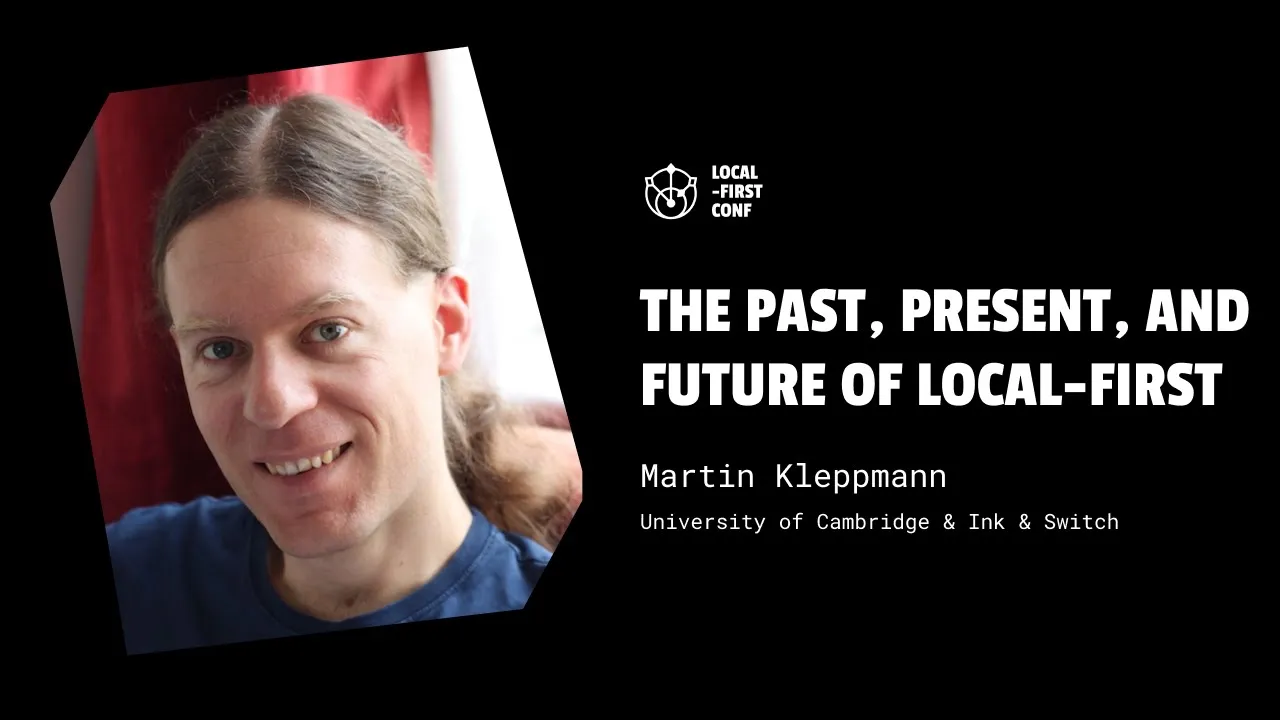
Local-First Conf
Applications must function indefinitely even if their creators shut down servers, requiring the industry to replace proprietary cloud backends with commoditized, open synchronization protocols that eliminate coercive SaaS data lock-in.
AI-assisted summary of The past, present, and future of local-first - Martin Kleppmann (Local-First Conf) — original source. Check the original for full context.
Source published:
Key ideas
- Five years after publishing the original local-first essay, Martin Kleppmann redefines local-first around an inversion of Leslie Lamport's distributed systems principle: the unavailability of another computer must never block a user from continuing their work. (7:20)
- To be truly local-first, applications must be 'Incredible Journey proof'—capable of functioning even if the vendor shuts down, goes bankrupt, or gets acquired and terminates its servers. (9:53)
- Standardizing generic, byte-level cloud sync protocols could commoditize data synchronization into a utility like Amazon S3, allowing users to switch backend hosts with a single configuration flag. (15:24)
- Local-first radically shifts the economics of software engineering by eliminating custom backend APIs, data plumbing, and 24/7 on-call rotations, enabling small teams to build competitive collaborative apps with minimal capital. (21:30)
Detailed notes
## Background Published on June 18, 2024, by the YouTube channel Local-First Conf, this video captures Martin Kleppmann's opening keynote at the inaugural Local-First Conference. According to the description, Kleppmann—a researcher at the University of Cambridge and Ink & Switch—reflects on the five years since co-authoring the foundational local-first software essay, examines the movement's current state, and outlines directions for its future.
## TL;DR Kleppmann traces the historical evolution of local-first software from early CRDT academic research and the creation of Automerge to the coining of the term in 2019. He proposes an operational definition rooted in Leslie Lamport's principles: the unavailability of another computer must never block a user from doing their work, making software resilient enough to survive even the complete shutdown or acquisition of its vendor ('Incredible Journey proof'). To overcome the operational hurdles of self-hosting and pure peer-to-peer networking, he advocates decoupling client applications from sync infrastructure via open, commoditized byte-relay protocols and hybrid opportunistic P2P. Kleppmann concludes by highlighting how local-first alters the economics of development by enabling small engineering teams to build collaborative tools without heavy backend maintenance, while challenging the industry to replace data-hostage SaaS business models with value-driven software.
## Atmosphere & style The presentation carries an authentic, thoughtful, and celebratory tone, reflecting Kleppmann's genuine excitement at seeing an academic concept grow into an auditorium-filling engineering movement. Kleppmann delivers his ideas with gentle humor, academic precision, and intellectual humility, openly acknowledging flaws in his early Ruby prototypes as well as gaps in his original 2019 essay. Watching the talk feels like a reflective campfire session among software pioneers—intellectually stimulating, pragmatic about distributed systems trade-offs, and grounded in a quiet optimism for an open, user-empowered future of computing.
## Bulletin - [07:20](https://www.youtube.com/watch?v=NMq0vncHJvU&t=440s) Five years after publishing the original local-first essay, Martin Kleppmann redefines local-first around an inversion of Leslie Lamport's distributed systems principle: the unavailability of another computer must never block a user from continuing their work. - [09:53](https://www.youtube.com/watch?v=NMq0vncHJvU&t=593s) To be truly local-first, applications must be 'Incredible Journey proof'—capable of functioning even if the vendor shuts down, goes bankrupt, or gets acquired and terminates its servers. - [15:24](https://www.youtube.com/watch?v=NMq0vncHJvU&t=924s) Standardizing generic, byte-level cloud sync protocols could commoditize data synchronization into a utility like Amazon S3, allowing users to switch backend hosts with a single configuration flag. - [21:30](https://www.youtube.com/watch?v=NMq0vncHJvU&t=1290s) Local-first radically shifts the economics of software engineering by eliminating custom backend APIs, data plumbing, and 24/7 on-call rotations, enabling small teams to build competitive collaborative apps with minimal capital.
## Key takeaways - [00:07](https://www.youtube.com/watch?v=NMq0vncHJvU&t=7s) Kleppmann's work on local-first began in 2013 after being inspired by Marc Shapiro's 2011 paper on Conflict-free Replicated Data Types (CRDTs), later collaborating with Ink & Switch to build Automerge. - [02:51](https://www.youtube.com/watch?v=NMq0vncHJvU&t=171s) The term 'local-first' was coined to represent a broader set of user ownership values and guarantees that earlier terms like 'offline-first' failed to capture. - [04:47](https://www.youtube.com/watch?v=NMq0vncHJvU&t=287s) Local-first is neither synonymous with CRDTs nor dogmatically anti-server; CRDTs are merely one enabling technology, and servers still serve valuable roles. - [04:47](https://www.youtube.com/watch?v=NMq0vncHJvU&t=287s) The original seven ideals outlined in 2019 describe end-user benefits rather than a precise technical test for whether software qualifies as local-first. - [07:20](https://www.youtube.com/watch?v=NMq0vncHJvU&t=440s) A rigorous technical definition derived from Leslie Lamport states that local-first software must never allow the availability of an external computer or server to block the user. - [07:20](https://www.youtube.com/watch?v=NMq0vncHJvU&t=440s) Local-first requires multi-device synchronization; it is distinct from local-only software that stores files exclusively on a single hard drive without networking. - [09:53](https://www.youtube.com/watch?v=NMq0vncHJvU&t=593s) Apps must be engineered to survive company acquisition or shutdown, a vulnerability highlighted by startup closures like Skiff despite using CRDT libraries like Yjs. - [12:45](https://www.youtube.com/watch?v=NMq0vncHJvU&t=765s) Self-hosting is an inadequate universal solution because running servers imposes technical overhead that very few end users or developers want to shoulder. - [12:45](https://www.youtube.com/watch?v=NMq0vncHJvU&t=765s) Pure peer-to-peer networking faces severe practical hurdles including asynchronous device usage, NAT traversal, and reliance on signaling and TURN servers. - [15:24](https://www.youtube.com/watch?v=NMq0vncHJvU&t=924s) Decoupling application business logic from data transport allows servers to act as dumb, generic byte-relays that work across arbitrary document types and schemas. - [19:44](https://www.youtube.com/watch?v=NMq0vncHJvU&t=1184s) A hybrid architecture combining opportunistic local peer-to-peer sync with commoditized cloud relays provides the highest overall resilience. - [21:30](https://www.youtube.com/watch?v=NMq0vncHJvU&t=1290s) Commoditized sync tools free developers from managing complex cloud backends and incident response, lowering operational costs for small and indie teams. - [26:17](https://www.youtube.com/watch?v=NMq0vncHJvU&t=1577s) Local-first threatens traditional SaaS business models by dismantling proprietary data lock-in, forcing applications to compete on product quality rather than hostage data. - [26:17](https://www.youtube.com/watch?v=NMq0vncHJvU&t=1577s) The local-first ecosystem is in an exploratory phase where diverse implementations must mature before formal standards bodies like the IETF should step in.
## Detailed walkthrough ### [00:07](https://www.youtube.com/watch?v=NMq0vncHJvU&t=7s) Origins and the Genesis of Automerge
Opening the inaugural Local-First Conf, Martin Kleppmann thanks Chad and expresses his genuine excitement at seeing an auditorium packed with people dedicated to making local-first software a reality. Kleppmann frames his talk around three horizons: reflecting on where the local-first movement originated from his personal vantage point, taking stock of where the ecosystem stands today, and exploring where the community should head in the coming years.
His journey began over a decade prior. In 2011, Marc Shapiro and his colleagues published their seminal academic paper on Conflict-free Replicated Data Types (CRDTs). Around 2013, Kleppmann was working in the tech industry and feeling deeply dissatisfied with the contemporary state of web applications, Software-as-a-Service, and client-server architectures. Shapiro’s paper struck a chord:
> “I thought, ‘Ah, this is—this is interesting, there seems to be the core of something here.’ I couldn't really articulate it very well yet at the time, but I wanted to start working on that properly.”
Taking a sabbatical from industry, Kleppmann transitioned into academia to research CRDTs full-time. In 2015, he wrote an experimental CRDT-based text editor in Ruby—joking that back then people still wrote Ruby, before quickly apologizing to any loyal Rubyists in the room. He admits it was a dreadful implementation that took two full minutes just to save a file after typing, but it functioned as a proof-of-concept. Around 2017, the research lab Ink & Switch reached out to collaborate on turning the underlying distributed data theory into practical software. That partnership produced Automerge. Initially written and maintained by Kleppmann in JavaScript, Automerge was later completely rewritten in Rust for production-grade performance, with Kleppmann shifting into an advisory role while others maintain it.
```mermaid flowchart LR accTitle: Evolution of Local-First Research accDescr: Timeline showing the path from Marc Shapiro's CRDT paper to the coining of local-first. subgraph S1["2011–2015"] A["2011: Marc Shapiro et al.<br/>CRDT research paper"] B["2015: Kleppmann experiments<br/>with Ruby text editor"] end subgraph S2["2017–2019"] C["2017: Ink & Switch collaboration<br/>Automerge JS launched"] D["2019: 'Local-first software'<br/>essay published"] end A --> B B --> C C --> D ```
---
[02:51](https://www.youtube.com/watch?v=NMq0vncHJvU&t=171s) Coining “Local-First” and the Growth of a Movement
Throughout the initial years of building Automerge, the team struggled with terminology. They lacked an effective adjective to describe what they were crafting: “I am building an X-type app,” where *X* represented the philosophical values and user-centric ideals they aimed to embody, rather than merely the technical mechanisms under the hood. After evaluating multiple candidates, they landed on the phrase “local-first.”
In 2019—almost exactly five years prior to this conference—Kleppmann and his Ink & Switch collaborators published their foundational essay, *“Local-first software: you own your data, in spite of the cloud.”* The essay articulated the user benefits and core values of this paradigm. Over the subsequent five years, Automerge matured into Rust, but more importantly, an entire independent movement took root. Kleppmann notes that dozens of independent software libraries, commercial products, and community projects began describing themselves explicitly as local-first or aligning closely with its philosophy:
> “It's actually become a real movement, you know it's—it's not just a small group of us writing academic papers and doing a bit of theory, but this is—this is actually a very much real thing and it has grown tremendously over the last few years.”
---
[04:47](https://www.youtube.com/watch?v=NMq0vncHJvU&t=287s) Addressing Misconceptions and the Limits of the Seven Ideals
As the movement expanded rapidly, newcomers raised fundamental clarifying questions about what the label actually means. Kleppmann addresses several common misunderstandings:
- **Offline-First vs. Local-First:** The phrase "offline-first" predated local-first by at least six years. Kleppmann explains that they deliberately avoided reusing "offline-first" because they wanted to encompass a broader set of guarantees and data ownership values that "offline-first" did not capture. - **CRDT Equivalence:** Some assume local-first simply means software built using CRDTs. Kleppmann pushes back against this view as far too narrow: CRDTs are merely one enabling technology among several that can achieve local-first properties. - **Pure Peer-to-Peer Dogma:** Others assume that local-first requires strict peer-to-peer networking with a total ban on servers. Kleppmann clarifies that servers can play valuable roles, and peer-to-peer is not an absolute requirement.
In their original 2019 essay, the authors laid out seven ideals (such as instant local reads/writes, multi-device synchronization, offline support, longevity, and privacy) with the idea that meeting all seven made an app local-first, or that apps could exist on a sliding spectrum. However, Kleppmann concedes that these ideals do not function well as a crisp, unambiguous technical definition:
> “We've now since then come to realize that actually these seven ideals aren't really a good definition of what local first is; the ideals actually more the benefits that local first can bring, especially from the point of view of an end user, but it's not really a crisp definition that allows you to say like, ‘Is this piece of software local first or not?’”
To resolve this ambiguity, Kleppmann and his co-authors set out to formulate an exact operational definition.
---
[07:20](https://www.youtube.com/watch?v=NMq0vncHJvU&t=440s) Formulating a Precise Definition: The Lamport Principle
To frame the new definition, Kleppmann invokes distributed systems pioneer Leslie Lamport (recipient of the 2013 ACM A.M. Turing Award). In a famous 1987 email, Lamport quipped:
> “A distributed system is one in which the failure of a computer you didn't even know existed can render your own computer unusable.”
Kleppmann remarks that anyone who has ever tried to work while GitHub is down or while AWS is experiencing an outage knows this frustration firsthand. Inverting Lamport's quip, Kleppmann offers his crisp definition for the movement:
> “The definition I will propose is that in local-first software, the availability of another computer should never prevent the user from working; it should never block the user.”
He then dissects the foundational prerequisites required by this definition: 1. **Multi-device sync (Local-first is not local-only):** Traditional desktop software that strictly saves files to a local hard drive without touching a network is technically local, but it is not what the local-first movement is about. A local-first system must support data syncing across multiple devices—whether across collaborating users or across multiple devices belonging to a single user. 2. **Offline-first is mandatory, but insufficient on its own:** Because the availability of any other machine (including remote servers) cannot block user progress, network availability cannot be a gatekeeper. If turning off Wi-Fi or entering a subway tunnel prevents the software from operating normally, it fails to be local-first. Being offline-first is a necessary prerequisite, but it does not fully satisfy the definition on its own.
[09:53](https://www.youtube.com/watch?v=NMq0vncHJvU&t=593s) Making Apps “Incredible Journey Proof”
Martin Kleppmann argues that the true litmus test of local-first software is not merely handling offline mode, but surviving the complete death of the company that created it. If an application ceases to function when its original creator goes out of business, shuts down servers, and stops paying AWS bills, then by definition it is not local-first. The goal is systemic robustness against total server disappearance and data loss. He references the long-running Tumblr blog *Our Incredible Journey*, which chronicles startups getting acquired, publishing sentimental farewell posts thanking users, and then abruptly announcing that their product will shut down in three months. Users are left stranded, at best receiving a zip file of raw JSON export data that cannot be imported into any competitor's software.
Kleppmann reflects that the original 2019 local-first essay did not sufficiently articulate this existential threat, making it vital to emphasize today. Crucially, employing Conflict-free Replicated Data Types (CRDTs) does not automatically protect users from this fate. As a prime example, he points to Skiff, an end-to-end encrypted workspace suite built on the Yjs CRDT library. Despite Skiff's modern cryptographic and collaborative foundation, it was acquired by Notion and scheduled for termination, landing straight onto *Our Incredible Journey*. Software longevity demands an entirely resilient application architecture rather than just a localized algorithm. Nor is this problem limited to venture-backed startups; tech giants shutter beloved software constantly, as tracked by the site *Killed by Google*, which catalogs nearly 300 discontinued products, including Google Reader. To encapsulate this survival criterion, Kleppmann describes the engineering objective as making applications “Incredible Journey proof.”
> “In my opinion, if the software doesn't work even if the original developer of the software goes out of business and shuts down all of their servers and stops paying their AWS bills, then it's not local-first.” — Martin Kleppmann
- Startups frequently shutter services within months of acquisition, leaving users with unimportable JSON dumps. - Skiff proved that utilizing Yjs and CRDT primitives is not enough on its own to prevent an app from vanishing. - *Killed by Google* tracks almost 300 terminated services, illustrating that large incumbents are just as prone to abandoning core software.
---
[12:45](https://www.youtube.com/watch?v=NMq0vncHJvU&t=765s) The Limitations of Self-Hosting and Peer-to-Peer
Building software that survives its creators creates a fundamental synchronization dilemma. Multi-device synchronization almost always relies on intermediary servers. When those servers are proprietary and closed-source, users are trapped with zero recourse once the servers go dark. While providing open-source server code for self-hosting offers an improvement, Kleppmann dismisses it as an inadequate general solution. Self-hosting requires specialized technical literacy possessed by a tiny sliver of the population. Furthermore, even technical users rarely want the administrative overhead: “In principle I could self-host the server, but do I really want to? Like, I don't want to be in the business of running servers; I have better things to do with my life.”
Turning to peer-to-peer (P2P) networking seems like the natural alternative because it allows devices to sync directly without centralized infrastructure or by relying on a distributed hash table (DHT). Yet in practice, Kleppmann explains, peer-to-peer software remains an extraordinarily difficult, largely unsolved engineering problem. P2P fundamentally struggles when two devices are rarely online simultaneously. Moreover, the modern internet topology is choked by NATs and firewalls, requiring intricate signaling protocols just to establish a direct connection, backed by TURN servers for relaying traffic when direct connections fail. This introduces a glaring architectural irony: if an application must deploy and maintain signaling and TURN servers anyway, those servers might as well synchronize the actual application data directly. For now, pure P2P introduces massive complexity for very little practical benefit.
> “So my my feeling is that maybe peer-to-peer will will get better with more people working on the technology, but right now it seems to me that uh it's a lot of complexity for fairly little benefit.” — Martin Kleppmann
- Self-hosting caters to a tiny fraction of users and imposes burdensome server maintenance on developers who have better things to do. - Peer-to-peer requires simultaneous connectivity between client devices, which conflicts with standard multi-device usage patterns. - Firewalls and NAT traversal necessitate signaling and TURN relays, undermining the serverless premise of P2P architectures.
---
[15:24](https://www.youtube.com/watch?v=NMq0vncHJvU&t=924s) Towards Generic Cloud Sync and Open Protocols
Looking beyond proprietary servers and complex P2P architectures, Kleppmann explores using decoupled, general-purpose cloud storage services like Dropbox, Google Drive, or Apple iCloud to persist local-first files. While third-party cloud hosts could theoretically shut down, there is vastly higher confidence that Google Drive will survive the next decade compared to a bespoke backend operated by a two-person startup. However, cloud drives are structured around coarse-grained file storage, making them poorly suited for low-latency, real-time multiplayer features like tracking remote collaborator cursors.
To resolve this, Kleppmann outlines a long-term architectural vision where client applications separate user interface and business logic from the synchronization transport. Because local-first applications perform all data mutations and computation locally on the user's laptop or mobile phone, the server's role can shrink to a dumb, generic byte-passing pipeline. A single generic sync service can support spreadsheets, graphic design tools, and task trackers without needing any awareness of application-specific data models or file schemas. Kleppmann envisions standardizing these sync protocols across the industry so that cloud providers such as AWS or Microsoft Azure could offer commoditized, pay-per-gigabyte synchronization services—analogous to Amazon S3. If an underlying provider raises prices or deprecates the service, users and developers could seamlessly redirect their applications to a competing provider implementing the identical open protocol.
```mermaid flowchart TD accTitle: Decoupled Local-First Architecture with Commoditized Sync accDescr: Client devices run application logic locally and sync through an interchangeable, standardized cloud protocol.
subgraph Clients["User Devices (Local-First Engine)"] Laptop["Laptop Apps<br>(Spreadsheet, Notes, Tasks)"] Phone["Phone Apps<br>(Spreadsheet, Notes, Tasks)"] end
subgraph Protocol["Open Standard Sync Protocol"] Wire["Generic Byte-Relay Interface<br>(No Domain/Business Logic)"] end
subgraph InterchangeableProviders["Commoditized Storage Providers"] AWS["AWS Sync Service<br>(Pay-per-GB, S3-style)"] Azure["Azure Sync Service<br>(Interchangeable Target)"] SelfHost["Self-Hosted / Third-Party<br>(Standard Protocol Replica)"] end
Laptop <-->|"Read/Write Local Bytes"| Wire Phone <-->|"Read/Write Local Bytes"| Wire Wire -.->|"Configurable Target"| AWS Wire -.->|"Failover / Alternative"| Azure Wire -.->|"Self-Hosted Target"| SelfHost ```
> “Part of the idea of local-first is that all of the interesting logic lives on the client side in the user's app, you know, in the software that actually runs on the user's devices, which means that any synchronization that happens between them should be like a really simple matter: it should be just a matter of getting some bytes over the wire from one device to the other device.” — Martin Kleppmann
- Generic syncing servers remain entirely agnostic of data models, schemas, and document types. - Standardized open sync protocols would eliminate vendor lock-in by allowing clients to switch backend providers at will. - Sync infrastructure can be commoditized like Amazon S3, billing users directly by data volume rather than coupling sync to proprietary SaaS subscriptions.
[19:44](https://www.youtube.com/watch?v=NMq0vncHJvU&t=1184s) Commoditizing Sync Infrastructure and Hybrid Peer-to-Peer
Martin Kleppmann envisions an ecosystem where switching out your cloud storage or synchronization provider requires nothing more than updating a single configuration flag in your application settings. When sync services implement a shared, interoperable protocol, the underlying synchronization mechanism becomes a commoditized piece of utility infrastructure. App developers no longer have to design their data flows around proprietary hosted backends. With a standardized sync layer in place, peer-to-peer (P2P) networking can be reintroduced naturally: direct synchronization over local networks makes intuitive sense when two laptops or phones sit next to each other on the exact same table, rather than routing edits across the continent through an AWS data center in Virginia.
Rather than relying entirely on peer-to-peer as the sole, fragile communication channel—a mistake made in earlier generations of P2P tooling—systems can use local and P2P networks opportunistically while retaining cloud relays as fallbacks. Kleppmann argues that pairing P2P with multi-provider cloud infrastructure produces an exceptionally durable, resilient foundation: “the situations in which the cloud service fails will probably be different from the situations in which the peer-to-peer sync fails and so if we can have both well then it would just gain robustness overall.” This combination makes software genuinely resilient against both local connectivity cutoffs and vendor shutdowns, achieving the ultimate goal of being "Incredible Journey" proof.
```mermaid flowchart TD accTitle: Dual Sync Architecture accDescr: Diagram illustrating simultaneous local peer-to-peer synchronization and off-the-shelf commoditized cloud sync providers.
subgraph Clients["Local Devices"] D1["Device A"] D2["Device B"] end
subgraph SyncLayer["Commoditized Sync Layer"] P2P["Opportunistic P2P / Local LAN"] Cloud["Interoperable Cloud Sync Service"] end
D1 <-->|"Direct Local Sync"| P2P P2P <-->|"Direct Local Sync"| D2 D1 <-->|"Standard Protocol Flag"| Cloud D2 <-->|"Standard Protocol Flag"| Cloud ```
- Commoditizing sync infrastructure frees engineers from proprietary cloud-vendor lock-in. - Direct device-to-device synchronization bypasses remote server round-trips (such as AWS `us-east-1` in North Virginia). - Opportunistic hybrid topologies eliminate single points of failure by blending local P2P availability with cloud backups.
---
[21:30](https://www.youtube.com/watch?v=NMq0vncHJvU&t=1290s) Developer Experience and the Economics of Small Teams
Reflecting on the original local-first essay published five years prior, Kleppmann acknowledges a major oversight: the initial writing focused almost exclusively on end-user advantages—such as ownership, latency, and longevity—without recognizing the massive operational upside for software developers themselves. Building conventional SaaS forces engineering teams to take on immense architectural baggage. Startups find themselves hiring dedicated backend specialists, wrestling with complex cloud infrastructure, managing intricate AWS configurations, setting up CI/CD pipelines, and subjecting engineers to around-the-clock on-call incident pager rotations.
By treating synchronization as an off-the-shelf, commoditized library from a registry like npm, front-end and product engineers bypass writing custom network error handling, offline retry queues, and timeout notifications. This shift radically alters the economics of software development, allowing tiny teams to deliver high-quality collaborative applications that once required massive venture-funded payrolls. As Kleppmann points out: “it's not about a particular technology, it's about changing the economics of software allowing smaller teams to get more done and building more impressive apps with fewer people and therefore with less capital.”
- Developers avoid building custom backend APIs, data pipes, and 24/7 on-call rotations. - Spotty Wi-Fi, dropped connections, and retry queues are absorbed entirely by background sync protocols. - Prototyping speed skyrockets, enabling engineers to stand up working multiplayer, collaborative applications within days. - Niche and boutique software tools become financially viable because low operational overhead reduces the need for massive user scale or venture capital.
---
[26:17](https://www.youtube.com/watch?v=NMq0vncHJvU&t=1577s) Business Model Challenges and the Future of the Ecosystem
The greatest unresolved challenge facing local-first software is economic: whether the conventional SaaS business model can sustain itself when the user fundamentally controls their own data. In classical web architectures, hosted software vendors retain leverage over their audience through artificial data moats. Kleppmann notes how the traditional subscription dynamic operates: “with the traditional model of SaaS, app developers have this gun that they can point at the user's head and say, 'you know you have some nice data here, it would be a shame if you lost all of that data wouldn't it be? So how about you pay up and pay your subscription so that we don't go and delete all your data?'” When an app is built to be Incredible Journey proof, that coercive hostage dynamic evaporates, since users can migrate their local files and change sync providers at will.
Kleppmann believes that long-term sustainability will come from charging for active value creation and superior user experience rather than vendor lock-in, but he welcomes deep debate on alternative commercial models. Across the community, diverse CRDT implementations and protocols are emerging alongside Automerge. While it is far too early to convene formal standards bodies like the IETF before the design tradeoffs are fully understood, Kleppmann emphasizes that local-first is an enduring set of architectural principles, not a single monolithic tool: the non-negotiable imperative is ensuring people can run their software and access their work forever, unencumbered by disconnected networks or bankrupt SaaS startups.
- Data moats vanish in local-first apps, forcing products to compete on user interface design, workflow quality, and actual service delivery. - A "thousand flowers blooming" phase is currently essential across Automerge and competing synchronization engines to stress-test architectural trade-offs. - Formal standardization through bodies like the IETF will make sense only after real-world production implementations mature over the coming years. - The fundamental pledge of local-first design remains offline capability coupled with resilience against vendor dissolution.
## Notable quotes > [07:20](https://www.youtube.com/watch?v=NMq0vncHJvU&t=440s) The definition I will propose is that in local-first software, the availability of another computer should never prevent the user from working; it should never block the user. — Martin Kleppmann
> [12:45](https://www.youtube.com/watch?v=NMq0vncHJvU&t=765s) In principle I could self-host the server, but do I really want to? Like, I don't want to be in the business of running servers; I have better things to do with my life. — Martin Kleppmann
## Mentioned Martin Kleppmann, Marc Shapiro, Leslie Lamport, Automerge, Ink & Switch, CRDTs, Skiff, Notion, Yjs, Our Incredible Journey, Killed by Google, Google Reader, Dropbox, Google Drive, Apple iCloud, Amazon Web Services (AWS), Microsoft Azure, Amazon S3, IETF
## Video description Speaker: Martin Kleppmann, University of Cambridge, Inc & Switch
We have come a long way since my colleagues and I published the local-first essay five years ago. In this talk I'll review where the local-first idea came from, where we are now, and what I hope the local-first community can work towards in the future.
---
Learn from engineers, designers, academics, startups, and indie developers who are putting local-first into practice and reaping the benefits of a cloud-optional architecture.
Join our discord! https://discord.com/invite/unjj72J6gH
---
Subscribe for more talks: @localfirstconf
Follow: https://twitter.com/localfirstconf
Visit: https://www.localfirstconf.com
---
Thanks to our wonderful sponsors:
- DXOS - https://dxos.org/ (foundation layer for cloudless, collaborative software) - Heavybit - https://www.heavybit.com/ (leading investor in dev-first startups) - PowerSync - https://www.powersync.com/ (Postgres and SQLite sync layer) - Rocicorp - https://rocicorp.dev/ (creator of multiplayer and sync infrastructure) - Axil - https://axil.llc/ (agency focused on local-first software dev) - Affine - https://affine.pro/ (workspace merging docs, whiteboards, and databases) - CrabNebula - https://crabnebula.dev/ (creator of Tauri, for deploying web technologies as desktop apps)
---
Thanks to https://sceal-studio.com/ for the videos!
[Source](https://www.youtube.com/watch?v=NMq0vncHJvU)