Tesla Halts Radar Installs as Vision AI Outperforms Sensor Fusion
YarrowFlower
Tesla eliminated radar hardware from its fleet after finding that multi-sensor fusion degraded tracking with phantom braking, proving camera-only neural networks trained on fleet data can reliably solve 3D depth and velocity.
AI-assisted summary of Andrej Karpathy (Tesla): CVPR 2021 (see description for better quality version) — original source. Check the original for full context.
Source published:
Key ideas
- Tesla transitioned newly produced vehicles entirely to pure vision ('Tesla Vision') three weeks prior to CVPR 2021, completely removing millimeter-wave radar from its sensor suite. (6:00)
- By shifting from manual labeling to an offline auto-labeling pipeline using heavy networks and temporal hindsight, Tesla compiled a 1.5-petabyte dataset featuring 1,000,000 challenging video clips and 6 billion depth-and-velocity annotations. (17:10)
- To train its synthetic visual cortex networks, Tesla deployed an in-house supercomputer cluster comprising 720 nodes of 8x NVIDIA A100 GPUs (5,760 total) backed by 10 PB of hot NVMe storage delivering 1.6 TB/s. (20:31)
- Initial validation of the production pure-vision build logged 1.7 million autonomous Autopilot miles with zero crashes, demonstrating higher precision and recall in Automatic Emergency Braking than the legacy radar fusion stack. (28:16)
Detailed notes
## Background This presentation was uploaded to YouTube by the channel YarrowFlower on June 21, 2021, documenting Andrej Karpathy's keynote at the CVPR 2021 Workshop on Autonomous Driving. The video description provides a link directing viewers to a higher quality recording of the talk.
## TL;DR Andrej Karpathy, Senior Director of AI at Tesla, details the technical rationale and engineering architecture behind Tesla's decision to drop radar and transition entirely to a camera-based vision stack. He explains how Tesla trains high-capacity deep neural networks on petabyte-scale fleet data using offline auto-labeling, temporal fusion transformers, and a top-tier supercomputer cluster of 5,760 NVIDIA A100 GPUs. By replacing brittle sensor fusion heuristics with pure vision models, the system successfully resolves long-standing autonomous edge cases like phantom braking under bridges and delayed stationary object detection.
## Atmosphere & style The presentation carries the brisk, pragmatic energy of an elite engineering lead speaking directly to his academic and industry peers. Karpathy balances self-deprecating humor about unfamiliarity with Zoom with unapologetic technical conviction, dissecting sensor fusion pitfalls and machine learning bottlenecks with effortless lucidity. The talk feels rapid, data-dense, and deeply grounded in production reality, moving steadily from high-level architectural philosophy to telemetry plots that validate Tesla's pure-vision thesis.
## Bulletin - [06:00](https://www.youtube.com/watch?v=NSDTZQdo6H8&t=360s) Tesla transitioned newly produced vehicles entirely to pure vision ('Tesla Vision') three weeks prior to CVPR 2021, completely removing millimeter-wave radar from its sensor suite. - [17:10](https://www.youtube.com/watch?v=NSDTZQdo6H8&t=1030s) By shifting from manual labeling to an offline auto-labeling pipeline using heavy networks and temporal hindsight, Tesla compiled a 1.5-petabyte dataset featuring 1,000,000 challenging video clips and 6 billion depth-and-velocity annotations. - [20:31](https://www.youtube.com/watch?v=NSDTZQdo6H8&t=1231s) To train its synthetic visual cortex networks, Tesla deployed an in-house supercomputer cluster comprising 720 nodes of 8x NVIDIA A100 GPUs (5,760 total) backed by 10 PB of hot NVMe storage delivering 1.6 TB/s. - [28:16](https://www.youtube.com/watch?v=NSDTZQdo6H8&t=1696s) Initial validation of the production pure-vision build logged 1.7 million autonomous Autopilot miles with zero crashes, demonstrating higher precision and recall in Automatic Emergency Braking than the legacy radar fusion stack.
## Key takeaways - [00:00](https://www.youtube.com/watch?v=NSDTZQdo6H8&t=0s) Autonomous transit fundamentally solves the safety hazards of human drivers, whose high-latency and distraction-prone biological control loops are replaced by 360-degree, low-latency silicon computation. - [03:00](https://www.youtube.com/watch?v=NSDTZQdo6H8&t=180s) Tesla deploys autonomy incrementally through production active safety features like Automatic Emergency Braking, Traffic Control Warning, and Pedal Misapplication Mitigation across millions of fleet vehicles. - [06:00](https://www.youtube.com/watch?v=NSDTZQdo6H8&t=360s) Unlike competitors relying on lidar and dynamic pre-mapped HD maps that are prohibitively difficult to maintain globally, Tesla requires vehicles to interpret intersections and road topology entirely online via cameras. - [08:53](https://www.youtube.com/watch?v=NSDTZQdo6H8&t=533s) Sensor fusion between high-precision vision and noisy radar acts as an anchor on perception, introducing false positives, tracking drops, and phantom braking events. - [10:24](https://www.youtube.com/watch?v=NSDTZQdo6H8&t=624s) Synthetic deep neural networks can perform accurate metric depth estimation and velocity tracking directly from multi-camera video without needing active rangefinders. - [12:04](https://www.youtube.com/watch?v=NSDTZQdo6H8&t=724s) Tesla frames 3D perception as a supervised learning problem solved by offline auto-labeling, which leverages unconstrained computation and temporal hindsight to generate ground truth trajectories. - [14:45](https://www.youtube.com/watch?v=NSDTZQdo6H8&t=885s) Tesla deployed 221 bespoke telemetry triggers running in shadow mode across customer vehicles to mine long-tail edge cases, including visual occlusions, dust clouds, and weather dropouts. - [18:25](https://www.youtube.com/watch?v=NSDTZQdo6H8&t=1105s) The perception architecture processes eight surround cameras through ResNet backbones, multi-camera transformer fusion, and temporal fusion before branching into hierarchical heads, trunks, and task-specific terminals. - [22:33](https://www.youtube.com/watch?v=NSDTZQdo6H8&t=1353s) Full vertical integration spanning data harvesting, annotation, custom supercomputing, in-house silicon (FSD dual-SoC NPU), and vehicle manufacturing gives Tesla full control over its engineering velocity. - [25:34](https://www.youtube.com/watch?v=NSDTZQdo6H8&t=1534s) Radar's poor vertical resolution historically triggered phantom braking under overhead bridges, a failure mode eliminated by pure vision's superior spatial resolution and depth tracking. - [27:10](https://www.youtube.com/watch?v=NSDTZQdo6H8&t=1630s) Eliminating radar removes brittle, heuristic-heavy sensor fusion code that struggled to resolve divergent error modes between optical and radar signals. - [29:54](https://www.youtube.com/watch?v=NSDTZQdo6H8&t=1794s) Tesla's operational philosophy shifts heavy 3D scene reconstruction and structural semantic parsing to offline training pipelines, keeping onboard runtime models lightweight and latency-compliant. - [34:14](https://www.youtube.com/watch?v=NSDTZQdo6H8&t=2054s) Designing edge-case triggers requires human intuition to identify semantic distribution shifts—such as tunnel lighting transitions—that automated anomaly alerts cannot reliably isolate. - [35:15](https://www.youtube.com/watch?v=NSDTZQdo6H8&t=2115s) Visible-light camera systems are necessary and sufficient for autonomous driving, supported by the biological existence proof of human vision and the unmatched manufacturing economics of optical sensors.
## Detailed walkthrough ### [00:00](https://www.youtube.com/watch?v=NSDTZQdo6H8&t=0s) Introduction and the Rationale for Autonomous Driving
The session begins with brief technical coordination as Andrej Karpathy confirms his screen sharing is active. He jokes about his unfamiliarity with the software, remarking, “I’m embarrassed to say that I barely use Zoom. I know this is shocking,” before expressing mock pride in pulling off “some impressive zero-shot learning on Zoom.” The workshop host introduces him as the Senior Director of AI at Tesla, noting that he leads the engineering team responsible for training and deploying all neural networks powering Autopilot.
Karpathy opens his presentation at the CVPR 2021 Workshop on Autonomous Driving by framing the broad societal motivation for automated transit. He argues that modern transport infrastructure is fundamentally flawed because heavy vehicles carrying massive kinetic energy are controlled entirely by human drivers. Describing the biology-machine mismatch, he emphasizes that “we have these metallic objects traveling incredibly quickly and with very high kinetic energy, and we are putting meat in the control loop into the system.” Because human drivers are error-prone, prone to distraction, and economically costly, replacing the “meat computer” with an onboard silicon computer provides decisive improvements in safety, convenience, and efficiency. Silicon computers operate with dramatically lower latencies, possess constant 360-degree situational awareness, and remain fully attentive without ever checking social media. He references the movie *I, Robot*, pointing out a scene where Will Smith manually operates a vehicle to the horror of his passenger, noting that its fictional 2035 timeframe may prove to be a prescient timeline for society viewing manual human driving as an absurd hazard.
- **Speaker**: Andrej Karpathy (Senior Director of AI, Tesla). - **Venue**: CVPR 2021 Workshop on Autonomous Driving. - **Key Silicon Advantages**: Substantially lower response latency, complete 360-degree coverage, and immunity to distraction (e.g., checking Instagram).
---
[03:00](https://www.youtube.com/watch?v=NSDTZQdo6H8&t=180s) Tesla's Incremental Autonomy and Active Safety in Production
Karpathy highlights Tesla's deployment strategy, contrasting it with typical lab-bound research. Rather than waiting for a fully finalized autonomous vehicle before shipping, Tesla relies on an incremental model where active safety and assistive autonomy operate continuously across millions of customer-owned vehicles already on the road.
He shares specific production examples where onboard neural networks intervene to avert severe collisions: - **Automatic Emergency Braking (AEB)**: In an intersection scenario, an occluded pedestrian steps into the vehicle's path; object detection detects the pedestrian instantly, triggers full braking, and prevents impact. - **Traffic Control Warning**: A distracted driver fails to slow down for an illuminated red traffic light; the vehicle recognizes the relevant signal for its lane, issues an acoustic warning beep, and the alerted driver slows down before entering the cross-traffic. - **Pedal Misapplication Mitigation (PMM)**: In parking situations where a driver accidentally floors the accelerator pedal instead of the brake while maneuvering around people or obstacles, the vision network detects forward obstructions and overrides the throttle input. In one video demonstration, a driver attempting to exit a parking stall accidentally floors the accelerator toward pedestrians; in another, a driver turning toward a parking spot hits the throttle directly toward a riverbank, and the vehicle overrides the throttle to prevent the car from plunging into the water.
Alongside these baseline fleet-wide active safety protections, Karpathy notes that Tesla is testing its advanced Full Self-Driving (FSD) Beta package with approximately 2,000 select customers. He plays a clip from an FSD Beta customer navigating complex city streets in San Francisco, showing how the instrument cluster visualizes real-time predictions for road boundaries, lanes, and dynamic actors. While zero-intervention drives have become routine for engineers in suburban environments like Palo Alto, dense and adversarial urban domains like San Francisco present a much higher challenge for autonomous perception and planning.
---
[06:00](https://www.youtube.com/watch?v=NSDTZQdo6H8&t=360s) Vision vs. HD Maps and Deleting the Radar Sensor
Addressing how Tesla's self-driving demonstrations compare to competitors, Karpathy notes that video demonstrations of an autonomous vehicle executing an unprotected left turn have been publicly visible for over a decade, citing early Waymo demonstrations. However, he stresses that identical-looking external behaviors mask completely divergent architectural paradigms under the hood: “Even though these two scenarios look the same—so there's a car taking a left at an intersection—under the hood and in terms of the scalability of the system, things are incredibly different.”
```mermaid flowchart TD accTitle: Comparison of Autonomous Driving Perception Paradigms accDescr: Contrasts the pre-mapped HD map and lidar approach with Tesla's online vision-only approach.
subgraph HDMapApproach["Pre-Mapped Approach (Lidar + HD Maps)"] A["Lidar Point Cloud Capture"] --> B["Pre-Built HD Map & Annotation"] B --> C["Test-Time Vehicle Localization"] C --> D["Restricted Geofenced Deployment"] end
subgraph VisionApproach["Tesla Approach (Vision-Only)"] E["8 Surround Video Cameras"] --> F["Onboard Neural Networks"] F --> G["Online Geometry, Lane, & Light Parsing"] G --> H["Scalable Global Deployment Anywhere"] end ```
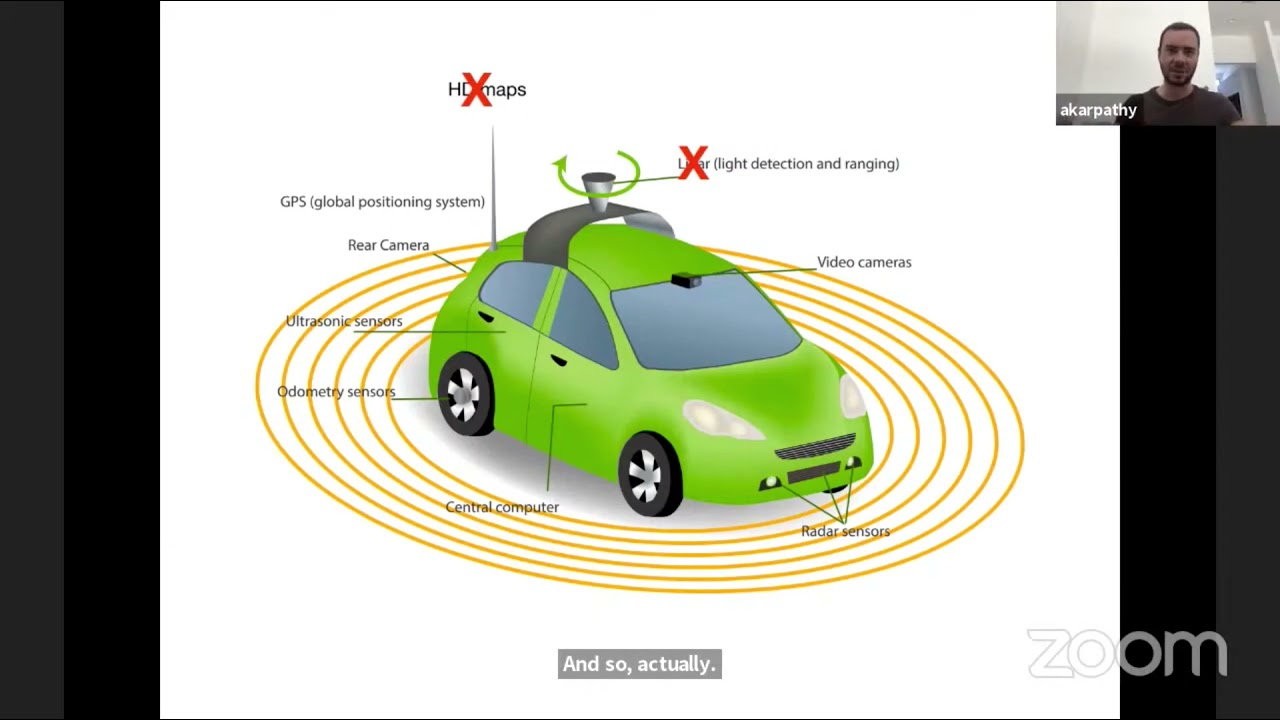
The mainstream industry approach relies on expensive roof-mounted lidar sensors and dense high-definition (HD) maps. These systems pre-scan an area, annotate road topology, lane connections, and static traffic light pairings in advance, and then reduce the online driving task to localizing within that pre-recorded map. Karpathy argues that pre-mapping cannot scale to millions of vehicles operating worldwide, as maintaining and updating dynamic HD map infrastructure across the globe is prohibitively expensive.
Tesla’s vision-first framework instead forces the car to interpret intersections completely online from scratch. Using video feeds from eight surround cameras, neural networks must reconstruct lanes, infer connectivity, isolate relevant traffic lights, and track road users purely in real time without high-definition prior maps. Because the onboard vision system had improved so rapidly, Tesla determined that secondary sensors were turning into unnecessary crutches. Karpathy reveals that three weeks prior to the talk, Tesla officially stopped installing radar sensors in newly shipped vehicles, transitioning Autopilot entirely to vision alone.
- **Sensor Suite Contrast**: Elimination of lidar, elimination of HD priors, and removal of millimeter-wave radar in favor of 8 surround-view video cameras. - **Fleet Scale**: Systems relying on pre-built HD maps struggle to scale maintenance across global road networks, whereas a pure vision pipeline can theoretically generalize anywhere. - **Hardware Transition**: Production vehicles shifted to pure vision (“Tesla Vision”) without radar three weeks prior to CVPR 2021.
[08:53](https://www.youtube.com/watch?v=NSDTZQdo6H8&t=533s) Doubling Down on Vision Over Sensor Fusion
Andrej Karpathy opens by revisiting the fundamental tension between radar and cameras, framing it through a public remark by Elon Musk. As Karpathy recounts, “He's saying, when radar and vision disagree, which one do you believe? Vision has much more precision, so better to double down vision than do sensor fusion.” The reasoning boils down to sensor disparity: when visual sensing improves to become roughly 100 times better than radar, attempting to fuse them is counterproductive. Rather than enhancing reliability, the inferior sensor acts as an anchor that holds the entire perception stack back, injecting noise, phantom detections, and hesitation into the vehicle's driving behavior. Tesla consequently made the architectural decision to abandon radar entirely and pursue pure vision-based control.
To illustrate the sheer fidelity of optical sensing, Karpathy showcases the raw video stream fed into the vehicle’s Autopilot computer. The setup relies on eight surround cameras capturing frames at 36 frames per second. This panoramic configuration constantly streams roughly eight million bits of constraints per second about the environment into the computing hardware. Karpathy stresses that the real, complex challenges of driving lie entirely within visual scene interpretation—understanding geometry, context, semantics, and occlusions. Recognizing that vision is the ultimate ceiling of the vehicle's intelligence, Tesla dissolved the friction of maintaining fragmented engineering silos, choosing to dismantle their dedicated radar and fusion pipelines to direct all engineering resources into a single, unified vision team.
- The multi-camera rig continuously supplies roughly 8 million bits of environmental constraints every second across 8 synchronized cameras running at 36 fps. - Tesla completely eliminated separate radar and sensor fusion development branches to focus full engineering throughput on one specialized vision team.
[10:24](https://www.youtube.com/watch?v=NSDTZQdo6H8&t=624s) The Range Finding Debate: Can Synthetic Neural Nets Estimate Depth?
Karpathy directly tackles the automotive industry's traditional hesitation toward camera-only autonomy: widespread skepticism about whether neural networks can reliably perform accurate metric depth estimation and velocity tracking without active rangefinders like lidar or radar. While biological vision systems prove daily that biological neural networks comfortably infer distances and rates of closure from visual streams alone, robotics engineers have long doubted whether artificial networks can emulate this capability reliably. Karpathy firmly dispels that skepticism: “The big question is can our synthetic neural networks also do the same, and I think the answer to us internally over the last few months that we've worked on this is an unequivocal yes.”
To justify replacing radar, vision must match or exceed what radar does well while discarding its notorious failure modes. Under nominal conditions, automotive radar provides direct, clean, and low-latency readouts of distance, longitudinal velocity, and acceleration for a leading target vehicle. However, real-world radar data exhibits sudden, unpredictable anomalies. Karpathy notes that while radar locks onto a leading car well, every so often it spontaneously throws a "dumb measurement" with zero forewarning. A roadside manhole cover, an overhead bridge, or a metal expansion joint can register as a stationary obstacle directly in the lane of travel. Furthermore, radar performs poorly on cross-traffic and oncoming vehicles. Because a vehicle’s planner cannot anticipate when radar will report false targets, attempting to perform tight, low-latency fusion with camera inputs invariably pollutes the state estimator with false positives and erratic phantom braking events.
```mermaid flowchart TD accTitle: Radar vs Vision Measurement Trade-offs accDescr: Visual trade-off illustrating radar failure modes versus pure vision depth estimation. subgraph RadarIssues["Radar Inconsistencies"] R1["Nominal Tracking (Accurate depth & velocity)"] --> R2["Spurious Objects (Manholes, bridges)"] R2 --> R3["Poor Tracking (Crossing / oncoming traffic)"] end subgraph VisionGoal["Vision-Only Target"] V1["8 Surround Cameras (36 fps)"] --> V2["Deep Neural Network"] V2 --> V3["Direct Metric Prediction (Depth, velocity, acceleration)"] end ```
[12:04](https://www.youtube.com/watch?v=NSDTZQdo6H8&t=724s) Building the Supervision Engine: Offline Auto-Labeling
To replicate and exceed radar accuracy purely with cameras, Tesla framed range finding as an end-to-end supervised learning challenge: training high-capacity deep networks to predict 3D depth, velocity, and acceleration directly from multi-camera imagery. Karpathy outlines the three indispensable criteria required for the dataset: it must be massive (spanning millions of examples), immaculate (offering clean metric ground truth), and diverse (heavily populated with long-tail corner cases). Emphasizing the certainty of this data-centric paradigm, he cites a favorite maxim from OpenAI co-founder Ilya Sutskever: “When you have a large clean diverse data set and you train a large enough neural network on it, what I've seen in practice is, in the words of Ilya Sutskever, success is guaranteed.”
Achieving millions of hyper-accurate 3D bounding boxes and kinetic trajectories was impossible using manual human labeling alone. Instead, Tesla designed a scalable offline "auto-labeling" infrastructure and tracker. Unlike the embedded inference engine running on the car under strict 20-millisecond real-time latency budgets, the offline auto-labeling pipeline processes recorded driving clips without computational restrictions. It leverages massive, non-deployable neural architectures, bidirectionally optimizes trajectories using the benefit of hindsight across past and future video frames, and incorporates multimodal sensor signals—including radar—in a relaxed setting. Karpathy emphasizes the profound difference between real-time and offline sensor usage: whereas an onboard real-time stack must react instantaneously to a spurious radar return or risk an accident, an offline reconstruction system can calmly assess the entire temporal clip, smooth sensor inconsistencies, and generate flawless ground truth trajectories with occasional human review.
```mermaid flowchart LR accTitle: Real-Time vs Offline Auto-Labeling Pipeline accDescr: Contrasting strict onboard vehicle inference against unconstrained offline auto-labeling. subgraph CarRuntime["Onboard Vehicle Inference"] C1["Vision Stream"] --> C2["Deployable Net"] C2 --> C3["Control Decision (20ms latency)"] end subgraph OfflineEngine["Fleet Auto-Labeling"] F1["Multi-frame Clip"] --> F2["Heavy Networks & Future Hindsight"] F2 --> F3["Calm Multimodal Tracking"] F3 --> F4["Supervised Training Set"] end ```
[14:45](https://www.youtube.com/watch?v=NSDTZQdo6H8&t=885s) Mining Edge Cases: Occlusions and 221 Fleet Triggers
Karpathy presents visual evidence demonstrating how offline auto-labeling conquers scenarios that baffle conventional trackers. In one clip, a vehicle ahead unexpectedly dumps a cascade of physical debris across the road, yet the offline tracker retains an unbroken 3D bounding box over the vehicle. In another video, a leading vehicle churns up an intense dust cloud that completely occludes the vehicle for several seconds; by evaluating frames recorded both before and after the visual dropout, the offline tracker seamlessly interpolates the vehicle's spatial trajectory. A third example illustrates the system reliably auto-labeling driving clips during severe snowstorms. When trained on millions of these edge-case reconstructions, the neural network learns to maintain temporal object permanence through harsh weather and transient visual dropouts.
Sourcing these high-value corner cases from Tesla's operating fleet required building a sophisticated targeted data-retrieval engine over a focused four-month sprint. Tesla engineered 221 bespoke software triggers that ran in "shadow mode" across customer vehicles worldwide. These triggers continually monitored for anomalies, disagreements, and uncertainty without affecting the vehicle's driving maneuvers. Whenever an interesting discrepancy emerged, the car uploaded a short video clip to Tesla’s servers for auto-labeling. Through continuous iteration—auditing uploaded clips, refining trigger sensitivity, and retraining the models—Tesla systematically exhausted edge cases and fortified the vision stack against catastrophic real-world failures.
- Tesla developed 221 bespoke telemetry triggers over a four-month period to mine edge-case data from customer cars globally. - Shadow mode runs updated vision networks in the background to detect metric disagreements against the active legacy stack or radar without taking vehicle control. - Fleet triggers specifically sample edge cases such as bounding-box detection jitter, discrepancies between the narrow and main front-facing cameras, false decelerations where human drivers remain on the throttle, and visual occlusions caused by dust clouds, flying debris, or blinding snowstorms.
[17:10](https://www.youtube.com/watch?v=NSDTZQdo6H8&t=1030s) The Data Engine Loop and Scale of the Vision Dataset
To achieve production-grade vision without radar, Tesla relied on an extensive iterative data engine. The process begins with a seed dataset used to train an initial neural network. This network is then silently deployed to customer vehicles in shadow mode, running in the background and generating predictions without taking driving actions. Using targeted triggers, Tesla detects scenarios where the model is likely misbehaving or generating inaccurate outputs. A fraction of these failure clips are converted into permanent unit tests to prevent future regressions, while the rest are automatically labeled and merged back into the main training pool. Alongside this cycle runs an asynchronous data-cleaning pipeline that continuously purges noise and errors from the cumulative dataset.
```mermaid flowchart TD accTitle: Tesla Data Engine Loop accDescr: Flow diagram showing how data cycles through training, shadow mode, trigger selection, unit tests, auto-labeling, and data cleaning.
subgraph TrainDeploy["Training & Fleet Deployment"] A["Seed Dataset"] --> B["Train Neural Network"] B --> C["Deploy in Shadow Mode (Fleet)"] end
subgraph Sourcing["Error Discovery & Ingestion"] C --> D["Trigger Mechanisms (Inaccuracies)"] D --> E["Unit Tests (Regression Tracking)"] D --> F["Auto-Labeling Pipeline"] end
subgraph Integration["Dataset Maintenance"] F --> G["Cleaned Training Set"] G -->|"Async Data Cleaning"| G G --> B end ```
By cycling through this loop repeatedly, the network's performance steadily climbs. For this specific release, Tesla executed seven full rounds of shadow mode. Andrej Karpathy notes that “we spin this loop over and over again until the network basically becomes incredibly good.” The resulting dataset represents an enormous operational effort:
- **7 shadow mode iterations** completed prior to release. - **1,000,000 extremely hard, diverse video clips** sourced directly from the fleet (typically ~10-second clips at roughly 36 fps). - **6,000,000,000 clean object labels** annotated for both depth and velocity. - **1.5 petabytes** of total high-density training data storage.
[18:25](https://www.youtube.com/watch?v=NSDTZQdo6H8&t=1105s) Neural Network Architecture: Synthetic Visual Cortex
Handling this high-volume sensory input requires a dedicated architecture that mimics a synthetic visual cortex. Multi-camera video streams from eight surround views enter the model and are initially processed by convolutional image feature extractors (similar in spirit to ResNet backbones). From there, a multi-camera fusion module—implemented via a transformer—unifies the representations across all eight visual perspectives. Next, temporal fusion integrates information across time, utilizing transformers, recurrent neural networks (RNNs), or 3D convolutions to model dynamic scene context over sequences of frames.
```mermaid flowchart TD accTitle: Tesla Vision Network Architecture accDescr: High-level overview of the multi-camera temporal fusion network and its hierarchical branching output heads.
subgraph InputsFusion["Perception & Fusion"] CAM["8 Camera Video Streams"] --> BB["Image Backbones (ResNet-style)"] BB --> MCF["Multi-Camera Fusion (Transformer)"] MCF --> TF["Temporal Fusion (Transformers / RNNs / 3D Convs)"] end
subgraph Branching["Hierarchical Branching"] TF --> H["Heads"] H --> T["Trunks"] T --> TERM["Terminals (Velocity, Depth, Classification, etc.)"] end ```
Downstream of temporal fusion, the network uses an extensive hierarchical branching structure comprising heads, trunks, and individual terminals. Because autonomous driving demands dozens of distinct task outputs, training separate neural nets for each task is computationally infeasible; sharing the backbone and early trunk stages amortizes the cost of the forward pass during inference. Furthermore, isolating specific prediction targets at the terminal branches allows individual engineers to fine-tune isolated features (such as the velocity of a specific obstacle category) without destabilizing or retraining the rest of the network. Karpathy highlights the team's collaborative engineering rhythm:
> “It’s a very interesting sort of mechanism because we have, you know, a team of roughly 20 people who are, I would say, training neural networks full time, and they’re all cooperating on the single neural net.”
Every so often, following targeted terminal fine-tuning runs, the team conducts a full end-to-end backpropagation update across the entire shared backbone to consolidate cross-task representations.
[20:31](https://www.youtube.com/watch?v=NSDTZQdo6H8&t=1231s) Supercomputing Infrastructure and Project Dojo
To train multi-task networks across a 1.5-petabyte dataset of multi-camera video, Tesla constructed a massive on-premises high-performance compute cluster. Karpathy explains that computer vision is the core engine of Autopilot, requiring enormous compute to run rapid experiments at scale. The dedicated data center cluster houses 720 nodes, each equipped with eight 80-gigabyte NVIDIA A100 GPUs (5,760 A100 GPUs in total). Karpathy estimates that “in terms of FLOPS, this is roughly number five supercomputer in the world.”
- **720 compute nodes** of $8 \times \text{NVIDIA A100}$ (80 GB variant). - **10 petabytes** of ultra-fast hot NVMe storage capable of delivering **1.6 terabytes per second** throughput to feed multi-view video files to the GPUs without starvation. - **Low-latency switching fabric** built to synchronize distributed gradient calculations across thousands of GPUs, which Karpathy jokingly compares to the “white matter of this synthetic cortex.” - **Project Dojo** is referenced as Tesla’s next-generation custom supercomputing initiative intended to elevate compute capacity further, though detailed architectural specifications were kept under wraps. - Karpathy closes the section with an open call to recruit engineers for the growing supercomputing team (`supercomputing@tesla.com`).
[22:33](https://www.youtube.com/watch?v=NSDTZQdo6H8&t=1353s) Vertical Integration: Custom Silicon and On-Device Deployment
Tesla’s edge comes from end-to-end vertical integration spanning the entire hardware and software stack. Rather than sourcing disparate components from third parties, Tesla manufactures the car, selects and places the sensors, gathers the raw fleet data, curates annotations internally, trains on its own supercomputer clusters, and deploys the finished models onto proprietary silicon. Regarding this independence, Karpathy stresses:
> “Everything is very vertically integrated in the team, and I think that’s pretty incredible because you get to really co-design and engineer at all the layers of that stack and there’s no third party that is holding you back; you’re fully in charge of your own destiny, which I think is incredibly unique and very exciting.”
In the vehicle, models run on the custom Full Self-Driving (FSD) Computer. The board integrates two distinct System-on-Chips (SoCs) for full hardware redundancy. Each SoC features Tesla’s in-house Neural Processing Unit (NPU) operating at roughly 36 TOPS (trillion operations per second), tailored explicitly to the tensor operations of Tesla's driving networks. Before customer rollout, models pass through an automated compilation and deployment pipeline that performs graph optimization, layer fusion, integer quantization, and threshold calibration to execute within the strict latency budgets of real-time driving.
[23:48](https://www.youtube.com/watch?v=NSDTZQdo6H8&t=1428s) Real-World Testing: Pure Vision Outperforms Radar Fusion
To demonstrate the concrete benefits of ditching radar, Karpathy shares track test telemetry comparing the legacy radar-plus-vision fusion stack (shown in orange) against the production pure-vision network (shown in blue). In an aggressive test scenario, an engineering test vehicle was commanded to slam on the brakes as hard as physically possible.
Under this severe deceleration, the legacy radar tracking subsystem repeatedly dropped the vehicle track. Because radar returns become noisy and scatter under sudden geometric and pitch changes, the fusion tracker failed to associate consecutive radar points with the lead vehicle, dropping and reinitializing the tracked obstacle roughly six times during a single braking maneuver. To downstream planning software, it appeared as though the vehicle in front vanished and reappeared six times in rapid succession, resulting in severe velocity spikes and tracking artifacts.
In contrast, the new pure-vision model tracked the stopping vehicle smoothly without a single dropped frame. Karpathy notes that the blue curve represents raw, unsmoothed depth and velocity directly from the neural net that had been released to the fleet approximately three weeks earlier. Addressing why Tesla abandoned attempts to tweak the radar filters, Karpathy explains:
> “And of course you could go into the radar stack and you could, you know, adjust the hyperparameters of the tracker, like why is it dropping tracks and so on, but then you are spending engineering efforts and focus on a stack that is like not really barking up the right tree.”
By redirecting full engineering resources toward vision trained on massive fleet data, the system achieved greater robustness than the legacy multi-sensor heuristic pipeline could ever provide.
[25:34](https://www.youtube.com/watch?v=NSDTZQdo6H8&t=1534s) Removing Radar to Solve Phantom Braking Under Bridges
Andrej Karpathy demonstrates how radar limitations directly cause phantom braking when vehicles drive under bridges. Because automotive radar lacks sufficient vertical resolution, it detects an overhead structure and reports an ambiguous stationary obstacle directly in front of the vehicle. Lacking the vertical awareness to differentiate between a bridge deck overhead and an actual stopped car in the lane, the radar system relies on vision for confirmation. In the legacy architecture, the vision network's depth and velocity predictions were never held to a driving-level quality standard because they were treated merely as candidates for radar association. As a result, if the vision system transiently estimated a slightly negative velocity for a lead car over just a few frames, the sensor fusion logic associated that visual noise with the radar's phantom target, mistook it for an actual stationary hazard, and slammed on the brakes.
```mermaid flowchart TD accTitle: Radar vs Vision Bridge Detection Failure Mode accDescr: Diagram contrasting how radar triggers false braking under bridges versus pure vision correctly classifying the scene.
subgraph Legacy["Legacy Fusion Stack"] R1["Radar detects overhead bridge"] -->|"No vertical resolution"| R2["Reports stationary object ahead"] V1["Legacy Vision"] -->|"Noisy velocity over few frames"| V2["Slight negative velocity"] R2 & V2 --> F1["Association logic triggers false stationary target"] F1 --> B1["Phantom braking"] end
subgraph VisionOnly["Pure Vision Stack"] PV1["High vertical resolution camera feed"] --> PV2["Accurate depth & velocity tracking"] PV2 --> B2["Correctly distinguishes bridge from car; smooth cruise"] end ```
By ditching radar entirely, the pure vision stack eliminates this failure mode. High-resolution camera imagery possesses the vertical resolution needed to separate an overhead bridge from a vehicle, accurately resolving both depth and velocity. Karpathy notes that while engineers could attempt to patch the legacy sensor fusion layer with complex heuristics, that effort amounts to unproductive busywork: “So again you could go into the vision step, the radar stack or the sensor fusion stack, and if you have an improved depth and velocity you could change the fusion strategy, but again you're just kind of like doing dead work, like this signal is so good by itself, why would you do that?”
[27:10](https://www.youtube.com/watch?v=NSDTZQdo6H8&t=1630s) Stationary Obstacle Approaches and Sensor Fusion Debt
Karpathy walks through a track test where a vehicle approaches a stationary target. In the orange visualizations representing the legacy stack, the vehicle experiences substantial delays before initiating deceleration. Radar inherently produces vast numbers of false stationary returns from minor road clutter and roadside objects. Because the radar cannot decipher whether a return corresponds to an actual car or roadside debris, it waits for visual confirmation. When the legacy vision predictions contained residual noise, the sensor fusion pipeline hesitated, recognizing the true obstacle far too late.
Attempting to resolve these mismatched sensor characteristics inside sensor fusion turns the software into an unwieldy tangle of edge-case conditional code. Karpathy highlights the architectural simplicity gained by trusting pure vision:
> “And the sensor fusion stack just kind of like picks it up too late and so again you could fix all that even though it's a very gross system with a lot of if statements and so on, because the sensor fusion is complicated because the error modes for vision and radar are quite different, but here when we just work with vision alone and we take out the radar, vision recognizes this object very early, gives the correct depth and velocity, and there's no issues.”
- Pure vision identifies stopped objects much earlier, allowing the planner to initiate smooth braking significantly sooner. - Eliminating radar strips out brittle, heuristic-heavy sensor fusion code that struggled to reconcile fundamentally divergent sensor error profiles.
[28:16](https://www.youtube.com/watch?v=NSDTZQdo6H8&t=1696s) Validation Metrics, Shadow Mode, and Fleet Deployment
Before shipping the vision-only system to production vehicles, Tesla subjected the stack to rigorous validation across multiple testing methodologies. The team assembled a benchmark of 6,000 hand-picked video clips spanning approximately 70 distinct categories, covering harsh braking events, vehicles cutting across lanes, atypical vehicle chassis, and diverse environmental conditions. These benchmark suites run on every code commit and are evaluated continuously on daily automated test cycles. Simulation supplements this pipeline for both synthetic scenario validation and selective training runs, alongside physical proving-ground track testing and internal QA fleet evaluations.
Tesla then ran the vision network in passive shadow mode across the customer fleet, where it demonstrated superior precision and recall for Automatic Emergency Braking (AEB) over the shipping radar-fusion software. Following those findings, the pure-vision build was rolled out to the broader fleet:
- The vision-only build accumulated approximately 15 million total driving miles, with 1.7 million miles driven autonomously under Autopilot engagement. - Across those 1.7 million miles, zero crashes were logged. - Karpathy points out the operational context: the legacy stack averaged roughly one crash per 5 million miles, meaning incidents will eventually occur as fleet exposure scales, but the rate of continuous vision improvements gives high confidence that “we're barking up the right tree here and that we can actually get this to work really incredibly well.”
[29:54](https://www.youtube.com/watch?v=NSDTZQdo6H8&t=1794s) Offline Auto-Labeling and 3D Scene Reconstruction
Karpathy expands on offline auto-labeling as an essential engine for sourcing supervised training data across all Full Self-Driving (FSD) perception subtasks, far beyond simple lead-car kinematics. He highlights an offline pedestrian auto-labeling pipeline that outputs remarkably smooth 3D trajectories, as well as dense static 3D reconstructions derived entirely from multi-camera vision without LiDAR.
Raw 3D point cloud measurements are fundamentally too unrefined and compute-heavy to process directly inside the vehicle. The design philosophy centers on shifting computational burden backward into the training pipeline:
```mermaid flowchart LR accTitle: Offline Auto-Labeling vs In-Car Runtime Inference accDescr: Pipeline showing heavy 3D reconstruction during offline training to produce lightweight labels for low-latency in-car execution.
subgraph Offline["Offline Auto-Labeling (Heavy Training Compute)"] A["Fleet Video Clips"] --> B["Multi-View 3D Reconstruction"] B --> C["Post-Process Static Curbs & Dynamics"] C --> D["Supervised Ground-Truth Labels"] end
subgraph Onboard["Onboard Inference (Strict Latency Budget)"] D --> E["Train Compact Vision Networks"] E --> F["Deploy to Car Hardware"] F --> G["Direct Actionable Outputs"] end ```
By reconstructing entire environments and post-processing structural semantics like curbs and lane boundaries during offline labeling, the onboard model only has to execute streamlined networks optimized for strict vehicle latency constraints: “So you want to do as much at training time and labeling time as possible, and then you want to figure out what are the tasks I really need at test time, and that's the thing that happens in the car, subject to very strict latency requirements, you want to do as little processing there as possible.”
[31:16](https://www.youtube.com/watch?v=NSDTZQdo6H8&t=1876s) Tesla's Vertically Integrated Vision Thesis and Hiring Call
Karpathy summarizes Tesla’s core autonomy thesis: camera vision alone is entirely capable of high-accuracy depth and kinematic estimation. Visual imagery offers extraordinary informational bandwidth compared to sparse alternative sensors. However, replicating and outperforming radar accuracy with neural nets requires massive scale that cannot be replicated without an active fleet of millions of customer vehicles encountering every corner case imaginable.
Achieving this required co-developing massive temporal neural networks, a world-class training supercomputer, an automated data curation engine, and a massive vehicle fleet. Karpathy emphasizes that this vertical integration gives the company a unique structural advantage in autonomy:
> “I believe it requires the fleet because the dataset that we were able to achieve was critical in all these performance improvements, and if you do not have the fleet, I'm not 100% sure how you can source all the difficult and diverse scenarios that we did source, because I believe that was critical to getting this to work.”
Karpathy closes his presentation with a recruiting call to the CVPR audience, directing engineers to `tesla.com/autopilotAI`, noting that candidate applications—consisting of a resume and a concise description of impressive technical accomplishments—go directly to the autonomous engineering team.
[32:39](https://www.youtube.com/watch?v=NSDTZQdo6H8&t=1959s) Q&A: Fleet Triggers and Environmental Edge Cases
Opening the Q&A session, the workshop moderator notes that because the workshop has run slightly past its scheduled time, Karpathy will take a focused set of questions. The moderator asks whether Tesla has investigated methods to automatically generate the data collection triggers that feed the auto-labeling pipeline.
Karpathy responds by explaining the engineering mechanics behind fleet trigger design: - Triggers are formulated by analyzing telemetry anomalies returned by production vehicles, particularly focusing on human interventions and disagreements where the driver manually braked but the network did not, or vice versa. - Disagreement triggers operate across different levels of abstraction. A high-level, general trigger monitors telemetry for discrepancies between legacy radar returns and the new vision predictions to capture unexpected anomalies fleet-wide. - Fine-grained triggers target specific optical failure modes. For instance, early vision iterations struggled when vehicles entered or exited tunnels due to severe dynamic range and lighting swings, requiring custom telemetry triggers designed to collect high volumes of tunnel lighting transitions.
[34:14](https://www.youtube.com/watch?v=NSDTZQdo6H8&t=2054s) The Difficulty of Automating Edge-Case Triggers
Addressing how Tesla identifies rare driving conditions, Andrej Karpathy reflects on the fundamental challenge of automating trigger generation for data retrieval. When edge cases fail because the network does not encounter them frequently enough, those exact scenarios must be explicitly targeted and curated into the training set. For Tesla, this remains an intensely human-driven endeavor: a specialized team spent four months working full-time on manually hunting and curating edge cases. Automating that pipeline presents a deeply tricky problem, because general automated triggers often fail to capture the true underlying error modes.
Karpathy explains that certain perceptual challenges are inherently semantic, requiring human intuition to recognize why a given physical environment breaks a neural network. An automated system cannot easily intuit on its own that transitions like entering or exiting tunnels represent severe visual distribution shifts requiring targeted data harvesting. Instead, engineers must reason through the problem and deliberately write tailored detectors to capture those events in the wild. As Karpathy observes regarding the limits of automated data mining: “I think it would be really hard to for example automatically somehow have a trigger that triggers for entering and exiting tunnels that's something semantic that you as a person have to like intuit that this is a challenge for whatever reason and actually go after it specifically.”
```mermaid flowchart TD accTitle: Edge-case data collection loop accDescr: Diagram illustrating human intuition driving the identification and curation of edge cases over automated triggers.
subgraph Problem["Distribution Gaps"] A["Low-Frequency Failure Modes"] --> B["General Triggers Fail to Capture Semantic Context"] end
subgraph Solution["Manual & Intuitive Curation"] C["Human Intuition\ne.g., Tunnel Ingress/Egress"] --> D["Custom Trigger Construction"] D --> E["Fleetwide Data Sourcing\nDedicated Team (4 Months)"] E --> F["Balanced Training Set"] end
B -.->|"Cannot automate cleanly"| C ```
- **Dedicated Effort**: Tesla maintained a dedicated team operating full-time for four months solely to curate these rare scenarios and clean up dataset imbalances. - **Semantic Nuance**: Context-dependent events—such as abrupt lighting and contrast shifts during tunnel entry and exit—require explicit semantic recognition by human engineers rather than naive anomaly alerts.
---
[35:15](https://www.youtube.com/watch?v=NSDTZQdo6H8&t=2115s) Vision as Necessary and Sufficient: Evaluating Alternative Sensors
The session moderator brings up audience questions regarding whether supplementary hardware could augment Tesla's vision-only system. Specifically, the host asks about thermal imaging cameras for low-light driving or the unique advantages of automotive radar, referencing known phenomena where radar beams can bounce beneath a lead car to detect a second vehicle ahead. The host asks Karpathy directly whether vision alone is truly adequate or if exotic sensors could provide a vital safety edge.
Karpathy acknowledges the conceptual appeal of niche hardware but strongly defends Tesla's focus on visible-light cameras. He notes that while there is an infinite array of possible sensors with varied price points, cameras operating within the visible spectrum possess unbeatable manufacturing and deployment economics at global fleet scale. Beyond the cost advantages, Karpathy emphasizes the existence proof provided by human drivers, who operate vehicles entirely within the visible light spectrum. Because the optical stream contains all the information needed to navigate the physical world, multiplying sensor modalities introduces unnecessary complexity. Summarizing Tesla's philosophical and technical stance, Karpathy states: “I would say that basically vision is necessary and sufficient in my mind and so we're primarily focusing on that and you could go crazy with a lot of sensors but I think we're definitely currently just doubling down on that alone.”
- **Economics at Scale**: Visible-light camera hardware is exceptionally inexpensive and reliable compared to thermal or active sensing suites, making fleet-wide mass production feasible. - **Biological Existence Proof**: Human drivers demonstrate daily that visible light contains the full set of information required to safely operate a motor vehicle in all standard conditions. - **Strategic Direction**: Rather than distributing computational and engineering bandwidth across exotic modalities, Tesla is strictly doubling down on the visual perception stack.
---
[37:03](https://www.youtube.com/watch?v=NSDTZQdo6H8&t=2223s) Session Conclusion and Concluding Remarks
With the Q&A running more than five minutes past the scheduled end time, the moderator steps in to wrap up the talk. With a touch of humor, the host lets Karpathy go, joking that they will refrain from asking any further “evil lidar versus camera questions” that frequently dominate autonomous driving debates. The host then transitions to the final concluding remarks of the workshop, offering sincere thanks to the entire organizing team and contributors whose collective effort made the workshop possible.
## Notable quotes > [12:04](https://www.youtube.com/watch?v=NSDTZQdo6H8&t=724s) When you have a large clean diverse data set and you train a large enough neural network on it, what I've seen in practice is, in the words of Ilya Sutskever, success is guaranteed. — Andrej Karpathy
> [08:53](https://www.youtube.com/watch?v=NSDTZQdo6H8&t=533s) when radar and vision disagree, which one do you believe? Vision has much more precision, so better to double down vision than do sensor fusion. — Andrej Karpathy
> [00:00](https://www.youtube.com/watch?v=NSDTZQdo6H8&t=0s) we have these metallic objects traveling incredibly quickly and with very high kinetic energy, and we are putting meat in the control loop into the system. — Andrej Karpathy
## Mentioned Andrej Karpathy, Tesla, Autopilot, CVPR 2021 Workshop on Autonomous Driving, Zoom, Will Smith, I, Robot, Waymo, Full Self-Driving (FSD) Beta, Elon Musk, Ilya Sutskever, OpenAI, NVIDIA A100, Project Dojo
## Video description Better quality version: https://youtu.be/g6bOwQdCJrc
[Source](https://www.youtube.com/watch?v=NSDTZQdo6H8)