Morgan Housel Urges Investors to Prioritize Endurance Over Optimization
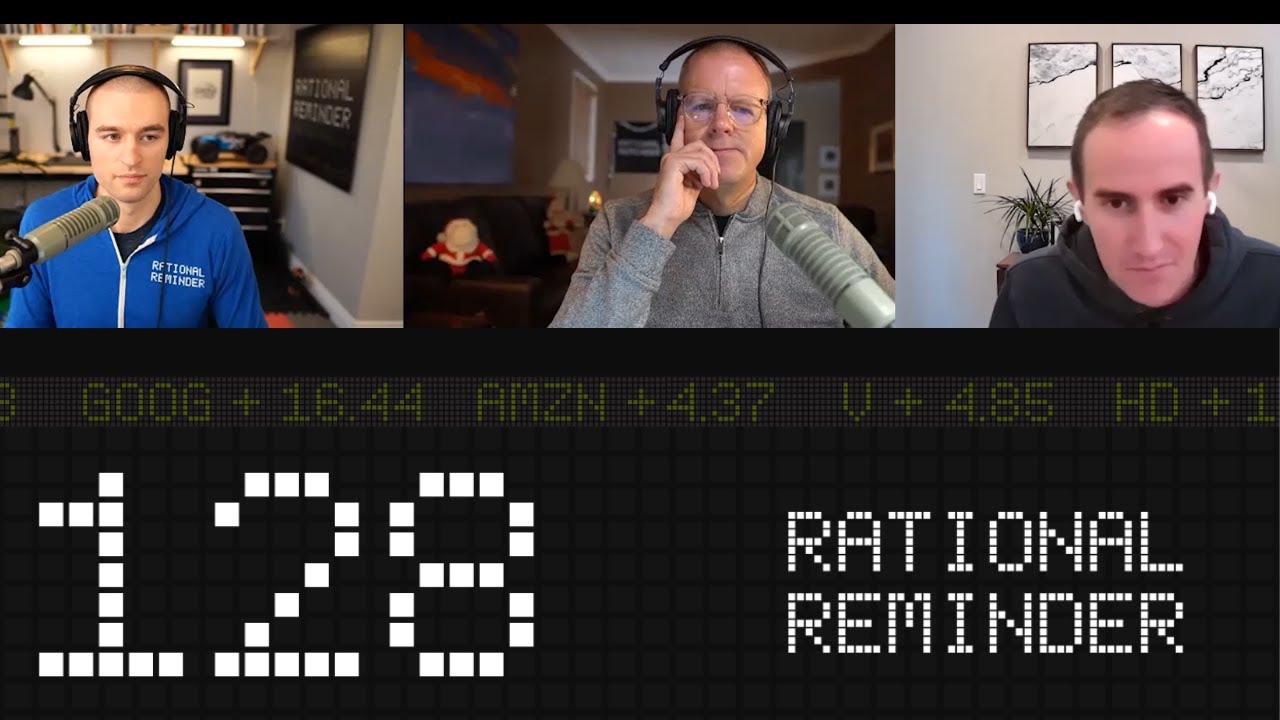
The Rational Reminder Podcast
Compounding depends on behavioral survival rather than analytical intellect, making cash cushions and debt elimination rational shields against panic selling during market crises.
AI-assisted summary of RR #128 - Morgan Housel: The Psychology of Money — original source. Check the original for full context.
Source published:
Key ideas
- Investing success is driven primarily by behavioral discipline—managing fear and greed over decades—rather than raw analytical intelligence or formal credentials. (3:00)
- Outsized financial success is heavily influenced by unrepeatable luck, making granular emulation of super-investors like Warren Buffett or Bill Gates counterproductive. (5:19)
- Prioritizing personal financial endurance over theoretical spreadsheet optimization enables investors to survive market panics and capture exponential long-term compounding. (8:58)
- The core function of bonds in a portfolio is not nominal yield generation, but acting as a psychological shock absorber to prevent forced selling of equities during crashes. (33:36)
Detailed notes
## Background This episode was published on YouTube by The Rational Reminder Podcast channel, hosted by Benjamin Felix and Cameron Passmore, on December 10, 2020. The episode description highlights an in-depth conversation with author and financial expert Morgan Housel about core themes from his book, The Psychology of Money, focusing on how behavior drives investing outcomes far more than intelligence, the dangers of emulating top investors, the psychological purpose of cash and bonds, and why people make financial choices at the dinner table rather than on spreadsheets.
## TL;DR Morgan Housel explains that long-term investment success is dictated by human behavior and emotional endurance rather than raw intellect or complex spreadsheets. He argues that investors should strive to make 'reasonable' decisions that grant personal autonomy and peace of mind—such as carrying zero debt or holding higher cash reserves—even if those choices appear suboptimal in academic models. Examining the interplay between luck, risk, and shifting expectations, Housel outlines why wealth is defined by what remains unspent and how saving like a pessimist allows one to invest like an optimist. The discussion also reframes fixed income as a psychological shock absorber to prevent panic selling, examines the behavioral fragility of lean FIRE strategies, and underscores that severe market drawdowns provide invaluable real-time data about an investor's true risk tolerance.
## Atmosphere & style The conversation carries a thoughtful, grounded, and deeply human tone that bridges academic finance and everyday lived experience. Felix and Passmore act as analytically rigorous yet open-minded sounding boards, creating an engaging dialogue where Housel shares vivid storytelling, philosophical reflections, and personal admissions with disarming humility. The discussion shifts smoothly from high-level market mechanics to vulnerable reflections on panic, family, and existential fear, making the listener feel like a participant in an intimate, reassuring dinner-table reflection on what truly matters in life and finance.
## Bulletin - [03:00](https://www.youtube.com/watch?v=NSaRb-iFwPA&t=180s) Investing success is driven primarily by behavioral discipline—managing fear and greed over decades—rather than raw analytical intelligence or formal credentials. - [05:19](https://www.youtube.com/watch?v=NSaRb-iFwPA&t=319s) Outsized financial success is heavily influenced by unrepeatable luck, making granular emulation of super-investors like Warren Buffett or Bill Gates counterproductive. - [08:58](https://www.youtube.com/watch?v=NSaRb-iFwPA&t=538s) Prioritizing personal financial endurance over theoretical spreadsheet optimization enables investors to survive market panics and capture exponential long-term compounding. - [33:36](https://www.youtube.com/watch?v=NSaRb-iFwPA&t=2016s) The core function of bonds in a portfolio is not nominal yield generation, but acting as a psychological shock absorber to prevent forced selling of equities during crashes.
## Key takeaways - [00:00](https://www.youtube.com/watch?v=NSaRb-iFwPA&t=0s) Financial decisions are made at the dinner table rather than on a spreadsheet, meaning reasonable, psychologically sustainable choices often outperform theoretical mathematical models. - [03:00](https://www.youtube.com/watch?v=NSaRb-iFwPA&t=180s) Investing is unique because an untrained novice dollar-cost averaging into index funds can outperform elite professionals, as behavioral endurance trumps technical expertise. - [05:19](https://www.youtube.com/watch?v=NSaRb-iFwPA&t=319s) Emulating legendary market figures usually fails because granular strategies change over time and extreme outlier success involves an unrepeatable degree of luck. - [08:01](https://www.youtube.com/watch?v=NSaRb-iFwPA&t=481s) Luck and risk are opposite sides of the same coin, as demonstrated by the tragic death of Bill Gates's talented classmate Kent Evans before his business potential could be realized. - [08:58](https://www.youtube.com/watch?v=NSaRb-iFwPA&t=538s) Maximizing financial endurance through zero debt and high cash reserves ensures an investor stays solvent long enough to harvest the backloaded rewards of exponential compounding. - [11:00](https://www.youtube.com/watch?v=NSaRb-iFwPA&t=660s) Academic lifecycle models recommending 2x leverage ignore the devastating psychological reality that an investor who gets wiped out rarely re-enters the market. - [14:37](https://www.youtube.com/watch?v=NSaRb-iFwPA&t=877s) Managing expectations and defining 'enough' is the most vital financial skill, as unchecked lifestyle creep leaves people feeling deprived even as median wealth increases. - [17:05](https://www.youtube.com/watch?v=NSaRb-iFwPA&t=1025s) Money's highest intrinsic value is personal independence and autonomy—the freedom to control your time rather than accumulating depreciating material goods. - [20:02](https://www.youtube.com/watch?v=NSaRb-iFwPA&t=1202s) True wealth is unspent money and invisible balance sheet strength, unlike outward displays of luxury consumption that are frequently financed by debt. - [22:32](https://www.youtube.com/watch?v=NSaRb-iFwPA&t=1352s) Durable investing requires a dual mindset: saving like a pessimist to endure inevitable short-term chaos, while investing like an optimist in human problem-solving over decades. - [25:30](https://www.youtube.com/watch?v=NSaRb-iFwPA&t=1530s) Home bias in equity allocations can be completely reasonable if the comfort and familiarity of local companies prevent an investor from capitulating during downturns. - [27:35](https://www.youtube.com/watch?v=NSaRb-iFwPA&t=1655s) Financial advisors should act as personal financial psychologists and objective guides rather than information gatekeepers, helping clients uncover unexamined blind spots. - [30:20](https://www.youtube.com/watch?v=NSaRb-iFwPA&t=1820s) A portfolio of simple index funds is designed to eliminate active levers and behavioral friction points, respecting Charlie Munger's rule never to interrupt compounding unnecessarily. - [33:36](https://www.youtube.com/watch?v=NSaRb-iFwPA&t=2016s) The four-decade bull market in fixed income was an anomaly; modern bonds exist primarily as a behavioral airbag to keep equity holdings intact through market crises. - [38:12](https://www.youtube.com/watch?v=NSaRb-iFwPA&t=2292s) Daniel Kahneman's key lesson from surprises is not to patch a single forecast model, but to accept that the world is intrinsically surprising and dominated by unpredictable shocks. - [42:08](https://www.youtube.com/watch?v=NSaRb-iFwPA&t=2528s) The FIRE movement's lean retirement assumptions and 4% safe withdrawal rules remain psychologically unproven when faced with prolonged bear markets or stagnant decades. - [44:04](https://www.youtube.com/watch?v=NSaRb-iFwPA&t=2644s) Fintech has commoditized investment management fees toward zero, but algorithmic platforms cannot easily scale holistic human advice around messy personal life events. - [45:58](https://www.youtube.com/watch?v=NSaRb-iFwPA&t=2758s) Capitulating during market crashes is understandable human behavior; enduring severe panic provides a valuable 'new data point' about an investor's true lived risk tolerance. - [50:59](https://www.youtube.com/watch?v=NSaRb-iFwPA&t=3059s) Historical crises like the 1930s Great Depression and the March 2020 pandemic reveal how close modern systems come to total collapse, requiring humility about systemic stability. - [52:56](https://www.youtube.com/watch?v=NSaRb-iFwPA&t=3176s) Ultimate success is defined not by career prestige, educational pedigree, or net worth, but by devotion to family and dedicating hard work to the care of loved ones.
## Detailed walkthrough ### [00:00](https://www.youtube.com/watch?v=NSaRb-iFwPA&t=0s) Rationality vs. Reasonableness at the Dinner Table
The episode opens with hosts Benjamin Felix and Cameron Passmore introducing their guest, Morgan Housel, partner at The Collaborative Fund and author of *The Psychology of Money*. Cameron remarks on the excitement surrounding the release of Morgan's book and praises the quality of the discussion. Reflecting on the conversation, Benjamin draws a parallel between Morgan’s insights and an earlier episode featuring Josh Brown and Dr. Brian Portnoy (Episode 126), where they explored the idea that what is strictly rational on paper is not necessarily optimal in real life.
Benjamin observes that while it remains crucial to understand rational principles to provide a solid baseline, people should not feel handcuffed to purely mathematical choices if those choices fail to match human nature. He highlights Morgan's framing that human finance cannot be separated from everyday lived reality, noting, “morgan explains it as people don't make decisions on financial decisions on a spreadsheet they make them at the dinner table and i think that's a pretty good way to say it.” Cameron agrees, commending Morgan’s regular, must-read biweekly blog posts and his compelling personal storytelling. Benjamin confesses that when he initially read Morgan’s book, it did not immediately strike him as technically groundbreaking, but after sitting with it for several days, he realized its true impact: it serves as an indispensable tool for helping clients navigate practical financial dilemmas rather than just providing analytical theory.
[03:00](https://www.youtube.com/watch?v=NSaRb-iFwPA&t=180s) Why Behavior Beats Intelligence in Investing
Cameron kicks off the interview by congratulating Morgan on the book's reception and brings up a striking line from the text: in no other profession can someone with zero training outperform someone who has dedicated their entire career to studying the field. Morgan elaborates on the thought experiment of an untrained layperson who simply dollar-cost averages into basic index funds and lets them compound undisturbed for 40 years. That individual could easily end up in the top decile of all investors over their lifetime without ever attending Harvard Business School, working at Goldman Sachs, or possessing specialized financial knowledge. Morgan contrasts this with medicine, pointing out that it is entirely unthinkable that someone without medical school or clinical training could ever perform in the top decile of heart surgeons.
While luck plays a partial role in explaining why financial novices can beat seasoned professionals, Morgan argues that the deeper explanation lies in the nature of investing itself: “doing well at investing is not about what you know it's not about how smart you are it's not about where you went to school or how sophisticated you are it's not about the amount of information that you have doing well at investing is by and large how you behave.” Financial success hinges on behavioral traits—navigating fear and greed, knowing whom to trust, managing panic when the world appears to be falling apart, and keeping one's head straight. Morgan warns that textbook geniuses who attend elite business schools can still fail catastrophically because raw analytical horsepower is useless if emotional instability sabotages execution.
```mermaid flowchart TD accTitle: Behavior Neutralizing Analytical Intelligence accDescr: A diagram showing how analytical skill is filtered through emotional behavior to produce investment outcomes.
subgraph Inputs["Investor Capabilities"] A["Analytical Intelligence<br/>(Degrees, technical skills)"] B["Information & Data<br/>(Ratios, modeling)"] end
subgraph Filter["Behavioral Filter"] C{"Psychological Control<br/>(Fear, greed, endurance)"} end
subgraph Outcomes["Portfolio Results"] D["Compounded Success<br/>(Long-term top decile)"] E["Catastrophic Failure<br/>(Panic selling, excessive risk)"] end
A --> C B --> C C -->|"Disciplined behavior"| D C -->|"Emotional breakdown"| E ```
[05:19](https://www.youtube.com/watch?v=NSaRb-iFwPA&t=319s) The Dangers of Emulating Super-Investors
Benjamin builds on this topic by asking about the risks of retail investors trying to copy the strategies of legendary market figures such as Warren Buffett, Ray Dalio, or Benjamin Graham. Morgan clarifies that while studying great investors is natural—and something he does himself—the primary flaw is that people tend to extract lessons that are far too specific. Granular takeaways, such as hunting for net-nets trading below 1.2 times net working capital because Benjamin Graham recommended it, often fail because market environments change drastically over time. What worked in 1960 may have zero utility today.
Instead, Morgan emphasizes that investors should focus on big, broad, 30,000-foot takeaways. In the case of Warren Buffett, the meaningful lesson is not a narrow valuation formula, but rather the reality that Buffett has been compounding his capital continuously for over 80 years. That sheer duration and persistence, rather than raw stock-picking wizardry in any single decade, drove his fortunes. Furthermore, Morgan points out that extreme outliers naturally introduce another insurmountable variable: unrepeatable luck. Addressing the role of luck at the very top, Morgan states: “the more successful that someone is the more likely it is that a degree of luck fueled their success not 100 i'm not saying bill gates and warren buffett were just lucky but is there an element of luck involved in it yes of course there's a very big element of luck involved and therefore the ability for me or you or anyone else to copy their success is substantially hindered because you cannot emulate luck.”
[08:01](https://www.youtube.com/watch?v=NSaRb-iFwPA&t=481s) Luck, Risk, and the Story of Kent Evans
Benjamin brings up an anecdote from the book illustrating this interplay between luck and risk: the story of Bill Gates and his high school friend Kent Evans at Lakeside School. Morgan explains that while Gates's immense success is celebrated worldwide, few people know that Gates shared an equally ambitious vision with Evans. By Gates’s own estimation, Evans was actually smarter, harder-working, and possessed a sharper business mind than Gates himself. The two boys had concrete plans to attend college together and co-found a business, meaning Evans could have very easily ended up as the co-founder—or even the driving force—behind Microsoft.
Tragically, that potential future was erased when Evans died in a mountaineering accident while still a teenager. Morgan notes that this contrast underscores the razor-thin margin between incredible success and devastating loss. Luck and risk are opposite sides of the exact same coin: both involve outside forces altering life outcomes in ways that individual talent and effort can neither predict nor control.
- Kent Evans was considered by Bill Gates to be the most talented and business-minded member of their close-knit circle at Lakeside School. - Evans died in a mountaineering accident at age 18 or 19, demonstrating how uncontrollable risks can alter the course of history before talent can be realized.
[08:58](https://www.youtube.com/watch?v=NSaRb-iFwPA&t=538s) Conservative vs. Margin of Safety: Maximizing Endurance
The conversation turns to the idea of bad luck and how an investor prepares for it. Morgan Housel distinguishes between merely being conservative and holding a margin of safety to achieve financial longevity. Looking at his personal finances, an outsider might conclude he is simply timid or risk-averse: he holds a high percentage of his net worth in cash and carries zero debt. However, Housel rejects the label of being "conservative." His true objective is maximizing financial endurance. He wants to be so structurally unbreakable in the short run that he guarantees his ability to survive long enough for his equities to compound over decades.
```mermaid flowchart TD accTitle: Compounding and Endurance Flowchart accDescr: Diagram illustrating how low leverage and high cash prevent margin calls, enabling long-term compounding.
subgraph Defense["Financial Defense"] A["High Cash Reserves + Zero Debt"] --> B["Unbreakable Short-Term Balance Sheet"] B --> C["Survive Shocks Without Panic or Margin Calls"] end
subgraph Outcome["Compounding Horizon"] C --> D["Remain Invested Over Decades"] D --> E["Exponential Dollar Gains in Final Years"] end ```
Compounding math dictates that the largest dollar gains inevitably arrive at the very tail end of an investment horizon. In a 30-year span, the final few years produce the vast bulk of the wealth because the growth is exponential. Therefore, an investor's single most important task is staying in the game. Housel points out that aggressive strategies that "swing for the fences" often backfire by dramatically raising the probability of being ejected from markets—either financially through a margin call or psychologically through sheer panic. While an ultra-safe stance may look timid from the outside, Housel argues it is actually the most rational way to capture compounding:
> “The game that I want to play is acknowledging how ridiculously powerful compounding is and therefore increasing the odds that I will be able to stick around long enough for compounding to work.”
[11:00](https://www.youtube.com/watch?v=NSaRb-iFwPA&t=660s) The Psychology of Leverage and Dinner Table Decisions
The hosts bring up the concept of lifecycle investing popularized by Ian Ayres and Barry Nalebuff, which academically argues that young investors should use leverage to smooth their asset exposure across time. Housel responds by referencing a Yale study from about a decade prior which concluded that backtested portfolios using 2x leverage (margin) generate vastly superior life outcomes, even if the investor suffers a total wipeout once every 30 years—provided they resume investing with 2x leverage the very next day. Housel views this conclusion as detached from human reality:
> “If you get wiped out, you're going to say screw this, I'm never doing this again, this is has been a scam, I'm out of here.”
When academic models disregard the psychological damage of catastrophic drawdowns, they miss the reality of how human beings function. On a more philosophical level, Housel explains that debt inherently compromises personal autonomy by pre-allocating future income to someone else. His personal primary financial goal is independence—the freedom to control his time and wake up each morning answering to no one. To that end, Housel and his wife paid off their mortgage:
> “My wife and i paid off our mortgage a couple years ago, which I write in the book was the worst financial decision we've ever made.”
On a spreadsheet, eliminating a low-interest mortgage makes no financial sense, but in terms of daily mental peace, having negligible fixed monthly housing costs dramatically enhanced their sense of freedom. Housel highlights that financial choices are not made on software grids; rather, “they make financial decisions at the dinner table.” Investors should feel comfortable embracing decisions that look suboptimal on paper if they satisfy their personal temperament, manage fear, and grant emotional security.
[14:37](https://www.youtube.com/watch?v=NSaRb-iFwPA&t=877s) Managing Expectations and Defining "Enough"
Discussing chapter three of his book, *Never Enough*, Housel explores how fortunes are repeatedly lost by wealthy individuals who cannot stop reaching for more. He identifies the core financial challenge as psychological rather than technical:
> “Well, I think the most important financial skill for anyone is just getting the goal post to stop moving.”
When expectations rise in tandem with wealth, an investor remains trapped on a hedonic treadmill, feeling no better off despite substantial gains. While the financial industry obsesses over optimizing returns and boosting income, Housel argues that an equal amount of energy must be devoted to regulating desires and expectations. Without this discipline, people inevitably wonder why hitting a specific income or portfolio milestone failed to make them happier.
To demonstrate that this dynamic operates at a societal scale, Housel contrasts modern life with the 1950s: - **Inflation-Adjusted Median Income:** The median U.S. household income today is roughly double what it was during the 1950s. - **Cultural Perception:** Despite being twice as wealthy in real terms today, the 1950s are remembered nostalgically as the golden era of middle-class prosperity. - **Home Sizes:** The median new single-family house in the 1950s measured around 950 square feet; by contrast, a median new home today is approximately 2,400 square feet.
Because material expectations have grown faster than real incomes, people experience a persistent sensation of falling behind. Housel emphasizes that having a clear concept of "enough" does not mean living like an ascetic monk; it simply requires intentionality to prevent ever-expanding desires from eroding the peace of mind that wealth is supposed to provide.
[17:05](https://www.youtube.com/watch?v=NSaRb-iFwPA&t=1025s) Expectations, "Enough," and the Intrinsic Value of Independence
To truly feel satisfied with your financial situation, Morgan Housel stresses that you must actively manage your expectations and keep them lower than your impulses urge them to be. Without that conscious dampening, you will never be happy with what you have, particularly if you are fortunate enough to experience a rising income and an expanding net worth over your career.
When asked about the concept of having "enough" and what constitutes money's greatest intrinsic value, Housel identifies independence and autonomy above all material goods. While he acknowledges that he appreciates nice cars and homes just like anyone else, he argues that the real lifestyle uplift comes from freedom:
> “And being able to do what you want when you want with who you want for as long as you want, that to me is something that I think you will never get accustomed to.”
Material possessions inevitably fall prey to hedonic adaptation; you get used to the mansion or the Ferrari, and their perceived benefits erode. Independence, however, never loses its luster. Even more painfully, lacking independence creates persistent misery. Being trapped in a job you dislike simply because you have bills to pay grinds people down over time. For Housel, accumulated savings and wealth exist solely to decrease reliance on others, allowing him to do the work he wants for as long as he finds it fulfilling.
This philosophy extends to leaving on one's own terms. Housel reflects on admiring figures like Jerry Seinfeld, who walked away from *Seinfeld* while sitting on top of the world. In roughly 1998 or 1999, NBC reportedly offered Seinfeld $100 million for an additional single season, but he declined because he wanted to bow out gracefully. Seinfeld explained that he had zero interest in experiencing the downside—enduring the inevitable ratings cliff and being pushed out when the audience had grown tired of him. That ability to say "I've had enough" and exit cleanly represents the real power of financial independence.
[20:02](https://www.youtube.com/watch?v=NSaRb-iFwPA&t=1202s) The Invisibility of Wealth and False Role Models
When people proclaim that they want to be a millionaire, Housel points out that their underlying desire is usually the exact opposite of reality:
> “Particularly young men, to single them out, when they say they want to be a millionaire, what they really mean is, ‘I want to spend a million dollars,’ which, as I read in the book, is literally the opposite of being a millionaire.”
True wealth is what remains unspent. It is the capital retained in investments, savings, and bank balances. Because unspent money is hidden from public view, wealth itself becomes completely invisible:
```mermaid flowchart TD accTitle: Visibility of Consumption Versus Invisibility of Wealth accDescr: Contrasting external displays of consumption against unseen assets and debt to illustrate why financial appearances mislead.
subgraph Visible["Visible Signals (External Display)"] A["Cars, Homes, Clothes"] end
subgraph Invisible["Invisible Reality (True Balance Sheet)"] B["Brokerage Statements & Cash Reserves"] C["Hidden Liabilities & Crushing Debt"] end
Visible -.->|"Often Confused With"| B Visible -->|"Frequently Funded By"| C ```
You can observe someone's clothing, house, and automobile, but you cannot inspect their brokerage statements or debt loads. This dynamic separates finance from something like physical fitness. With physical fitness, someone who is athletic or someone who is obese is immediately apparent; an observer can admire their physique and use them as an accurate, visible benchmark to emulate.
In finance, the absence of visibility breeds destructive misconceptions. Society ends up following false role models because a shockingly high percentage of people flaunting the outward trappings of wealth—such as leased exotic supercars and oversized houses—are actually buried under debt and barely making their monthly payments. Emulating their apparent success means emulating high consumption and hidden financial distress rather than genuine wealth.
[22:32](https://www.youtube.com/watch?v=NSaRb-iFwPA&t=1352s) Saving Like a Pessimist and Investing Like an Optimist
When committing to long-term investing through vehicles like low-cost index funds, investors struggle to reconcile pervasive negative headlines with the optimism required to stay the course. To manage this tension, Housel offers a core guiding framework:
> “The big philosophy that I have for my own money, and I think it will work for a lot of other people too, is save like a pessimist and invest like an optimist.”
- **Saving like a pessimist:** Historical data reveals that short-term chaos is the default state of the world. Economic history is an unbroken chain of recessions, bear markets, bankruptcies, and missed forecasts. By holding an ample cushion of cash and avoiding debt, an investor builds the endurance needed to survive that continuous gauntlet without getting wiped out. - **Investing like an optimist:** Over generational horizons, economic history demonstrates relentless human problem-solving and progress. Compounding requires long runways to produce dramatic gains, and that payoff accrues to those who believe humanity will continually advance.
Housel ties this dual mindset to the critical distinction between getting rich and staying rich: - **Getting rich** requires risk-taking, swinging for the fences, and maintaining broad optimism about the future. - **Staying rich** requires the opposite trait: healthy paranoia, humility regarding unknown risks, and an aversion to catastrophic drawdowns.
Most people intuitively believe they must choose one camp—becoming either a starry-eyed optimist or a bunker-dwelling doomer. However, durable financial success requires nurturing both conflicting mentalities simultaneously.
[24:57](https://www.youtube.com/watch?v=NSaRb-iFwPA&t=1497s) Spreadsheets vs. The Dinner Table
When asked whether people should strive to be rational—the namesake of the podcast—Housel pushes back against pure mathematical optimization. He argues that viewing personal finance as identical to physics or pure math, where two plus two always equals four and the investor simply executes whatever the formula outputs, fundamentally misreads human nature.
Instead, real financial decisions are not made on pristine spreadsheets; they are made at the dinner table, where human emotions, household goals, and personal fears take precedence over theoretical optimality.
[25:30](https://www.youtube.com/watch?v=NSaRb-iFwPA&t=1530s) Being Reasonable vs. Rational and the Logic of Home Bias
Morgan Housel explains that because everyone possesses distinct personalities, histories, goals, family dynamics, spending patterns, and views on politics, two equally intelligent and well-informed individuals can easily arrive at entirely different financial decisions. What makes sense for one person’s money might look completely illogical to another, and that does not indicate a flaw or an argument. Housel compares personal finance to dating and finding a spouse: everyone has a distinct idea of what they are looking for, which means you cannot condense what makes an ideal partner into a neat mathematical equation.
Because personal financial management is nuanced and individual, Housel argues that aiming to make “reasonable” decisions rather than purely “rational” ones is a far healthier objective. He revisits his own decision to pay off his mortgage. Whenever he brings it up, people attempt to walk him through the math, but he stops them immediately, acknowledging that on paper it makes no mathematical sense. He chose it simply because it was reasonable for his family and made them happier. Housel points to the well-documented phenomenon of home bias as another prime example.
```mermaid flowchart TD accTitle: Rational versus Reasonable Framework accDescr: Contrasts spreadsheet-optimized rational choices with behavior-supporting reasonable choices using home bias as an example. subgraph RationalApproach["The Purely Rational Approach"] R1["Optimize on a spreadsheet"] --> R2["Maximize global diversification"] R2 --> R3["Mathematically superior"] end subgraph ReasonableApproach["The Reasonable Approach"] B1["Align with psychology & comfort"] --> B2["Invest locally via home bias"] B2 --> B3["Increases endurance to stay invested"] end ```
It is not rational for an American to hold almost exclusively US equities or a German investor to stick only to German equities, as geographic proximity has no bearing on expected returns. However, holding familiar companies that an investor drives past every single day can be remarkably reasonable if that sense of familiarity gives them the conviction to stay in the market for decades rather than panicking.
- “And I think for financial decisions, aiming to be reasonable instead of rational is probably the better goal for people.” — Morgan Housel - Home bias serves as an emotional anchor: familiarity helps ordinary investors maintain the leap of faith necessary to remain invested through turbulent periods.
[27:35](https://www.youtube.com/watch?v=NSaRb-iFwPA&t=1655s) The Role of the Financial Advisor: From Engineer to Psychologist
Cameron Passmore asks where professional financial advice fits into this dynamic—specifically, whether an advisor should serve as the rational voice helping clients strike a balance between rational and reasonable. Housel responds with an analogy to medicine. When a patient faces a terminal illness like cancer, a good physician outlines the diagnosis, reviews the science, and details the available options. One patient may opt for aggressive chemotherapy and extensive surgeries, whereas another may prefer palliative care, morphine, and staying at home to let nature run its course. Both choices can be valid for the respective individuals, and the doctor's job is not to dictate the choice, but to present the landscape so the patient can choose.
Financial advisors operate under a similar paradigm. Advisors should outline historical market returns, the mechanics of the economy, and the available investment routes, but ultimately ask the client what best matches their life. Housel cites a quote from financial planner Tim Maurer to reinforce the point. Advisors must shift away from acting like analytical engineers who hoard information, and instead view themselves as personal financial psychologists who guide clients through their unique circumstances. Benjamin Felix concurs, noting that the mission of *The Rational Reminder Podcast* is not to force people into rigid spreadsheet rationality, but rather to give listeners the baseline facts a rational person would use so they can make informed, reasonable choices.
- “Personal finance is more personal than it is finance.” — Tim Maurer (quoted by Morgan Housel) - Smart, well-meaning individuals will arrive at completely divergent conclusions even when sharing identical ages, incomes, and assets. - Advisors succeed when they act as contextual guides and behavioral sounding boards rather than algorithmic gatekeepers.
[30:20](https://www.youtube.com/watch?v=NSaRb-iFwPA&t=1820s) The Active vs. Passive Debate and Designing for Endurance
Cameron Passmore highlights Housel’s writing on how the financial industry has become unnecessarily entrenched in the active versus passive management debate, and asks if there are circumstances where an investor might be better off pursuing an active strategy. Housel clarifies his own approach: he is an index investor whose entire net worth consists of a house, a checking account, and Vanguard index funds. However, he refuses to take the dogmatic stance of a passive zealot who claims nobody can ever beat the market or that all active managers are merely rent-seekers. Housel knows and respects gifted investors who will genuinely generate market-beating returns over time.
Even so, Housel chooses not to invest in active funds, which might seem hypocritical on the surface. His decision comes down to endurance. He recognizes that staying disciplined in simple index funds over the next 30, 40, or 50 years will comfortably meet all his financial goals and place him in the top decile of all investors over that horizon. Adding active managers introduces more levers to pull, more knobs to fiddle with, and more decision points where emotions or bad timing can disrupt the portfolio. Drawing on a famous Charlie Munger principle, Housel argues that simplifying his portfolio removes unnecessary interventions and preserves his longevity. If an investor's central priority is to outperform over the next five to ten years, Housel believes capable active managers do exist for them—it simply does not match his personal priorities.
- “The first rule of compounding is to never interrupt it unnecessarily.” — Charlie Munger (quoted by Morgan Housel) - “And the fewer decisions that I have to make, the more endurance I'm going to have, so that's why I want the simplest strategy.” — Morgan Housel - Housel’s portfolio simplicity is not driven by disbelief in active talent, but by a conscious effort to eliminate behavioral failure points.
[32:48](https://www.youtube.com/watch?v=NSaRb-iFwPA&t=1968s) Reassessing Fixed Income After a 40-Year Tailwind
Benjamin Felix pivots the discussion to fixed income, an area of mounting concern among investors due to historically low interest rates following several decades of strong bond performance. Felix asks how people should rethink fixed income and conservative allocations, especially given Housel’s personal preference for holding a substantial cash reserve rather than relying on conventional fixed-income products.
Housel points out that investors must place recent market history into perspective. The financial world experienced a roughly 40-year tailwind of steadily falling interest rates, beginning in the early 1980s. Throughout that secular bull market, long-term US Treasury bonds generated exceptional gains, frequently rivaling or outperforming standard stock portfolios. Housel stresses that investors cannot extrapolate those historical returns into the future now that the global economy sits in a near-zero interest rate regime, which strips away the high yields and outsized price appreciation that bond investors took for granted for four decades.
- “I think the biggest thing about fixed income is that, you know, we had a 40-year period now with falling interest rates where you could earn great returns on bonds.” — Morgan Housel - Over the prior three to four decades, holding long-term Treasuries produced equity-like returns due to relentless downward pressure on interest rates. - The shift to a near-zero interest rate environment alters the fundamental risk-reward calculation and purpose of traditional bond holdings.
[33:36](https://www.youtube.com/watch?v=NSaRb-iFwPA&t=2016s) The Real Purpose of Bonds: A Psychological Airbag
Morgan Housel explains that the period from roughly 1980 to 2010—when bonds acted as phenomenal return generators—was an extreme historical fluke, not the baseline norm. Investors earning low or negligible real yields today are actually experiencing the historical standard. Rather than expecting fixed income to build significant wealth, investors need to fundamentally reframe what bonds are designed to do. In Housel’s view, bonds exist as a psychological shock absorber to keep an investor from being terrified into selling their equities during a crash.
If an investor holds a classic 60/40 balanced portfolio, the sole mandate of the 40% fixed income sleeve is to ensure they leave the 60% equity sleeve untouched. It prevents them from being forced out of markets financially or spooked out psychologically. Looking at a bond portfolio yielding just 0.3% and lamenting the low nominal payout misses the larger point: if that flat or low yield prevents an investor from capitulating in 2008 or during the March 2020 crash, the hidden return on those bonds is astronomically high. The catastrophic, unrecoverable damage caused by panic selling equities vastly outweighs any yield deficiency. As Morgan put it: “So if you have a 60 40 portfolio the 40 that you have in bonds the sole purpose of that is to make sure that you can leave the 60 you have in stocks alone that's its purpose you don't get scared out you know that you don't get pushed out financially or psychologically and that's a really important part of a portfolio.”
- The 1980–2010 run in fixed income was an exceptional bond bull market, whereas near-zero real returns reflect typical historical norms. - The hidden return of bonds manifests during sharp sell-offs (e.g., March 2020, the 2008 Financial Crisis) by neutralizing panic.
```mermaid flowchart TD accTitle: The Psychological Function of Bonds accDescr: Diagram illustrating how holding bonds prevents panic selling and preserves long-term portfolio growth.
subgraph Portfolio["Portfolio Split"] B["40% Fixed Income<br/>Low nominal return (~0.3%)"] S["60% Equities<br/>Primary long-term growth driver"] end
subgraph MarketShock["Market Crisis (e.g., March 2020)"] D["Extreme Drawdown & Fear"] end
subgraph PsychologicalOutcome["Behavioral Protection"] B -->|"Serves as airbag"| D D -->|"Prevents forced selling"| S S -->|"Left untouched"| R["Compounded Lifetime Returns Intact"] end ```
---
[35:19](https://www.youtube.com/watch?v=NSaRb-iFwPA&t=2119s) Financial Advisors as Financial Psychologists
Responding to a question referencing Tim Maurer’s maxim that the personal side of personal finance matters most, Housel draws a parallel between financial advisors and medical doctors. Most physicians see their own general practitioners rather than treating themselves. That choice is not driven by a gap in medical knowledge; it is driven by the need for an objective, emotionally detached expert. An outside clinician does not carry the patient's internal blind spots and can dispassionately point out unhealthy habits or uncomfortable realities. Investors require that exact same dynamic. Even the most sophisticated market participants possess psychological blind spots that make them ignore critical topics simply because they find them boring or emotionally painful.
Housel shares his own experience: despite writing about investing and money professionally, he had never consulted a financial advisor until about a year prior. When he finally opened up his personal finances completely to a close advisor friend, his friend highlighted ten issues he had never considered. Housel admitted that his own ego had historically whispered, *“I know a lot about investing this is what i do for as a profession i don't need a financial advisor.”* Confronting those overlooked items proved profoundly eye-opening. Thirty years ago, Wall Street advisors operated as gatekeepers of secret data, mutual fund selections, and tax codes. Today, with Vanguard, Betterment, and free information everywhere, mechanics are commoditized. The contemporary advisor’s primary value lies in acting as a behavioral therapist who uncovers what clients prefer to ignore: “Again it it's much more closer i think to being a financial psychologist which was not the case 20 or 30 years ago when back before the internet era a financial advisor was an information gatekeeper.”
---
[38:12](https://www.youtube.com/watch?v=NSaRb-iFwPA&t=2292s) 2020 and the Kahneman Lesson: The World Is Surprising
When asked about the major takeaways from 2020, Housel references an insight shared by Nobel laureate Daniel Kahneman during a large dinner gathering around 2017. Kahneman observed that people routinely misinterpret surprises by assuming they only lacked a specific variable that can simply be patched into their forecast model. Kahneman argued that the only correct conclusion to draw when caught off-guard is far simpler: the world is fundamentally surprising.
Housel applies this to markets and global events, arguing that the biggest threat in any given year is almost by definition the thing absent from news headlines and forecasting models. Widely covered issues—election outcomes, trade tensions, pending tax policy shifts—are certainly risky, but market participants already track and price them. The catalysts that cause structural upheaval, like COVID-19, September 11th, or Pearl Harbor, blindside the public precisely because nobody anticipated them the day before they occurred. Over longer horizons, this dynamic intensifies: there is a 100% probability that the defining news event of the next half-century is something no one is currently discussing. Referencing Nassim Nicholas Taleb's black swan concept, Housel notes that it is precisely the absence of preparation that turns an unexpected surprise into an economic disaster: “The surprising aspect of it is what makes it a big deal because no one's prepared for it so it completely upends their plans people get completely wiped out overnight because something happened that they weren't expecting.”
- Daniel Kahneman’s takeaway: Surprises should not refine individual models; they should remind forecasters that the future is intrinsically unknowable. - Known risks (elections, trade disputes, tax changes) rarely cause total systemic disruption because market participants anticipate and hedge them. - Outsized historical shocks operate via Taleb-style black swans: their suddenness destroys unprepared capital.
---
[40:43](https://www.youtube.com/watch?v=NSaRb-iFwPA&t=2443s) The Dilemma of Early Retirement in the FIRE Movement
Turning to the Financial Independence, Retire Early (FIRE) movement, Housel agrees enthusiastically with the core ambition of building personal autonomy, yet raises a skeptical eyebrow at the literal execution of the "retire early" mandate. While he finds the discipline of high savings rates commendable, completely stepping away from the workforce at age 25 or 35 often causes unexpected psychological distress. Work provides structure, social connection, and a tangible sense of purpose; completely abandoning productive output frequently leaves retirees feeling disconnected and untethered from society.
Housel acknowledges that most sophisticated proponents of FIRE do not actually advocate sitting idle; rather, they use financial freedom to switch into lower-paying, high-fulfillment vocations. However, for the faction attempting to retire at 25 merely to play golf, the novelty wears off quickly. Within a couple of months, an aimless lifestyle typically breeds dissatisfaction because human beings thrive on contributing value alongside peers: “And in my view the majority of those people not all of them but the majority after doing that for about two months will say this isn't what i expected i'm not happy because they're not happy because they're not they're not providing value in the world they're not tied in with a group of co-workers that they love they're not being productive in the world.”
[42:08](https://www.youtube.com/watch?v=NSaRb-iFwPA&t=2528s) The Vulnerability of the FIRE Movement and the 4% Rule
Morgan Housel expresses skepticism regarding the long-term viability of the FIRE (Financial Independence, Retire Early) movement, pointing out that it emerged and gained massive popularity during a historic, uninterrupted bull market starting around 2011 and 2012. During that decade, equity markets consistently delivered 15% to 20% annual returns, making wealth accumulation appear deceptively straightforward. Although the market experienced a sharp 35% drop in March 2020, it rebounded almost immediately. Housel questions how the FIRE movement would hold up if investors encountered prolonged economic hardship analogous to the aftermath of 2008—which took years to recover—or the stagflation of the 1970s and 1980s, where real returns were nonexistent for roughly two decades.
```mermaid flowchart TD accTitle: The Psychological Friction in FIRE accDescr: Diagram illustrating how extended market drawdowns break tight FIRE assumptions.
subgraph MarketShock["Severe Economic Conditions"] A["Prolonged Bear Market<br>(e.g., 50% drop, 10–20 stagnant years)"] end
subgraph LeanFIRE["Lean Portfolio Assumptions"] B["Retiring on $300k–$400k<br>Skimming spending margins"] end
subgraph Outcome["Behavioral Breakdown"] C{"Can you endure psychologically?"} D["Theoretical survival<br>via 4% Rule backtests"] E["Psychological collapse<br>& panic selling"] end
A --> C B --> C C -->|"Spreadsheet logic"| D C -->|"Human reality"| E ```
The situation is especially perilous for individuals pursuing "lean" FIRE, who shave their margins dangerously thin by attempting to retire on nest eggs of $300,000 to $400,000. Housel emphasizes that watching a modest $300,000 net worth cut in half to $150,000 during an extended decade-long slump becomes an existential crisis. Benjamin Felix notes that while the classic 4% safe withdrawal rule was backtested historically against the harsh economic conditions of the 1970s and 1980s, technical survival on a spreadsheet differs sharply from emotional endurance. As Morgan Housel highlights: “It's not that you can't withstand it in technical terms, to me it's more like can you stand it in psychological terms?” Benjamin Felix observes that the reliance on such spending rules ultimately demands enormous faith, which is why adherents often react with intense anger when critics point out the flaws in their assumptions.
- **Bull market tailwinds:** The FIRE community largely formed between 2011 and 2012, riding double-digit annualized equity returns. - **Fragile margins:** Many practitioners attempt to retire on only $300,000 to $400,000, leaving virtually zero buffer for extended drawdowns. - **The real test:** Enduring a 50% drop over a decade is a psychological challenge rather than purely a mathematical problem.
---
[44:04](https://www.youtube.com/watch?v=NSaRb-iFwPA&t=2644s) Why Holistic Financial Advice Has Not Been Disrupted by Fintech
The conversation turns to financial innovation and how low-cost index funds have permanently transformed money management. When asked what the next big technological breakthrough for individual investors might be, Morgan Housel argues that the portfolio management side of the industry has already been solved. Software and robo-advisors have automated asset allocation and rebalancing, driving investment management fees down to near zero. However, scaling human financial advice remains an unsolved challenge because individual human lives are too messy for automated algorithms.
Housel points out that while platforms like Betterment can easily assign an age-based asset allocation, software struggles with the qualitative complexities of financial planning: distinct personality quirks, career transitions, spending habits, marital strains, and divorce. Because true comprehensive planning resists automation, financial advisory fees have stayed largely unchanged over the past two decades, even as underlying fund expense ratios plunged by 90%. Housel identifies this uncracked challenge as the single biggest opportunity for ambitious fintech entrepreneurs, though he admits he has no idea how one would successfully disrupt it.
- **Portfolio commoditization:** Asset allocation and fund management have been effectively automated, pushing investment fees toward zero. - **Fee stickiness:** Advisory fees have held firm over the last 10 to 20 years because human guidance cannot be easily standardized. - **The fintech frontier:** Automating holistic advice across messy life events—like marriage, lifestyle goals, and divorce—remains the elusive missing link.
---
[45:58](https://www.youtube.com/watch?v=NSaRb-iFwPA&t=2758s) Empathy for Selling in Panics and the Near-Catastrophes of 2008 and 2020
Cameron Passmore asks Housel what he would have told an investor who called him on March 23, 2020—the bottom of the COVID-19 crash—demanding to sell everything and move to cash. Housel admits that while the textbook answer is unequivocally “don't,” he has genuine empathy for those who capitulate. Money exists to provide a good life, and if the dread of watching a portfolio disintegrate causes parents sleepless nights wondering if they can still afford college for their children, dumping stocks to stop the pain is understandable. He likens it to a lawyer who racks up $200,000 in student debt, grinds through three years of law school, lands a prestigious New York corporate law firm job, realizes they despise it, and quits to become a school teacher. While selling equities at the bottom severely damages long-term wealth, walking away from emotional misery is a valid human choice:
> “The purpose of money is to give you a good life. That's why we're doing this, and if the amount of financial uncertainty of watching your portfolio decline, if that's giving you a bad life, if you're losing sleep... bailing out is going to relieve that pressure, I'm empathetic to that, even if I think it's the wrong answer.”
```mermaid flowchart LR accTitle: Unprecedented March 2020 Pandemic Shock accDescr: Contrast between historical downturn shocks and the March 2020 pandemic collapse.
subgraph Historical["Past Baselines"] H1["Great Depression:<br>Industry revenues down 25–30%"] end
subgraph March2020["March 2020 Reality"] M1["Pandemic Shutdown:<br>Airline revenues down 90%"] M2["Existential Terror:<br>Buying guns, ammunition, & plywood"] end
subgraph PolicyLuck["Massive Policy Intervention"] P1["CARES Act & Federal Reserve"] P2["Avoided 'Great Depression 2'"] end
Historical -.->|"Eclipsed by"| March2020 March2020 --> P1 P1 --> P2 ```
Housel explains that March 2020 was terrifying because its catalyst was completely foreign. It was not a routine recession or a standard banking crisis; it was an unprecedented global shutdown where industries like airlines saw revenues collapse by 90% overnight, dwarfing the 25% to 30% revenue drops seen in the Great Depression. In the grip of that panic, sophisticated finance professionals told Housel they were ignoring stocks to buy guns and ammunition. Benjamin Felix shares an equally candid personal memory: at the height of the panic, he and his wife seriously discussed having sheets of plywood in their shed ready to board up their home's windows if civil society broke down.
Housel argues that people forget how close the world came to absolute disaster in both 2008 and 2020. Had TARP not passed in 2008, or had political gridlock in an election year killed the CARES Act in 2020, the result likely would have been a second Great Depression. Society got lucky, and when existential collapse feels imminent, human beings inevitably embrace extreme behaviors they would never contemplate during ordinary times. During the Great Depression, that desperation led several European nations to embrace fascism—an outcome that was actively debated even in the United States.
- **Unprecedented contraction:** Airline revenues plummeted 90% in March 2020, an immediate shock far steeper than the 25% to 30% business contractions of the 1930s. - **Visceral panic:** Industry professionals stockpiled guns and ammunition, while Benjamin Felix and his wife planned to board up their house windows with plywood. - **The role of luck:** Housel asserts that avoiding a full financial collapse in both 2008 and 2020 required extraordinary policy intervention, without which catastrophic outcomes were not merely possible, but probable.
[50:59](https://www.youtube.com/watch?v=NSaRb-iFwPA&t=3059s) The Fragility of Capitalism and the 1933 Business Plot
Reflecting on historical crises while reading *The Great Depression: A Diary*, Morgan Housel highlights how severe downturns can shake society’s foundational faith in economic systems. During the 1930s, the prevailing mindset shifted dramatically, leading many people to wonder whether betting on capitalism was actually a mistake. Housel points to an underappreciated chapter in American history known as the Business Plot of 1933, in which a faction of wealthy businessmen and military figures conspired to orchestrate a coup against President Franklin D. Roosevelt to install retired Marine Corps Major General Smedley Butler as a fascist dictator. While it sounds unthinkable in hindsight, Housel cautions against brushing it off as absurd:
> “And it's easy to read that and say hahaha that never happened, but that happened in Germany, that happened in Italy, that happened other places around the world at the same time. It's just crazy to me to think of what world history would have been like if that happened.”
```mermaid flowchart TD accTitle: The Anatomy of Crisis and Belief Revision accDescr: Chart illustrating how severe macroeconomic crises challenge systemic beliefs and test personal risk tolerance.
subgraph MacroCrisis["Macroeconomic Shock"] GD["Severe Downturn<br>(e.g., 1930s Depression, 2008, 2020)"] SystemDoubt["Systemic Disillusionment<br>(Questioning capitalism / political stability)"] GD --> SystemDoubt end
subgraph MicroImpact["Individual Investor Introspection"] MarketDrop["Market Crash / Looking Down Pit of Despair"] NewDataPoint["Ken French's 'New Data Point':<br>Discovering real, lived risk tolerance"] AdjustPortfolio["Portfolio Realignment:<br>Embracing true risk capacity"]
MarketDrop --> NewDataPoint NewDataPoint --> AdjustPortfolio end ```
[51:50](https://www.youtube.com/watch?v=NSaRb-iFwPA&t=3110s) Crises as Near-Death Experiences and Learning Real Risk Tolerance
The hosts note how Housel’s empathy for investors fleeing to cash mirrors an insight shared by Professor Kenneth French in episode 100 of the podcast: while market timing is generally ill-advised, experiencing deep distress during a crash represents a genuine new data point about one's psychological constitution, signaling that an asset allocation adjustment may be necessary. Housel enthusiastically agrees, explaining that market convulsions like those in 2008 and 2020 serve as critical opportunities for self-discovery rather than purely economic lessons.
Drawing a parallel to physical trauma, Housel observes that just as a near-death experience frequently prompts people to reorder their priorities—such as stepping away from demanding careers to spend time with their families—severe market downturns provide a financial equivalent:
> “Once you're looking down the pit of despair, that's when you really realize like, okay, what is my risk tolerance? Do I actually have this risk tolerance that I thought I did one year ago? Maybe I don't, and therefore I should embrace that with both hands and do things a little bit differently than it was before this.”
- Experiencing severe financial panic is not merely irrational behavior; it reveals unexamined assumptions about an investor's true capacity for pain. - Rather than beating oneself up for lacking an iron stomach, investors should treat crisis reactions as actionable self-knowledge and adjust their portfolios accordingly.
[52:56](https://www.youtube.com/watch?v=NSaRb-iFwPA&t=3176s) Defining Success: Devotion, Family, and Supporting Others
To close out the conversation, the hosts pose their traditional signature question: how Morgan Housel defines success in his own life. While acknowledging that definitions vary widely from person to person, Housel shares that for him, everything revolves around his wife and children. Though he loves his work and finds deep satisfaction in his career, he views professional effort as being primarily in service of his family rather than an end in itself.
Housel explains that outward markers of prestige—such as income, industry, or university pedigree—matter very little to him compared to a person's underlying dedication to the people who depend on them. Even for individuals without spouses or children, channeling hard work into the care and support of others represents the pinnacle of a well-lived life:
> “To me, it doesn't matter how much money you make, it doesn't matter what career you're in, doesn't matter where you went to school. If you're working hard to support your family, like you've checked 95% of the boxes that you can check for me.”
The episode concludes with the hosts thanking Housel for sharing his perspectives and introducing his philosophy to the audience, ending on a warm and reflective note.
## Notable quotes > [22:32](https://www.youtube.com/watch?v=NSaRb-iFwPA&t=1352s) The big philosophy that I have for my own money, and I think it will work for a lot of other people too, is save like a pessimist and invest like an optimist. — Morgan Housel
> [14:37](https://www.youtube.com/watch?v=NSaRb-iFwPA&t=877s) I think the most important financial skill for anyone is just getting the goal post to stop moving. — Morgan Housel
> [25:30](https://www.youtube.com/watch?v=NSaRb-iFwPA&t=1530s) I think for financial decisions, aiming to be reasonable instead of rational is probably the better goal for people. — Morgan Housel
> [08:58](https://www.youtube.com/watch?v=NSaRb-iFwPA&t=538s) The game that I want to play is acknowledging how ridiculously powerful compounding is and therefore increasing the odds that I will be able to stick around long enough for compounding to work. — Morgan Housel
> [30:20](https://www.youtube.com/watch?v=NSaRb-iFwPA&t=1820s) the fewer decisions that I have to make, the more endurance I'm going to have, so that's why I want the simplest strategy. — Morgan Housel
## Mentioned Morgan Housel, Benjamin Felix, Cameron Passmore, Josh Brown, Brian Portnoy, Warren Buffett, Ray Dalio, Benjamin Graham, Bill Gates, Kent Evans, Ian Ayres, Barry Nalebuff, Jerry Seinfeld, Tim Maurer, Charlie Munger, Daniel Kahneman, Nassim Nicholas Taleb, Kenneth French, Smedley Butler, Franklin D. Roosevelt, The Collaborative Fund, Goldman Sachs, Harvard Business School, Vanguard, Betterment, The Psychology of Money, The Great Depression: A Diary, Seinfeld, TARP, CARES Act
## Video description As author and financial expert Morgan Housel explains this episode, “people don't make financial decisions on a spreadsheet. They make financial decisions at the dinner table.” Today we chat to Morgan about his key insights into financial decision-making — many of which are captured in his book, The Psychology of Money. Our conversation opens with an exploration of how investing success has less to do with what you know and more to do with how you manage your behaviour. We then look into the dangers of emulating top investors and how luck can fuel success. Reflecting the theme that people invest according to their unique circumstances, Morgan shares why he prioritizes endurance as an investor by minimizing his debt and having high cash reserves. After hearing his take on debt and whether young people should use leverage, we dive into how financial expectations impact investing and the importance of deciding what ‘enough’ means to you. We discuss the virtues of saving like a pessimist and investing like an optimist before looking into the role that financial advisors play in guiding their clients. In the latter part of the end of the episode, Morgan touches on active versus passive investing, the purpose that bonds serve in your portfolio, his top lesson from 2020, and why he’s empathetic toward people who sell their portfolios during a downturn. Throughout our discussion, Morgan shares his clear understanding of how our psychology affects our relationship to money. Tune in and benefit from his incredible perspective.
Books from Today’s Episodes: The Psychology of Money on Amazon — https://www.amazon.com/gp/product/0857197681/ The Great Depression: A Diary — https://www.amazon.com/Great-Depression-Diary-Benjamin-Roth/dp/1586489011
Links From Today’s Episode: Rational Reminder on iTunes — https://itunes.apple.com/ca/podcast/the-rational-reminder-podcast/id1426530582. Rational Reminder Website — https://rationalreminder.ca/ Morgan Housel — http://www.morganhousel.com/ Morgan Housel on Twitter — https://twitter.com/morganhousel The Collaborative Fund — https://www.collaborativefund.com/ Episode with Dr. Brian Portnoy and Josh Brown — https://rationalreminder.ca/podcast/126 Benjamin Felix on YouTube — https://www.youtube.com/channel/UCDXTQ8nWmx_EhZ2v-kp7QxA Episode with Professor Kenneth French — https://rationalreminder.ca/podcast/100
[Source](https://www.youtube.com/watch?v=NSaRb-iFwPA)