Mearsheimer Blames US NATO Push for Fueling Russia-Ukraine Crisis
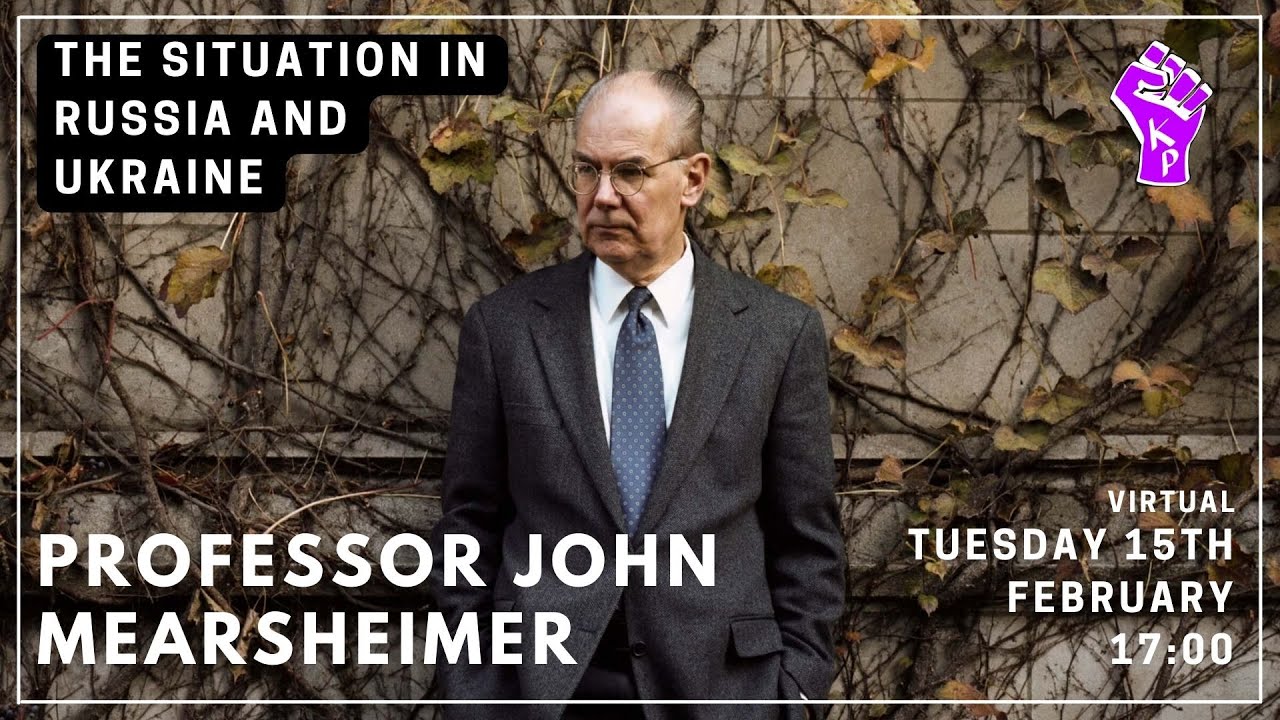
PROFESSOR JOHN MEARSHEIMER: THE CRISIS IN UKRAINE — King's Politics

King's Politics

The United States bears primary responsibility for the Ukraine crisis by turning Kyiv into a de facto NATO member, trapping Washington in Eastern Europe while driving Moscow toward Beijing.

AI-assisted summary of PROFESSOR JOHN MEARSHEIMER: THE CRISIS IN UKRAINE — original source. Check the original for full context.

Source published:

Key ideas

  • Professor John Mearsheimer contends that primary responsibility for the Ukraine crisis rests with the United States and its European allies rather than Russian revanchism, driven by a post-2008 policy to bring Ukraine into NATO and the EU. (1:44)
  • The Western strategy toward Ukraine combined three pillars—NATO expansion, European Union integration, and pro-democracy promotion—which Moscow consistently viewed as an existential security threat on its border. (3:35)
  • Mearsheimer advocates transforming Ukraine into a neutral buffer state and implementing the Minsk II accords as the only viable diplomatic resolution to prevent major conflict. (19:56)
  • By bogging American foreign policy down in Eastern Europe and driving Moscow into a tight partnership with Beijing, Washington's approach directly undermines its primary geopolitical priority of containing China. (35:26)

Detailed notes

## Background Published on YouTube by King's Politics on February 21, 2022, this interview features Professor John J. Mearsheimer discussing the escalating crisis between Russia, Ukraine, and the West. Recorded on February 15, 2022, shortly before Russia's full-scale invasion, the session highlights Mearsheimer's realist critique of Western foreign policy and the structural causes driving the confrontation.

## TL;DR Professor John Mearsheimer argues that the United States and its European allies bear primary responsibility for the Ukraine crisis rather than Vladimir Putin's alleged imperial ambitions. He contends that the West crossed an intolerable Russian security red line through a tripartite strategy of eastward NATO expansion, EU integration, and democracy promotion dating back to the 2008 Bucharest Summit. Characterizing Russian behavior as standard realpolitik analogous to the American Monroe Doctrine, Mearsheimer asserts that turning Ukraine into a de facto NATO asset provoked Moscow's reaction. He concludes that the only realistic path to peace is returning Ukraine to the status of a neutral buffer state, warning that Western intransigence needlessly embroils the U.S. in Europe while driving Russia into an alliance with China.

## Atmosphere & style The discussion carries the calm, unflinching tone of an academic briefing delivered right on the precipice of major conflict. Mearsheimer speaks with blunt, clinical realism, puncturing prevailing Western orthodoxies with colorful analogies like 'Bambi versus Godzilla' and dismissals of 'cockamamie' strategies. The dynamic between host Tom and Mearsheimer is polite and scholarly, creating an atmosphere that feels intellectually provocative, sober, and strikingly prescient given the date of recording.

## Bulletin - [01:44](https://www.youtube.com/watch?v=Nbj1AR_aAcE&t=104s) Professor John Mearsheimer contends that primary responsibility for the Ukraine crisis rests with the United States and its European allies rather than Russian revanchism, driven by a post-2008 policy to bring Ukraine into NATO and the EU. - [03:35](https://www.youtube.com/watch?v=Nbj1AR_aAcE&t=215s) The Western strategy toward Ukraine combined three pillars—NATO expansion, European Union integration, and pro-democracy promotion—which Moscow consistently viewed as an existential security threat on its border. - [19:56](https://www.youtube.com/watch?v=Nbj1AR_aAcE&t=1196s) Mearsheimer advocates transforming Ukraine into a neutral buffer state and implementing the Minsk II accords as the only viable diplomatic resolution to prevent major conflict. - [35:26](https://www.youtube.com/watch?v=Nbj1AR_aAcE&t=2126s) By bogging American foreign policy down in Eastern Europe and driving Moscow into a tight partnership with Beijing, Washington's approach directly undermines its primary geopolitical priority of containing China.

## Key takeaways - [01:44](https://www.youtube.com/watch?v=Nbj1AR_aAcE&t=104s) The prevailing Western narrative blaming the crisis entirely on Vladimir Putin's imperial ambitions misreads great power realpolitik and ignores decades of Russian security warnings. - [03:35](https://www.youtube.com/watch?v=Nbj1AR_aAcE&t=215s) Western strategy toward Ukraine since 2008 rested on three intertwined pillars: NATO expansion, EU economic integration, and democracy promotion via color revolutions. - [05:01](https://www.youtube.com/watch?v=Nbj1AR_aAcE&t=301s) The April 2008 Bucharest NATO summit declaration that Ukraine and Georgia would join the alliance crossed an explicit Russian red line, prompting immediate pushback in the August 2008 Russo-Georgian war. - [09:55](https://www.youtube.com/watch?v=Nbj1AR_aAcE&t=595s) Russia's reaction to Western military encroachment parallels Washington's own historical application of the Monroe Doctrine and its hardline posture during the 1962 Cuban Missile Crisis. - [12:51](https://www.youtube.com/watch?v=Nbj1AR_aAcE&t=771s) The 2021 escalation was triggered by Western efforts to turn Ukraine into a de facto NATO member through extensive lethal arms shipments, military training, and Black Sea naval exercises. - [15:31](https://www.youtube.com/watch?v=Nbj1AR_aAcE&t=931s) Arms deliveries and joint exercises intensified the classic security dilemma, wherein Western defensive measures were interpreted by Moscow as offensive threats. - [19:56](https://www.youtube.com/watch?v=Nbj1AR_aAcE&t=1196s) Returning Ukraine to the neutral buffer status it maintained between 1991 and early 2014 offers the only sustainable resolution to the conflict. - [23:18](https://www.youtube.com/watch?v=Nbj1AR_aAcE&t=1398s) The Minsk II framework remains deadlocked due to Ukrainian domestic political resistance to granting autonomy to the Donbas and Washington's refusal to publicly abandon NATO's open door policy. - [24:52](https://www.youtube.com/watch?v=Nbj1AR_aAcE&t=1492s) European allies like the UK, France, and Germany lack strategic autonomy, meaning any meaningful resolution must be negotiated bilaterally between Washington and Moscow. - [35:26](https://www.youtube.com/watch?v=Nbj1AR_aAcE&t=2126s) Western leadership trapped itself in moralistic rhetoric, making any pragmatic concession regarding NATO expansion politically unpalatable despite the geopolitical costs. - [38:42](https://www.youtube.com/watch?v=Nbj1AR_aAcE&t=2322s) The crisis in Ukraine is a legacy of the unipolar moment, distracting the United States from its essential strategic pivot to Asia to address China's rise. - [42:26](https://www.youtube.com/watch?v=Nbj1AR_aAcE&t=2546s) Western policy has accelerated Sino-Russian alignment, pushing any prospective US-Russia balancing coalition against Beijing into the distant future. - [58:25](https://www.youtube.com/watch?v=Nbj1AR_aAcE&t=3505s) Pervasive Russophobia in contemporary US politics, fueled by post-Cold War inertia and the 2016 election fallout, severely constrains realistic diplomacy with Moscow. - [01:01:13](https://www.youtube.com/watch?v=Nbj1AR_aAcE&t=3673s) The rules-based liberal international order was a unique byproduct of the unipolar era (1990–2017) and is disintegrating with the emergence of multipolar competition. - [01:07:52](https://www.youtube.com/watch?v=Nbj1AR_aAcE&t=4072s) NATO institutions and think tanks engage in threat inflation regarding Russia to maintain institutional relevance and justify continued American military presence in Europe. - [01:15:22](https://www.youtube.com/watch?v=Nbj1AR_aAcE&t=4522s) While nuclear weapons directly deter aggression against NATO members covered by Article 5, they play a secondary role in Ukraine compared to conventional cost-benefit calculations.

## Detailed walkthrough ### [00:04](https://www.youtube.com/watch?v=Nbj1AR_aAcE&t=4s) Introduction and Welcome

Tom, one of the co-chairs at King's Politics, introduces the evening's event focused on the unfolding situation between Russia and Ukraine. He outlines the format: an initial presentation by Professor John Mearsheimer of approximately twenty minutes, followed by questions from the host, and finally opening up the floor to the audience until roughly 6:30 PM. Attendees wishing to participate are instructed to type an "x" in the chat to be called on directly or to write out concise questions for the host to read.

Tom provides a formal biographical introduction of Professor Mearsheimer, highlighting his status as the R. Wendell Harrison Distinguished Service Professor of Political Science at the University of Chicago, where he has taught since 1982. Mearsheimer graduated from West Point in 1970, served five years as an officer in the U.S. Air Force, and authored six influential books on international relations theory, including *The Great Delusion: Liberal Dreams and International Realities*. In 2020, he received the James Madison Award from the American Political Science Association, an honor bestowed every three years for distinguished scholarly contribution to the discipline.

[01:44](https://www.youtube.com/watch?v=Nbj1AR_aAcE&t=104s) Mearsheimer's Opening and Western Conventional Wisdom

Taking the floor, Professor Mearsheimer expresses gratitude for the invitation, lamenting that the meeting is virtual rather than an in-person visit to Cambridge, where he would have loved to dine and converse with attendees directly. Setting up his lecture, he explains that he will cover the origins and history of the crisis, explain why it has returned to the "front burner" today, and conclude with remarks on where the geopolitical standoff is headed.

Mearsheimer immediately attacks the reigning narrative in Western capitals, asserting that the mainstream framework frames the issue as a simple moral binary that obscures the actual cause. He rejects the premise that Russian President Vladimir Putin is the primary culprit:

> “The conventional wisdom in the west this is certainly true in a place like britain and the united states is that putin is responsible for this crisis it's the russians they're good guys and bad guys and of course we are the good guys and the russians are the bad guys this is simply wrong uh the united states mainly but the united states and its allies are responsible for this crisis not putin and russia”

[03:35](https://www.youtube.com/watch?v=Nbj1AR_aAcE&t=215s) The Tripartite Western Strategy: Turning Ukraine into a Bulwark

To explain why the West bears responsibility, Mearsheimer argues that since 2008, the overarching Western policy has aimed to transform Ukraine into a "western bulwark on russia's border." This policy rested on three interconnected pillars designed to reorient the country away from Moscow and into the Western fold.

```mermaid flowchart TD accTitle: The Three Pillars of Western Strategy accDescr: Diagram illustrating the three dimensions of Western policy toward Ukraine since 2008.

subgraph Bulwark["Western Bulwark Strategy (2008–Present)"] A["1. NATO Expansion<br/>(Core military pillar)"] B["2. EU Expansion<br/>(Economic/institutional integration)"] C["3. Color Revolution<br/>(Orange Revolution / Liberal democracy)"] end

A --> D["Pro-Western, Allied Ukraine on Russia's Border"] B --> D C --> D ```

The primary and most consequential element was NATO expansion eastward to encompass Ukraine. The second component was European Union expansion, integrating Ukraine economically and institutionally into the European orbit. The third pillar was promoting "color revolution"—specifically Ukraine's Orange Revolution—to re-engineer Ukraine's domestic politics into a Western-allied liberal democracy resembling Britain or the United States.

- **Primary Pillar:** NATO expansion eastward to include Ukraine on Russia's perimeter. - **Economic Pillar:** Integrating Ukraine through European Union expansion. - **Political Pillar:** Promoting the Orange Revolution to establish a pro-American liberal democracy.

[05:01](https://www.youtube.com/watch?v=Nbj1AR_aAcE&t=301s) Bucharest 2008, Previous Expansion Tranches, and the 2014 Coup

Mearsheimer points to the April 2008 Bucharest NATO Summit as the critical turning point. While Russia had begrudgingly tolerated earlier expansions, the formal declaration in Bucharest crossed an explicit geopolitical boundary:

> “At the end of that april 2008 bucharest summit nato announced that georgia and ukraine would become part of nato they said this is going to happen period the russians made it unequivocally clear at that point that that is not going to happen they drew a line in the sand”

Mearsheimer reminds the audience that Moscow had previously "swallowed" two large tranches of NATO expansion despite intense dislike: the 1999 round incorporating Poland, Hungary, and the Czech Republic, and the 2004 round bringing in Romania and the Baltic states. But Bucharest went too far. A few months later, in August 2008, war erupted between Russia and Georgia—the other candidate country promised membership.

The crisis in Ukraine erupted openly on February 22, 2014, when a coup overthrew Ukraine's pro-Russian president and installed a pro-American regime, an action in which the United States was actively involved. In response, an enraged Moscow took two drastic steps: 1. **Annexing Crimea:** Russia seized the Crimean Peninsula primarily to secure Sevastopol, ensuring its vital naval base would never become a NATO facility. Mearsheimer notes bluntly: “crimea is gone it is never going back to ukraine”. 2. **Fueling Civil War:** Moscow backed Russian-speaking separatists in eastern Ukraine to destabilize the country internally. Mearsheimer summarizes Moscow's calculus as a commitment to wreck Ukraine economically and politically before ever permitting it to join NATO.

[09:55](https://www.youtube.com/watch?v=Nbj1AR_aAcE&t=595s) Realpolitik 101, Great Power Backyards, and the Monroe Doctrine

Mearsheimer argues that Russia's reaction is entirely predictable under classic power politics, expressing disbelief that Western policymakers fail to grasp it:

> “this is realpolytique 101 and the fact that people in the west especially in places like britain and the united states don't understand this boggles my mind i just don't understand it the idea that you could take a military alliance run by the united states the most powerful state in the world and run it up to russia's borders and the russians wouldn't be bothered by it is simply unthinkable”

To illustrate how great powers behave, Mearsheimer invokes the American Monroe Doctrine, which prohibits distant great powers from establishing military alliances or deploying armed forces anywhere in the Western Hemisphere. He recalls the Cuban Missile Crisis, where the United States found Soviet nuclear-tipped missiles in Cuba categorically unacceptable, successfully demanding their withdrawal. Similarly, when the Soviets later contemplated constructing a naval base at Cienfuegos, Washington flatly forbade it.

Because the United States ruthlessly defends its own hemispheric backyard, Western leaders should not be shocked that Moscow is equally alarmed by a rival military alliance moving onto its direct border. Instead, Western policymakers persisted because of a self-righteous conviction that the United States acts as a "benign hegemon" exempt from traditional balance-of-power constraints.

[12:51](https://www.youtube.com/watch?v=Nbj1AR_aAcE&t=771s) De Facto NATO Membership and the 2021 Escalation

Although the conflict simmered after 2014, tensions escalated sharply in the autumn of 2021 before erupting into a full-scale crisis in early 2022. Mearsheimer addresses the common Western defense that Ukrainian NATO membership was not actively being pursued, arguing that reality contradicted official rhetoric:

> “and the question that we want to ask ourselves is what happened here you know why why all of a sudden did this crisis go from the back burner to the front burner and the answer is that the united states and its allies were effectively turning ukraine into a de facto member of nato”

While Western officials claimed NATO expansion was off the table, the West had actively begun transforming Ukraine into a de facto member. Under the Obama administration, Washington had deliberately refused to provide lethal military arms to Kyiv, recognizing that doing so would provoke and frighten Moscow. However, starting under Donald Trump and continuing under Joe Biden, the United States reversed course and began heavily arming Ukrainian forces. Mearsheimer concludes that Russia regards an armed, Western-allied Ukraine on its border as an existential threat, and is demonstrating complete willingness to resort to military force to prevent it.

[15:31](https://www.youtube.com/watch?v=Nbj1AR_aAcE&t=931s) Western Arms, Black Sea Provocations, and the Security Dilemma

Turning Ukraine into a de facto military asset of the West has steadily crossed Russian red lines. Turkish Bayraktar drones supplied to Kyiv especially rattled Moscow, following their decisive combat performance in the hands of the Azerbaijanis against Armenian forces in Nagorno-Karabakh. Simultaneously, the United States and the United Kingdom began shipping substantial quantities of weaponry and actively training Ukrainian forces. Professor Mearsheimer stresses that labeling such shipments "defensive" ignores basic international relations theory: under the logic of the security dilemma, weapons framed as purely protective by one party will inevitably be perceived as an offensive threat by an adversary.

```mermaid flowchart TD accTitle: Western Integration of Ukraine into NATO Structure accDescr: Diagram showing military, diplomatic, and operational actions driving Russia to its boiling point.

subgraph WEST["Western Actions"] W1["Advanced Weaponry<br/>(Turkish drones, US/UK arms)"] W2["Military Training<br/>(British & American advisers)"] W3["Diplomatic Rhetoric<br/>(Treating Ukraine as de facto ally)"] W4["Black Sea Maneuvers<br/>(HMS Defender in territorial waters;<br/>US bomber runs near coast)"] end

subgraph REACTION["Russian Perception & Response"] R1["Security Dilemma Activated:<br/>Offensive threat on border"] R2["Lavrov: 'Boiling Point' reached"] R3["Massive Troop Buildup<br/>to alter status quo"] end

W1 --> R1 W2 --> R1 W3 --> R1 W4 --> R2 R1 --> R2 R2 --> R3 ```

This tightening military embrace was reinforced by high-profile Western maneuvers along Russia's immediate periphery. In June 2021, the British Royal Navy destroyer HMS *Defender* transited through Russian-claimed territorial waters off Crimea in the Black Sea, and the United States flew a strategic bomber right up against the Russian coastline. For Moscow, these operations signaled that Ukraine was effectively being integrated into NATO on the ground regardless of formal accession. As Russian Foreign Minister Sergey Lavrov signaled, Moscow had reached its "boiling point" and abandoned hope in empty talks, deciding instead to challenge the status quo through a massive border military buildup that has concurrently crippled Ukraine's fragile economy.

- Turkish combat drones provided to Ukraine mirrored the decisive air capabilities deployed by Azerbaijan against Armenia in 2020. - British and American military personnel conducted on-the-ground training for Ukrainian units. - In June 2021, a British destroyer sailed through Black Sea waters claimed by Russia, accompanied by proximate US strategic bomber flights. - As Professor Mearsheimer bluntly summarizes: “You give drones to the Ukrainians, do you think the Russians are going to view those as defensive weapons? I don't think so.”

---

[19:56](https://www.youtube.com/watch?v=Nbj1AR_aAcE&t=1196s) The Ideal of a Neutral Buffer vs. the "Munich Analogy"

The structural source of the present standoff traces back to NATO's Bucharest Summit in April 2008, when the alliance declared that Ukraine and Georgia would eventually join, before exploding into active conflict on February 22, 2014. For the preceding two decades—from the collapse of the Soviet Union in December 1991 until early 2014—Ukraine functioned quietly as a neutral buffer state between Russia and NATO, generating no acute geopolitical crises. Mearsheimer argues that restoring Ukraine to this neutral buffer status remains the only logical resolution, yet Western leadership has rendered it politically impossible by constructing a self-serving historical narrative.

Rather than acknowledging that Western policy miscalculated by pushing NATO eastward, Washington and European capitals manufactured a narrative after February 2014 casting Vladimir Putin as an aggressive imperial revanchist determined to recreate the Soviet Union or build a "Greater Russia." Contemporary political discourse regularly equates negotiations over Ukrainian security with the 1938 Munich Agreement, casting Putin as a modern Adolf Hitler. Mearsheimer dismisses this reading as revisionist fiction, noting that before the February 2014 coup, no Western leaders argued that Russia posed an expansionist danger requiring containment.

- Between December 1991 and early 2014, Ukraine operated as an unaligned buffer state without provoking major military confrontation between Moscow and the West. - The Western narrative depicting Putin as an insatiable aggressor intent on rebuilding the USSR was created only after the 2014 crisis exposed the failures of NATO expansion. - Popular political invocations of the October 1938 Munich Agreement and Neville Chamberlain are treated by Mearsheimer as misleading rhetoric designed to shut down realistic diplomacy. - As Professor Mearsheimer argues: “What happened on February 22nd, 2014, is this cockamamie strategy that we had invented to make Ukraine a part of NATO blew up in our face, and when it blew up in our face because of our flawed policies, we were not going to admit that we had screwed up—no, we had to blame the Russians.”

---

[23:18](https://www.youtube.com/watch?v=Nbj1AR_aAcE&t=1398s) The Deadlock: Minsk II and Domestic Political Obstacles

Even if the principle of neutrality were embraced in theory, practical realization faces insurmountable domestic and international obstacles. A stable, neutral Ukraine requires resolving the armed conflict inside the Donbas through the implementation of the Minsk II accords, reconciling Kyiv with its eastern, Russian-speaking population. However, intense nationalist politics inside Ukraine prevent any leadership in Kyiv from granting the political autonomy and constitutional concessions mandated by the agreements.

At the same time, the Biden administration remains politically incapable of offering formal guarantees against future NATO enlargement. With Washington unwilling to offer concessions and Kyiv unable to execute the Minsk framework, the crisis is locked into an escalatory spiral with no diplomatic exit ramp.

- Implementing the Minsk accords to end the civil war between Kyiv and the Donbas is structurally essential for Ukrainian neutrality. - Intense domestic political resistance inside Ukraine prevents the government from granting the decentralized status required by Minsk. - The Biden administration refuses to make any public concessions regarding NATO's "open door" policy. - As Professor Mearsheimer concludes: “And again, as I said, it's impossible to envision President Biden at this point saying that he's going to give up on NATO expansion, so the end result is this crisis is going to go on and on—that's the sad truth, in my humble opinion.”

---

[24:52](https://www.youtube.com/watch?v=Nbj1AR_aAcE&t=1492s) Secondary Actors: The UK, the EU, and the United Nations

Addressing questions regarding other major diplomatic institutions—the United Kingdom, the European Union, and the United Nations—Mearsheimer emphasizes that power in this crisis is held almost exclusively in Washington. Moscow exhibits zero interest in holding core negotiations with London, Paris, or Berlin because it recognizes that European capitals lack autonomous decision-making power. The United Kingdom acts as little more than an obedient subordinate to American foreign policy, a role Tony Blair previously exemplified during the 2003 invasion of Iraq. While German Chancellor Angela Merkel and French President Nicolas Sarkozy correctly diagnosed the danger and adamantly opposed offering Ukraine a Membership Action Plan at the 2008 Bucharest Summit, they eventually folded under American pressure.

```mermaid flowchart TD accTitle: Power Hierarchy in the Ukraine Crisis accDescr: Flowchart illustrating US dominance over European allies and institutional limitations.

subgraph HEGEMON["The Sole Decision-Maker"] US["United States<br/>(Biden Administration)"] end

subgraph SUBORDINATE["Subordinate / Constrained European Actors"] UK["United Kingdom<br/>(Complies automatically with Washington)"] FR_GER["France & Germany<br/>(Understood risks in 2008 Bucharest Summit,<br/>yet yielded to US pressure)"] EU["European Union<br/>(Vehicle for economic & institutional expansion)"] end

subgraph SIDELINED["Ineffective Arena"] UN["United Nations<br/>(Paralyzed by Russian Security Council veto)"] end

US -->|"Dictates policy line"| UK US -->|"Pressures / overrides"| FR_GER US -->|"Drives overall train"| EU HEGEMON -.->|"Direct target of bilateral diplomacy"| MOSCOW["Moscow / Putin"] ```

Mearsheimer contextualizes the crisis as a three-pronged Western push: NATO enlargement (the core military pillar), EU enlargement (the economic integration pillar), and democracy promotion via "color revolutions" like the Orange Revolution. Both Moscow and Beijing view Western democracy promotion as an existential threat intended to trigger regime change in their own capitals. Finally, the United Nations is structurally sidelined and functionally irrelevant because Russia holds a permanent veto on the UN Security Council, precluding any collective security enforcement.

- The Russians refuse meaningful bilateral talks with Britain, France, or Germany, focusing direct diplomacy entirely on Joe Biden and Washington. - France and Germany fought against setting Ukraine on the path to membership at the 2008 Bucharest Summit, but deferred to Washington when the US insisted on the final declaration. - The overarching Western strategy integrates three elements: NATO expansion, EU expansion, and democracy promotion ("color revolutions"). - The United Nations and Secretary-General António Guterres can exert no leverage because Russia wields a veto on the Security Council. - As Professor Mearsheimer observes regarding British autonomy: “The Russians don't want to negotiate with the Germans, they don't want to negotiate with the French, and they don't want to negotiate with the British because they understand full well that the United States runs the show, and the British will do what the United States asks them to do.”

[30:23](https://www.youtube.com/watch?v=Nbj1AR_aAcE&t=1823s) Resolving the Crisis: Bilateral Diplomacy vs. the UN

When considering the institutional avenues for defusing the standoff around Ukraine, the United Nations offers virtually no leverage. Because both Russia and the United States hold permanent seats and veto power on the UN Security Council, any meaningful resolution or binding measure proposed by one side would be promptly vetoed by the other. Consequently, John Mearsheimer stresses that this impasse cannot be outsourced to international bodies or multilateral forums.

Instead, the dispute rests entirely on direct great-power engagement between Washington and Moscow. Addressing host Tom directly, Mearsheimer emphasizes the unavoidable bilateral reality of the situation: “So this is, bottom line Tom, a problem that has to be solved by the United States and the Russians.”

---

[30:53](https://www.youtube.com/watch?v=Nbj1AR_aAcE&t=1853s) Putin's Intentions: Weighing the Costs and Benefits of Invasion

Asked whether Vladimir Putin genuinely intended to invade Ukraine or was merely posturing to embarrass the West and reshape the geopolitical narrative, Mearsheimer argues that Russia’s leadership did not start with an intention to launch a full-scale invasion. The only trigger that would have likely prompted Russian troops to enter Ukraine, in Mearsheimer’s view, would be a Ukrainian offensive against the Russian-backed separatist forces in the Donbas. In that contingency, Russia would intervene directly to protect those forces, which would entail an invasion of the eastern part of the country. Beyond that defensive trigger, however, the structural cost-benefit calculation strongly disincentivized an invasion.

From a cost perspective, conquering Ukraine would turn Russia into an occupying power in a vast territory inhabited by a hostile population. Modern history demonstrates that military occupations reliably ignite massive resistance and protracted instability, a reality Putin is certainly astute enough to recognize. Furthermore, the West made it abundantly clear that an invasion would trigger devastating economic sanctions designed to cripple the Russian economy. Conversely, by merely massing forces without crossing the border, Putin was already achieving his core strategic goals at very little cost. He secured the undivided attention of Western leaders, forced high-level diplomatic talks, and unambiguously signaled that NATO expansion into Ukraine constitutes an intolerable existential threat to Russia.

Mearsheimer points out that the standoff was already inflicting heavy damage on Ukraine itself. The persistent panic and talk of war depressed the Ukrainian economy—which was already struggling as an economic “basket case” prior to the crisis—and diminished Kyiv’s capacity to mount offensives in the Donbas or integrate into NATO. This dynamic explains why the Ukrainian president was publicly urging President Joe Biden to tone down rhetoric about an imminent Russian invasion. Assessing the overall balance of leverage and outcomes at that moment, Mearsheimer concludes: “So I think when you marry the costs with how well the strategy is working out, Putin is a winner.”

- An invasion would transform Russia into an occupier facing fierce local resistance and catastrophic Western economic retaliation. - The mere threat of force achieved the Kremlin’s goal: establishing an unmistakable red line against Ukraine’s accession to NATO. - Ukrainian leadership actively pleaded with the Biden administration to halt alarming pronouncements of imminent war due to severe capital flight and domestic economic harm.

---

[35:26](https://www.youtube.com/watch?v=Nbj1AR_aAcE&t=2126s) The West's Strategic Trap and the Unipolar Legacy

Evaluating whether the West had any viable policy alternatives other than matching Russian troop movements and sending arms to Kyiv, Mearsheimer bluntly remarks that Western leaders had trapped themselves: “There was no other option; we were screwed.” This dilemma is an unresolved vestige of the post-Cold War "unipolar moment." Back in 2008, when the United States stood unchallenged as the sole global superpower, it initiated the policy to expand NATO to Georgia and Ukraine. That project blew up in 2014 with the annexation of Crimea and the Donbas war, precisely as unipolarity was waning, yet Washington proved incapable of walking away from the commitment.

The West found itself paralyzed by its own narrative. For years, politicians and commentators framed the conflict in rigid moral terms: the West and Ukraine as virtuous defenders of self-determination, and Russia as an unprovoked, aggressive villain. Having declared that Ukraine possesses an absolute sovereign right to join Western alliances, Western leaders could not politically afford to publicly concede that Ukraine would never become part of NATO. Backing down became politically toxic at home, locking policymakers into an escalatory dynamic that runs directly counter to fundamental American strategic interests.

```mermaid flowchart TD accTitle: Strategic Contradiction in US Foreign Policy accDescr: Diagram illustrating how the Ukraine crisis forces Russia toward China instead of allowing the US to pivot and balance Beijing.

subgraph Unipolar_Legacy["Legacy Commitments"] A["2008 Bucharest Summit:<br/>NATO Promise to Ukraine"] --> B["Entrenched Narrative:<br/>Russia as Bad Guy / Inviolable Rights"] B --> C["Political Inability to<br/>Compromise on Neutrality"] end

subgraph Geopolitical_Crisis["Current Strategic Impasse"] C --> D["Ukraine Crisis Deepens"] D --> E["US Tied Down in Eastern Europe"] D --> F["Russia Driven into<br/>Strategic Partnership with China"] end

subgraph Grand_Strategy["US Grand Strategic Imperatives"] G["Pivot to East Asia"] -.->|"Obstructed by"| E H["Balance Peer Competitor China"] -.->|"Undermined by"| F end ```

Mearsheimer argues that this path violates the most basic principles of realism and grand strategy. The United States faces a true peer competitor in China, whereas Russia poses no plausible threat to dominate the European continent. Rational balance-of-power politics dictates that Washington should resolve friction in Eastern Europe to pivot its resources to East Asia, while simultaneously cultivating Moscow as a partner to balance Beijing. Instead, Western policy was actively cementing a Sino-Russian entente. Emphasizing the catastrophic consequences of this blunder for Eastern Europe, Mearsheimer observes: “They are the ones who are suffering the most as a result of these foolish policies that we pursued during the unipolar moment regarding Russia and Ukraine, and it's now blown up in our face.”

- American policy drives Russia directly into China's arms, committing what Mearsheimer terms “a gross violation of balance of power politics 101.” - The domestic political cost of publicly acknowledging that Ukraine cannot enter NATO prevents Western leaders from taking the only off-ramp available. - While the policy miscalculation severely damages American strategic flexibility, the Ukrainian people bear the ultimate physical and economic burden of being led down the “primrose path.”

---

[38:42](https://www.youtube.com/watch?v=Nbj1AR_aAcE&t=2322s) The End of Unipolarity and the Disciplining Effect of China

Addressing whether the rise of China might compel the United States to adopt a more disciplined, realistic foreign policy, Mearsheimer acknowledges that while multipolarity imposes strategic discipline, it is fundamentally worse for Washington than the unipolar era. Under unipolarity, the United States was the sole great power on the planet, enjoying an unprecedented margin for error. Washington could launch reckless interventions and make profound foreign policy errors because it was insulated from severe geopolitical retribution; the costs were almost entirely exported to weaker nations.

Mearsheimer colorfully characterizes American military excursions during that era as profoundly asymmetrical: “Almost all the wars that we fought in the unipolar moment were unfair fights: it was Bambi versus Godzilla, and we were Godzilla.” That era of impunity has now vanished. Today's multipolar world features two formidable great powers: a revived Russia and an economically surging China that represents a true peer competitor. Confrontations in the Indo-Pacific—whether over Taiwan or the South China Sea—would not be lopsided contests. China possesses cutting-edge, rapidly expanding military capabilities that will stretch American resources to their limits.

Because the penalties for failure against a peer competitor are immense, structural pressures will force Washington to act with greater prudence in East Asia than it exhibited in the Middle East or Eastern Europe. Yet the lingering Ukraine conflict remains an agonizing distraction from this core priority. In Mearsheimer's words: “The Ukraine crisis is a vestige of the unipolar moment; right, it just sticks in our craw, we can't get rid of it, but it's in our interest to put an end to the Ukraine crisis in large part because we want to pivot to Asia.”

- Unipolarity allowed the United States to engage in costly, undisciplined foreign adventures because weak opponents posed no existential threat to American security. - Multipolarity restores structural constraints: the formidable military expansion of China ensures that any conflict in the Pacific would be a high-stakes clash between peers. - Ending the crisis in Eastern Europe is an essential prerequisite for Washington to focus its strategic weight on containing China in the Indo-Pacific.

---

[42:26](https://www.youtube.com/watch?v=Nbj1AR_aAcE&t=2546s) The Geopolitical Realignment and the Distant Prospect of a US-Russia Coalition

Looking ahead to the long-term structure of great-power relations, Tom asks whether the challenge posed by Beijing might eventually force Washington to set aside its moralizing dogma and seek a rapprochement with Moscow. Mearsheimer reflects on the core balance-of-power argument he had advanced for several years: *ceteris paribus*, China poses a vastly greater structural threat to Russia than the United States does, given that Russia shares an expansive land border with China, whereas oceans separate Russia from North America. By all classic geopolitical logic, Moscow and Washington ought to align to contain Chinese power.

However, Mearsheimer concedes that the ongoing Ukraine crisis severely complicates and delays this realignment. The hardening of Western stances, the absence of any visible diplomatic off-ramp, and the rhetoric surrounding the conflict have deeply poisoned relations between Russia and the West. Rather than driving Russia toward Washington, the confrontation has accelerated Moscow's strategic alignment with Beijing, rendering near-term rapprochement impossible.

While Mearsheimer maintains that an eventual US-Russia balancing coalition against China remains logically probable in the broad arc of geopolitics, the timeline has been drastically pushed back. Acknowledging the sobering reality of the diplomatic breakdown, Mearsheimer concludes: “My bottom line is that I still think that at some point in the future the United States and Russia will be allies against China, but I think I now have to stick the word 'distant future' in there given the Ukraine crisis.”

[45:13](https://www.youtube.com/watch?v=Nbj1AR_aAcE&t=2713s) The Logic of Buffer States: Ukraine vs. East Asia

A student named Naman asks whether the logic of establishing Ukraine as a neutral buffer zone can be applied to Southeast Asia vis-à-vis China to create similar breathing space. Mearsheimer responds by explaining that sustaining buffer states between great powers is historically difficult because each great power has a strong incentive either to conquer the buffer or to turn it into an ally. He illustrates this dynamic with the tragic history of Poland, which was historically sandwiched between Prussia/Germany, Russia/the Soviet Union, and Austria, causing it to disappear from the map repeatedly due to its unforgiving geography.

```mermaid flowchart LR accTitle: Buffer State Mechanics in Europe vs East Asia accDescr: Diagram contrasting land-based buffer pressures in Europe with maritime flashpoints in East Asia. subgraph Europe ["Eastern Europe: Land Buffers"] R["Russia"] --- U["Ukraine (Buffer)"] W["West / NATO Expansion"] -. pressure.-> U end subgraph EastAsia ["East Asia: Maritime Flashpoints"] C["China"] <== "Water Barriers" ==> TW["Taiwan"] C <== "Water Barriers" ==> SCS["South China Sea"] C <== "Water Barriers" ==> ECS["East China Sea Rocks"] end ```

Ukraine's modern strategic situation, however, is fundamentally different from historical Poland's: there is no great power on its western border. Russia sits on its eastern flank, but in the absence of NATO expansion, Russia poses no existential threat to conquer Ukraine, nor does it have an urgent strategic need to worry about it. Thus, if NATO expansion were removed from the equation, Ukraine could easily function as a stable buffer state.

Turning to East Asia, Mearsheimer points out that the geography does not lend itself to traditional land buffer states. The primary flashpoints—the South China Sea, Taiwan, and the disputed rocks in the East China Sea claimed by both China and Japan—are separated by bodies of water rather than intermediary countries: - Water serves as the buffer between Taiwan and mainland China. - The South China Sea flashpoint centers entirely on maritime control and islets. - The East China Sea dispute between Japan and China revolves around contested maritime rocks.

Despite the geographic differences, the underlying strategic appetite is identical: both Beijing and the American-led coalition (including Japan and Australia) view Taiwan and these maritime locations as vital strategic assets. China seeks Taiwan as sacred national territory with enormous strategic value, while the United States, Japan, and Australia are determined to keep Taiwan on their side of the ledger. Mearsheimer summarizes the fundamental reality confronting small neighbors of major powers: “The general point here is the great powers worry greatly about their security, they tend to be paranoid, and any smaller country that lives in the neighborhood of a great power should be extremely careful not to anger any of its great power neighbors because those great power neighbors are likely then to do terrible things to them.”

---

[50:46](https://www.youtube.com/watch?v=Nbj1AR_aAcE&t=3046s) The 1990s Verbal Assurances on NATO Expansion

The moderator reads a question from the chat submitted by Daniel, asking whether there is any truth to Russian assertions that NATO promised in the 1990s not to expand eastward. Mearsheimer calls it a fascinating question and confirms that during the end of the Cold War, extensive discussions took place among the Soviet Union, the United States, and West Germany.

While there is substantial historical evidence that Western leaders verbally assured Moscow that NATO would not expand to the east, no formal treaty was ever signed. Because the Soviets failed to secure a binding written guarantee, both sides remain free to interpret the historical record as they see fit. Proponents of Russia's position emphasize that American leaders explicitly indicated NATO would not move east, whereas Western counter-arguments point to the lack of treaty text and selectively cite alternative documents.

Because nothing was codified on paper, the West felt unconstrained to pursue its own agenda. When the Clinton administration committed to NATO expansion in the mid-1990s, Russian leaders—including Boris Yeltsin, who maintained warm personal ties with Bill Clinton—screamed bloody murder and warned that expansion was completely unacceptable. Nevertheless, Washington ignored Moscow's protests: - **1999:** The first tranche of NATO expansion took place, incorporating Poland, Hungary, and the Czech Republic. - **2004:** The second tranche incorporated another wave of Eastern European states, including the Baltic nations. - **2008:** The Bucharest Summit declared that Ukraine and Georgia would eventually become members of NATO.

Mearsheimer highlights that Western policymakers developed hubris because they suffered no severe pushback during the initial rounds: “We got away with it in ’99, we got away with it in 2004, but after 2008 it blew up in their face.”

---

[53:41](https://www.youtube.com/watch?v=Nbj1AR_aAcE&t=3221s) Western Arms Shipments, Russophobia, and Russian Red Lines

A student named David asks why the crisis resurfaced after lingering quietly in the background, specifically asking what prompted the United States and the United Kingdom to suddenly ramp up arms shipments to Ukraine. Mearsheimer clarifies that the policy of arming Ukraine actually originated under the Trump administration. Paradoxically, if Donald Trump had had his way on foreign policy, the crisis would not exist: Trump wanted to dissolve NATO, sought close relations with Vladimir Putin, and wanted to pivot U.S. attention toward China, recognizing Beijing as America's sole peer competitor. However, Trump was constrained by the foreign policy establishment and ended up initiating weapons transfers to Kyiv, fueling Russian resentment.

Mearsheimer identifies two underlying causes behind this aggressive Western approach: 1. **Severe, systemic Russophobia in the American political landscape:** Hostility toward Putin and Russia is so extreme that antagonizing Moscow is viewed as an unmitigated good. Mearsheimer recalls his late friend Stephen F. Cohen, a prominent leftist Sovietologist and Russian studies scholar, who observed that it was significantly easier to voice sympathetic arguments about the Soviet Union during the Cold War than to make balanced arguments about Russia today. Critics who challenge the consensus—such as Cohen or Mearsheimer himself—are routinely smeared as unpatriotic Russian dupes or tools of Moscow. 2. **A perception that Russia is weak and passive:** For years, Moscow grumbled but ultimately tolerated the 1999 and 2004 NATO expansions. Even after the February 2014 crisis—when Russia seized Crimea and backed separatists in the Donbas—it avoided open confrontation with Washington. Consequently, Washington assumed it could continually push Moscow without repercussions.

That Western complacency has hit a wall. Russian Foreign Minister Sergey Lavrov explicitly announced that Russia reached its boiling point, signaling that Moscow's tolerance has expired. As Mearsheimer warns: “Lavrov has said explicitly we reached our boiling point and the russians have made it clear they are not screwing around they are deadly serious and i think we've gotten the message and i think we will be much more careful when we deal with them in the future than we have been in the past.”

---

[58:25](https://www.youtube.com/watch?v=Nbj1AR_aAcE&t=3505s) The Roots of Contemporary American Russophobia

David follows up by asking why Russophobia has become so entrenched in American politics and why it has grown even more vitriolic than anti-Soviet sentiment during the height of the Cold War. Mearsheimer admits that the sheer intensity is puzzling and warrants a deep group discussion, but highlights four key contributors: - **Cold War residual hostility:** Russia is the principal successor state to the Soviet Union, inheriting decades of deeply ingrained American enmity and resentment. - **Putin’s defiance:** Unlike post-Soviet leaders who deferred to Washington, Vladimir Putin refuses to be an American pushover and openly pushes back against U.S. hegemony, infuriating Western foreign policy elites. - **Domestic social and political values:** Putin heads an authoritarian regime and champions conservative policies on social matters, such as homosexuality, that antagonize Western liberal sensibilities. - **The 2016 election and the 'Russiagate' narrative:** When Hillary Clinton suffered an unexpected loss to Donald Trump in 2016, the Democratic Party establishment struggled to accept that she was a flawed candidate or that Trump was an effective political campaigner. Instead, they embraced the narrative that Russia had rigged the American political system to deliver the White House to Trump, creating deep, lingering resentment among Democrats.

[01:01:13](https://www.youtube.com/watch?v=Nbj1AR_aAcE&t=3673s) Russophobia in the Democratic Party and the Fate of the Liberal Order

Reflecting on domestic American politics, Professor John J. Mearsheimer notes that the narrative blaming Russia for the 2016 election results significantly contributed to deep-seated anti-Russian sentiment within the Democratic Party. However, he cautions listeners that this is an intuitive observation rather than a fully worked-out scholarly conclusion: “You want to take everything I said with a grain of salt because again, I haven't thought this one through, and I don't have, you know, a really sort of clear answer in my head, but it is a fascinating question.”

```mermaid flowchart TD accTitle: Collapse of the Liberal International Order accDescr: Diagram showing the transition from unipolarity to multipolarity and the subsequent collapse of the liberal order. subgraph Unipolarity ["Unipolar Moment (c. 1990–2017)"] US["U.S. Dominance"] --> Inst["Rules & Institutions (WTO, GATT)"] Inst --> LIO["Liberal International Order"] end subgraph Multipolarity ["New Multipolar Era"] China["Rise of China (Peer Competitor)"] Russia["Resurrection of Russian Power"] China & Russia --> Challenge["Challenge Western Rules"] Challenge --> NewInst["Competing Institutions (e.g., AIIB)"] NewInst --> Fractured["Fractured Order & New Cold War"] end LIO -.->|"Bound to Fail"| Fractured ```

A student named Ben asks whether returning to spheres of influence and buffer states means the world has definitively moved past the post–Cold War liberal international order. Mearsheimer directs listeners to his paper *Bound to Fail* (available on his website) to outline the structural mechanics behind international orders:

- **Orders are institutional clusters:** An international order is made up of clusters of institutions—rules negotiated to facilitate international economic and diplomatic intercourse (such as the WTO and its predecessor, GATT). - **Great powers write the rules:** International institutions are created, managed, and directed primarily by the leading powers of an era. - **The condition of unipolarity:** As Mearsheimer puts it, “My basic argument on this is that the liberal international order was only possible in a unipolar world.” During the unipolar moment (roughly 1990 to 2017), the United States stood unmatched and wrote the global rulebook. - **The shift to multipolarity:** The rise of China as a peer competitor alongside the resurgence of Russian military power shattered unipolarity. China is actively challenging existing arrangements and building rival institutions, such as the Asian Infrastructure Investment Bank (AIIB). As a result, the old liberal order has permanently broken down into a new Cold War architecture.

[01:05:52](https://www.youtube.com/watch?v=Nbj1AR_aAcE&t=3952s) Putin and Lavrov as Strategic Actors

Responding to a question from Gabor regarding Vladimir Putin's personality, Mearsheimer explains that while he does not analyze psychology, he evaluates the Russian leadership strictly through a geopolitical and strategic lens. Rather than erratic actors, he views Vladimir Putin and Foreign Minister Sergey Lavrov as exceptionally shrewd realists operating under severe structural constraints:

> “I believe that Putin and Lavrov are first-class strategists. They really understand the essence of international politics, they understand how international politics works, and they do, in my opinion, a terrific job of playing Russia's hand.”

Mearsheimer points out that the fundamental building blocks of military strength are wealth and population size. In both respects, Russia occupies a secondary rank compared to the United States and China: - Russia has a significantly smaller population than the United States, and it is dwarfed by China. - Economically, Russia's wealth is nowhere near the same tier as America's GDP.

Despite holding a comparatively weak geopolitical hand, Mearsheimer observes that Putin and Lavrov consistently navigate their security dilemmas with deep strategic comprehension: “Every time I hear Putin speak, I'm always impressed by his knowledge of the situation and his views on how best to deal with the situation from a Russian point of view—not from an American point of view, but from a Russian point of view.”

[01:07:52](https://www.youtube.com/watch?v=Nbj1AR_aAcE&t=4072s) NATO's Threat Inflation and European Free-Riding

Sarah shares an anecdote from her time with the Youth Atlantic Association, recalling an all-day workshop at NATO headquarters in Brussels where young students hoped to discuss contemporary issues like cybersecurity and interoperability, only to find alliance officials obsessively focused on Russia. She suggests this rhetoric sounded like an institution searching for a reason to justify its existence, and asks whether European governments will finally meet the NATO target of spending 2% of GDP on defense.

Mearsheimer validates her impression, explaining that institutions inevitably engage in threat inflation to protect their institutional relevance and American commitments:

> “Well, if you have a deep-seated interest in maintaining NATO and maintaining the American military presence in Europe, then hyping the Russian threat is manna from heaven.”

He notes that whenever Washington considers pivoting to Asia to confront its principal peer competitor, China, European-focused institutions push back. NATO Secretary General Jens Stoltenberg constantly emphasizes the imminent Russian menace, while think tanks like the Atlantic Council in Washington produce endless analyses warning of catastrophe to ensure the transatlantic defense umbilical cord remains intact.

Turning to defense expenditures, Mearsheimer advises against expecting significant budgetary increases: - **Rational free-riding:** European states are rational actors who realize they can let the United States shoulder the burden: “Look, the Europeans are basically free riders, and from the European point of view, it's the smart thing to do. If you're Germany, why spend 2% of GNP on defense if the United States is going to take care of you anyway?” - **The condition for change:** European spending will only rise significantly if the United States fully pivots to East Asia and removes its security umbrella. In that scenario, geography will dictate behavior: Britain, insulated by water, will feel less urgency, whereas Germany, situated close to Russia, would be compelled to spend 2% or more to protect itself. - **The Japanese precedent:** During the Cold War and the unipolar moment, Japan spent little on defense and relied on the United States. Facing an acute threat from China in the East China Sea and over Taiwan, Tokyo has rapidly increased its military outlays. As Mearsheimer remarks with humor, Japan's leaders now “sound more and more like me than they ever did in the past.”

[01:14:40](https://www.youtube.com/watch?v=Nbj1AR_aAcE&t=4480s) The Shadow of Nuclear Weapons

As the session nears its conclusion, the moderator selects a final question submitted by Valentina on the influence of nuclear weapons in the Ukraine crisis, asking whether they act as a safeguard against catastrophic military escalation between the great powers. Mearsheimer immediately affirms their central role: “This is a great question. I think there's no doubt that nuclear weapons cast a big shadow.” He begins contextualizing how the shadow of nuclear deterrence historically managed great-power confrontation during the Cold War between the United States, the Soviet Union, and their respective alliances.

[01:15:22](https://www.youtube.com/watch?v=Nbj1AR_aAcE&t=4522s) Nuclear Deterrence in the Cold War vs. the Ukraine Crisis

Reflecting on the role of nuclear weapons, Professor John Mearsheimer recalls the dynamic of the Cold War, when the superpowers were locked in a tense standoff across the so-called Central Front in Central Europe. While it was thankfully not a hot conflict, it was almost impossible to envision a conventional war breaking out because of the terrifying prospect of nuclear escalation. Both sides had amassed colossal military forces equipped not just with thousands of tanks and aircraft, but with thousands of nuclear warheads. When two armies armed to the teeth with nuclear weapons collide, the catastrophic stakes generate immense deterrence. As Mearsheimer puts it: “As you all know, the more horrible a war is likely to be, the less likely it is that that war will break out.” Consequently, while one could argue nuclear weapons were inherently hazardous, their presence in Europe functioned primarily as a powerful force for peace by rendering war extraordinarily improbable.

When examining how this logic translates to the crisis in Ukraine, Mearsheimer argues that nuclear weapons matter, but not decisively in deterring a Russian invasion. This is because the United States explicitly ruled out intervening militarily. President Joe Biden openly declared that American troops would not fight to defend Ukraine, and he went so far as to state that the military would not even be dispatched to rescue stranded American citizens if a Russian invasion took place. Biden fully grasps that direct military contact between two nuclear-armed superpowers creates an unacceptable risk of escalation. Because neither Washington nor Moscow wants to engage in a direct conventional conflict, a direct confrontation between the United States and Russia over Ukraine remains extremely unlikely.

Therefore, nuclear weapons are not what prevents Russia from invading Ukraine. Instead, Russian calculations are driven by the conventional cost-benefit analysis discussed earlier. Invading would saddle Moscow with the brutal costs of occupation alongside severe economic penalties from Western sanctions. Conversely, by mobilizing on the border, Russia has already reaped substantial strategic rewards: it forced the West to pay attention, asserted unequivocally that Ukraine will not join NATO, and inflicted serious structural and economic damage on Ukraine, making Ukrainian accession virtually impossible. Because the Russians have already achieved so much without crossing the border, Mearsheimer maintains they are doing very well for themselves and have strong incentives not to invade.

```mermaid flowchart TD accTitle: Cold War vs Ukraine Crisis Deterrence Logic accDescr: Diagram contrasting how nuclear deterrence functioned on the Cold War Central Front with how deterrence functions in the Ukraine crisis.

subgraph ColdWar["Cold War Central Front"] CW_Forces["Massive opposing armies with nuclear arsenals"] CW_Fear["Fear of inevitable nuclear escalation"] CW_Result["Total conventional deterrence (Force for peace)"] CW_Forces --> CW_Fear --> CW_Result end

subgraph UkraineCrisis["Ukraine Crisis Dynamic"] US_Stance["US rules out direct military defense of Ukraine"] No_Direct_War["Direct US-Russia war rendered extremely unlikely"] RU_Calc["Russian deterrence driven by occupation costs & sanctions"] US_Stance --> No_Direct_War --> RU_Calc end ```

- In the Cold War, the presence of thousands of nuclear weapons on both sides made a clash between conventional armies on the Central Front unthinkable due to escalation fears. - President Biden publicly clarified that the US would not enter Ukraine even to evacuate threatened American citizens in the event of an invasion. - Mearsheimer concludes that non-nuclear factors deter Moscow: the burdens of military occupation, harsh Western economic sanctions, and the fact that coercive diplomacy has already effectively blocked Ukrainian NATO membership.

---

[01:19:05](https://www.youtube.com/watch?v=Nbj1AR_aAcE&t=4745s) Article 5 Scenarios in the Baltics and Closing Remarks

While nuclear weapons may not govern the immediate crisis inside Ukraine, Mearsheimer posits alternative scenarios where nuclear weapons would come directly into play. The crucial distinction lies in potential confrontations involving sovereign NATO member states covered by Article 5 collective defense guarantees, such as Poland, Romania, or the Baltic states—Lithuania, Latvia, and Estonia. If Russia were ever to contemplate invading one of the Baltic nations, the United States would be obligated to come to their defense, or at least give that obligation the most serious consideration. However, the United States does not possess the requisite conventional forces stationed in Eastern Europe to guarantee victory against Russian forces in a localized conventional theater. In such an extremity, Washington might face the agonizing dilemma of whether to threaten or resort to nuclear weapons.

Although Mearsheimer considers that scenario improbable, he emphasizes that nuclear deterrence would genuinely serve its intended purpose in scenarios involving NATO territory. The existential danger of nuclear conflict forces leaders to abandon reckless posturing and exercise extreme caution. In his summary assessment of nuclear strategy, Mearsheimer observes: “I think nuclear weapons, the presence of nuclear weapons, really focuses the mind and really causes people, policymakers, to behave much more cautiously than they would if they didn't have nuclear weapons.”

Following this observation, the host, Tom, brings the session to an end, thanking Professor Mearsheimer for taking the time to share his analysis during such an unusually tense period in international relations. Mearsheimer thanks Tom, King's Politics, and the audience for their engagement and questions, expressing his gratitude and his hope that they will be able to meet in person in the future as the event concludes.

- Potential flashpoints that could trigger nuclear escalation lie outside Ukraine, specifically along NATO's eastern flank in the Baltic states, Poland, or Romania. - The United States lacks the local conventional dominance in Eastern Europe needed to easily defeat a Russian assault on the Baltic states, which creates hypothetical pressure toward nuclear posturing. - The primary stabilizing feature of nuclear weapons remains their capacity to focus the minds of policymakers and compel restraint among great powers.

## Notable quotes > [38:42](https://www.youtube.com/watch?v=Nbj1AR_aAcE&t=2322s) Almost all the wars that we fought in the unipolar moment were unfair fights: it was Bambi versus Godzilla, and we were Godzilla. — John Mearsheimer

> [01:01:13](https://www.youtube.com/watch?v=Nbj1AR_aAcE&t=3673s) the liberal international order was only possible in a unipolar world. — John Mearsheimer

> [01:07:52](https://www.youtube.com/watch?v=Nbj1AR_aAcE&t=4072s) if you have a deep-seated interest in maintaining NATO and maintaining the American military presence in Europe, then hyping the Russian threat is manna from heaven. — John Mearsheimer

> [05:01](https://www.youtube.com/watch?v=Nbj1AR_aAcE&t=301s) crimea is gone it is never going back to ukraine — John Mearsheimer

> [01:15:22](https://www.youtube.com/watch?v=Nbj1AR_aAcE&t=4522s) the more horrible a war is likely to be, the less likely it is that that war will break out. — John Mearsheimer

> [01:07:52](https://www.youtube.com/watch?v=Nbj1AR_aAcE&t=4072s) the Europeans are basically free riders, and from the European point of view, it's the smart thing to do. — John Mearsheimer

> [01:05:52](https://www.youtube.com/watch?v=Nbj1AR_aAcE&t=3952s) I believe that Putin and Lavrov are first-class strategists. They really understand the essence of international politics, they understand how international politics works, and they do, in my opinion, a terrific job of playing Russia's hand. — John Mearsheimer

## Mentioned John Mearsheimer, Tom, King's Politics, University of Chicago, West Point, U.S. Air Force, American Political Science Association, James Madison Award, Vladimir Putin, NATO, European Union, United States, Britain, Russia, Ukraine, Georgia, Poland, Hungary, Czech Republic, Romania, Crimea, Sevastopol, Donbas, Monroe Doctrine, Cuba, Cienfuegos, Barack Obama, Donald Trump, Joe Biden, Bayraktar, Armenia, Azerbaijan, Nagorno-Karabakh, HMS Defender, Sergey Lavrov, Adolf Hitler, Neville Chamberlain, Minsk II, Tony Blair, Angela Merkel, Nicolas Sarkozy, United Nations, António Guterres, UN Security Council, China, Taiwan, Bill Clinton, Boris Yeltsin, Stephen F. Cohen, Hillary Clinton, Jens Stoltenberg, Democratic Party, World Trade Organization (WTO), General Agreement on Tariffs and Trade (GATT), Asian Infrastructure Investment Bank (AIIB), Atlantic Council, Youth Atlantic Association, Bound to Fail, Germany, Japan, Australia, Lithuania, Latvia, Estonia, The Great Delusion: Liberal Dreams and International Realities

## Video description The views expressed in this video are not those of King's Politics or King's College.

Information on how you can support Ukraine: https://ukrainewar.carrd.co/

This interview was recorded on Tuesday 15th February before Russia invaded Ukraine.

Professor John J. Mearsheimer is the R. Wendell Harrison Distinguished Service Professor of Political Science at the University of Chicago, where he has taught since 1982. He graduated from West Point in 1970 and then served five years as an officer in the U.S. Air Force. He has published six immensely influential books on international relations theory. In 2020, he won the James Madison Award, which is given once every three years by the American Political Science Association to “an American political scientist who has made a distinguished scholarly contribution to political science.”

[Source](https://www.youtube.com/watch?v=Nbj1AR_aAcE)

中文简报

米尔斯海默指责美国推进北约扩张激化俄乌危机 美国通过将基辅打造成事实上的北约成员国,对乌克兰危机负有主要责任,此举使华盛顿深陷东欧,同时将莫斯科推向北京。 约翰·米尔斯海默教授认为,对乌克兰危机负有主要责任的是美国及其欧洲盟友,而非弗拉基米尔·普京所谓的帝国野心。他指出,西方自2008年布加勒斯特峰会以来,通过北约东扩、欧盟一体化以及民主推广这“三位一体”的战略,跨越了俄罗斯无法容忍的安全红线。米尔斯海默将俄罗斯的行为定性为类似于美国《门罗主义》的标准现实政治,并断言将乌克兰变成事实上的北约资产激怒了莫斯科。他总结道,唯一现实的和平途径是让乌克兰重回中立缓冲国的地位,并警告称西方的固执己见不仅让美国无端深陷欧洲泥潭,还将俄罗斯推向了与中国的联盟。 约翰·米尔斯海默教授主张,乌克兰危机的主要责任在于美国及其欧洲盟友,而非俄罗斯的复仇主义,这是由2008年后推动乌克兰加入北约和欧盟的政策所致。 (1:44) 西方对乌克兰的战略结合了三大支柱——北约东扩、欧盟一体化以及亲民主推广——莫斯科始终将其视为边境上面临的生存性安全威胁。 (3:35) 米尔斯海默主张将乌克兰转变为中立缓冲国并落实《新明斯克协议》,认为这是防止重大冲突唯一可行的外交解决方案。 (19:56) 华盛顿的做法使美国外交政策深陷东欧泥潭,并将莫斯科推向与北京紧密结伴的境地,这直接削弱了其遏制中国这一首要的地缘政治重点。 (35:26)

Reading summary

Professor John Mearsheimer contends that the United States and its European allies bear primary responsibility for the Ukraine crisis by pursuing a long-term strategy since 2008 to transform Ukraine into a pro-Western bulwark on Russia's border. Interpreted through the lens of structural realism, Moscow's hostile response represents a predictable great-power reaction to what it perceives as an existential security threat on its direct perimeter. Tripartite Strategy and the Bucharest Catalyst (3:35) Mearsheimer argues that Western policy toward Ukraine since 2008 rested on three interconnected pillars: NATO expansion eastward, European Union enlargement, and democracy promotion through "color revolutions" such as the Orange Revolution to reshape Ukraine into a Western-style liberal democracy. While Moscow reluctantly tolerated the 1999 expansion that incorporated Poland, Hungary, and the Czech Republic, as well as the 2004 round that brought in Romania and the Baltic states, the April 2008 Bucharest NATO Summit marked a decisive turning point by explicitly declaring that Ukraine and Georgia would become alliance members. According to Mearsheimer, this declaration provoked the August 2008 war between Russia and Georgia and laid the groundwork for the February 22, 2014 crisis, when Ukraine's pro-Russian president was overthrown in a coup with US involvement. Moscow responded by annexing Crimea to prevent the Sevastopol naval base from falling under NATO control and by backing separatists in the Donbas. Mearsheimer maintains that Russian strategy sought to destabilize Ukraine politically and economically rather than ever permit it to serve as a Western forward base. Realpolitik Backyards and De Facto Integration (9:55) Invoking the American Monroe Doctrine and Washington's uncompromising stance during the 1962 Cuban Missile Crisis, Mearsheimer emphasizes that great powers are inherently sensitive to rival military alliances encroaching on their borders. He asserts that Western policymakers exhibited profound hubris during the post–Cold War unipolar era by assuming the United States operated as a "benign hegemon" exempt from classic balance-of-power constraints, blinding them to how Moscow would perceive Western encirclement. Although formal NATO accession stalled after 2014, Mearsheimer argues that the West reignited the crisis by transforming Ukraine into a de facto alliance member. While the Obama administration avoided supplying lethal aid, the Trump and Biden administrations reversed course by sending advanced weaponry, dispatching British and American military advisers, and integrating Turkish Bayraktar combat drones into Ukraine's arsenal. Reinforced by provocative Western military maneuvers in the Black Sea during 2021—including the British destroyer HMS Defender transiting Russian-claimed waters and US strategic bomber flights—these actions activated a severe security dilemma, prompting Russian Foreign Minister Sergey Lavrov to warn that Moscow had reached its "boiling point." Diplomatic Deadlock and the Munich Analogy (19:56) Between the dissolution of the Soviet Union in December 1991 and early 2014, Ukraine operated peacefully as a neutral buffer state between Russia and NATO. Mearsheimer argues that restoring this neutral status remains the only realistic diplomatic solution, but Western leadership made compromise politically unfeasible by fabricating a post-2014 narrative that casts Vladimir Putin as an insatiable imperial revanchist comparable to Adolf Hitler at the 1938 Munich Conference. He dismisses this narrative as revisionist rhetoric designed to deflect blame from failed Western expansion policies. Simultaneously, practical resolution faces severe political obstacles on both sides. A neutral settlement requires implementing the Minsk II accords to grant political autonomy to the Donbas, but intense Ukrainian domestic nationalist resistance prevents Kyiv from making the necessary constitutional concessions. At the same time, the Biden administration remains politically unable to renounce NATO's "open door" policy, locking the conflict into an escalatory stalemate that secondary actors like the UK, France, Germany, and a veto-paralyzed UN Security Council cannot break. Strategic Blunders and Multipolar Constraints (35:26) Mearsheimer contends that current US policy fundamentally violates the principles of grand strategy by entangling Washington in Eastern Europe while driving Russia directly into a partnership with China. Because China represents America's sole peer competitor in the emerging multipolar order, realist logic dictates that the United States should settle the European dispute and partner with Moscow to balance Beijing. Mearsheimer observes that the unipolar era—where the US enjoyed vast margins for error in asymmetric conflicts he characterizes as "Bambi versus Godzilla"—has ended, replaced by peer competition that demands strategic discipline. Regarding the immediate standoff, Mearsheimer suggests that Russia's coercive military buildup achieved substantial strategic success without launching a full invasion. A full-scale occupation would saddle Moscow with fierce local resistance and devastating Western economic sanctions, whereas massing troops on the border effectively halted Ukrainian accession to NATO and severely damaged Ukraine's domestic economy. Furthermore, while President Biden explicitly ruled out deploying US forces to defend Ukraine—reflecting mutual fear of nuclear escalation—Mearsheimer warns that nuclear risks remain acutely relevant along NATO's eastern perimeter in the Baltic states. Mearsheimer concludes that the Ukraine standoff represents a damaging vestige of post–Cold War unipolar overreach that has trapped Western leaders in a strategic corner. With Washington politically unable to publicly renounce NATO expansion and Kyiv incapable of implementing the Minsk agreements, he foresees an enduring, unresolved crisis that distracts the United States from its paramount strategic imperative of balancing China in East Asia while leaving Ukraine to suffer the physical and economic consequences.

精炼阅读摘要

约翰·米尔斯海默(John Mearsheimer)教授认为,乌克兰危机的核心责任在西方而非俄罗斯。他指出,以美国为首的西方国家自2008年起试图将乌克兰打造成遏制莫斯科的边境堡垒,触碰了俄罗斯的地缘政治红线;这一失衡政策不仅激化了安全困境,更违背了大国均势原则,反将俄罗斯推向中国。 危机根源与西方的“堡垒”战略 (3:35) 米尔斯海默驳斥了西方主流叙事中将危机归咎于普京个人野心的“善恶二元论”,主张美国及其盟友应对危机负主要责任。他阐明,西方自2008年以来的核心政策是将乌克兰转变为紧贴俄罗斯边境的“西方堡垒”,其支柱包括三项:核心的北约东扩、促进制度一体化的欧盟扩张,以及通过“颜色革命”(如橙色革命)改造其国内体制。 历史转折点发生在2008年4月的北约布加勒斯特峰会。俄罗斯在1999年和2004年虽强烈反对但最终容忍了前两轮东扩,但峰会宣布乌克兰和格鲁吉亚终将加入北约,越过了莫斯科的明确红线,导致同年8月俄格战争爆发。2014年2月乌克兰政权更迭后,亲美政权上台,俄罗斯迅速吞并克里米亚以保住塞瓦斯托波尔海军基地,并在顿巴斯支持分离势力,力图在政治和经济上瘫痪乌克兰,以此阻止其加入西方联盟。 大国安全困境与事实上的北约化 (9:55) 米尔斯海默强调俄罗斯的反应符合“现实政治基础常识”(Realpolitik 101)。他援引美国“门罗主义”指出,美国绝不容许外部大国在西半球驻军或结盟(如古巴导弹危机),因此西方理应预见莫斯科绝不可能坐视敌对军事联盟推进至边界。西方政策制定者却自诩为“良性霸权”,无视传统均势规则。 针对西方坚称并未积极吸纳乌克兰的说法,米尔斯海默指出乌克兰已被转化为“事实上的北约成员”。特朗普政府打破奥巴马时期的限制向基辅提供致命军援,拜登政府延续了这一举措。土耳其向乌克兰提供“旗手”(Bayraktar)无人机,英美顾问展开战术培训,加上英国驱逐舰“卫士”号(HMS Defender)驶入克里米亚周边水域以及美军轰炸机逼近俄海岸,直接激化了安全困境。在莫斯科看来,防御性武器同样具备进攻威胁,促使俄罗斯外长拉夫罗夫表态局势已达“沸点”,并通过边境集结重兵来打破现状。 外交僵局、认知陷阱与对华战略失衡 (23:18) 从苏联解体到2014年初,乌克兰作为中立缓冲国存在了二十余年,并未引发重大对抗。米尔斯海默认为恢复其中立缓冲地位是化解危机的唯一理性出路,但已被现实政治堵死。在乌克兰国内,民族主义政治阻碍了基辅落实《明斯克协议》(Minsk II),无法给予顿巴斯自治地位;在华盛顿,拜登政府因国内政治代价无法放弃北约“门户开放”政策。 更深层的阻碍在于西方话语建构的道德陷阱。2014年后,西方普遍将普京塑造为企图重建苏联的帝国侵略者,并援引1938年“慕尼黑协定”将外交妥协污名化为绥靖。米尔斯海默直言这纯属事后掩盖政策失败的虚构叙事,因为2014年政变前西方从未视俄为扩张威胁。这种教条主义直接损害了美国根本利益:美国面临的真正同量级对手是中国,理应缓和欧洲局势以转向印太并联合莫斯科制衡北京,但现有政策却将俄罗斯推向中国。 普京的成本收益计算与单极终结 (30:53) 在评估冲突走向时,米尔斯海默分析普京最初并无全面入侵乌克兰的理性动机。除乌军主动进攻顿巴斯亲俄武装这一防御触发条件外,占领乌克兰将使俄罗斯面临敌对人口的持久治安战,并招致西方毁灭性的制裁。相反,仅凭在边境集结军队施加威慑,莫斯科便以极低成本迫使西方回到谈判桌,重申安全红线,并重创了乌克兰本就脆弱的经济,使其无法融入北约。据此,米尔斯海默认为俄方通过极限施压在战略上已处于赢面。 米尔斯海默指出,乌克兰危机是冷战后“单极时刻”的战略遗毒。在单极时代(约1990至2017年),美国无视大国均势肆意推行自由主义国际秩序;但随着中国作为全面竞争对手崛起和俄罗斯军力复苏,多极格局已彻底打破旧秩序。同时,欧洲盟友在安全上对美实行理性的“免费搭车”,只有当美国真正将战略重心抽调至亚洲时,欧洲国家才可能被迫提高防务开支。 核威慑的效力边界与真实引爆点 (75:22) 米尔斯海默肯定了核武器对大国决策的清醒约束作用,但他强调核威慑并非阻止俄军直接入侵乌克兰的核心变量。由于拜登政府已明确公开排除派美军进驻乌克兰(甚至不会派兵撤侨),华盛顿与莫斯科均极力避免核大国之间的直接常规碰撞,双方在乌克兰领土上直接开战的可能性极低。真正制约莫斯科行动的是前述的占领成本、经济制裁以及已达成的威慑收益。 然而,核阴影在北约防区边缘则具备根本性的升级风险。若危机外溢并威胁到受《北大西洋公约》第五条(Article 5)保护的盟国(如波罗的海三国、波兰或罗马尼亚),美国受集体防卫义务约束将不得不介入。鉴于美军在东欧不具备绝对的常规优势,极端情况下可能被逼至考虑核对抗的绝境。因此,核武器虽能有效防止大国跨越联盟红线,却也凸显出将缓冲地带直接纳为前线盟友所带来的巨大系统性风险。 米尔斯海默总结指出,由于大国地缘博弈的残酷逻辑已被道德叙事与国内政治绑架,华盛顿无法退让,莫斯科亦退无可退,乌克兰危机将长期持续并重创当地民众。从长远来看,尽管地缘均势最终可能迫使美俄走向联合制衡中国,但乌克兰冲突引发的深层敌意已将这一前景推至遥远的未来,暴露出后单极时代大国大战略的严重失序。

Source quotes

[38:42] John Mearsheimer: Almost all the wars that we fought in the unipolar moment were unfair fights: it was Bambi versus Godzilla, and we were Godzilla. [61:13] John Mearsheimer: the liberal international order was only possible in a unipolar world. [67:52] John Mearsheimer: if you have a deep-seated interest in maintaining NATO and maintaining the American military presence in Europe, then hyping the Russian threat is manna from heaven. [5:01] John Mearsheimer: crimea is gone it is never going back to ukraine [75:22] John Mearsheimer: the more horrible a war is likely to be, the less likely it is that that war will break out. [67:52] John Mearsheimer: the Europeans are basically free riders, and from the European point of view, it's the smart thing to do. [65:52] John Mearsheimer: I believe that Putin and Lavrov are first-class strategists. They really understand the essence of international politics, they understand how international politics works, and they do, in my opinion, a terrific job of playing Russia's hand.

Original transcript

[0:04] thank you for joining us it is great to see a  load of you here and we are really fortunate this [0:09] evening to be joined by professor john miyashima  my name's tom i'm one of the co-chairs at king's [0:16] politics and tonight we're going to begin with a  talk from professor mia shima about the situation [0:21] in in russia and ukraine and then i'll ask a  handful of questions and then we'll open up [0:26] to audience questions and professor milham has  kindly offered a lot of his time today so we'll [0:31] go to about 6 30 there'll be plenty of time for  audience questions um so if you would like to ask [0:37] a question please stick an x in the chat and i'll  come to you in order and you can ask the question [0:42] live on the screen but if you'd prefer for me to  read your question please write it out in the chat [0:48] i mean ideally if you could keep it concise  that that will help me out a lot professor [0:53] john mirsheimer is the art wendell harrison  distinguished service professor of political [0:59] science at the university of chicago where he has  taught since 1982 he graduated from west point in [1:06] 1970 and then served five years as an officer in  the u.s air force he has published six immensely [1:13] influential books principally on international  relations theory the most recent of which was the [1:18] great delusion liberal dreams and international  realities in 2020 professor mia sharma won the [1:25] james madison award which is given once every  three years by the immune political science [1:31] association to an american political scientist who  has made a distinguished scholarly contribution [1:37] to political science professor meishaima it is an  honor to have you with us today the floor is yours [1:44] thank you very much tom uh it's a great pleasure  to be here uh i wish i was not here virtually [1:52] but that i was physically at cambridge uh i'd  actually love to come to cambridge sometime [1:58] uh and talk to you and to meet people go  to lunch go to dinner and so forth and so [2:04] on uh i understand these virtual talks are a good  second best but nevertheless they are second best [2:12] uh tom asked me to talk for about 20 minutes  on the whole subject of the ukraine crisis [2:19] uh which i of course have written about and talked  about extensively since 2014. so i'm happy to do [2:27] that and i'll answer questions on ukraine and  i'm willing to answer questions on uh almost [2:32] any subject you folks would like to talk about uh  let me do two things first let me talk about the [2:40] origins uh and the history of this crisis and uh  then talk about why it's on the front burner today [2:53] and then let me say a few words in  conclusion about where we're headed [3:00] the conventional wisdom in the west  this is certainly true in a place like [3:06] britain and the united states is that putin is  responsible for this crisis it's the russians [3:14] they're good guys and bad guys and of course we  are the good guys and the russians are the bad [3:19] guys this is simply wrong uh the united  states mainly but the united states and [3:27] its allies are responsible for this crisis  not putin and russia now why do i say that [3:35] it's very important to understand that  what the west has been trying to do [3:43] since 2008. is turn ukraine into a  western bulwark on russia's border and [3:55] that policy had three dimensions to it the first  and most exp most important is nato expansion [4:03] the idea was that we were going to  expand nato eastward to include ukraine [4:10] the second element of the strategy was  eu expansion so in other words it was [4:16] not just nato expansion that was going to go  and include ukraine it was also eu expansion [4:26] and the third element of the strategy was the  color revolution uh and in the case of ukraine [4:33] that was the orange revolution and the idea  was to turn ukraine into a liberal democracy [4:39] like britain like the united states and not  only a liberal democracy but a liberal democracy [4:45] that was allied with the united states because  again this is all part and parcel of a strategy [4:52] that is designed to make ukraine a western  bulwark on russia's border now as i said to you [5:01] the most important element of the strategy is nato  expansion and that's why the april 2008 bucharest [5:13] nato summit is of immense importance at the end  of that april 2008 bucharest summit nato announced [5:24] that georgia and ukraine would become part of  nato they said this is going to happen period [5:33] the russians made it unequivocally clear at  that point that that is not going to happen [5:41] they drew a line in the sand as you all know  there were two big tranches of nato expansion [5:49] before that 2008 meeting the first  tranche of nato expansion was in 1999 [5:57] that included poland hungary and the czech  republic then there was a second tranche in 2004 [6:05] which included countries like romania and  the baltic states and so forth and so on [6:13] the russians swallowed those two nato  expansions they intensely disliked [6:19] both of them but they swallowed  them when nato said in 2008 that [6:28] expansion would now include georgia and ukraine  the russians drew a line in the sand it's very [6:37] important to understand it they said this has  not happened it is no accident that in august of [6:44] 2008 a few months after the april 2008 bucharest  summit you had a war between russia and georgia [6:53] remember georgia is the other country besides  ukraine that is going to be brought into nato [7:00] the russians said that ain't happening and you  had a war in august 2008. in february february [7:10] 22nd to be exact february 22 2014 the crisis broke  out over ukraine and it was mainly precipitated [7:23] by a coup in ukraine that overthrew a pro-russian  leader and installed a pro-american leader [7:36] the united states was involved in that coup the  russians went ballistic this is hardly surprising [7:46] they went ballistic and they did two things  first is they took crimea from ukraine [7:57] why did they do that you understand that there  is a very important naval base called sevastopol [8:03] on crimea and there's no way the russians  are going to let sevastopol become a nato [8:10] naval base this is not going to happen that's the  principal reason that the russians took crimea [8:19] and the second thing that they did is that  the russians took advantage of a civil war [8:27] that broke out in eastern ukraine almost  immediately after the february 22nd 2014 [8:34] crisis and what the russians have done is they  have fueled that civil war and they have made sure [8:43] that their allies were mainly russian speakers  and in many cases russian in eastern ukraine are [8:51] not defeated by the ukrainian government they  in effect are wrecking ukraine the russians are [9:00] basically saying we will wreck ukraine before  we allow ukraine to become a member of nato so [9:12] the russian response is very important to  understand this in 2014 when the crisis [9:19] first broke out into the open in response to what  had happened in bucharest in 2008 the russian [9:26] response was twofold number one they took crimea  and you should all understand crimea is gone [9:34] it is never going back to ukraine one and number  two they have said implicitly that we will destroy [9:45] ukraine we will wreck it before we will let it  become a member of nato now the question you want [9:55] to ask yourself is why are the russians doing this  this is realpolytique 101 and the fact that people [10:04] in the west especially in places like britain  and the united states don't understand this [10:10] boggles my mind i just don't understand it the  idea that you could take a military alliance [10:19] run by the united states the most powerful state  in the world and run it up to russia's borders [10:27] and the russians wouldn't be bothered by it  is simply unthinkable we in the united states [10:35] have the monroe doctrine the monroe  doctrine says that no distant great power [10:41] is allowed to form a military alliance  with a country in the western hemisphere [10:49] and is certainly not allowed to move military  forces into the western hemisphere i remember [10:57] the cuban missile crisis very well what happened  there is the soviets put nuclear-tipped missiles [11:03] in cuba the united states said this is  categorically unacceptable military forces from [11:10] afar are not allowed in the western hemisphere  and we had the cuban missile crisis and the [11:16] end result is those missiles were removed  when the soviets were later talking about [11:21] building a naval base at cienfuegos the united  states told them in no uncertain terms you are [11:27] not building a naval base at sienfuegos just  not going to happen the united states views [11:35] the western hemisphere as its backyard and it  prohibits distant great powers from coming into [11:42] its backyard well don't you think the russians are  going to be deeply disturbed by the united states [11:52] turning ukraine into a bulwark right on its  borders of course they are and the russians [11:59] told us that immediately after the bucharest  summit the russians made it categorically clear [12:08] categorically clear that ukraine is not  going to become part of nato but of course [12:15] the americans and their allies did not listen  because we believe that we're the good guys we're [12:22] a benign hegemon here in the united states and we  can do pretty much anything we want in the world [12:30] and for a while it looked like we could get  away with that as i said the russians accepted [12:35] the first nato expansion the 1999 one and  they accepted the second nato expansion [12:43] but after bucharest they said this is not  happening so you had this major crisis [12:51] it broke out in february 2014. now the crisis  the crisis tamped down quite a bit after 2014 [13:05] but in the fall in the fall of last year  2021 it began to ramp up and of course [13:14] early this year and i'm talking about  early 22 it became a full-blown crisis [13:21] and the question that we want to ask  ourselves is what happened here you know why [13:28] why all of a sudden did this crisis go from the  back burner to the front burner and the answer is [13:37] that the united states and its allies were  effectively turning ukraine into a de facto member [13:49] of nato you'll hear lots of rhetoric today that  the russians really had nothing to worry about [13:57] because nobody is talking about making ukraine  a member of nato today and i think that's true [14:08] uh but if you look at what we were actually doing  uh it's a different story first of all going back [14:16] to the trump administration and continuing  into the biden administration we are now [14:23] arming ukraine we were not arming ukraine during  the obama administration in february 2014 when the [14:33] crisis broke out and in the first few years after  that crisis when the obama administration was in [14:39] power we refused to arm the ukrainians because we  knew it would enrage the russians it would scare [14:46] the russians you want to understand that the  russians view ukraine becoming a part of nato [14:55] as an existential threat that's what's going on  here the russians are sending a very clear message [15:01] to the west they're telling you we take this  threat seriously and we're willing to use military [15:10] force if necessary to eliminate this threat  the russians are not fooling around here so [15:17] what you had happening in 2021 and of course it  started before that under the trump administration [15:25] is we were arming the ukrainians and when  you start talking about arming the ukrainians [15:31] those are ukrainian forces that can fight  against russia's allies in eastern ukraine [15:38] one thing that really spooked the russians was  that the turks gave the ukrainians drones and [15:45] drones have become a very effective weapon  on the battlefield as the eyes of rajanis [15:51] proved against the armenians last year and  the azerbaijanis were using turkish drones [15:58] so the turks are giving drones the americans and  the british are giving all sorts of other weapons [16:06] to the ukrainians you know of course that  we define these weapons as defensive weapons [16:13] but of course as sophisticated ir theorists  you all know that there's no such thing as a [16:18] meaningful distinction between defensive  weapons and offensive weapons as we all know [16:23] from the security dilemma what looks defensive  to us looks offensive to them you give drones [16:29] to the ukrainians do you think the russians  are going to view those as defensive weapons [16:34] i don't think so you start training the ukrainian  forces the way the british and the americans do [16:42] you don't think the russians are going to  see that as a threat i can guarantee you they [16:47] are right so what's happening here we're  arming we're training the ukrainians [16:54] and if you look at how we're dealing with  ukraine diplomatically we're basically [16:58] talking about ukraine as if it were an ally or  a partner that's the kind of rhetoric we use [17:05] when we talk about ukraine so it looks  like diplomatically and militarily [17:12] the bonds between the west especially the united  states and ukraine are tightening at the same [17:20] time we're doing a number of provocative things  outside of ukraine that really bother the russians [17:27] enormously the british foolishly run a destroyer  through russian territorial waters in the black [17:35] sea this past summer june 2021 the americans  take a bomber and they drive it right up against [17:45] the russian coastline in the black sea this  really bothers the russians unsurprisingly [17:53] so what you see happening here is the russians  have a very powerful sense that nato is moving [17:59] eastward nato is moving right up to the  russian border mainly by turning ukraine into [18:08] a de facto member of the alliance but also with  provocative measures like this british destroyer [18:15] and this american bomber the russians is sergey  lavrov the russian foreign minister said reached [18:23] the boiling point they had it they had it they're  not interested really in negotiating anymore [18:32] they're interested in altering the status quo  and the end result is you've had this massive [18:40] military buildup which is doing enormous damage to  the ukrainian economy which was already a basket [18:49] case before the crisis so ukraine situation is  getting worse and worse and the russians have [18:56] sent a very clear signal to the west that if  they up the ante they meaning the west if the [19:04] west ups the ante the russians will up the ante  and again ukraine is not becoming a part of nato [19:14] so that's where we are today  we have this major crisis [19:20] which goes back really to april 2008 that's that  that's the genesis that decision to make ukraine [19:30] part of nato and then you had the crisis  break out 22 february 2014 and over time [19:39] it was ameliorated somewhat pushed to  the back burner i think one could say [19:45] and then all of a sudden it broke out again now  is there any hope that we can settle this crisis [19:56] i'll tell you what i think the best solution is  i think it's an obvious solution but i think it's [20:02] politically unacceptable at this point in time  the obvious solution is to turn ukraine into [20:11] a neutral state more or less a buffer between  russia on one side and nato on the other [20:21] this is effectively what you had up until  february 2014. ukraine got its independence [20:31] when the soviet union broke apart in december 1991  and from december 1991 until roughly early 2014 [20:43] there was no real problem with ukraine the united  states and its allies were not fighting with the [20:50] russians over ukraine there was a verbal dispute  going back to the april 2008 bucharest summit [20:57] but there was no crisis because ukraine from  1991 to 2008 excuse me to 2013 was through [21:09] 2013 was effectively a neutral state it was a  buffer it was nato that changed the situation [21:17] you understand we now have changed the rhetoric  to make the russians the bad guys you hear all [21:24] this talk that russia is bent on creating  uh the second coming of the soviet union [21:32] uh russia is bent on creating a greater  russia all right the russians are the bad guys [21:39] this is a story that was invented after february  22 2014. nobody was making this argument before [21:47] february 22nd 2014. nobody was arguing that we had  to expand nato to contain russia before february [21:55] 22nd 2014. what happened on february 22nd 2014  is this cockamamie strategy that we had invented [22:05] to make romania to make ukraine a part of nato  blew up in our face and when it blew up in our [22:11] face because of our flawed policies we were not  going to admit that we had screwed up no we had [22:20] to blame the russians so we said they were  bent all along on dominating eastern europe [22:28] of course you hear the same argument made today  it's the russians who are the bad guys putin is [22:33] really dangerous we can't negotiate with him this  is the equivalent of munich which is another way [22:38] of saying he's the second coming of adolf hitler  and making a deal on ukraine is like making the [22:44] deal on czechoslovakia in october 1938 this is all  pure unadulterated nonsense right again there was [22:53] no threat from russia between before february  22nd 2014. just wasn't we invented that story [23:02] but anyway what the ideal situation would  be would be to create a neutral ukraine [23:11] a ukraine that looked a lot like the  ukraine that existed between 91 and 2014 [23:18] but we can't do that and we can't do that in  large part because the americans are unwilling [23:24] to make any sorts of concessions on nato  expansion and furthermore to make neutrality work [23:34] to make to create a neutral ukraine uh it's  very important that the ukrainian government [23:42] in kiev reach some sort of modus vivendi with  the russian-speaking population in the donbass uh [23:52] this is the famous minsk accords right  it's imperative that the kiev government [24:00] implement the minsk accords so that the civil  war and it is effectively a civil war between [24:08] the people in donbass and the people in  western ukraine that has to be settled [24:14] before this problem can be solved but the politics  inside of ukraine at this point in time make that [24:23] impossible and again as i said it's impossible to  envision president biden at this point saying that [24:31] he's going to give up on nato expansion so the  end result is this crisis is going to go on and on [24:41] that's the sad truth in my humble opinion so with  that i'll stop talking tom and turn it over to you [24:52] that was great super interesting  thank you for professor meisheimer [24:57] you mentioned a few of the key stakeholders  in there and a number of key dates and in [25:02] the lecture that you sent to us to  to watch beforehand which i will [25:06] stick in the chat for anybody who missed it  and would like to have a catch up on that [25:13] you mentioned again some of the key stakeholders  in europe from west to east germany poland ukraine [25:19] russia and then outside of europe obviously the us  and nato so i wanted to kick off with a three-part [25:24] question about some of the other stakeholders so  first does the uk play any role of importance here [25:31] second does the european union play any role  of importance here as a set of institutions [25:36] or as an individual institution and finally the  the united nations some have been asking where [25:42] antonio gutierrez the secretary general is in  all of this do you think it matters what he does [25:47] so the uk eu un do they play any role of  importance in this situation well let's talk [25:55] about the uk first and we could pick any european  country including germany and france as well [26:04] the russians don't want to negotiate with the  germans they don't want to negotiate with the [26:10] french and they don't want to negotiate with  the british because they understand full well [26:15] that the united states runs the show and  the british will do what the united states [26:22] asks them to do so you can have  perfunctory conversations with the british [26:28] but it really doesn't matter and that's why the  russians want to talk to the united states and [26:35] the russians don't even want to talk to nato they  don't want to talk to stoltenberg they want to [26:39] talk to the united states they want to talk to  joe biden because they know that the europeans [26:47] basically do what the americans asked them to  do and if there's any country that does what [26:54] the americans ask them to do almost axiomatically  it's britain the germans and the french sometimes [27:01] resist as we know from the iraq war in  2003 but tony blair was a mere cheerleader [27:09] for the united states in that war so britain does  not have much of a role to play here the united [27:15] states is the key player i don't say that because  i'm an american and indeed i think american policy [27:22] is usually so foolish these days that it would be  better if the united states had less influence and [27:27] it would be better if the europeans especially the  germans and the french stood up to the americans [27:34] with regard to the eu it's very important to  understand that it's not just nato expansion [27:43] that is designed to make ukraine a western  bulwark on russia's borders its nato expansion [27:53] eu expansion and the color revolution the orange  revolution the movement to democratize ukraine [28:03] because you understand just on the democratic  point the democratization point the russians [28:08] fear that what we will do is then have a color  revolution in russia itself if you go to beijing [28:15] you go to moscow in both places the leadership  lives in fear that the united states will try to [28:21] foster a color revolution inside china or inside  russia right so democratization eu expansion [28:32] and nato expansion are the three key elements of  the strategy although nato expansion is the key [28:39] so the eu does matter here uh there's no question  about that tom but uh but the eu is again not much [28:48] of a player nato's not much of a player it's  the united states that is driving this train [28:55] uh and let me make one more point on  that before i talk about the u.n it's [29:01] very important to understand that  at the april 2008 bucharest summit [29:10] germany and france were adamantly opposed to  any movement to make ukraine a member of nato [29:22] because germany and here we're talking about  angela merkel much to her credit understood [29:28] that this was asking for serious trouble  but it was the americans who as always [29:35] prevailed and at the end of the bucharest summit  a statement was issued at the americans insistence [29:46] that said that ukraine and georgia would become  members of nato so the europeans and here we're [29:52] talking about the french and the germans they  understood that this was a foolish thing to do [30:00] but they failed to stand up to the americans  so as is so often the case with the europeans [30:08] now finally you ask about the u.n the u.n  is effectively useless and for one very [30:14] simple reason the russians have a veto right  anytime there's a dispute between countries [30:23] that have a vote on the security council and this  obviously includes russia and the united states [30:30] the u.n is not going to be very meaningless very  meaningful simply because the russians would veto [30:38] anything that they didn't like and the americans  would veto anything that they didn't like [30:45] so this is bottom line tom a problem that has to  be solved by the united states and the russians [30:53] sure do you think putin had any intentions over  the past few days or weeks i guess including [31:00] and months including the preparations for was  unfolded over the past few days do you think [31:05] he had any intentions of invading ukraine  or is this all just about embarrassing the [31:11] west and creating a situation where the  narrative can be can be changed slightly [31:19] my view is that he did not have any intention of  invading ukraine and he nevertheless understood [31:31] that there might be circumstances under which that  was necessary for example i believe if ukraine [31:40] was to attack the forces the russian  supported forces in the donbass [31:47] he would come to their assistant and  assistance and that would that would [31:54] probably involve a russian invasion of the eastern  part of the country so i think there's certain [32:02] certain scenarios where he might have come in but  i think putting that aside he had no intention of [32:12] invading ukraine ukraine and there are two  reasons for that one are the costs and to [32:18] the benefits let's just talk about the cost  first of all if he invaded ukraine he'd own it [32:25] he'd be an occupier and that would not work out  very well as he surely knows when you occupy a [32:32] country in the modern world it invariably leads  to huge resistance and all sorts of trouble [32:40] putin is surely smart enough to know that invading  ukraine and owning it would be a prescription [32:48] for huge trouble secondly if he invades  ukraine we have made it clear in the west [32:55] that we will go to great lengths to [ __ ] the  russian economy so there will be significant [33:02] economic costs in addition to the costs of running  an occupation in a huge country filled with people [33:09] who don't want you there so those are the costs  now what about the benefits of not invading [33:16] putin is winning i mean first of all he's got our  attention right we're now scrambling to negotiate [33:26] with him talk to him to ameliorate this crisis  furthermore we in the west now understand [33:37] we understand that nato expansion into ukraine is  viewed by the russians as an existential threat [33:44] so ukraine is never going to become part of  nato that's just not going to happen we now [33:51] know that nobody will say that and biden is in no  position to back off but putin has made it clear [33:58] where the russians stand on this everybody knows  there is a red line in the sand furthermore [34:07] putin is doing enormous damage to the ukrainian  economy he is weakening ukraine he is making it [34:16] less likely that ukraine will be in a position  to launch an offensive against the donbass [34:21] making it less likely that ukraine will ever  be in a position to become a member of nato [34:28] this is why the president of ukraine is saying  to president biden please stop talking about [34:40] an imminent russian invasion because when  you do this you're doing serious damage [34:46] to the ukrainian economy which as i said  before was a basket case before the crisis [34:53] so this crisis has done serious damage to ukraine  and at the same time has sent a clear message to [35:04] the west that the present plans of the west to  bring ukraine into nato are not going to happen [35:15] so i think when you marry the costs with how well  the strategy is working out putin is a winner [35:26] do you think the west had many other options in  terms of how it would respond even if it made [35:32] your analysis which i guess in a lot of cases it  probably didn't but if the intelligence suggested [35:37] this was just a build up for the reasons you  suggest was there another option for the west [35:42] other than also matching the build up and  sending arms to ukraine or were they a little [35:47] bit snookered politically there was no other  option we were screwed yeah this is this is [35:55] a vestige of the unipolar moment right we in 2008  when we were the unipole we decided to expand nato [36:08] and it blew up in their face in 2014. this is  when the unipolar moment is coming to an end and [36:18] the problem continues to linger and and  we cannot figure out how to solve it [36:25] without saying that ukraine will not become part  of nato and that's politically unacceptable in [36:32] the west especially after you've told the story  year after year that the russians are the bad guys [36:40] and we're the good guys if the russians are the  bad guys and they're highly aggressive and you [36:46] believe the ukrainians have the right to this and  the right to that and you're committed to making [36:50] sure that they realize these rights it's almost  impossible politically to walk away from this one [37:00] it's really quite remarkable and you want to  understand tom that the united states has a [37:05] deep-seated interest in pivoting to asia the  united states faces a pure competitor in china [37:11] russia is not a pure competitor the idea that  russia is some meaningful threat to dominate [37:16] europe is a laughable argument right we have a  deep-seated interest in not getting involved in [37:25] eastern europe and pivoting to east asia number  one and number two we have a deep-seated interest [37:31] in having russia as an ally against china and  instead this foolish policy that we're locked into [37:41] and let me underline those words locked into  this foolish policy is driving the chinese [37:47] and the russians together we are driving  the russians into the arms of the chinese [37:53] this is a gross violation of balance of power  politics 101 so this situation is is disastrous [38:04] for the united states hey and and i want to be  clear here it's most disastrous for the ukrainian [38:10] people right you want to understand we have  led the ukrainian people down the primrose path [38:18] they are the ones who are suffering the most as a  result of these foolish policies that we pursued [38:25] during the unipolar moment regarding russia  and ukraine and it's now blown up in our face [38:34] and the people who will suffer the most again  i want to emphasize this are the ukrainians [38:42] let's pick up on on china a little bit more um  you've mentioned about the the incompetence of [38:48] western leaders in dealing with this kind of  security threat and you've described in the past [38:54] one root cause of that as being the united states  hegemonic status which has meant that the u.s has [39:00] not really been made to pay for for its foreign  policy mistakes the us pulls the strings it can [39:05] do what it wants because nobody can really touch  it do you think the rise of china will force the [39:10] us to tighten its focus and become more pragmatic  and realistic in its foreign policy perhaps [39:17] including granting more concessions and that this  might actually be a positive thing for the world [39:24] it's not a positive thing for the united states  because having a pure competitor is is not good [39:32] i mean it was much better to be the unipole when  you're the unipole you are by definition the [39:39] only great power on the planet we now live in a  multi-polar world where there are two other great [39:46] powers russia which putin brought back from the  dead and china which has grown by leaps and bounds [39:56] since the early 1990s and is now appear  competitive of the united states so it would [40:02] be much better from an american perspective if  we were still in the unipolar moment and not in [40:09] a multi-polar world but to get to the issue that  you're raising tom i think there's no question [40:16] that in unipolarity the united states is free  to pursue all sorts of foolish policies because [40:24] it doesn't pay a great price it's usually other  countries that pay for america's mistakes and [40:33] almost all the wars that we fought in the unipolar  moment were unfair fights it was bambi versus [40:41] godzilla and we were godzilla uh that world has  gone away and to sort of pick up on your rhetoric [40:50] the china threat is going to focus their mind  if the united states gets into a fight with the [40:56] chinese over taiwan or south china or the south  china sea it's not going to be an unfair fight [41:04] china has formidable military capabilities and  those capabilities are growing by the month [41:11] so we're gonna we are we the united  states are going to have our hands full [41:16] trying to contain china there's no question about  that and i believe that for structural reasons [41:24] given this new threat environment the united  states will behave less foolishly or more wisely [41:36] than it did during the unipolar moment where again  it was free to pursue foolish policies because the [41:42] costs were not very great the costs associated  with containing china are potentially much much [41:51] greater so i believe we will behave in smarter  ways vis-a-vis china moving forward but as i said [42:00] to you earlier tom you want to remember that the  ukraine crisis is a vestige of the unipolar moment [42:08] right it it just sticks in our crawl we can't  get rid of it but it's in our interest it's in [42:15] our interest to put an end to the ukraine crisis  in large part because we want to pivot to asia [42:26] i'm going to ask one more question and then  we'll turn to audience questions so if anyone [42:30] has a question they would like to ask please write  it in the chat or stick an x in the chat and you [42:35] can ask it on screen um so following on from from  the sort of the china threat do you think the the [42:44] rise of china's china as a serious peer competitor  could be a bit of a turning point that leads to [42:50] the us taking a more proactive and positive  approach towards russia because as you have [42:55] argued we we need russia to balance china or  is it the case that this latest episode and [43:01] and i guess um what we've seen before that is just  demonstrating that the west is going to continue [43:07] to be dogmatic about russia relations not not be  particularly proactive in bringing them on site [43:15] well i've been arguing for the past couple years  that russia and the united states would eventually [43:22] become threat or become allies against china  i think satirist parabus china is a greater [43:33] threat to russia than the united states is china  and russia share a border the united states is [43:41] separated from russia by the atlantic ocean on  one side the pacific ocean on the other side [43:49] but the fact is that this crisis over ukraine  really cuts against or contradicts that [43:58] basic argument that i've been making and when  you marry that fact to the fact that i just [44:06] said that i didn't see this crisis ending  anytime soon because i can't see an off-ramp [44:13] that cuts against my point that the united  states and china will ultimately come together [44:20] it seems to be the united states and russia will  ultimately come together to try to contain china [44:29] so my bottom line is that i still think that at  some point in the future uh the united states and [44:37] russia will be allies against china but i think  i now have to stick the word distant future in [44:44] there given the ukraine crisis because this new  round of trouble this new round of trouble between [44:57] russia and the west and russia and the united  states has further poisoned relations and i think [45:04] i'm sad to say i think it makes it tougher than  ever to see how we can get out of this situation [45:13] okay thank you for that i'm gonna hand over  to naman who i think has a question for you [45:26] we can't hear you [45:31] you try try again can you hear me now yeah  perfect apologies for that um i'm curious to [45:37] what is the logic of ukraine being a neutral  zone or buffer state uh can be applied to [45:42] southeast asia vis-a-vis china and whether or not  the same breathing space can be established there [45:53] well one can argue that it's hard to have  buffer states between great powers because [46:03] each great power has a vested interest in turning  that buffer state into an ally or even conquering [46:14] it this is why a country like poland which used  to be sandwiched between germany or prussia and [46:24] russia or the soviet union and austria  disappeared from the map on numerous occasions [46:32] poland had terrible geography because it  was sandwiched in between these great powers [46:40] but if you think about ukraine today naman  there's no great power on the left-hand side [46:51] of ukraine there is a great power russia on one  side but if you take away the united states and [46:58] nato expansion there's no threat to ukraine  there's no great power threatening ukraine [47:04] on its left-hand side and russia as  i said has no interest in conquering [47:11] ukraine and doesn't have to worry much about  ukraine for strategic reasons in the absence [47:21] of nato expansion so you take nato expansion  away ukraine can easily remain a buffer state [47:31] if you go to east asia the question is what  countries look like buffer states and i don't [47:40] see any buffer states out there and the reason is  that the potential points of conflict in east asia [47:50] involve the south china sea taiwan and the  east china sea especially these rocks in the [48:01] east china sea that the japanese say belong  to them and the chinese say belong to them [48:08] instead of having buffer states with regard to  those three flash points you have water you have [48:16] the south china sea no buffer state it's all  about water you have taiwan the buffer between [48:23] taiwan and mainland china is water and then  you have these rocks in the east china sea [48:30] where the buffer between them and japan and  them and china is water okay but you could argue [48:42] that if you look at taiwan you look at these  islands or islets in the south china sea and you [48:49] look at the rocks in the east china sea that both  sides both the chinese side and the american-led [48:57] side have a vested interest in controlling those  pieces of territory in the same way that the great [49:06] powers had a vested interest in controlling poland  in the past in other words think about taiwan [49:13] the united states and japan and now australia  they want to keep taiwan on our side of the ledger [49:20] the chinese want taiwan back not only because it's  sacred territory to them but also because it has [49:27] important strategic value so you can  see in response to your question that [49:33] if you look at east asia and you look at how the  americans the japanese australians on one hand [49:39] think about taiwan and you look at how the chinese  think about taiwan it's important strategic [49:46] real estate that they both have their  eye on for good security related reasons [49:53] and that's not unlike poland in the past  and excuse me it's not unlike ukraine [50:01] in a world where a nato alliance moves to  incorporate ukraine into uh in into nato [50:13] but the general point here is the great  powers worry greatly about their security [50:21] they tend to be paranoid and any smaller country  that lives in the neighborhood of a great power [50:30] should be extremely careful not to  anger any of its great power neighbors [50:38] because those great power neighbors are  likely then to do terrible things to them [50:46] all right thanks for the question norman  i'm gonna ask a question now from the chat [50:53] from daniel which is is there any truth  to russia's claims that in the 1990s [50:59] nato promised not to expand further to the east [51:05] this is a fascinating question the fact is that  when the cold war ended the soviet union and the [51:16] united states and the west germans had a series  of discussions on this very issue and there is all [51:29] sorts of evidence that the west promised not to  expand nato eastward but nothing was written down [51:45] the russians excuse me the soviets  did not get a written guarantee [51:52] what that means is that everybody is free  to interpret what was said verbally as [52:01] they see fit and therefore you have a number  of people who argue that it's clear that nato [52:12] and here we're talking mainly about the united  states said that there would be no expansion [52:19] and you have a number of people in the  west who say no such agreement was made [52:26] and they point to different documents and  different comments that people make but there's no [52:36] written document that serves as an agreement and  therefore the west has been pretty much free to do [52:45] whatever it wanted in that regard and of course  the russians have screamed bloody murder from [52:51] the get-go when it became clear in the mid-1990s  that the clinton administration was bent on nato [52:58] expansion the russians made it unequivocally clear  and this includes boris yeltsin who was a close [53:04] friend of bill clinton's that nato expansion  was unacceptable to the russians we did it [53:09] anyway and in 1999 you had the first tranche  in 2004 you had the second tranche and then in [53:16] 2008 you had the bucharest summit we just would  not listen to the russians we just ignored them [53:24] and we just kept marching eastward and as i said  in my formal comments we got away with it twice [53:31] we got away with it in 99 we got away with it  in 2004 but after 2008 it blew up in their face [53:41] cool thanks for the question daniel david [53:45] over to you hi uh um so you mentioned  that the crisis was kind of in the [53:53] in the background for quite a long time um but the  reason it basically bubbled back up is because um [53:59] uh the us and uk and so on start sending arms to  to the ukraine what actually caused this change [54:06] of policy uh from kind of the western side that  to send these arms to the ukraine all of a sudden [54:16] uh the first point to make is it it's important  to understand that it started under trump [54:22] right and you want to remember that if  donald trump had gotten his way we wouldn't [54:28] have this crisis today donald trump wanted  to do away with nato so there'd be no nato [54:33] donald trump wanted to jump into bed with vladimir  putin he liked vladimir putin so the relations [54:40] between the united states and the russians  would be much better today and donald trump [54:44] also wanted to pivot to asia donald trump was  the first president to recognize that china was [54:51] a pure competitor but anyway he didn't get his way  with russia and in fact what he did this is trump [55:01] what he did with russia is he started arming the  ukrainians to the chagrin of the russians so your [55:08] question which is an excellent one is why do we do  this uh i think there are two reasons first of all [55:15] the russophobia in the west is especially  the united states is just off the charts [55:22] it's truly remarkable how much russophobia there  is in the united states the hostility to putin [55:29] it's really mind-boggling um my good friend  steve cohen who's now dead who is a very [55:37] prominent sovietologist in his day an expert  on russia after the soviet union collapsed [55:45] steve was on the left politically and he argued  that it was much easier during the cold war [55:55] to make arguments that were sympathetic to the  soviet union than it is to make arguments that [56:02] are sympathetic to russia in the contemporary  political environment it's a really remarkable [56:09] statement and people like steve and this  is true of me making the sorts of arguments [56:16] you've listened to today and hopefully many of you  have seen with my video on youtube right we're uh [56:25] accused of being russian dupes tools of moscow  unpatriotic and so forth and so on it's really [56:35] quite remarkable so you have acute russophobia  and in a world where you have acute russophobia [56:44] taking a stick and poking the russians in the eye  is perfectly legitimate in fact it's a good thing [56:52] and by the way this cuts across political lines so  the russophobia is as pronounced in the republican [56:59] party as it is in the democratic party so  that's the first reason the second reason is [57:06] the russians didn't play hardball for  a long time they swallowed the first [57:14] nato expansion they sec swallowed the second  nato expansion and even after the ukraine crisis [57:24] in february 2014. yes they took crimea yes  they helped support the russian speakers [57:33] and the russians in the donbass but they didn't  get really rough with the united states so the [57:41] americans have this powerful sense of russophobia  and they have a powerful sense that the russians [57:48] are weak and that we can just push them around  we can poke them in the eye and they're not going [57:53] to do anything and this is why i said david in my  formal comments that the russians have had enough [58:00] lavrov has said explicitly we reached our boiling  point and the russians have made it clear they [58:06] are not screwing around they are deadly serious  and i think we've gotten the message and i think [58:14] we will be much more careful when we deal with  them in the future than we have been in the past [58:25] david do you want to follow up yeah thank you very  much um if again i can just follow this up so why [58:32] i'm not sure if this is completely  related to this but why do you think [58:37] there's where this russian phobia kind of came  from like how did they develop and why is it [58:44] even now more pronounced than  in the cold war as you said [58:49] i'm not exactly sure uh it's  a subject i've thought about [58:53] um getting a bunch of people together to talk  about and just talk it through i mean i'd be [59:00] curious what you know you folks have to say  about this uh i mean it has to do i think in [59:06] part with the fact that the soviet union  was our mortal enemy during the cold war [59:13] russia is the key remnant state left over from  the soviet union so i i think there is a lot of uh [59:25] a lot of leftover resentment or anger  towards russia that stems from the cold war [59:33] i think the fact that putin stands  up to the united states that putin [59:40] is not a pushover angers the  united states um i think that uh [59:51] the fact that putin heads an authoritarian state  uh and did his position on certain social issues [60:02] like homosexuality uh drive lots of people in  the west crazy i think that matters too how much [60:11] i'm not sure i think as far as the democrats are  concerned as you know in 2016 hillary clinton lost [60:21] to donald trump it seemed almost unthinkable  before the election that she would lose [60:28] but she did lose and the democrats invented this  story that it was not hillary's fault it was the [60:35] russians who threw the election for donald trump  that there was this tight-knit connection between [60:42] trump and the russians and the russians  manipulated the american political system so that [60:49] hillary lost and trump was in the white house uh i  think that caused many democrats who believed that [60:58] story because they couldn't possibly believe that  hillary lost because she was a terrible candidate [61:04] and that trump was in many ways a very clever  politician right and he barely won but he won and [61:13] uh there had to be some reason for that it was the  russians i think that really contributed to the [61:19] russophobia in the uh in the democratic party but  those would be some reasons but you want to take [61:26] everything i said with a grain of salt because  again i haven't thought this one through uh [61:31] and i don't have you know a really sort of clear  answer in my head but it is a fascinating question [61:42] thank you david if anyone else has any  thoughts on on that sort of question it'd be [61:47] really interesting to to hear those two  i've got a question from ben here which is [61:53] presuming that one does believe in the liberal  international order and viewing it as a concept [61:59] arising and viewing it as a concept arising  in its current form after the collapse of the [62:05] soviet union do you think it's fair to say  that we've moved out of this liberal order [62:10] if we're talking about a return to cold war  spheres of influence and buffer states yeah [62:17] i've actually written a piece on this that's on  my website it's called bound to fail that deals [62:24] with the uh liberal international order and what  i think happened and for anybody who's seriously [62:32] interested in what i have to say you should take  a look at bound to fail my basic argument on this [62:41] is that the liberal international order  was only possible in a unipolar world [62:50] uh that with the rise of china and  the resurrection of russian power [62:58] you moved from unipolarity multiplarity and  in that multi-polar world it's impossible to [63:07] sustain a liberal international order and let me  tell you why it's very important to understand [63:16] that an international order is comprised of  institutions that's what an order is an order is a [63:25] cluster of institutions many institutions and  those institutions are really rules that allow [63:34] states to engage in economic and diplomatic  intercourse okay that's what the institutions do [63:44] the world trade organization and before  that gap gatt was the predecessor of the wto [63:51] those institutions were designed  to facilitate international trade [63:56] now it's important to understand it's  the great powers who write the rules [64:04] the great powers form institutions  they build institutions they basically [64:11] run institutions this gets back to my earlier  point that the united states basically runs nato [64:17] it's the most powerful state on the planet  certainly the most powerful state in the west [64:22] during the cold war and was the most powerful  state in the world during the unipolar moment [64:28] so what happened was that you had  this liberal international order [64:35] during the unipolar moment roughly from 1990 to  2017 and the united states created it and left it [64:46] and we wrote the rules but what's happened here  is that we've moved out of unipolarity and the [64:53] chinese are now very powerful they're a pure  competitor and the chinese want to rewrite the [65:01] rules and the chinese by the way want to create  new international institutions of their own like [65:08] the aiib i don't blame the chinese at all but  the chinese are now challenging the americans [65:17] as are the russians but mainly the chinese are  challenging the americans regarding the shape of [65:25] the existing international order and the chinese  are creating new institutions the americans are [65:32] creating new institutions because we're in  a new cold war so that liberal international [65:40] order that existed during the unipolar moment has  fallen apart and we're never going to see it again [65:52] great thank you for the question we've gone  from gabor which is to what extent do you think [65:58] putin's personality has affected or will affect  this situation i don't know anything about his [66:05] personality all i will say is i believe that putin  and lavrov are first-class strategists they really [66:15] understand the essence of international politics  they understand how international politics works [66:24] and they do in my opinion a terrific job  of playing russia's hand russia has a [66:32] rather weak hand to play it's nowhere near as  powerful as the united states mainly because [66:42] the united states has many more people and  the united states is much wealthier and you [66:46] all know that the two principal building blocks  of military power are population size and wealth [66:55] and russia's population is  considerably smaller than america's [67:01] much smaller than china's and in terms  of wealth china i mean russia is not in [67:06] the same class as the united states so putin  and lavrov are playing a we can but i think [67:14] they play that weekend brilliantly i think they're  first-rate strategists and every time i hear putin [67:22] speak i'm always impressed by his knowledge of his  of the situation uh and his his views on how best [67:32] to deal with the situation from a russian point  of view not from an american point of view [67:37] but from a russian point of view so i think  uh i think very highly of him as a strategist [67:44] and and of lavrov as well but i i know nothing  about the personality of either one of them [67:52] thank you hand over to sarah hi yeah thank you  so much i actually wanted to make a brief comment [68:00] about um the rashfalvia and then the question i  was part of the youth atlantic association before [68:06] and i remember we had a workshop at nato  headquarters in brussels and we're all young [68:12] young students and we were all surprised that  throughout the whole day we could we could have [68:17] talked about cyber security inter interoperability  and they all talked about russia and we were [68:23] pretty taken aback about how sort of obsessed  they were um so just to say as maybe with the [68:30] younger generation it actually made me change it  also felt like they were basing like sort of like [68:36] they were trying to justify their existence like  nato was trying to justify their existence with [68:42] russia but we'll see anyways my my question is  um do you think that with the with the current [68:51] ukraine situation uh one of the things that  nato of course discusses most frequently is how [68:57] governments should spend up to two percent of  their uh gdp in defense and their defense um do [69:04] you think that this situation is gonna  of course it's gonna matter from that [69:09] international relations perspective for these  governments um but do you think there's actually [69:14] gonna be a change in their defense systems i  could imagine it may be from poland uh but do you [69:19] think it's likely or maybe not um that the um nato  members will increase their uh defense budget yeah [69:29] let me let me comment first on your remarks  about your experience on the russophobia front [69:36] i think your instincts are exactly right here nato  needs the russian threat to exist remember what [69:47] john said john said when i was talking to tom john  said that the united states should pivot to asia [69:55] you want to remember any time you pivot to some  place you pivot from away from another place [70:04] my view is and many people in the united states  believe that we should pivot away from europe [70:11] and pivot to asia because that's where the pure  competitor is well if you have a deep-seated [70:17] interest in maintaining nato and maintaining the  american military presence in europe then hyping [70:26] the russian threat is mana from heaven so it's no  accident that stoltenberg who is the head of nato [70:37] goes on and on day after day about how dangerous  the russian threat is how nato has to stand up [70:44] to the russian threat how important nato expansion  is for maintaining the alliance and keeping peace [70:50] in europe and so forth and so on by the way if  you look at the atlantic council in washington [70:57] dc go to their website the atlantic council  the atlantic council you know worries greatly [71:04] about the so-called transatlantic relationship  the atlantic council wants make to make sure [71:11] that the transatlantic relationship remains firmly  intact that nato remains firmly intact that the [71:17] americans remain firmly committed to the defense  of europe and if you look at the atlantic council [71:24] and what they have to say about the russian threat  and the present crisis uh it will be music to your [71:30] ears you'll see exactly what's going on here  right so uh so i find none of this surprising [71:38] with regard to whether or not the european members  of nato are now going to spend two percent of gnp [71:46] uh on defense or even more uh i  would say don't hold your breath [71:53] waiting for that to happen look the  europeans are basically free riders [71:59] and from the european point of view it's the  smart thing to do if you're germany why spend [72:06] two percent of gnp on defense if the united  states is going to take care of you anyway [72:14] right so your most european countries have  figured out that it makes sense to let the [72:21] americans do the heavy lifting and to free  ride now if the united states leaves europe [72:30] we pivot to asia and the europeans are on their  own and they decide that the russians are a [72:36] serious threat then the russians will spend two  percent of gnp on dealing with the russian threat [72:46] uh the germans certainly will all you have to  do is look at the geography of europe britain [72:52] is separated from the continent by a huge body of  water russia's far away from britain germany is [72:59] very close to russia and if the germans don't have  the americans protecting them and the germans have [73:06] to provide for their own defense they'll probably  spend two percent of gnp on defense and by the way [73:14] a really good indicator of how this works  is just looking at the japanese over time [73:20] during most of the cold war and certainly during  the unipolar moment the japanese did not spend a [73:26] lot of money on defense and they deferred to  the united states and they were free writers [73:32] and i'm not criticizing them because from their  point of view it made sense to be a free rider [73:38] right but now that china is emerging as a serious  threat to japan especially in the east china sea [73:47] and especially with regard to taiwan the  japanese are increasing their defense spending [73:53] and they're beginning to do more  and more for their own defense [73:57] than they did in the past they're beginning to  talk more and more like realists the japanese [74:03] sound more and more like me than they ever did in  the past and this is because they're now facing [74:10] what they think is an existential threat in  china but absence that in europe and given [74:19] the presence of the united states i think  you can rest assured that the europeans [74:25] most european countries are going to continue  to spend less than two percent of gnp on defense [74:32] thank you you're welcome thanks for the question  sarah we're we're getting short on time so i'm [74:40] gonna try and squeeze one more question in from  valentina sorry to those of you who didn't get [74:45] around to your question but the last question  from valentina is what role do you believe [74:51] nuclear weapons play in the current crisis  will they prevent it from further escalating [74:59] this is a great question i think there's no  doubt that nuclear weapons cast a big shadow [75:13] during the cold war when the united states and  its allies and the soviet union and its allies [75:22] were locked in a conflict in central europe [75:26] not a hot conflict thankfully but a cold conflict  in central europe on the so-called central front [75:35] it was almost impossible to imagine a conventional  war breaking out in large part because [75:45] we feared that when those huge armies crashed  into each other there would be nuclear escalation [75:52] remember those huge armies not only had thousands  of tanks and aircraft they had thousands of [75:58] nuclear weapons and two military forces armed to  the teeth with nuclear weapons crashing into each [76:03] other is a really scary thought and that provides  a lot of deterrence as you all know the more [76:11] horrible a war is likely to be the less  likely it is that that war will break out [76:19] so the presence of nuclear war excuse me  the presence of nuclear weapons in europe [76:23] during the cold war were a force for peace you  could argue they were dangerous because they [76:28] might have been used but putting that  aside they made war extremely unlikely [76:35] so the question is given this ukraine  crisis how does that logic apply [76:43] i think that the presence of nuclear weapons  matters but not that much and the reason is [76:50] that the united states has made it clear that  it will not come to the defense of ukraine you [77:00] want to remember that president biden not  only said we wouldn't come to the defense [77:04] of ukraine he said that if russia invaded  ukraine and american citizens inside of ukraine [77:13] were threatened by the russian invasion he  would not come to the rescue of those american [77:19] citizens president biden understands full well if  russia goes into ukraine and we go into ukraine [77:27] this is not a good situation because both of us  have nuclear weapons i mean of course he doesn't [77:34] want to fight a conventional war against  the russians in ukraine either but again [77:40] the united states says nukes the russians have  noobs we don't want to fight so i think it's [77:49] extremely unlikely not impossible but extremely  unlikely that you could get a war between russia [77:57] and the united states over ukraine and therefore i  think that nuclear weapons don't really deter the [78:08] russians from invading ukraine what deters the  russians from invading ukraine this goes back [78:15] to my earlier discussion with tom is the fact  that the cost would be enormous remember i said [78:21] to tom they'd pay the cost of occupation they'd  pay the economic costs that came with sanctions [78:27] but on the other side the benefits of not invading  are quite significant they've got our attention [78:35] they've made it clear that ukraine is not  going to become part of nato and they're also [78:41] doing great damage to ukraine which makes the  likelihood of ukraine joining nato almost zero [78:51] so the russians are doing very well for themselves  and i don't think they're going to invade [78:57] and i think that again is not due to nuclear  weapons but you can posit scenarios where nuclear [79:05] weapons come into play and i'll just say this in  closing what if what what if there was a problem [79:14] uh involving one of the baltic states and the  united states found itself in a position where [79:22] russia was contemplating invading lithuania  estonia or latvia what would we do then right [79:32] these are countries that are in nato we've given  them article 5 guarantees that we would come [79:38] to their defense or at least seriously consider  coming to their defense we don't really have the [79:45] conventional forces necessary to win a war against  the russians in eastern europe would we then turn [79:54] to nuclear weapons or at least threaten to use  nuclear weapons i don't think so but who knows [80:01] all this is to say that uh you could posit  scenarios outside of ukraine outside of ukraine [80:11] and involving nato members poland romania the  baltic states where the russians are involved and [80:18] the americans are involved and then you have um  you have the possibility of nuclear use and more [80:26] importantly for our purposes or for the question  uh for answering the question nuclear weapons [80:33] uh can serve as a deterrent or would hopefully  serve as a deterrent in those cases i think [80:40] nuclear weapons the presence of nuclear weapons  really focuses the mind and really causes people [80:46] policymakers to behave much more cautiously than  they would if they didn't have nuclear weapons [80:56] that's a really interesting point to end on  professor misharma thank you for spending so much [81:03] time with us today especially at this point when  it seems international relations are a especially [81:09] tense bit of time so thank you really for for  giving up your time to spend uh today with us [81:17] my pleasure tom thank you very much  for having me thank you to everybody [81:21] who came out and asked questions uh i hope  you enjoyed the talk and uh i hope you uh uh [81:28] i hope we get to meet in person it's somewhere  at some place down the road definitely [81:35] thank you everyone for joining  us have a great rest of the week [81:47] you