Movie Accent Expert Breaks Down 32 Actors' Accents | WIRED
WIRED
AI-assisted summary of Movie Accent Expert Breaks Down 32 Actors' Accents | WIRED — original source. Check the original for full context.
Source published:
Key ideas
- Dialect coach Erik Singer emphasizes that vocal success relies heavily on oral posture—the resting position and mechanics of the jaw, tongue, and lips—which actors like Daniel Day-Lewis integrate directly into character development. (14:26)
- Technical inconsistencies such as rhoticity vacillation, missing vowel breaking, and failing to devoice final consonants frequently undermine otherwise recognizable dialect performances. (6:17)
- Failed on-screen accents rarely stem from poor acting talent alone; they typically result from systemic production issues and insufficient prep time granted to performers. (15:53)
Detailed notes
## Background Published by WIRED on YouTube on November 16, 2016, this video features dialect coach Erik Singer evaluating the vocal performances of some of Hollywood's most prominent actors. The feature explores how accurately these screen stars replicate regional and foreign dialects, analyzing technical authenticity across dozens of film roles.
## TL;DR Dialect coach Erik Singer systematically examines 32 cinematic accents, breaking down phonetic mechanics, vowel placements, oral postures, and rhoticity across famous performances. He contrasts standout technical masterclasses—such as Philip Seymour Hoffman in *Capote* and Daniel Day-Lewis in *There Will Be Blood*—against notable misfires like Kevin Costner in *Robin Hood: Prince of Thieves* and John Malkovich in *Rounders*. Along the way, Singer unpacks why performers struggle with specific regional traits like Southern vowel breaking or German devoicing, while emphasizing that dialect failures typically stem from inadequate production prep time rather than a lack of talent.
## Atmosphere & style The presentation is analytical, engaging, and playfully candid, striking a balance between accessible film criticism and rigorous linguistic pedagogy. Singer demonstrates phonetic quirks and facial mechanics with infectious enthusiasm, moving seamlessly from good-humored bewilderment at bizarre performances to genuine reverence for transformative voice work. Watching it feels like sitting in on an intimate, fast-paced masterclass that pulls back the curtain on the hidden muscular mechanics behind cinematic storytelling.
## Bulletin - [14:26](https://www.youtube.com/watch?v=NvDvESEXcgE&t=866s) Dialect coach Erik Singer emphasizes that vocal success relies heavily on oral posture—the resting position and mechanics of the jaw, tongue, and lips—which actors like Daniel Day-Lewis integrate directly into character development. - [06:17](https://www.youtube.com/watch?v=NvDvESEXcgE&t=377s) Technical inconsistencies such as rhoticity vacillation, missing vowel breaking, and failing to devoice final consonants frequently undermine otherwise recognizable dialect performances. - [15:53](https://www.youtube.com/watch?v=NvDvESEXcgE&t=953s) Failed on-screen accents rarely stem from poor acting talent alone; they typically result from systemic production issues and insufficient prep time granted to performers.
## Key takeaways - [00:00](https://www.youtube.com/watch?v=NvDvESEXcgE&t=0s) Brad Pitt's Aldo Raine in 'Inglourious Basterds' misses GOOSE fronting, a fundamental vowel placement characteristic of Southern and Tennessee dialects. - [00:41](https://www.youtube.com/watch?v=NvDvESEXcgE&t=41s) Will Smith defaults to a generalized African cadence in 'Concussion' rather than replicating Dr. Bennet Omalu's specific Americanized Nigerian accent and dentalized fricatives. - [01:18](https://www.youtube.com/watch?v=NvDvESEXcgE&t=78s) Philip Seymour Hoffman's portrayal in 'Capote' stands out because the accent is perfectly executed and fully integrated into the emotional core of the character. - [02:22](https://www.youtube.com/watch?v=NvDvESEXcgE&t=142s) Oral posture often separates good accents from authentic ones, as seen in Kate Winslet's overly open jaw in 'Steve Jobs' compared to Meryl Streep's tighter posture in 'Sophie's Choice'. - [05:31](https://www.youtube.com/watch?v=NvDvESEXcgE&t=331s) Heath Ledger mirrors Ennis Del Mar's interior repression in 'Brokeback Mountain' through a clenched jaw and tight lips that physically anchor his Texas dialect. - [06:17](https://www.youtube.com/watch?v=NvDvESEXcgE&t=377s) Kevin Costner's performance in 'Robin Hood: Prince of Thieves' represents a classic cinematic dialect failure due to haphazard shifts between rhotic and non-rhotic American patterns. - [08:38](https://www.youtube.com/watch?v=NvDvESEXcgE&t=518s) Historical accents present a delicate compromise between absolute period accuracy and audience accessibility, which Daniel Day-Lewis balances in 'Gangs of New York'. - [10:44](https://www.youtube.com/watch?v=NvDvESEXcgE&t=644s) Cate Blanchett successfully captures Katharine Hepburn's timbre and intonation in 'The Aviator' but misses Hepburn's distinct high and forward jaw setting due to open-mouthed theater habits. - [11:36](https://www.youtube.com/watch?v=NvDvESEXcgE&t=696s) Angelina Jolie captures aristocratic Received Pronunciation in 'Maleficent' by retaining historical short ending vowels on words like 'royalty' and 'gentry'. - [11:58](https://www.youtube.com/watch?v=NvDvESEXcgE&t=718s) John Malkovich commits an unnatural error in 'Rounders' by over-palatalizing every English consonant, a mistake native Russian speakers do not make. - [12:48](https://www.youtube.com/watch?v=NvDvESEXcgE&t=768s) Brad Pitt misses German final-obstruent devoicing in 'Seven Years in Tibet' but successfully masters nuanced Belfast diphthongs in 'Snatch'. - [15:04](https://www.youtube.com/watch?v=NvDvESEXcgE&t=904s) In 'There Will Be Blood', Daniel Day-Lewis builds his vintage Californian persona entirely around vocal tract mechanics, bracing his tongue high against the upper molars with loose cheeks. - [15:53](https://www.youtube.com/watch?v=NvDvESEXcgE&t=953s) Accents represent a vital storytelling layer, and flawed performances like Don Cheadle's in 'Ocean's Eleven' are usually attributable to tight production schedules rather than lack of effort.
## Detailed walkthrough ### [00:00](https://www.youtube.com/watch?v=NvDvESEXcgE&t=0s) Introduction and Brad Pitt’s Southern Accent in *Inglourious Basterds*
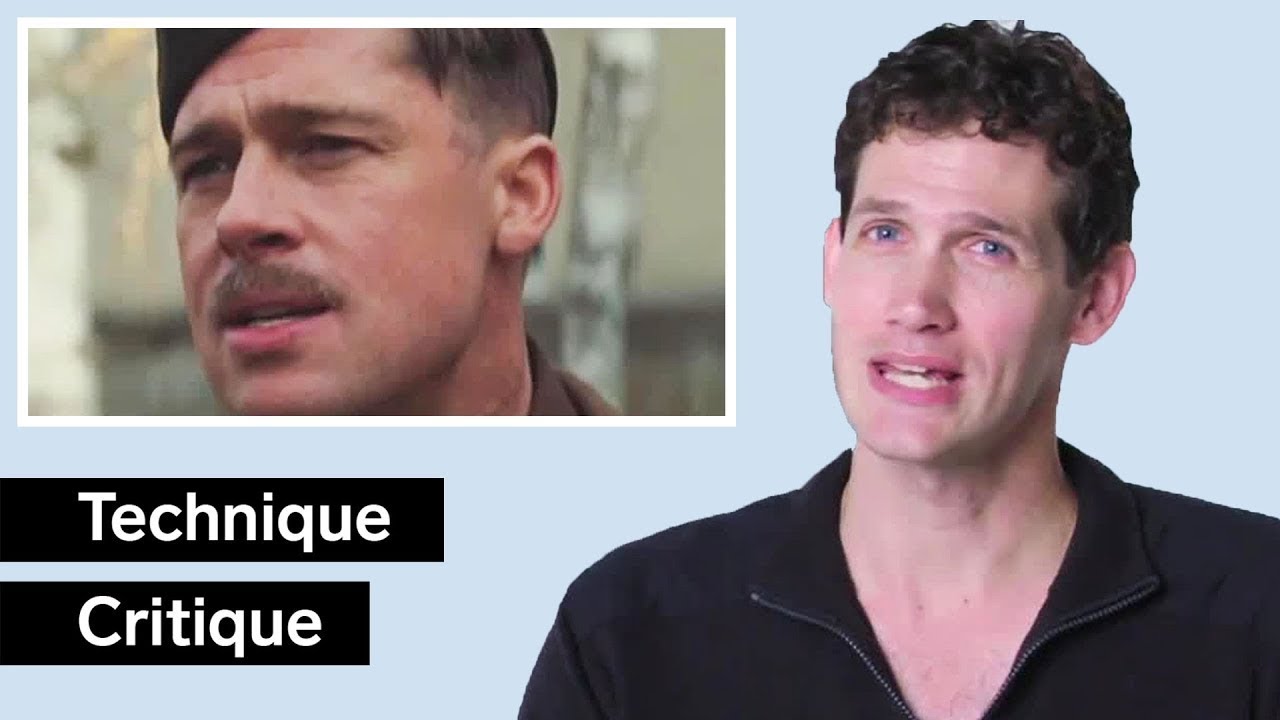
Dialect coach Erik Singer introduces his work helping actors master film and television accents before diving into clips of famous Hollywood performances. He begins with Brad Pitt portraying Lieutenant Aldo Raine in Quentin Tarantino’s *Inglourious Basterds*. Pitt delivers lines hunting down German forces, but Singer notes a defining regional phonetic feature that Pitt misses: Tennessee and broader Southern American dialects heavily feature "GOOSE fronting." In these accents, the vowel sound found in words like *goose*, *Jew*, *humanity*, and *cruel* should be pronounced further forward in the oral cavity. Demonstrating the target pronunciation, Singer notes that Aldo Raine’s vowel stays back rather than achieving that distinct fronted placement:
> “He doesn't really get that.”
[00:41](https://www.youtube.com/watch?v=NvDvESEXcgE&t=41s) Will Smith’s Nigerian Accent in *Concussion*
Evaluating Will Smith's performance as real-life forensic pathologist Dr. Bennet Omalu in *Concussion*, Singer highlights a disconnect between the source subject and the actor's execution. Bennet Omalu speaks with a distinct, Americanized Nigerian accent. Rather than replicating Omalu’s specific vocal identity, Smith delivers a generic, pan-African or broadly Nigerian cadence:
> “Smith doesn't seem to be going for Omalu's voice so much as a kind of generalized Nigerian or African accent.”
Singer draws attention to Smith's dental mechanics. When delivering lines like “this is bigger than they are,” the English voiced dental fricative ("th" sound) ought to be properly dentalized in this accent (*dis*, *dey*), a detail Smith overlooks in his delivery.
[01:18](https://www.youtube.com/watch?v=NvDvESEXcgE&t=78s) Philip Seymour Hoffman as Truman Capote in *Capote*
Turning to biographical drama, Singer examines Philip Seymour Hoffman’s Oscar-winning portrayal in *Capote*. Hoffman's performance stands out as an exceptional technical and artistic triumph:
> “The accent is dead on perfect, and the accent's totally integrated; it's integral to the character and what the actor is doing as the character.”
Hoffman captures Capote's idiosyncratic vocal timbre, high pitch, and mannerisms seamlessly. Rather than coming across as an applied vocal trick or a shallow impression, the accent functions as an organic extension of his physical and emotional life on screen.
[01:52](https://www.youtube.com/watch?v=NvDvESEXcgE&t=112s) Michael Keaton’s Boston Dialect in *Spotlight*
In *Spotlight*, Michael Keaton portrays Boston journalist Walter "Robby" Robinson. Keaton aims for a working Bostonian accent, attempting the stereotypical low-back vowel adjustments (often categorized around the *LOT* / *CLOTH* vowels). However, his delivery lacks consistency:
> “He says ‘on’ one time, and he says ‘on’ the next time.”
Keaton shifts between an open vowel in “come on” and a different rounded shape in “something was going on.” In addition, he fails to apply proper lip rounding to key words like *confirmation*, dropping the phonetic ball where an authentic local accent demands rounding.
[02:22](https://www.youtube.com/watch?v=NvDvESEXcgE&t=142s) Kate Winslet's Oral Posture in *Steve Jobs*
Kate Winslet’s Polish-accented performance as Joanna Hoffman in *Steve Jobs* is commended as strong overall, but Singer identifies a subtle structural issue regarding oral posture (the habitual resting setting and mechanical openness of the vocal tract):
> “A thing that she doesn't quite get is the oral posture: her mouth is very open, again, maybe theater training—the more you open your mouth, the more sound comes out.”
Real-life footage of Joanna Hoffman reveals a much closer, higher jaw setting with minimal clearance between upper and lower teeth when she speaks. Winslet, by contrast, drops her jaw wide open. Singer compares this with Meryl Streep’s Polish accent work in *Sophie’s Choice*, where Streep maintains a tight, restricted jaw posture.
```mermaid flowchart TD accTitle: Oral Posture Comparison for Polish Accents accDescr: Visualizing the differences in jaw posture between Winslet, Streep, and real speaker Joanna Hoffman.
subgraph Native["Authentic Polish Accent Posture"] A["Joanna Hoffman<br/>(Real Person)"] --> B["High, close jaw setting<br/>Restricted interdental space"] end
subgraph Cinematic["Screen Performances"] C["Kate Winslet<br/>(Steve Jobs)"] --> D["Open jaw / wide mouth cavity<br/>Typical of stage projection"] E["Meryl Streep<br/>(Sophie's Choice)"] --> F["Tight, narrow jaw posture<br/>Closely matches native setting"] end ```
[03:02](https://www.youtube.com/watch?v=NvDvESEXcgE&t=182s) Tom Cruise's Belfast Accent in *Far and Away*
Discussing Tom Cruise’s Irish dialect in *Far and Away*, Singer diagnoses an inconsistent execution, suggesting Cruise was likely not granted adequate dialect prep time:
> “The vowel sounds in like ‘Why can't you say you like my hat?’—keep going all over the place.”
In Cruise's delivery of lines such as “Can't you say you like my hat?”, the vowel targets fluctuate wildly across syllables. At moments the sounds drift near Belfast phonology, but just as quickly they wander into ungrounded territory, betraying a lack of sustained muscular muscle memory.
[03:35](https://www.youtube.com/watch?v=NvDvESEXcgE&t=215s) Joseph Gordon-Levitt’s French Accent in *The Walk*
Evaluating Joseph Gordon-Levitt playing Philippe Petit in *The Walk*, Singer terms the result largely successful despite minor irregularities. Gordon-Levitt achieves an accurate open vowel in words like *stop*, but his rhotic consonants fluctuate:
> “Sometimes he's got a French uvular [r], sometimes a more American sounding 'r'—but people are inconsistent, that's real.”
Crucially, Gordon-Levitt masters the dentalized voiced consonant in phrases like “mad with this,” avoiding the common native-French substitution traps and delivering an authentic linguistic profile.
[04:15](https://www.youtube.com/watch?v=NvDvESEXcgE&t=255s) Idris Elba as Nelson Mandela in *Mandela: Long Walk to Freedom*
Singer praises Idris Elba’s portrayal of Nelson Mandela in *Mandela: Long Walk to Freedom*, noting how Elba captures Mandela’s characteristic back-of-the-mouth resonance and vocal stance:
> “He's actually got a little bit of a retracted, a pulled-back tongue root.”
However, Elba falters on one prominent feature of Xhosa-influenced South African English: the *SQUARE* lexical set. When delivering words like *prepared*, Mandela naturally pronounced it as a pure monophthong. Elba accidentally articulates it as an English diphthong, sliding between vowel targets instead of holding the singular vowel steady.
[04:56](https://www.youtube.com/watch?v=NvDvESEXcgE&t=296s) Nicolas Cage’s Southern Accent in *Con Air*
Singer assesses Nicolas Cage's performance as Cameron Poe in *Con Air*, expressing bewilderment over the dialect decisions:
> “I don't know what happened to the actor's prep here; my first thought would be 'not a lot.'”
Cage fails to register foundational Southern dialect markers: - **Vowel breaking**: Words like *creep* and *freak* in authentic Southern dialects undergo vowel breaking, producing a glide or "wiggle" (*cree-up*, *free-uk*). Cage pronounces them flatly. - **Lower onset on diphthongs**: In words like *plane*, the starting point of the vowel should begin lower in the mouth, an inflection completely missing from Cage's delivery.
[05:31](https://www.youtube.com/watch?v=NvDvESEXcgE&t=331s) Jake Gyllenhaal and Heath Ledger in *Brokeback Mountain*
Analyzing *Brokeback Mountain*, Singer praises both leading men for distinct, accurate western regional choices. Jake Gyllenhaal hits the mark for a Wyoming accent, pulling vowels in words like *one*, *once*, and *couple* deep into the back of his mouth.
Heath Ledger's Texas accent is applauded equally for its psychological integration:
> “The character's tightness and repression and kind of struggle with himself is mirrored in his posture.”
Ledger anchors his performance in a physically clenched jaw and tight lips, conveying Ennis Del Mar's interior suppression through vocal tract tension so convincingly that the character visibly listens through that muscular posture.
[06:17](https://www.youtube.com/watch?v=NvDvESEXcgE&t=377s) Kevin Costner’s English Accent in *Robin Hood: Prince of Thieves*
Kevin Costner's turn in *Robin Hood: Prince of Thieves* is cited as an infamous benchmark for cinematic dialect failures:
> “So this is like the paradigm of bad movie accents; this is the one everybody brings up, for good reason.”
Costner vacillates between rhotic and non-rhotic speech, unable to decide whether to pronounce his *r* sounds at the end of syllables or omit them as non-rhotic English dialects do. Costner drops in and out of contemporary American speech patterns haphazardly, leading Singer to summarize that “nothing's right here.”
[06:48](https://www.youtube.com/watch?v=NvDvESEXcgE&t=408s) Leonardo DiCaprio’s Krio Accent in *Blood Diamond*
Leonardo DiCaprio tackles the English-based creole language of Sierra Leone—Krio—in *Blood Diamond*. Singer rates the effort as a creditable, respectable attempt:
> “It's a creditable job, but it's a little marred by some West Indian intonation; otherwise it's pretty good.”
While DiCaprio’s vowel placements and syntax mimic West African speech well, his pitch contours occasionally drift into Caribbean or West Indian pitch-tunes rather than preserving Sierra Leonean musicality.
[07:19](https://www.youtube.com/watch?v=NvDvESEXcgE&t=439s) David Oyelowo as Martin Luther King Jr. in *Selma*
In *Selma*, David Oyelowo portrays Dr. Martin Luther King Jr., opting for an artistic evocation rather than a straight acoustic impression:
> “David's not doing an impersonation; it's more of an evocation, which means he's just suggesting this very familiar voice.”
Singer demonstrates that while Oyelowo captures the gravity of King’s cadence, he does not access the expansive acoustic landscape of the real man. King used a massive dynamic pitch range across his sermons and speeches, rising and falling dramatically, whereas Oyelowo operates within a comparatively compressed vocal register.
[07:55](https://www.youtube.com/watch?v=NvDvESEXcgE&t=475s) Idris Elba’s Baltimore Accent in *The Wire*
Idris Elba’s long-term performance as Stringer Bell in HBO's *The Wire* receives high marks, reflecting years of study:
> “Elba was working on this accent for years.”
Despite its convincing execution, Singer points out that Elba misses a hyper-specific phonetic feature found in working-class African-American Baltimore speech: the distinct fronted vowel shift on the *TO* / *YOU* lexical sets (*tew*, *yew*). Singer contrasts Elba’s vowels with native Baltimore actors on the series—highlighting Robert F. Chew's performance as Proposition Joe—who land that specific local sound effortlessly.
[08:28](https://www.youtube.com/watch?v=NvDvESEXcgE&t=508s) Mickey Rooney in *Breakfast at Tiffany's*
Singer shows a brief clip of Mickey Rooney's exaggerated performance as Mr. Yunioshi in *Breakfast at Tiffany's*. Rather than offering technical analysis, Singer expresses disbelief and dismay at the infamous yellowface caricature:
> “Who the... let this happen?”
[08:38](https://www.youtube.com/watch?v=NvDvESEXcgE&t=518s) Daniel Day-Lewis's 19th-Century New York Dialect in *Gangs of New York*
Daniel Day-Lewis takes on the challenge of historical voice work as Bill "The Butcher" Cutting in *Gangs of New York*. Dialect coaches and actors always face a delicate balance when reconstructing extinct periods:
> “It's always tough to do a historical accent: do you go for absolute accuracy at the risk of alienating the audience and making it inaccessible?”
Day-Lewis balances accessibility with historic authenticity. He brings the tip of his tongue forward against the back of his front teeth, introduces heavy nasality, and preserves theatrical color and dynamic expression without compromising the archaic, mid-19th-century New York flavor.
[09:21](https://www.youtube.com/watch?v=NvDvESEXcgE&t=561s) Mel Gibson’s Scottish Dialect in *Braveheart*
Revisiting Mel Gibson’s portrayal of Scottish rebel William Wallace in *Braveheart*, Singer suggests history has been unnecessarily harsh to the actor:
> “You know, I think maybe Gibson gets a bad rap for this performance. It does slip out, but when it's on, it's pretty good.”
Though Gibson occasionally slips into Australian or generic vowel coloring during long monologues, his battle speeches feature surprisingly solid Scottish vowel placements and consonant taps when he is fully locked in.
[09:48](https://www.youtube.com/watch?v=NvDvESEXcgE&t=588s) Viggo Mortensen's Russian Accent in *Eastern Promises*
In David Cronenberg’s *Eastern Promises*, Viggo Mortensen portrays Nikolai Luzhin, a driver embedded in the Russian mafia in London. Singer finds the technical construction competent but musically detached:
> “It's not that the sounds are off—they're all pretty good—it just feels a little stiff and a little careful; the accent hasn't quite settled in yet, not like a real person speaking.”
Mortensen hits the requisite phonetic checkpoints, but the mechanical precision prevents the dialect from feeling fully integrated into an effortless conversational rhythm.
[10:17](https://www.youtube.com/watch?v=NvDvESEXcgE&t=617s) Matt Damon’s Afrikaans Accent in *Invictus*
Singer examines Matt Damon playing South African rugby captain Francois Pienaar in Clint Eastwood’s *Invictus*. Afrikaans-influenced English is notoriously treacherous for North American actors to master, but Damon prepared thoroughly:
> “Damon prepped really, really well for this role, and it's just a great job on an accent that's usually really hard for Americans.”
Damon executes the bulk of the difficult vocal shapes with fidelity, though Singer notes that when scrutinizing vowel uniformity across paired words like *chosen* and *know*, even well-drilled performances show minor inconsistencies.
[10:44](https://www.youtube.com/watch?v=NvDvESEXcgE&t=644s) Jon Voight and Cate Blanchett: Baffling Choices vs. Vocal Posture
Erik Singer examines Jon Voight's performance in *Anaconda*, where Voight attempts a Paraguayan accent with lines like, “Never look into the eyes of those you kill. They will haunt you forever.” Singer is entirely perplexed by the execution, bluntly confessing, “I have no idea what that accent was.”
Turning to Cate Blanchett's portrayal of Katharine Hepburn in *The Aviator*, Singer calls her work “a great evocation of Katharine Hepburn's particular idiolect.” However, he notes a small technical critique regarding physical mechanics: “If I had to quibble with it, I'd say that Blanchett relies really strongly on Hepburn's timbre and intonation.” While Blanchett hits the vocal inflections, she misses the physical setting of Hepburn's mouth. Blanchett maintains a very open jaw—likely stemming from her classical theater training—whereas Hepburn famously spoke with a high, tight, and slightly forward jaw posture.
[11:36](https://www.youtube.com/watch?v=NvDvESEXcgE&t=696s) Angelina Jolie and John Malkovich: Posh RP vs. Over-Palatalized Russian
In *Maleficent*, Angelina Jolie tackles an English accent, which Singer praises as a successful realization of an older, upper-crust dialect. “So Jolie's going for a slightly old-fashioned, very posh English accent here, what we'd call Received Pronunciation, and she does a great job of it.” Singer points specifically to how she pronounces the final vowels in words like *royalty*, *nobility*, and *gentry*. These words feature short ending [ɪ] vowels, an aristocratic touch that has largely disappeared from modern British accents.
By contrast, John Malkovich's Russian mobster accent in *Rounders* receives heavy criticism. While Russian speakers speaking English do insert a subtle "y" sound into certain words (such as *alligator*), Malkovich goes wildly off course: “And what Malkovich does here is something that no Russian speaker speaking English would actually do, which is palatalize everything.” His pronunciation of words like *money* becomes comically over-enthusiastic, producing an exaggerated sound no native Russian speaker would ever make.
[12:48](https://www.youtube.com/watch?v=NvDvESEXcgE&t=768s) Renée Zellweger and Brad Pitt: Estuary Nuances and German Devoicing
Singer applauds Renée Zellweger's London accent in *Bridget Jones's Diary*, noting that her musicality and oral posture work seamlessly together. She successfully adopts an Estuary English quality, highlighted by an advanced linguistic mechanic: “She does lateral plosion on words like *gentlemen*—that's exploding the T sound straight into the L sound, and is difficult for a lot of people.”
The analysis then moves to two contrasting roles from Brad Pitt:
```mermaid flowchart TD accTitle: Brad Pitt Accent Analysis Comparison accDescr: Diagram comparing Brad Pitt's accent flaws in Seven Years in Tibet against his strengths in Snatch.
subgraph SevenYears["Seven Years in Tibet (German)"] A1["Final Consonant Voicing Error"] A2["Says voiced 'v' in 'have' instead of devoiced 'f'"] A3["Says voiced 'd' in 'kind' instead of devoiced 't'"] A1 --> A2 A1 --> A3 end
subgraph Snatch["Snatch (Belfast / Pikey)"] B1["Accurate Belfast Vowel Shifts"] B2["Hits unique diphthongs in words like 'car'"] B3["Contrast with The Devil's Own failure on 'sea' and 'sleep'"] B1 --> B2 B1 --> B3 end ```
In *Seven Years in Tibet*, Pitt attempts an Austrian German accent, but fails to implement German final-obstruent devoicing into his English: “In German, the consonants at the ends of words are devoiced, and this carries over into English.” A native German speaker would pronounce the final consonant of *have* as an [f] and *kind* as a [t]. Pitt leaves them voiced, which is noticeably unnatural for a native German speaker.
However, in *Snatch*, Pitt's Belfast-influenced traveler accent works brilliantly. Singer notes that while Belfast English is notoriously difficult for American audiences to parse, Pitt captures the exact vowel nuances, particularly in words like *car*. Singer contrasts this success with Pitt's earlier Irish role in *The Devil's Own*, where Pitt completely failed to nail the local vowels in words like *sea* and *sleep*.
[14:26](https://www.youtube.com/watch?v=NvDvESEXcgE&t=866s) Heath Ledger, Keanu Reeves, and Daniel Day-Lewis: Physical Idiosyncrasies and Non-Rhoticity
In *The Dark Knight*, Heath Ledger crafts a unique vocal delivery for the Joker. Singer describes it as a strange, idiosyncratic American accent tailor-made for an idiosyncratic character. “I love the way he's able to maintain his accent even with this weird tongue-flicky-outy gesture that he does that's part of the character.”
Keanu Reeves's English accent in *Bram Stoker's Dracula* falters due to inconsistency with rhoticity. Because standard Southern English accents are non-rhotic, speakers drop the "r" sound after a vowel unless followed by another vowel. In the phrase *blue inferno*, Reeves hesitates and inconsistently voices the "r", leading Singer to remark, “He can't make up his mind whether to do it or not.”
Daniel Day-Lewis earns immense praise for his vintage California accent in *There Will Be Blood*. Singer observes that Day-Lewis constructs both the accent and the persona from the inside out using oral posture: - “I love the way he seems to build the accent, and even the character, around the oral posture.” - The tongue is bunched high in the center of the mouth and braced firmly against the upper molars. - The cheeks are kept loose, allowing the speech to resonate distinctively beneath his period-accurate mustache.
[15:53](https://www.youtube.com/watch?v=NvDvESEXcgE&t=953s) Don Cheadle and the Realities of Dialect Acting
Don Cheadle's Cockney accent in *Ocean's Eleven* is singled out as an example of an actor being set up to fail. Singer immediately excuses Cheadle, arguing, “There's no way the actor was given enough time to prepare.” In lines such as, “It'll be nice working with proper villains again,” none of Cheadle's vowels manage to hit their authentic Cockney targets.
Wrapping up the masterclass, Singer emphasizes empathy for the actors, noting that taking on dialects is an enormous artistic gamble: - “Look, this stuff isn't easy. Good or bad, these actors all took some serious risks for our entertainment.” - Dialect failures are rarely due to sheer lack of talent; rather, “When an accent doesn't go right, it's usually not the actor's fault. It's usually a combination of actor, coach, and production, and often is about not having enough time to prepare before shooting starts.” - Singer leaves viewers with a fundamental takeaway on cinema craft: “If there's one thing to remember, it's that accent is a crucial layer of storytelling.”
## Notable quotes > [15:53](https://www.youtube.com/watch?v=NvDvESEXcgE&t=953s) If there's one thing to remember, it's that accent is a crucial layer of storytelling. — Erik Singer
> [15:53](https://www.youtube.com/watch?v=NvDvESEXcgE&t=953s) When an accent doesn't go right, it's usually not the actor's fault. It's usually a combination of actor, coach, and production, and often is about not having enough time to prepare before shooting starts. — Erik Singer
> [08:38](https://www.youtube.com/watch?v=NvDvESEXcgE&t=518s) It's always tough to do a historical accent: do you go for absolute accuracy at the risk of alienating the audience and making it inaccessible? — Erik Singer
## Mentioned Erik Singer, Brad Pitt, Inglourious Basterds, Will Smith, Bennet Omalu, Concussion, Philip Seymour Hoffman, Truman Capote, Capote, Michael Keaton, Walter Robinson, Spotlight, Kate Winslet, Joanna Hoffman, Steve Jobs, Meryl Streep, Sophie's Choice, Tom Cruise, Far and Away, Joseph Gordon-Levitt, Philippe Petit, The Walk, Idris Elba, Nelson Mandela, Mandela: Long Walk to Freedom, Nicolas Cage, Con Air, Jake Gyllenhaal, Heath Ledger, Brokeback Mountain, Kevin Costner, Robin Hood: Prince of Thieves, Leonardo DiCaprio, Blood Diamond, David Oyelowo, Martin Luther King Jr., Selma, The Wire, Robert F. Chew, Mickey Rooney, Breakfast at Tiffany's, Daniel Day-Lewis, Gangs of New York, Mel Gibson, Braveheart, Viggo Mortensen, Eastern Promises, Clint Eastwood, Matt Damon, Francois Pienaar, Invictus, Jon Voight, Anaconda, Cate Blanchett, Katharine Hepburn, The Aviator, Angelina Jolie, Maleficent, John Malkovich, Rounders, Renée Zellweger, Bridget Jones's Diary, Seven Years in Tibet, Snatch, The Devil's Own, The Dark Knight, Keanu Reeves, Bram Stoker's Dracula, There Will Be Blood, Don Cheadle, Ocean's Eleven, WIRED
## Video description Dialect coach Erik Singer analyzes the accents of some of Hollywood's biggest names. How accurate were they really?
Check out more from Erik here: http://www.eriksinger.com/
Still haven’t subscribed to WIRED on YouTube? ►► http://wrd.cm/15fP7B7 Get more incredible stories on science and tech with our daily newsletter: https://wrd.cm/DailyYT
Also, check out the free WIRED channel on Roku, Apple TV, Amazon Fire TV, and Android TV. Here you can find your favorite WIRED shows and new episodes of our latest hit series Tradecraft.
ABOUT WIRED WIRED is where tomorrow is realized. Through thought-provoking stories and videos, WIRED explores the future of business, innovation, and culture.
Movie Accent Expert Breaks Down 32 Actors' Accents | WIRED
Created by: Joe Sabia
[Source](https://www.youtube.com/watch?v=NvDvESEXcgE)