Hydrogen Vehicle Survives Leak Fire as Gasoline Model Burns in Test
Hydrogen Societies
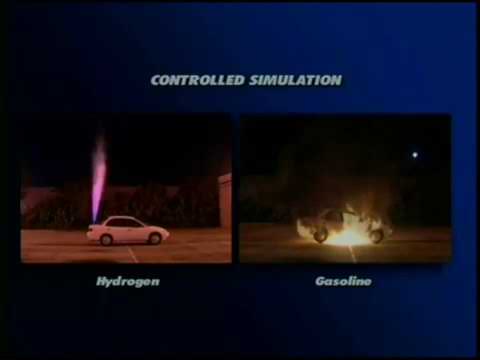
Ignited hydrogen vents upward and burns out within two minutes to spare the vehicle cabin from heat damage, whereas conventional gasoline leaks trigger sustained fires that consume the car.
AI-assisted summary of Hydrogen vs. Gasoline Leak and Ignition Test- which is safer? — original source. Check the original for full context.
Source published:
Key ideas
- A controlled fuel leak and ignition experiment demonstrates that a hydrogen-powered vehicle's fire vents upward and extinguishes in under two minutes, leaving the car virtually undamaged. (0:00)
- In contrast to the rapidly dissipating hydrogen jet flame, the gasoline-fueled test fire sustained burning and ultimately consumed the vehicle. (0:00)
- Internal sensors in the hydrogen vehicle recorded a temperature increase of just 13°F near the rear window, while the steering wheel detected almost no temperature rise. (0:00)
- Researchers emphasize that catastrophic fuel leaks are exceptionally rare, noting that multi-layered safety designs and pressure relief devices minimize fire hazards across alternative fuel vehicles. (0:00)
Detailed notes
## Background Published on YouTube by the channel Hydrogen Societies on January 9, 2019, this video documents Dr. Michael Swain's 2001 University of Miami study comparing vehicle fuel leaks and fires. The description details a controlled test where a simulated leak and ignition were staged between a hydrogen-powered car and a gasoline-powered car, highlighting that public fears regarding hydrogen fuel safety appear largely unfounded.
## TL;DR The video presents a controlled side-by-side simulation testing worst-case fuel leak scenarios by deliberately triggering a pressure relief device failure and igniting the escaping fuel with an electric spark. While the gasoline vehicle sustains a prolonged, destructive fire that consumes the car, the hydrogen fuel vents directly upward and expends itself completely in under two minutes. Sensors inside the hydrogen vehicle's cabin reveal minimal heat transfer, showing only a 13°F increase near the rear window and virtually no change at the steering wheel, leaving the vehicle essentially undamaged. The narration concludes by emphasizing that robust safety engineering makes such catastrophic failure events exceedingly improbable for modern alternative fuel vehicles.
## Atmosphere & style The presentation carries a calm, clinical, and reassuring scientific tone, relying on measured narration rather than sensationalism. Watching the side-by-side burn conveys a striking visual contrast between the violent, lingering destruction of the gasoline fire and the controlled, fast-clearing vertical plume of the hydrogen flame. The mood is analytical and educational, leaving the viewer with a sense of technical clarity and vindication regarding modern hydrogen safety design.
## Bulletin - [00:00](https://www.youtube.com/watch?v=OA8dNFiVaF0&t=0s) A controlled fuel leak and ignition experiment demonstrates that a hydrogen-powered vehicle's fire vents upward and extinguishes in under two minutes, leaving the car virtually undamaged. - [00:00](https://www.youtube.com/watch?v=OA8dNFiVaF0&t=0s) In contrast to the rapidly dissipating hydrogen jet flame, the gasoline-fueled test fire sustained burning and ultimately consumed the vehicle. - [00:00](https://www.youtube.com/watch?v=OA8dNFiVaF0&t=0s) Internal sensors in the hydrogen vehicle recorded a temperature increase of just 13°F near the rear window, while the steering wheel detected almost no temperature rise. - [00:00](https://www.youtube.com/watch?v=OA8dNFiVaF0&t=0s) Researchers emphasize that catastrophic fuel leaks are exceptionally rare, noting that multi-layered safety designs and pressure relief devices minimize fire hazards across alternative fuel vehicles.
## Key takeaways - [00:00](https://www.youtube.com/watch?v=OA8dNFiVaF0&t=0s) The experiment simulates a worst-case scenario involving the intentional leak and spark ignition of fuel on both hydrogen and gasoline vehicles. - [00:00](https://www.youtube.com/watch?v=OA8dNFiVaF0&t=0s) The simulation directly evaluates a mechanical breakdown of the pressure relief device (PRD), an occurrence proven to be extremely rare in natural gas vehicle operations. - [00:00](https://www.youtube.com/watch?v=OA8dNFiVaF0&t=0s) Extensive engineering and multi-layered safety mechanisms make major fuel leaks and subsequent fires highly improbable under standard operating conditions. - [00:00](https://www.youtube.com/watch?v=OA8dNFiVaF0&t=0s) Upon ignition, hydrogen gas vents straight upward, directing flame and heat away from the passenger compartment. - [00:00](https://www.youtube.com/watch?v=OA8dNFiVaF0&t=0s) The hydrogen tank completely vents and burns out in under two minutes, rapidly extinguishing the fire. - [00:00](https://www.youtube.com/watch?v=OA8dNFiVaF0&t=0s) The hydrogen test vehicle sustained virtually no structural or body damage from the fire. - [00:00](https://www.youtube.com/watch?v=OA8dNFiVaF0&t=0s) Cabin temperatures in the hydrogen car remained remarkably low, with the rear window sensor recording only a 13°F rise. - [00:00](https://www.youtube.com/watch?v=OA8dNFiVaF0&t=0s) Sensors at the driver's steering wheel registered virtually no detectable temperature increase during the hydrogen flame discharge. - [00:00](https://www.youtube.com/watch?v=OA8dNFiVaF0&t=0s) The gasoline-fueled vehicle experienced a sustained fire that consumed the car. - [00:00](https://www.youtube.com/watch?v=OA8dNFiVaF0&t=0s) Strict safety engineering standards successfully mitigate extreme fire hazards across both conventional and alternative fuel platforms.
## Detailed walkthrough ### [00:00](https://www.youtube.com/watch?v=OA8dNFiVaF0&t=0s) Pressure Relief Device Failure Simulation: Hydrogen vs. Gasoline
The narration emphasizes the multi-layered engineering designed into alternative fuel vehicles, asserting that catastrophic fuel escapes and subsequent blazes are practically anomalous under standard conditions. As the narrator explains: “With all these safety systems in place, it's extremely unlikely that these vehicles would leak much fuel and even less likely that a leak would result in fire.” To test the worst-case scenario, the controlled experiment simulates a direct failure of a single critical safeguard: the pressure relief device (PRD). Field data gathered from extensive natural gas vehicle operation indicates that an unexpected failure of a pressure relief device is an extremely rare occurrence, yet this simulation isolates that specific mechanical breakdown to evaluate the real-world thermal consequences for both fuels.
In the side-by-side comparison, fuel was intentionally leaked and ignited using an electric spark on both a hydrogen-powered vehicle and a conventional gasoline-fueled car. The physical behavior of the two fires diverges dramatically upon ignition. In the hydrogen-powered car, the escaping gas vents straight upward, and the entire tank empties in under two minutes, causing the jet flame to extinguish rapidly while leaving the car virtually undamaged. Sensor measurements inside the cabin confirmed the minimal heat transfer: the temperature recorded inside near the rear window climbed by only 13 degrees Fahrenheit, while the sensor stationed at the driver's steering wheel registered almost no detectable temperature increase. The demonstration concludes with the narrator reinforcing that rigorous engineering standards mitigate these hazards across the board: “The reality is that safe design makes this kind of an event highly unlikely for any kind of vehicle.”
| Parameter | Hydrogen Vehicle Result | Gasoline Vehicle Result | |:--- |:--- |:--- | | **Ignition Mechanism** | Controlled electric spark at leak point | Controlled electric spark at leak point | | **Duration of Fire** | Empties and self-extinguishes in under 2 minutes | Sustained fuel-fed fire | | **Vehicle Body Damage** | Virtually undamaged | Consumed by sustained burning | | **Interior Temp (Rear Window)** | Rose only 13°F | Elevated significantly by vehicle fire | | **Interior Temp (Steering Wheel)**| Barely increased at all | Elevated significantly by vehicle fire |
- **Component Evaluated**: Failure of the fuel tank pressure relief device (PRD). - **Hydrogen Depletion Time**: Under 2 minutes to completely vent and extinguish. - **Rear Window Temperature Rise**: 13°F maximum internal increase. - **Cabin Front Temperature**: Negligible temperature change detected at the steering wheel.
## Mentioned Dr. Michael Swain, University of Miami at Coral Gables, Pressure relief device (PRD)
## Video description 2001: Dr. Michael Swain with the University of Miami at Coral Gables attempted to simulate two car fires, one created by a 1/16th inch puncture in a gasoline fuel line, the other by a leaking hydrogen connector. He video taped the experiment to document what would happen if the leaks ignited. As the photos below clearly demonstrate, consumer fears about hydrogen as a transportation fuel would seem to be pretty much unfounded.
While the gasoline-fed fire eventually consumed the second test vehicle, leaving it a smoldering heap of charred steel and melted glass, the hydrogen fire was over in less than two minutes and left the hydrogen-tank equipped test car virtually undamaged. In fact, the heat inside the car never got above 67 degrees.
Dr. Swain points out in Fuel Leak Simulation that while the gasoline fire started as the result of a simple, small hole in the fuel line, for the hydrogen fire to occur, it would have taken the catastrophic failure of four separate safety systems, all at the same time, a highly unlikely occurrence.
Dr. Michael Swain Hydrogen Leak Study (PDF) https://www1.eere.energy.gov/hydrogenandfuelcells/pdfs/30535be.pdf
Help us tell the world about Hydrogen if you can - Thank you! PayPal: help@h2247.com
[Source](https://www.youtube.com/watch?v=OA8dNFiVaF0)