Walker Warns US Faces $53 Trillion Hole as Entitlement Costs Surge
IOUSAtheMovie
Unfunded Medicare and Social Security promises will consume all federal tax revenue and force taxes to double unless Washington enacts structural entitlement reforms.
AI-assisted summary of I.O.U.S.A.: Byte-Sized - The 30 Minute Version — original source. Check the original for full context.
Source published:
Key ideas
- The United States faces an unfunded liability hole of $53 trillion—equivalent to roughly $175,000 per citizen—driven primarily by future commitments for Medicare and Social Security. (0:04)
- The nation's fiscal vulnerability is compounded by four interlocking shortfalls: the federal budget deficit, a near-zero or negative personal savings rate, a chronic balance of payments/trade deficit, and a political leadership deficit. (0:04)
- Commonly debated political solutions fall far short of solving the structural imbalance: ending the Iraq War addresses under 3%, expiring the Bush tax cuts addresses about 10%, and eliminating all earmarks addresses only about 1% of annual spending. (27:46)
- By 2040, the national debt-to-GDP ratio is projected to reach double the historical peak set at the end of World War II, risking severe economic destabilization and dependency on foreign creditors. (27:46)
Detailed notes
## Background Uploaded to YouTube by IOUSAtheMovie on October 31, 2008, this presentation is a condensed 30-minute web adaptation of the acclaimed feature-length documentary 'I.O.U.S.A.' According to the video description, the release was designed for widespread online sharing to alert citizens to the rapidly mounting national debt and the staggering $53 trillion in federal obligations owed to foreign creditors and the American public.
## TL;DR Led by former U.S. Comptroller General David M. Walker, the program examines America's mounting fiscal crisis across four compounding fronts: the budget deficit, the savings deficit, the trade deficit, and a bipartisan leadership deficit. The film reveals that while the official debt stood near $9 trillion, the true total of unfunded federal promises—dominated by runaway Medicare and Social Security obligations for the retiring Baby Boomer generation—amounts to an unsustainable $53 trillion. Prominent figures including Warren Buffett and former Treasury Secretary Paul O’Neill demonstrate that popular political proposals, such as repealing tax cuts or ending the Iraq War, fail to fix the underlying structural shortfall. Ultimately, the documentary issues an urgent call for grassroots citizen action before reliance on foreign creditors and runaway entitlements permanently erode the nation's standard of living.
## Atmosphere & style The presentation carries the grave, high-stakes urgency of a national security briefing delivered by seasoned accountants, economic analysts, and whistleblowers. This sobering tone is punctuated by jarring street interviews that expose widespread public financial illiteracy, alongside satirical moments like a Saturday Night Live sketch that mock chronic overconsumption. Watching the film feels like an escalating wake-up call, using unrelenting mathematical charts and historical analogies to transform abstract economic data into an impending national horror story.
## Bulletin - [00:04](https://www.youtube.com/watch?v=O_TjBNjc9Bo&t=4s) The United States faces an unfunded liability hole of $53 trillion—equivalent to roughly $175,000 per citizen—driven primarily by future commitments for Medicare and Social Security. - [00:04](https://www.youtube.com/watch?v=O_TjBNjc9Bo&t=4s) The nation's fiscal vulnerability is compounded by four interlocking shortfalls: the federal budget deficit, a near-zero or negative personal savings rate, a chronic balance of payments/trade deficit, and a political leadership deficit. - [27:46](https://www.youtube.com/watch?v=O_TjBNjc9Bo&t=1666s) Commonly debated political solutions fall far short of solving the structural imbalance: ending the Iraq War addresses under 3%, expiring the Bush tax cuts addresses about 10%, and eliminating all earmarks addresses only about 1% of annual spending. - [27:46](https://www.youtube.com/watch?v=O_TjBNjc9Bo&t=1666s) By 2040, the national debt-to-GDP ratio is projected to reach double the historical peak set at the end of World War II, risking severe economic destabilization and dependency on foreign creditors.
## Key takeaways - [00:04](https://www.youtube.com/watch?v=O_TjBNjc9Bo&t=4s) U.S. Comptroller General David M. Walker describes the national debt and mounting liabilities as a domestic 'fiscal cancer' more dangerous than foreign adversaries. - [00:04](https://www.youtube.com/watch?v=O_TjBNjc9Bo&t=4s) The stated federal debt of $8.7 trillion in early 2007 represented only a fraction of total commitments; factoring in unfunded Medicare and Social Security promises expanded total obligations to $53 trillion. - [03:47](https://www.youtube.com/watch?v=O_TjBNjc9Bo&t=227s) Throughout early U.S. history, debts incurred during conflicts like the Revolutionary War and Civil War were deliberately paid down through strict fiscal discipline and shared public sacrifice. - [07:39](https://www.youtube.com/watch?v=O_TjBNjc9Bo&t=459s) During a 40-year window, the federal government ran 35 budget deficits and only five surpluses, masking operational shortfalls by absorbing cash surpluses from the Social Security trust fund. - [07:39](https://www.youtube.com/watch?v=O_TjBNjc9Bo&t=459s) A demographic inflection point was projected for 2017, when Baby Boomer retirements would cause Social Security's cash flows to reverse from generating surplus revenue to expanding federal deficits. - [11:39](https://www.youtube.com/watch?v=O_TjBNjc9Bo&t=699s) Mandatory spending on entitlement programs—Medicare, Medicaid, and Social Security—is driven upward by demographic shifts and escalating healthcare costs, threatening to crowd out all discretionary government functions. - [14:03](https://www.youtube.com/watch?v=O_TjBNjc9Bo&t=843s) American households exhibited negative savings rates for two consecutive years, a phenomenon previously seen only during the Great Depression, depriving the domestic economy of capital. - [17:11](https://www.youtube.com/watch?v=O_TjBNjc9Bo&t=1031s) Warren Buffett's parable of Squanderville and Thriftsville warns that chronic trade deficits lead a nation to trade away its physical assets and future income to foreign trading partners. - [19:29](https://www.youtube.com/watch?v=O_TjBNjc9Bo&t=1169s) The 1956 Suez Crisis illustrates the geopolitical danger of debt dependence, as the U.S. forced Great Britain to abandon a military operation by threatening to dump its British pound reserves. - [21:58](https://www.youtube.com/watch?v=O_TjBNjc9Bo&t=1318s) Former Treasury Secretary Paul O'Neill was ousted from the Bush administration after opposing tax cuts during wartime, revealing political leadership that routinely ignored compounding debt. - [26:17](https://www.youtube.com/watch?v=O_TjBNjc9Bo&t=1577s) Medicare obligations alone make up $34 trillion of the nation's $53 trillion fiscal shortfall, with $8 trillion generated by the 2003 Medicare Part D prescription drug law. - [27:46](https://www.youtube.com/watch?v=O_TjBNjc9Bo&t=1666s) Popular budget remedies—such as ending earmarks, expiring tax cuts, or withdrawing from foreign wars—fail to close more than a tiny fraction of the long-term entitlement-driven funding gap. - [27:46](https://www.youtube.com/watch?v=O_TjBNjc9Bo&t=1666s) Without structural reforms, closing the fiscal shortfall purely through revenue would require doubling federal tax burdens across the board. - [29:12](https://www.youtube.com/watch?v=O_TjBNjc9Bo&t=1752s) Because the fiscal crisis is entirely domestic and self-inflicted, long-term stabilization requires direct citizen engagement and political accountability.
## Detailed walkthrough ### [00:04](https://www.youtube.com/watch?v=O_TjBNjc9Bo&t=4s) A Fiscal Cancer: Introducing America’s Debt Crisis
The crisis opens not with foreign battlefields, but with a warning that the greatest danger to the country comes from within its own borders. As news montages flash across the screen—reporting on the housing market collapse, spreading Wall Street panic, spiking oil and gold prices, and emergency Federal Reserve interest rate cuts—an urgent alarm is sounded: “I would argue that the most serious threat to the United States is not someone hiding in a cave in Afghanistan or Pakistan, but our own fiscal irresponsibility.” At the center of this warning is David M. Walker, the Comptroller General of the United States and the nation's top accountant. After calculating the federal government's income, current liabilities, and future promises, Walker delivers a blunt diagnosis of the nation's trajectory: “We suffer from a fiscal cancer; it is growing within us, and if we do not treat it, it could have catastrophic consequences for our country.”
When everyday Americans on the street are asked to guess the size of the federal debt, their estimates miss the reality by orders of magnitude; one passerby guesses sixty-nine billion dollars, only to be shocked upon learning the actual figure stands at $8.7 trillion. In February 2007, that $8.7 trillion debt represented roughly 64 percent of the nation's $13.5 trillion Gross Domestic Product (GDP). Yet the existing debt is only the surface of the crisis. When adding up all of the federal government's unfunded promises for Medicare and Social Security as of September 30, 2007, the nation sits inside an astounding $53 trillion hole—a deficit expanding by two to three trillion dollars every year simply by doing nothing, accelerated even further by expanding annual deficits and financial bailouts.
To understand the crisis, the film frames the predicament not as a single shortfall, but as an interlocking web of four compounding national deficits:
```mermaid flowchart TD accTitle: The Four Deficits Facing America accDescr: A flow diagram showing how the four deficits feed into national fiscal instability.
subgraph Deficits["The Compounding National Pressures"] D1["1. Budget Deficit<br/>(Government spending exceeds revenue)"] D2["2. Savings Deficit<br/>(Citizens spend beyond their means)"] D3["3. Balance of Payments Deficit<br/>(Trade deficit & foreign borrowing)"] D4["4. Leadership Deficit<br/>(Inability of politicians to make hard choices)"] end
D4 --> D1 D2 --> D3 D1 --> Crisis["$53 Trillion Unfunded Obligations Hole"] D3 --> Crisis ```
- **The Federal Debt (Feb 2007):** $8.7 trillion, or approximately 64% of the $13.5 trillion gross domestic product. - **The True Total Obligations (Sept 2007):** $53 trillion when including unfunded promises for Social Security and Medicare. - **Annual Growth Rate:** Compounding by $2 to $3 trillion per year through inaction alone. - **The Four Deficits:** The budget deficit, the savings deficit, the balance of payments deficit (including the trade deficit), and the leadership deficit.
---
[03:47](https://www.youtube.com/watch?v=O_TjBNjc9Bo&t=227s) From the Founding Fathers to the Reagan Era: A History of U.S. Debt
America's debt accumulation reflects the cumulative total of every annual budget deficit and surplus since the founding of the republic. When the federal government began operations on March 4, 1789, it inherited an initial Revolutionary War debt of $75 million—roughly 40 percent of the young economy. Terrified by this burden, the Founding Fathers acted swiftly to pay it off. A similar discipline occurred after the Civil War, which brought the federal government to the brink of bankruptcy before the debt was rapidly reduced once more. The structural framework of modern American finance arrived in 1913 with the creation of the Federal Reserve System to manage the money supply, alongside the establishment of the modern federal income tax.
Following the immense hardships of the Great Depression, President Franklin D. Roosevelt introduced Social Security as foundational insurance bought and paid for by workers and employers. World War II necessitated unprecedented government borrowing, but it was matched by collective civilian sacrifice; as Hollywood star Humphrey Bogart declared in a public appeal, “Our fighting men have just won history's greatest victory for freedom; buy bonds for their future and for your own future.” However, the massive social and military outlays of the 1960s and 1970s eventually triggered severe stagflation and economic distress by the decade's end.
The 1980s heralded Ronald Reagan's supply-side economics and the contentious Laffer Curve, which posited that reducing marginal tax rates would stimulate enough economic activity to boost net tax revenues. The theory provoked fierce pushback even within conservative ranks; during the 1980 primary campaign, George H. W. Bush famously dismissed supply-side theory: “Let me just give you a difference that I have with Governor Reagan on taxes: it is what I call a voodoo economic policy.” Regardless of the ideological debate, the historical outcome was undeniable: debt exploded during an era of relative peace and prosperity as the country became structurally addicted to borrowing.
- **March 4, 1789:** Starting national debt was $75 million (~40% of GDP), which the Founders prioritized paying down. - **1913:** Creation of the Federal Reserve System and the modern federal income tax. - **1930s–1940s:** Social Security established; World War II debt financed directly through popular war bonds. - **1980s:** Emergence of supply-side economics ("Reaganomics"); national debt surged during peacetime as borrowing became institutionalized.
---
[07:39](https://www.youtube.com/watch?v=O_TjBNjc9Bo&t=459s) The Brief Surplus and the Looming Entitlement Tsunami
A rare moment of fiscal discipline arrived in the late 1990s when political leaders from both parties convened to balance the ledger. President Bill Clinton praised the achievement at a bill signing ceremony: “We come here today, Democrats and Republicans, to celebrate a true milestone for our nation; in a few moments, I will sign into law the first balanced budget in a generation.” Yet policy experts point out that the political system naturally tilts toward fiscal dysfunction. Political inertia perpetually favors expanding popular federal programs while simultaneously cutting taxes, avoiding the painful, necessary trade-offs required to balance actual program costs against realistic revenues.
Over a 40-year window, the federal government recorded 35 annual deficits and just five surpluses. Worse, those numbers concealed an accounting sleight-of-hand: the federal government systematically used massive cash surpluses from Social Security to pay for unrelated day-to-day government operations. As a speaker underscores, “This is something that's utterly unsustainable, and remember, all of that has happened before the Baby Boomers retire—and the Baby Boomers are not a projection; they're born, they're out there, they're going to be eligible for Social Security and Medicare, and yet we can't pay our bills now.”
By 2017, Social Security's cash flows will reverse, moving from generating surplus revenue that masks the general deficit to running shortfalls that actively widen it. When combined with runaway Medicare obligations, the long-term projection threatens total economic destabilization. One speaker underscores the gravity of the threat in stark national-security terms: “This issue represents the potential fiscal meltdown of this nation, and it absolutely guarantees, if it's not addressed, that our children will have less of a quality of life than we've had, that they will have a government they can't afford, and that we will be demanding so much of them in the area of taxes that they will not have the money to send their kids to college, or buy that home, or just live a good quality of life.”
- **The 40-Year Ledger:** 35 deficits versus only 5 budget surpluses. - **Hidden Deficits:** Annual Social Security trust fund surpluses were routinely absorbed into the general fund to pay standard operational bills. - **2017 Milestone:** The inflection point where Social Security stops buffering the federal deficit and begins compounding it as Baby Boomers retire.
---
[11:39](https://www.youtube.com/watch?v=O_TjBNjc9Bo&t=699s) Grassroots Awakening and the Inevitable Math
To combat public indifference, grass-roots advocates take their warning directly to high schools and college campuses, confronting students with the stark reality of the debt burden they are inheriting. Activists urge youth to wake up to the hypocrisy between what they are taught at home and what Washington practices: parents lecture children about saving money and avoiding credit cards, while the elected officials sent to represent them pile on historic debt. As an activist engages passing students, the message is intentionally blunt: “You're a prisoner to the national debt.” When someone protests that this approach is terrifying, the campaigner replies unapologetically: “I know I am scaring people; that's the point, man—it's a scary issue.”
The mathematical reality driving this fiscal imbalance is straightforward. While short-term federal budget deficits fluctuate with the business cycle, the long-term outlook is driven by three major entitlement programs: Medicare, Medicaid, and Social Security. The spending curve for these three programs rises relentlessly under current law, driven by rising longevity and escalating medical costs. As an economic analyst observes, “Unless we're willing to raise taxes and keep on raising them, or close down the rest of the federal government, we've got a very big problem staring us in the face.”
The sequence culminates with a satirical pop-culture critique from *Saturday Night Live*, parodying the nation's chronic inability to live within its means. A comedic infomercial pitches a revolutionary personal finance book with an absurdly straightforward concept: > “Did you know millions of Americans live with debt they cannot control? That's why I developed this unique new program for managing your debt. It's called: *Don't Buy Stuff You Cannot Afford*... If you don't have any money, you should not buy anything!”
[14:03](https://www.youtube.com/watch?v=O_TjBNjc9Bo&t=843s) The Savings Deficit and the Culture of Consumption
The film questions everyday Americans on the street about their personal financial habits, asking how much money they actually have put away in their savings accounts. The answers reveal a bleak reality: responses range from “a couple hundred bucks” to “about a thousand maybe.” One young person candidly admits, “I end up using most of the money in my savings account so it doesn't really like work as a savings account like I'm not actually saving anything I'm just storing it there,” while another observes that the overwhelming majority of citizens live paycheck to paycheck.
Following these street interviews, David Yepsen, chief political columnist for the *Des Moines Register*, convenes a discussion alongside Dean Baker and others, calling this the single most critical challenge facing the nation. Yepsen warns that the public is mirroring the destructive habits of the federal government by living well beyond their means—taking out home equity lines of credit, racking up credit card debt, and accumulating crushing compound interest until they are staring down an inability to make their basic payments.
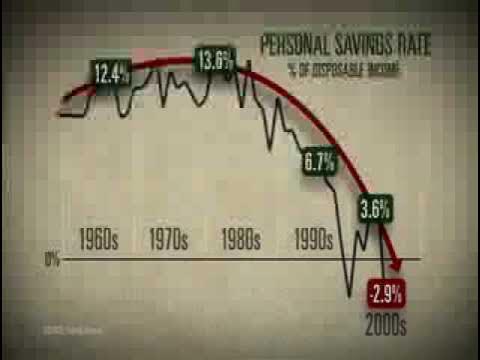
Compounding the problem, the United States experienced a negative household savings rate for two consecutive years, a phenomenon not seen since the Great Depression in 1933 and 1934. Economists in the film caution that sacrificing for tomorrow has been entirely replaced by an easy-credit, live-for-today mentality. Because many citizens have never endured a genuine economic downturn, they simply fail to save for a rainy day. This deprives the broader economy of the domestic capital required for research, development, and productive investment. As one commentator bluntly summarizes: “Without savings there is no future.”
- Everyday Americans report minimal personal savings, treating accounts as short-term cash depots rather than long-term reserves. - For two years in a row, American households ran a negative savings rate, spending more than their net take-home pay. - The only previous time household savings dropped below zero was during the Great Depression in 1933 and 1934. - David Yepsen states: “The reason we have to borrow from foreign players who hold more of our national mortgage who have more leverage on us and we have less leverage on them it's because we're not saving and that's got to change.”
---
[17:11](https://www.youtube.com/watch?v=O_TjBNjc9Bo&t=1031s) The Trade Deficit and Warren Buffett’s Parable of Squanderville
Street interviews continue, testing whether ordinary citizens understand what a trade deficit actually means. Several people hesitate or guess that it represents a medical condition, a general disorder, or simply “something wrong.” In economic reality, running a trade deficit means a country imports far more goods and services than it exports. In 2007, while China recorded the largest trade surplus on the globe, the United States ranked dead last.
```mermaid flowchart TD accTitle: Trade Deficit and Asset Transfer Mechanism accDescr: Flow showing how continuous consumption without domestic savings transfers national wealth to foreign creditors. subgraph S1["Domestic Trade Imbalance"] A["Low Personal Savings Rate"] --> B["U.S. Consumes More Than It Produces"] B --> C["Massive Trade Deficit (Imports Exceed Exports)"] end subgraph S2["Accumulation by Foreign Partners"] C --> D["Trading Partners Accumulate U.S. Dollars"] D --> E["Foreign Capital Buys U.S. Debt & Domestic Assets"] end subgraph S3["Long-Term Geopolitical Impact"] E --> F["Foreign Ownership of U.S. Wealth Increases"] F --> G["Severe Geopolitical Vulnerability & Financial Leverage"] end ```
To explain the danger of persistent trade imbalances without putting audiences to sleep, legendary investor Warren Buffett recalls the allegory he published in *Fortune* magazine concerning two fictional islands: Squanderville and Thriftsville. The residents of Squanderville choose to trade away portions of their island’s land and property to obtain everyday consumer items rather than producing goods themselves. While this creates a comfortable illusion of prosperity in the near term, Squanderville eventually runs completely out of property to barter. Its citizens are then forced to work twice as hard—not only to meet their daily basic needs, but also to service the mounting debt owed to their foreign neighbors. Buffett warns: “Short-term actions have long-term consequences that sometimes people don't think about in the short run.”
- In 2007, China had the largest trade surplus in the world, while the United States ranked dead last. - When trading partners run massive surpluses with the U.S., they reinvest those surplus dollars by purchasing American debt, real estate, and physical assets. - If domestic savings remain near zero while federal budget deficits continue to climb, the nation becomes entirely dependent on foreign capital to finance both public operations and private investment.
---
[19:29](https://www.youtube.com/watch?v=O_TjBNjc9Bo&t=1169s) Foreign Ownership of Debt and the 1956 Suez Crisis Lesson
When asked how the federal government raises money when it runs a deficit, an interviewee naively replies: “I'm under the assumption that everyone else borrows money from us.” The documentary explains that following World War II, virtually all outstanding U.S. government debt was held domestically by American citizens through savings bonds. Today, however, the convergence of low personal savings, deep budget deficits, and structural trade deficits has forced the federal government to become heavily reliant on foreign creditors to purchase Treasury securities.
To illustrate the geopolitical dangers of being deeply in debt to other nations, the documentary revisits the Suez Crisis of autumn 1956. When Great Britain and France launched a military campaign alongside Israel to seize the Suez Canal from Egypt, the Soviet Union threatened direct intervention, bringing the world to the brink of a third world war. Desperate to de-escalate the conflict without sending troops, President Dwight D. Eisenhower’s administration resorted to financial warfare.
At the time, the United States held massive amounts of British sovereign debt. Washington issued an ultimatum: if Britain did not immediately cease operations and withdraw its forces, the U.S. Treasury would dump its extensive holdings of the British pound sterling onto the open market. Doing so would have collapsed Britain’s currency and wrecked its post-war economy. Faced with total financial ruin, the British and French capitulated and pulled their forces out within weeks.
Buffett points out the haunting parallel for modern America: when a nation is structurally reliant on foreign lenders, it surrenders its strategic independence. Warren Buffett warns: “If 15 or 20 years from now 2 or 3% of the GDP is being paid abroad merely to service the debts or the ownership of assets that been incurred because we're overconsuming, that will be politically unstable.”
---
[21:58](https://www.youtube.com/watch?v=O_TjBNjc9Bo&t=1318s) The Leadership Deficit and Paul O’Neill’s Firing
The film transitions to what it labels the most dangerous deficit of all: the leadership deficit. While impossible to measure in raw dollar terms, political leaders across Washington are well aware of the looming fiscal catastrophe, yet deliberately dodge tough decisions because confronting them requires telling voters uncomfortable truths.
Former Treasury Secretary Paul O’Neill recounts his tumultuous 23-month tenure inside the Bush 43 administration. O’Neill was abruptly fired after vehemently opposing a second major round of tax cuts in the second half of 2002. He recalls that Vice President Dick Cheney called him in, informed him that President George W. Bush wanted to make personnel changes, and urged O'Neill to publicly claim that he was stepping down voluntarily to return to the private sector. O’Neill refused to participate in the charade: “For me to say that I've decided to leave the Treasury is a lie and I'm not into doing lies, and so that was it.” O'Neill packed his briefcase, walked down to his reserved parking spot, and drove straight home to Pittsburgh.
O’Neill reveals that during internal debates over the proposed 2003 tax cuts, Vice President Cheney dismissed his warnings about runaway deficits by insisting that “deficits don't matter.” O’Neill expresses his deep dismay over this philosophy, pointing out that when the administration took office, the national debt stood at roughly $5.6 trillion, but had ballooned to $8.8 trillion by the time of filming. O'Neill cautions: “You inevitably get into trouble when you get extended to the point that you can't service your debt, you're finished.”
- Paul O’Neill served as Secretary of the Treasury for 23 months before being dismissed for challenging administration fiscal policy. - O’Neill opposed cutting taxes in 2002–2003 while simultaneously launching and financing the war in Iraq. - Vice President Dick Cheney privately told O'Neill that the administration did not have to worry about debt. - The national debt expanded from roughly $5.6 trillion at the start of the George W. Bush administration to $8.8 trillion just a few years later.
---
[26:17](https://www.youtube.com/watch?v=O_TjBNjc9Bo&t=1577s) The True $53 Trillion Fiscal Hole
The segment concludes by puncturing common political talking points. Many partisans claim the national balance sheet can be repaired simply by eliminating government waste, fraud, and abuse, by reversing the 2001 and 2003 Bush tax cuts, or by withdrawing all troops from Iraq. The documentary demonstrates that enactments of all three policies combined would not even begin to solve the structural crisis, because the overwhelming driver of future debt lies in unfunded entitlement programs.
``` Total Current Liabilities (Public Debt & Other Direct Liabilities): $11 Trillion Unfunded Social Security Obligations: $7 Trillion Unfunded Medicare Promises (Total): $34 Trillion - Medicare Parts A & B (Hospital & Medical Insurance): $26 Trillion - Medicare Part D (Prescription Drug Benefit): $8 Trillion Miscellaneous Items: $1 Trillion --------------------------------------------------------------------------------- TOTAL ACCUMULATED FISCAL OBLIGATIONS: $53 Trillion ```
The narrator breaks down the staggering numbers that comprise America's real balance sheet: approximately $11 trillion in direct legal liabilities, $7 trillion in unfunded Social Security promises, $34 trillion in unfunded Medicare obligations (including $8 trillion alone for the 2003 Medicare Part D prescription drug law, which had been marketed as a cost-saving reform), and another $1 trillion in assorted obligations. All told, the actual bill facing the nation stands at $53 trillion.
To fund these commitments today would require having $53 trillion in cash already invested and earning interest—an amount equal to roughly $175,000 for every man, woman, and child in the country. The government currently has zero dollars set aside for this purpose. The film warns that unless massive structural changes occur, by the time current college graduates reach retirement age in four decades, every penny of incoming federal tax revenue will be entirely consumed by only two items: paying interest on the national debt and covering a portion of Social Security benefits.
[27:46](https://www.youtube.com/watch?v=O_TjBNjc9Bo&t=1666s) The Looming Fiscal Trap: Taxes, Debt-to-GDP, and Inadequate Fixes
The federal government’s trajectory threatens to overwhelm all basic functions of the state. If mandatory spending on programs like Medicare and Medicaid continues unchecked, it will consume all federal revenues, leaving every other federal agency and department completely defunded and out of business. To close this financing gap solely through taxation, the federal government would have to raise tax burdens across the board to more than double current levels. While politicians reflexively recoil at the mention of any tax increase, the mathematical reality of staying on the current fiscal path will eventually force a dramatic doubling of federal taxes. By the year 2040, the national debt-to-GDP ratio will reach twice the record level set at the end of World War II, continuing to skyrocket thereafter and raising a grim question: who will be willing to lend the United States money under those conditions?
```mermaid flowchart TD accTitle: Fiscal Fixes Compared to the Total Problem accDescr: Bar-style flowchart comparing the small fiscal impact of common political solutions against the overall problem size. subgraph Solutions ["Commonly Proposed Fixes"] Earmarks["Eliminating All Earmarks & Pork: ~1% of annual spending"] BushCuts["Expiring All Bush Tax Cuts: ~10% of financial hole"] IraqWar["Ending the Iraq War: <3% of total financial problem"] end subgraph TotalGap ["The Reality"] Gap["Unfunded Obligations & Deficits: The Remaining ~87%+ Financing Gap"] end Solutions -.->|"insufficient to close"| Gap ```
The scale of the crisis is far greater than the public or political leadership recognizes, rendering the most popular talking points and scapegoats numerically irrelevant. Partisan debate frequently focuses on budget items that account for only a trivial fraction of the structural shortfall:
- **Eliminating pork barrel spending and earmarks:** Completely abolishing all congressional earmarks and special-interest pork would address only about 1% of annual federal spending. - **Allowing the Bush tax cuts to expire:** Letting all three Bush tax cuts expire in 2010 would close only about 10% of the long-term federal financial hole. - **Ending the war in Iraq:** Even if the Iraq War concluded immediately in 2009, its entire estimated long-term cost represents less than 3% of the total financial shortfall facing the nation.
As the film cautions: > “No matter what you personally believe should be done to address our nation’s deficits, the magnitude of our problem is much bigger than people understand.”
---
[29:12](https://www.youtube.com/watch?v=O_TjBNjc9Bo&t=1752s) The Four Deficits and a Call to Citizen Action
America's structural vulnerability is driven by four interlocking shortfalls: the budget deficit, the savings deficit, the trade deficit, and the leadership deficit. While each of these deficits is perilous on its own, together they form a toxic mix that imperils the nation's economic stability and the living standards of future generations. This financial reckoning will arrive alongside a massive demographic shift, as tens of millions of Baby Boomers retire and claim their promised entitlement benefits, creating an unprecedented wave of mandatory spending that the federal government is thoroughly unprepared to finance.
Unlike external geopolitical conflicts, this fiscal crisis is entirely self-inflicted and cannot be blamed on foreign rivals or outside forces. Because the problem belongs to the United States alone, the responsibility for confronting it rests directly with the American public rather than entrenched political institutions. Viewers are urged to take responsibility as citizens, visit the Peter G. Peterson Foundation website (pgpf.org), and organize under its citizen action initiatives to demand accountability before the ship of state is overwhelmed.
> “As the Baby Boomers retire in large numbers, this tidal wave of spending will reach our shores and we are simply not prepared for it, and trust me, it could swamp our ship of state.”
> “Working together, we can make sure that our future is better than our past.”
## Notable quotes > [00:04](https://www.youtube.com/watch?v=O_TjBNjc9Bo&t=4s) I would argue that the most serious threat to the United States is not someone hiding in a cave in Afghanistan or Pakistan, but our own fiscal irresponsibility.
> [00:04](https://www.youtube.com/watch?v=O_TjBNjc9Bo&t=4s) We suffer from a fiscal cancer; it is growing within us, and if we do not treat it, it could have catastrophic consequences for our country. — David M. Walker
> [19:29](https://www.youtube.com/watch?v=O_TjBNjc9Bo&t=1169s) If 15 or 20 years from now 2 or 3% of the GDP is being paid abroad merely to service the debts or the ownership of assets that been incurred because we're overconsuming, that will be politically unstable. — Warren Buffett
> [21:58](https://www.youtube.com/watch?v=O_TjBNjc9Bo&t=1318s) You inevitably get into trouble when you get extended to the point that you can't service your debt, you're finished. — Paul O’Neill
## Mentioned I.O.U.S.A., David M. Walker, Warren Buffett, Paul O’Neill, David Yepsen, Dean Baker, Dick Cheney, George W. Bush, Bill Clinton, Ronald Reagan, George H. W. Bush, Franklin D. Roosevelt, Dwight D. Eisenhower, Humphrey Bogart, Federal Reserve, Social Security, Medicare, Medicaid, Des Moines Register, Peter G. Peterson Foundation, Saturday Night Live
## Video description By now, you may have heard about our acclaimed documentary I.O.U.S.A., a film that boldly examines the rapidly growing national debt and its consequences for the United States and its citizens. The film has been a huge hit, getting rave reviews from Roger Ebert and others.
Now, we proudly release a 30-minute condensed version of I.O.U.S.A. designed specifically for watching and sharing on the web - for free.
So if you haven't had a chance to see the movie yet, watch the condensed I.O.U.S.A. today. If you've already seen it in a theater, check out the abbreviated version for a refresher. Then, tell your friends, your family, your Facebook friends and your Twitter followers about the staggering amount of money - $53 trillion - in financial obligations owed by the federal government to foreign investors and to every single American in the form of pensions, health benefits, Social Security and Medicare.
[Source](https://www.youtube.com/watch?v=O_TjBNjc9Bo)