Jay Leno Drives 1909 Baker Electric to Detail Early EV Market Failure
MyClassicCarTV
Early electric vehicles lost dominance not to mechanical flaws, but because manufacturers branded them as women's parlors on wheels, alienating male buyers.
AI-assisted summary of Jay Leno's Baker Electric Car — original source. Check the original for full context.
Source published:
Key ideas
- Jay Leno showcases a 1909 Baker Electric featuring an upright glass cabin, direct rear-wheel drive, and an operational top speed of 23 mph. (3:06)
- Over 15,000 electric vehicles operated in New York City at the turn of the twentieth century, supported by dedicated urban charging infrastructure. (3:06)
- Early electric vehicles were aggressively marketed toward affluent women with parlor-style interiors, which inadvertently created a stigma among male buyers. (3:06)
- Leno powers his Baker Electric using twelve modern 6-volt deep-cycle batteries split evenly between the front bonnet and rear compartment. (6:20)
Detailed notes
## Background This video was published on YouTube by MyClassicCarTV on November 26, 2012, from Season 10, Episode 14 of *My Classic Car*. According to the show description, Dennis Gage visits Jay Leno's garage to take a spin in Jay's antique 1909 Baker Electric car.
## TL;DR Dennis Gage tours Jay Leno's garage, first checking out high-horsepower internal combustion projects like a Merlin V12-powered 1934 Rolls-Royce special and a rare Swiss Monteverdi 375 S. Jay then pivots to his answer to fuel consumption: a remarkably preserved 1909 Baker Electric, explaining early EV history, Victorian-era marketing directed at women, and Edison battery tech. The segment culminates with Jay and Dennis taking the tall, tiller-steered carriage out onto modern streets, demonstrating its 23-mph direct-drive cruising speed and quirky parlor-car ergonomics.
## Atmosphere & style The segment carries an upbeat, jovial, and lighthearted camaraderie between two veteran car enthusiasts who clearly revel in oddball machinery. Leno's dry, rapid-fire humor and historical storytelling balance Gage's wide-eyed amusement, especially once they leave the workshop. Watching them cruise down public roads feels charmingly absurd, blending the grandeur of an antique Victorian parlor with the mild adrenaline rush of navigating modern traffic from an upright glass carriage.
## Bulletin - [03:06](https://www.youtube.com/watch?v=OhnjMdzGusc&t=186s) Jay Leno showcases a 1909 Baker Electric featuring an upright glass cabin, direct rear-wheel drive, and an operational top speed of 23 mph. - [03:06](https://www.youtube.com/watch?v=OhnjMdzGusc&t=186s) Over 15,000 electric vehicles operated in New York City at the turn of the twentieth century, supported by dedicated urban charging infrastructure. - [03:06](https://www.youtube.com/watch?v=OhnjMdzGusc&t=186s) Early electric vehicles were aggressively marketed toward affluent women with parlor-style interiors, which inadvertently created a stigma among male buyers. - [06:20](https://www.youtube.com/watch?v=OhnjMdzGusc&t=380s) Leno powers his Baker Electric using twelve modern 6-volt deep-cycle batteries split evenly between the front bonnet and rear compartment.
## Key takeaways - [00:01](https://www.youtube.com/watch?v=OhnjMdzGusc&t=1s) Leno displays an in-progress 1934 Rolls-Royce custom fastback build powered by a 1,600-horsepower supercharged Merlin aircraft engine with modern fuel injection. - [00:01](https://www.youtube.com/watch?v=OhnjMdzGusc&t=1s) The garage houses a rare Swiss-built Monteverdi 375 S, combining a front mid-mounted Chrysler 440 V8 with a bespoke chassis and European coachwork. - [03:06](https://www.youtube.com/watch?v=OhnjMdzGusc&t=186s) The 1909 Baker Electric features unique period construction methods, including molded leather fenders to reduce weight and drop-sash railroad windows. - [03:06](https://www.youtube.com/watch?v=OhnjMdzGusc&t=186s) Turn-of-the-century electric powertrains were reliable, clean, and turnkey compared to dangerous hand-cranked gasoline cars and temperamental steam engines. - [03:06](https://www.youtube.com/watch?v=OhnjMdzGusc&t=186s) Manufacturers tailored electric vehicle interiors with bud vases, vanity mirrors, and plush seating, cementing an association that deterred male consumers. - [03:06](https://www.youtube.com/watch?v=OhnjMdzGusc&t=186s) A Beverly Hills regular reportedly utilized an identical Baker Electric for her weekly salon appointments from the mid-1930s until around 2001. - [06:20](https://www.youtube.com/watch?v=OhnjMdzGusc&t=380s) The Baker uses direct electric drive without a traditional transmission, producing maximum torque at stall and maintaining 23 mph regardless of incline. - [06:20](https://www.youtube.com/watch?v=OhnjMdzGusc&t=380s) Thomas Edison engineered nickel-iron alkaline battery crates aimed at extending EV range, known for their extreme durability and ease of maintenance with distilled water. - [06:20](https://www.youtube.com/watch?v=OhnjMdzGusc&t=380s) Cockpit controls are minimal and distinct from modern automobiles, relying on a folding tiller lever and handbrake rather than pedals and a steering wheel. - [10:01](https://www.youtube.com/watch?v=OhnjMdzGusc&t=601s) The Baker came equipped with full electric headlamps and interior lights in 1909, contrasting with the match-lit acetylene gas lamps standard on most contemporary vehicles. - [11:22](https://www.youtube.com/watch?v=OhnjMdzGusc&t=682s) The tall center of gravity and upright telephone-booth design create substantial body lean and a harrowing sensation at its 23-mph top speed. - [11:22](https://www.youtube.com/watch?v=OhnjMdzGusc&t=682s) While 23 mph appears slow by modern metrics, period road conditions were largely unpaved and rutted, where a contemporary Ford Model T topped out around 40 to 42 mph.
## Detailed walkthrough ### [00:01](https://www.youtube.com/watch?v=OhnjMdzGusc&t=1s) Custom V12 Rolls-Royce and the Swiss Monteverdi 375 S
Dennis Gage opens the visit to Jay Leno’s garage, marveling at how Jay always has unbelievable machinery undergoing fabrication. Jay jokingly sneaks into the frame, quipping that Dennis somehow has a key made to the shop. Jay immediately shows off a custom fastback build currently under construction on a 1934 Rolls-Royce chassis. A couple of years earlier, the project was just a rolling chassis with a wooden box on it. Jay’s friend Robin hand-formed the entire aluminum fastback body from scratch, styling it as a period-correct interpretation of what a mid-1930s Rolls-Royce would look like, complete with an aesthetic package planned to be finished in black and red. Under the elongated hood sits a massive supercharged Rolls-Royce Merlin aircraft engine sourced from a Spitfire fighter plane, fitted with modern Bendix fuel injection. When Dennis wonders how the chassis handles such an immense powerplant and what power it puts out, Jay explains that he hopes for around 1,600 horsepower, deadpanning, “I live in a hilly area so you want to be able to get over you know you get stuck on a hill and oh boy you know so you want to have that little extra oomph to get you over there.”
Sitting right next to the massive Rolls project is another rare curiosity: a Monteverdi 375 S built by Peter Monteverdi, whom Jay notes was born around 1937 or 1938 and stood as essentially Switzerland’s sole automobile manufacturer. While sporting sleek, aggressive coachwork that looks thoroughly Italian, the car is Swiss-engineered, utilizing a proprietary Monteverdi chassis, European suspension, heavy-duty brakes, and a durable American drivetrain: a Chrysler 440 V8 mated to a four-speed manual transmission. Leno explains that in their day, these cars commanded price tags equivalent to contemporary Ferraris, Lamborghinis, and Rolls-Royces, describing the concept with vivid color: “It's a bit as if you took your if you took your 1970 Plymouth Road Runner and you send it to college in Europe This is what come back.”
Jay pops the hood to point out how the vehicle achieves balanced handling despite the massive V8 block. The engine is shoved deeply into the firewall underneath the dashboard in a front mid-engine configuration, flanked by dual brake boosters positioned down below. Weighing roughly 3,300 pounds, this particular car was the London Motor Show vehicle and represents one of just four bodies ever built in this specific short-wheelbase style, with the "375 S" designation standing for 375 horsepower and speed. When Dennis remarks on the sheer fuel consumption of a 1,600-horsepower aero engine alongside a 440 big-block during modern gas price spikes, Jay declares he has the ultimate solution to the energy crisis and leads Dennis across the shop.
- **1934 Rolls-Royce Aero Special**: Hand-fabricated custom fastback body by metal shaper Robin, housing an aircraft Spitfire V12 engine converted to Bendix fuel injection with an estimated output of 1,600 hp. - **Monteverdi 375 S**: Swiss grand tourer featuring a front mid-mounted 440 ci Chrysler V8, four-speed manual, proprietary chassis, and European suspension, tipping the scales around 3,300 lb. Only four examples were built in this configuration, with this chassis having served as the London Motor Show display car.
---
[03:06](https://www.youtube.com/watch?v=OhnjMdzGusc&t=186s) The 1909 Baker Electric and Turn-of-the-Century EV Culture
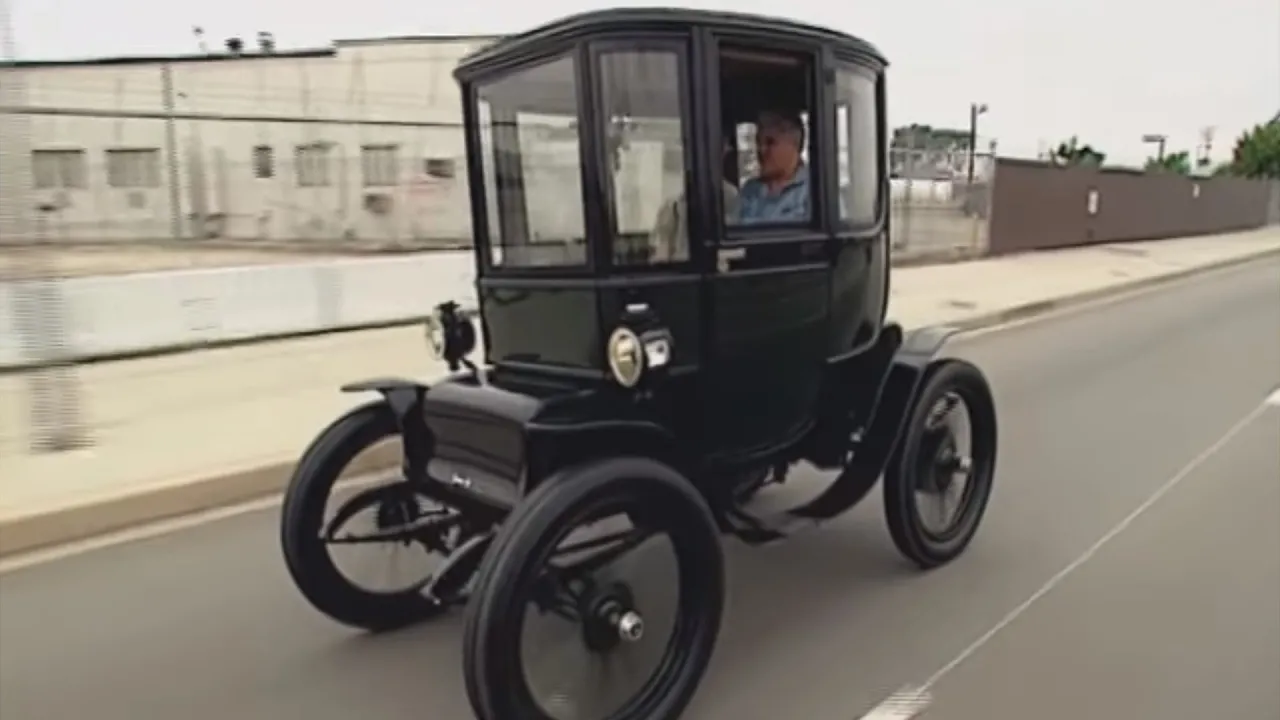
Jay reveals his answer to the fuel crisis: a pristine 1909 Baker Electric. Resembling an upright carriage with no conventional front hood, Jay likens the driving perspective to steering a tall glass telephone booth. Despite its antique carriage appearance, the Baker incorporated clever period engineering solutions, such as lightweight leather fenders, which Jay dubs the carbon fiber of the Edwardian era. The car features railroad-style drop sash windows that lift up, pull over a sill, and slide down into the doors before the invention of modern hand-crank regulators. Leno notes that the vehicle is shockingly reliable because the electric motor windings were crafted with exceptional turn-of-the-century craftsmanship to alleviate consumer dread, recalling, “People were scared of electricity I mean it was a frightening thing at the time you know it's a bit like hydrogen is now people like wait a minute that Hindenburg thing.”
Leno explains the social dynamics that defined early electric mobility. In the early 1900s, internal combustion vehicles were greasy, violent, and dangerous, requiring rigorous physical strength to set the spark, hand-crank the engine, and manage tricky manual transmissions, while steam-powered cars were notoriously messy, temperamental, and time-consuming to fire up. Consequently, early electric cars were aggressively marketed to affluent urban women. Manufacturers designed the cabins to resemble elegant Victorian parlors or sitting rooms, complete with floral bud vases, beveled vanity mirrors, clocks, and hidden compartments for makeup and face powder. However, this exact marketing strategy ultimately sealed the electric car's domestic fate: men flatly refused to purchase what had been stigmatized as a woman's parlor on wheels.
Despite being confined to this societal niche, the vehicles boasted practical utility in urban centers. Over 15,000 electric vehicles roamed New York City at the turn of the twentieth century, supported by early curb-side and garage charging networks. Jay shares an anecdote about driving the Baker to the Beverly Hills Hotel while his home was being fumigated for termites. The hotel valet immediately recognized the model, asking if it belonged to an elderly regular who had driven an identical Baker Electric to the hotel weekly for hair appointments from 1935 until her passing around 2001.
```mermaid flowchart TD accTitle: Turn-of-the-Century Powertrain Comparison accDescr: Comparison of Steam, Gas, and Electric cars around 1909 leading to the Baker's target demographic and ultimate limitation.
subgraph EarlyPowertrains["Turn-of-the-Century Powertrain Landscape"] Steam["Steam Powered<br>Messy, hot, scary, long boil-up times"] Gas["Internal Combustion<br>Dangerous hand-cranks, smelly, complex gears"] Electric["Electric Motor (Baker)<br>Turnkey, quiet, 100% torque immediately"] end
subgraph MarketingAndStigma["Market Positioning & Outcome"] Demographic["Tailored to Wealthy Women<br>Parlor interior, flower vases, vanity mirrors"] SocialStigma["Relegated as 'women's shopping carts'<br>Men refused to buy them"] ModernLongevity["Surviving Utility<br>100-mile original range, maintenance-free"] end
Electric --> Demographic Demographic --> SocialStigma Electric --> ModernLongevity ```
- **Baker Electric Construction**: 100% maintenance-free electric motor with heavy industrial windings; hand-molded leather fenders to shave weight; counterweighted railway-type sash drop windows. - **Urban Charging Network**: In the 1900s, approximately 15,000 electric vehicles circulated through New York City with commercial battery-charging stations scattered throughout town. - **Beverly Hills Anecdote**: An original owner reportedly used her Baker Electric as weekly transportation to the Beverly Hills Hotel salon for roughly 66 years, spanning from the mid-1930s into the early 2000s.
---
[06:20](https://www.youtube.com/watch?v=OhnjMdzGusc&t=380s) Driving Dynamics, Edison Alkaline Batteries, and Modern Operation
Examining the Baker's mechanical operation, Dennis Gage asks whether the machine runs completely silent and how the drive system is geared. Leno explains that the car has no conventional transmission; drive is direct to the rear axle. Like steam propulsion, the DC electric motor delivers maximum torque at stall, allowing it to conquer steep hills without downshifting or stalling, holding a steady top speed of 23 miles per hour uphill or downhill. Jay warns that cruising downhill at 23 mph feels harrowing due to the high center of gravity and upright telephone-booth profile, which tends to make the car feel like it wants to high-side in turns. Nevertheless, the silent and odorless cruising makes it a family favorite for viewing Christmas lights around the holidays, with Jay noting that wild deer will casually stroll right up to the curved glass windows because the car emits neither fumes nor mechanical noise.
```mermaid flowchart LR accTitle: Baker Electric Power and Control Layout accDescr: Flowchart illustrating battery layout to tiller steering control and direct drive motor.
subgraph BatteryBanks["6V Deep-Cycle Battery Banks (12 Total)"] FrontBank["Front Bay: 6 Batteries"] RearBank["Rear Bay: 6 Batteries"] end
subgraph Controls["Cabin Controls"] KeyMaster["Master Key & Voltage Meter"] Handbrake["Mechanical Handbrake"] TillerArm["Steering Tiller & Speed Selector"] end
subgraph Drivetrain["Direct Propulsion"] DirectMotor["Direct-Drive Electric Motor<br>(Instant Torque, No Transmission)"] Wheels["Rear Axle / Road Wheels<br>(Top Speed: ~23 MPH)"] end
BatteryBanks --> KeyMaster KeyMaster --> TillerArm Handbrake -.->|Release| Wheels TillerArm --> DirectMotor DirectMotor --> Wheels ```
Jay presents an original antique charging station alongside an authentic set of Thomas Edison nickel-iron alkaline battery crates. Edison had developed his alkaline cells specifically hoping to double the operating range of electric vehicles. Although the batteries fell short of making electric vehicles long-distance touring cars, their construction was remarkably resilient: operators could merely flush them out, add distilled water, clean the terminals, and run them continuously for years. Jay humorously slips during the explanation: > “I'm sorry I'm sorry Mr Edison I said acid it's distilled water.”
Examining a period magazine advertisement featuring a young woman appealing to an older gentleman with the caption "Daddy, get me a Baker," Jay jokes about the suggestive and racy undertones of early advertising. While the Edison storage crates can still be used, Jay keeps the vehicle running on twelve modern 6-volt deep-cycle golf cart batteries split evenly between compartments, placing six under the front bonnet and six under the rear deck. The layout provides ample amperage and voltage to maintain original performance. To demonstrate the driving process, Jay invites Dennis into the plush cabin. With no steering wheel, pedals, or conventional dashboard, control is handled entirely through a folding horizontal tiller bar on the left side, a ratcheting handbrake lever, and a master ignition key that brings the analog dashboard voltmeter alive before silently rolling out of the garage.
[10:01](https://www.youtube.com/watch?v=OhnjMdzGusc&t=601s) High-Perched Cruising and 1909 Electric Lighting
Cruising down the street in the 1909 Baker Electric, Dennis Gage remarks that the luxurious interior feel alone is well worth the price of admission, describing the ambiance as reminiscent of a vintage department store's menswear or lingerie counter. Jay Leno notes that the upright cabin gives the driver an exceptional perch above contemporary street traffic, creating a distinct feeling of superiority over modern eco-conscious drivers. Jay jokes, “And the nice thing is you look down on Prius owners with their gas polluting three cylinder whatever that is motor this is electricity only and everything even the lights are electric on this.”
Jay points out that having electric lighting all around was an extraordinary luxury and engineering feat for 1909, an era when the vast majority of automobiles still depended on acetylene gas lamps that had to be lit manually with matches. Jay remarks, “Electric lights were a big deal in 1909 most cars still had gas lamps so this was all electric.” He jokes that whenever he and his wife take the Baker Electric out to dinner, he simply parks the car and walks away leaving the headlights burning just because he can. Taking the vehicle down a slight grade, Jay observes that coasting downhill draws less power from the batteries, though he points out the obvious mechanical limitation of early 20th-century electric vehicles: there is no regenerative braking or modern energy-recovery system at work. Furthermore, with the vehicle being roughly as tall as it is long, the suspension provides virtually no cushioning against road imperfections.
- **Lighting Innovation**: The Baker Electric used fully integrated electric headlamps and exterior lights in 1909, contrasting with the era's standard match-lit gas/acetylene lanterns. - **Ride Profile**: The car features an extremely tall center of gravity with rudimentary carriage suspension, meaning drivers feel every bump and lean. - **Powertrain Characteristics**: Coasting downhill significantly reduces power draw, but the 1909 system lacks regenerative braking.
---
[11:22](https://www.youtube.com/watch?v=OhnjMdzGusc&t=682s) Dennis Gage Takes the Tiller
Jay offers Dennis Gage the chance to pilot the Baker Electric, relinquishing the steering tiller. Dennis quickly discovers that navigating a tall, narrow carriage without a conventional steering wheel is far more hair-raising than it looks from the passenger seat. Dennis admits, “This is a little unnerving Jay this just a you see suddenly 23 mph is pretty damn scary I will never complain again.” Despite the visceral thrill of traveling flat-out at just over twenty miles per hour, Dennis acknowledges that once a driver acclimates to the delicate tiller movements, the quiet electric glide becomes remarkably smooth and relaxing, which Jay notes makes it an ideal runabout for admiring neighborhood Christmas light displays.
```mermaid flowchart TD accTitle: Period Automotive Speed and Engineering Comparison accDescr: Comparison of performance, road conditions, and steering controls between the 1909 Baker Electric and contemporary era vehicles like the Ford Model T.
subgraph Baker["1909 Baker Electric"] B1["Top Speed: ~23 mph"] B2["Steering: Direct Tiller / Lever"] B3["Chassis: Upright, Top-Heavy Carriage"] end
subgraph PeriodContext["Early Automotive Era Realities"] C1["Unpaved / Rutted Dirt Roads"] C2["Hand Signatures Awkward Around High Windows"] end
subgraph ICE["Contemporary Gasoline (e.g., Ford Model T)"] T1["Top Speed: ~40–42 mph"] T2["Steering: Conventional Steering Wheel"] end
Baker --> PeriodContext ICE --> PeriodContext ```
Dennis jokes about the commercial potential of such a leisurely pace, noting, “I would think as a taxi'd be great cuz you don't go very fast the meter just keeps running and running.” Jay puts the car's performance into historical perspective, explaining that while 23 mph seems modest today, a contemporary Ford Model T could only reach roughly 40 to 42 mph on the unpaved, rutted dirt roads of the late 1900s and early 1910s. Dennis notes that even basic driving actions like sticking an arm out the window to make hand signals remain awkward due to the car’s high waistline and upright greenhouse, emphasizing that automotive ergonomics were still in their infancy.
- **Maximum Velocity**: The Baker Electric cruises flat-out at 23 mph, whereas contemporary mass-market gasoline competitors like the Model T managed 40 to 42 mph. - **Period Road Conditions**: Speeds in the low 20s were considered substantial given the rough, unpaved terrain of early 20th-century roads. - **Driver Ergonomics**: The high window sills make exterior hand signaling difficult, requiring the driver to reach far out around the cabin.
---
[13:02](https://www.youtube.com/watch?v=OhnjMdzGusc&t=782s) Return and Show Outro
Having successfully navigated the residential run without incident, Dennis guides the Baker Electric safely back to the garage. Dennis wraps up the segment by previewing the upcoming episode of *My Classic Car*, announcing a journey to Mount Washington in New Hampshire to cover the historic "Climb to the Clouds" hill climb competition featuring classic race cars, along with practical garage tips on inspecting and replacing underhood rubber hoses and bushings. Dennis signs off with his signature closing line: "Until our next meeting, remember: honor the timeless classics." Jay Leno adds a final humorous plug for early alternative propulsion, shouting to the audience: “Save the planet drive an electric car.”
## Notable quotes > [03:06](https://www.youtube.com/watch?v=OhnjMdzGusc&t=186s) People were scared of electricity I mean it was a frightening thing at the time you know it's a bit like hydrogen is now people like wait a minute that Hindenburg thing. — Jay Leno
## Mentioned Jay Leno, Dennis Gage, 1909 Baker Electric, 1934 Rolls-Royce Aero Special, Monteverdi 375 S, Peter Monteverdi, Rolls-Royce Merlin, Bendix, Chrysler, Thomas Edison, Ford Model T, Toyota Prius, Beverly Hills Hotel, My Classic Car, Mount Washington
## Video description Jay Leno takes us for spin in his 1909 Baker Electric.
#tesla #electriccar #ev
My Classic Car S10E14
[Source](https://www.youtube.com/watch?v=OhnjMdzGusc)