US Drops Sterile Flies in Panama to Protect $1B Livestock Industry
Half as Interesting
By pushing an irradiated fly perimeter to the narrow Darién Gap, the US shields North American livestock from a $1 billion annual parasite threat for roughly $15 million a year.
AI-assisted summary of Why the US Drops 14.7 Million Worms On Panama Every Week — original source. Check the original for full context.
Source published:
Key ideas
- The United States maintains an ongoing aerial barrier along the Panama-Colombia border, dispersing millions of sterile New World screwworm flies to prevent a flesh-eating parasite from re-entering North America. (0:00)
- Re-establishment of the New World screwworm in the United States would inflict an estimated $1 billion in annual damages on the livestock industry. (0:00)
- A specialized facility in Pacora, Panama, produces roughly 20 million sterile screwworms each week using Cobalt-60 radiation to exploit the female fly's single-mating biology. (1:50)
- Decades of bilateral campaigns pushed the biological boundary from the US-Mexico border south through the Isthmus of Tehuantepec to the Darién Gap, maintaining the barrier at a cost of roughly $15 million per year. (5:18)
Detailed notes
## Background Published on YouTube by the educational channel Half as Interesting on June 6, 2024, and written by Amy Muller, the video explains the biological containment efforts between the United States and Panama. The video's show notes provide promotional codes for meal service sponsor Factor alongside links to channel merchandise, social media accounts, and sister projects Wendover Productions and Jet Lag: The Game.
## TL;DR To protect North American livestock, pets, and humans from the flesh-eating New World screwworm, the United States partners with Panama to continuously maintain an invisible biological barrier along the Darién Gap. Utilizing the sterile insect technique pioneered by Edward Knipling and Raymond Bushland, an industrial bio-factory in Pacora produces irradiated, sterile screwworms that are air-dropped by the millions to mate fruitlessly with wild populations. Decades of diplomatic and logistical campaigns pushed the pest south from the American border and across Central America, backed by intensive ground surveillance in Panama to prevent a resurgence that would otherwise cause an estimated one billion dollars in annual livestock damage.
## Atmosphere & style The presentation is brisk, irreverent, and witty, juxtaposing gruesome parasitological details with snappy deadpan humor and absurdity. It transforms what could be dry agricultural history into an entertaining logistical caper, celebrating bizarre solutions like sleep-inducing cold storage, floor chutes on turboprop planes, and medicated doughnut holes. The viewing experience feels like an energetic, engaging dive into an unexpectedly brilliant government triumph driven by passionate science.
## Bulletin - [00:00](https://www.youtube.com/watch?v=Olj8arvfYj4&t=0s) The United States maintains an ongoing aerial barrier along the Panama-Colombia border, dispersing millions of sterile New World screwworm flies to prevent a flesh-eating parasite from re-entering North America. - [00:00](https://www.youtube.com/watch?v=Olj8arvfYj4&t=0s) Re-establishment of the New World screwworm in the United States would inflict an estimated $1 billion in annual damages on the livestock industry. - [01:50](https://www.youtube.com/watch?v=Olj8arvfYj4&t=110s) A specialized facility in Pacora, Panama, produces roughly 20 million sterile screwworms each week using Cobalt-60 radiation to exploit the female fly's single-mating biology. - [05:18](https://www.youtube.com/watch?v=Olj8arvfYj4&t=318s) Decades of bilateral campaigns pushed the biological boundary from the US-Mexico border south through the Isthmus of Tehuantepec to the Darién Gap, maintaining the barrier at a cost of roughly $15 million per year.
## Key takeaways - [00:00](https://www.youtube.com/watch?v=Olj8arvfYj4&t=0s) The New World screwworm (*Cochliomyia hominivorax*) infests warm-blooded mammals by depositing eggs in open wounds, where larvae feed on living flesh. - [00:00](https://www.youtube.com/watch?v=Olj8arvfYj4&t=0s) A domestic return of the screwworm would cost US livestock producers approximately $1 billion annually in fatalities and management. - [01:50](https://www.youtube.com/watch?v=Olj8arvfYj4&t=110s) Entomologist Edward F. Knipling developed the Sterile Insect Technique after observing that female screwworms only mate once in their lifetime. - [01:50](https://www.youtube.com/watch?v=Olj8arvfYj4&t=110s) Pupae are sterilized via X-rays or Cobalt-60 radiation at precisely 5.5 to 5.7 days of development, rendering them infertile without preventing normal mating behavior. - [01:50](https://www.youtube.com/watch?v=Olj8arvfYj4&t=110s) The COPEG plant in Pacora, Panama, houses 115 staff producing 20 million sterile screwworms weekly using a nutrient broth of milk, eggs, cellulose, and powdered cattle blood. - [01:50](https://www.youtube.com/watch?v=Olj8arvfYj4&t=110s) Flies are chilled to induce torpor and dropped from retrofitted cargo planes through automated chutes, awakening as they descend over the jungle canopy. - [03:51](https://www.youtube.com/watch?v=Olj8arvfYj4&t=231s) Surplus sterile production acts as a strategic reserve, successfully deployed during emergency outbreaks in Aruba and a 2016 infestation among Florida Keys deer. - [03:51](https://www.youtube.com/watch?v=Olj8arvfYj4&t=231s) The Darién province relies on 13 field outposts running regular livestock inspections and applying antiparasitic paint to ensure fertile flies cannot bypass aerial drops. - [05:18](https://www.youtube.com/watch?v=Olj8arvfYj4&t=318s) Initial USDA campaigns eliminated the screwworm from the American Southeast by 1959 and the broader United States by 1966. - [05:18](https://www.youtube.com/watch?v=Olj8arvfYj4&t=318s) To reduce the prohibitive cost of guarding the 2,000-mile US-Mexico border, a 1972 joint agreement relocated the barrier south to Mexico's 120-mile-wide Isthmus of Tehuantepec. - [05:18](https://www.youtube.com/watch?v=Olj8arvfYj4&t=318s) Subsequent treaties through Central America culminated in anchoring the permanent barrier at the Darién Gap, with costs shared under an 85/15 funding model.
## Detailed walkthrough ### [00:00](https://www.youtube.com/watch?v=Olj8arvfYj4&t=0s) The Flesh-Eating Threat: What is the New World Screwworm?
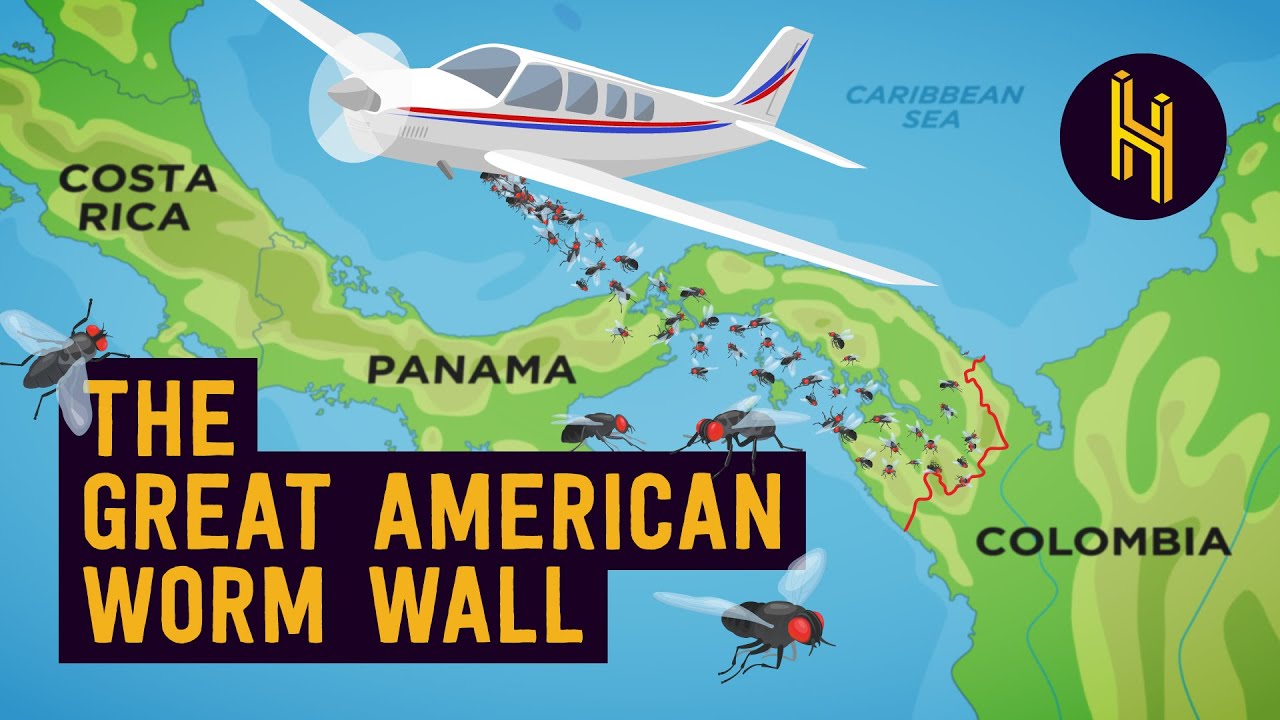
On any given day, there is roughly an 86% chance that the United States government is actively air-dropping millions of live flies along the border between Panama and Colombia. Rather than an odd military prank, this operation forms the frontline of a decades-long international program that shields the North American continent from the very pest being dropped: *Cochliomyia hominivorax*, better known as the New World screwworm. Described lightheartedly as an “idiotic insect sex scheme,” the effort relies on round-the-clock industrial insect breeding, cargo aircraft, checkpoint inspections, radiation, and surprising supplies like doughnut holes.
The New World screwworm poses a devastating threat to warm-blooded life. If the pest were still active in the United States, agricultural estimates indicate it would cost livestock producers approximately one billion dollars per year in animal fatalities. Unlike standard houseflies—which screwworms dwarf by about double the size—screwworms attack any living, warm-blooded mammal, including wildlife, cattle, pets, and human beings.
The parasite’s lifecycle lasts between 10 and 30 days. It begins when an adult female deposits several hundred eggs directly into the broken skin or open wound of a host, whether caused by tick bites, barbed-wire scratches, or freshly severed umbilical cords on newborns. Once hatched, the larvae burrow into the living flesh with sharp mouth hooks and consume the tissue alive. This process induces intense pain, tissue destruction, and eventual death if untreated. After the larvae reach maturity, they fall out of the host into the soil, pupate, transform into winged adult flies, and repeat the cycle.
- **Estimated agricultural damage:** Roughly $1,000,000,000 annually if re-established in the United States. - **Vulnerable hosts:** Any living warm-blooded animal, ranging from livestock and domestic dogs to humans. - **Egg-laying behavior:** Females deposit clusters containing hundreds of eggs inside fresh cuts, tick bites, or open wounds.
[01:50](https://www.youtube.com/watch?v=Olj8arvfYj4&t=110s) The Sterile Fly Solution and the Pacora Factory
The scientific breakthrough that halted the screwworm was pioneered by entomologist Edward F. Knipling, who grew up fighting infestations on his family's farm. Knipling realized an essential biological vulnerability: female screwworms mate only once in their lifetime. If female flies could be tricked into mating exclusively with sterile males, the wild population would rapidly collapse into extinction within a few generations. Alongside his colleague Raymond C. Bushland, Knipling spent years experimenting with radiation, ultimately determining that screwworms could be reliably sterilized by exposing them to X-rays between 5.5 and 5.7 days into their pupal stage.
This discovery gave rise to an invisible biological barrier dubbed the “Great American Worm Wall.” At the heart of the operation is an industrial bio-factory located in Pacora, Panama, operated by COPEG (the joint Commission for the Eradication and Prevention of Screwworms), which employs 115 workers to churn out roughly 20 million sterile screwworms every week. The larvae are nurtured in climate-controlled incubation rooms designed to mimic the heat and moisture of an infected mammal's wound. They feed on a nutrient broth made from reconstituted milk, eggs, powdered cattle blood, and cellulose thickeners.
Once developed, the pupae are sterilized with ionizing radiation using radioactive Cobalt-60. The sterile pupae are then transported to an airbase in chilled coolers, spread across emergence trays, and brought to adult maturity. Before flight operations, adult flies are placed into cold rooms to induce torpor, making them dormant and easy to handle. Retired military turboprop planes, retrofitted with specialized chutes in their floors, dispense the sleepy flies at calibrated release rates across the rainforest, where they awaken mid-fall to mate with wild populations. As the program’s logic is neatly summarized: “Flies that will wake up as they hurdle down to earth to eradicate their own species or as I like to put it, the screw worms screw worms to screw screwworms.”
```mermaid flowchart TD accTitle: Screwworm Factory and Eradication Pipeline accDescr: Step-by-step process of rearing, irradiating, packing, and dispersing sterile screwworms. subgraph Rearing["Factory Rearing (Pacora, Panama)"] A["Larvae in wound-simulating rooms"] --> B["Feed on egg, milk, blood slurry"] B --> C["Pupae stage reached"] end
subgraph Sterilization["Sterilization & Prep"] C --> D["Gamma irradiation with Cobalt-60"] D --> E["Coolers to airport emergence trays"] E --> F["Cold storage induces torpor"] end
subgraph Dispersal["Airdrop Operations"] F --> G["Retrofitted turboprop aircraft"] G --> H["Dispersed through floor chutes"] H --> I["Sterile flies mate with wild flies"] end ```
- **Sterilization timing window:** 5.5 to 5.7 days into the pupal stage. - **Factory production volume:** Approximately 20,000,000 sterile screwworms produced per week by 115 staff members in Pacora. - **Airdrop mechanism:** Retrofitted turboprop cargo planes dropping 2.1 million flies per 4-hour flight through calibrated floor openings, replacing old manual box drops that failed to open reliably.
[03:51](https://www.youtube.com/watch?v=Olj8arvfYj4&t=231s) Emergency Outbreaks, Doughnut Budgets, and the Darién Ground Game
Although routine flights drop around 12.6 to 14.7 million sterile flies across six weekly missions, the surplus flies from the 20-million-fly weekly production run serve as strategic reserves to suppress unexpected outbreaks. Screwworms remain endemic throughout South America and in certain Caribbean islands such as Cuba. When isolated infestations struck Aruba in 2004 and 2011, or when a sudden outbreak hit endangered Key deer in the Florida Keys in 2016, emergency reserves were mobilized. In the Florida Keys response, the USDA released 190 million sterile flies over three screwworm lifecycles, wiping out the threat in months.
The Florida containment also required unique field operations: a team of 200 workers combed through the Keys feeding wild deer oral antiparasitic medication covertly hidden inside commercial doughnut holes, prompting the joke that the federal government maintains an official "Federal Doughnut Budget."
Beyond aerial releases, COPEG maintains an intensive ground campaign across Panama's Darién province to halt fertile flies attempting to move northward from South America:
> “Yes the Its Raining Men Strat does a lot but Copeg also monitors animals across the Darion ensuring fertile screwworms that slip through the cracks don't make it far.”
Operating from 13 remote field stations, personnel travel via motorized boats, horses, and motorcycles to inspect livestock holdings on regular schedules dictated by risk models (monthly, every four months, or annually). All cattle transported out of the Darién region must pass mandatory inspections; any discovered wounds are treated with thick, antiparasitic topical paint to instantly kill lingering larvae.
- **Florida Keys response (2016):** 190 million sterile flies released across three insect generations, alongside doughnut-based deer baiting. - **Darién infrastructure:** 13 permanent field outposts staffed with inspectors on motorcycles, horses, and riverboats. - **Inspection schedules:** Farms evaluated and inspected monthly, triannually, or annually according to risk profile. - **Annual operating cost:** Roughly $15 million per year to maintain the entire biological barrier.
[05:18](https://www.youtube.com/watch?v=Olj8arvfYj4&t=318s) Pushing the Wall South: From the American South to Panama
The sterile insect technique first proved effective in field tests on the island of Curaçao. Encouraged by these results, the United States Department of Agriculture initiated a massive domestic program east of the Mississippi River in 1957. By 1959, the screwworm had been eliminated across the American Southeast. Eradication campaigns pushed westward, culminating in the United States declaring itself screwworm-free by 1966, supported by an active production facility in Texas.
However, holding a biological perimeter along the 2,000-mile United States–Mexico land border proved extraordinarily expensive and difficult to defend. In 1972, the American and Mexican governments concluded an agreement to push the barrier south to the narrowest bottleneck available: the Isthmus of Tehuantepec, which spans just 120 miles from coast to coast. Costs were divided based on the value of livestock protected, with the U.S. covering 80% and Mexico contributing 20%. By 1982, the original Texas rearing facility was retired and replaced by a new factory in Tuxtla Gutiérrez, Chiapas, as northern Mexican states like Sonora and Baja California Norte were cleared of the pest.
Recognizing that Central America offered even tighter geographic chokepoints, the United States negotiated subsequent bilateral treaties with each Central American nation between 1987 and 2006. Despite diplomatic tensions in the region during those decades, the countries agreed to an 85/15 cost-sharing formula with the United States. Today, the biological frontline rests permanently at the Darién Gap, maintained through shared Panamanian and American management under COPEG, with neighboring Colombia providing recurring monthly airspace clearances to allow fly-drops within its side of the protective buffer zone.
| Historical Phase | Era / Date | Boundary / Chokepoint | Primary Facilities & Terms | |:--- |:--- |:--- |:--- | | **Southeastern US** | 1957–1959 | East of Mississippi River | Early USDA operations following Curaçao test | | **Western US Push** | 1962–1966 | 2,000-mile US–Mexico border | Mission, Texas rearing facility | | **Mexican Expansion** | 1972–1982 | Isthmus of Tehuantepec (120 mi) | Cost: 80% US / 20% Mexico; Tuxtla factory opened | | **Central American Push** | 1987–2006 | Central America down to Darién | Cost: 85% US / 15% Central America; bilateral deals | | **Darién Gap Barrier** | Present | Panama–Colombia border | Pacora, Panama plant; COPEG joint management |
Reflecting on the scale of the program, the host observes:
> “Put another way it's a great example of what's possible when you combine passionate if slightly wacky scientists with government agencies that are actually willing to foot the bill for weird expensive but ultimately great solutions to big problems.”
[07:23](https://www.youtube.com/watch?v=Olj8arvfYj4&t=443s) Sponsor: Factor
Turning away from recipes involving powdered cattle blood, the host transitions into an endorsement for Factor, a prepared-meal delivery service. The service offers chef-crafted, pre-cooked meals shipped directly to customers' doors in plans ranging from 4 to 18 meals per week. Because meals only require heating in minutes, they provide a reliable, nutritious alternative to expensive takeout or time-consuming weeknight cooking. Factor is owned by HelloFresh. Viewers are offered a promotional deal at factor75.com using the discount code HAI50 for 50% off their first box and 20% off the following month.
## Notable quotes > [05:18](https://www.youtube.com/watch?v=Olj8arvfYj4&t=318s) Put another way it's a great example of what's possible when you combine passionate if slightly wacky scientists with government agencies that are actually willing to foot the bill for weird expensive but ultimately great solutions to big problems. — Sam from Half as Interesting
## Mentioned New World screwworm, Cochliomyia hominivorax, Edward F. Knipling, Raymond C. Bushland, COPEG, Pacora, Panama, Colombia, Darién Gap, United States Department of Agriculture, Factor, HelloFresh, Amy Muller, Sam from Half as Interesting, Half as Interesting
## Video description Use code HAI50 to get 50% OFF your first Factor box plus 20% off your next month at https://bit.ly/4aKohl9!
Get a Half as Interesting t-shirt: https://standard.tv/collections/half-as-interesting Suggest a video: http://halfasinteresting.com/suggest
Follow Sam from Half as Interesting on Instagram: http://Instagram.com/Sam.From.Wendover
Follow Half as Interesting on Twitter: http://twitter.com/halfinteresting
Discuss this video on Reddit: http://www.Reddit.com/r/halfasinteresting
Video written by Amy Muller
Check out our other channels: http://youtube.com/wendoverproductions http://youtube.com/jetlagthegame
[Source](https://www.youtube.com/watch?v=Olj8arvfYj4)