Risinger Deploys Zehnder ERV to Cut Leaks in Passive House Rebuild
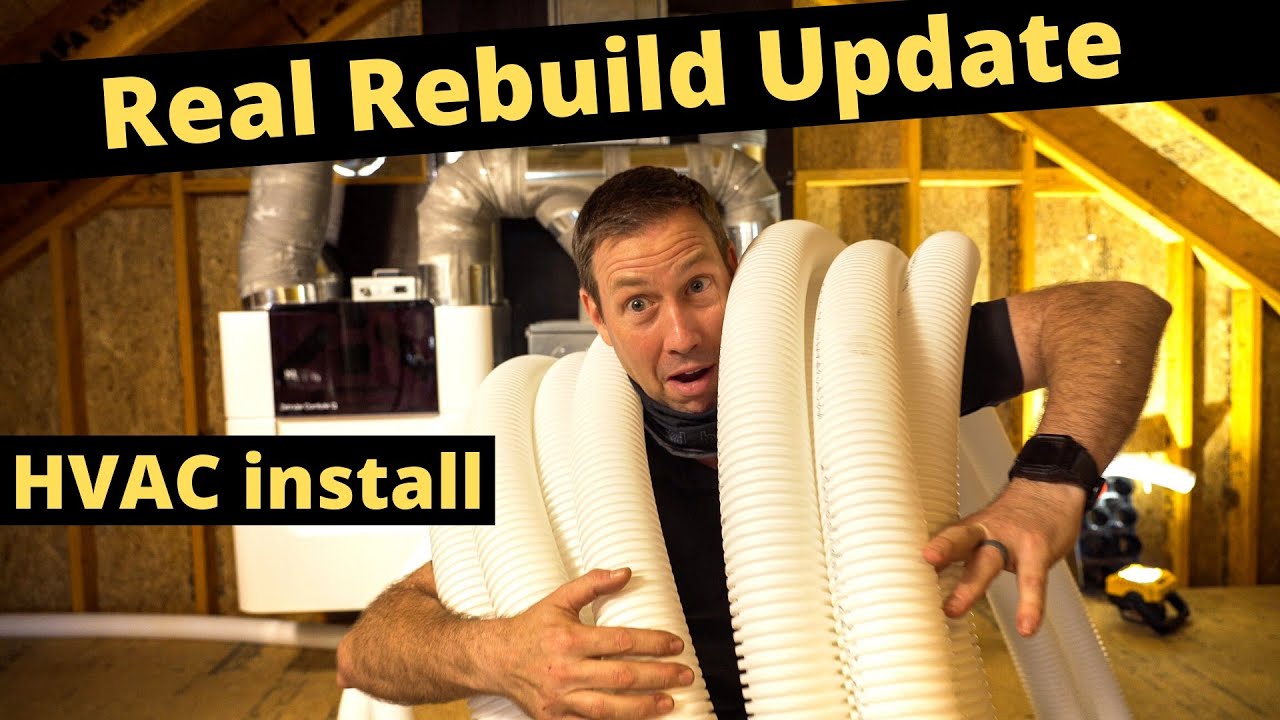
Matt Risinger
Airtight homes require continuous balanced ventilation through a dedicated two-hole manifold system to maintain indoor air quality without multiplying leaky wall penetrations or overloading HVAC equipment.
AI-assisted summary of Passive House - Fresh Air System Install & Costs (Zehnder) — original source. Check the original for full context.
Source published:
Key ideas
- Installing a centralized balanced ERV replaces multiple independent bath exhausts and laundry fans, reducing exterior envelope penetrations from eight or more down to just two 8-inch ducts. (3:31)
- The Zehnder ComfoAir Q600 achieves roughly 85% to 90% sensible heat recovery and approximately 66% moisture recovery via a counter-flow hexagonal enthalpy core. (5:33)
- Whole-house distribution utilizes an HDPE home-run manifold architecture calibrated in uniform 12 CFM increments per tube, operating at an electrical draw of approximately 100 watts. (16:03)
- Complete pre-engineered equipment packages run approximately $5,000–$6,000 for smaller layouts and $10,000–$12,000 for a 2,700 sq ft custom home, with installation labor estimated around 50% of equipment cost. (30:36)
Detailed notes
## Background Published on YouTube by Matt Risinger on September 29, 2020, this video explores the core building science principle of "build tight, ventilate right" at his personal residence project. The video description explains that continuous, balanced ventilation via an ERV or HRV is vital for indoor air quality and efficiency in airtight homes, highlighting why Matt selected a Zehnder ERV and illustrating that installation is easier than many builders expect.
## TL;DR Touring the rough mechanical stage of his high-performance personal home, Matt Risinger and Zehnder America representative Chris walk through the mechanics, installation, and economics of the Zehnder ComfoAir Q600 ERV. The system replaces multiple leaky exterior exhaust penetrations with a single balanced intake and exhaust pathway, delivering 180 CFM of continuous fresh air with approximately 85% heat and 66% moisture recovery through a counter-flow enthalpy core. They detail the home-run HDPE ComfoTube distribution network, integrated silencer manifolds, and multi-stage filtration capable of handling wildfire smoke. The walkthrough concludes with practical installation tips for lockable Luna ceiling diffusers, an overview of the unit's modest ~100-watt continuous power draw, and a transparent pricing breakdown of $10,000 to $12,000 for materials plus installation labor.
## Atmosphere & style The presentation has an energetic, builder-focused, and highly informative tone, set against the backdrop of an active framing and rough-in jobsite. Matt's enthusiastic curiosity meshes naturally with Chris's technical expertise as they take apart equipment housings, snap tubes into airtight collars, and demonstrate hands-on framing jigs. It feels like an accessible masterclass in residential building science, effectively stripping away the intimidating reputation of European Passive House mechanicals and presenting them as practical, common-sense assemblies.
## Bulletin - [03:31](https://www.youtube.com/watch?v=OrG7oG8Tvp8&t=211s) Installing a centralized balanced ERV replaces multiple independent bath exhausts and laundry fans, reducing exterior envelope penetrations from eight or more down to just two 8-inch ducts. - [05:33](https://www.youtube.com/watch?v=OrG7oG8Tvp8&t=333s) The Zehnder ComfoAir Q600 achieves roughly 85% to 90% sensible heat recovery and approximately 66% moisture recovery via a counter-flow hexagonal enthalpy core. - [16:03](https://www.youtube.com/watch?v=OrG7oG8Tvp8&t=963s) Whole-house distribution utilizes an HDPE home-run manifold architecture calibrated in uniform 12 CFM increments per tube, operating at an electrical draw of approximately 100 watts. - [30:36](https://www.youtube.com/watch?v=OrG7oG8Tvp8&t=1836s) Complete pre-engineered equipment packages run approximately $5,000–$6,000 for smaller layouts and $10,000–$12,000 for a 2,700 sq ft custom home, with installation labor estimated around 50% of equipment cost.
## Key takeaways - [00:00](https://www.youtube.com/watch?v=OrG7oG8Tvp8&t=0s) High-performance construction relies on the 'build tight, ventilate right' philosophy to ensure continuous, controlled air exchange instead of sporadic infiltration. - [02:40](https://www.youtube.com/watch?v=OrG7oG8Tvp8&t=160s) In hot, humid climates, an ERV is preferred over an HRV because it transfers both thermal energy (sensible heat) and moisture (latent heat/enthalpy). - [03:31](https://www.youtube.com/watch?v=OrG7oG8Tvp8&t=211s) Centralized continuous ventilation eliminates separate bath and laundry fans, dramatically reducing envelope penetrations and air leakage points. - [05:33](https://www.youtube.com/watch?v=OrG7oG8Tvp8&t=333s) The Zehnder ComfoAir Q600 recovers roughly 85% of sensible temperature differential and around two-thirds of incoming moisture differential. - [08:12](https://www.youtube.com/watch?v=OrG7oG8Tvp8&t=492s) Internal dynamic controls self-balance airflow by factoring in site elevation, real-time temperature, and static pressure resistance independently across intake and exhaust fans. - [09:21](https://www.youtube.com/watch?v=OrG7oG8Tvp8&t=561s) The hexagonal stacked-plate counter-flow heat exchanger provides extended surface area contact, significantly outperforming traditional square cross-flow cores. - [12:56](https://www.youtube.com/watch?v=OrG7oG8Tvp8&t=776s) Multi-stage filtration includes an internal MERV 13 outdoor air pre-filter, a MERV 8 return filter to protect the core, and an external MERV 15 or carbon filter for wildfire smoke and VOCs. - [16:03](https://www.youtube.com/watch?v=OrG7oG8Tvp8&t=963s) Airflow distribution uses dual 16-port manifolds that function as acoustic silencers, preventing fan noise transmission and room-to-room sound crosstalk. - [18:44](https://www.youtube.com/watch?v=OrG7oG8Tvp8&t=1124s) Crush-resistant HDPE ComfoTube runs connect directly from manifold to terminal boots with O-rings and clips, eliminating mid-run elbows, joints, or mastic sealing. - [19:40](https://www.youtube.com/watch?v=OrG7oG8Tvp8&t=1180s) Airflow is engineered in modular increments of 12 CFM per tube, scaling room deliveries based on volume and occupancy (e.g., 24 CFM for single bedrooms, 36 CFM for primary suites). - [21:09](https://www.youtube.com/watch?v=OrG7oG8Tvp8&t=1269s) System operation includes customizable speed tiers (Low, Normal, Boost, Away) manageable via wall controls, onboard screens, or mobile app gateways. - [24:30](https://www.youtube.com/watch?v=OrG7oG8Tvp8&t=1470s) Optional 0–10V terminal modules support wall-mounted CO2 or VOC sensors to automatically trigger boost ventilation during high-occupancy events. - [27:10](https://www.youtube.com/watch?v=OrG7oG8Tvp8&t=1630s) Terminal collars can be trimmed flush to framing using a simple 5/8-inch scrap sheathing jig before drywall installation. - [28:07](https://www.youtube.com/watch?v=OrG7oG8Tvp8&t=1687s) Zehnder Luna diffusers press-fit via airtight gaskets and feature internal dial-locking mechanisms to calibrate airflow at each terminal while the unit maintains total balanced CFM. - [30:36](https://www.youtube.com/watch?v=OrG7oG8Tvp8&t=1836s) Full equipment and engineering packages range from $5,000 to $12,000 depending on home size, with mechanical installation labor roughly estimated at 50% of the material package cost. - [32:44](https://www.youtube.com/watch?v=OrG7oG8Tvp8&t=1964s) The continuous whole-house ERV system operates at a low continuous power consumption of roughly 100 watts.
## Detailed walkthrough ### [00:00](https://www.youtube.com/watch?v=OrG7oG8Tvp8&t=0s) “Build Tight, Ventilate Right” and the Real Rebuild
Matt Risinger introduces the central philosophy of high-performance construction: “build tight, ventilate right.” Returning to the construction site of his personal home—known as the “Real Rebuild”—he explains that the project began as a remodel on an existing 1970s foundation slab, but transformed into a ground-up build engineered to airtight Passive House standards. With the project entering the rough mechanical phase after a short pause, Matt emphasizes that while HVAC is often treated solely as heating and cooling, the “V” (ventilation) is vital. In standard building practices, ventilation is routinely neglected as an afterthought, relegated to a collection of bath fans, a dryer vent, or an occasional duct tied to a furnace or dehumidifier.
Matt points out that when constructing an ultra-tight envelope, outdoor air cannot simply leak through the walls when the wind blows or an exhaust fan kicks on. Even for modern homes built strictly to minimum code, relying on wind or sporadic furnace cycles for fresh air is insufficient; indoor spaces require constant, purposeful air exchange. He draws a direct analogy between a high-performance home and the human body:
> “When God designed our bodies, we've only got one spot for air to come in, right? Through our nose or our mouth into our lungs, and our lungs are using their muscles constantly, 24/7, just to breathe a little bit in and out out of this one spot. We don't poke a hole in our body to get to our lungs; we don't want air leaking into other spaces.”
Humans have engineered closed-loop breathing environments for decades in submarines and spacecraft, yet residential construction has lagged behind. To mirror this biological logic, Matt is installing a Zehnder Energy Recovery Ventilator (ERV) that establishes exactly one dedicated pathway for outdoor air to enter and one pathway for indoor air to leave. Unlike a standard Heat Recovery Ventilator (HRV)—which typically transfers only sensible heat in colder, dry northern regions—an ERV also transfers moisture (enthalpy/latent heat), making it essential for hot, humid southern climates.
```mermaid flowchart TD accTitle: Dedicated Ventilation vs Multiple Envelope Penetrations accDescr: Diagram contrasting standard building ventilation with the single-pathway Zehnder ERV architecture.
subgraph Standard["Standard House: Multiple Leak Points"] S1["Bath Exhausts (3–5x)"] --> OUT1["Outdoor Penetrations"] S2["Laundry Fan"] --> OUT1 S3["Kitchen Hood"] --> OUT1 S4["Dryer Vent"] --> OUT1 OUT1 -.->|"Unfiltered Infiltration"| IN1["Wall Cracks & Gaps"] end
subgraph Zehnder["Zehnder ERV: Controlled Dedicated Pathway"] EXT_IN["Single Fresh Air Intake (8-inch duct)"] --> ERV["Zehnder ComfoAir Q600 ERV"] ERV -->|"Continuous Fresh Air"| SUP["Bedrooms & Living Areas"] EXH["Wet Rooms: Baths & Laundry"] --> ERV ERV --> EXT_OUT["Single Stale Air Exhaust (8-inch duct)"] end ```
[03:31](https://www.youtube.com/watch?v=OrG7oG8Tvp8&t=211s) Eliminating Exterior Penetrations: Conventional Setup vs. Zehnder
Ascending toward the second floor, Matt outlines the layout of his home for his large family of four children, featuring three upstairs bedrooms with the master bedroom situated on the ground floor. In a conventional home of this scale—approximately 2,700 square feet with three and a half bathrooms—ventilation typically creates an envelope full of holes. Standard construction would install individual bath exhausts (often two in a primary bath for the toilet closet and shower), dedicated laundry exhaust, a kitchen range hood, and a dryer exhaust. This frequently totals eight or more individual exterior penetrations, every one of them representing an envelope air leak and an entryway for outdoor moisture, bugs, or pests.
Matt eliminates nearly all of those wall-cap penetrations by routing the entire home’s background air exchange through the Zehnder system: - Stale, humid, and odorous air is continuously drawn out from all "wet" or stinky zones: every bathroom and the laundry room. - Filtered, conditioned fresh air is continuously supplied via small distribution tubes to every bedroom and shared living room. - Rather than eight or nine exterior penetrations, the entire ventilation infrastructure connects to the outdoors through just two 8-inch ducts—one intake and one exhaust.
[05:33](https://www.youtube.com/watch?v=OrG7oG8Tvp8&t=333s) Attic Mechanicals and the Zehnder ComfoAir Q600 Specs
Up in the attic—which will eventually be fully enclosed within the conditioned envelope using exterior continuous insulation and interior Rockwool batt insulation—Matt meets with Chris from Zehnder America. Matt gives credit to Jeff and the crew from Air Rite, who installed the manifold and ductwork over the previous few days.
Matt asks Chris to defend his claim that this is the best, most efficient ventilator on the market. Chris explains that they are installing the Zehnder ComfoAir Q600 ERV, engineered to provide continuous, whole-house balanced ventilation while recovering substantial thermal energy and humidity:
> “With an ERV, you're going to have a slightly less sensible or heating recovery than you do with an HRV, but still you're going to be with this unit around 85% heat recovery—that's 85% of the difference in temperature between outdoors and indoors.”
Matt notes the significance of that efficiency for a climate like Austin, Texas: across a 50-degree temperature delta between outside and inside, recovering 85% means recapturing roughly 42 to 45 degrees of temperature before the air enters the living space. For humidity, the unit transfers approximately two-thirds (around 66%) of the moisture differential between the outdoor incoming air stream and the outgoing exhaust air stream, preventing the severe indoor humidity penalties common when ventilating in hot, muggy climates.
```mermaid flowchart LR accTitle: Zehnder ComfoAir Q600 Internal Energy and Moisture Exchange accDescr: Flow diagram showing how stale exhaust air preconditions fresh outdoor air inside the heat exchanger.
subgraph IntakeStream["Intake Air Stream"] OA["Fresh Outdoor Air (e.g. 50°F Delta, High Humidity)"] --> CORE["Enthalpy Exchanger Core"] CORE -->|"~85% Heat Exchanged\n~66% Humidity Exchanged"| SA["Tempered Supply Air to Living Spaces"] end
subgraph ExhaustStream["Exhaust Air Stream"] EA["Stale Indoor Air (From Baths & Laundry)"] --> CORE CORE --> EX["Discharged Exhaust Outdoors"] end ```
[08:12](https://www.youtube.com/watch?v=OrG7oG8Tvp8&t=492s) Self-Balancing Operation and Motor Efficiency
Chris reveals what happens inside the mechanical cabinet of the ComfoAir Q600. The unit incorporates sophisticated onboard digital controls designed to be truly self-balancing: - During initial commissioning, the technician enters the site’s elevation above sea level, allowing the internal computer to factor local air density directly into its CFM and mass-flow calculations. - Integrated sensors continuously track real-time air temperatures and flow resistance. - The unit dynamically adjusts the supply fan and exhaust fan speeds completely independently of each other to maintain perfect volumetric balance. If heavy wind gusts pressurize either the intake or exhaust hoods on the exterior of the house, the unit instantly compensates. Similarly, as the fresh air intake filters accumulate dust and static pressure rises over time, the system automatically speeds up the supply fan to sustain design airflow without manual re-balancing. - Both fan motors operate at high electrical efficiency, easily beating the benchmark standard of less than 0.75 watts per CFM.
[09:21](https://www.youtube.com/watch?v=OrG7oG8Tvp8&t=561s) System Sizing, Airflow, and the Counter-Flow Core
Matt explains that his whole-house ventilation setup was engineered in collaboration with Positive Energy (a service Zehnder also offers directly) to match his home's specific conditions and family occupancy. The system is designed to run at a balanced 180 CFM—drawing in 180 CFM of fresh outdoor air from the north side of the house while simultaneously exhausting 180 CFM out the south/west side. Matt asks Chris how the two airstreams exchange energy without physically mixing. Chris points out the four duct ports atop the unit: two leading to the outdoors (intake and exhaust) and two connecting indoors (house return and house supply). Inside, the airstreams travel through an enthalpy exchanger core.
```mermaid flowchart TD accTitle: Zehnder ERV Airflow and Core Layout accDescr: The four airstream paths converging in the counter-flow enthalpy exchanger core.
subgraph Exterior["Exterior Environment"] OA["Outdoor Air (North)"] EA["Exhaust Air (South/West)"] end
subgraph Unit["Zehnder ERV Unit"] F_OA["MERV 13 Intake Filter"] F_RA["MERV 8 Return Filter"] Core["Counter-Flow Enthalpy Core<br/>(Hexagonal Plate Exchanger)"] F_Post["MERV 15 / Carbon Filter Box"] end
subgraph Interior["House Interior"] RA["Return Air (Kitchen & Baths)"] SA["Supply Air (Bedrooms & Living)"] end
OA --> F_OA --> Core RA --> F_RA --> Core Core --> EA Core --> F_Post --> SA ```
Matt removes three screws to pop open the casing, marveling at the sheer size of the equipment. While small units fit tight spaces, Chris explains that real thermal and latent efficiency requires raw physical surface area. The core is a hexagonal plate exchanger containing stacked, channeled plates. Rather than a conventional square cross-flow exchanger where air paths cross once at right angles, this hexagonal geometry channels incoming fresh air and outgoing stale air past one another in a prolonged counter-flow arrangement across opposite sides of each plate. Matt emphasizes how much research he did into plate designs before buying: “This is really the latest and best technology which has the most amount of surface area so that we're really exchanging that heat from one to the other that's how we're getting that like 85 90 percent efficiency that's crazy numbers.” Chris concurs: “Here when you see this hexagonal shape that's when you know you're dealing with a counter flow heat exchanger and you're you just should expect you're going to get much better performance.”
- **Design Flow Rate:** 180 CFM continuous balanced intake and exhaust. - **Port Orientations:** Outdoor intake on the north; outdoor exhaust on the south/west. - **Exchanger Type:** Stacked-plate counter-flow enthalpy core with hexagonal profile. - **Efficiency Range:** Reaches roughly 85% to 90% heat exchange efficiency. - **Cross-flow vs. Counter-flow:** Common square cross-flow units offer only a single point of channel contact, whereas hexagonal counter-flow plates channel air alongside each other across a wider surface area.
---
[12:56](https://www.youtube.com/watch?v=OrG7oG8Tvp8&t=776s) Multi-Stage Air Filtration and Smoke Mitigation
Examining the internal pathways, Matt asks about the pre-filters. Chris points out that incoming fresh outdoor air passes immediately through a MERV 13 pre-filter before it reaches the core. This stops pollen, dust, and mold spores, protecting both the heat-exchanger core from fouling and the building occupants from outdoor contaminants. Chris advises inspecting this filter every quarter. On the house return side, air pulled from the bathrooms and kitchen passes through a MERV 8 filter. Because this stale indoor air is directly exhausted out through the gable end and never recirculated, the MERV 8 filter’s exclusive role is keeping household dust and pet dander from dirtying the exchanger plates, which would degrade energy transfer efficiency. Chris affirms: “We're never recirculating air with this unit ever so we're always doing a constant air exchange.”
Beyond the internal pre-filters, Matt's installation features an external secondary filter housing positioned directly on the supply duct leaving the ERV. Inside is a MERV 15 hospital-outpatient-grade filter. Its broad surface area ensures minimal static pressure drop while offering extended filter life. When Matt asks about high-pollution scenarios such as wildfire smoke, Chris explains that the secondary housing can alternatively take an activated charcoal (carbon) filter. Chris shares an anecdote regarding an Oregon colleague during wildfire season: “He's basically running his system at a lower speed but he's continued his ventilation he's put in an active charcoal filter and um and he's got no smoke inside his house.”
- **Intake Pre-filter:** MERV 13, capturing 99.9% of coarse particulates, allergens, and spores. - **Return Air Filter:** MERV 8, strictly meant to keep indoor pet dander and dust off the enthalpy core. - **Maintenance Schedule:** Inspect internal filters quarterly. - **Post-Core Supply Filter:** MERV 15 high-efficiency filter, hospital-grade particulate capture. - **Wildfire Option:** Replaceable with an activated carbon filter to eliminate outdoor smoke, VOCs, and odors without turning off mechanical ventilation.
---
[16:03](https://www.youtube.com/watch?v=OrG7oG8Tvp8&t=963s) Manifolds, Silencers, and ComfoTube Ducting
Matt turns the conversation to whole-house balance and home performance. In an airtight build, he wanted to avoid punching numerous holes for independent bath fans that cause depressurization. Zehnder resolves this through an engineered home-run manifold system underneath the ERV, reminiscent of structured plumbing manifolds. The system features two main manifold boxes—one for exhaust and one for supply—each fitted with 16 connection ports. Instead of forcing a mechanical contractor to manually calculate dynamic trunk-and-branch sizing, the Zehnder design provides equal static pressure across every port.
Chris explains that the design plans airflow in straightforward increments: “In that way we just plan in multiples in in our case of 12 cfm per tube and we decide which room needs you know whether it's 12 24 36 cfm of supply or of return and um and we'll break it down that way.” In addition to equalizing pressure, the manifold body serves as a silencer. It deadens fan motor noise traveling down the ducts to quiet spaces like bathrooms and bedrooms, while simultaneously preventing sound crosstalk between different rooms that share the manifold. Matt examines the proprietary ComfoTube piping clipped into the ports, noting that while it resembles heavy-duty corrugated shop-vac hose on the outside, it is remarkably crush-proof—unlike delicate standard flex duct—and features a smooth inner liner to minimize airflow resistance.
- **Manifold Port Count:** 16 ports on the return/exhaust manifold, 16 ports on the fresh-air supply manifold. - **Airflow Unit Sizing:** Engineered in uniform 12 CFM increments per tube (e.g., running 1, 2, or 3 dedicated runs to deliver 12, 24, or 36 CFM). - **Integrated Silencer Benefits:** - Absorbs fan noise before it travels into living spaces. - Eliminates acoustic crosstalk between different rooms hooked into the shared manifold box. - **ComfoTube Duct Properties:** Rigid, crush-resistant exterior prevents duct compression behind framing, paired with a smooth interior lining for low static friction.
[18:44](https://www.youtube.com/watch?v=OrG7oG8Tvp8&t=1124s) ComfoTube Installation and Manifold Design
Matt Risinger begins by emphasizing that getting air where you want it requires an airtight distribution network. If ductwork leaks throughout the house, the ventilation system fails at its basic purpose. Chris demonstrates how the Zehnder ComfoTube system connects to the manifold. ComfoTube is made of high-density polyethylene (HDPE)—the exact same durable material used to manufacture milk jugs. To make a connection, an O-ring is slipped over the end of the tube, which is then pressed down firmly into the manifold collar until it fully seats. This rubber ring creates the airtight seal, after which an engineered retaining clip slides through the collar to lock the pipe mechanically into place so it cannot pull out.
```mermaid flowchart LR accTitle: Zehnder ComfoTube Connection Process accDescr: Three-step mechanical and airtight locking method for attaching ComfoTube to a distribution manifold. subgraph Connection["ComfoTube Assembly"] A["HDPE ComfoTube"] -->|"Seat O-ring"| B["Press into Manifold Collar"] B -->|"Slide retaining clip"| C["Mechanical Lock & Air Seal"] end ```
The entire system operates as a home-run manifold layout, mirroring modern PEX plumbing. Each run travels directly from the manifold box to its room terminal boot in one continuous, uninterrupted run without intermediate joints, elbows, or couplings. The two lines already installed in the attic connect down to Matt's daughter's bedroom. With each ComfoTube rated to deliver approximately 12 CFM, designing the layout comes down to occupancy and room volume:
- **Supply planning:** Matt's daughter's bedroom receives two tubes (24 CFM), while the primary bedroom utilizes three ports (roughly 36 CFM) because two adults sleep there. - **Exhaust planning:** Humid and odorous zones receive continuous extraction. Laundry rooms typically receive one or two runs, standard bathrooms one or two, and larger master baths may utilize three or more exhaust lines. - **Continuous ventilation advantage:** Matt shares that his children routinely forget to activate their bathroom exhaust timers when showering. Because the Zehnder unit operates 24/7, it continuously extracts moist, stale air from wet rooms and provides fresh, filtered outdoor air into bedrooms all night, eliminating moisture buildup even if an occupant forgets to hit a boost switch.
[21:09](https://www.youtube.com/watch?v=OrG7oG8Tvp8&t=1269s) Zehnder ComfoAir Q Controls, Fan Speeds, and Penetration Reduction
Matt explains that his home is engineered for a baseline airflow rate of around 180 CFM. Chris details how the Zehnder ComfoAir Q-series maintains constant volumetric balance through four customizable speed settings managed via the onboard interface, an optional wall controller, or a mobile smartphone app connected via an internet gateway:
| Speed Setting | Designated Mode | Purpose / Airflow Behavior | |:--- |:--- |:--- | | **Speed 1** | Low | Reduced airflow for low-occupancy periods | | **Speed 2** | Normal | Baseline everyday operation (set to 180 CFM for Matt's house) | | **Speed 3** | Boost | High-volume exhaust/supply for cooking, showering, or parties | | **Speed 0 / Preset** | Away Mode | Low-level continuous trickle to keep air fresh while traveling |
If homeowners leave for vacation and forget to adjust the system, they can open the smartphone app before takeoff, select Away mode, and program a specific return date so the home returns to normal ventilation upon their arrival. Furthermore, Matt highlights the dramatic reduction in envelope penetrations: a typical build might require eight or more exterior wall and roof caps for various bath fans and vents. With this balanced ERV, the entire house requires only two penetrations through the exterior envelope—one fresh-air intake and one exhaust discharge.
Comparing a sealed house to a parked automobile, Matt notes that when sitting in a turned-off car, the cabin turns stuffy and uncomfortable within minutes until a window is cracked an inch; a running car, by contrast, draws in fresh air continuously. In an airtight house without balanced ventilation, humidity, volatile organic compounds (VOCs), and carbon dioxide accumulate rapidly.
Matt notes that his house is entirely electric, utilizing Mitsubishi heat pumps for space conditioning, a SANCO2 heat pump water heater, and an induction cooktop, which eliminates indoor carbon monoxide sources. When Matt asks how the system protects homes containing high-output gas appliances (such as a large Miele gas range), Chris explains that the baseline ventilation rate—exchanging the home's total air volume roughly 0.4 times per hour—continually dilutes trace emissions. For active monitoring, Zehnder offers an add-on control module featuring 0–10V terminals capable of integrating up to four wall-mounted $CO_2$ or VOC sensors. If six children host a sleepover in one bedroom and carbon dioxide levels spike, the sensor signals the unit to automatically ramp into boost mode.
Reflecting on the installation process, Matt admits that while the system looks intimidating on paper, two days of field work proved it to be straightforward: “I think if you were a motivated homeowner you could even do this system yourself. It's not rocket science they're doing all the layout and the engineering for you so you know what to do.”
[26:31](https://www.youtube.com/watch?v=OrG7oG8Tvp8&t=1591s) Downstairs Terminal Boots and Flush-Trim Installation
Transitioning downstairs to the bedroom level, Matt and Chris examine the physical room distribution boots. In Matt's daughter's room, 24 CFM of fresh air is delivered through a ceiling register fed by two ComfoTubes plugged directly into the supply box using the identical O-ring and clip assembly used at the attic manifold.
Moving into his sons' bedroom, Matt inspects an uninstalled supply boot fastened directly to the subfloor framing. The plastic neck of the terminal extends 6 to 8 inches below the framing, terminating in an approximately 5-inch diameter circular opening that must eventually finish flush with the ceiling drywall. Chris shares an installation tip:
- Take a piece of scrap 5/8-inch ZIP System sheathing (matching the thickness of the 5/8-inch Sheetrock planned for the ceiling). - Drill a 5-inch hole through the plywood using a hole saw. - Slide this plywood jig over the protruding plastic neck and secure it with a couple of screws against the framing. - Run an oscillating multi-tool or saw blade flat against the wood scrap, utilizing the plywood template to slice the plastic throat cleanly and precisely flush with the plane of the future drywall.
With the terminal throats flush-trimmed ahead of time, the drywall crew can hang Sheetrock cleanly around the openings without interference, leaving the rough-in fully prepared for the final Zehnder decorative grilles and system commissioning.
[28:07](https://www.youtube.com/watch?v=OrG7oG8Tvp8&t=1687s) The Luna Diffuser and Flow Balancing
Chris and Matt inspect the Zehnder Luna diffuser, which is available in both supply and extract configurations. The unit pushes directly into the ceiling's five-inch rigid duct collar. Because it comes pre-gasketed on the back flange, pressing it home forms an instant, airtight friction seal without requiring mastic or foil tape. On the face of the diffuser, a clean cover twists off to reveal an internal, calibrated locking mechanism.
Chris shows how the balancing mechanism functions: turning the central plate clockwise closes down the air gap to choke back flow, while backing it off counterclockwise opens the aperture to increase airflow. Once the desired air volume is set, the dial locks firmly into place so the flow rate becomes tamper-proof before snapping the aesthetic cover back on. Matt observes that installed in a ceiling, the sleek round unit simply looks like an unobtrusive smoke detector.
```mermaid flowchart TD accTitle: Zehnder Luna Diffuser Airflow Adjustment accDescr: Step-by-step process of installing and balancing a Zehnder Luna diffuser into ductwork.
subgraph Install["Installation"] A["5-Inch Duct Collar"] --> B["Insert Pre-Gasketed Luna Diffuser"] B --> C["Airtight Friction Seal Formed"] end
subgraph Adjust["Balancing & Commissioning"] C --> D["Remove Outer Trim Cover"] D --> E{"Measure with Flow Hood"} E -->|"Too High"| F["Turn Clockwise to Restrict Gap"] E -->|"Too Low"| G["Turn Counterclockwise to Open Gap"] F --> H["Engage Lock Mechanism"] G --> H end
subgraph Finish["Final Appearance"] H --> I["Snap Outer Cover in Place"] I --> J["Flush, Tamper-Proof Ceiling Terminal"] end ```
The home-run distribution architecture removes traditional duct-sizing headaches. Matt explains that rather than calculating complicated stepped trunk line reductions—debating whether a branch needs to be two, three, or six inches—every register receives identical flexible ComfoTube runs. Some terminals sit close to the manifold, while others snake forty feet through the framing. Balancing happens entirely post-drywall at the diffuser face using a handheld airflow hood. Furthermore, because the Zehnder ERV incorporates smart, self-adjusting fans that monitor and maintain total static output, restricting or expanding flow at a single diffuser adjusts that room in isolation while the unit holds whole-house ventilation constant at 180 CFM.
- “The unit's going to maintain the overall airflow for the whole house so that 180 CFM is going to stay constant even while we make these fine adjustments,” Chris notes regarding the ERV’s self-modulating capabilities. - “Everything goes with those vacuum-cleaner-looking hoses, ComfoTubes, and then later we can dial it in,” Matt emphasizes.
---
[30:36](https://www.youtube.com/watch?v=OrG7oG8Tvp8&t=1836s) Equipment Costs, Install Labor, and Package Pricing
Matt asks Chris to break down real-world retail numbers for builders and homeowners evaluating a bid. Chris explains that Zehnder is unique across North America because they do not just supply a standalone ERV appliance; they sell an engineered, comprehensive air distribution system including the ERV, exterior intake and exhaust grilles, distribution manifolds, ComfoTubes, silencing attenuation, and interior room diffusers.
For a custom home of Matt's scale, the complete materials and equipment package prices out around $10,000 to $12,000, which also incorporates an optional third-party commissioning service to perform professional balancing. Smaller footprints, such as modest single-family homes or large urban apartments, require smaller equipment packages running approximately $5,000 to $6,000. Matt acknowledges that this upfront cost sits higher than off-the-shelf basic box ERVs, but stresses that receiving the entire system freighted in a handful of coordinated boxes completely eliminates jobsite duct fabrication.
Regarding labor, Chris explains that while an HVAC installer unfamiliar with Zehnder might initially hesitate, assembling the pre-engineered components requires none of the metal-shearing, crimping, or specialized sheet-metal craft of traditional trunk-and-branch layouts. Matt compares running the piping to assembling an “erector set.” As a practical estimating rule of thumb, Chris suggests budgeting roughly 50% of the equipment package cost for installation labor.
---
[32:44](https://www.youtube.com/watch?v=OrG7oG8Tvp8&t=1964s) Power Consumption and Whole-House Benefits
Matt recalls first seeing Zehnder units specified by Boston architect Steve Baczek, but says his real revelation came while touring active construction jobs in Vancouver, British Columbia. There, general carpentry and framing crews were roughing in the ComfoTubes themselves rather than waiting on specialized mechanical contractors, convincing Matt that his own lead installer, Jeff, could easily master the work.
When Matt raises electrical efficiency, Chris points out that this full-sized whole-house ventilation system operates continuously around 100 watts total, yielding negligible operating costs on monthly utility bills. Matt adds that this modest draw runs balanced 24/7 continuous fresh air while simultaneously replacing noisy, intermittent point-exhaust bathroom fans that typically run $120 to $150 each.
Closing out the episode, Matt reiterates that whether targeting rigorous Passive House certification or simply aiming to construct an airtight, durable, and healthy structure, continuous balanced ventilation is a baseline requirement: “And whether you're building a Passive House like I am or you're just building a really good house that's really tight, you need a really good system like this.”
- Continuous electrical demand for the active whole-house ERV system sits around 100 watts. - Zehnder operates as the dominant market leader globally across Europe and China, with growing adoption in the North American high-performance building sector.
## Mentioned Matt Risinger, Chris, Jeff, Steve Baczek, Zehnder America, Air Rite, Positive Energy, Rockwool, Polywall, Huber, Dorken Delta, Prosoco, Viewrail, Mitsubishi, SANCO2, Miele, Zehnder ComfoAir Q600, ComfoTube, Luna Diffuser, ZIP System, Passive House
## Video description Hopefully you know the benefits of building a tight home. With a properly sealed envelope we can increase our control over the conditioned space. This control is equally important for the durability of the building, as it is for occupant comfort and health. Because of this, building tight also means we need to ventilate right. Continuous, balanced ventilation is key to maintaining comfort and indoor air quality while reducing our heating or cooling costs. This is done through an ERV or HRV. These units will help extract energy from exhaust air and this energy to precondition fresh air we are supplying back to the house. And we can filter this air, giving us the peace of mind that the air in our house will never be stale or dirty. This is far from the reality of living in a leaky home with many exhaust fans with little to no supply or balanced ventilation. In this video we’ll see why Matt chose to install a Zehnder ERV at his house, what is involved, and why it is probably easier to install than you may think.
Be sure to visit Zehnder's website for more info https://www.zehnderamerica.com/
Follow Matt on Instagram! https://www.instagram.com/risingerbuild/ or Twitter https://twitter.com/mattrisinger
For more great video content check out Matts new site! https://buildshownetwork.com/ Sign-Up for the Newsletter https://buildshownetwork.com/newsletter Build Show Network on Instagram https://www.instagram.com/thebuildshow/
Huge thanks to our Show sponsors Polywall, Huber, Dorken Delta, Prosoco, Rockwool & Viewrail for helping to make these videos possible! These are all trusted companies that Matt has worked with for years and trusts their products in the homes he builds. We would highly encourage you to check out their websites for more info.
http://www.Poly-Wall.com http://www.Dorken.com http://www.Huberwood.com http://www.Prosoco.com https://www.Viewrail.com https://www.Rockwool.com
[Source](https://www.youtube.com/watch?v=OrG7oG8Tvp8)