Tom Scott Learns to Ride Bike in 30 Minutes Under Mike Boyd
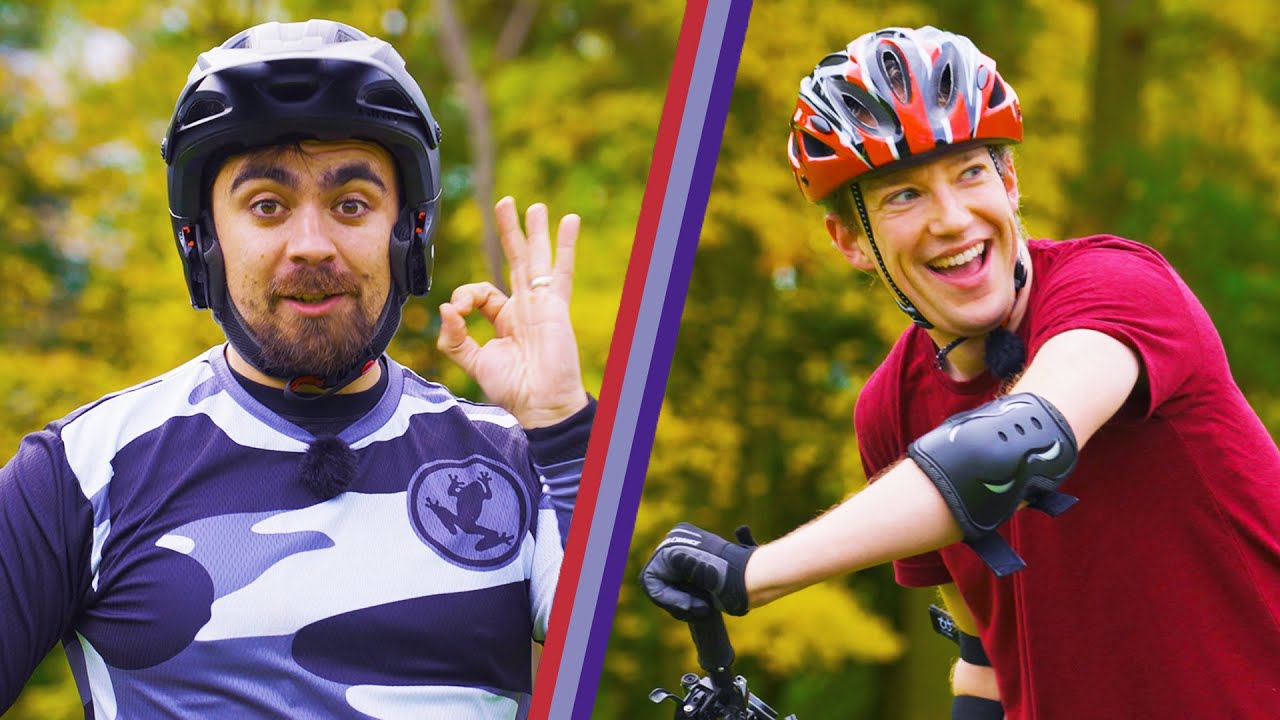
Tom Scott plus
Tom Scott masters independent cycling in roughly half an hour after discovering that forward momentum and proper saddle height allow the bicycle to self-stabilize.
AI-assisted summary of I can't ride a bike. How fast can Mike Boyd teach me? — original source. Check the original for full context.
Source published:
Key ideas
- Tom Scott learns to ride a bicycle independently in just over 30 minutes under the coaching of Mike Boyd. (16:36)
- Mike sets up a Deviate Highlander mountain bike with a dropper post and aggressive mud tires, configuring the brakes so Tom relies exclusively on the rear brake to avoid flipping over the handlebars. (1:23)
- A progression starting from balance-bike waddling and half-crank glides on grass to higher-speed runs on tarmac quickly unlocks natural gyroscopic stability. (3:57)
- Raising the saddle by approximately four inches dramatically improves pedal stroke clearance and allows Tom to launch independently without assistance. (12:38)
Detailed notes
## Background Published by Tom Scott on the YouTube channel Tom Scott plus on November 27, 2021, this video documents his attempt to learn how to ride a bicycle as an adult. According to the video description, Tom enlisted rapid-skill learner Mike Boyd to teach him a fundamental life skill he felt he really should have figured out by now.
## TL;DR Despite having briefly ridden as a small child, Tom Scott has zero memory of cycling and enters his thirties completely unable to ride. Mike Boyd coaches him through foundational mechanics on a high-spec mountain bike, starting with toddler-style balance waddling and single pedal half-cranks before transitioning from the grassy turf to firmer tarmac. After dialing in brake discipline, raising the saddle by four inches, and stepping up the gear ratio to maintain momentum, Tom establishes a target to independently circle a nearby pagoda. In just over thirty minutes of actual practice time, Tom successfully launches, navigates the sweeping loop solo, and returns safely, culminating in an inevitable but harmless tumble during post-challenge victory laps.
## Atmosphere & style The session carries a breezy, self-deprecating, and highly supportive energy, driven by the warm comedic chemistry between Tom's anxious, analytical skepticism and Mike's infectious, energetic optimism. Watching Tom bundle up in full protective pads in broad daylight evokes a charming blend of secondhand embarrassment and wholesome vulnerability. As tentative wobbles and nervous shrieks quickly transform into triumphant laughter upon achieving gyroscopic balance, the video delivers a genuinely heartwarming, fast-paced arc of adult learning.
## Bulletin - [16:36](https://www.youtube.com/watch?v=P7GKK3liv8M&t=996s) Tom Scott learns to ride a bicycle independently in just over 30 minutes under the coaching of Mike Boyd. - [01:23](https://www.youtube.com/watch?v=P7GKK3liv8M&t=83s) Mike sets up a Deviate Highlander mountain bike with a dropper post and aggressive mud tires, configuring the brakes so Tom relies exclusively on the rear brake to avoid flipping over the handlebars. - [03:57](https://www.youtube.com/watch?v=P7GKK3liv8M&t=237s) A progression starting from balance-bike waddling and half-crank glides on grass to higher-speed runs on tarmac quickly unlocks natural gyroscopic stability. - [12:38](https://www.youtube.com/watch?v=P7GKK3liv8M&t=758s) Raising the saddle by approximately four inches dramatically improves pedal stroke clearance and allows Tom to launch independently without assistance.
## Key takeaways - [00:00](https://www.youtube.com/watch?v=P7GKK3liv8M&t=0s) Tom Scott lost the ability to ride a bicycle after moving as a young child and going thirty years without practicing. - [00:45](https://www.youtube.com/watch?v=P7GKK3liv8M&t=45s) Mike Boyd reassures Tom that learning to ride as an adult is admirable rather than shameful. - [02:08](https://www.youtube.com/watch?v=P7GKK3liv8M&t=128s) In the UK, the right brake lever controls the front wheel and the left controls the rear, prompting Mike to keep Tom off the front brake to prevent endo crashes. - [03:57](https://www.youtube.com/watch?v=P7GKK3liv8M&t=237s) The lesson begins with balance-bike style waddling with the saddle dropped low to get comfortable with rolling without pedaling. - [04:35](https://www.youtube.com/watch?v=P7GKK3liv8M&t=275s) Bicycles are inherently more unstable at very low speeds due to the physics of momentum and gyroscopic forces. - [05:58](https://www.youtube.com/watch?v=P7GKK3liv8M&t=358s) Practicing single half-cranks helps build the confidence required to transition into continuous pedaling. - [07:15](https://www.youtube.com/watch?v=P7GKK3liv8M&t=435s) Looking up toward where you want to go significantly improves balance compared to looking down at the pedals. - [10:07](https://www.youtube.com/watch?v=P7GKK3liv8M&t=607s) A riderless push demonstration proves to Tom that the bicycle naturally balances itself once sufficient speed is reached. - [10:45](https://www.youtube.com/watch?v=P7GKK3liv8M&t=645s) Tom establishes a defined challenge goal to ride a complete loop around a park pagoda. - [11:20](https://www.youtube.com/watch?v=P7GKK3liv8M&t=680s) Turning into the direction of a tilt is the essential instinct needed to maintain balance on two wheels. - [12:38](https://www.youtube.com/watch?v=P7GKK3liv8M&t=758s) Raising the saddle height by about four inches prevents knee crowding and immediately smooths out pedaling mechanics. - [15:47](https://www.youtube.com/watch?v=P7GKK3liv8M&t=947s) Tension in the upper body causes arm fatigue, requiring the rider to relax while steering. - [16:36](https://www.youtube.com/watch?v=P7GKK3liv8M&t=996s) Tom completes a solo start, circles the pagoda cleanly, and brakes to a halt, hitting the objective in roughly 30 minutes of practice. - [18:42](https://www.youtube.com/watch?v=P7GKK3liv8M&t=1122s) During victory practice laps, Tom takes a low-speed tumble on the grass, highlighting the value of protective gear.
## Detailed walkthrough ### [00:00](https://www.youtube.com/watch?v=P7GKK3liv8M&t=0s) How Tom Scott Never Learned to Ride a Bike
Mike Boyd opens by questioning how Tom Scott has lived in London for so long without ever learning how to ride a bicycle. Tom clarifies that according to his parents, he actually did know when he was very young—holding his hand at waist height—and that they reached a point of checking off that childhood milestone. However, Tom has zero memory of it, and after his family moved somewhere he did not need a bike, he never got one. Now, thirty years later, he realizes the skill has completely faded from memory. Mike notes that their training spot is very close to where he personally learned to ride a bike 26 years ago, prompting Tom to joke that it is also close to where Mike learned extreme stunts like riding up stairs and doing track stands.
Padding up and getting on a bike in broad daylight feels mortifying to Tom, who considers riding a fundamental life skill he should have possessed decades ago. Mike insists there is no reason for shame, calling it admirable: “Everyone should learn to ride a bike.” Mike enthusiastically adds that riding is easy and life-improving, predicting Tom will pick it up within hours. Tom wryly envisions an immediate smash cut to a hospital bed ten minutes into the shoot, though Mike reassures him that the safety gear and slow speeds should keep him safe—and that if anything does go wrong, at least it will be caught on camera.
[01:23](https://www.youtube.com/watch?v=P7GKK3liv8M&t=83s) Mountain Bike Setup and Brake Mechanics
Mike introduces the mountain bike prepared for the lesson: a Deviate Highlander featuring 150 mm of rear suspension travel, 160 mm up front, and aggressive mud tires installed just in case Tom wants to shred through slick grass. The setup includes a dropper post, allowing instant on-the-fly seat height adjustments so Tom can drop the saddle down and plant his feet firmly on the turf whenever he panics.
The critical warning Mike gives is that the bike’s brakes are exceptionally sharp. He advises Tom to operate them using only one finger rather than clutching the entire lever with a full fist. A major hazard for beginners is grabbing the front brake during a panic stop, which can flip the rider over the handlebars—a scenario Tom is desperate to avoid after having seen a friend lose three teeth in a crash. Mike explains the British brake lever configuration, contrasting it with the setup used in Europe and the United States:
```mermaid flowchart TD accTitle: Handlebar Brake Configuration and Panic Prevention accDescr: Diagram contrasting UK handlebar brake assignments with the recommended beginner one-finger hand position to avoid over-the-bars crashes.
subgraph Controls["UK Brake Lever Setup"] R["Right Lever<br/>Front Brake"] L["Left Lever<br/>Rear Brake"] end
subgraph Strategy["Tom's Beginner Safety Grip"] ClosedR["Right Hand: Closed Fist<br/>(Locked off front brake)"] FingerL["Left Hand: One Finger on Lever<br/>(Controlled rear brake only)"] end
R -.->|"Risk: Over-the-bars"| ClosedR L -->|"Safe stopping"| FingerL ```
To eliminate the danger of an accidental endo during sudden panic, Mike gives Tom clear tactical instructions: “In the UK, the right-hand brake is your front wheel, and the left-hand is the back.” To keep Tom safe from flipping forward, Mike instructs him to keep his right hand closed around the grip without touching the lever, relying exclusively on one finger on the left lever to activate the rear brake.
[03:57](https://www.youtube.com/watch?v=P7GKK3liv8M&t=237s) Day 1, Hour 0: Balance Bike Waddling and Gyroscopic Stability
Before pedaling, Mike treats the bike like a toddler's balance bike. He slams the dropper post all the way down so Tom can easily plant his boots on the ground and tells him to simply waddle forward with his feet to get a physical feel for rolling and momentum. Right as Tom begins moving, he catches Mike off guard by asking for Mike's trademark catchphrase. Mike obliges with an energetic callout: “Alright, this is Tom's day one, hour zero.”
Tom sets off waddling across the lawn, giggling and groaning with tension as he tries to find equilibrium. Mike explains the core paradox of learning to ride: a bicycle relies on gyroscopic forces and forward momentum to stay upright, meaning the slower a rider moves, the more violently unstable the frame becomes. While Tom conceptually understands that speed creates stability, going faster also triggers natural fear. To help Tom experience the sensation without foot-steering, Mike runs alongside, holding Tom by the shoulders while Tom lifts his feet an inch off the grass. When Tom tries steering, he reflexively overcorrects in the wrong direction, but experiencing the rolling momentum helps him realize the bike is actually easier to balance once he stops awkwardly paddling with his feet.
[05:58](https://www.youtube.com/watch?v=P7GKK3liv8M&t=358s) Half-Cranks and the Psychology of Commitment
Eager to progress, Tom asks to try pedaling. Mike demonstrates a "half-crank" technique using his own bike: positioning one pedal at the top of the stroke, pushing down for a single half-rotation to gain forward drive, and then coasting with both feet off the ground. Mike explains: “But if you can do the half-crank, and then just coast... then you'll get comfortable with doing a full-crank.”
Tom attempts the half-crank drills, celebrating whenever he manages even a fraction of a second of rolling stability. Mike notes that linking the first pedal stroke to the second is identical to juggling: a beginner can easily manage two throws, but introducing the third throw causes the entire pattern to collapse until the brain suddenly rewires the coordination. During one successful glide, Tom realizes he stopped watching his feet and instinctively looked ahead: “The tendency is to look down, but if you look up, your balance is better,” Mike confirms.
- Tom jokes that his high saddle awareness proves he definitely has the guts for the challenge. - Tom declares the session will only end when one of three things happens: he successfully learns to ride, he winds up in the hospital, or the dark rainstorm looming overhead finally breaks.
[07:55](https://www.youtube.com/watch?v=P7GKK3liv8M&t=475s) Tuning Gears and Chasing Continuity
Noticing that Tom frequently stalls out after pushing off, Mike proposes adjusting the gear ratio. He steps over and shifts the derailleur up two gears so that each single pedal revolution provides significantly more forward distance. While this requires more muscular effort to push the pedal down, it prevents Tom from spinning out without gaining sufficient speed to balance.
The heavier gear gives Tom a fleeting burst of momentum, but riding across the resistance of thick grass proves exhausting and difficult to kickstart. Mike decides to reverse course and shift back down to a lighter gear so Tom can spin the pedals freely without grinding to a halt. Tom strips off his outer sweater as the physical exertion ramps up. With Mike sprinting alongside shouting constant encouragement—shouting to steer into turns and keep pedaling continuously—Tom begins piecing together consecutive pedal strokes on an uphill stretch of turf. Despite Tom's brain occasionally reversing steering cues in panic, Mike urges him forward, reminding him that once the bike is rolling, he finally has time to think.
[10:07](https://www.youtube.com/watch?v=P7GKK3liv8M&t=607s) Finding Stability at Speed
Mike Boyd guides Tom Scott onto the tarmac to test out a higher gear, reminding him to stay calm, keep pedaling, and steer into his balance when he tips. Mike observes that during several stretches he is barely touching Tom at all, and he argues that moving from the grass to the firmer tarmac at higher speed will provide natural balance. Mike insists that momentum changes everything: “The bike will ride itself.” When Tom immediately scoffs, “No it bloody won't(!)” Mike demonstrates by giving a riderless bike a push, sending it rolling smoothly in a straight line on its own. Conceding the physics demonstration, Tom admits, “You make a solid point. But only at-speed.”
With that demonstration in mind, Tom decides on a concrete milestone for the challenge, noting that Mike's skill-learning videos always focus on a clear endpoint: “By the way, I have... I have a goal now. 'Cause I know your videos tend to aim for a goal. There to pagoda.” Mike endorses it as an admirable objective. Holding Tom steady as they set off, Mike encourages him to get comfortable with the rolling velocity. Moments later, Mike lets go completely. Tom pedals down the path entirely under his own power, shrieking and laughing triumphantly as Mike yells, “He's riding a bike! Stop the clock! Stop the clock!” Tom shouts back in pure disbelief, “I'm riding a bike! Yes!” Reflecting on those first unsupported seconds, Tom notes that while it felt wobbly as hell, the breakthrough came down to instinct: “And the thing I had to crack was... turning into the... into it.”
```mermaid flowchart LR accTitle: Progression from Guided Balance to Independent Riding accDescr: Flowchart illustrating Tom's transition from guided tarmac riding to attempting the pagoda loop.
subgraph Phase1["Initial Breakthrough"] A["Tarmac run in higher gear"] --> B["Bicycle self-stabilizes at speed"] B --> C["Mike releases support"] C --> D["First unsupported ride"] end
subgraph Phase2["Target & Adjustments"] D --> E["Goal set: loop around the pagoda"] E --> F["Raise saddle height (~4 inches)"] F --> G["Shift up two more gears"] end
subgraph Phase3["Execution"] G --> H["Solo pedal start"] H --> I["Full circuit around pagoda and back"] end ```
[11:38](https://www.youtube.com/watch?v=P7GKK3liv8M&t=698s) Footing, Braking, and Saddle Height
Mike analyzes what is tripping Tom up between attempts, noticing that Tom manages far better when both feet are already positioned on the pedals before setting off. When Mike suggests that Tom is overthinking his foot placement and that his feet will naturally find their place, Tom dryly retorts, “They haven't been so far, but...” A moment later, after another brief run, Tom panics mid-roll because his feet slip off: “I was like, 'I'm fine, I'm fine. I have lost the pedals! I don't know where they are.' You know what I forgot? The brake!” Mike reassures him that losing the pedals does not mean instant doom—there is plenty of time to glide, breathe, and put feet back into position—while warning Tom that at higher speeds, he must keep his fingers resting over the brake lever.
Tom notices another stubborn habit: the bike keeps pulling off toward the right rather than going where he intends. Watching Tom pedal, Mike identifies a mechanical issue with how Tom's body is arranged on the frame. Because the saddle is set low enough for Tom's feet to rest flat on the ground, his knees are compressing tightly to the chest on every upstroke. Mike raises the seat roughly four inches to allow a more natural leg extension. Tom is initially skeptical, remarking, “It looks better. It does, but I'm just worried about my ability to reach the floor?” However, once he gets back on the saddle, the difference is immediate: his pedaling stroke becomes vastly smoother, and he begins launching completely independently without Mike holding him upright.
[14:47](https://www.youtube.com/watch?v=P7GKK3liv8M&t=887s) Steering Toward the Pagoda
Now starting under his own power, Tom begins steering across the grass, though his directional control remains erratic. At one point he veers straight toward the camera crew, muttering, “We're going this way now! Didn't intend to, but we are!” before narrowly steering clear. Mike laughs, praising Tom for managing a solo start without a word of complaint. Lining up another run, Tom commits to circling the pagoda, focusing on keeping his feet planted and his eyes locked forward. He angles into a wide left turn around the structure, with Mike cheering from the sideline: “Oh my god, he's actually going 'round it!”
Just as the loop is nearly finished, the bike wobbles, and Tom is forced to step off into the turf. He explains the sudden loss of control: “There was a divot in the grass that sent me slightly off, and it was all downhill from there!” To build even more rolling momentum, Mike suggests shifting up two more gears. Tom agrees, though he confesses an unexpected physical side effect of the lesson: “What I can't explain is... why my arms are the most tired part of me. Legs, doing absolutely fine. But I think I'm just holding myself like... solid.” Mike points out that Tom is simply holding himself too rigidly and needs to loosen up his upper body. Confident that the end is near, Mike tells Tom he will stay put and not even chase after him on the next run.
[16:36](https://www.youtube.com/watch?v=P7GKK3liv8M&t=996s) Completing the Goal in Record Time
Tom kicks off into the higher gear with clean, textbook technique. Mike watches in awe from a distance as Tom glides into the open field, murmuring, “Oh my god, starts like a pro.” Holding his fingers over the brake levers, Tom leans into a smooth, sweeping left turn around the pagoda, actively recalling the lesson to look where he wants the bike to go. Tom arcs cleanly past the structure, straightens out across the grass, and rides all the way back to the starting point before squeezing the brakes and putting his feet down safely.
Mike celebrates the completed run, shouting, “Stop the clock! That's how we do it!” Tom catches his breath, exhausted but ecstatic: “Oh, that felt good. That felt really good.” Reviewing the clock, they realize Tom learned to ride independently in just over thirty minutes. - The entire learning process took roughly 30-odd minutes of practice time. - Feeling energized by the breakthrough, Tom considers signing up for the London cycle hire scheme to practice in local parks, admitting, “I'm not gonna try cycling on roads anytime soon, but... I need to go learn in parks now, right?” - Tom jokes that after wearing bulky elbow and knee pads in front of thousands of viewers on camera, “I'm over the embarrassment bit.” Mike quips back: “I mean, if you can put on those elbow pads... you're immune to embarrassment.” - Mike is stunned by the pace of the lesson, remarking, “Well done, I'm gobsmacked. If only my videos were that quick(!)”
[18:29](https://www.youtube.com/watch?v=P7GKK3liv8M&t=1109s) Practice Laps and the Inevitable Spill
With the official challenge achieved, Tom stays on the bike to practice cornering and pacing across the open park grounds. An upbeat soundtrack kicks in as he loops smoothly across the lawns, surprised by how natural slowing down has become: “I was just able to slow down! I don't know how I did it. I just stopped pedaling!”
A moment later, during a turn on the grass, the front wheel slips out from underneath him. Tom takes a sharp tumble directly onto the turf, letting out an expletive as he hits the ground. Mike rushes over to check on him, asking, “Are you alright, man?” Tom laughs it off unhurt from the grass, declaring, “I'm fine! But I'm really glad I had the elbow pads!” With the first fall safely out of the way, Tom calls out to the production team: “That's it! Mike, that's a wrap. We're done!”
## Notable quotes > [05:58](https://www.youtube.com/watch?v=P7GKK3liv8M&t=358s) The tendency is to look down, but if you look up, your balance is better — Mike Boyd
> [00:00](https://www.youtube.com/watch?v=P7GKK3liv8M&t=0s) Everyone should learn to ride a bike. — Mike Boyd
## Mentioned Cambria Bailey-Jones, Dan Pugsley, Deviate Highlander, Guy Larsen, Kim Boyd, London, Mike Boyd, Pad26, Penny4, Pierre Blanc, Sophie Newton, Tom Scott
## Video description @MikeBoyd learns things quickly, so I asked him for help with something that I really should have figured out by now. ■ MIKE: https://www.youtube.com/MikeBoydVideo/ ■ https://twitter.com/mikeboydvideo
My main channel: https://www.youtube.com/tomscottgo
I'm at https://www.tomscott.com Twitter: https://twitter.com/tomscott Instagram: https://instagram.com/tomscottgo Facebook: https://facebook.com/tomscott
Series Producer: Cambria Bailey-Jones Assistant Producer: Sophie Newton Editor: Pierre Blanc Sound Design: Dan Pugsley | https://www.cassinisound.com/ Camera Operator: Kim Boyd Executive Producer: Guy Larsen A Pad26 / Penny4 Production https://www.penny4.co.uk
0:00 How have you never learned to ride a bike? 1:22 The basics of bikes 3:57 Day 1, Hour 0 8:51 Try, try again
[Source](https://www.youtube.com/watch?v=P7GKK3liv8M)