Tony Seba Models 100% Solar-Wind Grid Yielding Free Power by 2030
Tony Seba
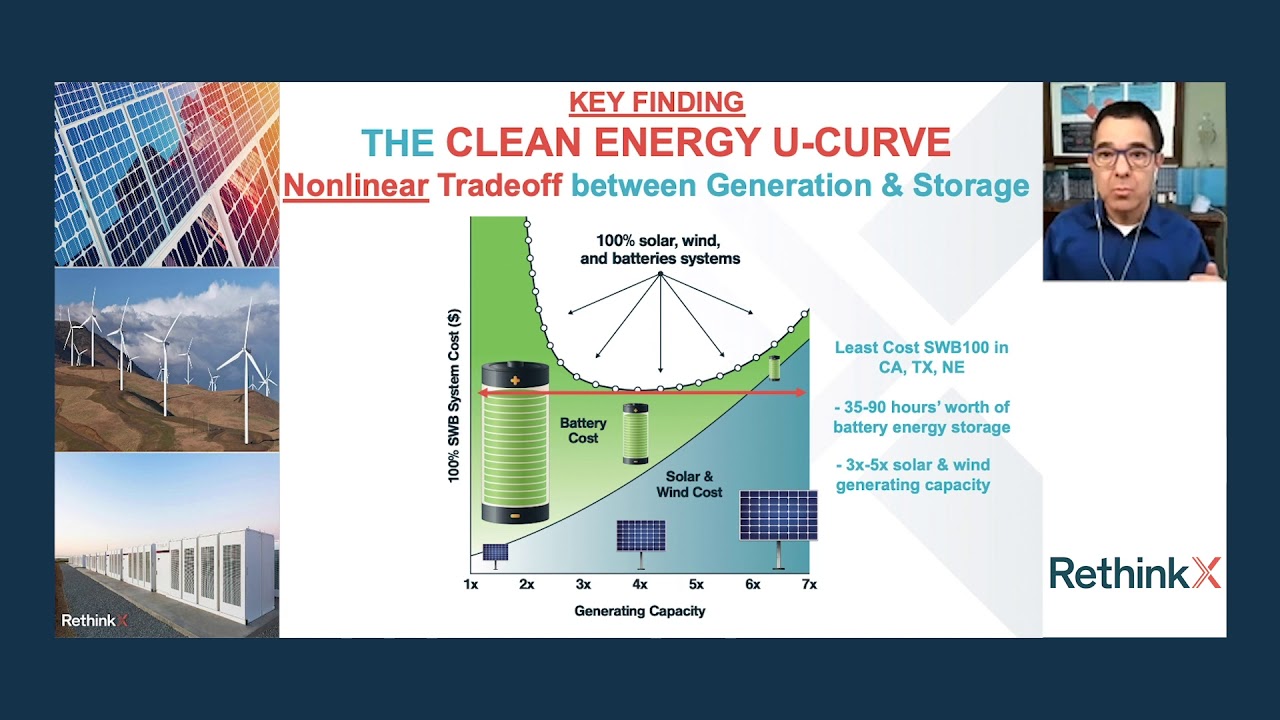
Oversizing solar and wind generation three to five times cuts required battery storage to just one to four days while generating superabundant, near-zero-cost power capable of fully electrifying transport and heating.
AI-assisted summary of Rethinking Energy -- 100% Solar, Wind and Batteries Is Just The Beginning — original source. Check the original for full context.
Source published:
Key ideas
- A 100% solar, wind, and battery (SWB) electric grid completed between 2021 and 2030 represents the cheapest possible power system, driven by learning curves rather than subsidies or policy mandates. (0:00)
- Transitioning the entire US electric grid to 100% SWB by 2030 requires approximately $2 trillion in capital investment, or roughly 1% of US GDP over a ten-year period. (5:00)
- Oversizing solar and wind generation by 3x to 5x reduces battery storage requirements to just 1 to 4 days, debunking assumptions that multi-month seasonal storage is necessary. (5:00)
- Sizing capacity for worst-weather days creates superabundant, near-zero marginal cost electricity ('superpower'), generating surplus energy on 93% of days in California and Texas and 63% of days in New England. (5:00)
- SWB economics behave like information technology: an incremental 20% capital investment in California beyond the base grid buildout can yield a 200% to 300% surge in superpower, enough to cover transport, residential, and commercial heating. (9:56)
Detailed notes
## Background Published on YouTube by Tony Seba on February 16, 2021, this presentation forms part of the Joint Declaration published by the Global 100% RE Strategy Group. Drawing on his research report, Seba outlines the technical and economic roadmap for building a 100% solar, wind, and battery power grid by 2030.
## TL;DR Tony Seba argues that the convergence of steep cost declines in solar, wind, and batteries (SWB) makes a fully renewable grid the cheapest possible electricity system by 2030. By optimizing generation and storage along a clean energy 'U-curve,' systems can overbuild generation three to five times, cutting required battery storage down to just one to four days and rendering seasonal multi-month storage obsolete. This deliberate overbuilding generates massive seasonal surpluses of clean electricity termed 'superpower' at near-zero marginal cost, unlocking enough clean energy to electrify transport, heating, and heavy industry while sparking widespread economic abundance.
## Atmosphere & style The presentation carries the crisp, authoritative cadence of a Silicon Valley tech keynote, driven by unrelenting data, cost-curve projections, and analytical conviction. Seba speaks with cool, matter-of-fact confidence, dismantling long-held energy orthodoxy not through moralizing environmental appeals, but through strict technological learning rates and market economics. The delivery evokes an exhilarating sense of inevitability, making a future of clean, superabundant energy feel both mathematically sound and economically unstoppable.
## Bulletin - [00:00](https://www.youtube.com/watch?v=PM2RxWtF4Ds&t=0s) A 100% solar, wind, and battery (SWB) electric grid completed between 2021 and 2030 represents the cheapest possible power system, driven by learning curves rather than subsidies or policy mandates. - [05:00](https://www.youtube.com/watch?v=PM2RxWtF4Ds&t=300s) Transitioning the entire US electric grid to 100% SWB by 2030 requires approximately $2 trillion in capital investment, or roughly 1% of US GDP over a ten-year period. - [05:00](https://www.youtube.com/watch?v=PM2RxWtF4Ds&t=300s) Oversizing solar and wind generation by 3x to 5x reduces battery storage requirements to just 1 to 4 days, debunking assumptions that multi-month seasonal storage is necessary. - [05:00](https://www.youtube.com/watch?v=PM2RxWtF4Ds&t=300s) Sizing capacity for worst-weather days creates superabundant, near-zero marginal cost electricity ('superpower'), generating surplus energy on 93% of days in California and Texas and 63% of days in New England. - [09:56](https://www.youtube.com/watch?v=PM2RxWtF4Ds&t=596s) SWB economics behave like information technology: an incremental 20% capital investment in California beyond the base grid buildout can yield a 200% to 300% surge in superpower, enough to cover transport, residential, and commercial heating.
## Key takeaways - [00:00](https://www.youtube.com/watch?v=PM2RxWtF4Ds&t=0s) The energy transition over the next 10 to 15 years is driven strictly by economic dynamics and technology cost curves, mirroring the disruption of internal combustion engines by electric vehicles. - [00:00](https://www.youtube.com/watch?v=PM2RxWtF4Ds&t=0s) Between 2010 and 2020, capital costs fell 82% for solar PV, 46% for wind, and 87% for battery storage, with aggregate SWB costs projected to drop an additional 70% during the 2020s. - [00:00](https://www.youtube.com/watch?v=PM2RxWtF4Ds&t=0s) Unsubsidized solar is the cheapest electricity source in history, and pairing solar or wind with 4 hours of battery storage is already cheaper than paying the operating costs of existing legacy power plants. - [00:00](https://www.youtube.com/watch?v=PM2RxWtF4Ds&t=0s) Modeling granular, real-world demand and generation in markets like California, Texas, New England, and India reveals that generation and storage scale non-linearly across a clean energy U-curve. - [05:00](https://www.youtube.com/watch?v=PM2RxWtF4Ds&t=300s) Conventional analysts err by treating renewable replacement as a 1:1 capacity swap requiring massive seasonal storage, whereas optimizing capital expenditure requires only 1 to 4 days of battery storage. - [05:00](https://www.youtube.com/watch?v=PM2RxWtF4Ds&t=300s) Because generation hardware is drastically cheaper than physical storage, oversizing solar and wind capacity by 3x to 5x represents the absolute least-cost architecture for 100% grid reliability. - [05:00](https://www.youtube.com/watch?v=PM2RxWtF4Ds&t=300s) The entire US power grid can transition to a 100% SWB system by 2030 for $2 trillion, representing approximately 1% of GDP over a ten-year timeline. - [05:00](https://www.youtube.com/watch?v=PM2RxWtF4Ds&t=300s) Oversized generation produces massive volumes of 'superpower'—superabundant electricity at near-zero marginal cost during the vast majority of the year. - [05:00](https://www.youtube.com/watch?v=PM2RxWtF4Ds&t=300s) Even resource-constrained regions like New England produce free surplus energy exceeding twice the grid's daily demand on 63% of days each year. - [09:56](https://www.youtube.com/watch?v=PM2RxWtF4Ds&t=596s) Unlike extractive fossil fuels, SWB exhibits disproportionate returns to incremental capital, where adding 20% more capital can generate 200% to 300% more superpower. - [09:56](https://www.youtube.com/watch?v=PM2RxWtF4Ds&t=596s) Baseline superpower from a 100% SWB grid in California generates enough zero-cost energy to satisfy 100% of all road transportation miles if the state's vehicle fleet is electrified. - [09:56](https://www.youtube.com/watch?v=PM2RxWtF4Ds&t=596s) Expanding capital investment in California by 20% yields sufficient clean electricity to power existing electric demand, all transport, residential heating, commercial heating, and part of industrial heat. - [09:56](https://www.youtube.com/watch?v=PM2RxWtF4Ds&t=596s) 100% SWB and superpower establish a foundation for a new era of clean prosperity, creating zero-carbon industries and addressing United Nations Sustainable Development Goals by replacing resource scarcity with abundance.
## Detailed walkthrough ### [00:00](https://www.youtube.com/watch?v=PM2RxWtF4Ds&t=0s) The Coming Disruption of Energy: Cost Curves and the SWB Convergence
Tony Seba opens by declaring that the world is standing on the precipice of the fastest, deepest, and most consequential transformation in energy seen in a century. This transition is not driven by mandates or charity, but will unfold over the next 10 to 15 years for purely economic reasons. Seba recalls how, in 2010, his forecast that internal combustion engine (ICE) vehicles would be obsolete by 2030 was dismissed by mainstream analysts as an insane prediction; conventional wisdom asserted that electric vehicles (EVs) would not reach parity until the 2050s or 2060s. Yet his cost curve projections pinpointed the EV tipping point precisely around 2020 to 2021, an inflection validated when Tesla became the most valuable automaker on Earth and the CEO of Volkswagen publicly conceded that the automotive disruption will indeed transpire over the coming decade.
The exact same economic dynamic that is dismantling the internal combustion engine is now targeting electric power generation through the convergence of solar, wind, and batteries (SWB). Drawing from his report *Rethinking Energy: 100% Solar, Wind, and Batteries Is Just the Beginning*, Seba examines whether a power grid built entirely on SWB without conventional backup is feasible by 2030. Unsubsidized solar is already the cheapest electricity source in human history, and combining solar or wind with four hours of battery storage—providing what the power industry terms "nearly firm power"—is now cheaper than merely paying the ongoing operating costs of legacy power plants. Because cost curves follow technology learning curves rather than commodity cycles, these technologies will continue their steep downward trajectory over the next decade.
To test the viability of a 100% SWB grid by 2030, Seba's team modeled granular, real-world solar and wind generation alongside real-world consumer demand profiles across diverse power markets, including California, Texas, New England, and India. The analysis uncovered a fundamental, non-intuitive property of these systems: generation and storage do not scale in lockstep. Instead, there is a non-linear relationship between generation capacity and energy storage capacity, mapping out an optimization curve with thousands of possible configurations capable of delivering 100% reliability.
```mermaid flowchart TD accTitle: SWB Cost Reductions and Market Disruption accDescr: Flowchart illustrating historical and projected cost declines of SWB technologies leading to grid parity and total displacement of conventional power.
subgraph Costs["Cost Trajectories (2010 to 2030)"] direction TB S["Solar Photovoltaics<br>2010–2020: -82%<br>2020–2030: -72%"] W["Wind Energy<br>2010–2020: -46%<br>2020–2030: -43%"] B["Battery Storage<br>2010–2020: -87%<br>2020–2030: -80%"] end
subgraph Economics["Economic Inflection Points"] FIRM["Solar/Wind + 4h Batteries<br>(Nearly Firm Power)"] CHEAP["Cheaper than marginal operating<br>costs of existing conventional assets"] end
subgraph Outcome["System Transformation"] DISRUPT["100% SWB Electric Power System<br>Cheapest clean buildout by 2030"] end
S --> FIRM W --> FIRM B --> FIRM FIRM --> CHEAP CHEAP --> DISRUPT ```
- In 2010, mainstream energy analysts maintained that EVs would not achieve market dominance until the 2050s or 2060s, whereas Seba forecasted the tipping point for 2020–2021. - Solar photovoltaic capital costs declined by 82% from 2010 to 2020 and are projected to decline by another 72% between 2020 and 2030. - Wind power capital costs dropped by 46% between 2010 and 2020, with an expected further decrease of 43% by 2030. - Battery storage costs plunged 87% between 2010 and 2020, with an anticipated additional cost drop of 80% over the subsequent decade. - Across all three components, the SWB suite is on track to drop an aggregate 70% in cost during the 2020s. - “Solar today, unsubsidized, is the cheapest source of energy, period, in history ever today,” Seba emphasizes regarding current market realities.
---
[05:00](https://www.youtube.com/watch?v=PM2RxWtF4Ds&t=300s) The Clean Energy U-Curve, Storage Realities, and the Rise of Superpower
Seba explains that conventional analysts fail to understand clean energy disruption because they treat it as a one-to-one component substitution—assuming a single coal, gas, or nuclear plant must be replaced directly by an identical capacity of solar panels and massive banks of multi-month battery storage. In reality, the non-linear trade-off between generation and storage generates a clean energy "U-curve." By calculating the absolute least-cost capital expenditure point along this curve for various geographic regions, Seba's team discovered that reaching 100% SWB requires only one to four days of battery storage, thoroughly debunking the persistent belief that seasonal multi-week or multi-month storage is technically or economically mandatory.
The trade-off for needing only a few days of battery storage is oversizing generation capacity: building three to five times more solar and wind capacity than existing average grid demand. Because solar and wind modules are becoming extraordinarily cheap, overbuilding nameplate generation capacity is dramatically less expensive than overbuilding physical battery storage. Built to these specifications, a 100% SWB system initiated in 2021 and completed by 2030 represents the cheapest possible electric power system achievable without subsidies. Across the entire United States, fully building out this 100% SWB architecture would require approximately $2 trillion in capital investment, translating to just 1% of US GDP spread over ten years.
Crucially, designing a grid sized to meet demand on the darkest, least windy days of the year creates a staggering operational byproduct: during the rest of the year, the overbuilt generation capacity produces superabundant clean electricity at near-zero marginal cost. Seba terms this surplus energy "superpower." Even New England, which possesses some of the weakest combined solar and wind endowments in the United States, would enjoy free surplus power exceeding twice the grid's total daily demand on 63% of days throughout the year. In high-resource regions like California and Texas, superabundant, essentially free electricity is generated on 93% of days.
```mermaid flowchart LR accTitle: Clean Energy U-Curve Trade-off accDescr: Diagram contrasting high-storage versus high-generation trade-offs, showing the least-cost optimum and the emergence of superpower.
subgraph Optimization["Clean Energy U-Curve Architecture"] direction TB HighStore["1:1 Capacity Replacement<br>(Requires weeks/months of batteries)<br>Prohibitively Expensive"] LeastCost["Least-Cost Optimum<br>• 3x to 5x generation overbuild<br>• 1 to 4 days of battery storage"] HighStore -.->|"Optimize Capex"| LeastCost end
subgraph GenerationSurplus["Byproduct: Superpower"] direction TB Winter["Sized for worst weather days<br>(Winter low-resource minimums)"] Surplus["Rest of year: Superabundant energy<br>produced at near-zero marginal cost"] Winter --> Surplus end
LeastCost --> Winter ```
- Transitioning the entire US electric grid to 100% SWB by 2030 requires an estimated $2 trillion in capital expenditure, equivalent to roughly 1% of GDP over a ten-year timeline. - Because generation is oversized 3x to 5x to ensure system reliability during seasonal resource minimums, battery storage needs drop to just 1 to 4 days across analyzed geographies. - New England receives free surplus power greater than 200% of existing daily demand on 63% of days each year. - California and Texas generate surplus superpower on 93% of days every year. - Seba stresses the economic feasibility of this buildout, stating: “And what we found was that 100% SWB, if we start 2021 and we finish it by 2030, is the cheapest possible electric power system, period.”
---
[09:56](https://www.youtube.com/watch?v=PM2RxWtF4Ds&t=596s) Sectoral Disruption, Disproportionate Returns, and Abundant Clean Prosperity
Seba underscores that SWB systems exhibit an economic phenomenon never before seen in extractive, resource-based energy: disproportionate, non-linear returns to incremental capital investments. In a conventional fossil-fuel system, adding 20% more capital investment yields, at best, 20% more energy. In an SWB architecture, investing an incremental 20% beyond the baseline 100% grid buildout can yield an additional 200% to 300% of superpower generation. This behavior mirrors information economics, where the combination of photons and electrons unlocks zero-marginal-cost scaling that legacy fuels can never replicate.
This flood of near-zero-cost electricity fundamentally disrupts not just the power grid, but the entire macro-energy complex. In California, the baseline superpower generated by the core 100% SWB buildout is already large enough to fuel every single vehicle-mile traveled if the state's entire automotive fleet were electrified—providing that transport power entirely for free. If capital investment in California is expanded by just 20% above the baseline buildout, the resulting superpower can cover 100% of existing electric power, 100% of electrified transport, 100% of residential heating, 100% of commercial heating, and a substantial share of high-temperature industrial heat.
Concluding his address, Seba highlights that every major expansion of human civilization and prosperity throughout history has been accompanied by access to cheaper and more abundant energy. Deploying 100% SWB grids is merely the foundation of a transformative economic shift. Superpower provides the platform to foster entirely new zero-carbon industries, reduce poverty, and fulfill the United Nations Sustainable Development Goals by replacing scarcity with clean, superabundant abundance.
- An incremental 20% capital investment in an optimized SWB system can unlock a 200% to 300% increase in total available superpower output. - Baseline superpower from California’s 100% SWB grid is sufficient to power 100% of all road transportation miles if all vehicles in the state are converted to electric drivetrains. - Increasing SWB investment in California by 20% supplies enough zero-marginal-cost energy to satisfy existing electrical consumption, complete vehicle electrification, residential space and water heating, commercial heating, and a portion of industrial process heat. - Seba points out the economic paradigm shift: “To think about this in another way, this looks more like information economics. It looks like photons plus electrons basically give you disproportionate positive returns.” - Emphasizing the broader human impact, Seba concludes: “Superpower, 100% SWB, are the keys to a new prosperity to developing new industries, and to solving the world's most intractable issues as defined by the United Nations sustainable development goals.”
## Notable quotes > [00:00](https://www.youtube.com/watch?v=PM2RxWtF4Ds&t=0s) Solar today, unsubsidized, is the cheapest source of energy, period, in history ever today — Tony Seba
## Mentioned Tony Seba, Tesla, Volkswagen, United Nations, Global 100% RE Strategy Group, Rethinking Energy: 100% Solar, Wind, and Batteries Is Just the Beginning
## Video description This presentation forms part of the Joint Declaration recently published by the Global 100% RE Strategy Group. Sign the declaration here: https://global100restrategygroup.org
[Source](https://www.youtube.com/watch?v=PM2RxWtF4Ds)