Lakoff Faults Democrats for Fact-First Strategy Defying Brain Science
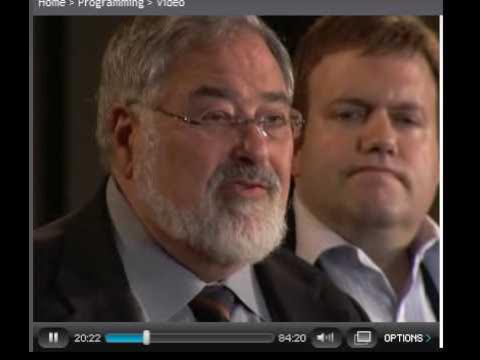
rTests334
Political persuasion fails when relying on raw facts because human reason operates 98 percent unconsciously and requires emotion to evaluate choices.
AI-assisted summary of Orwell comes to america - clip - reason 1 — original source. Check the original for full context.
Source published:
Key ideas
- Cognitive and brain sciences have disproven the Enlightenment model of reason, demonstrating that human thought is not purely conscious, logical, unemotional, or self-interest-driven. (0:00)
- Roughly 98 percent of human thought and conceptual framing occurs beneath conscious awareness, rendering facts and figures alone insufficient for political persuasion. (1:16)
- Neuroscientific findings by António Damásio establish that rationality fundamentally requires emotion; without the ability to feel emotional outcomes, individuals cannot make rational decisions. (1:36)
- All political policy and discourse stem from moral worldviews rather than neutral calculation, causing progressives and conservatives to operate through incompatible conceptual lenses. (3:16)
Detailed notes
## Background Published on YouTube by the channel rTests334 on October 18, 2009, this video excerpt is titled "Orwell comes to america - clip - reason 1." The brief description references "Orwell comes to america" and directs viewers to related material featuring George Lakoff's work on moral politics.
## TL;DR Cognitive linguist George Lakoff dismantles the traditional Enlightenment view of human reason, which mistakenly treats thought as conscious, literal, and devoid of emotion. Drawing on neuroscience and António Damásio's clinical findings, Lakoff explains that 98 percent of thought operates unconsciously and that rational decision-making fundamentally requires emotional neural pathways to assess value and consequence. As a result, political persuasion cannot succeed simply by reciting facts and figures, because political conflict is ultimately driven by competing, unconscious moral worldviews.
## Atmosphere & style The presentation carries a sharp, scholarly, and analytical tone characteristic of an intellectual lecture or deep-dive interview. Lakoff speaks with methodical conviction, systematically picking apart longstanding political intuitions with engaging clarity. Listening to the excerpt feels both eye-opening and sobering, as it reveals the deep biological disconnect between human cognitive reality and conventional political strategy.
## Bulletin - [00:00](https://www.youtube.com/watch?v=PYmi0DLzBdQ&t=0s) Cognitive and brain sciences have disproven the Enlightenment model of reason, demonstrating that human thought is not purely conscious, logical, unemotional, or self-interest-driven. - [01:16](https://www.youtube.com/watch?v=PYmi0DLzBdQ&t=76s) Roughly 98 percent of human thought and conceptual framing occurs beneath conscious awareness, rendering facts and figures alone insufficient for political persuasion. - [01:36](https://www.youtube.com/watch?v=PYmi0DLzBdQ&t=96s) Neuroscientific findings by António Damásio establish that rationality fundamentally requires emotion; without the ability to feel emotional outcomes, individuals cannot make rational decisions. - [03:16](https://www.youtube.com/watch?v=PYmi0DLzBdQ&t=196s) All political policy and discourse stem from moral worldviews rather than neutral calculation, causing progressives and conservatives to operate through incompatible conceptual lenses.
## Key takeaways - [00:00](https://www.youtube.com/watch?v=PYmi0DLzBdQ&t=0s) The traditional Enlightenment conception assumes human reason is fully conscious, universal, literal, logical, disembodied, and unemotional. - [00:20](https://www.youtube.com/watch?v=PYmi0DLzBdQ&t=20s) The Enlightenment framework incorrectly assumes individuals make choices driven purely by conscious self-interest. - [00:35](https://www.youtube.com/watch?v=PYmi0DLzBdQ&t=35s) Relying on the Enlightenment model leads Democratic Party strategists to mistakenly assume that presenting facts and figures alone will persuade voters to reach the correct conclusion. - [01:00](https://www.youtube.com/watch?v=PYmi0DLzBdQ&t=60s) Modern cognitive science has invalidated every primary dimension of the Enlightenment view of human reason. - [01:16](https://www.youtube.com/watch?v=PYmi0DLzBdQ&t=76s) Approximately 98 percent of all thought and reasoning operates unconsciously, shaping how people conceptualize the world without their conscious awareness. - [01:36](https://www.youtube.com/watch?v=PYmi0DLzBdQ&t=96s) Emotional processing is largely unconscious and serves as a biological necessity for rational decision-making. - [02:05](https://www.youtube.com/watch?v=PYmi0DLzBdQ&t=125s) António Damásio's clinical research demonstrated that brain damage severing emotional capacity leaves individuals unable to make rational everyday choices. - [02:30](https://www.youtube.com/watch?v=PYmi0DLzBdQ&t=150s) Rationality requires anticipating emotional valence, such as whether an outcome will produce happiness, sadness, or anger, in order to assign value to choices. - [03:16](https://www.youtube.com/watch?v=PYmi0DLzBdQ&t=196s) Movement conservatives and progressives disagree fundamentally because their underlying moral and conceptual worldviews are different. - [03:30](https://www.youtube.com/watch?v=PYmi0DLzBdQ&t=210s) Political candidates frequently talk past each other because they are speaking from fundamentally divergent moral systems rather than neutral logic. - [03:45](https://www.youtube.com/watch?v=PYmi0DLzBdQ&t=225s) Every political policy proposal is ultimately framed around an explicit claim of what is morally right or wrong rather than dispassionate technical calculation.
## Detailed walkthrough ### [00:00](https://www.youtube.com/watch?v=PYmi0DLzBdQ&t=0s) The Enlightenment Myth of Pure Rationality
Although the Enlightenment contributed foundational ideas about human equality and the balance of powers, it also introduced a deeply flawed model of human reason that persists today across distinguished newspapers, mainstream media, and particularly within the Democratic Party. Under this traditional Enlightenment view, human reason is assumed to be fully conscious, universal, strictly logical, literal, disembodied, and unemotional—operating on the premise that emotions merely contaminate rational thought. Crucially, this legacy assumes reason is purely interest-based, functioning exclusively to serve an individual's conscious self-interest.
This misconception has produced profound political blind spots. Political strategists in the Democratic Party frequently operate under the naive assumption that political persuasion simply requires delivering facts and figures, expecting voters to naturally calculate and reach the "correct" conclusion. Cognitive and brain sciences have thoroughly dismantled this model, proving that the Enlightenment conception is fundamentally incorrect across every single dimension. As George Lakoff argues regarding this flawed political strategy: “And one horrible thing thing about this, is you see it in the Democratic Party a great deal there that is if you believe this you'll think all you need to do is tell people the facts and the figures and then they'll reason to the right conclusion.”
- **The Enlightenment model assumes reason is:** - Fully conscious - Universal across all individuals - Strictly logical and literal (directly mapping onto external reality) - Unemotional (treating emotion as an impediment) - Disembodied - Grounded entirely in self-interest - **The political consequence:** Strategists believe providing raw data and objective truth is sufficient to sway voters, a strategy that has repeatedly failed in recent elections because human cognition does not function like an Enlightenment calculating engine.
```mermaid flowchart TD accTitle: Enlightenment Reason vs Cognitive Reality accDescr: Contrasting the Enlightenment model of logic and facts against the cognitive science model of unconscious thought and emotion.
subgraph Enlightenment ["Enlightenment Model (Disproven)"] E1["Conscious & Logical"] --> E2["Facts & Figures"] E2 --> E3["Direct Rational Conclusion"] end
subgraph CognitiveScience ["Cognitive Reality"] C1["98% Unconscious Thought"] --> C2["Conceptual Frames & Worldviews"] C3["Embodied Emotion & Damásio Pathways"] --> C2 C2 --> C4["Moral Political Judgments"] end ```
---
[01:16](https://www.youtube.com/watch?v=PYmi0DLzBdQ&t=76s) Why Reason Is Unconscious and Requires Emotion
Cognitive science reveals that roughly 98 percent of human thought and reasoning occurs beneath conscious awareness. This unconscious processing does not simply refer to subliminal sensory inputs; it governs the very conceptual systems and cognitive architecture that people use to make sense of the world. Individuals do not consciously know or perceive their own operating system of concepts. Unraveling these hidden cognitive structures remains a difficult, ongoing pursuit within cognitive linguistics and neuroscience.
Furthermore, rationality cannot function without emotion, and emotional processing is itself largely unconscious, as highlighted in the work of Drew Westen. Neuroscientist António Damásio famously documented this phenomenon in his book *Descartes' Error*. Studying patients who suffered neurological damage from strokes or head trauma that severed their capacity to feel emotion, Damásio discovered that these individuals were entirely unable to make rational decisions. Without emotional valence, a person cannot evaluate potential consequences—if someone cannot feel whether an outcome will bring joy, sadness, or anger, they have no baseline values upon which to prioritize goals or reason through a course of action. Rationality inherently relies on emotional neural pathways. Emphasizing this biological necessity, Lakoff states: “Reason, rationality, requires. Absolutely requires emotion and the pathways have begun to be figured out in great detail that shows in the brain how this works.”
- **Unconscious cognition:** Ninety-eight percent of all mental processing, conceptual framing, and reasoning happens without conscious awareness. - **Damasio’s clinical findings:** Patients with brain damage eliminating emotional feelings become incapable of making rational daily choices because they cannot assign subjective value to potential outcomes. - **The role of feeling in rationality:** Practical reasoning requires anticipating affective states—such as gauging whether an action will make oneself happy or sad, or whether other people will react with anger or approval.
---
[03:16](https://www.youtube.com/watch?v=PYmi0DLzBdQ&t=196s) Moral Worldviews and the Clash of Politics
Because reason is framed by unconscious conceptual structures rather than objective, neutral logic, different groups develop fundamentally divergent worldviews. Movement conservatives and strong progressives do not simply disagree on isolated facts; they experience and interpret reality through entirely incompatible lenses. When opposing political figures appear on television debates and talk right past each other, it is not merely theater—it is the direct outcome of divergent moral systems.
All political discourse is fundamentally an expression of morality. Whenever a politician proposes, defends, or attacks a policy, they do so based on a bedrock conviction of what is morally right and wrong rather than neutral spreadsheets or dispassionate policy calculus. Underscoring this dynamic, Lakoff concludes: “Every politician who proposes some policy does it because he says it's right.”
## Notable quotes > [03:16](https://www.youtube.com/watch?v=PYmi0DLzBdQ&t=196s) Every politician who proposes some policy does it because he says it's right. — George Lakoff
## Mentioned George Lakoff, Democratic Party, Drew Westen, António Damásio, Descartes' Error
## Video description Orwell comes to america
Other interesting videos George Lakoff: Moral politics
http://www.youtube.com/watch?v=5f9R9MtkpqM
[Source](https://www.youtube.com/watch?v=PYmi0DLzBdQ)