NASA Shuttle Tile Permits Bare-Hand Grip Fresh From 2,200F Oven
Roscket Tasartir
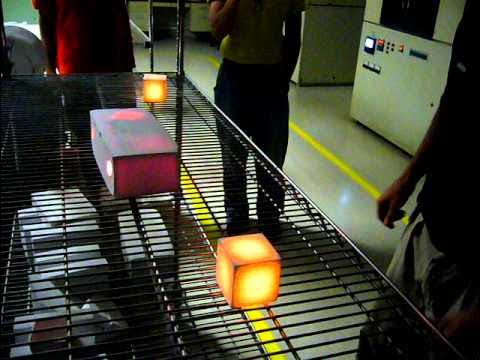
Extremely low thermal conductivity and rapid edge heat dissipation allow handlers to grasp glowing silica tiles bare-handed seconds after hours of 2,200-degree heating.
AI-assisted summary of Space Shuttle Thermal Tile Demonstration — original source. Check the original for full context.
Source published:
Key ideas
- Space Shuttle thermal protection tiles heated to 2,200°F can be handled bare-handed at the corners almost immediately upon removal from an industrial furnace. (0:00)
- The 9-pound-per-cubic-foot tile material dissipates surface heat rapidly while its interior retains an incandescent, molten-looking core. (0:25)
- Higher-density 22-pound-per-cubic-foot material retains heat significantly longer, continuing to glow for hours after removal from the heat source. (0:57)
- During atmospheric reentry, the Space Shuttle thermal protection system endures temperatures reaching roughly 2,500°F to protect the orbiter's aluminum skin. (1:13)
Detailed notes
## Background Published on YouTube by Roscket Tasartir on July 10, 2011, this video captures a demonstration filmed during a tour of the Kennedy Space Center. Recorded the day before the STS-135 launch of the Space Shuttle Atlantis—the program's final mission—the footage highlights how Space Shuttle thermal protection tiles insulate against extreme heat.
## TL;DR A presenter at the Kennedy Space Center demonstrates the extreme thermal insulation capabilities of Space Shuttle heat shield tiles heated in a 2,200°F furnace for several hours. While the raw 9-pound material continues to glow molten hot at its center, its low thermal conductivity and rapid heat dissipation allow its outer corners to cool almost instantaneously upon contact with the air. A visitor safely picks up the incandescent cube bare-handed by its corners without burning themselves, after which the presenter contrasts this rapid heat shedding with denser 22-pound tile material that retains heat for hours.
## Atmosphere & style The presentation carries an awe-inspiring, casual science-demo feel, balancing lighthearted humor with genuine technical wonder. The contrast between the intensely glowing, molten-hot block and the casual act of holding it bare-handed creates an immediate sense of disbelief and astonishment. The demonstrator remains relaxed and reassuring, fostering an engaging, educational atmosphere that brings the extreme physics of orbital reentry down to a tangible, hands-on level.
## Bulletin - [00:00](https://www.youtube.com/watch?v=Pp9Yax8UNoM&t=0s) Space Shuttle thermal protection tiles heated to 2,200°F can be handled bare-handed at the corners almost immediately upon removal from an industrial furnace. - [00:25](https://www.youtube.com/watch?v=Pp9Yax8UNoM&t=25s) The 9-pound-per-cubic-foot tile material dissipates surface heat rapidly while its interior retains an incandescent, molten-looking core. - [00:57](https://www.youtube.com/watch?v=Pp9Yax8UNoM&t=57s) Higher-density 22-pound-per-cubic-foot material retains heat significantly longer, continuing to glow for hours after removal from the heat source. - [01:13](https://www.youtube.com/watch?v=Pp9Yax8UNoM&t=73s) During atmospheric reentry, the Space Shuttle thermal protection system endures temperatures reaching roughly 2,500°F to protect the orbiter's aluminum skin.
## Key takeaways - [00:00](https://www.youtube.com/watch?v=Pp9Yax8UNoM&t=0s) Raw Space Shuttle thermal tile material was baked at 2,200°F for multiple hours to demonstrate its insulating capabilities. - [00:12](https://www.youtube.com/watch?v=Pp9Yax8UNoM&t=12s) Ordinary objects like frozen pizza would disintegrate within minutes in the 2,200°F oven. - [00:18](https://www.youtube.com/watch?v=Pp9Yax8UNoM&t=18s) Unlike metals, which melt or stay dangerously hot for hours, shuttle tile material has exceptionally low thermal conductivity. - [00:25](https://www.youtube.com/watch?v=Pp9Yax8UNoM&t=25s) The outer surface and corners shed thermal energy almost instantaneously upon exposure to room air. - [00:31](https://www.youtube.com/watch?v=Pp9Yax8UNoM&t=31s) The core of the tile remains glowing incandescent at over 2,000°F even as the exterior cools. - [00:43](https://www.youtube.com/watch?v=Pp9Yax8UNoM&t=43s) A visitor safely picks up a glowing block with bare hands by holding it strictly by the outermost corners. - [00:49](https://www.youtube.com/watch?v=Pp9Yax8UNoM&t=49s) Holding the material only at the corners is critical because those areas radiate heat into the surrounding air fastest. - [00:57](https://www.youtube.com/watch?v=Pp9Yax8UNoM&t=57s) Material density dictates thermal retention, with 22 lb/cu ft tiles glowing for hours compared to the faster-dissipating 9 lb/cu ft tiles. - [01:13](https://www.youtube.com/watch?v=Pp9Yax8UNoM&t=73s) The Space Shuttle's thermal tiles are designed to withstand atmospheric reentry temperatures reaching approximately 2,500°F.
## Detailed walkthrough ### [00:00](https://www.youtube.com/watch?v=Pp9Yax8UNoM&t=0s) Demonstrating Space Shuttle Thermal Tiles at 2,200 Degrees
During a demonstration at Kennedy Space Center, a presenter showcases the remarkable thermal insulation properties of raw Space Shuttle heat shield tile material. Displaying cubes of the raw 9-pound material that have been sitting inside an industrial furnace at 2,200 degrees Fahrenheit for several hours, he points out that they are glowing blazing hot. To put this extreme thermal environment into perspective, the demonstrator remarks that if a person put an ordinary frozen pizza in that oven, it would completely disintegrate within a couple of minutes. Metal placed in the same conditions would either melt outright or conduct and retain heat so intensely that no one could safely approach it for hours afterward.
Yet the shuttle tile material behaves entirely differently due to its exceptionally low thermal conductivity and rapid heat dissipation. Opening the oven and pulling out a glowing cube, the demonstrator highlights how quickly the outer edges release thermal energy, remarking, “It dissipates the heat so quickly that you can actually pick these up while they're glowing molten in the middle.” While the interior of the block continues to radiate an intense, molten incandescent glow from the 2,200-degree soaking, the surface corners cool almost instantaneously when exposed to the air.
- **Oven temperature:** The thermal tile cubes were baked at 2,200°F for multiple hours prior to extraction. - **Material grade:** Raw 9-pound-per-cubic-foot tile material without outer coating. - **Behavior comparison:** Unlike metals, which conduct heat throughout their entire mass and stay dangerously hot for hours, the tile material transfers heat so slowly through its structure that its exterior cools instantly to the touch.
[00:43](https://www.youtube.com/watch?v=Pp9Yax8UNoM&t=43s) Bare-Hand Handling and Density Comparisons
Confident in the material's properties, the demonstrator invites a visitor to pick up one of the incandescent blocks bare-handed to take a photo, emphasizing precise handling technique: “Just make sure you don't pick it up on the edges, just at the at the corners.” The visitor successfully grasps the block by its outermost corners without gloves, feeling warmth but suffering no burns despite the core still glowing brightly at over two thousand degrees. The demonstrator commends the visitor, noting, “That's perfect technique right there.”
The presenter goes on to explain how varying the density of the silica tiles alters heat retention and radiation. While the lighter 9-pound material sheds surface heat almost immediately, denser blocks behave differently. Pointing toward a block made of 22-pound-per-cubic-foot material, he jokes, “Look at that, that's the 22 lb per cubic foot—it's going to glow for hours; you could come back after dinner and roast marshmallows on that.” Connecting the demonstration back to spaceflight reality, he explains that during atmospheric reentry, the Space Shuttle's thermal protection system endures temperatures reaching up to approximately 2,500°F while successfully insulating the orbiter's aluminum skin underneath.
- **Handling technique:** Handlers can touch the block safely by touching only the extreme corners, where heat radiates into the surrounding air fastest. - **Material density contrast:** - *9 lb/cu ft material:* Emits surface heat extremely rapidly, permitting direct contact at the corners seconds after leaving a 2,200°F oven. - *22 lb/cu ft material:* Retains internal heat much longer and continues to glow for hours. - **Reentry conditions:** Space Shuttle orbiters experience atmospheric reentry temperatures climbing to roughly 2,500°F.
## Mentioned Kennedy Space Center, Space Shuttle, Space Shuttle Atlantis, STS-135, NASA
## Video description Recorded this video during my KSC tour 1 day before the launch of the Atlantis Space Shuttle for STS-135, the last Space Shuttle mission.
==Updated June 3, 2013== Thanks everyone for your interest and positive responses to this video! I just want to reiterate that this video may be used and reproduced for non-profit, educational purposes, so long as citation is given back to this YouTube video. For for-profit licensing and commercial usage, contact licensing@viralhog.com.
For information about the Space Shuttle thermal tiles, how they work, what they are made of, and other thermal insulation used on the Space Shuttle, check out this very informative brochure here: http://www.nasa.gov/centers/johnson/pdf/584728main_Wings-ch4b-pgs182-199.pdf
[Source](https://www.youtube.com/watch?v=Pp9Yax8UNoM)