Using AI To Detect AI Music (and other music industry data-porn)
Benn Jordan
AI-assisted summary of Using AI To Detect AI Music (and other music industry data-porn) — original source. Check the original for full context.
Source published:
Key ideas
- Scraping 560 top-ranked Suno tracks revealed that 549 (98%) were actively monetized on digital streaming platforms under disguised artist profiles, with a single track pulling nearly 700,000 streams from the shared royalty pool. (1:51)
- Benn Jordan developed an AI detection pipeline reaching 100% accuracy on Suno audio by identifying residual compression artifacts left over from the lossy, non-consensual web audio used to train the models. (5:05)
- An audit of royalty-free loop services with Venus Theory showed that assembling tracks from Splice, Loopcloud, and vintage sample CDs triggered high rates of automated Content ID collisions, offering no safe option among tested platforms. (10:00)
- Streaming payout analysis reveals major DSPs pay near the bottom—Spotify at $0.0029 and YouTube Music at $0.0027 per stream—while Qobuz reaches $0.0136 and curated fitness provider Peloton tops the list at roughly $0.03. (13:19)
Detailed notes
## Background Published by Benn Jordan on YouTube on January 5, 2025, the video investigates key data points across the music industry. According to the description, it covers which streaming platforms pay the highest royalty rates, audits sample libraries for copyright collision issues, and demonstrates how to determine whether music is human-made.
## TL;DR Benn Jordan presents an empirical deep dive into modern music industry dilemmas, beginning with an AI detection pipeline that leverages psychoacoustic compression artifacts to identify scraped Suno tracks monetized under fake artist identities on streaming platforms. Collaborating with Venus Theory, he audits prominent royalty-free sample libraries like Splice, Loopcloud, and vintage sample CDs, showing that automated Content ID systems generate alarming rates of false copyright matches across all services. Finally, drawing on independent distributor data from his own fully owned catalog, Jordan breaks down real-world pay-per-stream royalties, revealing that platforms like Spotify sit near the bottom while Qobuz and curated fitness services like Peloton offer substantially higher payouts.
## Atmosphere & style The presentation blends dry, sarcastic industry weariness with the rigor of a technical investigative report. Jordan speaks with calm, analytical authority, balancing dense spectrogram and audio codec physics with darkly humorous commentary on corporate venture capital and algorithmic streaming dilution. It feels like an intimate, behind-the-scenes laboratory dispatch, transitioning from technical defiance in unmasking bad actors to an impassioned, principled critique of modern streaming economics.
## Bulletin - [01:51](https://www.youtube.com/watch?v=QVXfcIb3OKo&t=111s) Scraping 560 top-ranked Suno tracks revealed that 549 (98%) were actively monetized on digital streaming platforms under disguised artist profiles, with a single track pulling nearly 700,000 streams from the shared royalty pool. - [05:05](https://www.youtube.com/watch?v=QVXfcIb3OKo&t=305s) Benn Jordan developed an AI detection pipeline reaching 100% accuracy on Suno audio by identifying residual compression artifacts left over from the lossy, non-consensual web audio used to train the models. - [10:00](https://www.youtube.com/watch?v=QVXfcIb3OKo&t=600s) An audit of royalty-free loop services with Venus Theory showed that assembling tracks from Splice, Loopcloud, and vintage sample CDs triggered high rates of automated Content ID collisions, offering no safe option among tested platforms. - [13:19](https://www.youtube.com/watch?v=QVXfcIb3OKo&t=799s) Streaming payout analysis reveals major DSPs pay near the bottom—Spotify at $0.0029 and YouTube Music at $0.0027 per stream—while Qobuz reaches $0.0136 and curated fitness provider Peloton tops the list at roughly $0.03.
## Key takeaways - [01:51](https://www.youtube.com/watch?v=QVXfcIb3OKo&t=111s) A lucrative gray market exists where users scrape generative AI outputs from tools like Suno and distribute them to DSPs under verified artist personas to siphon streaming royalties. - [01:51](https://www.youtube.com/watch?v=QVXfcIb3OKo&t=111s) Over 50 million tracks were registered via ISRC within a 12-month span, marking a sharp surge in unvetted independent uploads while major label registrations shrank. - [05:05](https://www.youtube.com/watch?v=QVXfcIb3OKo&t=305s) Psychoacoustic compression discards 75% to 90% of audio information that human brains filter out, making lossy 128-256 kbps files virtually indistinguishable from lossless masters to most listeners. - [05:05](https://www.youtube.com/watch?v=QVXfcIb3OKo&t=305s) Generative neural networks ingested lossy web audio as a black box, permanently baking the codecs' compression anomalies into synthesized outputs as an acoustic delta fingerprint. - [08:08](https://www.youtube.com/watch?v=QVXfcIb3OKo&t=488s) Commercial Content ID architectures are engineered for wholesale audio piracy and cannot differentiate between legitimate shared royalty-free licenses and copyright infringement. - [08:08](https://www.youtube.com/watch?v=QVXfcIb3OKo&t=488s) Sample distributors lack the economic incentive to resolve Content ID clashes because subscription and distribution fees are collected upfront before downstream collisions occur. - [10:00](https://www.youtube.com/watch?v=QVXfcIb3OKo&t=600s) Empirical testing showed commercial loop libraries frequently triggered false copyright matches, with vintage Akai sample CDs producing the highest collision risk. - [10:00](https://www.youtube.com/watch?v=QVXfcIb3OKo&t=600s) Splice's premium discovery features, such as 'Rare Finds' tags and 'Splice Stacks', failed to prevent automated copyright strikes on short test compositions. - [13:19](https://www.youtube.com/watch?v=QVXfcIb3OKo&t=799s) Social media platforms provide negligible streaming revenue, with VK paying $0.00005 per stream and TikTok generating just $0.0021. - [13:19](https://www.youtube.com/watch?v=QVXfcIb3OKo&t=799s) Spotify and YouTube Music rank near the bottom of traditional music DSP payouts at under $0.003 per stream, whereas Apple Music pays double and Amazon Unlimited roughly 3.5 times as much. - [15:00](https://www.youtube.com/watch?v=QVXfcIb3OKo&t=900s) Independent Spotify payouts have declined by 10.9% over the past year and dropped 68% over the last decade when adjusted for inflation. - [15:00](https://www.youtube.com/watch?v=QVXfcIb3OKo&t=900s) Peloton stands as the highest-paying digital streaming platform at roughly $0.03 per stream due to its closed ecosystem and hardware-tied direct licensing model. - [17:37](https://www.youtube.com/watch?v=QVXfcIb3OKo&t=1057s) The channel relies on non-profit status, media liability insurance, and direct Patreon backing to publish investigative exposés without fear of corporate legal intimidation or brand sponsor loss.
## Detailed walkthrough ### [00:00](https://www.youtube.com/watch?v=QVXfcIb3OKo&t=0s) Introduction and the Music Data Experiments
Benn Jordan introduces the video by acknowledging that the presentation might feel somewhat disjointed or all over the place, yet it is thoroughly packed with vital data for musicians and music enthusiasts alike. Throughout 2024, the single most frequent question he received was about how to support favorite artists through streaming—specifically, which streaming service actually pays artists the highest rate per stream. Benn notes that he has gathered extensive hard data on the topic, and the ultimate answer is completely unexpected; he bets that almost none of his viewers would be able to guess the top-paying service correctly.
Beyond streaming payouts, the video sets out to tackle two other major industry issues. First, Benn has developed a functional method to expose individuals who scrape tracks from AI music generators, pretend they wrote them, and distribute them to DSPs (digital streaming platforms) to hijack royalty pools meant for human artists. He reveals that he has developed an AI detection pipeline capable of identifying music generated via Suno with 100% accuracy. Second, he teamed up with fellow creator Venus Theory to audit sample and loop services. The two creators subscribed to every prominent loop platform, downloaded random samples, assembled nearly 100 songs, and routed them through an automated copyright fingerprinting API to determine which platform is most—and least—likely to cause false copyright claims. Benn humorously remarks: “Some guys like football. Some guys like motorcycles. Some guys like anime. I like to generate strange sounds on AI music sites by the thousands, then upload them with an API that compares them to previously copyrighted music, and then try and isolate reliable methodology that would stand up in court should, I don't know, an artist or record label say, 'Hey, assholes, you stole my work without asking and used it to raise hundreds of millions of venture capital dollars. How about you pay me now?'”
- Streaming payout analysis answering the most common 2024 audience inquiry. - Creation of an AI detection tool targeting platforms like Suno and Udio. - Empirical testing of royalty-free sample libraries alongside Venus Theory to audit automated Content ID collision rates.
---
[01:51](https://www.youtube.com/watch?v=QVXfcIb3OKo&t=111s) Identifying Fake Music on Spotify and the Gray Market
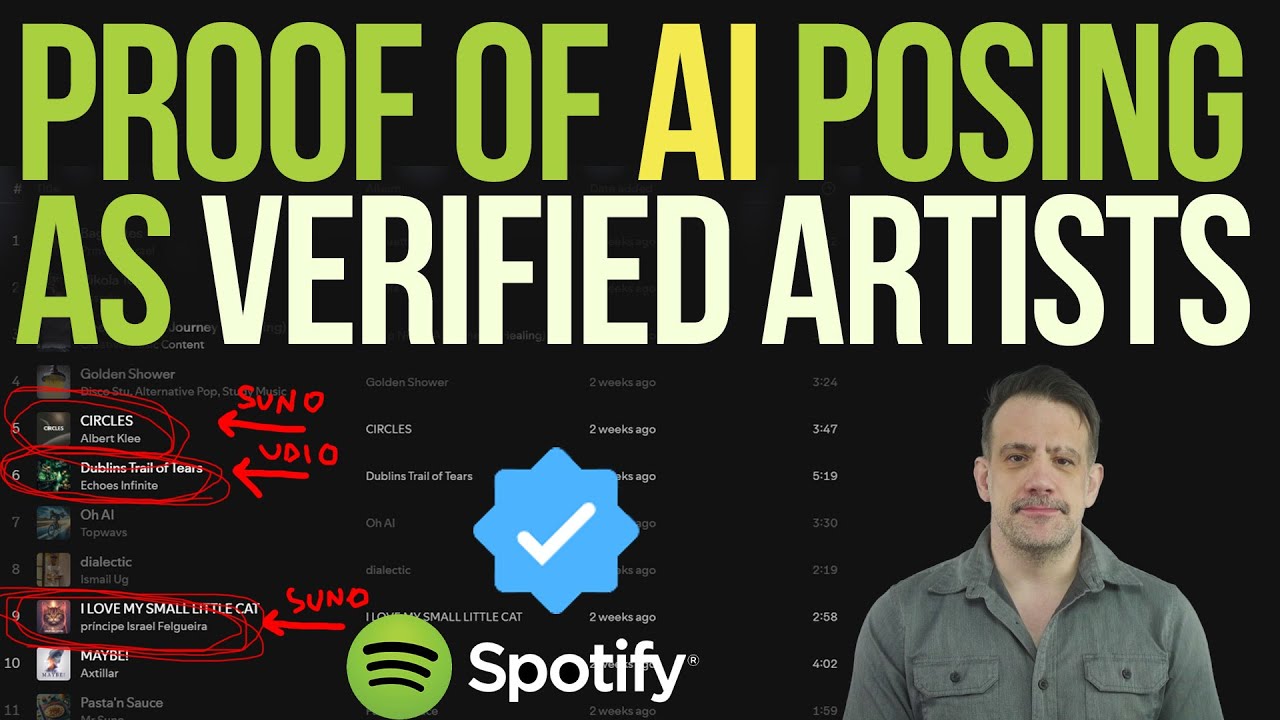
Benn explains that his investigation into generative music began years prior, dating back to experiments around the release of Google's Magenta project. More recently, he began scraping songs created by users on platforms like Suno and Udio and cross-referencing them against major streaming services. His findings confirm a bustling and highly profitable gray market. While streaming services like Spotify operate under vague policies regarding artificial intelligence, they have little desire to distribute their shared royalty pool to works that lack legal copyright protection.
To gauge the scale of the issue, Benn scraped 560 of Suno's staff picks and top-ranked generated tracks. Astonishingly, out of those 560 songs, only 11 were *not* currently monetized on commercial streaming platforms under the guise of an authentic human artist. Verifying these matches was grueling because he had to listen and compare them by ear to avoid falsely identifying legitimate human musicians. During this process, he found that bad actors deliberately obfuscated song and artist names to evade detection. Many of these accounts were fully "Verified Artists" on Spotify, possessing extensive discographies and algorithmic placement like "Artist's Pick." Inspecting one such account, Benn observes a single AI-generated song with 688,946 streams—translating to roughly $2,000 extracted from the streaming royalty pool.
Analyzing ISRC (International Standard Recording Code) data reveals the sheer scale of the dilution: daily new song registrations showed a 15% bump by June compared to preceding years, signaling that over 50 million songs were uploaded to platforms like Spotify within the prior 12 months. Concurrently, label registrations are shrinking while independent uploads are skyrocketing. Benn dryly laments: “'Independent artists representing a larger portion of released music is really good news,' said the version of me in a parallel universe where AI music isn't flooding into streaming services.”
- 549 out of 560 top Suno tracks (98%) were found actively monetized on digital streaming platforms under fake artist personas. - A single identified track logged 688,946 streams, siphoning approximately $2,000 from legitimate creators. - Industry ISRC data indicates an upload volume surpassing 50 million tracks annually, driven by an artificial explosion of unvetted "independent" releases.
---
[05:05](https://www.youtube.com/watch?v=QVXfcIb3OKo&t=305s) Psychoacoustic Compression and Building an AI Music Detector
```mermaid flowchart TD accTitle: AI Music Fingerprinting Flow accDescr: Diagram showing how lossy artifacts from web scraping create detectable acoustic fingerprints in AI models.
subgraph Ingestion ["1. Training Ingestion"] A["Scraped Audio<br/>(YouTube, Spotify, SoundCloud)"] B["Lossy Compression<br/>(7:1 to 10:1 Ratio / 128-256 kbps)"] A --> B end
subgraph Generation ["2. Black Box Synthesis"] C["Neural Network Model<br/>(e.g., Suno)"] D["Baked-in Artifacts<br/>(Unnoticed by Human Hearing)"] B --> C C --> D end
subgraph Detection ["3. Fingerprint Extraction"] E["Delta Identification Algorithm"] F["100% Detection Accuracy<br/>(Model / Source Verification)"] D --> E E --> F end ```
Benn shifts into the physics of sound and the history of audio distribution, recounting how MP3 encoding revolutionized audio sharing in his late teens through psychoacoustic compression. In modern environments, humans struggle to perceive what has been removed from compressed files. Benn admits that even on his highest-grade studio monitors, dedicated headphone setups, and amplifiers, he cannot reliably differentiate a 256 kbps MP3 from an uncompressed 24-bit WAV file. He points to an NPR double-blind test where 80% of participants could not tell a 128 kbps MP3 apart from a CD-quality lossless file, with most listeners ironically choosing the lowest-bitrate file as the best sounding. Streaming services rely on this psychoacoustic exploit, maintaining compression ratios between 7:1 and 10:1 (turning a 50 MB master into a 5 MB to 8 MB file) by discarding 75% to 90% of audio information that human brains filter out via latent inhibition.
This psychoacoustic blind spot forms the foundation of Benn’s AI detection breakthrough. Generative platforms like Suno (valued at $500 million) scraped enormous quantities of training audio non-consensually from websites like YouTube, SoundCloud, and Spotify. Because these repositories consist almost exclusively of lossy, compressed audio files, the neural networks ingested the specific artifacts and limitations of those codecs:
> “My point here is that 75 to 90 percent of information that humans don't realize is missing when listening to compressed audio could potentially be used as a fingerprint when identifying if something was created with generative AI and potentially even identifying the content that was scraped in the dataset.”
Because neural networks treat their input data as a black box, they bake these compression anomalies directly into their generative output. Benn successfully isolated this residual "delta" fingerprint in music generated by Suno, achieving a 100% detection rate in his initial tests. To prevent generative companies from updating their models to circumvent detection, Benn intentionally keeps the precise algorithm confidential, sharing the research only with trusted peers to validate and refine the model.
- Double-blind testing shows 4 out of 5 individuals cannot separate 128 kbps compressed files from lossless source material. - Streaming compression strips out roughly 75% to 90% of raw audio information. - Non-consensual web scrapers ingested lossy, compressed audio, leaving distinct mathematical artifacts inside the models' generative output. - Benn’s custom tool leverages these structural artifacts to identify Suno-generated tracks with 100% reliability.
---
[08:08](https://www.youtube.com/watch?v=QVXfcIb3OKo&t=488s) Copyright Auditing Splice and Sample Libraries
Turning to music production workflows, Benn explores the systemic flaws within digital sample libraries, directing viewers to Venus Theory's prior video addressing the "Splice problem." When artists assemble tracks out of commercially available, royalty-free sample packs, Content ID systems on YouTube and Spotify misinterpret the shared elements. Because automated copyright monitors are designed to catch wholesale piracy—such as an unauthorized re-upload of Pink Floyd's *The Dark Side of the Moon*—they cannot distinguish between legitimate, shared royalty-free licenses and blatant copyright infringement. When two independent producers release songs built around the same underlying sample, the Content ID system flags one creator as a fraud, frequently blocking their music or redirecting their hard-earned monetization straight to the other artist.
Benn emphasizes that this widespread industry friction is completely preventable through common-sense technical systems. Streaming and hosting platforms could easily establish an open whitelist for registered sample identifiers, or sample providers like Splice could register ownership of their catalog with Content ID prior to public distribution while leaving monetization claims turned off. However, because sample distributors and digital aggregators collect their subscription and distribution fees up front, they lack the economic incentive to resolve Content ID clashes that occur months downstream:
> “Unfortunately, if you run into this problem with loop or sample services, it will be long after you've paid the loop library and the distributor, so there's not much incentive for anybody to do much about it.”
To determine which sample platform causes the most severe copyright issues, Benn and Venus Theory put the major players to the test. Together, they subscribed to every leading loop library, constructed nearly 100 original tracks using random loops, and submitted them through a commercial Content ID API to measure how often false claims occur across different catalogs.
[10:00](https://www.youtube.com/watch?v=QVXfcIb3OKo&t=600s) Auditing Sample Libraries: Splice, Loopcloud, and Content ID Traps
To test how frequently commercial sample libraries trigger Content ID claims, Benn Jordan and Venus Theory generated roughly one-minute test tracks using loops that were pitched and time-stretched to aesthetically fit standard production workflows. Loopcloud proved technically frustrating during testing, repeatedly crashing in both its standalone app and DAW bridge. Furthermore, sample services often monetize safety features: accessing Splice’s filtering tools for undiscovered or Content ID-safe sounds requires paying extra for a Creator or Creator+ tier rather than base subscriptions like Splice Sounds+ or Splice x Studio One Pro.
To compare services, Benn calculated a relative flag rate score where a higher number denotes a higher risk of triggering a copyright match against existing published music:
| Sample Library / Source | Songs Created | Copyright Flags Received | Relative Risk Score | |:--- |:--- |:--- |:--- | | **FL Studio Cloud** | 14 | 18 | 128 | | **Loopcloud** | 18 | 28 | 155 | | **Splice** (standard browse) | 16 | (high rate) | (high score) | | **Vintage Akai Sample CDs** (Zero-G, Ueberschall) | 9 | 29 | 322 |
Reflecting on the findings, Benn concludes: “In my opinion, there is no real winner here. These are all really troubling numbers that should probably make you reconsider how you use loops.” He suggests using a loop strictly as initial inspiration, or composing around it and deleting it before final export.
Testing Splice’s specialized workflows yielded similarly poor outcomes: - **Rare Finds tag**: Designed to surface sounds undiscovered by the broader user base, four test songs built exclusively from these loops still racked up 6 copyright flags. - **Splice Stacks**: A feature that uses internal BPM and harmonic tagging to randomly blend loops produced 8 copyright pings across 10 generated tracks (most under 20 seconds long). Benn notes the slightly lower hit rate was likely due purely to the brevity of the clips. - **Tracklib**: Excluded from the test because it operates as a rights-holding entity backed by investment groups, leasing catalog masters and combining publishing holdings with work-for-hire music. Users must explicitly register sample use and share backend streaming royalties, meaning flags on Tracklib tracks generally reflect paperwork failures rather than algorithmic detection collisions.
---
[13:19](https://www.youtube.com/watch?v=QVXfcIb3OKo&t=799s) Streaming Royalty Pay-Per-Stream Breakdown
Assuming an artist navigates copyright hurdles and lands a hit, the question turns to streaming remuneration. Because Benn owns 100% of his discography—having bought back his vintage catalog masters and controlling all mechanical and publishing rights—his distributor data reflects direct per-stream royalties for independent musicians, verified alongside peers with similar complete catalog ownership.
Social media platforms pay fractions of a cent per stream: - **VK (VKontakte)**: $0.00005 per stream (requiring 200 streams to earn a single penny) - **Snapchat**: $0.0001 per stream - **TikTok**: $0.0021 per stream - **Meta (Facebook/Instagram)**: $0.003 per stream
Traditional streaming platforms fare marginally better, though major services sit near the bottom: - **YouTube Music**: $0.0027 per stream (tied with Pandora) - **Pandora**: $0.0027 per stream - **Spotify**: $0.0029 per stream - **Apple Music**: $0.006 per stream (more than double Spotify's payout) - **Deezer**: $0.0078 per stream - **Amazon Music Unlimited**: $0.0096 per stream (roughly 3.5 times Spotify's rate) - **Qobuz**: $0.0136 per stream
```mermaid flowchart LR accTitle: Pay Per Stream Hierarchy accDescr: Streaming platforms ordered from lowest payout per stream to highest payout per stream.
subgraph Bottom["Bottom Tier (< $0.003)"] VK["VK: $0.00005"] --> Meta["Meta: $0.003"] Meta --> YT["YouTube / Pandora: $0.0027"] YT --> Spot["Spotify: $0.0029"] end
subgraph Mid["Mid Tier ($0.006 - $0.0096)"] Apple["Apple Music: $0.006"] --> Deezer["Deezer: $0.0078"] Deezer --> Amazon["Amazon Unlimited: $0.0096"] end
subgraph Top["Top Tier (> $0.01)"] Qobuz["Qobuz: $0.0136"] --> Peloton["Peloton: ~$0.03"] end
Spot --> Apple Amazon --> Qobuz ```
---
[15:00](https://www.youtube.com/watch?v=QVXfcIb3OKo&t=900s) The Peloton Anomaly and the Long-Term Decline of Streaming
Qobuz represents the rare mainstream threshold where royalties cross one cent per stream, giving independent creators a semblance of fair compensation. However, Benn remains skeptical about its sustainability: “I don't think that optimism has ever rewarded me in this industry, and I'm sure like everybody else, as soon as they get a decent market share, they'll start wringing the towels and we'll see those streaming rates go down just like they did with Spotify and everybody else.” Historical tracking of his own Spotify payouts illustrates this erosion: payouts dropped 10.9% in the past year, declined over 50% across the last decade, and represent an inflation-adjusted 68% drop—meaning artists earn less than one-third of what they accepted ten years ago.
The single highest-paying digital streaming platform in Benn's reports is **Peloton**, paying approximately $0.03 per stream. Peloton operates a closed, curated, and directly licensed catalog for its fitness hardware. If Benn’s entire listener base hypothetically purchased a $1,500 exercise bike and paid the $40 monthly Peloton subscription, his music would generate around $6 million annually. Benn argues that Spotify and dominant DSP models remain toxic to musical sustainability, urging listeners to cancel predatory subscriptions, transition to higher-paying alternatives, or back artists directly via platforms like Patreon.
---
[17:37](https://www.youtube.com/watch?v=QVXfcIb3OKo&t=1057s) Channel Independence, Investigative Journalism, and Patreon
Investigative reporting on this channel—tackling issues like Spotify bot farms, predatory ADHD tele-health pharmaceutical firms, and automotive engineering practices—demands resources and significant legal risk that traditional ad-supported media cannot sustain. Major corporate brands like BetterHelp, MyHeritage, or NordVPN do not sponsor undercover recordings of pharmaceutical executives, nor can mainstream platforms easily manage corporate blowback.
- **Non-Profit Structure**: The channel operates beneath a non-profit umbrella funded entirely by direct viewer support. - **Legal Defense**: Community funding covers independent research and essential media liability insurance, allowing Benn's legal representatives and insurance providers to handle corporate cease-and-desist letters and aggressive legal threats. - **Community Benefits**: The Patreon hub distributes released and unreleased audio, professional sound libraries, and access to a creative community without corporate interference.
## Notable quotes > [05:05](https://www.youtube.com/watch?v=QVXfcIb3OKo&t=305s) 75 to 90 percent of information that humans don't realize is missing when listening to compressed audio could potentially be used as a fingerprint when identifying if something was created with generative AI and potentially even identifying the content that was scraped in the dataset. — Benn Jordan
## Mentioned Benn Jordan, Venus Theory, Spotify, Suno, Udio, Google Magenta, Splice, Loopcloud, FL Studio Cloud, Tracklib, Akai, Zero-G, Ueberschall, YouTube Music, YouTube, SoundCloud, Apple Music, Amazon Music Unlimited, Qobuz, Deezer, Pandora, Peloton, TikTok, Meta, Snapchat, VKontakte, Patreon, BetterHelp, MyHeritage, NordVPN, Pink Floyd
## Video description What streaming service pays the best? What sample library has the worst copyright problem? How to tell if music is human-made or not. It all gets answered here, folks!
The Splice Problem: https://www.youtube.com/watch?v=pbOop_za_OY&pp=ygUbdmVudXMgdGhlb3J5IHNwbGljZSBwcm9ibGVt
Udio Generated Music: https://open.spotify.com/playlist/0lPkLx6bo2GegvWPy8OUZN?si=aD7auMu2Q5iXSfTV-xLl4g
Suno Generated Music: https://open.spotify.com/playlist/7pRdrM4ZyQFStXGGowzRGk?si=MkvsqPPQQ-qBo9k-4pXG0A
💗 Support this channel and join an amazing community: http://www.patreon.com/bennjordan
👀 Stalk me on social media for more frequent updates: https://linktr.ee/BennJordan
🔴 Subscribe To My Streaming Channel. I stream weekly! https://www.youtube.com/watch?v=geaIEWGhgsI
⚡Those lovely custom acoustic panels in the background: https://psyacoustics.com
timestamps: 0:00 - Intro 1:51 - Identifying Fake Music On Spotify 5:05 - Building an AI Music Detector 8:08 - Copyright Auditing Splice (and others) 13:19 - Which streaming service pays the most? 17:37 - The Future Of This Channel
[Source](https://www.youtube.com/watch?v=QVXfcIb3OKo)