Steve Mould Replicates Semiconductor Circuits via Mechanical Chains
Steve Mould
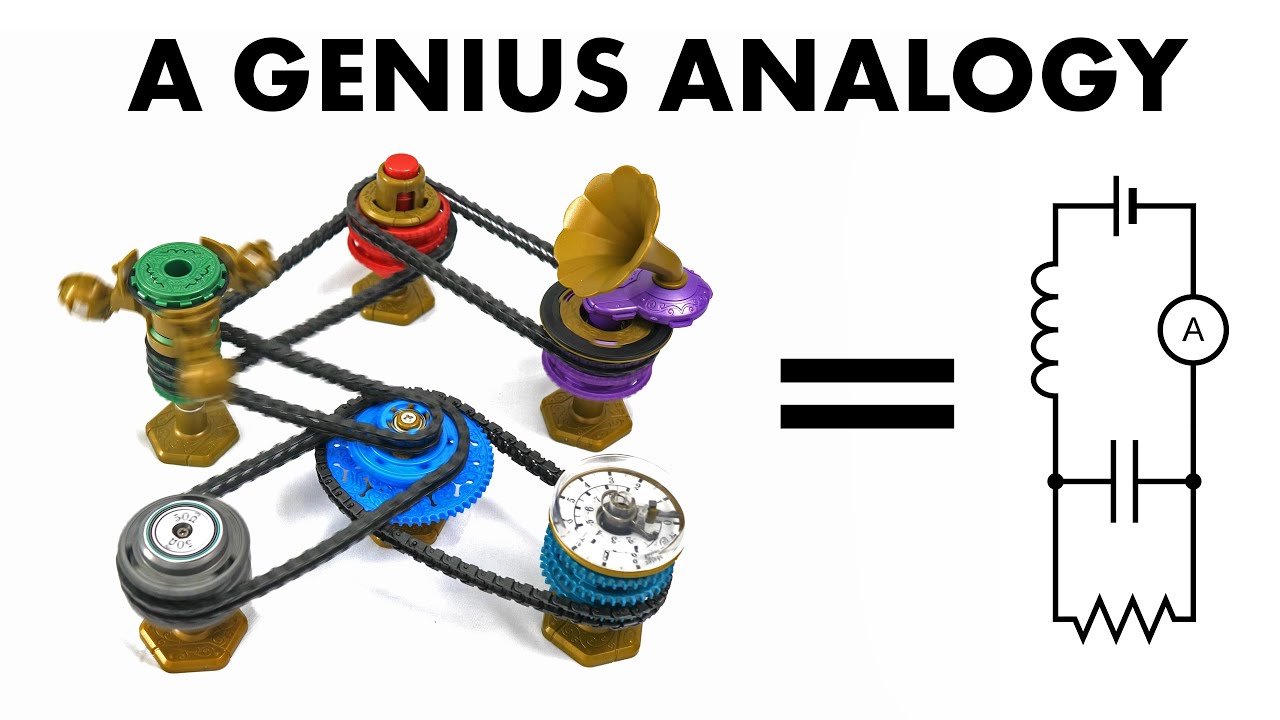
Mechanical chain systems reproduce complex electronic phenomena like inductive kickback and transistor switching because physical torque and chain velocity directly mirror voltage and current.
AI-assisted summary of Mechanical circuits: electronics without electricity — original source. Check the original for full context.
Source published:
Key ideas
- Steve Mould demonstrates Spintronics, a mechanical circuit system developed by Upper Story where chain velocity represents electric current, chain tension represents voltage, and friction provides resistance. (0:00)
- Spintronics replicates advanced electronic components mechanically, using torsion springs for capacitors, weighted flywheels for inductors, epicyclic differentials for parallel junctions and DC voltage transformation, and friction clamps for transistors. (4:12)
- Unlike electrical full-wave bridge rectifiers requiring four diodes, Spintronics accomplishes full-wave AC-to-DC rectification with only two diodes by mechanically crossing chain paths to reverse current direction. (14:58)
- The kit reproduces real electronic phenomena such as inductive kickback breaking open switches and transient LC oscillations resolving the classic two-capacitor energy paradox. (7:10)
Detailed notes
## Background Published on YouTube by science communicator Steve Mould on October 27, 2022, this video explores Spintronics, a mechanical circuit kit developed by Upper Story. The page description highlights how mechanical resistors, inductors, transistors, diodes, batteries, and capacitors linked with drive chains provide an intuitive physical model for understanding how electronic circuits function.
## TL;DR Steve Mould demonstrates the mechanics of Spintronics, where physical chains, torsion springs, flywheels, and differentials model electric currents, voltages, capacitors, and parallel junctions. He connects these tangible mechanisms to deeper physical concepts, including Veritasium's Poynting vector debate on energy delivery and his own high school publication resolving the two-capacitor paradox. Throughout the video, Mould constructs functioning mechanical high-pass and low-pass filters, transistor-based peak voltage detectors, and digital logic components such as flip-flops and XOR gates. The demonstration highlights how physical, lumped-element mechanical models give immediate, intuitive access to complex electromagnetic principles.
## Atmosphere & style The presentation is energetic, tactile, and intellectually enthusiastic, driven by Mould's genuine delight in feeling invisible physics concepts turn into tangible mechanical resistance. His delivery strikes a natural balance between playful maker tinkering and rigorous conceptual inquiry, shifting effortlessly from clacking chain demonstrations to mathematical debates on field theory. Watching the video feels like an engaging workshop demonstration where abstract electrical equations become audible clicks, whirs, and physical forces under tension.
## Bulletin - [00:00](https://www.youtube.com/watch?v=QrkiJZKJfpY&t=0s) Steve Mould demonstrates Spintronics, a mechanical circuit system developed by Upper Story where chain velocity represents electric current, chain tension represents voltage, and friction provides resistance. - [04:12](https://www.youtube.com/watch?v=QrkiJZKJfpY&t=252s) Spintronics replicates advanced electronic components mechanically, using torsion springs for capacitors, weighted flywheels for inductors, epicyclic differentials for parallel junctions and DC voltage transformation, and friction clamps for transistors. - [14:58](https://www.youtube.com/watch?v=QrkiJZKJfpY&t=898s) Unlike electrical full-wave bridge rectifiers requiring four diodes, Spintronics accomplishes full-wave AC-to-DC rectification with only two diodes by mechanically crossing chain paths to reverse current direction. - [07:10](https://www.youtube.com/watch?v=QrkiJZKJfpY&t=430s) The kit reproduces real electronic phenomena such as inductive kickback breaking open switches and transient LC oscillations resolving the classic two-capacitor energy paradox.
## Key takeaways - [00:00](https://www.youtube.com/watch?v=QrkiJZKJfpY&t=0s) Spintronics translates electronic principles into mechanical components, mapping chain velocity to amperage, chain tension to voltage, and mechanical drag to resistance. - [00:00](https://www.youtube.com/watch?v=QrkiJZKJfpY&t=0s) Series versus parallel circuits in Spintronics depend on loop topology rather than physical component arrangement; a single continuous chain loop forms a series circuit even if parts sit side by side. - [01:41](https://www.youtube.com/watch?v=QrkiJZKJfpY&t=101s) Mould addresses Veritasium's Poynting vector debate, arguing that while power travels through fields rather than drifting electron collisions, lumped-element mechanical models remain valid, intuitive abstractions for circuit design. - [04:12](https://www.youtube.com/watch?v=QrkiJZKJfpY&t=252s) A torsion spring serves as a mechanical capacitor, storing energy against the drive chain and increasing counter-torque until series current drops to zero. - [04:12](https://www.youtube.com/watch?v=QrkiJZKJfpY&t=252s) A three-gear epicyclic differential splits input torque and speed inversely across loads to model parallel junctions, and acts as a mechanical DC transformer providing a 2:1 advantage without AC. - [07:10](https://www.youtube.com/watch?v=QrkiJZKJfpY&t=430s) An acoustic ammeter uses a serrated rotor and a flexible reed inside a gramophone horn to audibly map current flow via pitch. - [07:10](https://www.youtube.com/watch?v=QrkiJZKJfpY&t=430s) A heavy flywheel models an inductor by storing angular momentum, producing inductive kickback that can physically break switches unless routed through a parallel shunt resistor. - [07:10](https://www.youtube.com/watch?v=QrkiJZKJfpY&t=430s) The wind-up spring battery incorporates a centrifugal seatbelt-style brake to prevent runaway speeds and self-destruction during short circuits. - [09:42](https://www.youtube.com/watch?v=QrkiJZKJfpY&t=582s) Unlike electrical components that remain open circuits when unplugged, disconnected Spintronics parts default to closed loops that discharge immediately unless constrained. - [09:42](https://www.youtube.com/watch?v=QrkiJZKJfpY&t=582s) A mechanical transistor uses low input torque on an upper sprocket to lever open spring-loaded friction clamps around a rubber ring, releasing power to a lower output sprocket. - [11:41](https://www.youtube.com/watch?v=QrkiJZKJfpY&t=701s) High-pass filters use parallel flywheels to shunt steady DC while passing high-frequency oscillations to the load; low-pass filters achieve the inverse using torsion springs. - [11:41](https://www.youtube.com/watch?v=QrkiJZKJfpY&t=701s) Connecting a charged capacitor to an uncharged capacitor dissipates exactly 50% of the initial energy through transient oscillations driven by stray inductance and damped by internal resistance. - [14:58](https://www.youtube.com/watch?v=QrkiJZKJfpY&t=898s) Full-wave AC-to-DC rectification requires only two mechanical diodes instead of the four semiconductor diodes required in electrical bridge rectifiers because drive chains can easily cross to reverse polarity. - [14:58](https://www.youtube.com/watch?v=QrkiJZKJfpY&t=898s) Spintronics can implement digital computing logic, demonstrated through working Set/Reset flip-flops and XOR logic gates.
## Detailed walkthrough ### [00:00](https://www.youtube.com/watch?v=QrkiJZKJfpY&t=0s) Introduction to Spintronics and Mechanical Circuits
Steve Mould introduces a mechanical circuit kit called Spintronics, developed by Upper Story. The system uses mechanical components—including resistors, transistors, capacitors, ammeters, batteries, and inductors—linked by drive chains to create an intuitive physical model of electronics. Mould clarifies that the manufacturer is not sponsoring the video, but explains that he backed the Kickstarter because of his lifelong passion for conceptual analogies. Describing the visceral appeal of the system, Mould remarks: “I can feel voltages and see currents.”
```mermaid flowchart LR accTitle: Spintronics Core Analogies accDescr: Mapping between electronic principles and mechanical Spintronics equivalents. subgraph Electrical["Electrical Domain"] V["Voltage (V)"] I["Current (Amps)"] Q["Charge (Coulombs)"] R["Resistance (Ohms)"] end subgraph Mechanical["Mechanical Domain"] F["Force / Tension (Spin Volts)"] S["Chain Velocity (Spin Amps)"] L["Chain Length (10 m = 1 C)"] Fric["Internal Friction (Spin Ohms)"] end V <--> F I <--> S Q <--> L R <--> Fric ```
The system operates via looped chains driven by a wind-up spring-powered battery, charged by pulling a pull-string:
- **Battery mechanism**: Pulling a pull-string winds an internal mainspring, which releases mechanical energy into the circuit chain when allowed to turn. - **Resistors**: Resistors use internal mechanical drag. A 100-ohm resistor provides a baseline drag; swapping in a 200-ohm resistor doubles the felt resistance and cuts the chain's speed in half. - **Chain velocity**: The linear speed of the interlocking chain is directly proportional to electrical current (amperage). - **Series connection layout**: Two resistors can be connected sequentially on one continuous chain loop or linked hub-to-hub. Even when physically configured side-by-side—which superficially resembles parallel components—they form a strict series circuit if the same single chain loop drives both.
[01:41](https://www.youtube.com/watch?v=QrkiJZKJfpY&t=101s) Models in Physics: Veritasium and Poynting Vectors
Addressing the classic hydrodynamic ("water in pipes") model, Mould brings up the debate sparked by Veritasium’s two videos analyzing an open-wire transmission line one light-second across. In Veritasium's analysis, electrical power is delivered via Poynting flux—the orthogonal electric and magnetic fields traveling through the space around the wires—rather than by electrons physically nudging their neighbors end-to-end at drift speed. Mould points out that while field propagation disproves the crude notion of electrons acting like incompressible fluid pellets exiting a hose, electron motion remains foundational because those fields belong to the charges themselves.
Mould emphasizes that scientific understanding relies on choosing the appropriate abstraction level rather than insisting on a single absolute truth: “Even quantum mechanics is just a model, and it's wrong in the sense that we know it's not a true description of the universe because it doesn't play well with relativity, but we still use quantum mechanics because it's insanely accurate under most circumstances.” Different domains demand different tools: field theory explains electromagnetic wave arrival across transmission lines, but lump-element mechanics such as Spintronics or hydrodynamic models build functional intuition for circuit behavior.
[04:12](https://www.youtube.com/watch?v=QrkiJZKJfpY&t=252s) Capacitors, Junctions, and DC Voltage Transformation
The Spintronics capacitor functions by winding a internal torsion spring against the driving chain. The more it turns, the higher the counter-torque becomes, mirroring how back-electromotive force rises as real capacitors accumulate charge. The faceplate features numbered graduations acting as a voltmeter calibrated in "spin volts" (where, by convention, 10 meters of chain passage equals 1 coulomb of electric charge). When placed on a single loop with a resistor, charging the capacitor causes the entire loop to grind to a halt once fully wound, illustrating how series DC current drops to zero.
To connect components in true parallel, Spintronics uses a mechanical junction built around a three-gear epicyclic differential:
```mermaid flowchart TD accTitle: Epicyclic Junction Branching accDescr: How the Spintronics three-gear differential splits torque and velocity. B["Bottom Input Sprocket (Source Voltage / Torque)"] J{"Differential Cage"} T1["Upper Sprocket 1 (Branch Circuit A)"] T2["Upper Sprocket 2 (Branch Circuit B)"]
B --> J J --> T1 J --> T2 ```
- **Differential kinematics**: The bottom sprocket couples through bevel gears to two concentric upper sprockets. Holding any single shaft stationary forces the remaining two shafts to drive one another, splitting input speed inversely with load. - **Parallel load division**: When two parallel resistors (for example, a 100-ohm and a 200-ohm unit) are driven through the differential, the lower-value resistor spins significantly faster, cleanly modeling how current takes the path of least resistance. - **Feeling the potential**: Resting a finger against an open differential sprocket provides tactile feedback of the circuit's force: “If I hold the top sprocket of the junction with my fingers, I can feel it pushing against me. That's the voltage.” - **Mechanical DC transformer**: By linking a single load across two sprockets of the junction while turning the third, the device yields a 2:1 mechanical advantage. The load turns at half speed while cutting perceived resistance in half, accomplishing direct-current voltage and current transformation without requiring alternating current or magnetic induction coils.
[07:10](https://www.youtube.com/watch?v=QrkiJZKJfpY&t=430s) Auditory Ammeters, Inductors, and Inductive Kickback
To visualize and hear current draw, the kit includes an acoustic ammeter. It features a serrated perimeter track riding against a flexible mechanical reed connected to an upright gramophone-style horn. Fast chain flow yields a sharp, high-pitched acoustic buzz, while sluggish movement drops the tone to an audible low crawl. When paired with an RC-style charging capacitor, the acoustic horn starts at a high whine that continuously drops in pitch until silence indicates current has ceased entirely.
| Component | Electrical Counterpart | Physical Mechanism in Spintronics | |:--- |:--- |:--- | | **Ammeter** | Current meter (A) | Serrated rotor buzzing an acoustic reed through a flared gramophone horn | | **Capacitor** | Charge storage device (C) | Torsion spring tightening under chain rotation; dial reads out spin volts | | **Differential** | Parallel junction / Transformer | 3-way epicyclic bevel differential; redistributes speed and torque | | **Inductor** | Magnetic coil (L) | Weighted brass-rimmed flywheel that resists angular acceleration | | **Battery Brake** | Internal battery protection | Centrifugal seatbelt-style ratchet limiting runaway speed during short circuits |
Mould introduces the mechanical inductor—his favorite component in the system. The unit uses a heavy perimeter-weighted flywheel to model electromagnetic reluctance. Mould explains the underlying symmetry: “An inductor resists the buildup of current, but once there is a current, it resists the reduction of current.” While electronic inductors rely on magnetic field storage, the Spintronics module relies on angular momentum.
This momentum produces identical real-world hazards, notably inductive kickback. When Mould opens an inline switch on a circuit powering an active inductor, the flywheel refuses to halt instantly. The sudden mechanical shock violently shears the latching switch teeth, physically breaking the switch. Mould demonstrates the standard electrical remedy: placing a shunt resistor in parallel with the inductor. When the switch cuts battery power, the flywheel discharges its accumulated kinetic momentum safely through the parallel resistor. Mould also highlights the built-in safety features: run without a load or shorted out across an open differential, the battery's pull-spring attempts to spin out of control, tripping an internal centrifugal seatbelt-style brake to prevent the mainspring from destroying itself.
[09:42](https://www.youtube.com/watch?v=QrkiJZKJfpY&t=582s) Transistors, Amplification, and Peak Voltage Detection
A peculiar quirk of Spintronics is that its components default to being closed circuits rather than open circuits. While a traditional electronic capacitor holds its charge when physically disconnected from a breadboard, a charged Spintronics capacitor will instantly unwind and discharge the moment it is let go, because disconnected components are effectively looped back into themselves. Steve Mould remarks: “So unless a Spintronics component is connected to something else, it's probably connected to itself.”
```mermaid flowchart TD accTitle: Spintronics Transistor Operation accDescr: Diagram showing how a small input voltage releases mechanical clamps to permit a larger current flow in Spintronics.
subgraph Input["Control Side"] Vin["Small Input Voltage / Hand Force"] --> SprocketTop["Top Sprocket Turns"] end
subgraph Mechanism["Mechanical Action"] SprocketTop --> Clamps["Mechanical Clamps Open"] Clamps -.->|"Release Grip"| RubberRing["Rubber Ring on Lower Spindle"] end
subgraph Output["Load Side"] RubberRing --> SprocketBottom["Bottom Sprocket Spins Freely"] SprocketBottom --> Vout["Amplified Current / Voltage across Load"] end ```
Spintronics reproduces active semiconductor behavior using purely mechanical interactions. The transistor module consists of two levels: an upper control sprocket and a lower power sprocket encircled by a rubber ring held tightly by spring-loaded clamps. With no input signal, the clamps bite down on the rubber ring, preventing any chain or current from turning the bottom sprocket. When a delicate rotational voltage is applied to the upper sprocket, it levers the clamps open, allowing the bottom sprocket to spin freely. Steve demonstrates this by using one capacitor-based voltmeter to track the small finger-applied voltage at the control input, while a second voltmeter reveals the amplified output driving a heavier load. By routing a transistor back to itself through a junction, it can even mimic a diode—allowing rotation in only one direction.
Using these fundamentals, Steve constructs a peak voltage detector. Manual turning inputs an erratic voltage, visible on an input voltmeter, while a downstream capacitor captures and preserves the peak voltage achieved. Because the transistor-diode pairing blocks back-drive, the measuring capacitor cannot discharge backwards when he releases the input. Steve marvels at the physical tactility of the system: “What's brilliant about all this is I can feel it as it happens.” Spintronics also includes a standalone dedicated diode component, which achieves one-way current flow using an internal mechanical ratchet mechanism.
- Disconnected Spintronics components act as closed loops, discharging springs unless externally constrained. - The transistor amplifies current by using low-torque input rotation to part mechanical friction pads off a rubber ring. - Transistors looped back through junctions behave as diodes, complementing the dedicated mechanical ratchet diode.
[11:41](https://www.youtube.com/watch?v=QrkiJZKJfpY&t=701s) Mechanical Filters and the 1997 Two-Capacitor Paradox
Electronic filtering translates seamlessly into mechanical chain drives. In a high-pass filter, an inductor (represented by a heavy flywheel) sits in parallel with the load. Because an inductor acts like a short circuit to low frequencies and direct current (DC), turning the input with a continuous, steady DC force simply spins up the heavy flywheel, shunting all the mechanical motion away from the ammeter. When Steve rapidly wiggles the input back and forth at high frequency, the flywheel's rotational inertia prevents it from responding quickly, behaving like a circuit break and forcing the rapid oscillations to pass directly through to the ammeter. Swapping the inductor for a capacitor reverses the behavior to create a low-pass filter, since capacitors behave like short circuits to rapid alternating currents and open breaks to DC.
This behavior reminds Steve of his first scientific publication from his school days: “When I was 18, I wrote a scientific paper and got it published in a journal.” Encouraged by his physics teacher, Mr. Parkinson, who offered to submit the student piece to the *Physics Education* journal, Steve had tackled the classic two-capacitor paradox: when a charged capacitor is wired in parallel to an identical uncharged capacitor, exactly half the charge transfers, reaching equilibrium. Calculating the stored energy ($E = \frac{1}{2} C V^2$) reveals that exactly half the original energy has vanished.
Steve had conceptualized this paradox using two equal water tanks linked by a bottom pipe. Opening the valve causes water to rush into the empty tank; rather than stopping neatly at the midpoint, the momentum of the moving water causes it to overshoot the level, sloshing back and forth and dissipating half the total potential energy as frictional fluid heat until equilibrium is reached. In electrical circuits, where electrons lack meaningful momentum, the overshoot and oscillation stem from the stray inductance inherent in the connecting wires. Steve tests this directly on Spintronics by linking a wound capacitor to a slack one without adding an explicit flywheel. Despite stray mechanical resistance damping the motion fairly quickly, the two sprockets clearly oscillate back and forth past their midpoint before settling: “Not for long because there's a decent amount of stray resistance in Spintronics as well, but it's nice to have my paper from 1997 validated.”
- High-pass filters use parallel flywheels (inductors) to bypass steady DC while allowing high-frequency oscillations through to the output. - Low-pass filters replace the flywheel with a torsion spring (capacitor), shunting fast wiggles and passing slow motion. - Connecting two matched capacitors loses 50% of total energy to transient oscillations driven by stray inductance, damping out via internal resistance.
[14:58](https://www.youtube.com/watch?v=QrkiJZKJfpY&t=898s) Rectifiers, Logic Gates, and Mechanical Computing
To turn alternating current into direct current, electronics uses a full-bridge rectifier consisting of four diodes arranged in a diamond bridge. In a software simulation of Spintronics, Steve shows AC oscillation on one side converted into pulsating DC at the load, which can then be smoothed out using smoothing capacitors. While real electrical circuits require four diodes to accomplish full-wave rectification, Spintronics can do it with only two diodes. Steve explains the mechanical advantage: “The reason you can do it with Spintronics but not with regular electric circuits is because with Spintronics, it's really easy to change the direction of current, which it isn't in normal circuits.” Crossing chains over or routing them around opposing sides of a junction sprocket effortlessly reverses current direction without extra active semiconductor gates.
Steve moves on to computational elements, demonstrating how Spintronics functions as a mechanical digital computer: - **Set/Reset Flip-Flop:** Flipping a mechanical input switch triggers a volt-meter to register an active state; turning that switch off leaves the voltmeter displaced in memory until a secondary reset switch is engaged to restore it back to zero. - **XOR Logic Gate:** Turning either switch one or switch two independently routes mechanical power to register on an ammeter; activating both switches simultaneously creates opposing mechanical movements that cancel out, leaving the ammeter at zero.
Steve reflects that these basic elements could be chained together to build an entirely mechanical binary adder, echoing his past water-computer project. He signs off by thanking Paul from Spintronics and giving credit to Mr. Parkinson “for being just a brilliant physics teacher.”
[16:36](https://www.youtube.com/watch?v=QrkiJZKJfpY&t=996s) Sponsor: Private Internet Access
Steve transitions into a sponsor segment for Private Internet Access (PIA), outlining how an unencrypted connection exposes internet browsing data. While SSL protects internal site content, ISPs, network administrators, and local governments can still catalog visited domain names to compile comprehensive tracking profiles. Steve praises PIA’s ability to bypass regional geoblocks, describing a trip to Spain where PIA allowed his family to stream a difficult-to-access service and avoid disruptive locale redirects on UK shopping websites. He emphasizes his preference for PIA's transparency: “But the reason I choose PIA is because all their software is open source.”
- PIA features servers distributed across more than 83 countries and covers all 50 individual US states. - The service maintains a strict no-logs policy backed by independent third-party audits and verified in court cases. - Steve offers an 82% discount via `piavpn.com/stevemould`, pricing the subscription at $2.11 per month with 3 free additional months. - A single account supports up to 10 simultaneous device connections and includes 24/7 customer support alongside a 30-day money-back guarantee.
## Notable quotes > [07:10](https://www.youtube.com/watch?v=QrkiJZKJfpY&t=430s) An inductor resists the buildup of current, but once there is a current, it resists the reduction of current. — Steve Mould
> [01:41](https://www.youtube.com/watch?v=QrkiJZKJfpY&t=101s) Even quantum mechanics is just a model, and it's wrong in the sense that we know it's not a true description of the universe because it doesn't play well with relativity, but we still use quantum mechanics because it's insanely accurate under most circumstances. — Steve Mould
## Mentioned Steve Mould, Spintronics, Upper Story, Veritasium, Private Internet Access, Mr. Parkinson, Paul, Physics Education
## Video description Get 82% off Private Internet Access and 3 extra months free: https://piavpn.com/stevemould
Spintronics has mechanical resistors, inductors, transistors, diodes batteries and capacitors. When you connect them together with chains, they give a really good intuition for how circuits works.
Spintronics: https://upperstory.com/spintronics/
Veritasium's videos: https://youtu.be/bHIhgxav9LY https://youtu.be/oI_X2cMHNe0
You can buy my books here: https://stevemould.com/books
You can support me on Patreon and get access to the exclusive Discord: https://www.patreon.com/stevemould
just like these amazing people:
Frank Hereford Will Ackerly Brendan Williams Cameron Leigh Middleton Matthew Cocke Frederic Merizen Jeremy Cole Pavel Dubov Lizzy and Jack Alan Wilderland Joel Van der loo Glenn Watson Doug Peterson Paul Warelis John Zelinka Alnitak Grant Hay Heather Liu Marshall Fitzpatrik Lukas Biewalk JJ Masson Ben McIntosh Damien Szerszinski
Twitter: http://twitter.com/moulds Instagram: https://www.instagram.com/stevemouldscience/ Facebook: https://www.facebook.com/stevemouldscience/ Buy nerdy maths things: http://mathsgear.co.uk
[Source](https://www.youtube.com/watch?v=QrkiJZKJfpY)