DNI Clapper tells Wyden the NSA does not collect data on millions of Americans
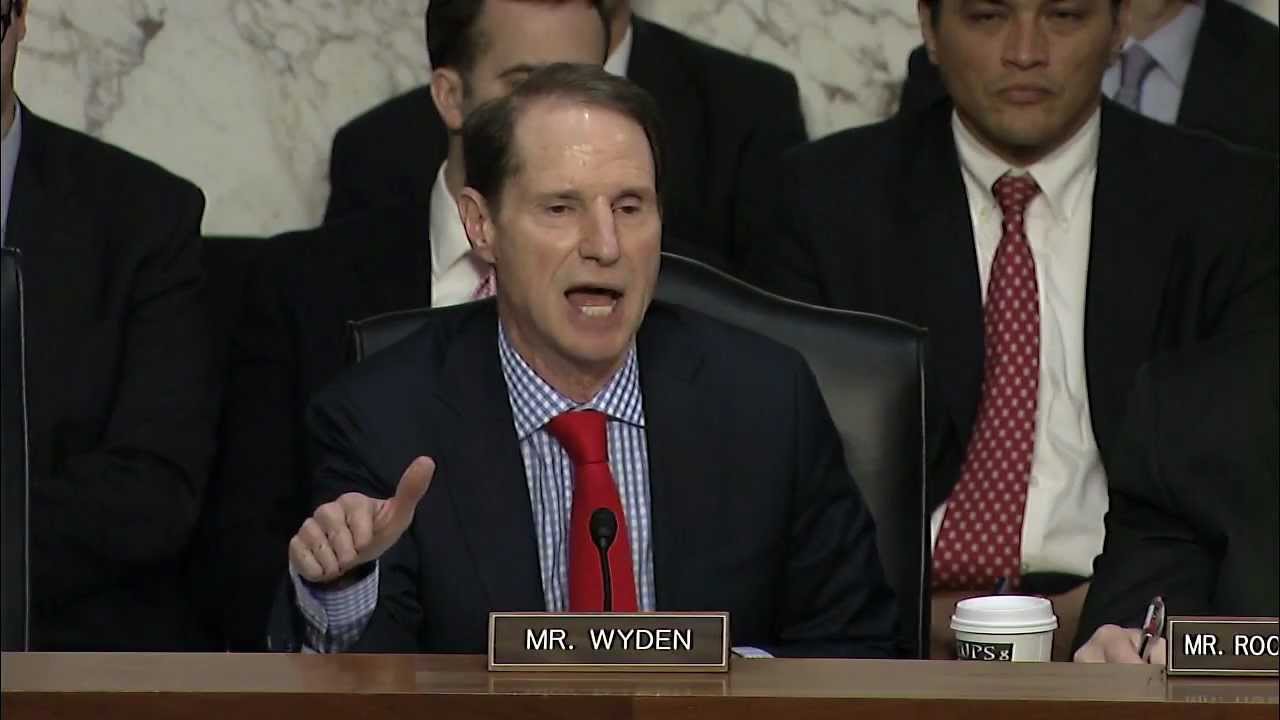
Ron Wyden
AI-assisted summary of DNI Clapper tells Wyden the NSA does not collect data on millions of Americans — original source. Check the original for full context.
Source published:
Key ideas
- Director of National Intelligence James Clapper explicitly denied to the Senate Intelligence Committee that the NSA collects data on millions of Americans, stating 'No, sir ... not wittingly.' (6:01)
- Senator Ron Wyden pushed the intelligence community for unclassified legal standards regarding the electronic tracking of Americans' physical movements inside the United States. (0:00)
- FBI Director Robert Mueller acknowledged that while physical trespass for GPS tracking requires a warrant under United States v. Jones, broader non-trespassory electronic location tracking standards remain legally unresolved in the courts. (1:37)
- Clapper maintained that the CIA and NSA operate under strict statutory prohibitions against domestic tracking, leaving domestic intelligence and criminal tracking within the remit of the FBI and Foreign Intelligence Surveillance Act oversight. (1:37)
Detailed notes
## Background This video was published on YouTube by Senator Ron Wyden's official channel on March 12, 2013. According to the page description, it documents Wyden asking Director of National Intelligence James Clapper whether the NSA collects any type of data on millions or hundreds of millions of Americans, prompting Clapper's infamous denial—"No, sir ... not wittingly"—just months before disclosures revealed the agency's bulk telephone metadata collection program.
## TL;DR During a Senate Intelligence Committee hearing, Senator Ron Wyden presses intelligence leadership on the legal and constitutional thresholds required to track the physical locations of American citizens domestically. Director of National Intelligence James Clapper points to statutory limits under FISA and defers specific criminal standards to FBI Director Robert Mueller, who acknowledges the legal ambiguity left by the Supreme Court's decision in United States v. Jones. In the session's climactic exchange, Wyden directly asks whether the NSA collects any data on millions or hundreds of millions of Americans. Clapper denies bulk collection, stating the agency does not do so wittingly, concluding an exchange that quickly became a pivotal historical reference point for government surveillance.
## Atmosphere & style The hearing carries the taut, deliberate tension of a high-stakes congressional inquiry, defined by Senator Wyden's precise, surgical cross-examination and the calculated caution of top intelligence officials. The dynamic feels measured and formal on the surface, yet an underlying friction builds as Wyden systematically steers the conversation past jurisdictional deflections and vague semantics. When the ultimate question of mass surveillance is posed, the atmosphere turns palpably uneasy; Clapper's brief hesitation and forehead rub reveal the strain of the moment, imbuing the final denial with an eerie, consequential weight.
## Bulletin - [06:01](https://www.youtube.com/watch?v=QwiUVUJmGjs&t=361s) Director of National Intelligence James Clapper explicitly denied to the Senate Intelligence Committee that the NSA collects data on millions of Americans, stating 'No, sir ... not wittingly.' - [00:00](https://www.youtube.com/watch?v=QwiUVUJmGjs&t=0s) Senator Ron Wyden pushed the intelligence community for unclassified legal standards regarding the electronic tracking of Americans' physical movements inside the United States. - [01:37](https://www.youtube.com/watch?v=QwiUVUJmGjs&t=97s) FBI Director Robert Mueller acknowledged that while physical trespass for GPS tracking requires a warrant under United States v. Jones, broader non-trespassory electronic location tracking standards remain legally unresolved in the courts. - [01:37](https://www.youtube.com/watch?v=QwiUVUJmGjs&t=97s) Clapper maintained that the CIA and NSA operate under strict statutory prohibitions against domestic tracking, leaving domestic intelligence and criminal tracking within the remit of the FBI and Foreign Intelligence Surveillance Act oversight.
## Key takeaways - [00:00](https://www.youtube.com/watch?v=QwiUVUJmGjs&t=0s) Senator Ron Wyden pressed DNI James Clapper for an unclassified accounting of the legal standards required to track the physical movements of Americans inside the country. - [00:00](https://www.youtube.com/watch?v=QwiUVUJmGjs&t=0s) Wyden noted that intelligence community attorneys had purportedly spent an entire year studying domestic location tracking thresholds without producing a public answer. - [00:00](https://www.youtube.com/watch?v=QwiUVUJmGjs&t=0s) Clapper distinguished foreign intelligence collection from domestic law enforcement, asserting that statutory strictures prohibit the NSA and CIA from tracking Americans domestically. - [01:37](https://www.youtube.com/watch?v=QwiUVUJmGjs&t=97s) Wyden insisted that the public deserves to know the basic legal thresholds for surveillance, including when a warrant is required versus when lower or no evidentiary standards apply. - [01:37](https://www.youtube.com/watch?v=QwiUVUJmGjs&t=97s) Clapper stated that intelligence tracking of U.S. persons requires a terrorism nexus under FISA and is strictly overseen by the Foreign Intelligence Surveillance Court, the ODNI, and the Attorney General. - [01:37](https://www.youtube.com/watch?v=QwiUVUJmGjs&t=97s) FBI Director Robert Mueller explained that the FBI maintains parity between criminal investigations and foreign counterintelligence regarding location tracking warrant requirements. - [01:37](https://www.youtube.com/watch?v=QwiUVUJmGjs&t=97s) Mueller highlighted the constitutional uncertainty following the Supreme Court's United States v. Jones ruling regarding non-trespassory electronic tracking methods. - [01:37](https://www.youtube.com/watch?v=QwiUVUJmGjs&t=97s) Wyden cited his protracted effort of submitting seven separate requests over two years to obtain the executive branch's targeted killing legal memos as context for his oversight persistence. - [06:01](https://www.youtube.com/watch?v=QwiUVUJmGjs&t=361s) Wyden criticized NSA Director Keith Alexander's public claim that the agency does not keep 'dossiers' on millions of Americans, calling the word 'dossier' vague and misleading regarding bulk collection. - [06:01](https://www.youtube.com/watch?v=QwiUVUJmGjs&t=361s) Wyden asked directly whether the NSA collects any type of data at all on millions or hundreds of millions of Americans. - [06:01](https://www.youtube.com/watch?v=QwiUVUJmGjs&t=361s) Clapper denied bulk domestic collection, answering 'No, sir' and hedging only that inadvertent collection might occasionally occur, but 'not wittingly.'
## Detailed walkthrough ### [00:00](https://www.youtube.com/watch?v=QwiUVUJmGjs&t=0s) Domestic Location Tracking and Foreign Intelligence Strictures
Senator Ron Wyden opens his questioning before the Senate Select Committee on Intelligence by congratulating newly confirmed CIA Director John Brennan, noting that while they had discussed various topics previously, he planned to press Brennan further on drone strikes and targeted killings in the near future. Turning his attention to Director of National Intelligence James Clapper, Wyden revisits an unresolved inquiry from the previous year’s hearing regarding electronic surveillance. He asks Clapper to specify the exact legal threshold and evidentiary standards an intelligence agency must satisfy before it can electronically track the physical movements and locations of an American citizen inside the United States, pointing out that intelligence community attorneys had purportedly spent an entire year studying the matter without delivering a public answer.
Clapper offers a preliminary defense by drawing a hard jurisdictional line between domestic law enforcement and foreign intelligence agencies. He emphasizes that both the National Security Agency (NSA) and the Central Intelligence Agency (CIA) operate under statutory boundaries prohibiting the domestic tracking of Americans for foreign intelligence purposes. Rather than detailing specific evidentiary tests, Clapper attempts to redirect the question to FBI Director Robert Mueller, characterizing the electronic tracking of individuals within the country as an issue falling primarily under criminal law enforcement.
```mermaid flowchart TD accTitle: Jurisdictional Division of Domestic Surveillance accDescr: Diagram illustrating the jurisdictional separation discussed between foreign intelligence collection and domestic law enforcement.
subgraph ForeignIntel["Foreign Intelligence Collection"] CIA["CIA"] NSA["NSA"] CIA & NSA -->|"Foreign focus / strictures against domestic tracking"| FISA["FISA Framework & Oversight"] end
subgraph DomesticLE["Domestic Law Enforcement & Security"] FBI["FBI (Director Mueller)"] FBI -->|"Criminal & National Security parity"| Courts["Warrant Standards / U.S. v. Jones"] end
Wyden["Senator Wyden's Inquiry"] -->|"Evidentiary threshold for tracking Americans?"| Clapper["DNI Clapper"] Clapper -.->|"Defers to"| FBI ```
[01:37](https://www.youtube.com/watch?v=QwiUVUJmGjs&t=97s) FISA Standards and the Fourth Amendment Post-Jones
Wyden intervenes before Director Mueller can step in, insisting that Director Clapper first articulate the overarching legal principles that govern the broader intelligence community. Wyden stresses that the public deserves an unclassified explanation of what intelligence agencies believe the law authorizes, particularly when a formal warrant is required, when a lower standard of evidence suffices, or when no evidence is required at all. Clapper replies that the governing framework resides in the Foreign Intelligence Surveillance Act (FISA), which Congress had recently reauthorized for five years. He insists that tracking a United States person requires an established nexus to terrorism and remains subject to strict dual oversight from the Foreign Intelligence Surveillance Court (FISC) and executive leadership, noting: “The law is of course as you know is embedded in the Foreign Intelligence Surveillance Act which was recently the amendment and to which was recently extended for 5 years and had places very strict strictures on the intelligence community's tracking of U.S. persons where there is a terrorism nexus and that is overseen very strictly by both the FISA Court as well as within the executive branch both by my office and and the Attorney General.” Clapper reiterates that neither the CIA nor the NSA engages in tracking citizens inside the United States.
FBI Director Robert Mueller then addresses the practical and constitutional mechanics of domestic location tracking. Mueller clarifies that within the FBI, no operational distinction exists between foreign counterintelligence and criminal investigations when it comes to location tracking standards; if an activity requires a warrant on the criminal side, the bureau requires it for national security cases as well. However, Mueller points out that the Supreme Court's landmark ruling in *United States v. Jones* left significant constitutional ambiguity surrounding electronic tracking, remarking: “That being said, in the wake of the Jones decision which I'm sure you're familiar with, that is put some things in an area where we're waiting to see where the courts go quite obviously.” Mueller explains that while physical trespass to attach a GPS device clearly requires a warrant, the broader legal standards for non-trespassory tracking remain unresolved in the courts. Wyden acknowledges Mueller's candor, comparing his pursuit of surveillance guidelines to his protracted battle to obtain the administration's targeted killing legal memos:
- FISA had recently been reauthorized for an additional five-year period. - Surveillance involving U.S. persons with a terrorism nexus is reviewed by the FISA Court, the Office of the Director of National Intelligence (ODNI), and the Department of Justice. - *United States v. Jones* established a warrant requirement for physical trespass to attach tracking devices, but left open the evidentiary threshold for tracking without a trespass. - Wyden noted it had taken seven separate requests over a two-year period to compel the executive branch to release the legal memos justifying targeted killings.
[06:01](https://www.youtube.com/watch?v=QwiUVUJmGjs&t=361s) The Question of Bulk Data Collection on Millions of Americans
With his round of questioning nearly concluded, Wyden pivots to a direct confrontation regarding the scale of NSA domestic collection. He recounts a public appearance from the previous summer where NSA Director General Keith Alexander dismissed public reporting about bulk surveillance by stating, “The story that we have millions or hundreds of millions of dossiers on people is completely false.” Wyden explains that after serving a dozen years on the Senate Intelligence Committee, he found the term "dossier" vague and unhelpful for understanding the actual scope of electronic dragnet collection.
To eliminate any ambiguity, Wyden asks Clapper for a direct, binary confirmation: “Does the NSA collect any type of data at all on millions or hundreds of millions of Americans?” Clapper pauses momentarily, rubs his forehead, and delivers an explicit denial: “No, sir.” When pressed further, Clapper hedges his statement, adding: “Not wittingly. There are cases where they could inadvertently perhaps collect, but not not wittingly.” Wyden accepts the response and yields his time, concluding an exchange that would become a focal point of public and congressional debate just months later when revelations about the bulk collection of domestic telephony metadata under Section 215 of the PATRIOT Act were publicly disclosed.
## Notable quotes > [06:01](https://www.youtube.com/watch?v=QwiUVUJmGjs&t=361s) The story that we have millions or hundreds of millions of dossiers on people is completely false. — Keith Alexander
## Mentioned Ron Wyden, John Brennan, James Clapper, Robert Mueller, Keith Alexander, Senate Select Committee on Intelligence, Central Intelligence Agency, National Security Agency, Federal Bureau of Investigation, Office of the Director of National Intelligence, Foreign Intelligence Surveillance Court, Foreign Intelligence Surveillance Act, United States v. Jones, Supreme Court of the United States, Department of Justice, Section 215 of the PATRIOT Act
## Video description March 12, 2013- Senator Ron Wyden (D-Ore.) asks Director of National Intelligence James Clapper "Does the NSA collect any type of data at all on millions or hundreds of millions of Americans?". Director Clapper answered "No, sir ... not wittingly." Later that year, it was revealed the the NSA was indeed collecting telephone metadata of millions of law-abiding Americans. (minute 6:03)
[Source](https://www.youtube.com/watch?v=QwiUVUJmGjs)