Police Interrogations: Last Week Tonight with John Oliver (HBO)
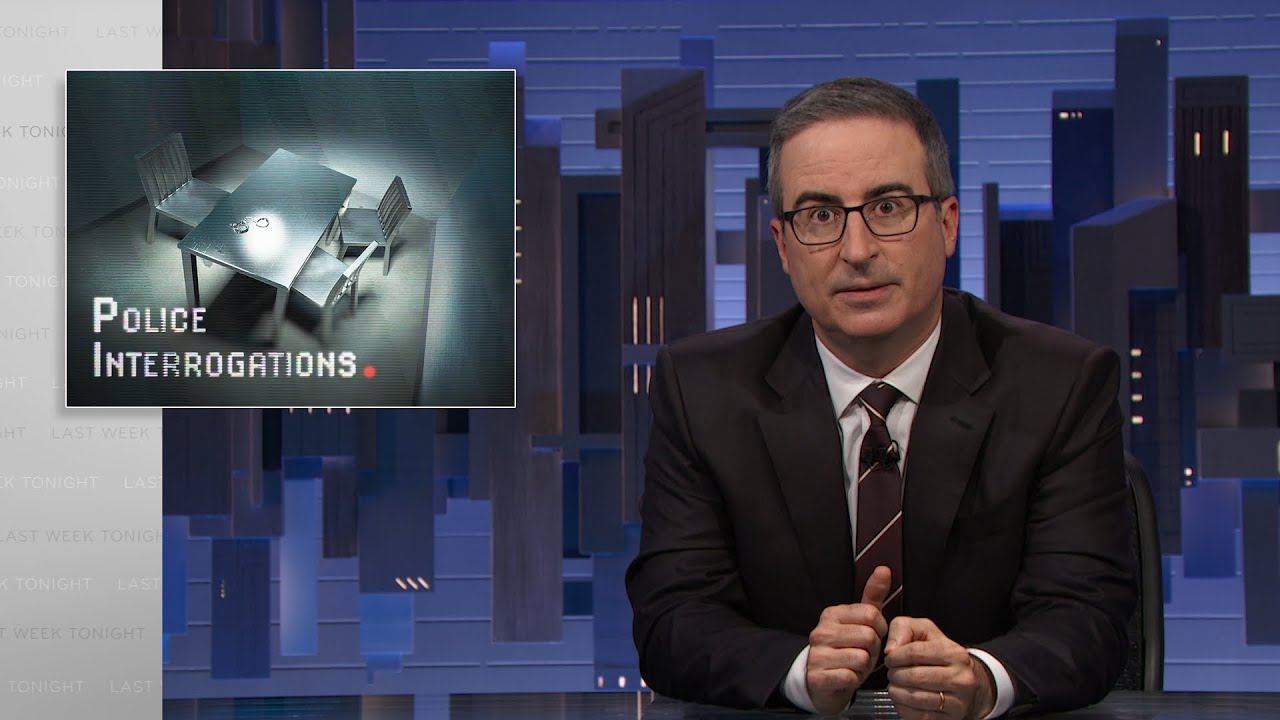
Police Interrogations: Last Week Tonight with John Oliver (HBO) — LastWeekTonight

LastWeekTonight

AI-assisted summary of Police Interrogations: Last Week Tonight with John Oliver (HBO) — original source. Check the original for full context.

Source published:

Key ideas

  • False confessions account for 29% of convictions overturned by post-conviction DNA testing, rising to 34% among wrongly convicted juveniles and 69% for individuals with intellectual disabilities or mental illnesses. (0:05)
  • The widely adopted Reid Technique relies on behavioral analysis claiming an 83% accuracy rate in detecting deception, though empirical research demonstrates it is no more reliable than a 50/50 coin flip. (4:46)
  • U.S. law permits interrogators to fabricate evidence and lie to suspects, and a study found that 94% of proven false confessions were contaminated with non-public crime scene details supplied by police. (11:45)
  • Only 30 states require full interrogations to be recorded on video, prompting reform advocates to push for mandatory complete recordings, bans on deceptive tactics, and the adoption of the UK's PEACE interviewing framework. (15:02)

Detailed notes

## Background This video was published on YouTube by the official LastWeekTonight channel on April 18, 2022. According to the show description, host John Oliver discusses the damaging tactics utilized in police interrogations—especially regarding their impact on innocent suspects—while touching on why he relates more to Lorelai than Rory Gilmore.

## TL;DR John Oliver breaks down how modern American police interrogations rely on junk behavioral science, deceptive practices, and extreme psychological pressure to extract confessions. While juries treat confessions as unimpeachable proof of guilt, techniques like the Reid Technique often induce innocent people—particularly juveniles and individuals with intellectual disabilities—to falsely confess after hours of relentless exhaustion and fabricated evidence. Detectives exploit legal loopholes that allow them to lie about forensic proof, systematically contaminate testimony with private crime scene details, and face virtually zero accountability when coerced confessions lead to wrongful convictions. To counteract this crisis and the cultural myths popularized by television crime procedurals, Oliver advocates for mandatory full-length video recordings, prohibitions on police deception, and non-coercive interview frameworks like the UK's PEACE model.

## Atmosphere & style The piece carries John Oliver's signature blend of investigative outrage, sharp sarcasm, and fast-paced comedy, seamlessly pivoting between sobering true-crime tragedies and absurd pop-culture references. The emotional arc transitions from disbelief and moral indignation over real exonerees' ruined lives to biting satire aimed at junk science and unconstitutional police bravado. Watching the segment feels both infuriating and eye-opening, as the grim reality of psychological coercion is starkly contrasted against television tropes, culminating in an over-the-top, pitch-black parody procedural that highlights the nightmarish absurdity of the interrogation room.

## Bulletin - [00:05](https://www.youtube.com/watch?v=obCNQ0xksZ4&t=5s) False confessions account for 29% of convictions overturned by post-conviction DNA testing, rising to 34% among wrongly convicted juveniles and 69% for individuals with intellectual disabilities or mental illnesses. - [04:46](https://www.youtube.com/watch?v=obCNQ0xksZ4&t=286s) The widely adopted Reid Technique relies on behavioral analysis claiming an 83% accuracy rate in detecting deception, though empirical research demonstrates it is no more reliable than a 50/50 coin flip. - [11:45](https://www.youtube.com/watch?v=obCNQ0xksZ4&t=705s) U.S. law permits interrogators to fabricate evidence and lie to suspects, and a study found that 94% of proven false confessions were contaminated with non-public crime scene details supplied by police. - [15:02](https://www.youtube.com/watch?v=obCNQ0xksZ4&t=902s) Only 30 states require full interrogations to be recorded on video, prompting reform advocates to push for mandatory complete recordings, bans on deceptive tactics, and the adoption of the UK's PEACE interviewing framework.

## Key takeaways - [00:05](https://www.youtube.com/watch?v=obCNQ0xksZ4&t=5s) Confessions exert immense psychological weight in court, frequently convincing juries of guilt even when contradicted by physical or forensic evidence. - [03:06](https://www.youtube.com/watch?v=obCNQ0xksZ4&t=186s) After the Supreme Court ruled physical coercion unconstitutional in 1936, American law enforcement shifted from physical torture ('the third degree') to psychological methods, leading to the widespread adoption of the Reid Technique. - [04:46](https://www.youtube.com/watch?v=obCNQ0xksZ4&t=286s) The Reid Technique's behavioral analysis phase treats contradictory non-verbal behaviors—such as either making too much eye contact or avoiding it—as proof of deception, turning the process into junk science. - [08:23](https://www.youtube.com/watch?v=obCNQ0xksZ4&t=503s) Once an investigator assumes guilt, the interrogation phase is designed solely to extract a confession by systematically cutting off any denials or explanations from the suspect. - [08:23](https://www.youtube.com/watch?v=obCNQ0xksZ4&t=503s) Interrogations that produce proven false confessions last an average of 16.3 hours, subjecting individuals to extreme psychological fatigue and desperation. - [09:46](https://www.youtube.com/watch?v=obCNQ0xksZ4&t=586s) Roughly 80% of suspects waive their Miranda rights, often out of a naive belief that their actual innocence will protect them or that they are being questioned only as witnesses. - [11:45](https://www.youtube.com/watch?v=obCNQ0xksZ4&t=705s) U.S. Supreme Court precedent allows police to invent evidence—such as non-existent forensic matches or failed polygraphs—which often gaslights suspects into doubting their own sanity and memories. - [15:02](https://www.youtube.com/watch?v=obCNQ0xksZ4&t=902s) Vulnerable groups are especially susceptible to interrogation tactics, with false confessions factoring into 34% of wrongful convictions of children and 69% of those with intellectual disabilities or mental illness. - [15:02](https://www.youtube.com/watch?v=obCNQ0xksZ4&t=902s) Interrogation records are routinely withheld or presented selectively, with only 30 states mandating that the entire interrogation be recorded on video. - [17:12](https://www.youtube.com/watch?v=obCNQ0xksZ4&t=1032s) Investigators and prosecutors face virtually zero professional or legal accountability when coerced confessions lead to wrongful convictions, often receiving promotions and career honors instead. - [17:12](https://www.youtube.com/watch?v=obCNQ0xksZ4&t=1032s) Key proposed reforms include mandatory full-length video recording, statutory bans on police deception, and replacing Reid tactics with the UK's open-ended PEACE method. - [20:06](https://www.youtube.com/watch?v=obCNQ0xksZ4&t=1206s) Decades of television crime dramas have culturally conditioned the public to believe that aggressive, coercive interrogation tactics are both heroic and necessary to crack cases.

## Detailed walkthrough ### [00:05](https://www.youtube.com/watch?v=obCNQ0xksZ4&t=5s) The Power and Peril of Confessions

Police interrogations are a familiar cultural staple across television, appearing even in unexpected places like children's media—such as an intense, hardboiled interrogation scene in *My Little Pony* where Pinkie Pie aggressively badgers a suspect, resembling a scene straight out of *Training Day*. The dramatic appeal of these scenes lies in the climactic payoff of securing a confession. However, confessions exert an immense, often distorting influence on real-world juries. Within the legal system, a confession is widely viewed as the gold standard of guilt, frequently proving more persuasive to jurors than forensic or DNA evidence. Jurors from high-profile trials reflect this conventional mindset:

> “We just felt that no one would confess three times if they didn't do it.”

Another juror argued that an innocent person accused of harming a child would "go to your grave saying no, I didn't," while a juror from the infamous trial of the Central Park Five (now known as the Exonerated Five) admitted it was hard to believe someone would fabricate an elaborate, self-incriminating story full of convincing details.

Yet people fundamentally misunderstand the psychology of interrogations, falsely assuming a confession is something only a guilty person produces—like issuing an apology via the Apple Notes app or refusing to answer Ronan Farrow's inquiries. In reality, in every one of the cited jurors' cases, the confessions were later proven entirely false. As Lester Holt observed when discussing a case devoid of forensic evidence, ordinary people cannot fathom confessing to a crime they did not commit. A skilled interrogator, however, can manipulate human psychology to the point of breaking nearly anyone.

- Of all convictions overturned through post-conviction DNA testing in the United States, 29% involved false confessions. - John Oliver jokes that a skilled interrogator could easily make him confess to being the Lindbergh baby, given that his own physical build is best described as a "92-year-old dead baby."

---

[03:06](https://www.youtube.com/watch?v=obCNQ0xksZ4&t=186s) From the Third Degree to the Reid Technique

To understand why innocent people confess, one must look at the history of interrogation tactics in the United States. Historically, law enforcement routinely used physical torture to extract confessions—a brutal method known as "the third degree." In 1936, the U.S. Supreme Court ruled physical coercion unconstitutional, forcing police departments to invent non-physical interrogation frameworks. Early instructional efforts were rudimentary; a Texas Department of Public Safety training film literally instructed officers to stare at an imaginary "X" drawn between a suspect's eyebrows or nose if they struggled to look them in the eye.

```mermaid flowchart TD accTitle: Evolution of Police Interrogation Approaches accDescr: Historical transition from physically coercive tactics to psychological interviewing frameworks.

subgraph Pre1936["Pre-1936 Era"] A["The Third Degree<br/>(Physical Torture & Coercion)"] end

subgraph LegalShift["1936 Constitutional Shift"] B["Supreme Court Ruling<br/>(Physical Coercion Unconstitutional)"] end

subgraph ModernFramework["Modern Era"] C["Early Psychological Experiments<br/>(Visual cues, imaginary forehead 'X')"] D["The Reid Technique<br/>(Developed by John E. Reid)"] end

A --> B B --> C C --> D ```

Eventually, modern interrogation doctrine was standardized around the "Reid Technique," developed by former Chicago police officer and polygraph examiner John E. Reid. His training firm, John E. Reid and Associates, claims to have trained hundreds of thousands of investigators, embedding the practice deep into American policing culture.

The Reid Technique splits questioning into two primary phases: 1. **The Interview:** A non-accusatory assessment designed to determine whether a subject is telling the truth or lying by establishing baseline behavior and asking "behavior-provoking questions." 2. **The Interrogation:** An accusatory phase aimed strictly at securing a confession once the officer has decided the subject is deceptive.

---

[04:46](https://www.youtube.com/watch?v=obCNQ0xksZ4&t=286s) The Flawed Science of Behavioral Analysis

During the interview phase, investigators are taught to evaluate verbal answers and non-verbal body language. In a Reid training video available for purchase on their website for $100, actors in stiff, community-theater-style vignettes demonstrate supposedly telltale deceptive cues, such as shifting into "barrier postures" like crossing their arms when asked critical questions about selling marijuana or inappropriately touching a child.

While Reid claims that trained investigators achieve an 83% accuracy rate in detecting deception, scientific research completely contradicts this claim. As a retired homicide investigator points out:

> “The real science says it's baloney, it doesn't work, and when they've done experiments with it, they pretty much show that the accuracy is like flipping a coin—it's 50/50.”

Oliver compares this level of accuracy to a BuzzFeed quiz that purports to determine which *Gilmore Girls* character you are based on trivial questions about pita bread (with Oliver vehemently rejecting a "Rory" result, insisting he is a fast-talking, pea-coat-wearing "Lorelai").

The 400-page Reid manual is so riddled with internal contradictions that an officer can interpret virtually any behavior as deception: - If a suspect avoids direct eye contact, they are supposedly lying. - If a suspect maintains too much eye contact, they are supposedly overcompensating by staring.

Decades of psychological research have confirmed that non-verbal gestures, gaze direction, and blinking are entirely useless for detecting deceit, since people move unpredictably regardless of guilt. Oliver quips that the only purely honest body movement a human being can make is the frantic flailing that occurs when accidentally walking through a spiderweb.

---

[08:23](https://www.youtube.com/watch?v=obCNQ0xksZ4&t=503s) Tunnel Vision and the Grinding Interrogation

Because behavioral analysis relies on junk science, police officers often convince themselves of an innocent suspect's guilt during the initial interview. Once an investigator commits to that assumption, the process shifts into the interrogation phase. Far from an open-ended search for facts, the interrogation is engineered exclusively to obtain an admission of guilt.

Reid training tapes instruct interrogators to aggressively cut off any attempt by the suspect to deny the accusations. The tape warns that suspects frequently use "permission phrases" such as *"Can I say one thing?"*, *"Would you just listen to me?"*, or *"Sir, if I could only explain."* When these phrases arise, the trainer explicitly directs officers:

> “When the interrogator hears those phrases, it's important to interject yourself and stop the person from continuing, because if you let him talk, he'll say the words 'I didn't do it,' and the more often a person says they didn't do it, the more difficult it becomes for us to get a confession.”

By systematically suppressing denials and cutting off explanations, interrogators trap subjects in a psychological pressure cooker. These sessions often extend for hours; research indicates that interrogations resulting in proven false confessions lasted an average of 16.3 hours. Under relentless psychological fatigue, exhaustion, and despair, innocent people routinely confess simply to make the ordeal stop. This exact pattern trapped 18-year-old Robert Davis, who was subjected to more than five hours of interrogation after being accused of a double murder.

[09:46](https://www.youtube.com/watch?v=obCNQ0xksZ4&t=586s) Breaking Under Pressure and the Trap of Waiving Rights

Interrogations push suspects to extreme desperation, to the point where they will say whatever they think the detective wants to hear just to make the interrogation end. In archival footage, suspect Robert Davis pleads with an investigator, asking what he can say that will allow him to go home to his mother. The detective refuses to make promises, insisting that if Robert works with him, he might get him home, before flatly accusing him: “All right, since you're not gonna tell me you stabbed that woman, you stabbed her, didn't you?” Under this relentless framing, Davis lied and said he stabbed her, then immediately stated that he had made it up; nevertheless, he served 13 years in prison before eventually being exonerated. John Oliver stresses that the reality of cracking under stress should not be surprising: “The notion that people crack under pressure and falsely confess really shouldn't be that hard to understand. It's a concept that even children's cartoons get.” To prove the point, Oliver cuts back to a *My Little Pony* clip where a distressed character frantically screams, “What do you want to hear? Tell me what you want me to see and I'll see it, tell me what you want me to say and I'll say it! I kidnapped the Lindbergh baby, is that what you want to hear, you pink psycho?!”

Many assume that a falsely accused person can simply confess to escape the immediate interrogation room, recant later, and count on the genuine evidence to clear them at trial. However, that rarely works out: “As soon as the police get a confession, thorough investigations tend to stop.” Oliver then tackles the obvious question of why suspects do not simply invoke their constitutional right to an attorney. In reality, around 80 percent of suspects waive their Miranda rights and voluntarily submit to questioning. They do so for seemingly intuitive reasons—either naively believing they do not need an attorney because they are innocent, or assuming they were brought into the station merely as a witness rather than as an actual suspect.

[11:45](https://www.youtube.com/watch?v=obCNQ0xksZ4&t=705s) The Legal Power to Lie and Fabricate Evidence

Waiving the right to counsel leaves suspects extraordinarily vulnerable to an enormous, court-sanctioned police power: under U.S. Supreme Court jurisprudence, detectives are legally permitted to lie to suspects about evidence. Investigators can falsely claim they found the suspect's fingerprints on the murder weapon, matched hair retrieved from the victim's hand, located their shoe prints at the scene, or that the suspect failed a polygraph exam they agreed to take. Some fabrications reach absurd extremes, such as a Florida investigator who convinced a suspect that police possessed a “laser, the kind that you shoot on *Star Wars*,” capable of lifting fingerprints off human bodies—a piece of technology that does not exist. Oliver jokes that Hollywood is only one bad pitch meeting away from giving that fictitious Star Wars laser a 10-episode Disney+ series voiced by Oscar Isaac.

```mermaid flowchart TD accTitle: Tactics Leading to False Confessions accDescr: Flowchart illustrating how deceptive interrogation tactics lead to false confessions and wrongful convictions.

subgraph Pressure["Interrogation Tactics"] A["Suspect Waives Miranda (approx. 80%)"] --> B["Detectives Lie About Evidence"] B --> C["Contaminating Case Facts & Gaslighting"] end

subgraph Outcome["Systemic Consequences"] C --> D["Suspect Doubts Own Memory & Confesses"] D --> E["Investigation Halts"] E --> F["Juries Only Shown Isolated Confession Video"] F --> G["Wrongful Conviction"] end ```

Allowing law enforcement to lie to suspects is barred in most developed nations because it is overwhelmingly coercive. In the interrogation tape of Robert Davis, the detective claimed that dust consists of dead human skin containing DNA that proved Robert was present at the crime scene, loudly boasting: “That shows I can't lie about the evidence!” Oliver mocks the detective's bravado, noting: “'I can't lie about the evidence,' he lied as he lied about the evidence and did it gesturing with all the theatrical nuance of a high schooler auditioning for *A Few Good Men*.” This level of fabrication gaslights suspects into second-guessing their own sanity. Christopher Tapp, who served 20 years in prison for a murder he did not commit, described in a recorded interview how police insisted he was suppressing horrific trauma into his subconscious. Tapp began to genuinely question his own faculties: “I started second guessing myself during all this. I started to not believe in myself or who I was.” Oliver compares this psychological manipulation to an officer exploiting mundane pop-culture memory slips—like misremembering the spelling of the Berenstain Bears or the nonexistent Sinbad genie movie *Shazaam* (versus Shaquille O'Neal's *Kazaam*)—and telling someone their brain is doing the same thing with murder.

[15:02](https://www.youtube.com/watch?v=obCNQ0xksZ4&t=902s) Targeted Vulnerabilities and Withholding the Record

These deceptive strategies prey most severely on marginalized and vulnerable populations. Although legal standards technically limit outright promises of leniency, officers frequently dance along that line by intimating that confessing will help a suspect avoid harsher sentences or escape the death penalty. Furthermore, while detectives are not supposed to leak non-public crime details to suspects, confession contamination happens systematically.

- False confessions factored into 34% of cases where children were wrongly convicted. - A staggering 69% of exonerations involving individuals with mental illness or intellectual disabilities involved false confessions. - A study of DNA exonerations found that 94% of false confessions were contaminated with non-public crime details fed by investigators. - Only 30 states mandate recording entire interrogations, leaving other jurisdictions free to record solely the final, rehearsed admission while hiding hours of prior manipulation.

Oliver illustrates the distortion of showing jurors a single isolated clip using a bizarre, out-of-context scene from *One Tree Hill*—in which a golden retriever snatches a donor heart off a hospital floor—noting that no viewer would ever guess the show is actually about a high school basketball team.

[17:12](https://www.youtube.com/watch?v=obCNQ0xksZ4&t=1032s) Zero Accountability and Necessary Reforms

Because the American legal system shields officers from the fallout of coerced confessions, interrogators rarely face consequences. Oliver highlights the case of a man with an intellectual disability who, as a 19-year-old former special education student, was interrogated for four days (including two polygraph tests administered by Reid and Associates) for a rape and murder he did not commit. He served nearly two decades before DNA evidence cleared him. The exoneree noted that every detective and prosecutor involved retired on full pensions and received promotions to captains, majors, and lieutenants, with Lake County State's Attorney Michael Waller even receiving a plaque for doing a good job. Oliver argues that such a plaque should only come with an addendum reading: “...at fucking up innocent people's lives, you monumental asshole.”

Many individuals remain imprisoned under confessions bearing these exact red flags, including Brendan Dassey (featured in *Making a Murderer*), who confessed at age 16 to details he could not explain, and Melissa Lucio, who was facing execution within 10 days following a heavily manipulative interrogation. To address these systemic failures, Oliver urges meaningful statutory changes:

- Interrogations must be recorded on video in their full duration so jurors witness the entire context rather than an isolated clip. - Police must be legally prohibited from lying to suspects. Illinois, Oregon, and Utah have banned lying to juveniles, and New York introduced legislation banning deceptive practices for all suspects while requiring courts to assess confession reliability before admitting them as evidence. - Interrogators should adopt transparent, non-coercive interview frameworks, such as the UK's PEACE method, which focuses on asking open-ended questions and gathering an unprompted narrative rather than extracting confessions through deception. When critics ask how officers will solve cases without deception, Oliver bluntly counters that “their job is literally to investigate, so maybe they could try doing some of that.”

[20:06](https://www.youtube.com/watch?v=obCNQ0xksZ4&t=1206s) Cultural Conditioning and the Need for a More Realistic Crime Drama

Oliver acknowledges that while policy reforms like mandatory video recording may not produce miracles—joking that it might not force the Queen to confess to killing Princess Diana on camera—they represent an essential first step. However, an equally pressing obstacle is the deep-seated cultural conditioning surrounding interrogations that society must actively unlearn. For decades, popular television has trained audiences to believe that aggressive, coercive tactics are both heroic and remarkably effective. Viewers are conditioned to cheer when a detective roughs up a suspect to break a case, trusting that an officer’s initial hunch is always validated before the credits roll.

Oliver emphasizes how severely these entertainment tropes have warped public understanding, stating: “Our misconceptions about police interrogations have been hammered in by crime dramas, and they’ve been hammered in deep and perhaps one small way to help undo that damage is for shows to present a slightly more accurate picture of what can really happen in that room.” To demonstrate what a truly representative procedural would look like—complete with bad science, blatant fabrications, relentless badgering, and sheer exhaustion—Oliver introduces a trailer for an unvarnished new cop show.

[20:48](https://www.youtube.com/watch?v=obCNQ0xksZ4&t=1248s) Parody: Introducing "The Confestigators"

The parody preview introduces two aggressive, supposedly expert interrogators who flatly refuse to hear any assertion of innocence. When their suspect attempts to deny involvement in an alleyway murder, the detectives cover their ears, shouting that they literally cannot hear him say he did not do it. They then deploy pseudoscientific body-language analysis where every reaction confirms guilt: looking away is deemed a lie, making steady eye contact is declared lying, and staring at a detective's forehead is treated as an obvious deception. To force an admission, the officers unleash outrageous lies, asking the suspect if he has seen the film *Rogue One: A Star Wars Story* before claiming police possess real lightsabers capable of extracting DNA from dead bodies, insisting with straight faces that the law forbids them from lying about such technology.

```mermaid flowchart TD accTitle: Coercive Tactics Parodied in The Confestigators accDescr: Flowchart illustrating the escalating interrogation tactics parodied in the sketch leading to a false confession. subgraph Pressure["Interrogation Tactics"] A["Deny all claims of innocence"] --> B["Catch-22 body language analysis"] B --> C["Fabricated evidence & pseudo-science"] C --> D["Absurd alternative choices & sleep deprivation"] end subgraph Outcome["False Resolution"] D --> E["Suspect breaks after 15.5 hours"] E --> F["'I just came in here to charge my phone'"] F --> G["Cuffed and charged anyway"] end ```

The barrage descends into pure absurdity, mirroring real-world maximization and minimization techniques. The cops attempt to implant false memories by asking if the murder might have been forgotten like a routine morning commute, present meaningless choices between two different murder charges, yell "Murderer says what?" to catch him on a reflex, and blow alleged corpse dust into the room. After 15 and a half grueling hours of non-stop browbeating, the exhausted man reaches his breaking point, asking for relief. The detective dangles the classic empty promise of leniency, hinting that cooperation might allow him to sleep in his own bed that night, prompting the suspect to finally surrender: “Fine, I did it.”

Just as the detectives celebrate their hard-won confession, another officer walks through the door escorting the actual suspect meant for interrogation. Baffled, the detectives ask the broken man who he actually is, to which he replies: “I just came in here to charge my phone.” Rather than admit their grotesque error, the detectives casually order him handcuffed and hauled off to jail anyway, cheerfully handing him his device with the parting words, “Hey, don't forget your phone,” before cutting to the title card: *The Confestigators: Hey, It Ain't Ruining My Life.*

## Notable quotes > [09:46](https://www.youtube.com/watch?v=obCNQ0xksZ4&t=586s) As soon as the police get a confession, thorough investigations tend to stop. — John Oliver

> [09:46](https://www.youtube.com/watch?v=obCNQ0xksZ4&t=586s) The notion that people crack under pressure and falsely confess really shouldn't be that hard to understand. It's a concept that even children's cartoons get. — John Oliver

## Mentioned John Oliver, John E. Reid, John E. Reid and Associates, Robert Davis, Christopher Tapp, Brendan Dassey, Melissa Lucio, Michael Waller, Lester Holt, Ronan Farrow, Oscar Isaac, Shaquille O'Neal, Sinbad, My Little Pony, Training Day, Gilmore Girls, A Few Good Men, Making a Murderer, One Tree Hill, Star Wars, Rogue One: A Star Wars Story, The Reid Technique, PEACE method, Central Park Five, Exonerated Five, Supreme Court of the United States, Texas Department of Public Safety, Apple Notes, Berenstain Bears, Kazaam, The Confestigators

## Video description John Oliver discusses the tactics that can make police interrogations so damaging, particularly for the innocent, and why he’s more of a Lorelai than a Rory.

Connect with Last Week Tonight online...

Subscribe to the Last Week Tonight YouTube channel for more almost news as it almost happens: www.youtube.com/lastweektonight

Find Last Week Tonight on Facebook like your mom would: www.facebook.com/lastweektonight

Follow us on Twitter for news about jokes and jokes about news: www.twitter.com/lastweektonight

Visit our official site for all that other stuff at once: www.hbo.com/lastweektonight

[Source](https://www.youtube.com/watch?v=obCNQ0xksZ4)

中文简报

警察审讯:《约翰·奥利弗上周今夜秀》(HBO) 约翰·奥利弗剖析了现代美国警方审讯如何依赖劣质行为科学、欺骗手段和极度的心理压力来榨取供词。尽管陪审团通常将认罪供词视为无可辩驳的有罪证明,但诸如“里德技术”等手段往往会在数小时无休止的精神折磨和捏造的证据面前,迫使无辜者——特别是未成年人和智力障碍人士——做出虚假自白。刑警利用法律漏洞在物证调查结果上撒谎,系统性地用未公开的案发现场细节污染口供,并且在逼供导致冤假错案时几乎无需承担任何责任。为了应对这一危机并打破电视罪案剧宣扬的文化迷思,奥利弗呼吁推行强制全程录像、禁止警方采取欺诈手段,并引入英国 PEACE 模型等非强制性讯问框架。 在定罪后通过 DNA 检测被推翻的判决中,虚假自白占 29%;在被错误定罪的未成年人中,该比例升至 34%;在智力障碍或精神疾病患者中更是高达 69%。 (0:05) 被广泛采用的里德技术依赖号称识别谎言准确率达 83% 的行为分析,但实证研究表明其可靠性并不高于抛硬币猜正反的概率。 (4:46) 美国法律允许审讯人员捏造证据并对嫌疑人撒谎,一项研究发现,在已被证实的虚假自白中,有 94% 混入了警方提供的未公开现场细节。 (11:45) 目前仅有 30 个州要求对审讯进行全程录像,这促使司法改革倡导者推动强制全程录像、禁止欺诈策略,并采纳英国的 PEACE 询问框架。 (15:02)

Reading summary

John Oliver argues that American police interrogations rely on junk science, psychological coercion, and legal deception, routinely producing false confessions that lead to wrongful convictions while shielding law enforcement from accountability. The Illusion and Weight of Confessions (0:05) Within the American legal system, confessions are widely treated as the gold standard of guilt, often carrying more weight with juries than DNA or forensic evidence. Jurors frequently operate under the assumption that an innocent person would never admit to a crime they did not commit, a misconception exemplified in cases like that of the Exonerated Five. However, data indicates that 29% of all convictions overturned through post-conviction DNA testing in the United States involved false confessions. Flawed Behavioral Analysis in Modern Techniques (3:06) Following a 1936 Supreme Court ruling outlawing physical torture during interrogations, departments turned to psychological methods standardized by the Reid Technique. This framework begins with an interview phase that purports to detect deception through verbal cues and body language, claiming an 83% accuracy rate. In contrast, scientific research and former investigators report that behavioral deception detection performs no better than a 50/50 coin toss. The Reid manual's behavioral indicators are often contradictory, allowing interrogators to classify either avoiding eye contact or maintaining steady eye contact as evidence of lying. Once officers arrive at a presumption of guilt based on these unproven metrics, they shift into an aggressive accusatory phase aimed strictly at securing an admission rather than evaluating facts. Coercion, Fabricated Evidence, and Interrogation Tactics (8:23) During interrogations, officers are instructed to systematically interrupt and suppress any attempts by suspects to deny the allegations. Proven false-confession cases involve interrogations lasting an average of 16.3 hours, pushing suspects into severe psychological fatigue. Approximately 80% of suspects waive their Miranda rights, often naively believing their innocence protects them or assuming they are mere witnesses. Once rights are waived, U.S. jurisprudence permits detectives to lie to suspects about evidence. Investigators frequently claim that non-existent DNA, fingerprints, or failed polygraphs prove guilt, and even intimate that unremembered trauma explains the crime. Suspects like Robert Davis and Christopher Tapp second-guessed their own memories or confessed simply to end the ordeal. Furthermore, confession contamination is widespread, with 94% of false confessions in one study containing non-public crime details inadvertently fed to suspects by interrogators. Disproportionate Impacts and Statutory Reform (15:02) Deceptive and coercive tactics disproportionately harm vulnerable suspects. False confessions were a factor in 34% of wrongful convictions involving children and 69% of exonerations involving individuals with intellectual disabilities or mental illness. Despite these outcomes, only 30 states mandate recording entire interrogations, leaving many jurisdictions free to show juries solely the final confession video out of context, while officers involved face virtually no professional accountability. To counter these failures, Oliver advocates for statutory changes already adopted in peer nations or limited U.S. jurisdictions. These include mandatory full-length video recordings, prohibitions against police lying to suspects—recently enacted for juveniles in Illinois, Oregon, and Utah—and shifting toward non-coercive investigative models like the UK's PEACE method, which prioritizes open-ended fact-finding over confession extraction. Oliver concludes that meaningful reform requires not only statutory limits on deceptive policing practices and full video transparency, but also an active unlearning of decades of pop-culture crime tropes that condition the public to view coercive interrogations as effective justice.

精炼阅读摘要

节目《约恩·奥利弗上周今夜秀》(Last Week Tonight with John Oliver)指出,美国司法体系与流行文化长期将口供奉为定罪黄金标准,但建立在伪科学行为分析、合法欺诈与高压心理灌输基础上的警察审讯技术,经常诱导无辜者作出虚假供述,导致大量冤假错案。 口供崇拜与虚假供述的现实隐患 (0:05) 在各类警匪影视与司法审判中,供词向来被视为无可辩驳的证据。然而,公众普遍误以为无辜者绝不会认罪,导致陪审团在面对口供时往往忽视物证甚至DNA证据。在中央公园五人案(现称“免罪五人案”)等高知名度审判中,陪审员均曾坚信没人会捏造自我归罪的详细事实,但这些供述事后均被证实完全虚假。据统计,在美国因定罪后DNA检测而被平反的案件中,有29%涉及虚假供述。心理学研究与现实案例表明,经验丰富的审讯者能够利用严酷的心理操纵手段击溃受审者的意志,使清白之人为求脱身而承认从未犯下的罪行。 里德技术与伪科学的行为分析 (3:06) 自1936年美国最高法院裁定肉刑等“第三级”刑讯非法后,执法机构转向心理审讯,并在芝加哥前警官约翰·E·里德(John E. Reid)创立的“里德技术”(Reid Technique)基础上形成行业标准。该流程分为非指控性的访谈与指控性的审讯两个阶段。里德公司声称受训调查员识别谎言的准确率高达83%,但在心理学与科学研究中,通过眼神接触、肢体姿势或眨眼等非语言线索判断谎言的准确度仅与抛硬币的50%几率相当。长达400页的手册充斥着自相矛盾的解释——避开视线被定为心虚,紧盯审讯者又被解读为过度代偿——导致警官往往凭直觉确立有罪推断,陷入严重的通道思维(tunnel vision)。 高压审查与剥夺否认机制 (8:23) 一旦调查员在访谈阶段认定嫌疑人说谎,审讯便会转变为旨在获取有罪招供的高压模式。里德技术的训练明确要求警员打断并剥夺嫌疑人辩白的机会,压制诸如“你能听我解释吗”等试图否认的言辞,因为反复申辩会增加获取口供的阻力。在封闭环境下,审讯往往持续数小时甚至数十小时;数据显示,导致虚假供述的审讯平均长达16.3小时。在极度疲惫、心理绝望与急于离开现场的压力下,无辜受审者常常屈服。18岁嫌疑人罗伯特·戴维斯(Robert Davis)在长达5小时的连续审讯与语言诱导下被迫虚假承认刺伤受害者,尽管他随后立即声明该陈述纯属编造,最终仍服刑13年后才得以昭雪。 法定义务放弃与谎报证据的特权 (11:45) 约80%的嫌疑人因误信“清白者无需律师”或以为自己仅是证人,主动放弃了米兰达权利(Miranda rights),从而失去了法律防护。在此情况下,根据美国最高法院的相关判例,侦探在审讯中编造虚假指纹、毛发检测或谎称测谎未通过均属于合法行为。这种被绝大多数发达国家明令禁止的技术在实际操作中极易击垮嫌疑人的心理防线,诱导其产生记忆失真并自我怀疑,例如在克里斯托弗·塔普(Christopher Tapp)的案件中,警方通过宣称其潜意识压抑了犯罪创伤,最终导致其服刑20年。一旦警方拿到口供,真实的案件侦查往往戛然而止,后续证据核实被严重忽略。 针对弱势群体的污染与必要制度改革 (15:02) 欺骗性审讯战术对弱势群体造成的伤害尤为剧烈。在儿童冤假错案中,虚假口供占34%;在涉及精神障碍或智力缺陷人士的平反案件中,虚假口供占比高达69%。此外,在DNA平反案件中,高达94%的虚假供述存在案情污染,即警方在审讯时不经意将未公开的案底细节灌输给嫌疑人。目前美国仅有30个州强制要求对审讯进行全程录像,许多司法管辖区仅向陪审团播放最后排练好的认罪片断。奥利弗呼吁全美推行关键改革:强制对审讯全程录像、立法禁止警察向嫌疑人撒谎(如伊利诺伊州、俄勒冈州和犹他州已对未成年人审讯立法禁止欺诈),并推广英国以开放式提问和中立核实为核心的“PEACE”审讯模型,从制度和文化上破除对刑侦神话的盲从。 奥利弗指出,改变这一现状不仅需要推进全程无死角录像和禁止虚假证据欺诈等法定改革,更需要公众反思被罪案影视剧长期塑造的戏剧化认知,正视严苛审讯对无辜者所造成的无法挽回的系统性毁灭。

Detailed notes — zh

## Background 该视频由 YouTube 频道 LastWeekTonight(《约翰·奥利弗上周今夜秀》官方账号)于 2022 年 4 月 18 日发布。节目简介指出,约翰·奥利弗(John Oliver)在当期节目中深入探讨了警察审讯手段为何极具破坏性(尤其是对无辜者而言),并顺便调侃了自己更像《吉尔莫女孩》里的 Lorelai 而非 Rory。 ## TL;DR 节目揭露了美国司法系统中被奉为定罪“黄金标准”的认罪口供背后残酷的制度漏洞。以“里德技术”为代表的现代审讯方式严重依赖毫无科学依据的行为识谎术,通过预设有罪立场、粗暴打断无罪辩解以及动辄十数小时的高压心理消耗逼取口供。更为荒谬的是,法律不仅允许警方在审讯室内合法编造虚假证据欺诈嫌疑人,而且全美仅有少数州强制要求全程录像,导致大量虚假供述与冤假错案发生,尤其是未成年人和认知障碍群体受害最深。为此,奥利弗呼吁推行强制全程录像、立法禁止警方撒谎并转向英国 PEACE 法等开放式询问模式,彻底破除影视剧对审讯神话的扭曲美化。 ## Atmosphere & style 全片充斥着奥利弗标志性的辛辣讽刺与机智吐槽,在荒诞幽默与沉重司法现实之间形成了强烈的戏剧反差。他巧妙地将《小马宝莉》审讯恶龙、曼德拉效应乃至恶搞短剧《认罪神探》等通俗文化桥段,与冤狱受害者被毁掉的人生、警检人员免责退休的冷酷事实并置。整场解说节奏明快、言辞犀利,观众在被警员满嘴胡诌的“星战激光枪”逗笑的同时,更能深刻体会到置身于孤立无援的密闭审讯室中那种令人窒息的无力感与制度性绝望。 ## Bulletin - [00:02](https://www.youtube.com/watch?v=obCNQ0xksZ4&t=2s) 在所有通过 DNA 证据最终洗脱冤屈的定罪错案中,有 29% 涉及虚假供述,而公众与陪审团往往高估口供真实性。 - [06:10](https://www.youtube.com/watch?v=obCNQ0xksZ4&t=370s) 美国普遍采用的“里德技术”等行为识谎培训,实际测试识别撒谎的准确率仅为 50%,与抛硬币无异且充满逻辑自洽陷阱。 - [08:23](https://www.youtube.com/watch?v=obCNQ0xksZ4&t=503s) 虚假口供平均在长达 16.3 小时的封闭审讯后产生,且约 80% 的嫌疑人因误信清白而主动放弃米兰达权利。 - [11:45](https://www.youtube.com/watch?v=obCNQ0xksZ4&t=705s) 美国最高法院判例允许警方在审讯时合法捏造证据说谎,且未成年人及智障群体的冤案中虚假供述比例分别高达 34% 与 69%。 ## Key takeaways - [00:02](https://www.youtube.com/watch?v=obCNQ0xksZ4&t=2s) 口供在法庭上常被视为压倒客观证据的“黄金标准”,陪审团对供述存在极高的盲信倾向。 - [03:06](https://www.youtube.com/watch?v=obCNQ0xksZ4&t=186s) 1936 年最高法院裁定刑讯逼供违宪后,警方审讯由暴力手段转向心理操控技术,并确立了里德技术的主导地位。 - [06:10](https://www.youtube.com/watch?v=obCNQ0xksZ4&t=370s) 里德技术依靠双臂交叉、眼神闪烁等肢体语言推断嫌疑人说谎,被科学界证实全无实证依据。 - [08:23](https://www.youtube.com/watch?v=obCNQ0xksZ4&t=503s) 审讯阶段的核心策略是迅速打断嫌疑人的无罪申辩,防止其重复否认罪行以降低取证难度。 - [09:46](https://www.youtube.com/watch?v=obCNQ0xksZ4&t=586s) 封闭环境下的持久心理战会彻底击垮意志,大量无辜者认罪仅是为了尽早摆脱审讯折磨。 - [09:46](https://www.youtube.com/watch?v=obCNQ0xksZ4&t=586s) 多数嫌疑人因自认清白或误认自身仅为证人,草率放弃宪法赋予的米兰达律师咨询权。 - [11:45](https://www.youtube.com/watch?v=obCNQ0xksZ4&t=705s) 美国法律赋予警方合法对嫌疑人编造虚构法医证据的权力,这一做法在多数文明国家被明令禁止。 - [11:45](https://www.youtube.com/watch?v=obCNQ0xksZ4&t=705s) 高压审讯配合伪造证据会引发记忆污染与自我怀疑,诱使无辜者确信自己可能在潜意识中犯案。 - [15:02](https://www.youtube.com/watch?v=obCNQ0xksZ4&t=902s) 弱势群体受害最为严重,未成年人冤案中 34%、精神或智力障碍者冤案中 69% 均存在虚假口供。 - [15:02](https://www.youtube.com/watch?v=obCNQ0xksZ4&t=902s) 全美仅有 30 个州强制要求全程录像,陪审团往往只能看到脱离语境的最终认罪画面。 - [17:12](https://www.youtube.com/watch?v=obCNQ0xksZ4&t=1032s) 逼取虚假口供的执法与检控人员享有免责保护,往往能全额领取退休金甚至加官晋爵。 - [17:12](https://www.youtube.com/watch?v=obCNQ0xksZ4&t=1032s) 司法改革呼吁全流程强制录像、立法禁止审讯欺诈,并借鉴英国以开放式提问为主的“PEACE”审讯模式。 - [20:06](https://www.youtube.com/watch?v=obCNQ0xksZ4&t=1206s) 大众刑侦影视剧长期美化警方直觉与施压逼供,严重固化了社会对审讯正义性的错误认知。 ## Detailed walkthrough ### [00:02](https://www.youtube.com/watch?v=obCNQ0xksZ4&t=2s) 口供的致命诱惑与虚假供述 约翰·奥利弗(John Oliver)以影视作品中屡见不鲜的审讯桥段开场,甚至播放了一段《小马宝莉》(My Little Pony)中碧琪(Pinkie Pie)审讯恶龙的夸张动画片段,调侃其画风宛如电影《训练日》(Training Day)的删减镜头。审讯戏码在电视上经久不衰,是因为它具备天然的戏剧张力,并且能以嫌疑人的招供迅速推进剧情。然而,对口供深信不疑的不仅是观众,还有法庭上的陪审团。在司法审判中,自白口供常被视作判定有罪的“黄金标准”,其说服力甚至能够压倒客观的 DNA 证据。节目播放了多起重大案件中陪审员的采访片段,他们纷纷表示:“我们觉得如果不是他干的,谁会认罪三次?”“如果你没伤害那个婴儿,哪怕到死你都会坚持否认。”“很难想象有人会编造一套不仅让自己获罪、而且细节听起来真实发生的供述。” 然而,这些陪审员所参与审判的案件中,所有口供最终都被证实是虚假自白。那位感叹供词“细节逼真”的陪审员,所审理的正是著名的“中央公园五人案”(Central Park Five,现被称为“洗冤五人案” The Exonerated Five)。数据表明,在所有通过 DNA 证据最终洗清冤屈的错案中,竟然有 29% 涉及虚假供述。公众往往极难理解为什么有人会承认自己没做过的罪行;正如记者在与莱斯特·霍尔特(Lester Holt)讨论一起案件时所言,普通人根本无法想象这种行为,但“事实是,一名熟练的审讯人员很可能让我或你承认是我们绑架了林德伯格家的婴儿(Lindbergh baby)”。奥利弗顺势打趣称,审讯专家甚至能让自己承认“我就是那个林德伯格婴儿”,毕竟自己的体型看起来就像个“92岁的死婴”。无辜者被迫认罪的核心根源,正是封闭审讯室内所使用的各种审讯手段。 - 在经 DNA 证据平反的定罪案件中,有 29% 包含虚假口供。 - 陪审团对口供具有极高的信任度,往往认为没有罪的人绝不可能承认莫须有的罪名。 --- ### [03:06](https://www.youtube.com/watch?v=obCNQ0xksZ4&t=186s) 审讯手段的演变与“里德技术”的兴起 审讯手段有一段残酷的演变史。早期的警察部门依靠被称为“第三度酷刑”(the third degree)的肉体折磨来逼取口供,直到 1936 年美国最高法院裁定肉体强迫认罪违宪,警方才不得不转向心理与行为技巧。早期的替代培训教材粗糙得令人发笑,例如得克萨斯州公共安全部(Texas Department of Public Safety)的一部培训片指导警员:如果嫌疑人眼神闪烁,或者警员不敢直视嫌疑人,可以在其额头或鼻子上想象画一个“X”来观察微表情。奥利弗对此吐槽道:“如果他们连额头都找不到,恐怕根本不配去抓罪犯。” 最终,由前芝加哥警官、测谎专家约翰·E·里德(John E. Reid)创立的“里德技术”(Reid Technique)脱颖而出,成为了现代美国警务审讯的标准范式。里德创办的培训机构声称已培训了数十万名调查人员,深刻塑造了当代警察的审讯模式。里德技术主要分为两个核心阶段:初步的“询问/调查阶段”(Interview)与随后的“审讯阶段”(Interrogation)。 ```mermaid flowchart TD accTitle: 现代警方审讯的主要阶段架构 accDescr: 展示里德技术中从询问阶段到审讯阶段的流程及判定逻辑 subgraph Phase1["第一阶段:询问调查(Interview)"] A["建立基线反应(基础问题)"] --> B["行为诱导性提问"] B --> C{"行为举止评估<br/>(肢体、眼神、坐姿)"} end subgraph Phase2["第二阶段:审讯施压(Interrogation)"] D["预设立场:嫌疑人必有罪"] D --> E["打断所有无罪辩解"] E --> F["长时间高压心理消耗"] F --> G["获取认罪口供"] end C -->|"认定有欺瞒(主观臆断)"| D ``` 在第一阶段的“询问”中,警察会像进行测谎仪测试一样,先提出基本问题建立生理与情绪基线,再提出“行为诱导性问题”,借此分析嫌疑人的言语和非语言肢体行为。里德公司出品的教学录像带(至今仍在其官网上以 100 美元售价售卖)声称,诸如双手抱胸等“屏障姿势”(barrier postures)就是撒谎的铁证。录像中由社区剧场水平的业余演员演绎涉嫌贩卖大麻和涉嫌猥亵儿童的嫌疑人,其夸张僵硬的抱胸表现引来奥利弗无情嘲弄。 --- ### [06:10](https://www.youtube.com/watch?v=obCNQ0xksZ4&t=370s) 伪科学识谎术与闭环的逻辑陷阱 虽然里德机构宣称,接受过其培训的调查人员在识别撒谎者时的平均准确率达到 83%,但现实却极为惨淡。一名退休命案侦探在采访中直言不讳:“里德的人承认这完全没有任何科学依据,仅仅基于他们自己的观察。真正的科学界表明这全是一派胡言,根本不管用……实验显示其准确率就像抛硬币,只有 50/50。”这种准确率简直堪比 BuzzFeed 网站上那种“回答17个问题测测你是《吉尔莫女孩》(Gilmore Girls)里的哪个角色”的无聊测试(奥利弗在此强烈抗议测试结果将他算作 Rory,坚称自己举手投足都是 Lorelai)。 面对质疑,里德公司坚称他们的技术是一个整体,只要严格遵照其长达 400 页的培训手册就能奏效。然而,这本手册充斥着自相矛盾的免责条款和主观推论:例如手册提到,撒谎的人“可能无法保持直接的目光接触”,但紧接着又写道,有些人会因为试图掩饰而“过度凝视”。奥利弗总结道:“这意味着只要你有眼睛,你就彻底完蛋了。”多年科研已反复证明,眨眼、抱胸等行为线索根本无法作为判断欺瞒的可靠指标。人类在紧张、恐惧或日常放松时都会做出各类动作,除了“不小心一头撞进蜘蛛网时的剧烈挣扎”是人类绝对真诚且毫无伪装的肢体反应外,没有任何身体姿态能直接指证谎言。依靠这套伪科学,警察往往在正式审讯前就已经在内心给嫌疑人定罪,并形成自我印证的偏见。 - 里德技术声称受训者识破谎言准确率达 83%,但实际科学实验证明其准确率仅为 50%(与抛硬币无异)。 - 培训手册存在不可证伪的自相矛盾:不敢对视是心虚,一直盯着看也是心虚。 --- ### [08:23](https://www.youtube.com/watch?v=obCNQ0xksZ4&t=503s) 高压审讯:打断辩解与长时间心理消耗 一旦调查人员依据行为分析主观认定了嫌疑人有罪,程序便切换至“审讯阶段”。此时审讯人员的目的不再是探求事实真相,而是全力以赴逼出认罪供词。里德技术明确指导警员,必须迅速打断嫌疑人任何洗脱嫌疑的企图。在教学视频中,讲师强调:有罪的人往往会用“我能说一件事吗?”“你能不能听我说?”“长官,如果我能解释一下”等请求许可的句式作为辩解的铺垫;此时审讯者必须立刻插话打断,绝不能让他们开口,因为“如果你让他继续说,他就会说出‘我没干过’这几个字;而一个人说自己没干过的次数越多,我们获取口供的难度就越大”。 审讯不仅充满话术压制,更是残酷的耐力消耗战。审讯可以持续数小时乃至两位数的小时。一项关于虚假自白的研究发现,虚假供述平均是在长达 16.3 个小时的持续审讯后产生的。在高度密闭、隔绝且充满敌意的环境中,极度的精神和肉体疲惫会彻底击垮一个人的意志,许多无辜者最终认罪仅仅是为了摆脱眼前难以承受的心理折磨。奥利弗列举了罗伯特·戴维斯(Robert Davis)的案例:当年年仅 18 岁的戴维斯被怀疑卷入一起双重谋杀案,在经历了超过 5 个小时的残酷审讯逼迫后面临崩溃。 - 虚假供述案件中,嫌疑人认罪前平均经受了长达 16.3 小时的审讯。 - 里德技术的审讯策略核心在于主动封堵嫌疑人的自白渠道,阻止其反复重申“我没做过”。 ### [09:46](https://www.youtube.com/watch?v=obCNQ0xksZ4&t=586s) 虚假自白与被放弃的权利 审讯录像中,身陷困境的罗伯特·戴维斯(Robert Davis)绝望地向审讯员发问:“我能说些什么让我脱身?大家都说能回家……我今天什么时候能回家?”审讯人员并未给出明确承诺,而是诱导道:“只要你配合我,我会尽一切努力,也许能让你回家……既然你不打算亲口承认,那你捅了那个女人,对吧?一两次?”戴维斯随后顺着警方的要求撒谎承认自己捅了人,甚至随即改口说明自己刚刚是在说谎。然而为时已晚,这份被诱导出的虚假供词让他白白坐了13年冤狱,直到后来才获平反。 约翰·奥利弗(John Oliver)指出,人在高压审讯下会崩溃并做出虚假自白,这绝非难以理解的事情,甚至连动画片《小马宝莉》(My Little Pony)中都有类似的讽刺场景——角色在重压下崩溃大喊:“你想听什么?告诉我你想让我看什么我就看什么,你想让我说什么我就说什么,是我绑架了林德伯格家的小孩行了吧,你这个粉色疯子!” 大众往往误以为即使作了虚假供词,后续也可以翻供并依靠真实证据自证清白。但现实极其严酷:警方一旦拿到口供,往往会彻底终止深入侦查。此外,许多人疑惑为何嫌疑人不直接行使宪法赋予的律师权。残酷的事实是,大约 80% 的人会主动放弃米兰达权利(Miranda rights)并接受审讯,原因通常只是朴素地认为“我又没做错事,不需要律师”,或者误以为自己仅是以证人而非嫌疑人身份协助调查。 - 罗伯特·戴维斯在虚假自白后被判入狱长达 13 年,最终洗清罪名 - 约 80% 的嫌疑人在审讯时放弃米兰达权利,自愿接受警方盘问 ```mermaid flowchart TD accTitle: 虚假供述与侦查终止流程图 accDescr: 展示嫌疑人因心理防线崩溃作出虚假自白后,警方往往停止进一步调查,最终导致冤狱的恶性循环。 subgraph S1["心理施压与诱导"] A["嫌疑人放弃米兰达权利<br>(约80%因自认清白而放弃)"] --> B["高压审讯与回家承诺诱导"] B --> C["嫌疑人精神崩溃<br>迎合警方虚假自白"] end subgraph S2["司法恶果"] C --> D["警方自满:彻底终止深入侦查"] D --> E["即便翻供也难以推翻口供"] E --> F["导致数年乃至数十年冤狱"] end ``` --- ### [11:45](https://www.youtube.com/watch?v=obCNQ0xksZ4&t=705s) 合法谎言与记忆篡改 没有律师在场会让嫌疑人陷入极度脆弱的境地,因为绝大多数人根本不知道美国最高法院赋予了警方一项极其荒唐的权力:**侦探可以合法地对嫌疑人撒谎编造证据**。警官可以在审讯室内面不改色地谎称在凶器上提取到了你的指纹、在受害者手中发现了你的毛发、现场遗留了你的鞋印,或者谎称你没有通过测谎仪。有些谎言甚至离谱至极,佛罗里达州一名调查人员曾对嫌疑人声称警方拥有“像《星球大战》里那种能从尸体上提取指纹的激光枪”——这种技术根本不存在。 多数文明国家严禁警方对嫌疑人撒谎,因为这种权力过于危险。在戴维斯的案子里,审讯人员满嘴荒唐言论,称“灰尘大多由死皮组成,那可以提取 DNA”,并恐吓道:“如果你不跟我说实话,我没办法帮你摆脱最坏的下场……证据显示你就在那里,我不能在证据上撒谎!”审讯员一边说着自己不能撒谎,一边极其讽刺地编造谎言。 高压审讯加上凭空捏造的证据,甚至能让无辜者怀疑起自己的记忆。克里斯托弗·塔普(Christopher Tapp)因莫须有的谋杀罪名坐了 20 年冤狱。在长期的心理操纵下,警方不断向他灌输“遇到可怕的事情大脑会自动隐藏进潜意识”的伪科学理论,最终塔普彻底陷入自我怀疑,他在录像中迷茫地说道:“我不知道了,因为现在我脑子里认为对的所有事情,全都是错的。”奥利弗讽刺这种审讯手段就像是利用“曼德拉效应”把人逼疯:“你知道你分不清到底是贝伦斯坦熊还是贝伦斯坦熊,或者沙奎尔·奥尼尔有没有演过那部电影?你的大脑现在就是这样,只不过这次是关于谋杀。” - 多数国家禁止警方对嫌疑人说谎,而美国最高法院判例允许警方伪造证据谎言 - 佛罗里达州调查员曾谎称拥有“星战激光枪”能提取尸体指纹 - 克里斯托弗·塔普受心理暗示与虚构证据操纵,蒙冤服刑 20 年后才被平反 --- ### [15:02](https://www.youtube.com/watch?v=obCNQ0xksZ4&t=902s) 易受害群体与缺失的录像 这些极具操纵性的审讯手段对弱势群体杀伤力最大。数据显示,在未成年人被错误定罪的案件中,虚假自白占了 34%;在患有精神疾病或智力障碍后被平反的案件中,虚假自白所占比例高达惊人的 69%。尽管法律规定警方不得以“宽大处理或免除死刑”作为直接交易,但警方极擅长打擦边球,通过暗示“能保你免受最坏结果”来规避限制;同时,警方也被明令禁止向嫌疑人透露非公开的案情细节,然而 DNA 平反案件的数据表明,高达 94% 的虚假供述中都受到了非公开内幕信息的污染。 更致命的是,陪审团在法庭上往往只能看到最终签字认罪的那段口供,根本看不到此前长达数小时甚至数天的残酷审讯过程。全美目前仅有 30 个州强制要求对审讯进行全程录像,其余地区全凭警方自愿,导致警方往往只录下自白本身。奥利弗以美剧《篮球兄弟》(One Tree Hill)中狗把移植心脏吃掉的离谱片段打比方:如果只看那 20 秒,你绝对猜不到这是一部关于高中篮球队的剧集。同样,脱离了漫长审讯的完整上下文,仅看几分钟的认罪画面,任何人都无法辨别嫌疑人当时究竟经历了怎样的精神折磨。 约翰·奥利弗在此严肃地总结道:“目前警察审讯的问题,本质上与整个警务系统的问题如出一辙:在一个他们拥有过大权力、而平民(尤其是最弱势群体)几乎毫无保护的体制中,他们被纵容可以为所欲为。” - 未成年人错误定罪案件中,34% 涉及虚假自白 - 精神疾病或智力障碍者平反案件中,69% 涉及虚假自白 - DNA 平反案例中,94% 的虚假供述被所谓独家内部案情细节所污染 - 全美仅有 30 个州强制要求对审讯过程进行全程完整录像 --- ### [17:12](https://www.youtube.com/watch?v=obCNQ0xksZ4&t=1032s) 零问责现状与改革方向 制造虚假供词的执法人员几乎不需要承担任何后果。一位曾在 19 岁(当时为特殊教育学生)时因强奸和谋杀指控被连续审讯四天的受害男子现身说法,他曾接受了两次由里德公司(John E. Reid and Associates)进行的测谎,在重压下作了虚假自白并服刑近 20 年,最终依靠 DNA 证据洗冤。他悲愤地表示:“参与我案子的所有警察和州检察官,他们全都拿着全额退休金退休了。没有任何惩罚,没有任何报应,没有任何刑事指控,什么都没有。他们甚至步步高升,以警长、少校、副官的身份退休。首席州检察官迈克尔·沃勒(Michael Waller)退休时,他们还颁发了一块‘工作出色’的奖牌给他。” 不仅如此,许多具有虚假自白典型特征的案件当事人仍在监狱中挣扎。例如《制造杀人犯》(Making a Murderer)中的布兰登·达西(Brendan Dassey),他在 16 岁时承认了一起自己根本无法准确描述的谋杀案;还有梅丽莎·卢西奥(Melissa Lucio),在遭受极度诱导的审讯后被判死刑,距离执行仅剩 10 天。 针对这一系列系统性漏洞,奥利弗呼吁推行多项必要改革: 1. **全面推行全程无死角录像**:强制要求所有审讯全程录像,使陪审团掌握完整的现场语境。 2. **立法禁止警方撒谎**:目前已有三个州禁止警方对未成年嫌疑人撒谎;纽约州则引入了更进一步的法案,拟禁止对所有嫌疑人撒谎,并要求法院在采纳自白证据前对其可靠性进行前置审查。 3. **转变审讯模式**:针对“不撒谎怎么让罪犯招供”的质疑,奥利弗反驳称警察的职责本就是扎实侦查,而非靠威逼欺骗。英国推行的“PEACE”审讯法便是一大替代范例,该方法强调采用开放式提问,让嫌疑人自主叙述案情,而非一味施压诱供。 - 纽约州提出法案拟禁止警方对所有嫌疑人撒谎,并强化自白证据准入审查 - 英国等国采用开放式的“PEACE”审讯模式替代对抗诱导式的里德审讯法 - 布兰登·达西(16岁认罪)与梅丽莎·卢西奥等争议死刑/重刑案仍在多方斡旋上诉中 ### [20:06](https://www.youtube.com/watch?v=obCNQ0xksZ4&t=1206s) 影视剧对审讯认知的扭曲与文化重塑 约翰·奥利弗(John Oliver)在探讨完诸多改革措施后指出,尽管彻底改革审讯制度道阻且长,但在现实中,公众对警察审讯的认知早已被长年累月的文化观念所固化,这种根深蒂固的误解亟待破除。观众只要回想一下自己看过的电视刑侦剧就会发现,几乎所有剧情都在强化相同的套路:警察对坏人施加压力甚至动粗,最终成功破案;或者嫌疑人看起来疑点重重,而警官仅仅凭借所谓的“直觉”,在剧集结尾就总能得到印证并揪出真凶。 这种影视剧的叙事模式向社会大众灌输了一种极度失真的审讯印象,使人们误以为只要被审问,对方就必然有罪,且审讯人员的各种施压手段都是正义且精准的。正如约翰·奥利弗所尖锐指出的:“Our misconceptions about police interrogations have been hammered in by crime dramas and they've been hammered in deep and perhaps one small way to help undo that damage is for shows to present a slightly more accurate picture of what can really happen in that room.”(我们对警察审讯的误解已经被刑侦剧深深地锤进了脑海里,而扭转这种损害的一个微小方法,就是让影视剧更真实地展现那间审讯室里究竟会发生什么)。为了打破这种影视神话,节目随后播放了一段精心制作的恶搞警匪剧预告片,将现实审讯中的种种荒唐与强制手段推向极致。 ```mermaid flowchart TD accTitle: 影视剧对审讯认知的塑造与现实反思 accDescr: 展示大众媒体如何通过虚构剧情误导公众对审讯的看法,以及呼吁更准确呈现审讯真实情况的逻辑链条。 subgraph MediaMyth ["虚构影视剧的刻板印象"] A["警探凭借‘直觉’锁定嫌犯"] --> B["暴力施压与心理逼供"] B --> C["嫌犯必定认罪且直觉被印证"] end subgraph Reality ["现实与纠偏"] D["公众产生严重认知偏差"] E["恶搞短剧还原审讯室残酷荒谬现实"] end C --> D D --> E ``` --- ### [20:48](https://www.youtube.com/watch?v=obCNQ0xksZ4&t=1248s) 恶搞短剧《认罪神探》(The Confestigators) 这支戏仿经典刑侦剧风格的恶搞短剧名为《认罪神探》(*The Confestigators*),讲述了两位自诩经验丰富、受过高度专业训练且“绝不接受否定回答”的强硬审讯警官。审讯一开始,面对坚决否认“我没干”的被审人,警官立刻捂住耳朵粗暴打断:“不不不,我们听不见你说那个!”接着,短剧讽刺了审讯中伪科学的行为分析技巧:嫌疑人移开视线被指责为撒谎,嫌疑人直视警官又被说成是撒谎,甚至嫌疑人努力保持眼神接触时,警官还神经质地怀疑对方是在盯着自己的额头。 随着审讯推进,两名警官开始使出浑身解数编造荒诞无稽的谎言。他们煞有介事地询问嫌疑人是否看过《星球大战外传:侠盗一号》(*Rogue One: A Star Wars Story*),并坚称警方配备了绝地武士的光剑,只需轻轻一挥就能从尸体上提取 DNA,还信誓旦旦地补充说自己绝不可能对此撒谎。随后,警官搬出了各种荒唐的认知操纵技巧,例如将谋杀比作“上班通勤时想不起路途细节”的走神现象,逼问嫌疑人裙子究竟是蓝黑相间还是白金色,甚至设置了经典的二选一虚假陷阱,其中一名警官直接摊牌怒吼道:“You’ve got two choices: confess to one count of murder two or two counts of murder one. You gotta help us help you help us help you help us convict you.”(你只有两个选择:承认一项二级谋杀,或者承认两项一级谋杀。你得帮我们帮你,帮我们帮你,帮我们给你定罪!)不仅如此,他们还使用了弱智的“谁是凶手谁说话”小学生把戏,甚至故意把骨灰般的粉末吹向对方,声称嫌疑人打喷嚏是因为“对自己的受害者过敏”,叫嚣着“我身体的每个孔都在往外冒证据”。 在经历长达 15 个半小时无休止的精神折磨与体能消耗后,筋疲力尽的当事人终于精神崩溃,表示自己实在撑不下去了。警官随即抛出经典的虚假承诺诱饵:“Well, you know if you help me out a little bit maybe I can make sure that you get to sleep in your own bed tonight.”(如果你肯稍微帮帮我,说不定我能确保你今晚睡在自己的床上)。彻底绝望的当事人只能顺从地低头认罪:“行,是我干的。”两名警官顿时兴奋地庆祝大获全胜。然而此时,另一名巡警押着真正的嫌疑人推门而入,困惑地表示昨天送来的犯人搞错了,真正的杀人嫌犯现在才带到。当警官震惊地质问被审了 15 个小时的人到底是谁时,那名刚刚含冤认罪的男子无辜地回答:“I just came in here to charge my phone.”(我只是进这屋充个手机电而已)。尽管真相大白,荒诞的体制依然没有放过他——警官愣了一下,随即决定将错就错:“哦,那你还是得坐牢,给他拷上!嘿,别忘了拿你的手机!”短剧最终在充满讽刺意味的旁白中收尾:“《认罪神探》——嘿,反正毁掉的又不是我的人生。” - **短剧揭露的伪科学与操纵手法**: - 将所有无意识的微表情(闪避视线、正视眼神)一律强行定性为“说谎”。 - 虚构完全不存在的高科技法医证据(如能提取 DNA 的“星战光剑”)进行心理诈术。 - 设立虚假认罪选项(二级谋杀 vs 一级谋杀),剥夺证明清白的可能性。 - 制造虚假承诺,用“认罪就能回家睡觉”引诱精疲力竭的受审者自证其罪。 ## Notable quotes > [15:02](https://www.youtube.com/watch?v=obCNQ0xksZ4&t=902s) 目前警察审讯的问题,本质上与整个警务系统的问题如出一辙:在一个他们拥有过大权力、而平民(尤其是最弱势群体)几乎毫无保护的体制中,他们被纵容可以为所欲为。 — John Oliver > [00:02](https://www.youtube.com/watch?v=obCNQ0xksZ4&t=2s) 一名熟练的审讯人员很可能让我或你承认是我们绑架了林德伯格家的婴儿(Lindbergh baby) — 记者 > [08:23](https://www.youtube.com/watch?v=obCNQ0xksZ4&t=503s) 如果你让他继续说,他就会说出‘我没干过’这几个字;而一个人说自己没干过的次数越多,我们获取口供的难度就越大 — 讲师 ## Mentioned John Oliver, Last Week Tonight, John E. Reid, John E. Reid and Associates, Robert Davis, Christopher Tapp, Brendan Dassey, Melissa Lucio, Michael Waller, Lester Holt, 中央公园五人案(洗冤五人案), 小马宝莉, 吉尔莫女孩, 星球大战外传:侠盗一号, 训练日, 篮球兄弟, 制造杀人犯, 认罪神探, PEACE 审讯法, 米兰达权利 ## Video description John Oliver discusses the tactics that can make police interrogations so damaging, particularly for the innocent, and why he’s more of a Lorelai than a Rory. Connect with Last Week Tonight online... Subscribe to the Last Week Tonight YouTube channel for more almost news as it almost happens: www.youtube.com/lastweektonight Find Last Week Tonight on Facebook like your mom would: www.facebook.com/lastweektonight Follow us on Twitter for news about jokes and jokes about news: www.twitter.com/lastweektonight Visit our official site for all that other stuff at once: www.hbo.com/lastweektonight [Source](https://www.youtube.com/watch?v=obCNQ0xksZ4)

Source quotes

[15:02] John Oliver: 目前警察审讯的问题,本质上与整个警务系统的问题如出一辙:在一个他们拥有过大权力、而平民(尤其是最弱势群体)几乎毫无保护的体制中,他们被纵容可以为所欲为。 [0:02] 记者: 一名熟练的审讯人员很可能让我或你承认是我们绑架了林德伯格家的婴儿(Lindbergh baby) [8:23] 讲师: 如果你让他继续说,他就会说出‘我没干过’这几个字;而一个人说自己没干过的次数越多,我们获取口供的难度就越大

Source quotes

[9:46] John Oliver: As soon as the police get a confession, thorough investigations tend to stop. [9:46] John Oliver: The notion that people crack under pressure and falsely confess really shouldn't be that hard to understand. It's a concept that even children's cartoons get.

Original transcript

[0:02] [Music] [0:05] moving on our main story tonight [0:07] concerns police interrogations you're [0:09] probably familiar with them as they're a [0:10] staple of countless tv shows including [0:12] ones you might not expect [0:14] did you kill your father with this axe [0:17] no i didn't lie to me again and i'll [0:19] arrest you for murder capisce honey i'd [0:22] like a mineral water no ice [0:24] and i'd like your balls in a blender but [0:25] ain't like a [0:31] [Music] [0:33] holy [0:35] pinkie pie's about to that dragon [0:37] up [0:38] i was not expecting a clip from my [0:39] little pony to look like a deleted scene [0:41] from training day but you can see why [0:44] interrogation scenes are so popular on [0:46] tv they're inherently dramatic and can [0:48] result in a confession moving the story [0:50] along but it's not just audiences who [0:52] find them compelling juries do too [0:55] confessions are viewed as the gold [0:56] standard when it comes to an indicator [0:58] of guilt as they can apparently be more [1:00] persuasive than even dna evidence just [1:03] listen to all these jurors in high [1:04] profile trials explain the key evidence [1:06] that convinced them to convict we just [1:09] felt that no one would confess three [1:11] times [1:12] if they didn't do it he could have [1:13] continued to deny it if you did not hurt [1:16] that baby i mean you would go to your [1:18] grave saying no i didn't it was very [1:21] hard to imagine why anybody would make [1:23] up something that not only incriminates [1:26] them but have is full of details [1:30] that [1:30] sound like they actually happened [1:32] yeah confessions are wildly persuasive [1:35] because we think that they're one of [1:36] those things that only guilty people do [1:38] you know like a posting a notes app [1:40] apology or refusing to answer any of [1:41] ronan farrow's questions but here is the [1:44] thing in all those jurors cases the [1:46] confession later turned out to be false [1:48] that last juror was from the case of the [1:50] central park five was the now known the [1:52] exonerated five in fact of all the [1:54] convictions that have been overturned [1:56] through dna testing 29 [1:59] involved false confessions and you may [2:01] find that hard to believe because it can [2:02] be very hard to comprehend how someone [2:05] could confess to something they didn't [2:07] do just watch lester holt struggle to [2:09] get his head around it while talking to [2:10] a journalist who covered a false [2:12] confession case the more i investigated [2:14] it the more i came to believe that he [2:16] might be telling me the truth [2:18] there is not a shred of forensic or [2:19] physical evidence but he confessed yeah [2:22] like most people you can't possibly [2:24] fathom admitting you did something that [2:26] you didn't do nobody does that nobody [2:28] would think they're capable of doing it [2:30] but the truth is a skilled interrogator [2:33] could probably get uri to admit we [2:35] kidnapped the lindbergh baby [2:36] exactly honestly a skilled interrogator [2:39] could probably even get me to admit that [2:40] i am the lindbergh baby it does kind of [2:43] make sense considering that this body [2:44] type is a physique best described as 92 [2:47] year old dead baby [2:49] the truth is there are a number of [2:51] reasons an innocent person might confess [2:53] to something they didn't do and a lot of [2:54] that comes down to what happens in a [2:56] police interrogation room so tonight [2:58] let's talk about police interrogations [3:00] what tactics they use and how damaging [3:02] they can be particularly for the [3:04] innocent and let's start with some [3:06] history here because it used to be [3:07] police could basically torture people to [3:09] get confessions a practice that came to [3:11] be known as using the third degree but [3:13] in 1936 the supreme court declared [3:15] physical coercion unconstitutional [3:17] meaning that police departments had to [3:19] adopt new techniques and it says [3:21] something that their early attempts to [3:23] do this feature some pretty basic [3:25] instructions like in this film from the [3:27] texas department of public safety [3:29] look the suspect in the eyes to observe [3:31] eye movements and physical changes that [3:33] might indicate deception [3:36] if you can't look him in the eyes watch [3:38] an imaginary x on the forehead or knows [3:40] it's the same effect [3:42] once deception is detected you know [3:45] you're on the right track [3:46] okay hold on [3:48] was drawing the x really necessary there [3:51] were they genuinely worried their [3:52] officers wouldn't know how to look at a [3:54] forehead without visual representation [3:56] because if they cannot spot a forehead [3:58] i'd argue maybe they should not be [3:59] trusted to spot a criminal [4:01] but eventually one particular approach [4:03] became the standard the read technique [4:06] named after one of its creators john e [4:08] reed a former chicago police officer [4:10] turned polygraph expert he formed a [4:12] training firm that now claims to have [4:13] trained hundreds of thousands of [4:15] investigators and has influenced nearly [4:18] every aspect of modern police [4:19] interrogations the read techniques [4:21] become one of those things that just [4:22] culturally comes with being a cop you [4:24] know like they're fondest for donuts or [4:27] their complicity in the perpetuation of [4:28] state-sponsored violence [4:30] and when it comes to questioning [4:32] suspects there are two major phases to [4:34] the read technique the interview where [4:36] you determine whether someone is a [4:38] suspect and the interrogation where you [4:40] try to get them to confess now in the [4:42] interview stage the goal is to gauge how [4:44] truthful the answers you're getting are [4:46] the approach is similar to a lie [4:48] detector test you essentially start with [4:50] some basic questions to set a baseline [4:52] then move to so-called behavior [4:54] provoking questions when you analyze the [4:56] suspect's verbal and crucially [4:58] non-verbal behavior this retraining film [5:01] for instance explains how barrier [5:03] postures like crossing your arms are a [5:05] sign that you're lying [5:06] the next two illustrations we're going [5:08] to see [5:09] each subject moves into a barrier [5:12] posture after they were asked the [5:14] critical question [5:16] why do you think bob said he saw you [5:18] selling marijuana [5:19] hey come on how should i know i mean who [5:22] who knows why people say things i sure [5:24] don't [5:26] mark [5:27] have you ever thought about sexually [5:28] touching a child [5:30] no [5:32] not seriously [5:34] now hold on first let's acknowledge [5:37] those are clearly community theater [5:38] actors trying their hardest to convey [5:40] guilt [5:41] and we should give the first actress her [5:42] flowers because she showed up to that [5:44] non-union gig ready to work [5:46] as for this guy he's doing a pretty spot [5:48] on kevin spacey impression there between [5:50] the facial resemblance the haircut and [5:52] the unconvincing denials of sexual [5:54] attraction to children he's really [5:55] nailing it [5:57] and i know that that looks dated but [5:59] it's still very much in use that video [6:01] is available for purchase right now on [6:04] reed's website it was 100 [6:06] and it was not remotely worth it but [6:10] there is a big issue with relying on [6:12] that sort of behavioral analysis because [6:13] while reid claims that investigators [6:15] trained in their technique have shown an [6:17] average accuracy of 83 [6:19] in identifying deceptive subjects the [6:21] truth is much less impressive as this [6:24] retired homicide investigator explains [6:26] the read people admit that it's not [6:28] based on any science whatsoever just [6:30] based on their own observations [6:33] the real science says [6:35] it's baloney it doesn't work [6:38] um and it [6:40] when they've done experiments with it [6:42] they pretty much show [6:44] that the accuracy is like flipping a [6:46] coin [6:47] it's 50 50. [6:48] right it's basically chance it's got [6:51] around the same accuracy as a buzzfeed [6:53] quiz answer 17 questions about peter and [6:56] we'll tell you which gilmore girl you [6:57] are [6:58] wait i'm a rory the are you talking [7:00] about buzzfeed i'm a lorelei all day i [7:03] talk fast i carry the weight of the [7:04] world on my shoulders and god do i look [7:06] good in a pea coat [7:09] and i have to tell you reed and [7:10] associates will insist that their [7:12] interview technique is part of an [7:13] overall approach that works if you just [7:16] follow all of the instructions in their [7:18] 400th page manual to the letter but this [7:20] thing is so full of caveats and outright [7:23] contradictions you can find support in [7:26] it for nearly any conclusion that you [7:27] want to reach for instance when it comes [7:29] to eye contact it advises that when a [7:31] person is being less than honest he may [7:33] not maintain direct eye contact but also [7:36] others may over compensate by staring [7:39] meaning if you have eyes you're [7:42] basically and i'm not saying that [7:45] reed is the only problem here there's [7:46] now a whole industry of consultants who [7:48] supposedly train cops to spot liars but [7:51] it's all [7:53] years of research has demonstrated that [7:55] behavioral cues like eye blinking and [7:57] arm crossing are simply not reliable [7:59] indicators of deception which does make [8:02] sense people move their bodies in all [8:04] sorts of ways whether they are telling [8:06] the truth or not in fact the only truly [8:08] honest body movement that humans are [8:10] capable of is when someone accidentally [8:12] walks through a spider web that's it [8:14] then and only then are your gestures [8:17] completely truthful [8:19] and void of presence of [8:22] so [8:23] thanks to this junk science police can [8:26] essentially assure themselves of their [8:28] own certainties and if they have decided [8:29] you are guilty you're in big trouble [8:32] because that is when the interrogation [8:34] begins and while they'll say that they [8:35] are looking for the truth read trains [8:38] officers to steer the conversation away [8:40] from anything that's not a confession [8:42] many guilty people introduce their [8:44] denials with permission phrases such as [8:47] can i say one thing would you just [8:49] listen to me but sir if i could only [8:51] explain [8:53] when the interrogator hears those [8:54] phrases it's important to interject [8:56] yourself and stop the person from [8:58] continuing because if you let him talk [9:01] he'll say the words i didn't do it [9:03] and the more often a person says they [9:05] didn't do it [9:06] the more difficult it becomes for us to [9:09] get a confession [9:10] oh yes the telltale signs of guilt would [9:13] you please listen to me can i explain [9:15] and i'm telling you i didn't do it [9:18] and if an investigator is trying to get [9:20] you to confess they can grind you down [9:22] interrogations can last from a couple of [9:24] hours to double digits one study of [9:26] false confessions found that they came [9:28] after an average of 16.3 hours of [9:31] questioning which can be utterly [9:33] exhausting innocent people can wind up [9:35] confessing just to escape the stress of [9:37] that situation that was the case with [9:40] robert davis who at just 18 was [9:42] suspected of double murder and [9:43] interrogated for over five hours [9:46] what can i say that i did to get me out [9:49] of this people like go home [9:52] huh when will i go home today [9:54] like a whole town i can't promise you [9:57] look when you work with me i'm do [9:59] everything i can to make sure your mom [10:01] and we can get you maybe get you home [10:03] robert i'm gonna come straight out and [10:04] tell you what i was what what i'm [10:06] getting [10:07] all right since you're not gonna tell me [10:09] you stabbed that woman [10:11] you stabbed her didn't you [10:13] one or two times what do you think about [10:15] me telling you this is going to be [10:30] yeah he lied about stabbing someone then [10:32] immediately admitted that he lied but by [10:34] that point it was too late he actually [10:36] went to prison for 13 years before being [10:39] exonerated the notion that people crack [10:42] under pressure and falsely confess [10:44] really shouldn't be that hard to [10:45] understand it's a concept that even [10:47] children's cartoons get because remember [10:49] that my little pony scene from earlier [10:51] this is how it continued [10:53] no no no no [10:57] what do you want to hear tell me what [10:58] you want me to see and i'll see it tell [11:00] me what you want me to say and i'll say [11:02] it i kidnap the lindbergh baby is that [11:04] what you want to hear your pink psycho [11:08] and the thing is people might assume [11:09] that even if they falsely confess they [11:11] can later recant and the real evidence [11:13] will prevail and clear them but that's [11:15] actually very unlikely because as soon [11:18] as the police get a confession thorough [11:20] investigations tend to stop and at this [11:22] point i'm going to answer the question [11:23] that you may have had for a while now [11:24] why don't people just invoke their [11:26] constitutional right to an attorney well [11:28] the truth is approximately 80 percent [11:31] waive their miranda rights and willingly [11:33] submit to a police interrogation for a [11:35] number of understandable reasons [11:37] sometimes people think i don't need a [11:39] lawyer i didn't do anything or they [11:41] believe they're only being brought in as [11:42] a witness and not a suspect but not [11:45] having a lawyer makes you incredibly [11:47] vulnerable because for one thing a [11:48] lawyer might clue you into an absolutely [11:50] insane power that police in america have [11:53] been given by the supreme court in the [11:55] united states a detective can legally [11:58] lie about the evidence to a suspect it [12:01] is lawful for detectives to turn to a [12:03] suspect and say you say you didn't do [12:06] this but we've got your fingerprints on [12:08] the murder weapon or we have a victim [12:11] who had hair in her grasp and we tested [12:14] the hair it's yours [12:16] or the shoe prints we found at the scene [12:18] are yours or that polygraph you wanted [12:21] to take you failed it [12:23] it's true the police in this country can [12:25] flat out lie to you to make you think [12:27] you have no choice but to confess and [12:29] some of the lies they tell are simply [12:31] ridiculous an investigator in florida [12:33] told the suspect they had a laser the [12:35] kind that you shoot on star wars and [12:37] with it they can actually lift [12:39] fingerprints off bodies a technology [12:41] that to be clear does not exist [12:44] although having said that i'm now pretty [12:46] sure that we're just one bad pitch [12:47] meeting away from the star wars laser [12:49] getting its own 10 episode series on [12:51] disney plus the laser will be voiced by [12:54] oscar isaac and we'll all come [12:57] now [12:57] allowing the police to lie to suspects [13:01] is crazy [13:02] most countries do not allow it and for [13:04] good reason it is far too powerful a [13:06] tool remember robert davis it might [13:09] still be hard for you to imagine why he [13:11] confessed to doing something that he [13:13] didn't do [13:14] but look at what the interrogator was [13:16] claiming in that room [13:17] i can't even have to ask dust is made of [13:20] most of some human dead skin [13:23] that can be picked up that's dna i'm not [13:26] going to keep you from the worst robert [13:27] if you don't talk to me i can't keep you [13:29] from the word [13:32] ronnie you were you were there that [13:34] evidence shows you were there [13:36] that shows i can't lie about the [13:38] evidence [13:39] i can't lie about the evidence he lied [13:42] as he lied about the evidence and did it [13:45] gesturing with all the theatrical nuance [13:47] of a high schooler auditioning for a few [13:49] good men [13:50] the overwhelming pressure of a police [13:52] interrogation coupled with their ability [13:54] to invent evidence can actually make [13:56] people question their own memories that [13:58] happened with christopher tapp who [14:00] served 20 years in prison for a murder [14:02] he did not commit and was heavily [14:04] manipulated during his interrogation [14:07] i wasn't there [14:09] wait i think you sounded to me like i [14:11] was there the police told me a few times [14:13] if there was something that horrific you [14:15] would definitely hide it and it'd go in [14:17] your subconscious [14:18] it's just like me [14:20] some of the little stuff that we see out [14:21] on the streets my mind shuts down on me [14:24] because i don't want to remember [14:25] i started second guessing myself during [14:27] all this i started to not believe in [14:30] myself or who i was i don't know because [14:32] right now everything i've been saying [14:34] what i think is right in my head has [14:36] been wrong [14:37] that is terrible and it is more than a [14:39] little infuriating how that investigator [14:41] convinces him of doubting his own memory [14:43] by making it seem like it happens all [14:45] the time you half expect him to say you [14:47] know how you can't remember if it was [14:48] the berenstein bears or berenstain bears [14:51] or if shaq was in a movie called shazam [14:54] or maybe it was simbad and the movie was [14:55] actually called kazam that's what your [14:57] brain's doing right now but with murder [15:00] brains are weird huh [15:02] all these tactics are incredibly [15:04] manipulative and they work especially [15:05] well on certain people research shows [15:08] false confessions were a factor in 34 [15:10] of cases in which children were wrongly [15:12] convicted and a stunning 69 of cases in [15:16] which people with mental illness or [15:17] intellectual disabilities were later [15:19] exonerated and look [15:21] there are some limits on what police can [15:23] do some judges won't allow a confession [15:25] if the police promised you leniency in [15:27] exchange for it but many cops walk right [15:31] up to that line by suggesting a [15:32] confession might reduce prison time or [15:34] spare you the death penalty you just saw [15:36] that happen with robert davis when that [15:38] officer told him he could keep him from [15:40] the worse also [15:42] police are told not to feed you [15:44] information about the crime that is not [15:46] publicly available as it's obviously [15:47] damning for a jury to hear that you knew [15:49] details only the guilty party would know [15:52] but that happens all the time too one [15:54] study of dna exonerations found that 94 [15:57] of false confessions were contaminated [15:59] by allegedly inside information and the [16:02] thing is [16:03] even if police engage in these tactics [16:05] crucially the jury may only see the [16:07] confession not the interrogation that [16:10] led up to it only 30 states require the [16:13] recording of interrogations at all and [16:15] in the rest it's up to the police who [16:17] might only record the confession that's [16:20] it [16:20] and you just cannot get the full story [16:23] from seeing one short clip imagine if [16:26] the only clip that you'd ever seen in [16:27] the show one tree hill was [16:35] to the this [16:37] dr passport [16:39] [Applause] [16:42] nurse henderson [16:54] [Music] [16:58] do you want to know what one tree hill [17:00] is about it's about a high school [17:02] basketball team you'd have no way of [17:04] knowing that from that clip all you [17:06] would know is that it contained the most [17:07] perfect 20 seconds of television that [17:09] has ever existed [17:12] the problem with police interrogations [17:13] right now is the same problem that we [17:15] have with policing at large they're [17:17] emboldened to act however they'd like in [17:19] a system where they hold an undue amount [17:21] of power with very few protections for [17:23] civilians especially the most vulnerable [17:26] because there can be little to no [17:27] consequences for extracting a false [17:29] confession just listen to this man who [17:31] was a 19 year old former special [17:33] education student at the time of his [17:35] arrest for raping and murdering a woman [17:37] after being interrogated over the course [17:39] of four days including fun fact two [17:42] polygraphs conducted by reading [17:44] associates he confessed under pressure [17:46] and spent nearly 20 years in prison [17:49] until finally being exonerated by dna [17:51] all the officers [17:54] that worked in my case as well as [17:56] state's attorneys they've all retired [17:58] with pension [17:59] full pension there was no repercussion [18:01] no retribution no criminal charges [18:04] nothing [18:05] they actually exceeded in their job [18:09] they retired as captains majors [18:12] lieutenants the headstays attorney [18:14] michael waller retired and they gave him [18:16] a plaque for a good job [18:18] that is maddening that state attorney [18:21] certainly doesn't deserve a good job [18:23] plaque unless it came with another [18:24] drop-down plaque that read at up [18:27] innocent people's lives you monumental [18:31] and what i've spent tonight showing you [18:32] people who were exonerated there are [18:34] still many incarcerated people fighting [18:36] convictions that have every hallmark of [18:38] a false confession like brendan dassey [18:41] from making a murderer who was 16 when [18:43] he confessed to a murder that he could [18:44] not describe and melissa lucio whose [18:47] incredibly manipulative interrogation we [18:50] featured in our wrongful convictions [18:52] piece and it was set to be executed in [18:54] just 10 days so what can we do well we [18:57] should absolutely require all [19:00] interrogations to be recorded in their [19:01] entirety so juries have the full context [19:04] of what happened in that room we should [19:06] also make it illegal for police to lie [19:09] to suspects because it is madness that [19:11] they are currently allowed to do that [19:13] and there's actually a growing movement [19:15] for some reform here these three states [19:17] have now banned police from lying to [19:19] juvenile suspects and new york has [19:21] introduced legislation that would ban [19:23] lying to all suspects and require courts [19:25] to evaluate the reliability of [19:27] confession evidence before allowing it [19:29] to be used and that should be adopted [19:31] absolutely everywhere and if you think [19:33] you will hold on john how will [19:35] investigators get guilty people to [19:37] confess if they can't intimidate or lie [19:39] to them well not to be a total but [19:43] their job is literally to investigate so [19:45] maybe they could try doing some of that [19:48] also you can productively interrogate [19:51] someone without lying to them the uk now [19:54] uses something called the peace method [19:56] where they ask open-ended questions and [19:58] let the suspect give their own account [20:00] and i am not saying that that system is [20:02] perfect it clearly isn't among other [20:05] things they still haven't gotten the [20:06] queen to confess to killing diana on [20:08] camera but it's at least a start and in [20:11] the meantime there's actually a lot of [20:14] cultural conditioning regarding police [20:15] interrogations that we need to start [20:17] undoing because think about it how many [20:20] dramas have you seen on tv where [20:22] roughing up the bad guy led to solving [20:24] the crime how many shows have there been [20:26] where the bad guy seemed guilty and the [20:29] officer's gut feeling was confirmed by [20:31] the end of the episode our [20:32] misconceptions about police [20:34] interrogations have been hammered in by [20:36] crime dramas and they've been hammered [20:38] in deep and perhaps one small way to [20:41] help undo that damage is for shows to [20:43] present a slightly more accurate picture [20:45] of what can really happen in that room [20:48] this fall [20:50] meet two tough cops [20:52] expert interrogators [20:54] knock knock who won't take no for an [20:57] answer [21:00] you son of a you're guilty you [21:02] dirty rat bastard what are you talking [21:05] about you know what we're talking about [21:07] the murder in the alley i didn't do no [21:09] no no no [21:10] i can't hear that we cannot hear you say [21:12] that [21:14] they're highly trained you're lying no [21:17] i'm not oh you looked away that is lying [21:21] now you're staring that's lying too [21:24] more lies [21:25] and incredibly skilled what are you [21:28] doing making eye contact no you're not [21:30] yes i am [21:33] are you looking at my forehead no [21:35] and they'll say anything to get what [21:38] they need have you seen rogue one the [21:41] star wars movie that star wars film [21:45] i think i saw it once yeah you're [21:46] probably familiar with lightsabers [21:48] probably less familiar with the fact [21:49] that we have them and they have the [21:51] ability to pull dna from a dead body [21:53] with a single [21:56] i cannot lie about this it's true he [21:59] can't lie about the wrong [22:01] and i mean anything you ever get to work [22:04] and not remember any of your commute [22:07] maybe it was like that it was murder is [22:09] this dress black and blue or gold and [22:12] white you've got two choices confess to [22:15] one count of murder two or two counts of [22:17] murder one you gotta help us help you [22:20] help us help you help us convict you [22:25] murderer says what [22:26] what well that counts that counts [22:31] oh no are you allergic to your own [22:34] victim did you spoil a dead body on me [22:36] did you just blow it dead body on me yes [22:39] yeah i got evidence coming out of every [22:42] hole of my body those can't be aliens [22:46] those can't be the only choice [22:58] guys [23:00] it's been 15 and a half hours [23:04] i can't take much more of this [23:07] well you know if you help me out a [23:09] little bit maybe i can make sure that [23:11] you get to sleep in your own bed tonight [23:14] fine [23:15] i did it [23:17] yes [23:18] ace in the hole baby [23:22] sorry about the delay fellas here's your [23:23] perp we don't need any more suspects the [23:26] one you brought us yesterday just [23:27] confessed [23:28] but this was the guy you're supposed to [23:30] interrogate yesterday [23:31] who the hell is this [23:33] i just came in here to charge my phone [23:37] [Music] [23:38] [Laughter] [23:58] oh you're still going to jail [24:01] put them in the cups [24:04] [Laughter] [24:16] hey don't forget your phone [24:19] [Applause] [24:20] i'm gonna fist [24:23] the confestigators [24:25] hey it ain't ruining my life [24:42] you