Will Wright Unveils Spore to Counter Soaring Next-Gen Content Budgets
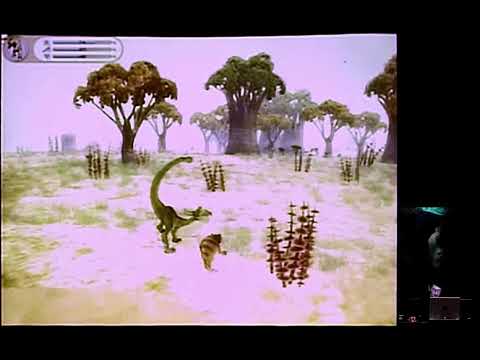
Zeusmonomon
Procedural generation and automated player authorship solve the game industry's next-generation budget crisis by turning lightweight player instructions into functional worlds without ballooning studio headcount.
AI-assisted summary of Will Wright GDC 2005 Spore (The Future of Content) Remastered — original source. Check the original for full context.
Source published:
Key ideas
- Will Wright unveiled the prototype of Spore at GDC 2005, directly challenging the industry consensus that next-generation HD gaming would trigger an unsustainable asset production crisis for developers. (0:00)
- Spore circumvents massive storage requirements through procedural generation, storing complex user creations as ~1 kilobyte parameter sets that expand at runtime into ~5 megabyte assets—achieving a 5,000-to-1 compression ratio. (26:35)
- The game operates on an asynchronous multiverse model where player-authored organisms, buildings, and vehicles are dynamically downloaded from a central server to populate other players' ecosystems based on parametric queries. (14:35)
- Spore combines the exponential macroscopic progression of Charles and Ray Eames' Powers of Ten with SETI's Drake equation, transitioning players from cellular life up to galactic civilization. (58:27)
Detailed notes
## Background Published on YouTube by channel Zeusmonomon on August 27, 2020, this video is a remastered recording of Will Wright's landmark presentation at the 2005 Game Developers Conference (GDC). Titled 'The Future of Content', the talk served as the surprise industry reveal and live technical demonstration of his ambitious evolutionary project, Spore.
## TL;DR Addressing industry anxieties over ballooning next-generation asset production costs, Will Wright argues that procedural generation and player agency offer a scalable path forward by turning consumers into world authors. Demonstrating an early alpha prototype of Spore, he showcases seamless progression across astronomical scales—from a 2D cellular tide pool to terrestrial creature evolution, municipal architecture, and full interstellar exploration. Wright details how procedural inverse kinematics, behavioral synthesis, and automated 'artist in a box' pipelines achieve a 5,000-to-1 compression ratio, using lightweight mathematical instruction sets (~1 KB) to asynchronously populate a shared galactic ecosystem.
## Atmosphere & style The presentation carries the electrifying atmosphere of an unexpected paradigm shift, blending Wright's deadpan, self-effacing wit with ambitious technological evangelism. Watching the talk feels like being in a hushed keynote hall witnessing groundbreaking computational magic held together by 'bailing wire and duct tape,' where the audience oscillates between stunned laughter and awe-inspired applause. Wright's delivery is casual yet deeply erudite, casually bridging references from the demoscene and Care Bears lore to evolutionary biology and the Drake equation with infectious creative wonder.
## Bulletin - [00:00](https://www.youtube.com/watch?v=ofA6YWVTURU&t=0s) Will Wright unveiled the prototype of Spore at GDC 2005, directly challenging the industry consensus that next-generation HD gaming would trigger an unsustainable asset production crisis for developers. - [26:35](https://www.youtube.com/watch?v=ofA6YWVTURU&t=1595s) Spore circumvents massive storage requirements through procedural generation, storing complex user creations as ~1 kilobyte parameter sets that expand at runtime into ~5 megabyte assets—achieving a 5,000-to-1 compression ratio. - [14:35](https://www.youtube.com/watch?v=ofA6YWVTURU&t=875s) The game operates on an asynchronous multiverse model where player-authored organisms, buildings, and vehicles are dynamically downloaded from a central server to populate other players' ecosystems based on parametric queries. - [58:27](https://www.youtube.com/watch?v=ofA6YWVTURU&t=3507s) Spore combines the exponential macroscopic progression of Charles and Ray Eames' Powers of Ten with SETI's Drake equation, transitioning players from cellular life up to galactic civilization.
## Key takeaways - [00:00](https://www.youtube.com/watch?v=ofA6YWVTURU&t=0s) Next-generation HD game development risks squeezing out smaller studios due to escalating asset production costs and diminishing returns on visual content creation. - [03:44](https://www.youtube.com/watch?v=ofA6YWVTURU&t=224s) Adding player agency and ownership creates a third dimension of perceived value (the Z-axis), multiplying game depth without linearly increasing art budgets. - [05:24](https://www.youtube.com/watch?v=ofA6YWVTURU&t=324s) Emergent player-driven narratives, such as idiosyncratic roleplaying in Grand Theft Auto, resonate far more deeply with players than heavily scripted, authored cutscenes. - [06:41](https://www.youtube.com/watch?v=ofA6YWVTURU&t=401s) The advent of the 650 MB CD-ROM shifted the industry ratio from code-and-algorithm reliance on early microcomputers toward massive pre-baked data storage. - [08:30](https://www.youtube.com/watch?v=ofA6YWVTURU&t=510s) Techniques adapted from the demoscene demonstrated that procedural algorithms can compress vast visual and auditory experiences into miniscule binaries. - [15:52](https://www.youtube.com/watch?v=ofA6YWVTURU&t=952s) All creature locomotion and physical interactions in Spore are generated on the fly via procedural inverse kinematics rather than hard-coded animation clips. - [21:36](https://www.youtube.com/watch?v=ofA6YWVTURU&t=1296s) Unconventional creature anatomies grant procedural animation creative leeway, as players lack rigid real-world expectations for how alien forms should move. - [26:35](https://www.youtube.com/watch?v=ofA6YWVTURU&t=1595s) Lead artist Ocean Quigley's 'artist in a box' concept automates complex meshing, UV unwrapping, texturing, and skeletal rigging behind an intuitive player interface. - [28:39](https://www.youtube.com/watch?v=ofA6YWVTURU&t=1719s) Spore's offline distribution media included tens of thousands of procedural assets pre-generated using the identical algorithmic sliders given to players. - [39:48](https://www.youtube.com/watch?v=ofA6YWVTURU&t=2388s) The game intentionally defies standard industry rules against genre mixing, integrating distilled mechanics from cellular action, creature survival, city building, and 4X space strategy. - [39:48](https://www.youtube.com/watch?v=ofA6YWVTURU&t=2388s) Creative level editors redefine player identity away from being a protagonist like Luke Skywalker or Frodo Baggins to becoming an author like George Lucas or J. R. R. Tolkien. - [47:43](https://www.youtube.com/watch?v=ofA6YWVTURU&t=2863s) Terraforming in the space stage takes inspiration from Kid Pix, prioritizing tactile, chaotic, and unpredictably playful tools over rigid scientific modeling. - [55:21](https://www.youtube.com/watch?v=ofA6YWVTURU&t=3321s) Spore employs a T-shaped design architecture where linear, evolutionary stages serve as tutorials before unlocking an open vertical and horizontal galactic sandbox. - [59:47](https://www.youtube.com/watch?v=ofA6YWVTURU&t=3587s) Over 200 experimental prototypes were developed by Maxis to test and validate Spore's untried procedural systems prior to full production. - [01:00:54](https://www.youtube.com/watch?v=ofA6YWVTURU&t=3654s) Wright concluded that the primary bottleneck in groundbreaking game design is often internal self-doubt rather than external publisher or technical resistance.
## Detailed walkthrough ### [00:00](https://www.youtube.com/watch?v=ofA6YWVTURU&t=0s) Introduction and the "Next-Gen Content Crisis"
After a brief introduction and warm applause from the Game Developers Conference audience, Will Wright takes the stage, joking about his booming microphone sounding like “the voice of god.” Before diving in, he handles the standard conference housekeeping—instructing attendees to switch off cell phones, refrain from taking photographs, and remember their evaluation forms, dryly adding, “and they made me say all that stuff.” He introduces Chris, a co-designer who has worked alongside him for roughly five years and will be assisting him with the presentation. Wright opens with a quick apology to the simultaneous translators in the room, warning them that he talks notoriously fast when trying to cram an enormous amount of material into a single hour: “If you can't keep up, feel free to just make up stuff, and it might be better than what I'm saying.”
Turning to the session’s official topic, Wright admits that its listing, “The Future of Content,” is hopelessly vague. Typically, GDC organizers call him months in advance to ask for a presentation topic; he usually spends a week pondering general concepts before handing over a generic working title. This year, however, was different: “When they asked me what I was going to talk about, I just flat out lied.” While he will touch on content, his true intent is to challenge the prevailing anxiety rippling through the game industry regarding the looming transition to high-definition, next-generation hardware. The conventional wisdom across the conference halls suggests that next-generation games will demand unprecedented, unsustainable labor costs that will choke out innovation.
Will Wright outlines this looming crisis and his proposed alternative: “It seems like the theme that I'm coming away from this conference with so far is that the next generation titles are going to be incredibly expensive, we're going to have to build mountains of content, and it's going to drive most of the smaller players out of the market.” Rather than accepting this brute-force arms race of asset production as an inevitability, Wright argues that the industry needs to rethink its approach to world-building entirely.
[02:04](https://www.youtube.com/watch?v=ofA6YWVTURU&t=124s) Diminishing Returns and the Power of Player-Generated Content
Proposing that an alternative title for the session could be “What I Learned About Content from *The Sims*,” Wright examines the explosive, non-linear growth of development overhead. Displaying the content inventory for *The Sims 2*, he highlights the sheer mountain of labor required compared to the original game. As development teams expand across console generations, the proportion of personnel dedicated exclusively to content creation grows disproportionately fast compared to the rest of the team. This creates an economic trap governed by basic utility theory: building twice as much content takes twice as much human effort, yet it fails to deliver double the perceived value to the user.
Wright illustrates this principle through a desert island metaphor: if an individual is starving on an island, a single apple holds life-saving utility, but “once you have 100 apples, you know, the 101st apple is not worth that much.” Developers are pouring exponential resources into crafting additional assets that yield diminishing emotional and financial returns. In sharp contrast, players demonstrate an insatiable enthusiasm for creating their own content whenever they are given the appropriate toolsets. Even accounting for varying levels of amateur craftsmanship, the sheer volume of high-quality community output vastly outstrips what an internal development studio could ever hope to produce manually.
- *The Sims 2* official exchange had already accumulated approximately 17,000 player-uploaded characters and 10,000 houses shortly after launch. - Even if only 5% to 10% of user submissions meet professional standards, the rapidly improving quality curve yields a massive, free reservoir of engaging content. - A prominent player fan site recently celebrated hosting its 100,000th custom-uploaded object.
[03:44](https://www.youtube.com/watch?v=ofA6YWVTURU&t=224s) The Content Value Equation: Adding the Ownership Dimension
Wright notes that monitoring player telemetry and behavioral metrics in *The Sims* provided critical design insights: tracking which verbs players select, what items they purchase, and how they navigate systems reveals how people actually play. A primary takeaway is that players fundamentally despise arbitrary boundaries, especially unnatural invisible walls that block their curiosity. While the industry is shifting toward more expansive, open-ended environments to address this, widening the possibility space typically demands steep, non-linear iteration cycles to balance emergent interactions.
```mermaid flowchart LR accTitle: Player Value Dimensions accDescr: Diagram illustrating how adding player ownership expands value beyond the traditional 2D model of content quantity versus quality.
subgraph Traditional["Traditional Content Model"] direction TB QNT["Content Quantity<br/>(e.g., Katamari Damacy)"] QLT["Content Quality<br/>(e.g., Pikmin)"] VAL2D["2D Value Area<br/>(Quantity × Quality)"] QNT --- VAL2D QLT --- VAL2D end
subgraph Expanded["Wright's Proposed Model"] direction TB OWN["Player Ownership<br/>& Agency"] VAL3D["3D Value Volume<br/>(Massive Exponential Area)"] VAL2D -->|"Extrude along Z-axis"| OWN OWN --> VAL3D end ```
To evaluate content efficiency, Wright critiques the implicit industry assumption that player value is strictly a two-dimensional calculation multiplying asset quantity by visual fidelity. Games like *Pikmin* feature relatively modest quantities of content polished to high visual fidelity, whereas games like *Katamari Damacy* offer sprawling arrays of low-fidelity objects, yet both land in a comparable sweet spot of overall player value. However, Wright argues this 2D gradient completely ignores a critical third dimension: player agency and ownership. By allowing players to author, customize, and invest themselves into the assets in their world, developers can unlock an enormous volume of value without incurring exorbitant production budgets:
> “I think, you know, the ownership that we can give players over content feels like a very meaningful new dimension that, you know, by pulling that out just a little bit, we add tremendous amount of area to that player value.”
[05:24](https://www.youtube.com/watch?v=ofA6YWVTURU&t=324s) "Moe" from Grand Theft Auto and the Primacy of Player Stories
To illustrate how agency transforms engagement, Wright shares a personal anecdote from playing *Grand Theft Auto: San Andreas*. Instead of pursuing the main narrative missions, he created a custom persona named “Moe,” a total slacker who spent his days wandering the map, learning minor bicycle tricks, and ignoring criminal syndicates. Wright customized Moe to wear nothing but underwear and a Barbie wristwatch. The absurd juxtaposition of serious mob bosses treating this half-naked bicycle slacker with deadly gravity during dramatic story cutscenes became Wright's favorite part of the game.
When he finished his play sessions, Wright found himself eager to share stories with his wife and daughter about Moe’s mundane, off-beat misadventures rather than the scripted plot points authored by the studio. For Wright, this dynamic proves that players form deep emotional attachments to events they initiate themselves, whereas pre-rendered cinematic moments rarely leave lasting, shareable memories. Emphasizing why game design should pivot toward generative autonomy, Will Wright insists: “And so I contend that player stories will always be more powerful than scripted stories that we try to tell the players.”
[06:41](https://www.youtube.com/watch?v=ofA6YWVTURU&t=401s) From Apple II Code to the CD-ROM "Meteor"
Synthesizing these insights—the shift toward non-linear agency, spiraling art costs, the power of player-authored content, and behavioral analytics—Wright arrives at the true thesis of his presentation: “What I learned about content from *The Sims* and why it's driven me to procedural methods.” To explain how game development arrived at its current predicament, he reflects on his early career developing for the Apple II, a machine an original advertisement jokingly touted as being six times faster than a teletype.
In the early personal computer era, developers worked down to the bare metal in assembly and machine code, keeping explicit physical memory maps to track every byte. Because 140-kilobyte floppy disks and system RAM were severely restricted, a typical program's memory footprint was split evenly: roughly 50% code and 50% data. In modern games, that ratio has skewed drastically to 1 to 100 in favor of pre-baked assets.
Wright identifies the pivotal historical turning point as the arrival of the 650-megabyte CD-ROM, an optical format that looked like an unfathomable supertanker compared to 5.25-inch floppies: “Well, actually, before I talk about that, I mean, this basically was kind of like the meteor that came in and sounded the death knell for the algorithm.”
Data immediately ascended to supremacy. Wright points to Cyan’s *Myst*, created by Robyn and Rand Miller in HyperCard, as the definitive triumph of the data-heavy era. While *Myst* was functionally an elaborate prerendered slideshow, Wright found it astonishingly immersive and brilliantly designed. Even so, playing it left him with an inescapable realization: the designers had experienced all the true fun of building the world, leaving players to passively click through the static aftermath of that creation.
[08:30](https://www.youtube.com/watch?v=ofA6YWVTURU&t=510s) The Demoscene and the Power of the Algorithm
While the mainstream games industry pursued data-driven pipelines—stuffing CD-ROMs with pre-rendered, hand-crafted assets—a different movement kept an older tradition alive. Will Wright describes this subculture as a separate tribe centered in Northern Europe, Scandinavia, and specifically Helsinki: the demoscene. Wright observes: “They basically worshipped the algorithm, kind of kept practicing their black arts, they adopted kind of modern dress and technology, but... we call it the demoscene, and these guys are basically crazy.”
```mermaid flowchart LR accTitle: Demoscene Data Compression Contrast accDescr: Visualizing the massive mathematical scale difference between 64 kilobytes and a full CD-ROM. subgraph Demo["Demoscene"] A["64 KB Executable"] end subgraph CD["Mainstream CD-ROM"] B["(64 KB)^2"] --> C["Squaring Steps..."] --> D["650 MB CD-ROM Capacity"] end A -.->|"Algorithmically produces equivalent visuals"| D ```
These programmers trace their origins back to software cracking groups who attached animated cracktros to showcase their technical prowess. Over time, these grew into elaborate competitive art pieces where developers pack massive procedural animations, visual effects, and music into binaries as compact as 64 kilobytes. To illustrate the magnitude of difference between algorithmic generation and raw data storage, Wright notes that if you take 64 kilobytes and repeatedly square it, you arrive at the capacity of a standard CD-ROM.
- Demoscene origins lie in competitive software cracking groups signing their releases with intro screens. - Programmers rely on procedural generation to fit expansive audio, visual, and animated routines into 64-kilobyte files. - Wright found this algorithmic philosophy a powerful alternative to the industry's ballooning content budgets.
---
[10:18](https://www.youtube.com/watch?v=ofA6YWVTURU&t=618s) The Microscope Tangent and Assembling the Team
Reflecting on his experiences developing *The Sims*, Wright reframes the thesis of his keynote: “What I learned about content from *The Sims*, why it’s driven me to procedural methods, and what I now plan to do with them.” To bring this vision to life, he recruited an elite team skilled in procedural programming and set them up in a covert development studio.
Before revealing the prototype, Wright shares a parenting tangent from when his daughter was five years old. He had set out to buy both a high-end telescope and a quality microscope. While telescopes were widely available at retail science shops like The Nature Company, finding a good stereoscopic microscope proved nearly impossible until online marketplaces like eBay emerged. He advises the audience on the best hobbyist setup: buy a low-power stereo microscope equipped with overhead illumination. Wright explains that while high magnification seems intuitive, low magnification produces a revelatory experience: “You’ll put your hand under this thing and you’ll spend an hour just obsessing over your hand, and it’s like a religious experience.”
- Wright opted to unveil the prototype at the Game Developers Conference rather than a commercial marketing venue like E3 due to his kinship with fellow developers. - The demonstration build was in an early alpha state, described by Wright as being “held together with, you know, bailing wire and duct tape.”
---
[12:41](https://www.youtube.com/watch?v=ofA6YWVTURU&t=761s) The Cellular Phase: Procedural Pac-Man
Moving over to the display screen, Wright presents the prototype, titled *Spore*. The demonstration begins at the micro scale, placing the player in control of a single-celled organism drifting through a fluid-dynamic environment. Wright characterizes the phase as “a very analog, fluid version of Pac-Man.” The player maneuvers the microbe around hazardous elements, hunts floating nutrient pellets, and evades hostile organisms that can kill the player's creature on contact.
```mermaid flowchart TD accTitle: Cellular Lifecycle Loop accDescr: The loop of consuming nutrients, laying an egg, editing creature morphology, and returning to the game. A["Guide Cell & Eat Nutrients"] --> B["Lay Egg"] B --> C["Enter Cell Editor"] C --> D["Attach Parts: Mouths, Locomotion, Weapons"] D --> E["Hatch Modified Organism"] E --> A ```
Consuming enough food allows the organism to reproduce by laying a small yellow egg. Clicking on this egg opens an editor where the player can evolve the microbe using modular biological components. These parts fall into distinct functional categories: mouthpieces (such as filter feeders or piercing proboscises that dictate dietary habits), locomotion appendages (cilia, flagella, or micro-jets), and defensive weapons like spikes or nematocysts. Wright attaches a defensive spike to the front of his cell, returning to the simulation with new offensive capabilities that transform former predators into viable food sources.
- The entire cellular habitat and its fluid dynamics are procedural. - Part attachments alter core game verbs, expanding diet options, locomotion speed, and combat strength. - As the creature grows, the camera gradually pulls back, shifting depth of field to reveal larger layers of the microscopic ecosystem.
---
[14:35](https://www.youtube.com/watch?v=ofA6YWVTURU&t=875s) The Tidepool Phase and the Asynchronous Multiverse
Skipping forward several evolutionary cycles, the game transitions from a two-dimensional cellular broth into a three-dimensional aquatic environment beneath the ocean surface. Here, player creation integrates directly with procedural systems: players sculpt the morphologies, while procedural animation, behavior trees, and surface textures are synthesized on the fly.
Crucially, Wright reveals that the creatures inhabiting the local world are not authored by Maxis designers or spawned purely at random; they are pulled asynchronously from other players over the network:
> “When I say coming from other players, what I mean is that they are asynchronously being sent to your computer to fill out your world. We’re actually building a balanced ecosystem depending on what your world needs; we deliver other players’ content to pull out that world around you.”
- The transition shifts the simulation from micro-scale 2D fluid dynamics to a full 3D marine environment. - The procedural ecosystem balances its food webs by dynamically fetching user-created organisms suited to specific ecological niches.
---
[15:52](https://www.youtube.com/watch?v=ofA6YWVTURU&t=952s) The Creature Editor and the Emergence of Land Animals
When the marine organism reproduces, the player enters the creature editor. Wright describes the editing suite as a creative hybrid of “Mr. Potato Head, Erector Set, and clay.” The player directly manipulates an underlying spine and skeletal structure that dictates body topology. Scrolling the mouse wheel inflates or narrows flesh around the vertebrae to sculpt the torso, while modular body components provide functional traits:
| Part Category | Biological Implementations | Primary and Secondary Functions | |:--- |:--- |:--- | | **Graspers** | Claws, Hands, Pincers | Object manipulation, secondary attack utility | | **Locomotion** | Fins, Multi-jointed legs, Cilia | Swimming, terrestrial walking, speed modification | | **Appendages** | Tails, Spines, Feet | Balance, defense, swimming propulsion |
Wright strips the fins off his aquatic creature, drastically diminishing its swimming performance, and replaces them with a three-jointed leg and foot assembly to construct an asymmetrical tripod. Because the creature can no longer navigate the water efficiently, Wright walks the beast up the ocean slope onto dry land.
The software inspects the user-authored bone hierarchy, joint counts, and body weight, and then procedurally calculates locomotion on the fly: “The walking you see here is all procedurally generated based upon an analysis of the skeleton that you created; in fact, every verb in the game is as well.”
- Parts can be scaled, rotated, warped, or removed entirely from the skeletal structure. - Locomotion mechanics and animation cycles are generated purely through dynamic physics and kinematic analysis rather than static, pre-recorded animation clips. - Leaving the water marks the evolutionary leap from the marine phase to terrestrial survival.
[18:22](https://www.youtube.com/watch?v=ofA6YWVTURU&t=1102s) Creature Combat, Procedural Verbs, and Mating
Will Wright guides his newly evolved creature into the wild, explaining that since his creature is a carnivore, survival hinges on hunting down prey. He directs the creature toward an unsuspecting target and attacks. Wright points out that the creature's combat style is directly tied to the anatomy defined in the editor; because he placed the creature's weapon on its tail, it attacks by whipping its rear end around. Positioning matters: if the creature is not close enough, the attack misses entirely. Luckily, Wright's creature has enough speed to chase down the prey, kill it, and begin feeding.
```mermaid flowchart LR accTitle: Procedural Verb Mixing Flowchart accDescr: Diagram illustrating how the Spore engine blends two base actions, biting and walking, into a newly emergent compound action called dragging. subgraph S1["Atomic Player Commands"] A["Command: Take a bite"] B["Command: Walk forward"] end subgraph S2["Procedural Synthesis Engine"] C["Blend Animation & Kinematics"] end subgraph S3["Emergent Game Verb"] D["Result: Drag prey carcass"] end A --> C B --> C C --> D ```
Wright uses this moment to demonstrate the power of procedural verbs, showing how fundamental actions can be cleanly blended by the engine to yield brand-new behaviors. By commanding the creature to take a bite out of the carcass while simultaneously ordering it to walk forward, the system synthesizes an entirely new verb: dragging. He underscores the broader consequence for gameplay:
> “One of the real wins though is that whatever I've created in this game is going to behave differently—I mean, you know, it's just going to be fundamentally different behavior than anything that you might create in the game, which is a huge win.”
Danger suddenly arrives when an aggressive apex predator appears. Wright scrambles to flee, noting that the game automatically populates a balanced ecosystem where the player is not guaranteed to be at the top of the food chain. He outruns the pursuer, hoping the beast will distract itself by devouring a few nearby hopping creatures instead. Once safe, Wright transitions to the life-cycle loop: a creature lives out its lifespan, gathers in-game currency, and performs a mating call to find a partner. Finding a mate and successfully performing a quirky procedural mating dance yields an egg, which grants the player access to the creature editor to evolve the next generation.
[21:36](https://www.youtube.com/watch?v=ofA6YWVTURU&t=1296s) Emergent Morphology: From Buttface to Care Bears
Wright returns to the creature editor to showcase the system's open-ended expressiveness by loading a series of bizarre community and internal builds. He presents a creature nicknamed "Buttface," which features an unconventional, backwards leg arrangement. Despite the bizarre anatomy, the procedural animation system makes it walk smoothly and naturally. Wright points out a psychological trick at play: because players have never seen a creature like Buttface in real life, they have no ingrained expectations of how it ought to walk, giving the animation engine far more leeway than it would have with a humanoid.
He then demonstrates several other creations to show the breadth of the system: - **Tweety Bird**: A creature sporting an enormous head on top of a slender frame, which Wright compares to an unstable SUV like a Ford Explorer, joking that it would probably suffer from very low evolutionary fitness. - **Hang Dog**: A slumped, slouching creature with an exceptionally cool, languid walking cadence. - **Dilemma**: A spindly, elongated creature whose skeletal topology happens to produce an intensely rapid, scuttling gait. - **Care Bear**: A custom-built, cuddly pink bear that Wright insisted the development team include, though he jokes he will turn it into a vicious carnivore.
Wright stresses that every single one of these wildly divergent forms runs on the exact same underlying animation script. The physical performance and movement speed of a creature are not pre-baked stats; they are emergent properties arising from how the procedural inverse kinematics interpret the skeleton and part topology chosen by the player.
[24:01](https://www.youtube.com/watch?v=ofA6YWVTURU&t=1441s) Player Ownership and Pop-Culture Archetypes
Reflecting on past evolution games, Wright argues that most titles made players feel alienated from their creations because players were restricted to choosing from a rigid set of fixed parts or slotting heads, torsos, and tails into predefined sockets. He contrasts this with the creative friction of *The Sims*, where players had to leave the game, download external utility programs, make a custom item, and manually upload it to a fan site. For *Spore*, Wright's core design philosophy is to embed creation tools seamlessly inside the primary gameplay loop and make content sharing entirely transparent: the game should automatically study a player's habits and quietly pull down matching, high-quality creatures made by other players across the world without anyone touching a browser.
Wright draws a parallel between this creative ownership and the way children master pop-culture rule sets:
> “By learning the different types and the names of the dinosaurs, you know, it's kind of cool that I knew what an Ankylosaurus was, my mother didn't, you know, and that gave me a certain ownership of those.”
Whether it was memorizing dinosaur match-ups in his own youth, mastering the elaborate mechanics of *Pokémon*, or collecting *Neopets*, children naturally project deep narratives onto systems with defined traits.
This leads Wright into an extended, comic analysis of the *Care Bears* franchise. Originally conceived by American Greetings as greeting cards with emotional traits and specialized superpowers, they gradually accumulated a complex mythology. Wright shares that an online psychology quiz identified him as Sunshine Bear, then riffs on the lore of the Care Bear Cousins (who are not bears at all) and their cosmology: the Care Bears inhabit Care-a-Lot in the sky, while the Cousins live below them in the Forest of Feelings. When falling from clouds, they pass the forest and descend all the way to Earth for their rescue missions—placing Care-a-Lot roughly in low Earth orbit. Wright quips that while the entire realm is called the Kingdom of Caring, the creators implicitly treat Earth as the "kingdom of who gives a crap," since it is the troubled place in perpetual need of rescue.
[26:35](https://www.youtube.com/watch?v=ofA6YWVTURU&t=1595s) "Artist in a Box" and Creative Amplification
Returning to technical architecture, Wright introduces a guiding concept coined by the game's lead artist, Ocean Quigley: building an "artist in a box." The development team inventoried every laborious stage of commercial art production—mesh generation, UV unwrapping, texturing, rigging, keyframing, and scripting—and set out to automate them entirely. By placing an automated production pipeline behind a clean set of intuitive controls, the game grants ordinary players immense creative leverage. Wright outlines the game's stylistic spectrum as spanning from the family-friendly whimsy of Pixar (like Dr. Seuss worlds) to the dark biomechanical horror of H.R. Giger.
```mermaid flowchart TD accTitle: The Spore Creative Amplification Pipeline accDescr: Pipeline diagram illustrating how minimal player inputs are expanded into full-fidelity in-game assets via procedural generation. subgraph Input["1. Player Creative Input (~1 KB)"] A["Simple Topology & Part Placement"] end subgraph Generation["2. 'Artist in a Box' Procedural Systems"] B["Polygon Mesh Synthesis"] C["Topology-Aware Procedural Textures"] D["Procedural Rigging & Animation"] E["Autonomous AI & Player Controls"] end subgraph Output["3. Runtime Game Output (~5 MB)"] F["Fully Realized, Living Creature"] end A --> B A --> C A --> D A --> E B --> F C --> F D --> F E --> F ```
The game's texturing algorithms analyze the topological contours of the generated 3D mesh, automatically identifying features like the creature's spine or belly and painting them appropriately. The resulting creature can then be steered directly by the player or handed over to NPC artificial intelligence routines when imported into another person's game world.
Wright frames the entire procedural philosophy around the concept of creative amplification: - **Data Footprint**: The raw player-authored skeleton and part selections compress down to roughly 1 kilobyte of data. - **Runtime Expansion**: When the engine evaluates the procedural textures, polygon meshes, and kinematic animation rigs, the creature expands to the equivalent of a 5-megabyte asset. - **Compression Ratio**: This workflow achieves roughly a 5,000-to-1 data compression ratio. - **Practical Advantages**: This extreme data efficiency gives individual players extraordinary expressive leverage while allowing massive ecosystems of unique creatures to be stored in minuscule local databases, making deep gameplay possible even without an active internet connection.
[28:39](https://www.youtube.com/watch?v=ofA6YWVTURU&t=1719s) Procedural Generation, Genotype Compression, and Content Pollination
Will Wright explains how the underlying architecture of *Spore* enables an unprecedented pipeline for content distribution. If an offline player installs the game, the installation CD comes preloaded with tens of thousands of procedural assets in an internal database. Because assets are represented not as heavy polygonal meshes or massive textures, but as compressed instructional recipes, they have almost zero friction when transmitted across networks, whether hosted on a central server or shared peer-to-peer. Wright points out that the creative handles given to the player are identical to the procedural parameters an automated system uses: the software's generative engine can turn the exact same algorithmic knobs that a human user adjusts when designing a character.
This design mirrors biological developmental systems. Just as in *The Sims*, where tweaking facial sliders triggers a procedural pipeline that compiles a final model, *Spore* treats user-defined slider values and bone configurations as a compact genetic code that undergoes embryological development to yield an interactive organism. This compact representation is the linchpin of what Wright calls "pollination." Whenever a player crafts a creature, that compact genotype is sent up to Maxis servers, where it is classified based on dietary habits, size, behavior, and life cycle. When a local game client requires rival species to populate an environment, it queries the central database through parametric matching, downloading suitable player-made creations to assemble a dynamic, balanced ecosystem on the fly. As Wright puts it: “And this is kind of basically mapping to the idea of a genotype going through embryology to an initial phenotype and that compression is vital for this whole thing.”
```mermaid flowchart LR accTitle: Spore Content Pollination Pipeline accDescr: Diagram illustrating how player creations become compressed genotypes, are categorized on a server, and are pulled dynamically into other players' local game worlds. subgraph Authoring["Client Authoring"] A["Player / Procedural Knobs"] --> B["Compact Genotype"] end subgraph Server["Central Processing"] B -->|"Low-friction upload"| C["Server Categorization\n(Diet, Size, Behavior)"] end subgraph WorldGen["Ecosystem Instantiation"] C -->|"Parametric query"| D["Embryology & Rigging"] D --> E["Phenotype in Local Ecosystem"] end ```
- Data transfer overhead remains minimal because the game transfers generative instructions rather than raw 3D geometry or baked texture maps. - Categorization algorithms track functional attributes—such as carnivore versus herbivore status, territorial traits, and scale—to ensure downloaded fauna naturally fit local ecological niches.
---
[30:08](https://www.youtube.com/watch?v=ofA6YWVTURU&t=1808s) The Brain Palette and the Tribal Phase: Monkeys with Guns and Procedural Dance
Returning to the Creature Editor, Wright points to the final palette at the bottom of the user interface: the brain palette. Throughout the survival phase, players must resist the urge to spend all their earned points exclusively on immediate survival upgrades like bigger weapons, stealthy camouflage, or increased running speed. Instead, disciplined players divert resources into their brain capacity, treating it like a long-term college savings fund. Once the player invests enough capital to unlock the top tier of the brain ladder, their species crosses the threshold into sentience, triggering an abrupt mechanical genre shift. The game mutates from a first-person survival-eater into a real-time strategy (RTS) tribe simulator where the player manages a whole collective herd.
Wright references a recurring design landmark he introduced in previous lectures: his enduring creative obsession with "monkeys with guns." In the tribal phase, physical evolutionary morphology is locked in, and progression shifts toward cultural and material tooling. Wright purchases a spear rack, prompting excited, procedural vocalizations and animations as the pack inspects the weapon rack. To maintain order among his volatile creatures, he adds a campfire and a drum. Once the drum is placed, the creatures gather around and begin performing a dynamic dance routine whose animations are calculated entirely on the fly based on the creature's limb structure and joint topology, an effect that draws spontaneous applause from the conference audience. Play at this tier echoes classic god games like *Populous*: players assemble hunting expeditions, manage food stores, compete against rival tribes, and upgrade the central tribal hut to grow their population and unlock advanced tools. Wright emphasizes his design touchstone: “One of the landmarks is I've always been fascinated with the idea of monkeys with guns, and I don't know why, you know, but just what happens when you give monkeys guns, you know, it's just there's something cool about that.”
- Advancing the brain category permanently shifts the core game loop from individual creature survival to squad-based management. - Depending on player guidance and social reinforcement, a tribe can develop an emotional, expressive temperament or a cold, calculated, and logical culture. - Procedural verbs dictate creature interactions, enabling unique, morphology-specific animations for social activities, weapon handling, and musical performance.
---
[33:04](https://www.youtube.com/watch?v=ofA6YWVTURU&t=1984s) The City Phase: SimCity Dynamics, Modular Architecture, and Cultural Aesthetics
Upgrading the central tribal hut to its final tier catapults the civilization into the City phase, which plays out as a streamlined, accessible incarnation of *SimCity*. Here, players zone roads, construct buildings, manage municipal services, and attend to the emotional happiness of their citizens. Every structure in the settlement is subject to complete authorial customization. When purchasing municipal structures, players can browse an integrated catalog pre-populated with creations downloaded from the community. An internal recommendation engine monitors the player's aesthetic choices and curates the storefront with assets that match their emerging stylistic profile.
For those who want to design from scratch, the building editor repurposes the morph-block interaction model seen in the creature creator, adapting it into a modular system reminiscent of digital Lego bricks. Players drag basic geometric primitives, intersecting or stacking them, while manipulating intuitive handles to reshape and extrude forms. Wright notes that this interface capitalizes on Maxis's discoveries during the development of *The Sims* build mode: giving users simple spatial operators and instant visual feedback creates an intrinsically rewarding toy. To demonstrate the aesthetic range of the toolset, Wright pans across the landscape to an adjacent rival city. While his own settlement features whimsical, organic silhouettes reminiscent of Dr. Seuss, the neighboring city boasts harsh, industrial, metallic architecture reminiscent of *Star Wars* or H.R. Giger. Wright emphasizes the player's complete artistic ownership over their community: “And basically I'm trying to keep them happy in their little city, you know, and again I have complete creative control over everything you see here, you know, so I am, you know, the player is the author of this little world.”
- Building editing relies on simplified CSG-like interactions (stacking and intersecting) anchored by contextual manipulation handles on platonic solids. - Stylistic range in the procedural building system spans an aesthetic spectrum from soft, stylized Pixar forms to hyper-detailed, industrial Giger architectures. - Citizen behavior mirrors structural quality and social stability, scaling up from simple interpersonal dynamics to crowd-level happiness indices.
---
[36:20](https://www.youtube.com/watch?v=ofA6YWVTURU&t=2180s) Vehicles, City Specialization, and the Transition to Civilization
As municipal infrastructure expands, cities gain the capacity to manufacture vehicles, unlocking the primary vector for inter-city engagement. While tribal interaction relied on direct physical raids, trades, or cultural mingling, cities operate on a grander geopolitical scale. Players can subjugate or assimilate neighboring municipalities via three distinct strategies: military dominance, economic leverage, or cultural conversion. As an aggressive, industrialized neighboring city advances hostile units across the border, Wright enters the vehicle editor to craft a countermeasure.
```mermaid flowchart TD accTitle: City Interaction Vectors accDescr: Three distinct interaction vectors available to cities in the Spore City phase: Military, Economic, and Cultural. A["Player City Strategy"] --> B["Military\n(Direct conquest & armed force)"] A --> C["Economic\n(Trade dominance & financial buyout)"] A --> D["Cultural\n(Ideological influence & assimilation)"] B --> E["Rival City Assimilation"] C --> E D --> E ```
Like the architectural toolset, the vehicle editor combines modular styling with functional parts: attaching propellers enables flight, while specific chassis attachments grant aquatic or terrestrial capabilities. For demonstration purposes, Wright bypasses deep engineering and buys a goofy, Nazca-style flying contraption from the catalog. Upon deploying, the erratic craft flies aimlessly, prompting Wright to joke that his peaceful citizens are cowards who refuse to fly toward the battlefront. Despite the comic skirmish, Wright clarifies that brute combat is merely one optional path among more diplomatic and cultural alternatives. Panning the camera out past the immediate warzone, the local landscape rounds into a curved planetary horizon. This visual expansion marks the transition into the Civilization phase, where gameplay broadens into a global strategy experience modeled after games like *Civilization* and *Risk*. Wright outlines the tri-fold diplomatic framework: “At the city level we basically have kind of three ways to capture or ally with another city: they're basically military, economic, or cultural, depending on kind of the cultural flavor of my people.”
- Functional vehicle attachments directly dictate operational mobility across land, sea, and airspace. - Inter-city diplomacy is non-binary, allowing players to conquer via cultural proselytizing or corporate buyout rather than armed conquest alone. - Zooming out transitions the camera from a localized tactical perspective into a spherical planetary projection, shifting the scale to global geopolitics.
[38:10](https://www.youtube.com/watch?v=ofA6YWVTURU&t=2290s) City Scale Transition, Micromanagement, and Database Pollination
Will Wright demonstrates how the game manages scale and micromanagement as the camera moves between strategic and tactical views. When zooming in close to a city, the buildings snap into realistic proportions; if the player wants to modify structures or continue designing their own version of Paris while under enemy attack, they can click individual buildings and open them directly in the editor. Conversely, pulling the camera back causes the city to exaggerate its proportions for both aesthetic and functional reasons, condensing down into an icon that represents a single interactive button with a streamlined menu. Wright explains that players will progress through this Civilization-style phase city by city and continent by continent until they have conquered and customized their entire home planet.
```mermaid flowchart LR accTitle: Spore Content Recommendation Loop accDescr: Diagram illustrating how player purchases feed back into database sorting to recommend content. subgraph Client ["Player Game Client"] Playstyle["Player Play Style"] BuyMode["Populated Buy Mode"] Purchase["Player Buys / Uses Content"] end subgraph Server ["Master Database"] Parametric["Parametric Mapping Engine"] MasterDB["Content Database Pool"] Sorting["Top-End Sorting Algorithm"] end
Playstyle --> Parametric MasterDB --> Parametric Parametric --> BuyMode BuyMode --> Purchase Purchase -->|"Positive Feedback"| Sorting Sorting -->|"Continuously Re-ranks"| MasterDB ```
Wright breaks down the procedural content sharing running underneath this stage, contrasting it with earlier phases. Rather than simple random sharing, the system draws from a master database of player creations and uses parametric mapping tailored to the user’s individual play style to populate their in-game "buy mode." When a player selects and purchases an asset created by someone else, that action serves as positive feedback for the central database. The server continuously resorts and re-ranks assets at the top end based on broad player adoption, curating the highest-quality community creations automatically.
[39:48](https://www.youtube.com/watch?v=ofA6YWVTURU&t=2388s) Genre Mixing, Design Philosophy, and Player as Author
Addressing the overall game structure, Wright compares Spore to *WarioWare, Inc.*, describing it as an unapologetic homage to his favorite strategy games. He notes that conventional industry wisdom warns developers never to mix disparate genres:
> “And I know it's kind of like one of the rules of thumb in the game is don't mix genres, and so I've always wanted to break that rule really badly.”
He details the classic influences underpinning each stage: - **Tide Pool Phase:** Draws heavily from *Pac-Man*. - **Creature Evolution Phase:** Mirrors the dynamic loop of *Diablo*, where the player ventures out into a hostile world to fight monsters, returns to the safety of an editor (acting as the village) to upgrade their creature's "armor and swords" across generations, and ventures back out to battle harder threats. - **Tribal Phase:** Built as an explicit homage to Peter Molyneux's *Populous*. - **City Phase:** Distills the essence of *SimCity*. - **Civilization Phase:** Borrows the empire-building spirit of *Civilization*.
Wright clarifies that he wanted each phase to offer a distilled, lighter experience—around 20 percent of the best mechanics of *SimCity* or *Civilization*. As an aging hardcore gamer, he finds himself playing handhelds like the Game Boy because he no longer has dozens of hours to invest in massive systems. Wright anticipates that roughly 40 percent of the Spore experience will be purely aesthetic creative expression, supported by simple, accessible systems that anyone can pick up. Crucially, the editors attached to each level reshape the player's agency:
> “And really, you know, I did not want to put the player in the role of, you know, Luke Skywalker or Frodo Baggins; instead I wanted to put the player in the role of George Lucas or J. R. R. Tolkien or Dr. Seuss, or whoever, you know? I wanted the player to feel like, you know, they had built an entire world, you know, going through these different levels.”
[41:49](https://www.youtube.com/watch?v=ofA6YWVTURU&t=2509s) Emergent Storytelling and the Robert Louis Stevenson Model
Wright pauses to reflect on narrative design, arguing that narrative should be treated as an emergent result of interactive systems rather than a rigid baseline:
> “More recently I've been thinking of story as really a side effect or a property of interesting experiences, not a prerequisite.”
He points out that games like *Grand Theft Auto* often provide incredible personal player stories despite the player ignoring the scripted plot; because the events happen directly to the player, they possess a strong sense of personal ownership. In Wright's view, stories serve as filtering processes that emphasize causality. Unlike cinema, where a director can cleanly sequence cause and effect—such as showing precisely why a character gets angry, kicks an object, and breaks their foot—games rely on the player's personal experience of the events to provide that logic. Stories also function as tools for portability, compression, and abstraction, converting concrete gameplay events into mental schemas that apply to other contexts. Wright recalls Robert Louis Stevenson’s process writing *Treasure Island*, noting that Stevenson began simply by drawing an island map and letting his eyes wander across the terrain, allowing the narrative to emerge naturally from the geography.
[43:22](https://www.youtube.com/watch?v=ofA6YWVTURU&t=2602s) The UFO Swiss Army Knife, Abduction, and Interplanetary Scale
Returning to the live game, Wright looks over his stylized "clock-like toy world" and inspects the local city, noting a fresh crater where an attacked building once stood. He enters the vehicle editor to highlight its final unsealed category: after unlocking ground, water, air, and submersible craft, players eventually earn the UFO. Wright selects a stock flying saucer, describing it as the ultimate Swiss Army knife for the late game, granting unmatched speed to traverse the globe instantly.
He shares a childhood memory that inspired the vehicle's mechanics: watching *Mutual of Omaha's Wild Kingdom*, hosted by Marlin Perkins. Wright recounts that no matter the crisis or endangered animal being studied, the climax almost inevitably involved leaning out of a helicopter with a high-powered tranquilizer gun to dart a creature. Channels of that show inspired Spore's abduction beam, which Wright uses to capture wildlife. Scouting the planet's surface, he spots the hostile creature species that had bullied his tribe earlier in the game, declaring it time for payback. After a brief chase, he lines up the beam, snatches a specimen directly off the terrain, and stores it in his cargo hold.
Wright then pulls the camera straight up, flying higher and higher as the planet shrinks, pulling the audience past the atmosphere until the entire solar system comes into view, earning enthusiastic applause from the room. Wright points out the system's comets, the central sun, hot planets orbiting close in, the home world, and frozen outer bodies. He zooms the camera toward a distant, barren moon with radically different geology, explaining that every planet functions as a blank-slate sandbox for player experimentation and colonization. Seeking to bootstrap the frozen moon with life, he descends to its desolate surface and drops the creature he just abducted from home, only for it to instantly perish in the harsh environment. As Wright asks the audience why the creature died, he calls over to the audio booth to turn up the stage machine's volume for the next demonstration.
[47:43](https://www.youtube.com/watch?v=ofA6YWVTURU&t=2863s) Terraforming and Colonization Mechanics
Addressing a world lacking an atmosphere, Will Wright explains that the overarching objective is to transform barren planets into livable habitats. In conceptualizing the terraforming toolset, he drew creative inspiration from the classic educational painting program *Kid Pix*. Wright appreciated that *Kid Pix* gave users wacky, expressive tools that constantly risked slipping out of strict control, producing serendipitous accidents. As Will Wright puts it: “Basically what I loved about Kid Pix is you had all these cool weird wacky creative tools and they were always out of your control—I mean you always did these unexpected oops I didn't mean to do that type of thing—and I wanted the terraforming to kind of feel like that as well.”
```mermaid flowchart TD accTitle: Planetary Terraforming and Colonization Loop accDescr: Diagram illustrating the iterative loop between terraforming, establishing colonies, generating revenue, and purchasing advanced UFO upgrades.
subgraph Terraforming["Atmospheric Engineering"] A["Barren Planet (No Atmosphere)"] --> B["Volcano Tool / Gas Emission"] B --> C["Atmosphere Densifies & Biosphere Score Rises"] C --> D["Plant Seeding & Biosphere Maturation"] end
subgraph Colonization["Colony Infrastructure"] A -.->|"Early Settlement"| E["Enclosed Bubble Colony"] D --> F["Open-Air Elaborate Cities"] end
subgraph Economy["UFO Progression"] E --> G["Earn Revenue / Resources"] F --> G G --> H["Purchase Advanced Tools & Genesis Device"] H -->|"Accelerated Seeding"| D G --> I["Unlock Interstellar Drive"] end ```
To demonstrate, Wright deploys a volcano tool directly onto the planetary crust, simultaneously altering the elevation of the terrain and venting gases into the sky. Over time, these thermal vents generate a dense atmosphere. While waiting for the atmospheric pressure to stabilize, players can immediately begin founding settlements. Early colonies on airless rocks appear beneath sealed biodomes—a visual motif shared with deep underwater cities on oceanic home planets. Once an atmosphere is fully formed, domes are discarded in favor of sprawling open-air colonies, which generate revenue to finance further UFO equipment upgrades. To bypass the natural timeline during the keynote demo, Wright triggers an endgame superweapon called the Genesis Device, instantly clearing storm clouds, greening the landscape, and boosting the planet's biosphere score so harvested flora and fauna can take root.
- **Kid Pix Philosophy**: Emphasizes unpredictable, tactile, and expressive creative tools over rigid landscape editors. - **Atmospheric Mechanics**: Volcanic activity pumps out gases to alter density, cloud cover, and surface color. - **Bubble Architecture**: Applied interchangeably to airless extraterrestrial colonies and domestic oceanic underwater settlements. - **Economic Loop**: Settled colonies produce funds that allow players to purchase higher-tier ship capabilities and terraforming gadgets. - **Genesis Device**: A late-game, high-cost item that instantly bootstraps planetary atmospheres and initiates rapid biosphere growth.
---
[51:00](https://www.youtube.com/watch?v=ofA6YWVTURU&t=3060s) The Stellar Zoo and Asynchronous First Contact
After accumulating sufficient capital from provincial colonies, players can purchase the interstellar drive to break out of their solar system and enter the galactic view. Wright terms this macro-environment the "stellar zoo." He expresses deep frustration with how traditional astronomy curricula flatten outer space into two-dimensional star charts, obscuring the three-dimensional grandeur revealed by deep-space photography. As Will Wright explains: “One thing that's always really annoyed me about the way astronomy is presented is it's presented as two-dimensional—if you look at star maps like that, I mean that's the way astronomy is taught—but it's yet it's this beautifully three-dimensional thing and you just are not given the sense of what that's like.” The galactic map incorporates authentic cosmological entities—such as black holes, planetary nebulae formed from supernova shells, star-forming stellar nurseries, and hazardous blue giant stars on the verge of detonation.
Navigating this interstellar terrain, the player uses a SETI radio scanner tool to mouse over stellar targets and listen for artificial transmissions. Picking up an alien broadcast, Wright pinpoints an inhabited solar system and descends upon an arid, sun-scorched planet populated by a civilization designed by an entirely different human player. Wright emphasizes that *Spore* does not run as a synchronized real-time multiplayer game; instead, worlds and species are pollinated asynchronously across the network. When visiting a downloaded world, the local AI assumes control of the foreign species, driving their behavior using the personality sliders chosen by the player who originally evolved them.
Wright approaches a large alien metropolis to initiate first contact, launching an interactive musical dialogue inspired by *Close Encounters of the Third Kind*. When the musical exchange fails and the hostile natives scramble anti-aircraft fighters in an arcade-style dogfight reminiscent of *Space Invaders*, Wright tests the UFO's offensive loadout. Finding basic energy beams underwhelming, he deploys an ultimate weapon that completely shatters the alien planet into an asteroid ring. Observing the catastrophic planetary destruction, Wright dryly jokes: “So there you go, our friends—and there goes my reputation as a non-violent game developer.”
- **3D Astronomy Sandbox**: Incorporates genuine astrophysical objects, including supernova shells, stellar nurseries, blue giants, and black holes. - **SETI Audio Scanning**: Players scan stellar coordinates with directional radio receivers to detect intelligent alien transmissions. - **Asynchronous Pollination**: World states, creatures, and structures seamlessly download in the background; offline AI pilots them based on original player sliders. - **First Contact Minigame**: A musical pitch-matching mechanic modeled on *Close Encounters of the Third Kind* determines diplomatic outcomes. - **Extinction-Level Escalation**: Ineffective dogfighting weapons give way to planetary demolition tools that collapse entire worlds into rings of debris.
---
[55:21](https://www.youtube.com/watch?v=ofA6YWVTURU&t=3321s) Science Fiction Metagames and the T-Shaped Architecture
The space stage functions as a massive canvas designed around classic science fiction tropes. Wright lists several distinct metagames players can pursue: invasion battles inspired by *The War of the Worlds*; peacekeeping missions reminiscent of *The Day the Earth Stood Still*; monolithic uplifting of primitive creatures inspired by *2001: A Space Odyssey*; genetic abduction and hybridization; and deep galactic diplomacy. To make race relations distinct, Maxis mapped planetary personalities along behavioral dimensions inspired by archetypal *Star Trek* civilizations, ensuring that belligerent Klingon-like societies clash naturally with relentless, expansionist Borg analogues. Visually, Wright drew inspiration from 1930s and 1940s pulp sci-fi magazine covers, which celebrated the very combination of elements *Spore* systematizes: exotic vehicles, retro-futuristic architecture, bizarre aliens, and alien planetary vistas.
```mermaid flowchart TD accTitle: The T-Shaped Game Progression Model accDescr: Flowchart illustrating Spore's T-shaped architecture, showing how linear evolution stages serve as tutorials feeding into the expansive horizontal and vertical space sandbox.
subgraph Stem["Vertical Evolution (Tutorial / Goal-Oriented Progression)"] T1["Tide Pool / Cellular Stage"] --> T2["Creature Evolution Stage"] T2 --> T3["Tribal Stage"] T3 --> T4["City / Civilization Stage"] end
subgraph Crossbar["The Space Sandbox (Horizontal & Fractal Freedom)"] T4 --> S1["Interstellar Space Travel"] S1 <--> M1["Diplomacy (Star Trek Archetypes)"] S1 <--> M2["Abduction & Cross-Breeding"] S1 <--> M3["Uplift (Monolith Technology)"] S1 <--> M4["Conquest & Galactic War"] end
Crossbar -.->|"Fractal Deep-Dive Surfing"| Stem ```
At this macro level, content pollination expands from procedural distribution to overt browsing. Players can visit specific user-generated planets, abduct native wildlife, hijack signature vehicles, and transport specimens back home to seed custom planetary zoos. This loop completes what Wright describes as the overarching "T-shaped" structural design of *Spore*. Rather than following the conventional game industry paradigm—where open sandboxes serve as simple, low-stakes tutorials before funneling users into restrictive goal-oriented endgame campaigns—*Spore* deliberately turns the model upside down. As Will Wright points out: “We're using the goal-oriented game to basically train you to use all the editors and to teach you the simulation dynamics at every level, so by the time you get to the space game you can kind of fractally surf, you know, both horizontally, you know, from planet to planet, and vertically, you know, from like city to civ to tribal.”
- **Sci-Fi Archetypes**: Metagames incorporate themes of planetary uplifting, alien abduction, first contact, interspecies warfare, and diplomacy. - **Personality Dimensions**: Alien behavior is calibrated against recognizable science fiction archetypes, using the behavioral spectra of *Star Trek* races to balance relations between warmongers, traders, and diplomats. - **Pulp Aesthetic Heritage**: The visual range of vehicles, buildings, creatures, and landscapes directly channels the cover art of 1930s–1940s science fiction magazines. - **Active Pollination & Specimen Harvesting**: Players can beam foreign flora and fauna into their hold to stock customized planetary nature reserves. - **Inverted Sandbox Architecture**: Progression moves up a narrow stem of goal-directed evolution stages (Cell, Creature, Tribe, Civilization) that teach the editors, culminating in an expansive horizontal and vertical space sandbox.
[58:27](https://www.youtube.com/watch?v=ofA6YWVTURU&t=3507s) The Genesis of the Concept: *Powers of Ten*, SETI, and the Drake Equation
Looking at the galactic overview, Will Wright explains that the entire civilized planet shown earlier occupied just a single microscopic square in an immense galaxy consisting of tens or hundreds of thousands of worlds, all open for players to visit, alter, and make up their own games within. The concept traces its origins back to Charles and Ray Eames' seminal short film *Powers of Ten*, of which Wright had long been an admirer. For years, however, he had struggled to conceptualize how to unify that dramatic progression across physical orders of magnitude into a coherent, functioning game structure.
The breakthrough arrived through Wright's fascination with astrobiology and an independent prototype he had started exploring around the Search for Extraterrestrial Intelligence (SETI). Examining Frank Drake’s famous formula for estimating the number of active, communicative extraterrestrial civilizations in the Milky Way, Wright realized that the individual variables within the Drake equation—from the rate of star formation and fraction of stars with planetary systems, to the emergence of life, intelligence, and communicative civilizations—mapped seamlessly onto distinct exponential powers of physical scale. By folding the SETI concept and the *Powers of Ten* framework into a single continuous design, the foundation for *Spore* was born.
In a wry aside about industry secrecy, Wright reveals that the game's earliest design document had actually been hiding in plain sight for an entire year. *Wired* magazine had approached him to design a single page for an upcoming issue focused on the theme of life, offering him total creative freedom. Wright simply drafted and submitted the foundational design schematic for the game without identifying what it was, and the magazine published it without anyone in the gaming community deciphering its true purpose.
```mermaid flowchart TD accTitle: Spore Conceptual Synthesis accDescr: Diagram illustrating how Powers of Ten and the Drake Equation merged into Spore's multi-scale architecture. subgraph Inspirations ["Inspirational Frameworks"] A["Eames' 'Powers of Ten'<br/>(Scales of the Universe)"] B["SETI & Astrobiology<br/>(The Drake Equation)"] end subgraph Realization ["Structural Alignment"] C["Equation terms map directly<br/>to exponential physical scales"] end subgraph Execution ["Spore Progression"] D["Microscopic Tidepool<br/>(Bacteria)"] --> E["Planetary Civilization<br/>(Culture & Tech)"] E --> F["Galactic God<br/>(Interstellar Empire)"] end A --> C B --> C C --> Execution ```
[59:47](https://www.youtube.com/watch?v=ofA6YWVTURU&t=3587s) Compressing Life: The Architecture of Generative Content
To make such an intimidating scope understandable to the broader public, the team distilled the player's core journey into a clean, intuitive arc: guiding an organism from a single bacterium up into a galactic deity, effectively simulating the full past and speculative future of life. Wright jokes about the difficulty of condensing that ambition into typical publishing parlance, remarking, “It's hard to come with a really kind of catchy marketing line for that if anybody comes up with one let me know please.”
The mechanical linchpin binding this entire simulation together is algorithmic compression and procedural generation. Rather than forcing artists to hand-craft static assets, procedural compression provides immense creative leverage to the player, allowing anyone to fashion idiosyncratic creatures, buildings, and vehicles that the engine instantly animates and parses. That same structural leverage feeds back into generative systems that populate massive shared content libraries. Because the procedural data files represent compact mathematical instructions rather than raw polygonal meshes and textures, assets become extraordinarily lightweight and portable, allowing the client to continuously stream thousands of player-created species across an unbounded universe.
Wright emphasizes that reaching this stage required immense technological exploration: - Maxis built over 200 distinct experimental prototypes over the course of development. - Wright had actually displayed several of these isolated prototypes during earlier talks and lectures over the years without ever disclosing their ultimate application. - Iterative prototyping became what Wright describes as an organizational “religion” to validate gameplay systems that had never existed before.
[01:00:54](https://www.youtube.com/watch?v=ofA6YWVTURU&t=3654s) The Bottleneck of Imagination and the GDC Farewell
Reflecting on his career developing unconventional titles, Wright observes that creators often assume their chief obstacle lies in external resistance—convincing skeptical executives, publishers, or focus groups that a strange title can actually sell. On this project, however, the real roadblock was internal. As Wright admits to the audience, “When I look back on this idea you know the biggest obstacle I truly had was making myself believe that we could build the game it was my own imagination was the biggest bottleneck.” Once he crossed that threshold of conviction and proved to himself that the mathematics and technology were viable, bringing his development staff and company leadership on board proved surprisingly straightforward.
He urges the developers in the room not to discard their most radical impulses simply because the production hurdles appear insurmountable on first glance. When designers hit upon an eccentric idea that seems too far outside conventional industry paradigms to possibly succeed, they should continually revisit it, as technological breakthroughs and shifts in perspective can eventually make the impossible practical.
Wright closes the presentation on a conspiratorial note, explaining that Electronic Arts had granted him strict, one-time permission to reveal the game exclusively to his peers in the room at GDC. He warns that he is forbidden from uttering another word about it publicly until the Electronic Entertainment Expo (E3) later that year, before stepping away from the podium to thunderous, sustained applause from the auditorium, playfully telling the audience, “You can keep clapping.”
## Notable quotes > [05:24](https://www.youtube.com/watch?v=ofA6YWVTURU&t=324s) I contend that player stories will always be more powerful than scripted stories that we try to tell the players. — Will Wright
> [39:48](https://www.youtube.com/watch?v=ofA6YWVTURU&t=2388s) I did not want to put the player in the role of, you know, Luke Skywalker or Frodo Baggins; instead I wanted to put the player in the role of George Lucas or J. R. R. Tolkien or Dr. Seuss, or whoever, you know? — Will Wright
> [41:49](https://www.youtube.com/watch?v=ofA6YWVTURU&t=2509s) More recently I've been thinking of story as really a side effect or a property of interesting experiences, not a prerequisite. — Will Wright
## Mentioned Will Wright, Maxis, Electronic Arts, Game Developers Conference, Spore, The Sims, The Sims 2, SimCity, Grand Theft Auto: San Andreas, Ocean Quigley, Kid Pix, Civilization, Populous, Pac-Man, Diablo, Myst, Cyan, George Lucas, J. R. R. Tolkien, Dr. Seuss, H.R. Giger, Pixar, SETI, Frank Drake, Powers of Ten, Charles and Ray Eames, Robert Louis Stevenson
## Video description Original Video Description: Will Wright talking at the 2005 Game Developer's Conference about 'Spore', which looks like it could possibly be the best video game ever.
https://www.gdcvault.com/play/1019981/The-Future-of-Content-(English
Source Videos: https://archive.org/details/2005_GDC_-_Will_Wright_SPORE_Reveal_-_Camera_Angle_of_Wright_Only_-_2005-03-11_A https://archive.org/details/2005-gdc-will-wright-spore-demonstration-audience-reaction https://archive.org/details/2005-will-wright-keynote-spore-screen-only-2005-03-11
I tried to fix up this video as best as I could. Unfortunately the game sections were recorded off of a projector screen so it's pretty blown out.
Original Videos (Dead Links): http://video.google.com/videoplay?docid=8372603330420559198 http://video.google.com/videoplay?docid=-775656482294094003
[Source](https://www.youtube.com/watch?v=ofA6YWVTURU)