Brooks Says Constant Phone Use Fuels Depression by Eliminating Boredom
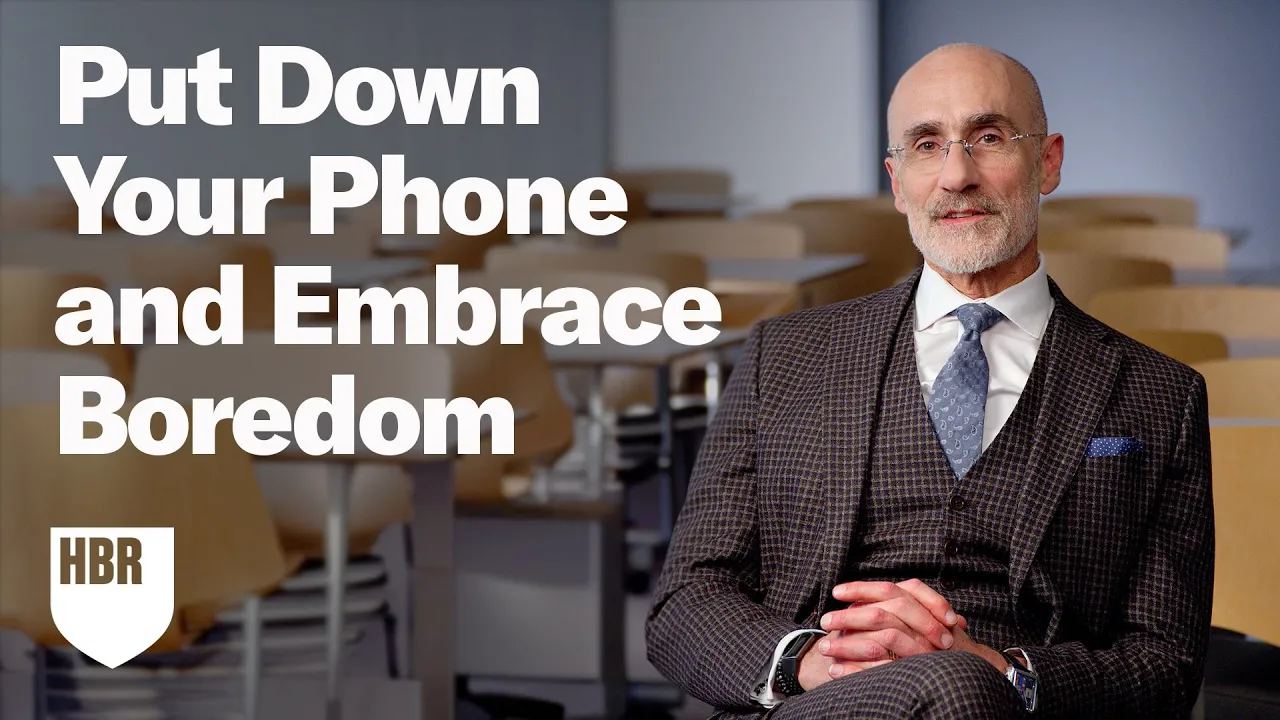
Harvard Business Review
Constantly evading downtime with smartphones silences the brain's default mode network, cutting off the existential reflection required to establish purpose and ward off depression.
AI-assisted summary of You Need to Be Bored. Here's Why. — original source. Check the original for full context.
Source published:
Key ideas
- Boredom is a critical psychological necessity that automatically triggers the brain's default mode network (DMN) when external cognitive demands cease. (0:00)
- In a Harvard study led by Dan Gilbert, a large majority of participants preferred self-administering painful electric shocks over sitting quietly with their own thoughts for 15 minutes. (0:00)
- Constantly reaching for smartphones during brief lulls creates a doom loop that suppresses existential reflection, fueling modern surges in anxiety, depression, and loss of purpose. (1:46)
- Arthur Brooks advocates building a 'boredom muscle' via 15-minute unplugged sessions and strict digital hygiene, including an evening screen curfew and phone-free family meals. (3:40)
Detailed notes
## Background Published by Harvard Business Review on YouTube on August 26, 2025, this video features Harvard professor Arthur C. Brooks examining why boredom is essential rather than detrimental. Drawing from insights explored in his work and writings, Brooks explains how downtime activates the brain's default mode network, fuels creativity, and protects individuals from anxiety and depression.
## TL;DR Arthur Brooks argues that boredom is a psychological necessity that activates the brain's default mode network, enabling people to process existential questions and find personal meaning. Modern habits of constantly reaching for smartphones suppress this network, creating a self-reinforcing loop of hollow distraction, anxiety, and depression. To break this pattern, Brooks urges viewers to actively train their tolerance for stillness through silent commutes and screen-free workouts. He details four personal digital hygiene rules—including phone-free evenings and dinners—to overcome dopamine-driven impulses and reclaim deep life purpose.
## Atmosphere & style The presentation carries the warmth, clarity, and authority of a captivating masterclass delivered by an approachable academic. Brooks balances hard psychological and neurological research with candid personal vulnerability, openly admitting his own dopamine cravings and screen-withdrawal discomfort. The pacing shifts smoothly from an analytical diagnosis of modern distraction to an empathetic, impassioned plea for intentional presence, leaving the viewer feeling gently challenged rather than judged.
## Bulletin - [00:00](https://www.youtube.com/watch?v=orQKfIXMiA8&t=0s) Boredom is a critical psychological necessity that automatically triggers the brain's default mode network (DMN) when external cognitive demands cease. - [00:00](https://www.youtube.com/watch?v=orQKfIXMiA8&t=0s) In a Harvard study led by Dan Gilbert, a large majority of participants preferred self-administering painful electric shocks over sitting quietly with their own thoughts for 15 minutes. - [01:46](https://www.youtube.com/watch?v=orQKfIXMiA8&t=106s) Constantly reaching for smartphones during brief lulls creates a doom loop that suppresses existential reflection, fueling modern surges in anxiety, depression, and loss of purpose. - [03:40](https://www.youtube.com/watch?v=orQKfIXMiA8&t=220s) Arthur Brooks advocates building a 'boredom muscle' via 15-minute unplugged sessions and strict digital hygiene, including an evening screen curfew and phone-free family meals.
## Key takeaways - [00:00](https://www.youtube.com/watch?v=orQKfIXMiA8&t=0s) Being bored is an essential psychological need rather than a flaw to be eliminated. - [00:00](https://www.youtube.com/watch?v=orQKfIXMiA8&t=0s) When external cognitive demands stop, the brain shifts to the default mode network (DMN). - [00:00](https://www.youtube.com/watch?v=orQKfIXMiA8&t=0s) People instinctively resist boredom because the default mode network forces them to confront difficult existential questions like 'What does my life mean?' - [00:00](https://www.youtube.com/watch?v=orQKfIXMiA8&t=0s) Research by Dan Gilbert shows that most people would rather endure physical electric shocks than spend 15 minutes alone with their unguided thoughts. - [00:00](https://www.youtube.com/watch?v=orQKfIXMiA8&t=0s) Widespread avoidance of existential contemplation directly contributes to rising rates of anxiety, depression, and hollowness. - [01:46](https://www.youtube.com/watch?v=orQKfIXMiA8&t=106s) Smartphones act as an omnipresent escape hatch that silences the default mode network even during brief moments of downtime. - [01:46](https://www.youtube.com/watch?v=orQKfIXMiA8&t=106s) Dodging uncomfortable questions by reaching for screens reinforces a doom loop that makes it harder to discover genuine life purpose. - [01:46](https://www.youtube.com/watch?v=orQKfIXMiA8&t=106s) Boredom can be trained as a muscle through everyday unplugged routines, such as exercising without headphones or commuting in silence. - [01:46](https://www.youtube.com/watch?v=orQKfIXMiA8&t=106s) Tolerating periods of silence for 15 minutes or longer recalibrates baseline stimulation, making ordinary work and personal relationships feel less dull. - [01:46](https://www.youtube.com/watch?v=orQKfIXMiA8&t=106s) Allowing the mind to wander provides the mental space necessary to process core pillars of human fulfillment: purpose, meaning, coherence, and significance. - [03:40](https://www.youtube.com/watch?v=orQKfIXMiA8&t=220s) Initial screen fasts trigger noticeable neurochemical dopamine withdrawal, which Brooks likens to children screaming in one's head. - [03:40](https://www.youtube.com/watch?v=orQKfIXMiA8&t=220s) Enforcing a strict device cutoff at 7:00 p.m. and banning phones from the bedroom restores mental equilibrium. - [03:40](https://www.youtube.com/watch?v=orQKfIXMiA8&t=220s) Eliminating screens from the dining table protects relational presence for the people physically present. - [03:40](https://www.youtube.com/watch?v=orQKfIXMiA8&t=220s) Configuring emergency bypass settings allows urgent calls to come through while filtering out non-essential news and social media noise.
## Detailed walkthrough ### [00:00](https://www.youtube.com/watch?v=orQKfIXMiA8&t=0s) The Default Mode Network and Why We Fear Boredom
Arthur Brooks opens with an unequivocal declaration: being bored is an absolute psychological necessity. When people are never bored, they inevitably suffer a loss of meaning and face heightened risks of depression. From a neurological standpoint, boredom occurs when the brain is free from external cognitive occupation, prompting it to transition to an internal system known as the default mode network (DMN). Far from being merely fancy academic jargon, the default mode network comprises interconnected brain structures that automatically switch on the moment an individual has nothing immediate to focus on—such as getting stuck waiting at a traffic light without a mobile phone.
Yet human beings instinctively resist this state. Brooks points to research conducted by his Harvard psychology colleague, Dan Gilbert, in which participants were instructed to sit alone in an empty room for 15 minutes with zero distractions. The only object available was a button that, if pressed, delivered a painful electric shock. Given the choice between enduring boredom with their own thoughts or experiencing physical pain, the outcome was striking: “A big majority of the participants gave themselves shocks instead of thinking about nothing.” People detest boredom because the default mode network steers attention toward deeply uncomfortable existential terrain. When the mind wanders, it naturally confronts sweeping, unresolved dilemmas such as “What does my life mean?” While facing these existential questions can feel unsettling, Brooks argues that doing so is essential for long-term psychological well-being. Today’s societal surge in anxiety and depression is intimately tied to people lacking a coherent sense of life purpose—a search previous generations engaged in, but which contemporary society has largely abandoned.
- The default mode network (DMN) activates automatically during periods of cognitive downtime when no external task demands attention. - In Dan Gilbert’s Harvard study, participants preferred self-administering painful electric shocks over sitting quietly with their thoughts for 15 minutes. - Brooks links the modern epidemic of anxiety and depression to the widespread avoidance of existential contemplation and the loss of personal meaning.
[01:46](https://www.youtube.com/watch?v=orQKfIXMiA8&t=106s) The Doom Loop of Meaning and Building the Boredom Muscle
Modern technology has provided humanity with an unprecedented escape hatch from downtime, allowing people to virtually eliminate boredom and silence their default mode network altogether. The primary culprit is the smartphone. Even during trivial pauses, such as waiting fifteen seconds on a street corner for a pedestrian light to change, people instinctively pull out their screens to avoid the mild discomfort of unguided reflection. Brooks describes this compulsive habit as a self-reinforcing trap: “If every time you're slightly bored pull out your phone, it's going to get harder and harder for you to find meaning, and that's the recipe for depression and anxiety and a sense of hollowness, which, by the way, are all through the roof.” By continuously dodging the questions they cannot easily wrap their arms around, individuals forfeit their ability to discover purpose.
To counter this cycle, Brooks urges people to intentionally practice boredom as a deliberate skill. He challenges listeners to attempt basic everyday tasks completely unplugged: going to the gym without a phone or podcast, sitting alone with one's thoughts while exercising, or commuting in complete silence without turning on the radio. Enduring periods of boredom lasting 15 minutes or longer rewires one's perspective in two major ways. First, building tolerance for cognitive stillness makes everyday routines, jobs, and personal relationships feel markedly less dull. Second, it creates the mental space required to confront the core pillars of human fulfillment: purpose, meaning, coherence, and significance.
```mermaid flowchart TD accTitle: The Doom Loop versus the Boredom Breakthrough accDescr: Flowchart illustrating how reaching for devices creates a doom loop of meaning while embracing boredom activates the default mode network to foster purpose.
subgraph DL["The Doom Loop of Meaning"] A["Momentary Downtime"] --> B["Reach for Smartphone"] B --> C["Default Mode Network Suppressed"] C --> D["Avoid Existential Reflection"] D --> E["Hollowness, Anxiety & Depression"] E --> A end
subgraph BB["The Boredom Breakthrough"] F["Tolerate Boredom (15+ Minutes)"] --> G["Default Mode Network Activates"] G --> H["Mind Wanders into Big Questions"] H --> I["Creative Ideas, Purpose & Meaning"] end ```
- Withdrawing from constant digital stimulation unlocks higher-level creative thinking during routine activities like working out. - Tolerating 15-minute intervals of silence recalibrates baseline stimulation, reducing boredom in ordinary workplace and relational settings. - Sustained mind-wandering directs cognitive resources toward the key dimensions of well-being: coherence, purpose, and significance.
[03:40](https://www.youtube.com/watch?v=orQKfIXMiA8&t=220s) Practicing What You Preach: Digital Hygiene Protocols and Dispelling Excuses
Anticipating skepticism, Brooks confirms that he adheres strictly to his own guidance, noting that he shares the exact same neurochemical vulnerabilities and addictive dopamine impulses as anyone else. When he embarks on screen fasts, he admits the initial withdrawal feels “like children screaming in my head” demanding the device. To maintain psychological balance, he relies on four concrete digital hygiene rules: 1. Enforcing a strict no-device policy after 7:00 p.m. 2. Keeping the phone completely out of the bedroom overnight. 3. Banning devices during family meals, explaining: “We're there for each other. We're not there for people who aren't there.” 4. Scheduling regular, extended cleanses from screens and social media to reset dopamine levels and remember that life does not need to revolve around technology.
Brooks dismantles the common objection that disconnecting risks missing urgent crises. Modern devices allow users to configure settings so that only one or two vital contacts can break through in genuine emergencies—a feature he humorously suggests asking your kids to set up if you cannot figure it out yourself. Beyond true emergencies, Brooks stresses that the vast majority of digital consumption is trivial: breaking political news and social media chatter do not require instant attention. Previous generations lived healthy, productive lives without tracking developments in Washington, D.C., second by second. Closing with an urgent appeal to both his own children and the audience, Brooks implores: “You need more meaning in your life. And so do I.”
- Establishing boundaries—such as an evening device curfew and phone-free dinner tables—protects interpersonal presence and mental calm. - Dopamine withdrawal symptoms during digital fasts are intense initially but dissipate as the nervous system re-regulates. - Emergency bypass filters allow crucial family calls to come through while filtering out the non-essential noise of news and social media.
## Notable quotes > [01:46](https://www.youtube.com/watch?v=orQKfIXMiA8&t=106s) If every time you're slightly bored pull out your phone, it's going to get harder and harder for you to find meaning, and that's the recipe for depression and anxiety and a sense of hollowness. — Arthur Brooks
## Mentioned Arthur C. Brooks, Dan Gilbert, Harvard University, Harvard Business Review, The Happiness Files, The Leader’s Happiness Reset, The Atlantic
## Video description Boredom isn’t a bug—it’s a feature. Harvard professor Arthur C. Brooks explains why boredom unlocks creativity, activates a powerful brain network, and might even protect you from depression. Learn how the mind wanders—and why that’s a very good thing.
For more insights on leadership, success, and workplace well-being, explore Arthur's new book, "The Happiness Files", a curated selection of essays from his popular column in The Atlantic: https://www.amazon.com/dp/B0F4MFQ6VN
You can also sign up to receive Arthur’s new six-week newsletter, “The Leader’s Happiness Reset.” It includes excerpts from his new book along with insights and guidance on how to find happiness at work, for yourself and for your team: https://hbr.org/email-newsletters.
More by Arthur Brooks: https://arthurbrooks.com/
Books, tools, and more: store.hbr.org
Follow us: https://hbr.org/ https://www.linkedin.com/company/harvard-business-review/ https://www.facebook.com/HBR/ https://twitter.com/HarvardBiz https://www.instagram.com/harvard_business_review
Sign up for Newsletters: https://hbr.org/email-newsletters
#HarvardBusinessReview #YourCareer #Career #Job #Work #Business #Harvard #HarvardBusinessSchool
Copyright © 2025 Harvard Business School Publishing. All rights reserved.
[Source](https://www.youtube.com/watch?v=orQKfIXMiA8)