NASA Redesigns Apollo F-1 as Lost Craftsmanship Blocks Direct Rebuild
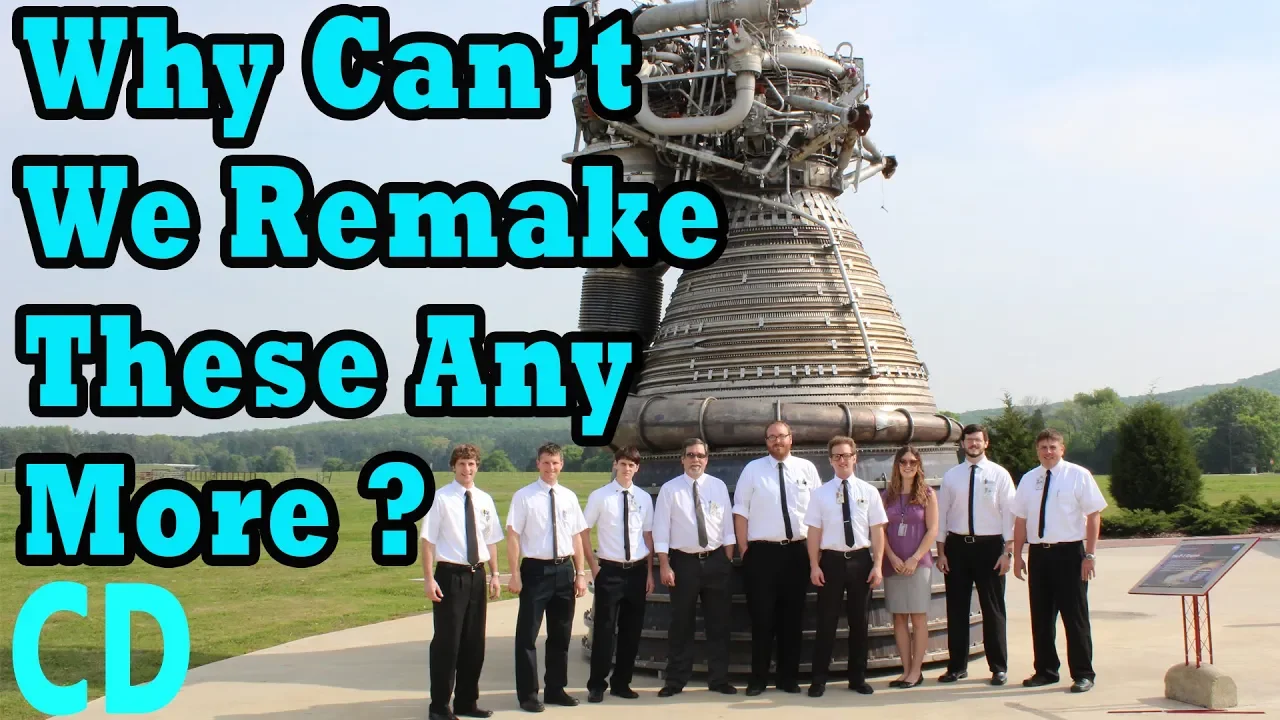
Curious Droid
Engineers could not reproduce the Apollo-era F-1 rocket engine from surviving blueprints because 1960s manufacturing relied on undocumented manual adjustments and artisan craftsmanship that no longer exist.
AI-assisted summary of Why Can't we Remake the Rocketdyne F1 Engine? — original source. Check the original for full context.
Source published:
Key ideas
- NASA's SLS Advanced Booster Competition favored liquid-fueled engine concepts over solid boosters due to critical safety features like mid-flight throttling and shutdown capabilities. (0:00)
- The persistent rumor that NASA lost the original Saturn V and F-1 blueprints is false; every design document remains preserved in agency archives. (1:34)
- The true barrier to remaking the F-1 was lost institutional knowledge: 1960s engines were essentially handcrafted machines shaped by unrecorded manual modifications and trial-and-error testing. (1:34)
- By reverse-engineering museum artifacts and applying modern manufacturing, engineers designed the F-1B, reducing the engine's part count from roughly 5,600 individual components to just 40 while delivering 1.8 million pounds of thrust. (3:45)
Detailed notes
## Background This video was written, presented, and published by Paul Shillito on the YouTube channel Curious Droid on July 24, 2018. According to the page description, the episode explores what happened when NASA engineers evaluated resurrecting the historic Apollo-era Rocketdyne F-1 engine to power the Space Launch System boosters, revealing how drastically aerospace manufacturing has evolved since the 1960s.
## TL;DR When evaluating expendable booster concepts for the Space Launch System, NASA examined whether the legendary Rocketdyne F-1 engine from the Saturn V could simply be put back into production. Despite persistent myths claiming the blueprints were lost, all original schematics remain preserved; the true barrier was the loss of the 1960s manual craftsmanship, undocumented workarounds, and bespoke assembly methods required to build them. Engineers instead reverse-engineered surviving museum artifacts using modern CAD modeling to conceptualize the F-1B, which matched the original's 1.8 million pounds of thrust while consolidating roughly 5,600 handcrafted parts down to just 40 major components. Ultimately, the project demonstrated that starting from scratch with modern manufacturing techniques is far more practical than attempting to replicate obsolete manual engineering.
## Atmosphere & style The presentation is brisk, informative, and engaging, led by host Paul Shillito's warm, matter-of-fact British narration and signature vintage style. Rather than relying on technical jargon or dry academic recitations, the video strikes an inquisitive, myth-busting tone that dismantles popular aerospace folklore with calm authority. The viewing experience feels like an insightful engineering post-mortem, contrasting the visceral, trial-and-error sweat of the 1960s Space Race against the clean, precise elegance of modern digital design.
## Bulletin - [00:00](https://www.youtube.com/watch?v=ovD0aLdRUs0&t=0s) NASA's SLS Advanced Booster Competition favored liquid-fueled engine concepts over solid boosters due to critical safety features like mid-flight throttling and shutdown capabilities. - [01:34](https://www.youtube.com/watch?v=ovD0aLdRUs0&t=94s) The persistent rumor that NASA lost the original Saturn V and F-1 blueprints is false; every design document remains preserved in agency archives. - [01:34](https://www.youtube.com/watch?v=ovD0aLdRUs0&t=94s) The true barrier to remaking the F-1 was lost institutional knowledge: 1960s engines were essentially handcrafted machines shaped by unrecorded manual modifications and trial-and-error testing. - [03:45](https://www.youtube.com/watch?v=ovD0aLdRUs0&t=225s) By reverse-engineering museum artifacts and applying modern manufacturing, engineers designed the F-1B, reducing the engine's part count from roughly 5,600 individual components to just 40 while delivering 1.8 million pounds of thrust.
## Key takeaways - [00:00](https://www.youtube.com/watch?v=ovD0aLdRUs0&t=0s) NASA investigated liquid-fueled options for the SLS boosters to provide the ability to throttle back or shut down engines in the event of an in-flight anomaly. - [00:00](https://www.youtube.com/watch?v=ovD0aLdRUs0&t=0s) Solid rocket boosters cannot be extinguished once ignited, presenting distinct safety limitations compared to liquid propulsion. - [00:00](https://www.youtube.com/watch?v=ovD0aLdRUs0&t=0s) Repurposing complex and expensive Space Shuttle RS-25D engines for expendable, single-use SLS boosters was deemed financially and mechanically wasteful. - [00:00](https://www.youtube.com/watch?v=ovD0aLdRUs0&t=0s) The Apollo-era Rocketdyne F-1 was considered an ideal booster candidate because of its immense thrust, mechanical simplicity, and relatively low manufacturing cost. - [01:34](https://www.youtube.com/watch?v=ovD0aLdRUs0&t=94s) Claims that NASA lost or destroyed the original Apollo program blueprints are completely untrue, as all schematics remain archived. - [01:34](https://www.youtube.com/watch?v=ovD0aLdRUs0&t=94s) Original F-1 production relied on slide rules, physical trial-and-error firing tests, and extensive manual fabrication rather than computer-aided design. - [01:34](https://www.youtube.com/watch?v=ovD0aLdRUs0&t=94s) Every Apollo-era F-1 was essentially a unique, bespoke mechanical sculpture featuring undocumented manual adjustments by specialized craftsmen. - [01:34](https://www.youtube.com/watch?v=ovD0aLdRUs0&t=94s) Because critical manufacturing techniques were kept in the memories of 1960s technicians who have since retired or passed away, the original manufacturing process cannot be replicated. - [03:45](https://www.youtube.com/watch?v=ovD0aLdRUs0&t=225s) Modern propulsion engineers scanned and tore down surviving museum F-1 engines to capture their underlying physics and design principles. - [03:45](https://www.youtube.com/watch?v=ovD0aLdRUs0&t=225s) The resulting F-1B design was projected to produce 1.8 million pounds of thrust, matching the output of the unflown Apollo-era F-1A upgrade. - [03:45](https://www.youtube.com/watch?v=ovD0aLdRUs0&t=225s) Advanced modern casting and manufacturing consolidated approximately 5,600 individual F-1 components down to just 40 major parts for the F-1B. - [03:45](https://www.youtube.com/watch?v=ovD0aLdRUs0&t=225s) The engineering study demonstrated that redesigning a complex system from scratch with modern tools is often far more practical than attempting to recreate obsolete historical craftsmanship.
## Detailed walkthrough ### [00:00](https://www.youtube.com/watch?v=ovD0aLdRUs0&t=0s) The SLS Booster Problem and the F-1 Legacy
As technology leaps forward, conventional wisdom suggests that recreating a half-century-old machine should be relatively straightforward. However, the realities of aerospace engineering prove far more complicated. When NASA began developing the Space Launch System (SLS), the agency hosted the Advanced Booster Competition to determine the propulsion system that would flank the heavy-lift rocket. Two of the three proposed configurations relied on liquid-fueled engines rather than solid rocket motors. Liquid-fueled boosters offered distinct safety advantages, most notably the crucial ability to be throttled back or shut down completely in the event of an in-flight anomaly—an option entirely impossible once a solid rocket booster has been ignited.
The logistical challenge came down to engine availability and expendability. Unlike the reusable Space Shuttle orbiters, the boosters designed for the SLS were designated as single-use hardware that would burn up upon re-entering Earth's atmosphere. There were simply no massive, production-ready liquid engines in active service capable of meeting the thrust requirements. While engineers could theoretically have clustered four modified RS-25D engines—the high-performance Space Shuttle Main Engines already earmarked to power the SLS core stage—doing so was widely seen as an extraordinarily wasteful sacrifice of an intricate, expensive, and exquisitely efficient piece of machinery.
Looking back through NASA's history, the obvious candidate for the role was the legendary Rocketdyne F-1, the towering powerplant that propelled the Apollo program's Saturn V rocket on journeys to the Moon. The F-1 was not only intensely powerful but comparatively simple in architecture, making it inexpensive enough to treat as an expendable asset. Despite these appealing traits, an F-1 had not rolled off an assembly line since the late 1960s, prompting the obvious question: why not simply put the original engine back into production?
- Two out of three entries in NASA's SLS Advanced Booster Competition favored liquid-fueled engine configurations. - Liquid rocket boosters can be shut down mid-flight if a catastrophic failure occurs, whereas solid rocket boosters cannot be extinguished once lit. - Repurposing additional Space Shuttle RS-25D engines for expendable booster duty was rejected as financially and mechanically wasteful. - As Paul Shillito observes: “The F-1 engines were not only extremely powerful but they were also simple which meant they were cheap enough to be disposable so why don't we just remake them.”
---
[01:34](https://www.youtube.com/watch?v=ovD0aLdRUs0&t=94s) The Blueprint Myth and the Lost Art of Handcrafted Rocketry
A widespread urban legend insists that NASA somehow misplaced, discarded, or destroyed the original Saturn V and F-1 blueprints. In reality, this claim is pure fiction; every single design document and schematic generated across the Apollo program remains carefully cataloged and accessible in the agency's archives. If reviving the engine were merely a matter of pulling vintage microfiche out of storage and feeding it to a factory floor, aerospace contractors would have done so decades ago. The insurmountable hurdle was not the technical drawings themselves, but the fundamental divergence in how aerospace manufacturing has evolved over the intervening fifty years.
When modern propulsion engineers sat down to examine how the F-1 was physically built, they encountered a manufacturing philosophy radically alien to modern standards. In the 1960s, computer-aided design (CAD) did not exist. Rocketry was guided by slide rules, intuitive approximations, and iterative trial-and-error firing tests on physical test stands. Components were designed on paper, physically hammered or turned into metal, stress-tested, and then modified by hand on the shop floor before being approved. Subassemblies were stitched together from hundreds of discrete individual parts through painstaking manual labor, with master craftsmen spending entire shifts executing a single intricate, specialized weld.
What was entirely missing from the blueprints was the institutional knowledge—the undocumented oral tradition and personal adjustments made by the original workforce. Each F-1 engine was essentially a bespoke, handcrafted mechanical sculpture possessing its own distinctive tolerances, quirks, and mechanical idiosyncrasies. Under extreme political pressure to meet President Kennedy’s end-of-the-decade lunar deadline, technicians and fitters kept critical manufacturing workarounds stored in their memories or scribbled on loose scraps of paper that vanished long ago. Fifty years later, that generational cohort has retired or passed away, taking those obsolete manual arts with them, leaving contemporary engineers unable to reproduce the engines using the historical methods.
- Every original Apollo program blueprint and design document remains preserved in the archives; none were lost or destroyed. - Fabrication in the 1960s relied heavily on slide-rule calculations, trial-and-error testing, and manual modifications rather than computer simulation. - Single complex subassembly welds could consume an entire workday for an expert welder. - Paul Shillito dispels the persistent archival rumor directly: “Now there is a common myth which says NASA lost or threw away the blueprints which of course is complete rubbish every design document ever created for the Apollo program is still available but if it was just a case of wheeling out old designs they would have done that years ago.”
---
[03:45](https://www.youtube.com/watch?v=ovD0aLdRUs0&t=225s) Reverse-Engineering the F-1B and Redesigning the Past
Rather than trying to blindly copy the past, modern rocket engineers undertook a forensic teardown of surviving F-1 engines housed in museum displays and long-term storage facilities. By scanning, measuring, and dissecting these historic artifacts with contemporary diagnostic instruments, the team extracted the core physics of the machine to draft an advanced descendant: the F-1B. Designed with the aid of computer fluid dynamics, finite-element modeling, and modern manufacturing technology, the reimagined F-1B was projected to equal the output of the uprated, unflown 1960s F-1A variant, generating a staggering 1.8 million pounds of thrust while achieving superior operational efficiency.
The dramatic advantage of modern manufacturing lay in parts consolidation. The Apollo-era F-1 required roughly 5,600 individual components to be manually mated, brazed, and welded together. Through advanced casting and modern fabrication methods, the F-1B design slashed that parts inventory down to a mere 40 major pieces. This staggering reduction eliminated hundreds of potential failure points, drastically reduced production overhead, and significantly increased reliability. Even though NASA ultimately selected traditional solid rocket boosters for the initial iterations of the SLS, the F-1 resurrection study yielded a definitive lesson for high-tech engineering: starting clean on a modern drawing board is often far easier than attempting to resurrect obsolete craftsmanship.
```mermaid flowchart TD accTitle: F-1 to F-1B Evolution accDescr: Diagram illustrating the shift from manual 1960s F-1 construction to the modern CAD-driven F-1B redesign. subgraph Apollo["Apollo Era: Rocketdyne F-1"] A["Slide Rules & Trial-and-Error"] --> B["Handcrafted Components"] B --> C["~5,600 Individual Parts"] C --> D["Manual Hand Welds"] end subgraph Modern["Modern Era: F-1B Redesign"] E["Museum Engine Scans"] --> F["Modern CAD & Computer Modeling"] F --> G["Just 40 Manufactured Parts"] G --> H["1.8M lbf Thrust & Lower Costs"] end Apollo -.->|"Redesigning from Scratch"| Modern ```
- The modernized F-1B design matched the power of the Apollo-era F-1A upgrade, producing 1.8 million pounds of thrust. - Advanced casting and computer-aided fabrication reduced the total manufactured component count from approximately 5,600 parts to just 40. - Fewer parts and seams directly improved structural reliability while suppressing fabrication expenses. - Summing up the core engineering takeaway, Paul Shillito reflects: “Although in the end NASA selected the solid rocket boosters for the SLS, this exercise proved that it's sometimes easier to redesign something from scratch than it is to try and remake the past.”
## Notable quotes > [03:45](https://www.youtube.com/watch?v=ovD0aLdRUs0&t=225s) it's sometimes easier to redesign something from scratch than it is to try and remake the past. — Paul Shillito
## Mentioned NASA, Space Launch System (SLS), Rocketdyne, Rocketdyne F-1, F-1A, F-1B, Saturn V, Apollo program, RS-25D, Space Shuttle, Paul Shillito, John F. Kennedy
## Video description When NASA was looking for a very large engine for the SLS boosters some of its engineers looked at resurrecting the Rocketdyne F-1 engines but what they found out might well surprise some people and just goes to show how things have moved on since the 1960's.
Patroen : https://www.patreon.com/curiousdroid
Patroens : Kosmonaut, Muhammad Tauha Ali, Pascal Hausammann Florian Hesse.
Also : Mark Orser, Jonathan Merage, Daniele Noacco, Dale Kirkwood, Alan Johns, Rodney Aries, Johan Roman, Morten Granvold Tim Allen, David Thomas, Robert Goldwein, Oscar Anderson, Collin Copfer, coolascats, Katy, Blair Leduc, La¡szla Antal, Chad Mellor, Giacomo Catenazzi, AMIR BLACHMAN, Larry Ackerman, Ara Kirakosyan, Johan Rombaut, Kevin Hinnen, Mitchel J. Mullin II, Hunter Schwisow, Cody Belichesky, Mogoreanu Daniel, Marcus Chiado, Jorn Magnus Karlsen.
This episodes shirt is the ‘Capo’ Paisley Mod Spear collar by Madcap England available from https://www.atomretro.com/madcap_england
Get 10% off using the code DROID10
Presented by Paul Shillito
Written and Researched by Paul Shillito
Footage and images NASA, Rocketdyne Dynetics
Music by Mike Mullen BMI www.positrosmic.com with James Zota Baker on guitar www.jameszotabaker.com
[Source](https://www.youtube.com/watch?v=ovD0aLdRUs0)