David Marquet Scraps Orders to Drive USS Santa Fe to Record Navy Score
Speakers Spotlight
Pushing decision-making authority down to front-line personnel produces superior operational results because technical information sits with operators rather than central executives.
AI-assisted summary of Inno-Versity Presents: Greatness by David Marquet — original source. Check the original for full context.
Source published:
Key ideas
- Assigned to the USS Santa Fe with only two weeks of preparation after a year studying a different submarine, David Marquet recognized that a captain lacking ship-specific knowledge paired with an obedient crew was a recipe for catastrophe. (0:19)
- To break passive compliance, Marquet eliminated routine operational orders and replaced permission-seeking with intent-based language, requiring officers to state 'I intend to' instead of requesting permission. (2:03)
- Safely transferring control depends entirely on establishing two core pillars: technical competence ('Is it safe?') and organizational clarity ('Is it the right thing to do?'). (4:18)
- By moving authority to where operational information resides rather than routing data upward to central leadership, the previously dead-last USS Santa Fe achieved the highest inspection score in naval history. (6:16)
Detailed notes
## Background Published on YouTube by Speakers Spotlight on October 15, 2013, this video features retired US Navy Captain David Marquet delivering an Inno-Versity presentation on leadership and innovation. The page description highlights Marquet's turnaround of the nuclear submarine USS Santa Fe from "worst to first" by treating his crew as leaders rather than followers, a method chronicled in his book Turn the Ship Around!.
## TL;DR Faced with captaining the nuclear submarine USS Santa Fe after having trained for an entirely different vessel, David Marquet recognized the peril of leading a crew conditioned to follow orders blindly. To break this dynamic, he vowed to stop issuing routine operational orders, replacing direct instructions with clear intent and shifting the language of his crew from seeking permission to stating their intentions. By anchoring this transfer of control on two pillars—technical competence ("Is it safe?") and organizational clarity ("Is it the right thing to do?")—Marquet pushed decision-making authority directly to where information lived, resulting in record-breaking operational inspections. Ultimately, he argues that true leadership is not measured by individual heroism, but by creating an empowering environment that enables everyone across the organization to achieve greatness.
## Atmosphere & style The presentation carries an engaging, direct, and candid energy, pairing self-deprecating humor about being an operational "dummy" with the grounded gravity of nuclear submarine command. Marquet's delivery is crisp, kinetic, and passionate, eschewing polished corporate jargon in favor of visceral military realities and unvarnished admissions of vulnerability. The narrative moves from the impending dread of catastrophic blind obedience to a sharp, empowering epiphany, leaving the audience with an inspiring yet pragmatically challenging call to overcome their own instincts to control.
## Bulletin - [00:19](https://www.youtube.com/watch?v=psAXMqxwol8&t=19s) Assigned to the USS Santa Fe with only two weeks of preparation after a year studying a different submarine, David Marquet recognized that a captain lacking ship-specific knowledge paired with an obedient crew was a recipe for catastrophe. - [02:03](https://www.youtube.com/watch?v=psAXMqxwol8&t=123s) To break passive compliance, Marquet eliminated routine operational orders and replaced permission-seeking with intent-based language, requiring officers to state 'I intend to' instead of requesting permission. - [04:18](https://www.youtube.com/watch?v=psAXMqxwol8&t=258s) Safely transferring control depends entirely on establishing two core pillars: technical competence ('Is it safe?') and organizational clarity ('Is it the right thing to do?'). - [06:16](https://www.youtube.com/watch?v=psAXMqxwol8&t=376s) By moving authority to where operational information resides rather than routing data upward to central leadership, the previously dead-last USS Santa Fe achieved the highest inspection score in naval history.
## Key takeaways - [00:19](https://www.youtube.com/watch?v=psAXMqxwol8&t=19s) A leader conditioned to issue commands paired with a team conditioned only to obey creates a dangerous dynamic of blind compliance. - [00:19](https://www.youtube.com/watch?v=psAXMqxwol8&t=19s) Traditional command cultures rely on the Hollywood archetype of an omniscient leader barking orders, ignoring front-line realities and limitations. - [02:03](https://www.youtube.com/watch?v=psAXMqxwol8&t=123s) Replacing instructions with intent forces team members to think critically and solve problems rather than waiting to be directed. - [02:03](https://www.youtube.com/watch?v=psAXMqxwol8&t=123s) Marquet retained only one order for himself—the launch of lethal weapons—carrying the moral responsibility personally while delegating all routine evolutions. - [02:03](https://www.youtube.com/watch?v=psAXMqxwol8&t=123s) Transitioning team language from 'Request permission to...' to 'I intend to...' transfers psychological ownership directly to subordinates. - [04:18](https://www.youtube.com/watch?v=psAXMqxwol8&t=258s) Releasing operational control without technical competence causes chaos; leaders must first confirm that teams know how to execute actions safely. - [04:18](https://www.youtube.com/watch?v=psAXMqxwol8&t=258s) Organizational clarity ensures that technically competent actions align directly with the strategic mission and broader organizational goals. - [04:18](https://www.youtube.com/watch?v=psAXMqxwol8&t=258s) When competence and clarity permeate an organization, even entry-level watchstanders adapt their tasks based on high-level operational context without waiting for orders. - [06:16](https://www.youtube.com/watch?v=psAXMqxwol8&t=376s) Traditional top-down structures waste human capital by reducing an entire organization to one primary thinker supported by passive order-followers. - [06:16](https://www.youtube.com/watch?v=psAXMqxwol8&t=376s) High-performing organizations move authority to where information lives rather than channeling information up to where authority sits. - [06:16](https://www.youtube.com/watch?v=psAXMqxwol8&t=376s) Front-line personnel with access to immediate operational information make faster, higher-quality decisions than disconnected senior executives. - [08:12](https://www.youtube.com/watch?v=psAXMqxwol8&t=492s) Surrendering control feels inherently uncomfortable because leaders are culturally and biologically conditioned to seize control and amass followers. - [08:12](https://www.youtube.com/watch?v=psAXMqxwol8&t=492s) Leadership greatness is evaluated not by personal accolades or individual heroics, but by creating an environment where surrounding teams and individuals achieve greatness.
## Detailed walkthrough ### [00:19](https://www.youtube.com/watch?v=psAXMqxwol8&t=19s) The Deadly Combination and the Wardroom Epiphany
David Marquet recounts finding himself in a perilous leadership dilemma: he had spent a full year studying and preparing to captain a different submarine, the USS *Olympia*, but was assigned to the USS *Santa Fe* with only two weeks of preparation. Meanwhile, his crew had been conditioned purely to follow orders without question. As Marquet explains, “I was trained for one submarine, my guys were trained to do what they were told; that's a deadly combination.” Recognizing that blindly following a leader leads organizations directly into disaster, he gathered his officers in the wardroom and openly stated the reality: he had been trained for a completely different ship, yet they were poised to obey whatever nonsense came out of his mouth. The crew already knew it; as Marquet humorously notes, he felt like he had been largely talking to himself anyway.
```mermaid flowchart TD accTitle: The Wardroom Dilemma accDescr: Visualizing the deadlock between standard captain behavior and the reality aboard USS Santa Fe.
subgraph Problem["The Dangerous Default"] A["Captain trained for USS Olympia<br/>(Only 2 weeks on Santa Fe)"] B["Crew trained to obey orders<br/>without question"] A --> C["Deadly combination of blind obedience"] B --> C end
subgraph Solution["The Wardroom Shift"] D["Initial suggestion:<br/>Captain must learn every valve & pipe"] E["Timeline failure:<br/>Takes 1 year; deployment in 6 months"] F["Radical decision:<br/>Captain stops giving orders"] D --> E --> F end
C --> D ```
When discussing solutions, the initial reaction from the crew was that the captain simply needed to get smarter and issue better orders. But mastering miles of valves, pipes, and complex nuclear systems would take at least a year, whereas the ship had to deploy in just six months. The officers arrived at the only logical alternative: pointing at Marquet, they told him that he needed to "shut up." This went against every traditional Hollywood stereotype of naval command, where captains walk around sounding like Russell Crowe—barking commands like *“ahead two-thirds,”* *“dive, make your depth 500 feet,”* *“steady course 255,”* or ordering torpedoes loaded and outer doors opened. Yet Marquet realized they were completely right.
- **Preparation mismatch**: Marquet spent 12 months learning the USS *Olympia*, but had only two weeks on the USS *Santa Fe*. - **Deployment timeline**: The submarine had to deploy in six months, making the "study for a year" option completely unviable. - **The traditional mold**: Nuclear submarine captains are culturally expected to bark continuous operational commands and act as omniscient authorities.
[02:03](https://www.youtube.com/watch?v=psAXMqxwol8&t=123s) Vowing Never to Give Another Order: Replacing Instructions with Intent
Accepting the crew's conclusion, Marquet made a vow never to issue another order aboard the submarine. An outside visitor walking onto the USS *Santa Fe* would have had trouble figuring out who the captain was because he simply was not seen barking instructions. Marquet retained exactly one order for himself: the command to launch a weapon, whether a torpedo or a missile. Because that action would result in taking human lives, he felt a strict moral and ethical obligation to keep the weight of that consequence solely on his own conscience. Outside of that sole exception, he refused to issue authorizations for the long catalog of routine evolutions that Navy rules typically require the captain to sign off on—submerging, getting underway, starting up or shutting down the reactor, connecting or disconnecting shore power, and rigging the ship for dive.
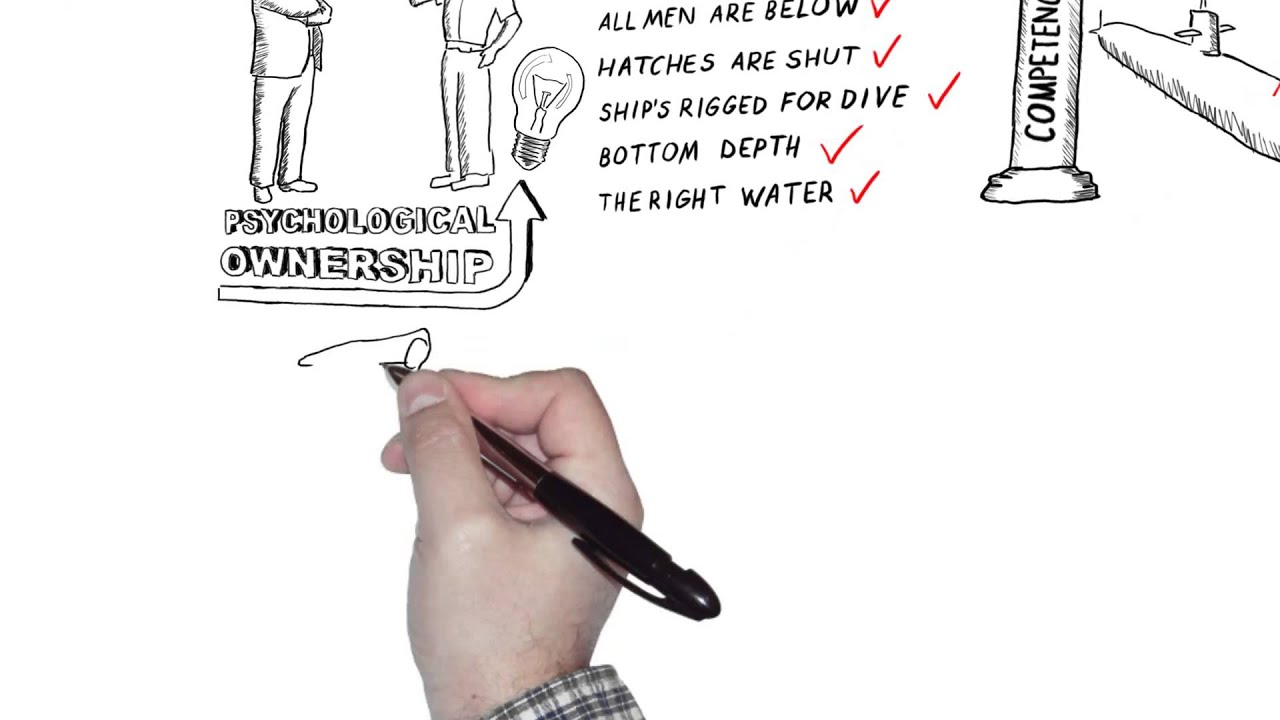
Instead of issuing instructions, Marquet replaced them with "intent." As he summarizes: “If you want your people to think, don't give instructions; give intent.” When officers approached asking what course to steer, rather than giving rudder orders, Marquet asked them what they were trying to accomplish and where the ship needed to be positioned relative to an approaching enemy submarine. The officers then identified the appropriate position, and he told them to proceed. Crucially, the officers stopped asking for permission. Instead of asking *“Captain, request permission to submerge the ship,”* they switched to stating, *“Captain, I intend to submerge the ship.”* Marquet responded with *“Very well,”* shifting the psychological ownership entirely to them. By forcing officers to find the answers rather than relying on him as the "answer man," Marquet freed himself from micromanagement and allowed his crew to take true ownership.
```mermaid flowchart LR accTitle: Intent-Based Command vs Traditional Permission accDescr: Comparison between top-down command and intent-based leadership on the USS Santa Fe.
subgraph Traditional["Traditional Command"] T1["Officer asks permission:<br/>'Request permission to submerge'"] --> T2["Captain issues order:<br/>'Submerge the ship'"] T2 --> T3["Ownership remains with Captain"] end
subgraph IntentBased["Intent-Based Leadership"] I1["Captain provides intent & goal"] --> I2["Officer states intention:<br/>'Captain, I intend to submerge'"] I2 --> I3["Captain validates:<br/>'Very well'"] I3 --> I4["Ownership shifts to crew"] end ```
- **The single retained order**: Marquet reserved only the launch order for lethal weapons (missiles and torpedoes) to bear the moral burden himself. - **Bypassed routine authorizations**: Starting/shutting down reactors, shore power connections, and submerging were delegated away from direct captain orders. - **Language shift**: Replacing *“Request permission to…”* with *“I intend to…”* shifted psychological ownership from the captain to the officers.
[04:18](https://www.youtube.com/watch?v=psAXMqxwol8&t=258s) The Two Pillars of Giving Control: Competence and Clarity
Marquet soon expanded the "I intend to" interaction into an active thinking exercise. Whenever an officer stated an intention to submerge, Marquet asked what the officer thought he was thinking. The officers correctly guessed that the captain was wondering whether it was safe. Marquet challenged them to convince him: the officer would run through the technical checks—confirming all crew members were below deck, hatches were shut, the ship was rigged for dive, bottom sounding depth was verified, and the submarine was within its assigned waters. Later, Marquet added a second inquiry: *“Is it the right thing to do?”* to which the officer would justify the action based on the vessel's broader mission requirements.
```mermaid flowchart TD accTitle: The Two Pillars of Giving Control accDescr: The two core foundations needed to safely transfer control to a team.
P1["Technical Competence<br/>('Is it safe?')"] --> C["GIVING CONTROL"] P2["Organizational Clarity<br/>('Is it the right thing to do?')"] --> C C --> O["Flawless Execution &<br/>Leadership at Every Level"] ```
These two diagnostic questions formed what Marquet terms the foundational pillars for delegating control:
> “These are the two pillars that need to be in place: the technical competence, which is represented by 'is it safe,' and the organizational Clarity, which is represented by 'is it the right thing to do?'”
Once technical competence and organizational clarity are firmly established, leaders can safely release control and be "off to the races." Within 24 hours, the behavioral shift was palpable, and over the next couple of years, it permeated the entire vessel. Officers began thinking like the captain, which caused the enlisted crew beneath them to think like the officers. Down in the engine room, a lower-level watchstander logging lube-oil pump pressures knew the ship's operational context—whether they were close to an adversary and needed to maintain absolute acoustic silence, or whether they had opened the distance, making it safe to change filters and make noise.
- **Pillar 1: Technical Competence**: Verified by the check *“Is it safe?”* ensuring operational and physical readiness before acting. - **Pillar 2: Organizational Clarity**: Verified by the check *“Is it the right thing to do?”* ensuring actions align directly with the strategic mission. - **Watchstander context**: Engine room personnel adjusted acoustic hygiene based on knowing the tactical scenario, rather than waiting for discrete noise-silence orders.
[06:16](https://www.youtube.com/watch?v=psAXMqxwol8&t=376s) "Worst to First": Moving Authority to the Information
A year after beginning this transformation, the USS *Santa Fe* underwent a comprehensive naval operational inspection. The inspection team awarded the crew the highest operational grade they had ever recorded in naval history—surpassing scores across the entire Pacific fleet. Marquet remarks on the paradox: the ship achieved historic excellence despite having a captain who started out as a complete "dummy" on the vessel's specific layout. The difference was systemic: on a conventional submarine, there is one person thinking, one person giving orders, and 134 people waiting to be told what to do.
> “On my submarine, I got 135 thinking, active, passionate, creative, proactive, taking initiative people; it's a tidal wave, you don't stand a chance.”
Marquet translates this experience into a core rule for modern leadership: move the authority to where the information resides, rather than forcing information upward to where authority sits. In business, that means letting software engineers decide when software is ready to ship, or empowering sales representatives to close deals regardless of price thresholds. This does not mean creating chaos with people running in random directions; rather, leaders must create an environment where front-line employees make decisions as if the CEO were standing right behind them. In fact, their decisions will often be superior to the CEO's because front-line workers have direct access to the actual operational information.
```mermaid flowchart LR accTitle: Traditional Information Bottleneck vs Moving Authority accDescr: Comparing routing information up to authority versus pushing authority down to the information.
subgraph Centralized["Traditional Model"] F1["Front-line Information"] -->|"Delay / Distortion"| Exec["Central Authority"] Exec -->|"Orders"| F1 end
subgraph Distributed["Santa Fe Model"] F2["Front-line Information + Authority"] -->|"Instant, Better Decisions"| Action["Flawless Execution"] end ```
- **Inspection record**: The Santa Fe earned the highest score ever seen by the inspection team, not merely for that year or region. - **The manpower math**: 135 proactive, engaged thinkers versus a 1-thinker, 134-follower model. - **Speed of execution**: Pushing authority down eliminates bureaucratic bottlenecks, delays, and employee disenfranchisement.
[08:12](https://www.youtube.com/watch?v=psAXMqxwol8&t=492s) The Discomfort of Leadership and the Definition of Greatness
Marquet acknowledges that while the mechanics of this framework sound simple, implementing it is profoundly difficult because of human conditioning. Leaders are culturally and biologically conditioned to take charge, make things happen, seize control, and attract followers. Reversing this habit feels unnatural:
> “The secret is nothing is—nothing I said is hard; there's nothing hard, the only that's hard is you: it will feel wrong.”
He cautions that anyone undertaking this path will experience moments of failure and frustration, slipping back into old, controlling habits before picking themselves back up to try again. However, true greatness as a leader is not measured by personal accolades, individual heroism, or direct deeds. Rather, true greatness is realized by cultivating an empowering environment that allows the people around you—their teams, their families, their schools, and their broader organizations—to achieve greatness themselves. He concludes with the direct charge: “Go forth and be great.”
- **Conditioning hurdle**: Leaders must overcome the ingrained impulse to take control and gather followers, choosing instead to give control and produce leaders. - **Nonlinear progress**: Transitioning away from top-down command involves backsliding into old patterns before successfully re-engaging intent-based leadership. - **Definition of greatness**: Evaluated by the sustained success and empowerment of the people left behind, not the personal deeds of the person at the top.
## Notable quotes > [02:03](https://www.youtube.com/watch?v=psAXMqxwol8&t=123s) If you want your people to think, don't give instructions; give intent. — David Marquet
## Mentioned David Marquet, USS Olympia, USS Santa Fe, Russell Crowe, Columbia University, Fortune, Turn the Ship Around! How to Create Leadership at Every Level
## Video description David Marquet - Retired US Navy Captain | Expert on Leadership and Innovation
David Marquet single-handedly "turned his ship around" when he became captain of the USS Santa Fe, a nuclear powered submarine which had a crew ranked dead last in retention and operational standings. By treating his crew as leaders, not followers, Marquet's sub went from "worst to first." Marquet addresses audiences who want to create empowering work environments that release the passion, initiative, and intellect of everyone on their team.
Marquet is the author of Turn the Ship Around! How to Create Leadership at Every Level. Fortune magazine called it the "best how-to manual anywhere for managers on delegating, training, and driving flawless execution."
A US Naval Academy graduate, Marquet served in the US submarine force, where he commanded the nuclear-powered fast-attack submarine USS Santa Fe, stationed in Pearl Harbor, Hawaii. The Santa Fe continued to win awards after his departure and promoted a disproportionate number of officers and enlisted men to positions of increased responsibility, including nine subsequent submarine captains. Marquet teaches a graduate level leadership course at Columbia University.
Book David Marquet as a keynote speaker for your next event by contacting: request@speakers.ca
[Source](https://www.youtube.com/watch?v=psAXMqxwol8)