The Power Grid: Last Week Tonight with John Oliver (HBO)
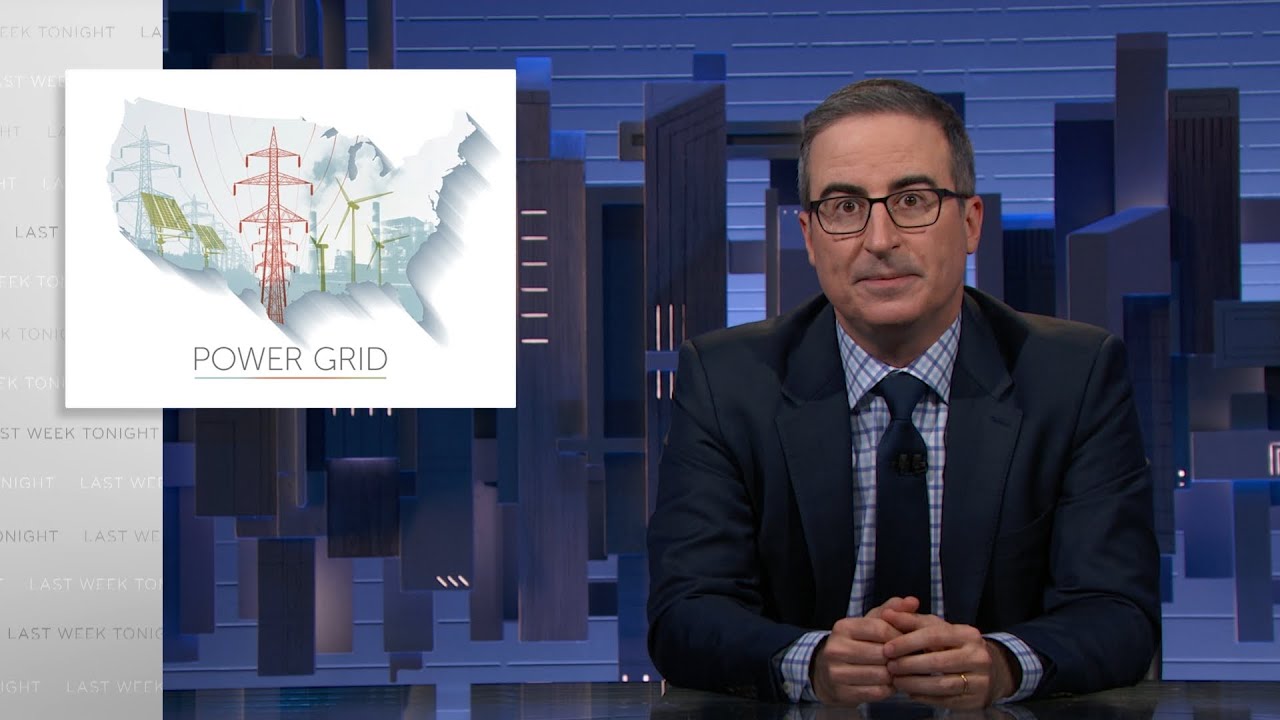
The Power Grid: Last Week Tonight with John Oliver (HBO) — LastWeekTonight

LastWeekTonight

AI-assisted summary of The Power Grid: Last Week Tonight with John Oliver (HBO) — original source. Check the original for full context.

Source published:

Key ideas

  • The frequency of annual U.S. blackouts doubled between 2015 and 2020 as severe climate extremes collide with an electrical system built largely in the 1950s and 1960s with a 50-year engineering lifespan. (0:04)
  • Clean energy potential is heavily concentrated in the nation's interior, meaning decarbonization requires transporting power across vast distances to coastal cities that represent 70% of national electricity demand. (10:29)
  • Unlike interstate natural gas pipelines overseen by FERC, interstate power lines face fragmented multi-state, municipal, and private landowner approvals, causing fewer than one in four proposed wind and solar projects to enter operation. (13:25)
  • Upgrading and modernizing the power grid will require an estimated $2.5 trillion over the next decade, with federal research indicating that transmission expansions generate up to $2.50 in economic returns per dollar spent. (17:36)

Detailed notes

## Background This video was published on YouTube by the official LastWeekTonight channel on November 8, 2021. According to the show's description, host John Oliver explores the precarious state of the United States electrical grid, why it urgently needs fixing, and the deceptively hazardous nature of party balloons.

## TL;DR John Oliver examines the growing instability of the United States power grid, where decades-old equipment and escalating climate extremes have caused blackouts to double between 2015 and 2020. Shifting to renewable energy introduces a major spatial mismatch, as optimal wind and solar resources in the rural interior must be transported across immense distances to coastal population centers. This clean energy transition is severely bottlenecked by state-by-state regulatory approvals, local opposition, and an estimated $2.5 trillion price tag, despite research showing significant economic and safety returns on transmission investments. Oliver concludes that blackouts occur not because the grid is inherently flawed, but because modern society is demanding tasks and resilience from legacy infrastructure that it was never engineered to provide.

## Atmosphere & style The presentation balances investigative urgency with rapid-fire satirical wit, effortlessly pivoting from sobering disaster footage to absurd tangents about mid-century thermostat enthusiasts, Nikola Tesla's pigeon obsession, and humanoid transmission towers. Oliver maintains an indignant, fast-paced cadence that treats technical utility policy with both comedic irreverence and life-or-death gravity. The episode's narrative tension steadily mounts as it confronts systemic infrastructure paralysis, culminating in a sudden, explosive physical gag that literally plunges the set into pitch darkness.

## Bulletin - [00:04](https://www.youtube.com/watch?v=qBpiXcyB7wU&t=4s) The frequency of annual U.S. blackouts doubled between 2015 and 2020 as severe climate extremes collide with an electrical system built largely in the 1950s and 1960s with a 50-year engineering lifespan. - [10:29](https://www.youtube.com/watch?v=qBpiXcyB7wU&t=629s) Clean energy potential is heavily concentrated in the nation's interior, meaning decarbonization requires transporting power across vast distances to coastal cities that represent 70% of national electricity demand. - [13:25](https://www.youtube.com/watch?v=qBpiXcyB7wU&t=805s) Unlike interstate natural gas pipelines overseen by FERC, interstate power lines face fragmented multi-state, municipal, and private landowner approvals, causing fewer than one in four proposed wind and solar projects to enter operation. - [17:36](https://www.youtube.com/watch?v=qBpiXcyB7wU&t=1056s) Upgrading and modernizing the power grid will require an estimated $2.5 trillion over the next decade, with federal research indicating that transmission expansions generate up to $2.50 in economic returns per dollar spent.

## Key takeaways - [04:21](https://www.youtube.com/watch?v=qBpiXcyB7wU&t=261s) The United States is divided into three semi-independent electrical systems: the Eastern Interconnection, the Western Interconnection, and the Texas Interconnection. - [04:21](https://www.youtube.com/watch?v=qBpiXcyB7wU&t=261s) The nation's infrastructure encompasses roughly 600,000 miles of high-voltage transmission lines and 5.5 million miles of local distribution lines, historically vulnerable to routine disruptions from wildlife and stray foil balloons. - [00:04](https://www.youtube.com/watch?v=qBpiXcyB7wU&t=4s) Decarbonization goals targeting net-zero emissions by 2050 are projected to increase peak electricity consumption by 40% to 60% as heating, cooking, and transportation electrify. - [08:30](https://www.youtube.com/watch?v=qBpiXcyB7wU&t=510s) Much of the physical electrical infrastructure is operating decades past its planned 50-year service life, creating vulnerabilities under worsening extreme weather conditions. - [08:30](https://www.youtube.com/watch?v=qBpiXcyB7wU&t=510s) The deadly 2018 Camp Fire in Northern California occurred after a 98-year-old PG&E C-hook snapped on a transmission pylon, igniting dry brush during high winds. - [10:29](https://www.youtube.com/watch?v=qBpiXcyB7wU&t=629s) Fossil fuel power generation can be placed directly near demand centers, whereas renewable solar and wind generation depend entirely on regional geography. - [10:29](https://www.youtube.com/watch?v=qBpiXcyB7wU&t=629s) Wind and solar development has provided hundreds of millions of dollars in lease payments to rural landowners, yet major political friction remains over siting infrastructure that primarily serves distant urban populations. - [13:25](https://www.youtube.com/watch?v=qBpiXcyB7wU&t=805s) Severe transmission bottlenecks have caused states like Vermont to enact moratoria on new clean energy installations due to lack of carrying capacity on existing lines. - [13:25](https://www.youtube.com/watch?v=qBpiXcyB7wU&t=805s) Expanding electric transmission lines requires navigating individual approvals across multiple state regulators, localities, and private landowners, unlike interstate natural gas pipelines which require only federal FERC approval. - [17:36](https://www.youtube.com/watch?v=qBpiXcyB7wU&t=1056s) Comprehensive transmission expansion delivers up to $2.50 in direct economic return per dollar invested, while blackouts impose enormous direct and indirect financial damage. - [20:21](https://www.youtube.com/watch?v=qBpiXcyB7wU&t=1221s) The House-passed infrastructure bill dedicated over $65 billion toward grid modernization and transmission expansion as an initial step toward larger required investments. - [20:21](https://www.youtube.com/watch?v=qBpiXcyB7wU&t=1221s) Public perspective must shift from treating blackouts as a mechanical failure of the grid to recognizing that the system is being forced to operate outside the physical conditions and loads it was originally designed to handle.

## Detailed walkthrough ### [00:04](https://www.youtube.com/watch?v=qBpiXcyB7wU&t=4s) The Reality and Rising Frequency of Grid Failures

John Oliver introduces the power grid by comparing electricity to Oscar Isaac: "without its involvement, nothing in my house gets turned on." He contrasts our current dependence on electric power with vintage mid-century marketing, airing an archival advertisement that introduced suburban buyers to the "total electric home." The ad marvels over dedicated household "electric centers," highlighting an entertainment center and the supposed pride of the patriarch: a central "weather control center" managing heating, cooling, and air filtration. Oliver jokes about "thermo-bros" gathering around on a Sunday to drink beer and stare at a digital thermostat for hours.

Turning to modern infrastructure, Oliver defines the power grid as the vast network of power plants generating electricity combined with the intricate latticework of high-voltage transmission and distribution lines delivering power to American homes. While people rarely think about this system when it works, power failures have escalated nationwide. Oliver showcases news clips of millions of Texans freezing in dark homes during winter storm outages, Hurricane Ida ravaging the grid across Louisiana, and a downtown Detroit blackout cutting power to 1,400 buildings simultaneously. In one courtroom broadcast, power cuts out mid-session during a murder trial, prompting Oliver to remark that either the power grid is in catastrophic disrepair, or the murder victim's ghost has returned seeking vengeance.

```mermaid flowchart TD accTitle: Anatomy of the U.S. Electrical Grid accDescr: Diagram showing electricity flowing from generation through transmission and distribution to consumers across three regional interconnections.

subgraph Generation["Electricity Generation"] A["Power Plants & Renewables"] end

subgraph GridSplit["Three Regional Interconnections"] B1["Eastern Interconnection"] B2["Western Interconnection"] B3["Texas Interconnection (ERCOT)"] end

subgraph Lines["Delivery Infrastructure"] C["600,000 Miles of High-Voltage Transmission Lines"] D["5.5 Million Miles of Local Distribution Lines"] end

subgraph EndUsers["End-Use Demand"] E["Residential, Commercial, Industrial Consumers"] end

A --> B1 & B2 & B3 B1 & B2 & B3 --> C C --> D D --> E ```

Between 2015 and 2020, the annual number of blackouts in the United States doubled. Beyond the everyday misery of being stuck indoors without entertainment—joking that going outside or reading books merely exposes you to places where snakes live and sleep—outages trigger critical system failures. Municipal water treatment facilities and sewage plants shut down, while medical patients dependent on home machinery face direct peril. Oliver highlights an interview with a medically vulnerable woman, Tur Horst, who underscores the existential stakes: “This isn’t like I'm going to lose a casserole in my fridge, you know, this is I may not be alive tomorrow.” Oliver seizes on the food detail to riff on casseroles as depressing smorgasbords of twice-rejected leftover food like "tuna surprise" and "chicken I'm sorry."

- U.S. annual blackouts doubled across the five-year window from 2015 to 2020. - Decarbonization goals require reaching net-zero carbon emissions by 2050. - Transitioning residential heating, cooking, and light-duty transportation to electric power is projected to drive a 40% to 60% surge in peak electricity consumption.

---

[04:21](https://www.youtube.com/watch?v=qBpiXcyB7wU&t=261s) History, Architecture, and Everyday Grid Disruptors

The United States electrical system is not a single monolith, but rather three distinct, semi-independent systems: the Eastern Interconnection, the Western Interconnection, and the Texas Interconnection. Oliver likens this structure to Major League Baseball, noting there are two dominant leagues alongside rogue actors in Texas who insist on writing their own rules. The modern grid traces its origins to 1882 in Lower Manhattan, where Thomas Edison launched the Pearl Street Station, the nation's first central commercial power plant. Edison's rival, Nikola Tesla, subsequently engineered alternating current systems that allowed electricity to travel over long distances. Oliver digresses into Tesla's eccentric late-life obsession with injured street pigeons, including a documented bond with a specific bird Tesla described as his wife, whose death he claimed extinguished his inventive drive.

Oliver charts the transformation of electricity from an urban luxury to an essential civic utility. Prior to the New Deal, private utilities largely bypassed rural communities because running miles of wire to sparsely populated farmland was unprofitable. In 1935, Franklin D. Roosevelt established the Rural Electrification Administration (REA), which funded cooperative networks to bring affordable electricity to America's agricultural heartland. Oliver airs period REA propaganda that patronizingly framed the electric iron as a life-altering luxury designed to lighten a farm wife's domestic burdens while her husband tended to work.

Today, this sprawling network contains over 600,000 miles of high-voltage transmission lines and roughly 5.5 million miles of local distribution lines. Despite being celebrated by historians as one of the supreme engineering achievements of the 20th century, overhead wires remain constantly exposed to mundane physical hazards. Outage databases show thousands of interruptions triggered by wildlife, including over 600 outages caused by squirrels, more than 200 by birds, 53 by raccoons, and intermittent disruptions caused by snakes and even slugs. Oliver plays footage of a bundle of stray foil balloons floating into power lines, touching off an explosive, blinding arc of electrical fire.

- 1882: Thomas Edison opens the Pearl Street Station in New York City. - 1935: FDR creates the Rural Electrification Administration (REA) to electrify rural America. - Physical footprint: 600,000 miles of high-voltage transmission lines paired with roughly 5.5 million miles of local distribution lines. - Wildlife interference: Hundreds of recorded electrical fires and outages caused by squirrels, raccoons, birds, and slugs contacting live wires.

---

[08:30](https://www.youtube.com/watch?v=qBpiXcyB7wU&t=510s) Compounding Crises: Aging Infrastructure and Extreme Weather

While animals and balloons have triggered localized disruptions for decades, Oliver explains that the grid now faces an existential squeeze between two structural pressures: decades of severe equipment aging and escalating climate volatility. The vast majority of transmission lines and substations across the United States were built throughout the 1950s and 1960s with an expected operational lifespan of roughly 50 years. Consequently, millions of components are operating decades past their intended retirement date. At the same time, climate change brings unprecedented severe weather events—intensified hurricanes, winter freezes, and prolonged heat waves—that continually exceed the historical specifications of the physical infrastructure.

Oliver examines the deadly 2018 Camp Fire in Northern California as the clearest consequence of this neglect. The disaster was sparked during heavy winds amidst a severe regional drought when decades-old equipment operated by Pacific Gas and Electric (PG&E) broke. Oliver airs investigative footage examining the physical steel C-hook that fractured on the Caribou-Palermo transmission tower. The hook had been in continuous service for nearly a century, grinding a deep groove through the metal loop over 98 years of friction until the worn hook snapped. When it gave way, the energized transmission line hit the steel tower and ignited parched brush below, starting a wildfire that killed 84 people. As the investigative reporter notes: “And PG&E’s decision was simply just to let these things hang until they broke.”

Summarizing the broader issue, Oliver notes: “PG&E basically took the same approach to their equipment as Democrats did with Ruth Bader Ginsburg, and in both cases, it didn't end well.” He concludes this section by warning that the country is leaning on a deteriorating, twentieth-century mechanical system to survive twenty-first-century climate extremes, making large-scale infrastructure upgrades non-negotiable.

- Most U.S. power lines were built in the 1950s and 1960s with 50-year engineering lifespans, meaning they are operating decades beyond their designed limits. - The 2018 Camp Fire killed 84 people after a 98-year-old PG&E C-hook snapped under wind load, dropping a live wire against a metal pylon.

[10:29](https://www.youtube.com/watch?v=qBpiXcyB7wU&t=629s) The Geography of Renewable Energy

While upgrading the power grid involves numerous critical areas—such as investing in microgrids, weatherproofing, and expanding storage capacity so excess power does not go to waste—John Oliver zeroes in on the most fundamental challenge: shifting to renewable energy completely upends the physical layout of the grid. Historically, a convenient feature of fossil fuel power plants has been that they can be built virtually anywhere, allowing utilities to place them directly adjacent to densely populated areas with high electricity demand. Clean energy, however, cannot simply be swapped in one-for-one on those same footprints, because wind and sunshine are dictated by geography rather than human settlement patterns.

A Princeton University study mapping potential wind and solar development across the continental United States demonstrates that the vast majority of renewable potential lies throughout the center of the country and offshore. Another study revealed that while these interior states hold the vast majority of wind and solar capacity, the residents living there represent only about 30% of national electricity demand. Decarbonization fundamentally requires hauling massive amounts of power from sparsely populated rural plains to heavily populated coastal cities. Oliver points out the immediate political friction baked into this dynamic: telling a Midwestern farmer that infrastructure must be built across their land so a driver in California can power an electric vehicle is practically handing future election cycles over to the opposition.

At the same time, renewable projects have already brought substantial economic windfalls to rural communities. In the prior year, renewables like solar, wind, and hydropower represented the largest share of new generating capacity in the nation. Beyond lowering emissions, wind farms distributed roughly $706 million in land lease payments to rural landowners in 2019 alone, funding local infrastructure, public services, and police vehicles. Oliver highlights an interview with a Wyoming mayor who enthusiastically endorsed wind power:

> “My personal belief is it provides money, it provides jobs, taxes, and then I look at the towns that they're by and just think of what people have that they wouldn't have had—a lot of infrastructure, police cars, those kind of things. When I look at a wind farm, all I think about is cha-ching.”

Oliver appreciates the sentiment, though he takes an extended comedic detour to correct the mayor’s sound effects: cash registers go "cha-ching," whereas wind farms go "whoosh," solar panels make a gentle humming sound, a cat on a forgotten birthday goes "meow," and an amorous cartoon wolf goes "awoooga."

- Fossil fuel plants were intentionally built near high-density population centers. - Wind and solar potential is concentrated in interior states representing only 30% of total electricity demand. - In 2019, wind projects provided $706 million in lease payments to rural landowners.

```mermaid flowchart LR accTitle: Renewable Energy Generation vs Demand accDescr: Diagram showing how renewable energy generated in rural areas must travel long distances to coastal demand centers. subgraph Supply["Generation (Rural Interior)"] A["Wind & Solar Potential<br/>(Midwest, Great Plains, Offshore)"] end subgraph Bottleneck["Transmission"] B["High-Voltage Lines<br/>(Interstate approvals & land rights)"] end subgraph Demand["Demand (Urban Centers)"] C["70% Electricity Consumption<br/>(Coastal & Major Metro Areas)"] end A -->|"Must Transport Electricity"| B B -->|"Supplies Power To"| C ```

---

[13:25](https://www.youtube.com/watch?v=qBpiXcyB7wU&t=805s) The Transmission Bottleneck and Siting Obstacles

The real crisis facing clean energy is not generation, but transmission—moving electricity from where it is generated, such as a Wyoming wind installation, to where it is consumed, which may be over a thousand miles away. The existing transmission network is so antiquated and constrained that power is frequently stranded. In Vermont, authorities had to place a moratorium on new solar and wind installations simply because existing lines lacked the capacity to carry any additional electricity. Yet expanding transmission lines across state lines is an enormous bureaucratic and logistical nightmare. Unlike interstate natural gas pipelines, which only require federal approval from the Federal Energy Regulatory Commission (FERC), electric transmission lines require separate permits from numerous state agencies, local regulators, and hundreds of individual private landowners.

Opposition arises from both practical concerns—such as interference with active farming operations, threats to fragile ecosystems, or encroachment on Native American cultural and sacred sites—and aesthetic pushback against high-voltage towers, which must be significantly larger than older utility poles. Other nations have attempted playful design solutions: Hungary constructed pylons shaped like jesters, Iceland proposed monumental humanoid towers known as the "Land of Giants," and Buenos Aires, Argentina features "Coloso," an enormous robot-shaped pylon that lights up at night, smiles, and winks. Oliver finds the winking robot particularly unsettling, joking that it feels like an unwanted advance at a bar where he'd rather take his Long Island iced tea and leave.

Grassroots local pushback routinely derails projects. In Pennsylvania, a proposal to build 16 miles of new transmission lines was stalled by a landowner coalition that produced opposition videos featuring residents expressing resentment toward out-of-state energy consumers:

> “I understand everybody needs electric and everybody has to have electric. I wouldn't want to be without electric, but from what I understand, you know, this is only going to help people in western PA, Maryland, and Virginia. And what's it do? You know, I mean, I chose to live here, and they chose to live there, so don't make your problem my problem. That's how I feel.”

Oliver acknowledges the frustration of having industrial infrastructure imposed on one's property, but criticizes the attitude that neighboring states' energy security is entirely someone else's problem. Ignoring grid reliability affects everyone eventually; he compares it to dismissing a neighbor whose yard is overrun by bears, only to realize the bears can easily climb the fence. Because transmission lines face such fierce opposition, the approval process can drag on for a decade or collapse entirely, resulting in fewer than one in four proposed wind and solar generation projects ever reaching commercial operation.

- Interstate gas lines require only FERC approval; interstate electric lines require approval from every state, municipality, and landowner along the route. - Vermont enacted a moratorium on new renewable projects due to overwhelmed transmission capacity. - Fewer than 25% of proposed clean energy projects successfully reach commercial operation due to grid interconnection hurdles.

---

[17:36](https://www.youtube.com/watch?v=qBpiXcyB7wU&t=1056s) The Trillion-Dollar Price Tag and Return on Investment

The second major hurdle to modernizing the grid is pure cost. Decarbonizing the American electrical system is projected to cost roughly $2.5 trillion over the next decade. During congressional hearings on the Clean Future Act, which aimed to fund transmission expansions, Representative Bill Johnson pushed back against clean energy investments by aggressively demanding to know the strict financial return for taxpayers:

> “Whether the American people are stuck picking up this tab through higher taxes or rate increases on their utility bills, can you honestly say that they'll be receiving a return on their investment?”

When a witness attempted to explain that the return includes clean air, public health, and grid resilience, Johnson cut her off repeatedly, insisting that an investment return can only be defined in monetary terms.

Oliver rejects this framing on multiple fronts. First, even on purely financial terms, research from a federal national laboratory concluded that comprehensive transmission expansion can generate up to $2.50 in direct benefits for every single dollar spent, easily clearing Johnson's threshold for an investment return. Second, failing to build a reliable grid carries immense financial costs of its own, as demonstrated by the catastrophic winter blackouts in Texas earlier that year.

Finally, Oliver argues that evaluating grid reliability strictly through a quarterly balance-sheet lens is absurd. Decarbonization helps avert catastrophic climate disruptions—or as Oliver puts it, ensuring your grandchildren "won't die in weekly lava hurricanes." Treating essential public goods as profit centers makes as little sense as demanding a cash return on investment from the local fire department. While a municipal fire department does not turn an accounting profit, it prevents homes from burning to the ground—and, Oliver jokes, produces calendars filled with oiled-up fire hunks, making society simultaneously safer and hornier. Overcoming the grid crisis will require significant public compromise, beginning with a broader view of what infrastructure is worth.

- Decarbonizing the power grid is estimated to require $2.5 trillion over a ten-year period. - A federal laboratory study found expanding interstate transmission yields up to $2.50 in economic benefits per $1 invested. - Blackouts cause severe economic damage, as seen during the Texas winter grid collapse.

[20:21](https://www.youtube.com/watch?v=qBpiXcyB7wU&t=1221s) Rethinking Transmission Expansion and the Infrastructure Bill

Addressing the contentious process of expanding transmission infrastructure across the country, John Oliver argues that development does not require resorting to heavy-handed tactics or corporate overreach. Instead, project developers can ensure that landowners are compensated fairly for the use of their property, while minimizing disruption by routing lines along already disturbed corridors such as existing railroad tracks and interstate highways. The financial side has seen tangible momentum with recent federal legislation: the infrastructure bill passed by the House of Representatives commits more than $65 billion toward modernizing the nation's power grid, with a specific allocation set aside directly for expanding and upgrading transmission capacity. While Oliver welcomes this major legislative milestone as an encouraging start, he emphasizes that it remains far short of the total investment ultimately required.

Beyond funding and route planning, Oliver calls for a fundamental shift in how the public perceives grid reliability. Whenever widespread blackouts hit, people routinely frame the problem as an operational collapse of the infrastructure itself, but that diagnosis misplaces the blame. As Oliver puts it: “Because for far too long whenever we've experienced blackouts we've tended to think of it as the power grid failing but the truth is it's not failing us we are failing it by asking to do something it was not designed to do in conditions that it was not designed to handle.” Meeting this challenge demands bold and immediate action, treating the issue with the urgency it deserves—as Oliver quips, acting as if both our lives and our subpar casseroles depend on it.

- Minimizing land disputes by siting new high-voltage lines alongside existing transit corridors such as highways and railways. - The House-passed infrastructure package commits over $65 billion specifically aimed at grid resilience, transmission capacity expansion, and modernizing electrical networks. - Shifting perspective from viewing outages as an inherent technological defect to recognizing that the legacy grid is overburdened by extreme weather and demands it was never engineered to withstand.

---

[21:24](https://www.youtube.com/watch?v=qBpiXcyB7wU&t=1284s) Celebrating with Balloons and Sudden Blackout

Successfully modernizing and overhauling the national power grid would stand as one of the defining engineering achievements of the 21st century—a triumph that Oliver suggests deserves a proper celebration. Proposing that nothing marks a victory quite like a festive bunch of balloons, he muses on how innocent and joyful they seem. However, as metallic foil balloons are released into the studio rafters, they immediately trigger an electrical catastrophe.

The balloons hit the studio's overhead wiring, producing deafening sparks, electric arcs, and violent explosions that completely knock out the set lights and plunge the entire soundstage into pitch-black darkness. Shaken by the blast and scrambling amid the smoke, Oliver quickly reassures the audience that he is unharmed, fumbles around the darkened set trying to find the exit, and signs off blindly into the dark to conclude the broadcast.

```mermaid flowchart TD accTitle: Studio Balloon Stunt Power Failure accDescr: Sequence showing how releasing balloons into the studio rafters leads to a short circuit and immediate blackout.

subgraph Celebration["Festive Proposal"] A["Oliver suggests celebrating grid modernization with balloons"] end

subgraph Hazard["Electrical Contact"] B["Foil balloons float into studio ceiling"] C["Contact with overhead high-voltage equipment"] end

subgraph Blackout["Catastrophic Failure"] D["Explosive arcing and sparks"] E["Total studio blackout"] F["Oliver signs off in the dark"] end

A --> B B --> C C --> D D --> E E --> F ```

- Oliver highlights the scale of the task, noting: “And if we do this if we manage to properly upgrade our power grid it will genuinely be one of the biggest accomplishments of the 21st century and one definitely worth celebrating perhaps i don't know with some balloons you know balloons are always fun aren't they.” - The resulting explosion serves as a live, comedic demonstration of the vulnerability of electrical systems to airborne hazards like mylar balloons. - Disoriented in the sudden dark, Oliver announces, “That's our show, thanks so much for watching, we'll see you next week, good night,” before feeling his way offstage.

## Notable quotes > [21:24](https://www.youtube.com/watch?v=qBpiXcyB7wU&t=1284s) If we manage to properly upgrade our power grid it will genuinely be one of the biggest accomplishments of the 21st century and one definitely worth celebrating — John Oliver

## Mentioned John Oliver, Oscar Isaac, Tur Horst, Thomas Edison, Nikola Tesla, Franklin D. Roosevelt, Rural Electrification Administration (REA), Pacific Gas and Electric (PG&E), Ruth Bader Ginsburg, Princeton University, Federal Energy Regulatory Commission (FERC), Bill Johnson, Clean Future Act, ERCOT, Eastern Interconnection, Western Interconnection, Texas Interconnection

## Video description John Oliver discusses the current state of the nation’s power grid, why it needs fixing, and, of course, how fun balloons are.

Connect with Last Week Tonight online...

Subscribe to the Last Week Tonight YouTube channel for more almost news as it almost happens: www.youtube.com/lastweektonight

Find Last Week Tonight on Facebook like your mom would: www.facebook.com/lastweektonight

Follow us on Twitter for news about jokes and jokes about news: www.twitter.com/lastweektonight

Visit our official site for all that other stuff at once: www.hbo.com/lastweektonight

[Source](https://www.youtube.com/watch?v=qBpiXcyB7wU)

中文简报

美国电网危机:《约翰·奥利弗上周今夜秀》(HBO) 约翰·奥利弗探讨了美国电网日益严峻的不稳定性;在已有数十年历史的陈旧设备与愈演愈烈的极端气候共同冲击下,2015年至2020年间的停电事件增加了一倍。向可再生能源转型带来了巨大的空间错配难题,因为内陆农村地区最优的风能和太阳能资源必须跨越极远距离输送至沿海人口密集区。尽管研究表明对输电基础设施的投资能带来显著的经济与安全回报,但由于各州监管审批繁琐、地方阻力以及高达约2.5万亿美元的预估资金需求,清洁能源转型面临严重瓶颈。奥利弗总结称,停电频发并非因为电网本身存在固有缺陷,而是因为现代社会要求这些老旧基础设施承担其设计之初从未设想过的任务与韧性负荷。 2015年至2020年间,美国每年的停电频率翻了一倍,主要原因在于严峻的极端天气冲击了大多建于20世纪50和60年代、设计寿命仅50年的老旧电力系统。 (0:04) 清洁能源潜力高度集中在美国内陆腹地,这意味着脱碳进程必须将电力跨越漫长距离输送至占全国用电需求70%的沿海城市。 (10:29) 与由FERC集中监管的跨州天然气管道不同,跨州输电线路面临各州、市政以及私人土地所有者分散的审批壁垒,导致拟建的风能和太阳能项目中投入运营的不足四分之一。 (13:25) 未来十年升级和改造电网预计需要2.5万亿美元,而联邦研究显示,输电扩建每投入1美元,可产生高达2.50美元的经济回报。 (17:36)

Reading summary

John Oliver argues that the United States' aging electrical grid is increasingly incapable of withstanding extreme weather and escalating demand, warning that clean energy goals will fail without a massive, coordinated expansion of interstate transmission lines. Aging Infrastructure and Escalating Grid Failures (8:30) The U.S. power network comprises three regional interconnections spanning over 600,000 miles of high-voltage transmission lines and roughly 5.5 million miles of local distribution lines. Between 2015 and 2020, annual blackouts across the nation doubled. Most transmission lines and substations were constructed in the 1950s and 1960s with 50-year design lifespans, leaving vast portions of the system operating decades past their intended retirement date. This deferred maintenance collides directly with climate volatility, as severe weather routinely exceeds legacy engineering specifications. The fatal consequence of this gap was illustrated by California's 2018 Camp Fire, which killed 84 people after a 98-year-old PG&E transmission hook wore through and snapped in heavy winds. Beyond everyday disruption, grid failures imperil municipal water plants, sewage systems, and home medical patients. Geographic Mismatch Between Supply and Demand (10:29) Reaching net-zero carbon emissions by 2050 will require electrifying home heating, cooking, and light transportation, which is projected to drive a 40% to 60% surge in peak electricity consumption. Unlike fossil fuel power plants that could be constructed adjacent to major population centers, renewable generation is constrained by geography. According to studies cited by Oliver, including research from Princeton University, the vast majority of wind and solar capacity lies offshore and across the interior United States, where local residents account for only about 30% of national power demand. Decarbonization requires hauling huge volumes of clean energy across long distances to coastal metropolitan centers. While wind projects generated roughly $706 million in land lease payments for rural landowners in 2019, building long-distance power lines through rural communities to service distant cities creates significant political friction. Transmission Bottlenecks and Permitting Gridlock (13:25) The core barrier to clean energy deployment is transmission capacity rather than generation. Antiquated lines have already led to local moratoriums on new wind and solar projects in states like Vermont. Currently, fewer than one in four proposed clean energy projects successfully reach commercial operation due to grid interconnection hurdles. Interstate transmission faces severe regulatory hurdles compared to natural gas pipelines, which require only federal approval from the Federal Energy Regulatory Commission (FERC). By contrast, high-voltage electric transmission lines must secure individual approvals from multiple state agencies, local municipal regulators, and hundreds of private landowners along the route. Projects frequently stall for over a decade or collapse entirely due to local opposition over aesthetic impacts, disruption to farming, ecological concerns, and resistance to bearing infrastructure for out-of-state consumers. Weighing Decarbonization Costs Against Returns (17:36) Decarbonizing the American electrical system carries an estimated price tag of $2.5 trillion over a decade. While critics in Congress have questioned the financial return on investment for taxpayers, Oliver notes that research from a federal national laboratory found comprehensive transmission expansion yields up to $2.50 in direct economic benefits for every dollar invested, even setting aside the severe financial costs of catastrophic outages like the Texas winter freeze. To overcome development deadlocks, developers can utilize existing rights-of-way along highways and rail corridors while ensuring fair compensation for landowners. Oliver highlights the House-passed infrastructure bill's commitment of over $65 billion toward grid resilience and transmission upgrades as an essential down payment, but stresses that true progress requires recognizing that blackouts are not inherent equipment bugs, but the result of forcing an outdated grid to operate in conditions it was never built to survive. Modernizing the power grid represents one of the defining infrastructure challenges of the 21st century. Oliver emphasizes that overcoming reliability issues requires shifting away from blaming legacy systems for collapsing under unprecedented demands, and instead committing the public resources and regulatory compromises necessary to build an interstate transmission network suited for clean energy.

精炼阅读摘要

John Oliver 指出,美国电网正深陷二十世纪老旧设备与二十一世纪极端气候碰撞的双重危机;向清洁能源转型的进程不仅面临电力供需地理错配的制约,还遭遇跨州输电审批繁琐、地方邻避阻力及巨额资金分摊的多重瓶颈。 老旧基础设施与气候剧变下的断电危机 (8:30) 美国的电力系统由东部联合电网、西部联合电网和得克萨斯州电网(Texas Interconnection)三大系统组成,覆盖约 60 万英里高压输电线路与 550 万英里地方配电线路。在 2015 年至 2020 年间,全美每年的断电事件增加了一倍。大范围停电不仅造成生活不便,更迫使自来水厂和污水处理设施停运,并直接威胁依赖家用医疗维持生命设备的重症患者。造成电网高度脆弱的核心症结在于资产严重超期服役:绝大多数输电线路与变电站建于 20 世纪 50 至 60 年代,设计工程寿命通常仅为 50 年,数以百万计的关键组件已超期运转数十年。 与设备老化相伴而生的是气候变化引发的高强度飓风、冬季寒潮以及持久热浪,极端天气频频突破基础设施原有的工程承载上限。2018 年加州北部造成 84 人死亡的坎普大火(Camp Fire)便是最惨痛的案例,其起因系太平洋瓦电(PG&E)铁塔上一个持续服役达 98 年的钢制 C 型吊钩发生机械磨损断裂,带电导线跌落引燃干旱草木。此外,松鼠、鸟类和浣熊等野生动物接触,以及金属气球漂入导线引发爆炸电弧等日常偶发物理事故,也持续凸显了空中裸露导线网络的脆弱性。 清洁能源地理错配与跨区域输电瓶颈 (10:29) 实现 2050 年净零碳排放目标以及建筑采暖、烹饪和交通的全面电气化,预计将推动美国电网高峰用电需求激增 40% 至 60%。然而,向可再生能源转型彻底颠覆了电网原有的空间布局。传统的化石燃料发电厂可以根据负荷需求直接建设在人口密集的都市周边,而风能与太阳能发电完全受制于自然地理分布。普林斯顿大学的研究显示,美国绝大部分的风能和太阳能资源集中在中部内陆大平原和近海区域,但这些内陆州的人口仅占全国电力总需求的约 30%,另外 70% 的电力消耗集中在沿海和大都市区。 由于缺乏长距离输送电力的硬件网络,清洁能源正面临被困在源头的严重瓶颈。例如在佛蒙特州,由于现有输电线路容量饱和,地方管理机构不得不对新建风电与太阳能项目实施暂停审批。全美当前规划的清洁能源项目中,最终仅有不到 25% 能够克服并网延误和电网输送限制,真正进入商业化运营。 碎片化监管审批与地方邻避冲突 (13:25) 扩大跨州电力输送面临的最大现实障碍在于极其分散复杂的行政审批制度。与跨州天然气管道仅需获得联邦能源监管委员会(FERC)单一联邦机构批准不同,跨州高压输电线路必须逐一获得沿线每一个州级监管机构、地方市镇政府以及成百上千位私人土地业主的审批和许可。这种冗长的流程往往导致输电线路项目审批周期长达十年甚至中途流产。 项目推进过程中常伴随着激烈的基层阻力,包括对占用农业耕地、破坏脆弱生态、侵犯美洲原住民文化圣地的担忧,以及居民对巨型输电铁塔破坏景观的审美抵触。与此同时,区域间的利益冲突进一步激化了矛盾,中部农村土地所有者往往拒绝为了向远方沿海城市输送电力而牺牲自身财产利益。针对这些矛盾,建设方需对受影响业主提供公平经济补偿,并优先沿现有高速公路和铁路走廊铺设线路,以减少额外的土地征用争议。 两万亿美元转型成本与电网公共品定位 (17:36) 将美国电网彻底脱碳改造预计在未来十年需耗费约 2.5 万亿美元。在针对相关法案的国会听证中,部分议员要求必须证明纳税人能从清洁能源扩建中获得确凿的货币投资回报率(ROI)。然而研究表明,仅从账面经济效益来看,联邦国家实验室的数据显示跨区域输电扩建每投资 1 美元即可产生高达 2.50 美元的直接收益,同时还能规避像得州寒潮引发系统崩溃所造成的惨重经济代价。 更关键的是,电网具有关乎公共安全的社会基础设施属性,不应被单纯视作追求短期盈利的商业工具。美国众议院通过的基础设施法案已包含超过 650 亿美元用于提升电网韧性与扩建输电容量,这虽然迈出了重要一步,但仍远低于数万亿美元的整体资金缺口。 Oliver 总结认为,当停电发生时公众习惯于将其归咎于电网故障,但实质上是社会在以远超原有设计标准的严酷气候与负荷条件向其过度索取。对电网进行现代化升级不仅是避免人道和经济灾难的基础保障,更将是二十一世纪极其重大的国家级工程挑战。

Detailed notes — zh

## Background 该视频由 YouTube 频道 LastWeekTonight(《约翰·奥利弗上周今夜秀》官方频道)于 2021 年 11 月 8 日发布。根据页面简介,主持人 John Oliver 在本期节目中深入探讨了美国国家电网的现状、为何迫切需要对其进行彻底整修,以及顺带调侃了气球究竟有多好玩。 ## TL;DR 节目围绕美国脆弱且老旧的电网体系展开,揭示了从动物侵扰、气球短路到极端气候与设备超期服役所引发的日益频繁的停电危机。John Oliver 指出,向清洁能源转型面临严重的地理错配,绝大多数风能和太阳能集中在中部各州,但向沿海负荷中心输送电力却遭遇跨州审批繁琐、地方邻避效应(NIMBY)以及高达数万亿美元改造成本的重重阻碍。尽管最新基建法案注资超过 650 亿美元,但电网改造仍任重道远;节目呼吁公众彻底转变认知——并非电网辜负了人类,而是人类在强求一套过时的物理网络承担超出其设计极限的重任。 ## Atmosphere & style 整期节目延续了 John Oliver 标志性的辛辣讽刺与高密度幽默,在硬核严谨的基础设施政策科普中穿插荒诞的拟声词连击与跨界吐槽,节奏明快且极具攻击力。从批判 PG&E 漠视设备安全夺走人命的愤慨,到调侃国会议员狭隘“投资回报率”思维的荒谬,情感在严肃的危机警示与荒唐的幽默包袱之间自如切换。结尾处天花板掉落气球瞬间引发短路火花与全场漆黑,让主持人在狼狈摸黑告别中为节目收场,充满戏剧性的自嘲与极具冲击力的舞台荒诞感。 ## Bulletin - [00:04](https://www.youtube.com/watch?v=qBpiXcyB7wU&t=4s) 从2015年到2020年,美国年均停电次数翻倍,而向电动汽车与全电气化生活的转型预计将使全美用电峰值负荷激增40%至60%,严重超出建于20世纪的中老龄电网承载力。 - [10:29](https://www.youtube.com/watch?v=qBpiXcyB7wU&t=629s) 可再生能源潜力与负荷中心存在严重地理错配:蕴藏绝大多数风光资源的中部各州仅占全美用电需求的30%,且因跨区审批和地方“邻避效应”阻碍,全美仅不到四分之一的新能源项目能成功并网。 - [17:36](https://www.youtube.com/watch?v=qBpiXcyB7wU&t=1056s) 未来十年美国电网全面脱碳预计耗资2.5万亿美元,尽管美国众议院已在基建法案中拨出超650亿美元用于电网改造,但相比总体需求仍只是杯水车薪。 - [17:36](https://www.youtube.com/watch?v=qBpiXcyB7wU&t=1056s) 研究表明跨区域电网扩建的投资回报比高达1:2.5,合理方案应优先利用铁路和公路走廊铺设线路,并为沿线土地业主提供足额经济补偿。 ## Key takeaways - [00:04](https://www.youtube.com/watch?v=qBpiXcyB7wU&t=4s) 电网瘫痪不仅造成生活不便,更会破坏水处理等市政设施并直接危及依赖电力医疗设备的居民生命安全。 - [03:42](https://www.youtube.com/watch?v=qBpiXcyB7wU&t=222s) 实现2050年温室气体净零排放需依靠电气化转型,但这将导致全美峰值电力负荷增加40%到60%,现有脆弱电网无法承受。 - [03:42](https://www.youtube.com/watch?v=qBpiXcyB7wU&t=222s) 全美电网在物理上并非单一网络,而是划分为东部、西部和德克萨斯三大互联电网。 - [06:58](https://www.youtube.com/watch?v=qBpiXcyB7wU&t=418s) 架空电线面临松鼠、鸟类等野生动物侵扰及铝箔气球接触短路爆炸等频发的外部脆弱性干扰。 - [08:30](https://www.youtube.com/watch?v=qBpiXcyB7wU&t=510s) 大部分主干输电线路建于1950与1960年代且超期服役,在气候变暖引发的极端天气下极易引发严重安全事故,如导致84人死亡的加州坎普山火。 - [10:29](https://www.youtube.com/watch?v=qBpiXcyB7wU&t=629s) 化石燃料电厂可贴近城市布局,但风光资源集中在中西部平原,与东西两岸的用电负荷中心严重分离,亟需大规模长途输电线路。 - [10:29](https://www.youtube.com/watch?v=qBpiXcyB7wU&t=629s) 风电等清洁能源项目已成为农村经济支柱,2019年全美风电项目向土地业主支付了超过7亿美元的租赁费用。 - [13:25](https://www.youtube.com/watch?v=qBpiXcyB7wU&t=805s) 跨州天然气管道享有 FERC 联邦单一审批通道,而跨州输电线路必须逐一经过沿途各州监管机构和私人业主的批准,导致工期经常延宕逾十年。 - [13:25](https://www.youtube.com/watch?v=qBpiXcyB7wU&t=805s) 由于公众对大型铁塔景观的抵触与“邻避效应”(NIMBY),许多关键跨区输电线路遭沿线居民否决,导致全美不到四分之一的申报新能源项目最终能投入运行。 - [17:36](https://www.youtube.com/watch?v=qBpiXcyB7wU&t=1056s) 面对国会对基建“投资回报率”(ROI)的质疑,研究显示输电网扩建每投入1美元可换来2.5美元收益,且抵御气候灾害的公共价值远非单纯财务指标能衡量。 - [20:21](https://www.youtube.com/watch?v=qBpiXcyB7wU&t=1221s) 解决征地矛盾的可行路径是优先利用现有铁路与公路交通走廊铺设线路,并给予受影响的土地所有者合理补偿。 - [20:21](https://www.youtube.com/watch?v=qBpiXcyB7wU&t=1221s) 美国众议院通过的基建法案向电网升级划拨了逾650亿美元,这为输电线路扩建迈出了关键一步,但与脱碳所需仍有巨大资金缺口。 - [20:54](https://www.youtube.com/watch?v=qBpiXcyB7wU&t=1254s) 面对频发的停电事故,不应仅怪罪电网本身失效,而是人类在极端环境与超负荷需求下强加给了电网其最初设计所无法承受的任务。 ## Detailed walkthrough ### [00:04](https://www.youtube.com/watch?v=qBpiXcyB7wU&t=4s) 现代生活的基石与停电危机 在节目开场,John Oliver 谈到了当晚的主题——电力,并开玩笑说电就像奥斯卡·伊萨克(Oscar Isaac)一样,家里要是没有它,什么东西都“兴奋/启动(turned on)”不起来。电力早已是现代生活不可分割的一部分,以至于很难想象过去还需要向人们大肆推销家用电器。节目播放了一段老式复古广告,片中宣传“全电化住宅(total electric home)”,里面不仅有娱乐中心,更有让男主人引以为豪的“天气控制中心(weather control center)”,让他能掌控全屋的电采暖、空调和空气过滤。John 调侃道,这简直就是给男人们提供了一个无聊的借口:周日把一群“测温兄弟(thermo bros)”请到家里喝啤酒,盯着温度计看上几个小时,并对女士们说“这是男人的浪漫,你们不懂”。 转入严肃议题,当晚的核心是电网(the power grid)——即发电设施与将电送往千家万户的庞大线路网络。电网往往在正常运转时被人们忽略,但近年来它瘫痪的频率越来越高。新闻画面接连展示了德克萨斯州电网崩溃让数百万人在寒冬中醒来、飓风“艾达”(Hurricane Ida)席卷路易斯安那州导致电网瘫痪、底特律市中心因断电切断了1400栋大楼的电力,甚至还有法庭在审理谋杀案时突然陷入一片漆黑。John 讽刺说,如果谋杀案庭审现场突然断电,要么是电网极度缺乏维修,要么就是受害者化作鬼魂回来复仇,无论哪种情况,都意味着该集中精力应对更大的麻烦了。 - 据一项评估统计,从2015年到2020年期间,美国每年的停电次数增加了一倍。 - 停电不仅令人无所事事,更对基础设施造成破坏,波及污水处理厂与净水系统。 - 对于依赖呼吸机、电动轮椅等医疗设备的人来说,断电甚至会危及生命;接受采访的 Tur Horst 直言:“这可不是在冰箱里损失一盒砂锅菜那么简单,而是我明天可能就活不成了。” - John 还顺势吐槽了剩菜拼凑的砂锅菜(casserole),称其不过是冰箱残羹冷炙的悲惨拼盘,像“金枪鱼惊魂(tuna surprise)”一样难以下咽。 --- ### [03:42](https://www.youtube.com/watch?v=qBpiXcyB7wU&t=222s) 电网体系演变与历史包袱 不仅现状堪忧,未来的形势还将更加严峻。美国设立了到2050年实现温室气体净零排放的目标,而据一项研究估计,随着向电动汽车、电力烹饪和电力取暖的转变,全美的峰值用电需求将增加40%到60%。如果明天所有人突然都换上电动车,虽然利好地球,但现有的电网根本承受不住这种极限负荷。 紧接着,John 剖析了美国电网的历史与架构。虽然口头上常说“电网(grid)”这个单数名词,但全美实际上是由三大互联电网组成的体系: 1. 东部互联(Eastern Interconnection) 2. 西部互联(Western Interconnection) 3. 德克萨斯互联(Texas Interconnection) John 吐槽这就像美国职业棒球大联盟(MLB),由两大主要阵营以及“一群只想自己立规矩的德州混蛋”组成。 ```mermaid flowchart TD accTitle: 美国三大区域互联电网示意图 accDescr: 展示构成美国现代电网的三大互联电网结构 subgraph US_Grids["美国电网系统架构"] direction TB East["东部互联<br/>(Eastern Interconnection)"] West["西部互联<br/>(Western Interconnection)"] Texas["德克萨斯互联<br/>(Texas Interconnection)"] end ``` 追溯源头,全美电网始于1882年托马斯·爱迪生(Thomas Edison)在纽约珍珠街(Pearl Street)落成的全美首座中央发电站。随后,爱迪生的对手尼古拉·特斯拉(Nikola Tesla)开发了支持远距离输电的技术。John 调侃了特斯拉晚年的古怪癖好,包括他在卧室窗外建了救助受伤鸽子的“医务室”,并声称自己爱上了一只白鸽甚至视其为妻子,在它死后“发明的灵感也随之离去”。此外,电网在20世纪不仅是技术奇迹,更是一场民生工程:在1930年代以前,电力基本是有钱城市地区的奢侈品;直到富兰克林·德拉诺·罗斯福(FDR)于1935年建立农村电气化管理局(REA),才让广大农民用得起电。当时的宣传片强调电熨斗减轻了农村妇女整整一天的负担,John 则辛辣讽刺这不过是把女人锁死在日复一日枯燥的家务劳动里。 --- ### [06:58](https://www.youtube.com/watch?v=qBpiXcyB7wU&t=418s) 动物侵扰与气球短路 全美如今拥有约60万英里的输电线路(transmission lines)以及约550万英里的本地配电线路(distribution lines),被誉为“20世纪最伟大的工程成就之一”。但露天的架空线路注定极为脆弱,容易受到各种外界干扰。一个专门追踪电网中断事故的网站记录显示,大量停电事故竟是由动物引起的: - 松鼠引发了超过600起停电事故; - 鸟类引发了超过200起; - 浣熊引发了53起; - 还有蛇以及鼻涕虫(slugs)造成的短路。 John 特别给鼻涕虫送上“敬意”,惊叹这种长得像“有态度的便便”的小虫子居然能干翻人类的电网。除了动物,气球飘落接触高压线也是导致停电的元凶之一。节目播放了一段铝箔气球飘上高压电线瞬间引发剧烈电弧爆炸、火花四溅的视频,画面极具破坏力和视觉冲击,John 禁不住拍手称奇,开玩笑说哪怕现场有人因此受伤他都觉得这画面“精彩得挑不出毛病”。 --- ### [08:30](https://www.youtube.com/watch?v=qBpiXcyB7wU&t=510s) 设施老化与气候变暖的双重危机 然而,除开动物和气球这些长期存在的偶发干扰,真正使当今电网脆弱不堪的是两大核心致命因素的交织:第一是设备老旧,大多数输电线路修建于1950和1960年代,设计寿命只有50年,目前早已严重超期服役;第二是气候变化,飓风、龙卷风以及极端高温与极寒等恶劣天气愈发频繁。 这种“陈旧设备遭遇极端气候”的组合带来了灾难性后果。加利福尼亚州数年前爆发的致命“坎普山火(Camp Fire)”就是典型例证。当时严重的干旱使植被变成干柴,在强风吹袭下,太平洋煤电公司(PG&E)老旧的基础设施彻底失效。调查新闻画面显示,引发这场山火的是一个挂在铁塔上的老旧金属挂钩(C-hook),上面的凹槽磨损了整整98年直至断裂,导致高压线缆与铁塔金属碰撞,爆发出漫天火花点燃了枯草林木。 新闻调查指出:“PG&E 的决定就是任由这些设备一直挂着,直到断裂为止。”这场大火最终夺走了84条无辜生命。John 愤慨地批评道: > “PG&E 基本上对他们的设备采取了与民主党对待鲁斯·巴德·金斯伯格(Ruth Bader Ginsburg)完全相同的态度,而且在这两种情况下,结果都十分糟糕。” 归根结底,美国拥有一套建于20世纪、根本无法承受21世纪需求与压力的过时电网。面对亟需升级换代的现实,整个电网系统面临着无论从微观维护还是宏观重构上都极其庞大复杂的艰巨挑战。 ### [10:29](https://www.youtube.com/watch?v=qBpiXcyB7wU&t=629s) 可再生能源的地理错配与农村经济红利 虽然电网现代化还涉及微电网投资、防风雨改造以及提升储能能力以防弃电等议题,但最根本的挑战在于:从化石燃料转向可再生能源需要彻底改变电网的物理架构。化石燃料发电厂最大的优点之一就是“可以建在任何地方”,因此它们通常坐落在人口密集区附近,紧贴负荷中心。然而,人们无法简单地把燃煤电厂直接替换为风电场,因为最强风力所在的位置与人口聚集区完全不重合。普林斯顿大学(Princeton University)的一项建模研究绘制了美国本土可建设风能和太阳能项目的潜在地点,结果显示除了少数海上风电场外,绝大多数资源集中在美国中部;另一项研究也证实,中部各州蕴藏着美国绝大部分的风能和太阳能潜力,但当地居民的用电需求仅占全美的30%。在去碳化的未来,必须把电力从中部的广袤平原输送到东西两岸的人口密集地带。正如 John Oliver 所吐槽的,这在政治上极其棘手:“一旦你意识到升级电网需要让普林斯顿大学的研究人员去告诉一位中西部农民‘我们得在你家后院修点东西,好让加利福尼亚州的人能开上电动汽车’,你大概就已经能断定接下来八个选举周期都是共和党赢了。” 不过,可再生能源的发展并非全无好消息。去年,太阳能、风能和水电等可再生能源首次在美国新增发电装机容量中占据了最大份额。这不仅对消费者有利,也为设施所在地带来了真金白银。仅在2019年,风能项目就向农村土地所有者支付了高达7.06亿美元的土地租赁费,推动了整个小镇的基础设施建设与就业。怀俄明州一位市长在受访时公开支持可再生能源项目,并感慨道:“当我看到风电场时,我脑子里想的全都是‘钱币落袋的叮当响(cha-ching)’。”Oliver 随后借此开启了一段经典的拟声词连环吐槽:风力发电机发出的声音明明是呼呼的风声(“thwup-thwup”),收银机才是“叮当响”,太阳能电池板是一片死寂,被人遗忘生日的猫叫是“喵”,而色狼卡通狼是“嗷呜”,千万别搞混了声音。 - **用电与资源错配**:拥有美国大部分风能和太阳能潜力的中西部各州,其本土电力需求仅占全美总需求的 30%。 - **土地租赁收入**:2019年,全美风电项目向农村土地所有者支付了 7.06 亿美元土地租赁费。 - **发电装机里程碑**:可再生能源在上一年度首次占到美国新增发电装机容量的最大比例。 --- ### [13:25](https://www.youtube.com/watch?v=qBpiXcyB7wU&t=805s) 输电线路瓶颈、地方邻避效应与高压电塔美化 当前的核心瓶颈并非发电本身,而是“输电”(transmission)——即如何将怀俄明州风电场发出的电送往上千英里外的用电需求地。由于老旧输电设施的容量上限,部分地区甚至陷入了“发电量过剩却送不出去”的怪圈;例如佛蒙特州(Vermont)曾不得不暂停新的太阳能和风能并网项目,因为当地电网线路根本无法承载更多负荷。要解决这一问题,就必须新建大容量输电线路,但工程面临的第一大难关便是地理选址与土地审批。跨州天然气管道只需获得联邦能源监管委员会(FERC, Federal Energy Regulatory Commission)的批准,而跨州高压输电线路则完全不同:开发商不仅必须逐一打通所穿过的每一个州及地方各级监管机构的审批关卡,还必须挨个搞定沿线所有私人土地所有者的土地使用权。 ```mermaid flowchart TD accTitle: 跨州能源项目审批流程对比 accDescr: 对比天然气管道单一联邦审批与高压输电线路复杂的多级审批 subgraph GasPipeline["跨州天然气管道审批"] GP["管道建设项目"] --> FERC["FERC 联邦能源监管委员会<br/>(单一联邦机构审批)"] FERC --> GP_OK["获批开工"] end subgraph PowerGrid["跨州高压输电线路审批"] TL["输电线路建设项目"] --> ST["沿线各州及地方机构<br/>(多层级交叉审批)"] TL --> LO["沿线所有私人土地业主<br/>(逐一谈判路权)"] ST --> Block{"任何一方反对?"} LO --> Block Block -->|"是"| Stall["陷入诉讼或无限期停滞<br/>(耗时常超10年)"] Block -->|"否"| TL_OK["最终获批"] end ``` 土地所有者的反对往往有充分合理的理由,比如破坏农耕作业、穿过生态脆弱区,或是侵犯美洲原住民的文化与神圣遗址。但也有相当一部分反对仅仅是出于对外观的厌恶(审美问题),因为承载更高电压的线路必须搭配比旧塔更庞大雄伟的铁塔。为了缓解审美抵触,有些国家采取了艺术化设计:匈牙利建造了小丑造型的电塔,冰岛提出了“巨人之地”(Land of Giants)人体形态电塔方案,阿根廷则建成了名为“Colossal”的巨型机器人输电塔——它在夜间不仅会亮灯,甚至还会微笑和眨眼。Oliver 忍不住吐槽道:“我知道你想让它看起来亲切点,别把小孩吓哭,但它为什么要眨眼?它是想勾引我们吗?我对这机器人的感觉跟我对那只鸽子一样:哪怕过上一百万年我也绝不答应!” 民间强烈的“邻避效应”(NIMBY)往往能直接扼杀关键工程。例如此前有电力公司计划在宾夕法尼亚州建设一段仅16英里长的新输电线路,当地业主便自发组织抵制并发布视频声称:“我明白人人都需要用电……但据我所知,这只能造福宾夕法尼亚州西部、马里兰州和弗吉尼亚州的人。我自己选了住这儿,他们选了住那儿,别把你们的问题变成我的问题,这就是我的想法。”针对这种自私逻辑,Oliver 严厉驳斥道:“说出‘如果这东西只能帮到别人,我就不希望它建在我这儿’,只会让你显得像个混蛋。”如果全美电网得不到现代化升级,所有人都会遭殃;这就像看到邻居院子里满是黑熊,却还在喊“别把你的问题变成我的问题”,一旦黑熊翻过篱笆,它瞬间就会变成你自己的大麻烦。由于层层审批壁垒,一个输电项目从提议到获批往往要拖上整整十年,导致全美提出的太阳能和风能项目中,最终能成功并网投入商运的不到四分之一。 --- ### [17:36](https://www.youtube.com/watch?v=qBpiXcyB7wU&t=1056s) 万亿改造成本与关于“投资回报率”的交锋 升级输电基础设施面临的第二大阻碍是高昂的建造成本。有研究预测,未来十年内美国实现电网脱碳的全部花费可能高达2.5万亿美元。巨额资金引发了国会山内部的激烈争议。在审议包含电网扩建条款的《清洁未来法案》(CLEAN Future Act)听证会上,共和党籍众议员比尔·约翰逊(Bill Johnson)对清洁能源转型是否具有“投资回报率”(ROI, Return on Investment)展开了咄咄逼人的质询。面对证人试图阐述对社区健康和安全的益处,约翰逊蛮横打断并坚称:“投资回报率是一项货币指标,这才是你投资的原因!” 针对约翰逊对“投资回报”的狭隘定义,Oliver 作出了有力反驳。首先,电网扩建在纯商业账目上也完全站得住脚——联邦实验室的一项研究发现,跨区域扩建全美输电线路,每投入1美元成本就能带来高达2.50美元的综合收益,这正是标准意义上的财务投资回报;此外,德克萨斯州在2021年初大寒潮中所经历的毁灭性大停电也证明,电网崩溃造成的直接和间接经济损失远超升级改造的支出。更重要的是,并非所有回报都能简单折算为钞票。建设更清洁的电网能对抗气候变化,避免后代陷入环境灾难;用纯粹的净利润来权衡基础设施,就像在质问“给消防局拨款有什么投资回报率?我们能靠它赚多少钱?”一样荒谬。消防局本身不盈利,但当房屋起火时会有人拿着水枪来救援,顺带还能让人买到印满肌肉消防员的性感日历,“既保住了安全又满足了眼福,这叫双赢”。面对电网选址与建设的高额成本,全社会必须展现出妥协与灵活性,通过更合理的方案化解公众的担忧。 > “无论美国人民最终是通过更高的税收还是公共事业账单上涨来买单,你敢摸着良心说他们能获得投资回报吗?”——比尔·约翰逊众议员(Bill Johnson)质问证人清洁能源电网法案的经济合理性。 ### [20:21](https://www.youtube.com/watch?v=qBpiXcyB7wU&t=1221s) 电网升级的破解方案与基建法案的投资进展 在处理电网输电线路线路规划和土地征用时,并不意味着必须走向冷酷专断的极端方式,也不需要用敷衍讨好的态度去糊弄大众。约翰·奥利弗(John Oliver)指出,合理的解决之道应当是确保民众因土地被征用而获得公平充分的经济补偿,并尽可能将新增的输电线路铺设在那些已经被开发的土地上,例如沿着现有的铁路线和高速公路沿线延伸,从而最大限度地减少对私人土地和自然生态的额外干扰。 在资金投入方面,美国也终于迎来了一定程度的实质性进展。就在该期节目播出当周,美国众议院刚刚通过了重磅的基础设施投资法案。该法案拨出了超过 650 亿美元用于改善全美电网,其中一部分资金将直接专项投向输电线路的升级改造与网络扩建。奥利弗对此评价道:“这是一个良好的开端,但与此同时也还远远不够。” - 土地规划策略:优先利用已开发的走廊带(如铁路和公路沿线),并向受影响的土地所有者提供合理补偿。 - 资金扶持力度:最新通过的基建法案向电网升级注资超过 650 亿美元,专门划拨部分款项用于输电线路的扩建与技术更新。 --- ### [20:54](https://www.youtube.com/watch?v=qBpiXcyB7wU&t=1254s) 认知转变与气球引发的讽刺性混乱收尾 奥利弗强调,面向未来推进电网改造,最关键的一环也许在于彻底转变大众看待这一问题的固有思维。长期以来,每当面临大范围停电危机时,人们总是习惯性地将责任归咎为电网自身的功能瘫痪与技术失效。然而,奥利弗直言不讳地指出,真正的症结在于我们自身强加给电网的负担:“但事实是它并没有辜负我们,是我们辜负了它,要求它在根本无法承受的极端条件下,去完成它最初设计时根本未曾打算承担的任务。”(“The truth is it's not failing us we are failing it by asking to do something it was not designed to do in conditions that it was not designed to handle.”)因此,社会各界必须拿出前所未有的魄力迅速采取行动,其紧迫程度就如同大家的生命和那些难吃的砂锅菜全都命悬一线一样。 如果美国能够齐心协力成功升级全国电网,这无疑将成为 21 世纪人类最伟大的成就之一,理所应当值得好好庆祝一番——奥利弗打趣提议,或许可以用大家最爱的气球来搞一场狂欢。话音刚落,演播室天花板上便掉下一堆气球(呼应了气球飘进高压线会导致短路爆燃的安全隐患),随即现场电火花四溅、灯光骤熄。演播室陷入一片黑暗与混乱,奥利弗在烟雾和惊慌中摸黑摸索出口,一边确认自己人身安全,一边对着镜头狼狈告别:“这就是我们今天的节目,非常感谢收看,我们下周再见,晚安!”他在昏暗的摄影棚里晕头转向地寻找出路,跌跌撞撞地走下舞台,为本期节目画上了一个讽刺而戏剧性的句号。 ## Notable quotes > [13:25](https://www.youtube.com/watch?v=qBpiXcyB7wU&t=805s) 说出‘如果这东西只能帮到别人,我就不希望它建在我这儿’,只会让你显得像个混蛋。 — John Oliver ## Mentioned John Oliver, Oscar Isaac, Tur Horst, Thomas Edison, Nikola Tesla, Franklin Delano Roosevelt, Ruth Bader Ginsburg, Bill Johnson, FERC (Federal Energy Regulatory Commission), PG&E (Pacific Gas and Electric Company), Princeton University, Eastern Interconnection, Western Interconnection, Texas Interconnection, CLEAN Future Act, Camp Fire ## Video description John Oliver discusses the current state of the nation’s power grid, why it needs fixing, and, of course, how fun balloons are. Connect with Last Week Tonight online... Subscribe to the Last Week Tonight YouTube channel for more almost news as it almost happens: www.youtube.com/lastweektonight Find Last Week Tonight on Facebook like your mom would: www.facebook.com/lastweektonight Follow us on Twitter for news about jokes and jokes about news: www.twitter.com/lastweektonight Visit our official site for all that other stuff at once: www.hbo.com/lastweektonight [Source](https://www.youtube.com/watch?v=qBpiXcyB7wU)

Source quotes

[13:25] John Oliver: 说出‘如果这东西只能帮到别人,我就不希望它建在我这儿’,只会让你显得像个混蛋。

Source quotes

[21:24] John Oliver: If we manage to properly upgrade our power grid it will genuinely be one of the biggest accomplishments of the 21st century and one definitely worth celebrating

Original transcript

[0:04] our main story tonight concerns [0:06] electricity it's like oscar isaac in [0:08] that without its involvement nothing in [0:10] my house gets turned on [0:12] electricity is such an integral part of [0:15] modern life it is hard to believe that [0:17] we used to have to sell people on the [0:19] idea of electric appliances with ads [0:21] like this when you step inside the total [0:23] electric home you step into an entirely [0:26] new concept in living [0:28] organized around electric centers [0:31] such as this entertainment center the [0:33] pride and joy of the man of the house is [0:35] the weather control center a center that [0:38] puts you in charge of the electric [0:41] heating and air conditioning and the [0:43] electronic air filtering of the entire [0:46] house yes the pride and joy of the man [0:48] of the house is of course the [0:50] temperature control system just invite [0:52] all your thermo bros over on a sunday [0:54] crack open a few brews and watch the [0:56] temperature for hours sorry ladies you [0:58] wouldn't understand it's a guy thing [1:02] specifically tonight we're going to talk [1:03] about the power grid the system of [1:05] generators that produce electricity and [1:07] the vast lattice work of wires that get [1:10] it to our homes the grid is something [1:12] that you probably don't think much about [1:14] until it goes down which unfortunately [1:16] has been happening more and more in [1:17] recent years [1:19] millions of texans woke up to cold homes [1:21] when the power grid failed this video [1:23] shows lights going out as parts of the [1:25] power grid failed that power grid failed [1:28] yesterday when hurricane ida ravaged [1:30] parts of louisiana the lights went out [1:32] across downtown detroit cutting power to [1:35] 1400 buildings watch as the lights go [1:38] out during a murder trial these lawyers [1:40] left in the dark holy [1:43] when the lights go out during a murder [1:45] trial one of two things is happening [1:48] you've either got a power grid deeply in [1:50] need of repair or the murder victim has [1:52] come back as a ghost and is seeking [1:54] revenge either way your priorities have [1:56] shifted and it's time to focus on a much [1:58] bigger problem [2:00] if it feels like there have been more [2:02] outages than usual recently that's [2:03] because there have by one estimate from [2:06] 2015 to 2020 the number of annual [2:09] blackouts in the us doubled and that is [2:12] not good for numerous reasons the most [2:14] obvious being sitting around without [2:16] power for any period of time absolutely [2:19] sucks what are you supposed to do [2:21] without tv and the internet go outside [2:24] that's where snakes live yeah idiots [2:27] so what else you're supposed to do read [2:29] a book that's where snakes sleep you're [2:31] idiots [2:32] why do you think we invented kindles [2:35] but it is not just inconvenience losing [2:37] electricity wreaks havoc on everything [2:39] from sewage treatment plants to water [2:41] purification systems and can be [2:43] life-threatening to people who rely on [2:45] medical equipment like ventilators and [2:47] powered wheelchairs it's traumatizing [2:50] it's terrifying for tur horst an outage [2:52] is more than just an expensive [2:54] inconvenience this isn't like i'm going [2:56] to lose [2:58] a casserole in my fridge [3:02] you know this is i may not be alive [3:04] tomorrow [3:05] exactly this is clearly about much more [3:08] than just lost casseroles especially [3:10] because and let's be honest here all [3:12] casseroles are they don't rely on [3:15] specific ingredients so much as [3:17] whatever's in someone's house casseroles [3:19] are a sad smokers board of other [3:21] leftovers desperately cobbled together [3:23] to make a pathetic almost meal with [3:25] names like tuna surprise and chicken i'm [3:27] sorry but to have a casserole left over [3:31] that is abandoned food that didn't make [3:33] the cut two rounds in a row i'm sorry [3:36] but if that is your only option there [3:37] are genuinely worse fates than being [3:39] dead and look while things are bad now [3:42] they could get a lot worse in the future [3:45] because the u.s has a goal of net zero [3:47] carbon emissions by 2050 which we [3:49] absolutely must meet but one study [3:53] estimates that's going to require a 40 [3:54] to 60 percent increase in peak [3:57] electricity consumption which when you [3:58] think about it does make sense if we are [4:00] switching to electric cars cooking and [4:03] heating all that electricity is going to [4:05] have to come from somewhere and the [4:07] truth is if everyone suddenly had an [4:10] electric car tomorrow that might be [4:11] great for the planet but it could push [4:13] our grid to its absolute limit so [4:16] tonight let's talk about the power grid [4:18] the current state that it's in and what [4:20] we can do to fix it let's start with the [4:21] fact that while i'm saying grid singular [4:24] our system is actually made up of three [4:26] grids there is the eastern [4:28] interconnection the western [4:30] interconnection and the texas [4:32] interconnection it's basically like [4:34] major league baseball in that there are [4:36] two dominant groups and then arseholes [4:38] in texas who'd rather make up their own [4:39] rules [4:40] and it all started in 1882 right here in [4:44] new york when thomas edison unveiled the [4:46] country's first central power station on [4:49] pearl street interestingly it was then [4:51] edison's sometime rival nikola tesla who [4:53] helped develop the technology enabling [4:55] electricity to travel for long distances [4:57] something all the more remarkable given [5:00] tesla's [5:01] let's say [5:02] eccentricities [5:04] tesla suffered from bizarre compulsions [5:06] like his consuming need to rescue [5:08] injured pigeons and nurse them back to [5:10] health [5:11] he has an infirmary for them right [5:12] outside his bedroom window where he's [5:14] trying to heal you know some that have [5:16] broken wings broken legs and in fact at [5:18] one point he actually referred to one [5:20] bird has his wife [5:22] and he said you know when she died [5:25] the inventive spirit left him [5:28] did it now [5:31] look this isn't the point of this story [5:32] or really anything but if tesla were [5:34] alive today i genuinely wonder which [5:36] would upset him more the fact that his [5:38] name has been co-opted by history's [5:39] first edgelord billionaire or the fact [5:42] that modern pigeons have just gotten so [5:44] unfuckable listen i said no respectfully [5:47] thank you for your attention but i'm not [5:48] interested please leave me and my [5:50] friends alone [5:52] and when it was built our power grid [5:54] wasn't just a technical marvel it was a [5:56] civic one until the 1930s electricity [5:59] was a luxury mainly for dense urban [6:02] areas of the country but after fdr [6:04] created the rural electrification [6:05] administration in 1935 that began to [6:09] change [6:10] the rea was set up by the president and [6:12] the congress in 1935 [6:15] to help farmers to get the power and [6:17] light at a price they can afford here is [6:19] the first thing women ask for after [6:22] light itself [6:23] if you have ever ironed for an hour [6:25] you'll know why [6:27] an electric iron may not look important [6:29] to a man but it lightens one whole day's [6:32] burden for a woman yes don't worry [6:35] ladies with hubby naturally busy staring [6:38] at the thermostat [6:39] you'll have plenty to do to occupy your [6:41] time like ironing his clothes or [6:43] teaching a different woman to iron his [6:45] clothes and if there is still time [6:47] pressing the iron to your neck just for [6:49] a moment simply to feel something you [6:52] thought getting lights would make things [6:53] better but it only made things clearer [6:55] didn't it [6:56] didn't it [6:58] now in the end we wound up with 600 000 [7:01] miles of transmission lines and around [7:02] five and a half million miles of local [7:05] distribution lines like the ones that [7:06] you might see outside of your house all [7:08] of which form our modern electrical grid [7:11] it has been called the supreme [7:13] engineering achievement of the 20th [7:15] century which is not to say that it is [7:17] completely invulnerable of course not [7:19] when you string wires in the air they're [7:21] going to be subject to interference from [7:23] all sorts of things a website that [7:25] tracked disruptions found that they've [7:27] been over 600 outages caused by [7:29] squirrels over 200 by birds 53 by [7:34] raccoons and a number of others caused [7:35] by everything from snakes to slugs let [7:37] me just quickly say here [7:39] kudos slugs [7:41] out of everything on that list you are [7:43] honestly the ones that i underestimated [7:45] the nicest thing i can say about you is [7:47] that on your best day you look like [7:49] sassy poop but [7:51] you really showed us something by [7:52] disrupting our power so once more slugs [7:55] kudos [7:56] but is not just animals that can wreak [7:58] havoc they've also been multiple [8:00] balloon-based disruptions and if you're [8:02] wondering how on earth a balloon could [8:05] cause a power outage the answer is like [8:08] this [8:14] [Music] [8:19] excellent [8:21] not one single note i hope no one [8:24] standing there was hurt but honestly [8:26] even if someone was it wouldn't be a [8:28] deal breaker for me [8:30] but disruptions have always been an [8:32] issue for the power grid what makes it [8:34] especially vulnerable now is a [8:36] combination of two key factors the first [8:39] is old age most power lines were [8:41] constructed in the 50s and 60s with a [8:44] 50-year life expectancy which they are [8:46] clearly now well past and the second is [8:49] climate change meaning there's now more [8:50] danger posed by extreme weather like [8:52] hurricanes tornadoes and abnormally hot [8:55] or cold temperatures and that combo of [8:57] old equipment and new climate threats [9:00] has been disastrous the massive campfire [9:02] in california a few years ago happened [9:04] because there was a drought in the area [9:06] making it essentially a tinderbox and in [9:09] intense winds some pacific gas and [9:11] electric equipment failed and for a [9:13] pretty infuriating reason this is the [9:16] hook that killed [9:18] 84 people [9:23] that groove took [9:24] about 98 years [9:27] to wear in it's not a defect [9:30] these hooks are what are holding the [9:32] electrical lines off the ground [9:35] and pg e's decision was simply just to [9:38] let these things hang until they broke [9:40] when this old hook did break the power [9:43] line made contact with the metal tower [9:46] showering the ground in sparks [9:48] that's how pg e started the campfire [9:51] yeah and let that be a lesson to you you [9:54] can't just keep something that old in [9:56] place and expect it to keep working [9:58] forever pg e basically took the same [10:00] approach to their equipment as democrats [10:02] did with ruth bader ginsburg and in both [10:04] cases it didn't end well [10:07] so basically we've got a power grid [10:10] built in the 20th century that is not [10:12] equipped to deal with the needs and [10:14] stresses of the 21st and if you think [10:16] well okay [10:17] let's upgrade it then yeah absolutely [10:20] right but that is also a massive [10:22] undertaking because there are a lot of [10:24] fixes both small and huge that the power [10:26] grid badly needs the small ones we don't [10:29] have time to get into tonight like [10:30] investing in microgrids and [10:32] weatherproofing as well as better [10:33] storage capabilities so the excess power [10:35] we generate doesn't go to waste but [10:37] we're going to focus on the huge one [10:39] here because our shift to renewable [10:42] energy is going to require a fundamental [10:44] shift in what our grid looks like one of [10:47] the few benefits of fossil fuel plants [10:49] is that you can put them anywhere that [10:51] is why most are located near densely [10:53] populated areas close to the people that [10:55] they serve but you can't just replace [10:58] every coal plant with a wind farm [11:00] because that is not necessarily where [11:02] the wind is strongest and that fact [11:05] alone changes everything [11:07] this is a model created by princeton [11:09] mapping out possible places in the [11:11] continental u.s where wind and solar [11:13] projects could in theory be built [11:16] aside from some offshore wind farms it's [11:18] mostly in the middle of the u.s [11:21] another study found that these states [11:23] have most of the wind and solar [11:25] potential yet the people living there [11:27] would only make up 30 of the electricity [11:29] demand [11:31] in a decarbonized future we're going to [11:33] need to get electricity from here to [11:36] here [11:37] right and you probably don't even need [11:39] me to tell you why this is going to be [11:42] an uphill battle because as soon as you [11:43] saw that graphic and realized updating [11:45] the grid was going to require a [11:47] princeton researcher telling a [11:48] midwestern farmer we need to build [11:50] something in your backyard so someone in [11:52] california can power their electric car [11:54] you already called the next eight [11:55] election cycles for republicans [11:58] but there is actually some good news [12:00] here because we've already made [12:02] considerable progress in building out [12:04] renewable energy power sources last year [12:06] for the first time ever renewables like [12:08] solar wind and hydropower accounted for [12:11] the largest portion of new generating [12:13] capacity and that is good not just for [12:16] consumers but in many cases for the [12:18] communities where those facilities are [12:20] built in 2019 wind energy projects alone [12:23] provided 706 million dollars in land [12:26] lease payments to rural land owners so [12:29] entire towns and areas can benefit from [12:32] the money and the jobs renewables can [12:34] bring as this mayor in wyoming can [12:36] attest my personal belief is it provides [12:39] money it provides jobs taxes and then i [12:42] look at the towns that they're by and [12:44] just think of what people have that they [12:46] wouldn't have had [12:47] a lot of infrastructure police cars [12:50] those kind of things when i look at a [12:52] wind farm all i think about is cha-ching [12:55] and that's great well to be clear when [12:57] you look at a wind farm you can't think [12:59] to ching because that's the cash [13:00] register noise i know you're trying to [13:02] make a different point but this is [13:03] important too wind farms go through [13:07] that's how wind farms go a cash register [13:09] goes to ching a solar farm goes [13:12] a cat on the day everyone forgot his [13:13] birthday goes meow [13:15] a horny cartoon wolf goes ugh and again [13:18] wind farms go [13:21] just so we're clear about how things go [13:25] so the physical generation of renewable [13:28] energy isn't really the problem here the [13:30] key issue is the transmission of it [13:32] basically how do you get that energy [13:34] from where it's made like a wind farm in [13:36] wyoming to where it is needed which [13:38] could be a thousand miles away and that [13:40] brings us to transmission lines because [13:43] they are at the absolute heart of our [13:45] grid and we're going to need a lot more [13:47] of them partly because due to [13:49] limitations of our aging transmission [13:51] infrastructure in some places we [13:53] actually have more electricity than we [13:55] have the capability to transport for [13:57] instance in vermont they had to put a [13:59] moratorium on new solar and wind [14:02] projects because the transmission lines [14:03] couldn't carry any more electricity so [14:06] building out newer [14:08] higher capacity lines is crucially [14:10] important but so far [14:12] we haven't done nearly enough and that [14:14] is for a couple of reasons the first big [14:16] one is location stringing power lines [14:19] out across the country is a logistical [14:21] nightmare unlike interstate gas lines [14:24] which only require approval from the [14:25] federal energy regulatory commission [14:27] with power lines you must secure the [14:29] buy-in from multiple state and local [14:31] agencies in every state you pass through [14:34] alongside all the individual landowners [14:36] whose property you need to use and look [14:39] there are legitimate reasons for people [14:41] to not want power lines in their [14:43] backyard for instance if it disrupts [14:45] their farming operation or goes through [14:47] environmentally sensitive areas or [14:48] cultural or sacred sites for native [14:50] americans other objections are simply [14:53] aesthetic the fact is high voltage lines [14:55] capable of carrying more electricity [14:57] require bigger towers than their [14:59] predecessors and some people just don't [15:01] want to see them this is such an issue [15:03] that some countries have actually made [15:05] efforts to beautify their towers in [15:07] hungary they decided to build ones that [15:09] look like jesters [15:11] in iceland they proposed these designs [15:13] for a project called land of giants and [15:15] in argentina there is colossal the giant [15:18] transmission line robots at night [15:20] colossal lights up and can even smile [15:23] and wink and look i get the smile part [15:27] you want colossal to come off as [15:28] friendly so children aren't terrified of [15:30] the giant electrified robot with glowing [15:32] monster eyes but why does it need to [15:35] wink [15:36] what is it trying to communicate there [15:38] is it coming on to us because i feel the [15:40] same way about colossal as i do about [15:42] that pigeon never in a million [15:45] years no thank you please stop looking [15:47] at me like that it's making me [15:48] uncomfortable it's my friend's birthday [15:50] we're just trying to give her a nice [15:51] evening although i will i will keep the [15:53] long island iced tea thank you [15:56] and good night [15:58] and the thing is [15:59] local opposition can be very effective [16:01] in killing transmission line projects a [16:04] few years back a company proposed plans [16:05] to build 16 miles of new lines through [16:08] pennsylvania but local landowners formed [16:10] a grassroots group to push back even [16:12] releasing videos like this one to detail [16:14] their objections i understand everybody [16:16] needs electric and everybody has to have [16:19] electric i wouldn't want to be without [16:20] electric but from what i understand [16:23] you know [16:24] this is only going to help people in [16:25] western pa [16:27] maryland and virginia [16:29] and what's it do you know i mean i i [16:30] chose to live here [16:32] and they chose to live there so don't [16:34] make your problem my problem [16:36] that's that's how i feel [16:38] okay i mean that is a little bit [16:41] maddening the mirrored sunglasses [16:42] definitely don't help but it's a lot [16:44] more than that because i do get i don't [16:47] want this on my land i really do but to [16:49] make your argument i don't want this [16:51] here if it'll only help someone there [16:54] just makes you sound like a dick also if [16:56] we don't upgrade the grid absolutely [16:59] everyone is going to have problems [17:01] including you it's like saying don't [17:03] make your problem my problem when your [17:04] neighbor's yard is full of bears sure [17:07] but when it gets over that fence guess [17:09] what it's your problem now too [17:12] and when you consider all the hurdles [17:14] transmission projects have to clear it [17:16] is no wonder it can take up to a decade [17:18] to get new ones approved if they're [17:20] approved at all and this can make it [17:22] harder to bring renewable energy onto [17:24] the grid in the first place fewer than a [17:26] quarter of proposed energy projects like [17:29] solar and wind actually ever make it to [17:31] commercial operation because of [17:33] transmission hurdles and that is really [17:36] not good now the second big obstacle to [17:39] overcome here is cost because the truth [17:42] is this won't be cheap one study [17:44] projects decarbonizing our power grid [17:46] could cost two and a half trillion [17:47] dollars over the next decade and to put [17:50] it mildly not everyone is on board with [17:52] spending that money when congress was [17:54] considering the clean future act a bill [17:56] that would among other things provide [17:57] for expanding our transmission system [18:00] representative bill johnson absolutely [18:02] refused to entertain the notion that it [18:04] could possibly be worth it and would not [18:07] back down whether the american people [18:09] are stuck picking up this tab the higher [18:12] taxes or rate increases on their utility [18:14] bills [18:15] can you honestly say that they'll be [18:18] receiving a return on their investment [18:21] as you look at the cost benefit for [18:24] the [18:25] health and safety of communities what's [18:28] the return on the investment what is the [18:30] return on investment they're making a [18:32] monetary [18:34] investment with their taxes or their [18:37] rate increases [18:38] what is the return on their investment [18:41] so the return on the investment is [18:43] access to clean energy it's access to no [18:46] that's not a return on investment a [18:48] return on investment is a monetary thing [18:50] that's why you make an investment okay a [18:53] few things one [18:54] shut up [18:56] two [18:57] if you let her talk for more than two [18:59] seconds there she might have [19:01] told you that many studies have found [19:03] that it is cost effective for instance a [19:05] federal lab looked into expanding [19:06] transmission lines across the country [19:08] and found that such a project could [19:09] return up to two dollars and fifty cents [19:12] in benefits for every dollar of cost [19:14] which is as an might put it a [19:16] return a return on a investment [19:21] set that aside set aside also that [19:23] blackouts can cost us a lot of money as [19:25] the people of texas will tell you after [19:27] what happened to them earlier this year [19:29] there are also many benefits here that [19:32] are not purely monetary a cleaner grid [19:34] helps combat climate change meaning that [19:36] maybe your grandkids won't die in weekly [19:38] lava hurricanes which does seem pretty [19:40] worthwhile framing this purely as a [19:43] matter of debt profit is so weird it's [19:45] like saying what's the return on [19:47] investment in funding the fire [19:49] department how much money do we make of [19:51] that well i guess technically none but [19:53] if your house is on fire someone will [19:55] come with a hose to put it out plus we [19:57] get those sexy firefighter calendars [19:59] full of oiled up fire hunks so we get to [20:02] be safer and hornier i'd call it a [20:04] win-win [20:06] and look i admit this is going to [20:09] require a lot of compromise and [20:11] flexibility from all of us but there are [20:13] ways to overcome the hurdles that i've [20:15] described tonight when it comes to [20:17] transmission line location we can ease [20:19] people's concerns not necessarily by [20:21] going full creepy colossal here we don't [20:24] have to be winked at but we can make [20:26] sure that people are compensated fairly [20:29] for the use of their property and place [20:31] lines to the extent possible on already [20:33] disturbed lands like along railroads and [20:36] highways and when it comes to cost we [20:38] are finally making some progress the [20:40] infrastructure bill that passed the [20:41] house this week devotes over 65 billion [20:44] dollars to improve the power grid with a [20:46] portion going directly to transmission [20:48] upgrades and expansion it is a good [20:50] start while also being not nearly enough [20:54] but the key thing going forward here [20:56] might be to start thinking about this [20:58] differently than we currently are [21:00] because for far too long whenever we've [21:02] experienced blackouts we've tended to [21:04] think of it as the power grid failing [21:06] but the truth is it's not failing us we [21:09] are failing it by asking to do something [21:12] it was not designed to do in conditions [21:14] that it was not designed to handle so we [21:17] need to act boldly and quickly as if [21:20] both our lives and our shitty casseroles [21:22] depend on it [21:24] and if we do this if we manage to [21:26] properly upgrade our power grid it will [21:28] genuinely be one of the biggest [21:30] accomplishments of the 21st century and [21:32] one [21:33] definitely worth celebrating perhaps i [21:35] don't know with some balloons you know [21:38] balloons are always fun aren't they [21:40] their lips are oh oh oh [21:43] oh [21:45] oh no oh uh [21:47] uh hold on i'm okay [21:50] uh [21:53] that's our show [21:54] [Applause] [21:55] thanks so much for watching we'll see [21:57] you next week good [22:00] good night thank you that's it [22:02] which way is uh [22:04] i'm gonna go [22:05] i'm gonna go this way look [22:07] it's over here [22:10] we'll be back next week [22:12] we'll be back [22:14] we'll be back next week [22:28] you