HOA Fines Trigger Home Foreclosures as State Regulators Step Aside
LastWeekTonight
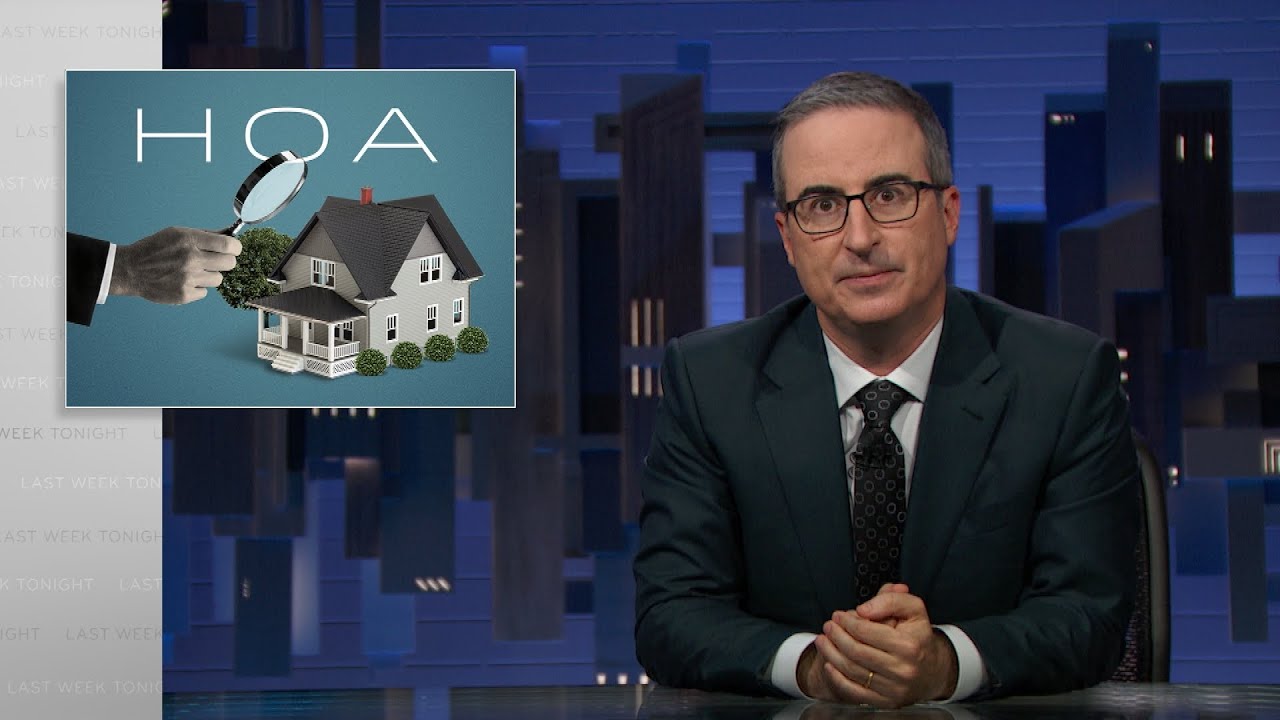
Private management companies exploit legal loopholes to convert minor neighborhood citations into thousands of dollars in debt, foreclosing on residents' homes because state officials refuse to regulate private associations.
AI-assisted summary of Homeowners Associations: Last Week Tonight with John Oliver (HBO) — original source. Check the original for full context.
Source published:
Key ideas
- Homeowners associations govern an overwhelming majority of modern developments, with 82% of newly sold single-family homes in 2021 belonging to an HOA. (3:15)
- HOAs possess quasi-governmental powers that allow them to enforce aesthetic rules, issue private traffic citations, and leverage satellite imagery to audit resident properties. (6:05)
- Because HOAs can foreclose on homes over delinquent assessments, relatively minor unpaid balances frequently balloon into thousands of dollars in legal fees and lead to evictions. (15:26)
- State agencies typically classify HOAs as private corporate entities, leaving homeowners without regulatory oversight or legal protection against compounding fines and foreclosures. (18:54)
Detailed notes
## Background Published on YouTube by LastWeekTonight on April 10, 2023, this segment features John Oliver discussing homeowners associations and their surprising legal authority. According to the video's description, the episode explores the extensive power wielded by HOAs and playfully questions how to determine whether a tree is considered 'tree-shaped.'
## TL;DR John Oliver investigates homeowners associations (HOAs), quasi-governmental entities that govern more than 80 percent of newly built single-family homes despite widespread consumer frustration. While ostensibly formed to preserve neighborhood amenities and property values, HOAs frequently impose draconian aesthetic mandates enforced by aggressive surveillance and for-profit management companies. Trivial infractions can rapidly snowball into exorbitant debt when associations hire collection attorneys who tack on massive legal fees. Shockingly, HOAs wield the legal authority to foreclose on delinquent homeowners and auction off properties for negligible sums with virtually no state oversight. In response, Oliver calls for statutory guardrails, such as pre-closing transparency mandates and bans on foreclosures stemming purely from disputed fines and inflated legal charges.
## Atmosphere & style The segment balances John Oliver's signature rapid-fire, sardonic humor with sharp investigative outrage as lighthearted suburban pettiness curdles into predatory corporate cruelty. Starting with amusing local news clips of absurd disputes over duck statues and porch benches, the broadcast steadily descends into a chilling and infuriating reality check on civil discrimination and unchecked foreclosure powers. Watching the piece feels like a rollercoaster between incredulous laughter and genuine disbelief, capped by a surreal, darkly comic sketch that dramatizes suburban tyranny with slapstick brutality.
## Bulletin - [03:15](https://www.youtube.com/watch?v=qrizmAo17Os&t=195s) Homeowners associations govern an overwhelming majority of modern developments, with 82% of newly sold single-family homes in 2021 belonging to an HOA. - [06:05](https://www.youtube.com/watch?v=qrizmAo17Os&t=365s) HOAs possess quasi-governmental powers that allow them to enforce aesthetic rules, issue private traffic citations, and leverage satellite imagery to audit resident properties. - [15:26](https://www.youtube.com/watch?v=qrizmAo17Os&t=926s) Because HOAs can foreclose on homes over delinquent assessments, relatively minor unpaid balances frequently balloon into thousands of dollars in legal fees and lead to evictions. - [18:54](https://www.youtube.com/watch?v=qrizmAo17Os&t=1134s) State agencies typically classify HOAs as private corporate entities, leaving homeowners without regulatory oversight or legal protection against compounding fines and foreclosures.
## Key takeaways - [03:15](https://www.youtube.com/watch?v=qrizmAo17Os&t=195s) HOAs have expanded rapidly across the United States, making it increasingly difficult for new homebuyers to avoid mandatory membership. - [03:15](https://www.youtube.com/watch?v=qrizmAo17Os&t=195s) While intended to maintain property values and common amenities, HOAs frequently enforce hyper-specific, arbitrary aesthetic and behavioral rules. - [06:05](https://www.youtube.com/watch?v=qrizmAo17Os&t=365s) Local municipalities encourage HOA creation because it transfers infrastructure costs like road maintenance and trash collection to private residents while expanding the tax base. - [06:05](https://www.youtube.com/watch?v=qrizmAo17Os&t=365s) HOAs operate as private nonprofit corporations with quasi-governmental power, occasionally deploying speed cameras and auditing backyards with satellite surveillance. - [10:31](https://www.youtube.com/watch?v=qrizmAo17Os&t=631s) Historically rooted in racially restrictive covenants, HOA policies can still perpetuate racial segregation, such as banning Section 8 vouchers in communities where most affected tenants are Black. - [12:26](https://www.youtube.com/watch?v=qrizmAo17Os&t=746s) Volunteer boards routinely outsource operations to for-profit management companies, which are financially incentivized to maximize violation citations and late fees. - [15:26](https://www.youtube.com/watch?v=qrizmAo17Os&t=926s) Minor infractions and unpaid dues can trigger aggressive debt escalation, where attorney fees and compounding penalties quickly dwarf the original assessment. - [15:26](https://www.youtube.com/watch?v=qrizmAo17Os&t=926s) HOAs possess the legal authority to foreclose on properties over unpaid fines and fees, occasionally resulting in seized homes being sold at auction for nominal sums. - [18:54](https://www.youtube.com/watch?v=qrizmAo17Os&t=1134s) State governments and attorneys general largely decline to intervene in HOA disputes, treating them as private contractual issues and leaving homeowners with little recourse. - [18:54](https://www.youtube.com/watch?v=qrizmAo17Os&t=1134s) Prospective buyers face significant information asymmetry, frequently being denied access to binding HOA bylaws until closing. - [20:40](https://www.youtube.com/watch?v=qrizmAo17Os&t=1240s) Meaningful reform requires state-mandated consumer protections, including statutory debt caps before legal escalation and complete bans on foreclosures sparked solely by fines and legal fees.
## Detailed walkthrough ### [00:00](https://www.youtube.com/watch?v=qrizmAo17Os&t=0s) Introduction to HOAs: The Widely Loathed American Institution
John Oliver begins by warning viewers under the age of 35 that this story is not for them, as they will never own a home under the unspoken deal made by being born after 1988. Instead, the show prepared a 25-minute alternative video on Chuck E. Cheese, describing it as another crumbling American institution. For those remaining, the subject is homeowners associations (HOAs)—entities set up to govern suburban neighborhoods or condominium developments. HOAs frequently make local news as petty villains.
Oliver highlights a local news report by Joe Ducey about Ted, a nearly 92-year-old resident of Bethany Villa Association, whose HOA ordered him to remove the bench outside his front door. Neighbor and self-described "Ted fan" Tanya defended him on air, arguing: “The man deserves a place to rest and enjoy nature and eat his little snacks and say hello to people and pet puppies.” Oliver enthusiastically agrees, joking that eating snacks and petting puppies is the single greatest activity imaginable—easily beating out being present for the birth of a child—and commends Tanya for putting on a full face of makeup in the morning just to tell the HOA to stop bothering Ted.
Beyond Ted's bench, local news broadcasts across the country are filled with examples of bizarre HOA enforcement: - Fining a homeowner in a valley community for installing water-saving artificial grass. - Ordering a San Antonio family to take down holiday decorations because they were put up too early. - Bombarding a resident with letters demanding they stop feeding local ducks. - Issuing a formal violation notice because a front-yard tree was deemed “not tree-shaped.”
[03:15](https://www.youtube.com/watch?v=qrizmAo17Os&t=195s) The Ubiquity, Structure, and Rules of Community Associations
Despite widespread complaints, avoiding an HOA is becoming nearly impossible. In 2021, 82% of newly sold single-family homes were part of an HOA. When a local news station surveyed viewers about their feelings toward HOAs, the response was overwhelmingly negative, save for one resident who noted they were happy—prompting another viewer to issue a stark warning: “Don't count yourself lucky too soon. Every HOA is just one vote away from hellish nightmares.”
An archival 1990s instructional video outlines how community associations operate: they are legal entities created during the development of planned communities and governed by an elected board of directors composed of fellow residents. Members must pay mandatory dues, which typically average $200 to $300 a month but can climb much higher. In exchange, the HOA maintains shared neighborhood amenities—such as swimming pools, community parks, and playgrounds—while strictly enforcing architectural and landscaping guidelines to maintain aesthetic uniformity and protect property values. These aesthetic mandates range from requiring grass to be cut to precise heights to micromanaging specific shrubs, plants, and exterior accents.
```mermaid flowchart TD accTitle: Structure and Authority of a Homeowners Association accDescr: Flowchart showing how property developers establish HOAs, how boards govern them, and the rules and enforcement actions that result.
subgraph Origin["Creation"] Dev["Property Developer"] -->|"Writes deed restrictions"| Auto["Mandatory HOA Membership"] end
subgraph Governance["Governance & Funding"] Auto --> Board["Elected Resident Board"] Auto --> Dues["Monthly Dues ($200–$300+)"] Dues --> Amenities["Common Amenities (Pools, Parks)"] end
subgraph Control["Rule Enforcement"] Board --> Rules["Aesthetic & Conduct Rules"] Rules --> Fines["Fines & Audits (e.g., Google Maps)"] Rules --> Police["Privatized Enforcement (Speed Cameras)"] end ```
[06:05](https://www.youtube.com/watch?v=qrizmAo17Os&t=365s) Aggressive Enforcement, Surveillance, and Quasi-Governmental Power
HOA guidelines are backed by harsh financial penalties, which boards enforce aggressively. In Wake County, North Carolina, homeowner Debra Blue faced fines of $25 per day over the color of her plum shutters. After accumulating nearly $2,000 in fines, she took the shutters down, only for the association to immediately fine her again for the absence of shutters. In another instance, Gavin Henry, a disabled veteran, received a notice about an unapproved backyard shed three years after purchasing his property. Because the shed was invisible from the street and neighbors had never complained, Henry asked how the board discovered it, only to be told the HOA had audited his property using Google Maps satellite imagery. Oliver questions why an organization relies on the space program to inspect private backyards.
HOAs hold immense power because they are baked into property deed restrictions by developers from day one, meaning buyers automatically agree to their bylaws upon purchase. Organized as private nonprofit corporations, HOAs frequently operate like mini-governments: - Contracting private trash collection, snow removal, and street maintenance. - Setting traffic regulations and installing private automated speed cameras, such as in the Park View community of Spring Valley, where tickets start at $250 for driving slightly over 15 mph and scale up to $1,000 for a third offense.
Oliver compares this sweeping power to visiting Disney World: “When you walk into the Mouse's house, you play by the Mouse's rules. And if you step out of line, Goofy is allowed to break your fucking knees.” Municipalities actively encourage this shift because it allows local governments to expand their tax base without taking on the cost of building and maintaining local infrastructure. However, unlike actual governments, HOAs aggressively resist public accountability. In Val Vista Lakes, Arizona, after residents voiced criticism of the board on social media ahead of an election, the HOA threatened fines and legal action unless the posts were removed. When pressed by local reporter Cameron Polom outside a private board meeting, board director Todd McCoy repeatedly shouted, “Get away from me!” rather than answering questions.
[10:31](https://www.youtube.com/watch?v=qrizmAo17Os&t=631s) A History of Discrimination and Exclusion
Following an aggressive confrontation in which an official named McCoy shoves a reporter and screams with fury, John Oliver remarks that “He came at that reporter with the fire of a thousand Mel Gibsons,” quipping that there is rarely an excuse for yelling “Get away from me!” so intensely, “aside from maybe bumping into Ezra Miller in Hawaii.” Oliver pivots to the systemic reality behind these bodies: private associations designed with the force of suburban law have a long track record of excluding certain groups. Neighborhoods originally relied on explicitly racist covenants to ban Black Americans from purchasing homes, and even after the Supreme Court declared racial covenants unconstitutional, some HOAs still tried to enforce them.
That exclusionary impulse persists today under different guises. In June 2022, the board of the Providence HOA in Denton County, Texas—which governs a development of 2,200 homes—passed a regulation barring homeowners from renting to anyone utilizing publicly financed or subsidized housing programs, such as Section 8 vouchers. The human impact was immediate; resident Revisha Threat tearfully told reporter Scoop Jefferson, “I sit in my living room and cry. Because I just don't know what to do.” The policy threatened to displace numerous renters across the development. Oliver highlights the stark demographics:
> “And I know that those HOA officials might not think of themselves as racist, but 93 percent is a pretty solid ‘A’ for racism.”
Oliver notes that while the Providence policy fell under official investigation, HOA rules effectively serve as a “segregation loophole”—which he jokes would make a fitting slogan for the American suburbs.
- **Providence HOA (Denton County, TX):** Banned Section 8 voucher holders across 2,200 homes. - **Demographic Disparity:** Black families made up 93% of the households threatened with displacement by the rental voucher ban.
---
[12:26](https://www.youtube.com/watch?v=qrizmAo17Os&t=746s) For-Profit Management Companies and Compounding Fines
While HOA governing boards are technically made up of elected neighborhood volunteers, those volunteers frequently lack the time, expertise, or desire to police their neighbors. Consequently, neighborhoods hire private, for-profit management firms. In a promotional video, Associa—one of the largest management companies in the nation—pitches itself as coming alongside volunteer boards to do the “heavy lifting” and help them “achieve that vision.” Yet Oliver points out that when for-profit companies are incentivized to uncover violations, neighborhoods rapidly deteriorate into hostile environments. Associa, for instance, managed the community where an elderly resident named Ted was forced to remove his front-porch resting bench.
Management companies routinely employ inspectors whose sole job is driving through neighborhoods to spot petty infractions. In a news report by Kaitlyn Ross, homeowner Pat Kramer detailed how her life spiraled when a new management company took control of her HOA. First, she was cited because her trash cans were momentarily visible from the street if a driver turned their head at a specific angle. After struggling to drag them inside, she was cited for a neatly coiled garden hose, followed by unauthorized lawn art, unwashed siding, and an unswept driveway. Because she could not remedy the issues fast enough, the company assessed late fees of $25 per day per violation, ultimately billing her an astronomical $17,000. Kramer expressed her outrage on camera:
> “These are things that are so incidental. They’re not important. They’re asinine. And you’re charging me 17,000 dollars?”
Oliver praises Kramer's perfect delivery of the word “asinine,” while joking that although her taste in lawn ornaments might be questionable compared to novelty duck statues—such as ducks wearing boots or ducks sculpted from peeled bananas—it certainly does not warrant a five-figure financial penalty.
---
[15:26](https://www.youtube.com/watch?v=qrizmAo17Os&t=926s) The Debt Trap and Foreclosure Power
The combination of strict enforcement and aggressive billing rapidly plunges homeowners into a vicious cycle of debt. Once an owner falls behind on dues or fines, management companies levy penalties and interest, before passing the account to collections lawyers who bill astronomical hourly legal fees to the resident's balance. Oliver highlights the bill of an 88-year-old Texas homeowner who entered a nursing home due to illness and missed a $423 annual dues payment in early 2021. Within five months, missed payment fees pushed the debt to $682. Once attorneys stepped in, the debt exploded: over two years, her balance surpassed $8,000, with more than half of the total consisting entirely of legal fees.
```mermaid flowchart TD accTitle: The HOA Escalation Cycle accDescr: Flowchart illustrating how a minor unpaid HOA fee escalates into foreclosure.
subgraph Phase1["Initial Delinquency"] A["Missed Dues or Minor Fines<br/>(e.g., $423 unpaid balance)"] --> B["Interest & Late Fees Added<br/>(Balance grows to $682)"] end
subgraph Phase2["Legal Escalation"] B --> C["Private Management Involves Lawyers"] C --> D["Astronomical Legal Fees Added<br/>(Bill surpasses $8,000)"] end
subgraph Phase3["Property Loss"] D --> E["Foreclosure Notice Served"] E --> F["Home Sold at Auction<br/>(Sometimes for nominal sums)"] end ```
Lawyers are brought in because HOAs wield a terrifying legal tool: the power to foreclose on homes to satisfy delinquent debts. Homeowner Miesha Ross recalled her shock when a process server arrived at her door with a foreclosure notice while she was working through her finances:
> “Miesha Ross: But this was the HOA, and I had no idea that an HOA could foreclose on you.”
Oliver stresses that HOA foreclosure is one of those unbelievable but true realities, like the fact that chickens outnumber people four to one, Lenny Kravitz is Al Roker's second cousin, or Charlie Puth's unusual musical coming-of-age confessions. Thousands of foreclosure actions are initiated by HOAs across states like Colorado and beyond. To make matters worse, foreclosed properties can be auctioned off without the owner fully understanding the timeline. In a report by Rebecca Lindstrom, a homeowner described paying $2,700 to settle her account, only to be hit with subsequent letters demanding $6,400 due to post-judgment legal expenses and an 18 percent interest rate. Even after she paid over $9,000, the HOA foreclosed on her property and acquired her entire house at auction for just $3.24, later serving her with an eviction notice. Oliver notes with utter disbelief that $3.24 is less than the $17.89 he paid to order a tiny banana-duck desk figurine.
- **88-Year-Old Texas Resident:** A missed $423 assessment turned into over $8,000 within two years, with legal fees making up more than half. - **$3.24 Home Foreclosure:** An owner paid over $9,000 toward fees and 18% back interest, yet her HOA acquired her entire house at auction for $3.24 before evicting her.
---
[18:54](https://www.youtube.com/watch?v=qrizmAo17Os&t=1134s) Lack of State Oversight and Path Forward
The fundamental reason HOAs can exert such extreme leverage is their legal structure: because HOAs are private entities, most state laws do not force them to offer payment plans, and government bodies routinely refuse to intervene. Attorney general offices in major states, including California, New York, and the Texas Secretary of State, treat HOA disputes as strictly private matters between homeowners and corporate boards, leaving homeowners with no state recourse. As Oliver summarizes, government offices telling owners to pursue private litigation is simply a polite way of saying:
> “Which is basically just a cute way to say, ‘You’re fucked!’”
Prospective homebuyers cannot easily sidestep this dynamic. Over 80 percent of newly constructed homes in the United States are governed by an HOA, and buyers are often unable to review the binding governing bylaws and covenants until closing, when backing out is no longer viable. Oliver observes that while HOAs can practically examine a homeowner's backyard via satellite imagery, buyers cannot even review the association's rulebook before signing their life away.
While Oliver acknowledges that eliminating HOAs overnight is impractical—many local governments rely on them to fund and operate neighborhood services like road maintenance and trash collection, and some owners do appreciate their amenities—he urges state legislatures to curb their worst abuses. At an absolute minimum, states must pass consumer protections preventing homeowners from being stripped of their homes over trivial debts, including mandating accessible payment plans.
[20:40](https://www.youtube.com/watch?v=qrizmAo17Os&t=1240s) The Need for Reform and HOA Transparency
John Oliver wraps up the investigation by calling for urgently needed guardrails on homeowners associations. At a minimum, states must implement sensible legal limits, such as placing statutory caps on unpaid debt before associations are legally allowed to escalate matters, and outright banning home foreclosures that stem purely from disputed fines and inflated legal fees. While neighborhood associations are often framed merely as nuisance bureaucracy, their legal privileges make them far more hazardous in practice. As Oliver summarizes: “Because at their best, HOAs are annoying, student council adults telling you to trim your shrubs and move your trashcans. But at their worst, they are glorified debt collectors with the power to upend your life and expel people from a neighborhood.” Because of those steep stakes, Oliver argues that, at the absolute bare minimum, HOAs should be mandated to provide transparent disclosures so home buyers clearly understand the sweeping power they are subjecting themselves to before signing a deed.
- Recommended statutory reforms include debt thresholds before legal actions can commence and a ban on foreclosures triggered solely by fines or attorney charges. - The fundamental issue is that HOAs bridge the gap between petty neighborhood busybodies and aggressive debt collectors with legal authority to seize property.
[21:10](https://www.youtube.com/watch?v=qrizmAo17Os&t=1270s) Welcome to Cedar Paradise: Arbitrary Rules and Ruthless Enforcement
To illustrate the hidden nightmare awaiting prospective buyers, the show transitions into a satirical orientation video for a fictional planned development called "Cedar Paradise." A perky HOA representative greets new homeowners Stephanie and Chloe with an aggressive smile, reminding them that membership is mandatory from the second escrow closes. As the host cheerily explains: “The moment you purchased your home, you joined our wonderful homeowners association, whether you wanted to or not.” The community pitch quickly pivots from promises of pristine neighborhood upkeep to unabashed extortion, accompanied by a checklist of mandatory front lawn decorations. Every homeowner must display exactly one tree, six three-gallon shrubs, a bird bath, an American flag, a Victorian child playing hopscotch, and three garden gnomes—one initial gnome, a second gnome for the first one to converse with, and a third gnome that the other two deliberately shun.
Meanwhile, unauthorized amenities are met with swift violence, demonstrated when an older homeowner named Ted is tackled and pummeled on his lawn while the host shouts, "Eat shit, Ted!" for daring to install a bench. The representative embarks on a neighborhood stroll, doling out arbitrary citations with total impunity: a novelty mailbox is cited immediately; a set of wind chimes garners three separate fines; a healthy tree receives an infraction simply because she does not care for it; and a driver named Ken is hit with a $1,000 penalty for driving 16 mph in a 15 mph zone. The tyrannical surveillance is underscored by a furious neighbor who vents about the extreme lengths the board goes to in order to catch infractions, exclaiming: “They found my shed by strapping a GoPro to a raccoon.”
```mermaid flowchart TD accTitle: The HOA Escalation Cycle accDescr: Flowchart showing the rapid escalation from minor infraction to home foreclosure in the Cedar Paradise sketch.
subgraph Surveillance ["Surveillance & Petty Fines"] A["Minor HOA Violation<br/>($20 fine, 3:57 PM trash, wind chimes)"] --> B["Surveillance Escalation<br/>(GoPro strapped to raccoon)"] end
subgraph CompoundingDebt ["Compounding Fees"] B --> C["Compounding Charges<br/>(Late fees, attorney billing, raccoon fees)"] C --> D["Instant Balance Balloon<br/>($11,067.38 owed)"] end
subgraph ForeclosureAction ["Foreclosure & Eviction"] D --> E["Non-Judicial Foreclosure<br/>(Home sold for $4 during conversation)"] E --> F["Immediate Eviction<br/>(Former owner tossed, fridge raided)"] end ```
[22:53](https://www.youtube.com/watch?v=qrizmAo17Os&t=1373s) Curb Violations and the $11,000 Foreclosure Trap
The sketch continues by highlighting the hyper-specific, trap-like regulations surrounding trash collection. A resident named Pam attempts to explain how she conceals her garbage cans behind her house, only for the HOA representative to pop out from inside Pam's blue recycling bin like a jack-in-the-box. The representative points out that neighborhood rules forbid putting cans out at the curb before 4:00 p.m. on pickup day, catching Pam red-handed at precisely 3:57 p.m. To make matters worse, the representative snatches a bottle from the bin, smashes it onto the pavement, and immediately levies another fine for having broken glass on the driveway. When Pam timidly asks if such behavior is allowed, the host cheerfully points out that nothing in the covenants technically forbids it, leaving Pam trembling in tears.
The sketch reaches its climax when the representative knocks on another resident's door to collect an unpaid $20 fine mailed three months prior. When the homeowner quickly hands over a twenty-dollar bill to settle up, the representative summons the association's private lawyer, who appears from behind a pillar and announces that the meter on his billable hour has officially started. The lawyer rattles off a comical cascade of fees: late fees, late-late fees, hourly attorney charges, conversation fees, and a dedicated "raccoon fee," bringing the grand total to $11,067.38. When the stunned resident insists he cannot pay, the host announces that the board foreclosed on the property right then and there. A bystander's phone chimes, revealing he just purchased the seized house at an HOA auction for four dollars flat. When the ruined homeowner protests that the process feels blatantly illegal, the lawyer and the board representative laugh in his face:
> “It's completely legal! I'm a lawyer!”
Two muscular movers immediately hoist the homeowner into the air and throw him off his own property while the representative and lawyer stroll inside his former home to drink his alcohol and raid his refrigerator. Closing out the segment, the representative looks directly into the camera to deliver the final, inescapable truth about American community associations: “So welcome to the HOA. I think you're gonna like it here. And if you don't? Tough nuts. You've got no other choice. Bye!”
- Rules enforced against Pam include a strict ban on placing trash cans at the curb before 4:00 p.m. on trash day and penalties for broken glass on the driveway. - The itemized bill that escalated from a $20 unpaid fine totaled $11,067.38 after late fees, legal billing, and miscellaneous operational costs were tacked on. - The home was foreclosed on in real time and snapped up at an association auction for just $4.00.
## Notable quotes > [20:40](https://www.youtube.com/watch?v=qrizmAo17Os&t=1240s) Because at their best, HOAs are annoying, student council adults telling you to trim your shrubs and move your trashcans. But at their worst, they are glorified debt collectors with the power to upend your life and expel people from a neighborhood. — John Oliver
## Mentioned John Oliver, Chuck E. Cheese, Joe Ducey, Ted, Bethany Villa Association, Tanya, Google Maps, Debra Blue, Gavin Henry, Cameron Polom, Todd McCoy, Val Vista Lakes, Associa, Kaitlyn Ross, Pat Kramer, Scoop Jefferson, Revisha Threat, Providence HOA, Miesha Ross, Rebecca Lindstrom, Cedar Paradise
## Video description John Oliver discusses homeowners associations, the surprising power they have, and how to tell if a tree is “tree-shaped.”
Connect with Last Week Tonight online...
Subscribe to the Last Week Tonight YouTube channel for more almost news as it almost happens: www.youtube.com/lastweektonight
Find Last Week Tonight on Facebook like your mom would: www.facebook.com/lastweektonight
Follow us on Twitter for news about jokes and jokes about news: www.twitter.com/lastweektonight
Visit our official site for all that other stuff at once: www.hbo.com/lastweektonight
[Source](https://www.youtube.com/watch?v=qrizmAo17Os)