RBNZ's MONIAC Shows Policy Tightening Curbs GDP With Inherent Lags
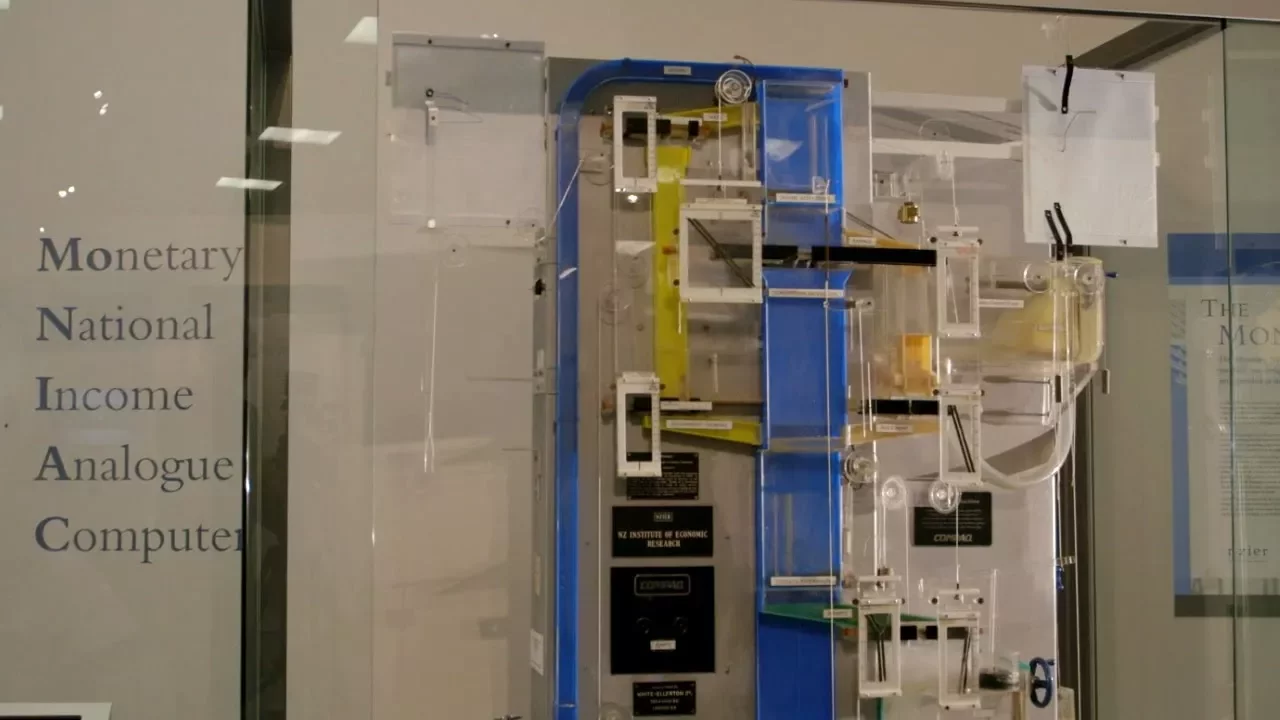
Making Money Flow: The MONIAC — Reserve Bank of New Zealand

Reserve Bank of New Zealand

Draining liquidity from the investment reservoir drives interest rates higher and cuts private expenditure, but physical circulation delays prove central bank policy shifts take time to filter through the broader economy.

AI-assisted summary of Making Money Flow: The MONIAC — original source. Check the original for full context.

Source published:

Key ideas

  • The Reserve Bank of New Zealand Museum houses the only known operational MONIAC computer in the Southern Hemisphere, originally built in the late 1940s by Bill Phillips. (0:00)
  • The analog, hydromechanical computer models macroeconomics by pumping colored water through transparent tanks, representing national income, taxes, savings, and investment. (0:00)
  • Central bank monetary tightening is simulated by draining fluid from the investment tank, raising interest rates and mechanically curbing corporate investment and consumption. (1:46)
  • The physical transit time of water through the machine's tubes and valves demonstrates the real-world transmission lag of monetary policy on GDP. (1:46)

Detailed notes

## Background Published on YouTube by the Reserve Bank of New Zealand on August 10, 2017, this video introduces Bill Phillips' hydro-mechanical economic computer, the MONIAC. It provides a live demonstration of the Southern Hemisphere's only operating unit, located at the Reserve Bank Museum & Education Centre in Wellington, New Zealand.

## TL;DR The video showcases the MONIAC, an analog macroeconomic computer built in the late 1940s that models national economies by circulating colored water through interconnected tanks, pipes, and floats. Fluid represents monetary flows across national income, taxation, household consumption, and private savings, while investment fund levels establish prevailing interest rates. A live demonstration simulates central bank monetary tightening by removing fluid from the investment reservoir, showing how higher rates mechanically depress business borrowing and household spending. Because water takes time to cycle through the physical valves and conduits, the machine visually captures the natural transmission lags of monetary policy.

## Atmosphere & style The presentation carries an engaging, educational museum tone that turns abstract macroeconomic theory into something tangible and mechanical. Watching liquid pump, drain, and adjust through transparent tubes while plotting pens trace real-time charts gives economic principles a mesmerizing, clockwork physicality. The host guides viewers with quiet enthusiasm, highlighting the sheer ingenuity of Phillips' inventive engineering and making monetary policy feel unexpectedly kinetic.

## Bulletin - [00:00](https://www.youtube.com/watch?v=rAZavOcEnLg&t=0s) The Reserve Bank of New Zealand Museum houses the only known operational MONIAC computer in the Southern Hemisphere, originally built in the late 1940s by Bill Phillips. - [00:00](https://www.youtube.com/watch?v=rAZavOcEnLg&t=0s) The analog, hydromechanical computer models macroeconomics by pumping colored water through transparent tanks, representing national income, taxes, savings, and investment. - [01:46](https://www.youtube.com/watch?v=rAZavOcEnLg&t=106s) Central bank monetary tightening is simulated by draining fluid from the investment tank, raising interest rates and mechanically curbing corporate investment and consumption. - [01:46](https://www.youtube.com/watch?v=rAZavOcEnLg&t=106s) The physical transit time of water through the machine's tubes and valves demonstrates the real-world transmission lag of monetary policy on GDP.

## Key takeaways - [00:00](https://www.youtube.com/watch?v=rAZavOcEnLg&t=0s) The MONIAC was invented in the late 1940s by New Zealand economist and engineer Bill Phillips as an analog, hydromechanical model of macroeconomics. - [00:00](https://www.youtube.com/watch?v=rAZavOcEnLg&t=0s) The machine at the Reserve Bank of New Zealand Museum & Education Centre is the only functioning MONIAC in the Southern Hemisphere. - [00:00](https://www.youtube.com/watch?v=rAZavOcEnLg&t=0s) Colored water circulating through transparent tanks, pipes, and floats physically models the flow of money throughout an entire economic system. - [00:00](https://www.youtube.com/watch?v=rAZavOcEnLg&t=0s) National income is initially pumped upward from a base tank before taxes are siphoned off as government revenue. - [00:00](https://www.youtube.com/watch?v=rAZavOcEnLg&t=0s) Unspent tax receipts accumulate in a dedicated holding box to represent a government budget surplus. - [01:46](https://www.youtube.com/watch?v=rAZavOcEnLg&t=106s) After-tax disposable income flows to households, where it is split between consumption expenditure and savings. - [01:46](https://www.youtube.com/watch?v=rAZavOcEnLg&t=106s) Household savings feed into an investment fund tank, where fluid level inversely indicates the prevailing interest rate and borrowing costs. - [01:46](https://www.youtube.com/watch?v=rAZavOcEnLg&t=106s) Domestic expenditure is represented by combining government spending, consumer expenditure, and firm investment (C + I + G). - [01:46](https://www.youtube.com/watch?v=rAZavOcEnLg&t=106s) An overheating economy operating above capacity is indicated when the bottom GDP tank reaches an excessively high fluid level. - [01:46](https://www.youtube.com/watch?v=rAZavOcEnLg&t=106s) Monetary policy tightening is simulated by draining fluid from the investment fund, which drives up interest rates and is recorded by a mechanical plotting pen. - [01:46](https://www.youtube.com/watch?v=rAZavOcEnLg&t=106s) Higher interest rates mechanically force firms to slash investment, households to cut consumption, and overall demand for imports to fall. - [01:46](https://www.youtube.com/watch?v=rAZavOcEnLg&t=106s) The delayed drop in the GDP tank reflects the operational transmission lag of monetary policy observed in real-world economies.

## Detailed walkthrough ### [00:00](https://www.youtube.com/watch?v=rAZavOcEnLg&t=0s) The Invention and Architecture of the MONIAC

The MONIAC (Monetary National Income Analogue Computer), housed at the Reserve Bank of New Zealand Museum & Education Centre, stands as the only operational machine of its kind known in the Southern Hemisphere. Conceived and built in the late 1940s by New Zealand economist and engineer Bill Phillips, it represents one of the earliest macroeconomic computers ever devised. Rather than relying on digital microchips, the MONIAC is an analog, hydromechanical computer designed to model the economy as an interconnected whole by pumping colored water through transparent tanks, pipes, sluices, and floats to represent the physical circulation of money. Reflecting on the sheer originality of the design, a museum commentator notes: “What Bill Phillips did was so creative, lateral, and offthe-wall.”

The physical apparatus demonstrates how national income circulates and branches off into different sectors of the economy. At the base of the machine sits an income tank, from which water is pumped upward to represent total national income entering the economic system before it ever reaches private citizens. Before that stream arrives at households, a portion of the water is siphoned off as taxation, which cascades down as revenue for the government. The government then determines how much of that revenue it wishes to spend back into the economy. If tax receipts exceed public expenditures, the surplus accumulates in a dedicated holding box.

```mermaid flowchart TD accTitle: Hydromechanical Flow of the MONIAC accDescr: Visual flowchart showing how water flows through the MONIAC to model national income, taxes, household decisions, and domestic expenditure.

subgraph Income ["National Income"] T_Income["Income Tank (Pumped Up)"] end

subgraph GovSector ["Government Sector"] T_Taxes["Taxes (Government Revenue)"] T_Surplus["Government Surplus / Deficit"] G_Spend["Government Spending"] end

subgraph PrivateSector ["Households & Firms"] H_Income["Disposable Household Income"] H_Savings["Savings Tank"] H_Consume["Consumption Flow"] F_Invest["Investment Fund & Interest Rates"] end

subgraph AggregateExpenditure ["Domestic Demand & Output"] DomesticExp["Domestic Expenditure (C + I + G)"] GDP["Gross Domestic Product (GDP Tank)"] end

T_Income -->|"Tax deduction"| T_Taxes T_Income -->|"After-tax income"| H_Income T_Taxes --> G_Spend T_Taxes -.->|"Unspent revenue"| T_Surplus H_Income -->|"Savings choice"| H_Savings H_Income -->|"Consumption choice"| H_Consume H_Savings --> F_Invest F_Invest -->|"Business borrowing"| AggregateExpenditure G_Spend --> AggregateExpenditure H_Consume --> AggregateExpenditure AggregateExpenditure --> DomesticExp DomesticExp --> GDP GDP -->|"Cycles back"| T_Income ```

- Built in the 1940s by Bill Phillips as an analog, hydromechanical model of macroeconomic principles. - Uses water volume, fluid levels, and flow rates to represent money stock, interest rates, and expenditure streams. - Accounts for government taxation, expenditure, and fiscal balance (surplus/deficit).

[01:46](https://www.youtube.com/watch?v=rAZavOcEnLg&t=106s) Household Choices, Domestic Expenditure, and Monetary Tightening

After tax deductions, the remaining fluid represents disposable income reaching households. At this junction, households face an allocation choice: they must decide how much money to channel into savings, with the remainder flowing directly into private consumption. The rate at which households choose to save is governed by the prevailing interest rate, which is visually indicated by the water level inside the investment fund tank. When the volume of liquid in the investment reservoir is low, money is scarce, causing interest rates to rise. Conversely, higher reserves signify abundant liquidity and cheaper borrowing costs. This investment fund determines the borrowing capacity and capital expenditure of private firms. When combined, government spending ($G$), household consumption ($C$), and corporate investment ($I$) unite to form total domestic expenditure.

The presenter transitions to a live demonstration illustrating central bank intervention. When the GDP tank at the bottom registers an excessively high fluid level, it signifies an overheating economy operating above capacity. To counter this, the operator demonstrates a tightening of monetary policy by physically draining fluid out of the investment fund:

> “So when there's less money in this investment funds, we're going to see the level drop, which is just like seeing interest rates rise.”

As the water drains away, an attached mechanical plotting pen records a sharp, rapid spike on an interest-rate chart. Mechanical slides on the machine illustrate how other economic actors respond to this sudden rise in the cost of borrowing: firms slash capital investment budgets, households curb their consumption spending, and falling national income leads to a measurable reduction in imports. While the primary GDP level does not instantly plummet, the delay mirrors the real-world operational transmission of monetary policy. Because fluid must travel through interconnected tubes, valves, and reservoirs, the policy shock works its way through the entire economic loop over an extended lag, demonstrating why central bank actions take months to fully materialize in the wider economy.

- Domestic expenditure is modeled by combining government expenditure, consumption, and firm investment ($C + I + G$). - d-CON / central bank tightening is simulated by removing water from the investment chamber, reducing the available supply of credit. - Rising interest rates trigger behavioral cutbacks across the apparatus, depressing firm investment, private consumption, and import demand. - The physical delay in fluid circulation captures the real-world time lags inherent to monetary policy transmission.

## Mentioned MONIAC, Bill Phillips, Reserve Bank of New Zealand, Reserve Bank Museum & Education Centre

## Video description Introducing Bill Phillips' amazing hydro-mechanical economic computer. A live demonstration of the only working MONIAC in the Southern Hemisphere. This is located in the Reserve Bank Museum & Education Centre, Wellington, New Zealand. Directions to the Museum: http://www.rbnzmuseum.govt.nz/visitus/FindUs.aspx

To try a virtual MONIAC, visit http://www.rbnzmuseum.govt.nz/activities/moniac/introduction.aspx

For directions and Museum hours see http://www.rbnzmuseum.govt.nz/visitus/FindUs.aspx

[Source](https://www.youtube.com/watch?v=rAZavOcEnLg)

中文简报

新西兰联储MONIAC模型展示紧缩政策抑制GDP及其固有滞后性 从投资水池中抽取流动性会推高利率并削减私人支出,但物理循环的延迟证明央行政策转变需要时间才能渗透到更广泛的经济体系中。 该视频展示了制造于20世纪40年代末的宏观经济模拟计算机MONIAC,它通过在相互连接的水箱、管道和浮标间循环有色水流来模拟国民经济。流体代表在国民收入、税收、家庭消费和私人储蓄之间的货币流动,而投资基金的储水水平则决定了现行利率。现场演示通过从投资水池中抽取流体来模拟央行的货币紧缩政策,展示了更高的利率如何机械性地抑制企业借贷和家庭支出。由于水流通过物理阀门和管道需要时间循环,该机器生动直观地再现了货币政策固有的传导滞后性。 新西兰储备银行博物馆藏有南半球唯一一台已知仍可运行的MONIAC计算机,它最初由比尔·菲利普斯于20世纪40年代末制造。 (0:00) 这台模拟水力机械计算机通过在透明水箱中泵入有色水流来建模宏观经济,分别代表国民收入、税收、储蓄和投资。 (0:00) 通过从投资水箱中抽取流体来模拟央行的货币紧缩,从而推高利率并在机械结构上抑制企业投资和消费。 (1:46) 水流穿过机器管道和阀门的物理流动时间,展示了货币政策对GDP产生影响的现实传导滞后。 (1:46)

Reading summary

Designed in the late 1940s by New Zealand economist and engineer Bill Phillips, the MONIAC models national income and macroeconomics through an analog hydromechanical system of circulating colored water. Housed at the Reserve Bank of New Zealand Museum, the apparatus visually demonstrates sectoral income flows, private and public expenditure, and the transmission lags of central bank monetary policy. Hydromechanical Architecture and Fiscal Circulation (0:00) The MONIAC (Monetary National Income Analogue Computer) is the only operational machine of its type known in the Southern Hemisphere. Regarded by a museum commentator as a creative and lateral invention, it uses transparent tanks, pipes, sluices, and floats rather than digital microchips to model the economy as an interconnected whole. Water representing total national income is pumped upward from a base tank into the system before circulating to private citizens. Prior to reaching households, a portion of the stream is diverted as taxation revenue for the government. The state then directs this revenue back into the economy via public expenditure, with any unspent tax receipts accumulating in a dedicated surplus holding box. Household Allocation and Domestic Expenditure (1:46) After tax deductions, the remaining fluid flows as disposable income to households, who divide it between consumption spending and savings. The proportion allocated to savings is dictated by prevailing interest rates, which are represented by the fluid level in an investment fund reservoir. A low water level in this tank indicates capital scarcity and higher interest rates, whereas higher fluid levels represent abundant liquidity and reduced borrowing costs. Funds pooled in the investment chamber govern private corporate borrowing and capital spending. Combined, household consumption, corporate investment, and government expenditure merge to form total domestic expenditure, which subsequently drains into the primary gross domestic product tank. Simulating Monetary Tightening and Transmission Lags (1:46) Central bank policy adjustments are demonstrated when elevated fluid in the bottom GDP tank signals an overheating economy operating above capacity. To simulate monetary tightening, the operator drains water from the investment fund, visually signaling scarce credit and prompting an attached mechanical plotting pen to record a sharp rise on an interest-rate chart. This tightening triggers broader contractionary responses across the machine's mechanical slides: private firms reduce capital investment, households scale back consumption, and falling national income suppresses import demand. Because the fluid must circulate through interconnected valves and chambers, output does not drop immediately; this physical transit time mirrors the real-world operational lag where central bank interventions require months to fully permeate the macroeconomy. By translating abstract macroeconomic relationships into observable fluid dynamics, the MONIAC demonstrates both the mechanical equilibrium of fiscal and monetary variables and the physical delays that characterize central bank policy transmission.

精炼阅读摘要

新西兰储备银行介绍的 MONIAC(货币国民收入模拟计算机)由比尔·菲利普斯(Bill Phillips)于 1940 年代末发明,是一台利用有色水流模拟宏观经济资金循环与政策传导的水力机械模拟计算机。 水力机械架构与收入循环流向 (0:00) 位于新西兰储备银行博物馆的 MONIAC 是南半球已知唯一仍在运作的同类机器。该计算机由新西兰经济学家兼工程师 Bill Phillips 于 1940 年代末设计制造,它摒弃了现代数字微芯片,依靠泵、透明水箱、管道、水闸和浮标,通过有色液体的物理流动模拟国民经济各部门的互联运作。 在设备底部的收入水箱中,水流首先被泵送至系统顶端,代表尚未流入私人部门的国民总收入。在水流到达家庭部门之前,一部分液体作为税收被分流至政府部门;政府随后决定将多少税收重新支出回经济体中,若税收超出财政支出,多余资金便会积存在专门的盈余箱内。 私人部门决策与国内总支出结构 (1:46) 扣除税金后的水流转化为家庭可支配收入,家庭在此面临消费与储蓄的分配抉择。储蓄规模由投资水箱内的水深(即市场利率)决定:当投资水箱中的水量偏低时,资金短缺会推高利率;存量充裕时则代表流动性充足、借贷成本低廉。 该投资水箱直接决定了企业的借贷能力与资本支出规模。在此机制下,政府支出(G)、居民消费(C)与企业投资(I)共同汇入底部的国内生产总值(GDP)水箱,构成国内总需求;若 GDP 水箱中的水位过高,则表明经济出现过热且运行超出了实际负荷。 货币紧缩模拟及其传导时滞特征 (1:46) 在模拟央行加息操作时,操作人员直接从投资水箱中抽离液体以模拟货币紧缩。随着投资池水量减少,相连的机械绘图笔随即在利率图表上记录下剧烈的上升走势,这生动诠释了可贷资金匮乏导致借贷成本走高的逻辑。 设备上的机械滑块展示了经济主体对利率攀升的联动反应:企业大幅削减投资预算,家庭压缩消费支出,国民收入缩减亦导致进口需求随之降低。由于液体在管道、水箱及水闸之间的流动需要物理时间,底层 GDP 水位并未瞬间暴跌,这一物理延迟准确重现了现实世界中货币政策需要数月才能在广泛经济领域完全生效的时滞特征。 MONIAC 凭借工程学构思将抽象的宏观经济学与流体力学相融合,直观验证了宏观支出构成与货币政策传导机制,但其机械回路固有的物理特性主要用于原理解释与教学展示,无法直接替代面对复杂外部冲击的现代数字经济预测。

Detailed notes — zh

## Background 该视频由新西兰储备银行(Reserve Bank of New Zealand)于 2017 年 8 月 10 日发布在 YouTube 平台上。视频简介指出,本片现场演示了新西兰经济学家比尔·菲利普斯(Bill Phillips)发明的水力机械经济计算机 MONIAC,该设备现陈列于惠灵顿的新西兰储备银行博物馆与教育中心,是南半球唯一一台已知仍可正常运转的实体机。 ## TL;DR 视频展示了 20 世纪中叶诞生的水力宏观经济计算机 MONIAC 的物理运作原理及其在经济模拟中的应用。演示者通过有色水流在管道、水箱和阀门间的循环,形象地拆解了总收入如何被税收、储蓄和消费分流,并汇总为国内总支出(C + I + G)。随后,视频现场模拟了央行紧缩性货币政策的操作过程,直观呈现了资金收紧导致利率飙升、企业投资和家庭消费受抑的连锁反应,并揭示了现实调控中极为关键的政策时滞效应。 ## Atmosphere & style 整部影片洋溢着科技史与经济学交织的古典匠心氛围,叙事严谨从容且充满启发性。解说与实操演示配合默契,伴随着真实水流在透明管路中穿梭与机械滑块的精密位移,将原本高度抽象的宏观经济学模型转化为极具触感的物理实物。观感上既有对菲利普斯天马行空般工程创造力的由衷赞叹,又带来了一种如钟表运转般纯粹、通透的智识愉悦感。 ## Bulletin - [00:00](https://www.youtube.com/watch?v=rAZavOcEnLg&t=0s) 新西兰储备银行博物馆保存着南半球唯一一台已知仍可运转的 MONIAC 水力经济计算机,由新西兰经济学家比尔·菲利普斯于 20 世纪 40 年代发明。 - [01:04](https://www.youtube.com/watch?v=rAZavOcEnLg&t=64s) MONIAC 摆脱了电子芯片依赖,完全通过有色水流在透明管道、水箱、滑块和浮标间的流动,直观模拟国民收入循环与 C + I + G 国内总支出的宏观构成。 - [02:50](https://www.youtube.com/watch?v=rAZavOcEnLg&t=170s) 现场紧缩性货币政策模拟显示,抽离投资基金水流会推高利率并抑制企业投资与家庭消费,同时生动复现了政策传导到 GDP 过程中的时滞效应。 ## Key takeaways - [00:00](https://www.youtube.com/watch?v=rAZavOcEnLg&t=0s) MONIAC 是 20 世纪中叶发明的水力宏观经济计算机,通过物理水流和机械结构将国民经济作为一个整体系统进行动态建模。 - [00:00](https://www.youtube.com/watch?v=rAZavOcEnLg&t=0s) 菲利普斯最初设计 MONIAC 的核心目的是作为教学工具,向学生直观展示抽象且复杂的宏观经济学概念与资金流动机制。 - [01:04](https://www.youtube.com/watch?v=rAZavOcEnLg&t=64s) 国民收入从底层收入水箱泵送至顶部,在进入家庭部门之前首先被政府征收税款,未被支出的税收会流入专用容器形成财政盈余。 - [01:04](https://www.youtube.com/watch?v=rAZavOcEnLg&t=64s) 家庭面临储蓄与消费的资金分配抉择,该比例受到市场利率水平的动态调控。 - [01:04](https://www.youtube.com/watch?v=rAZavOcEnLg&t=64s) 投资基金水箱的水位与利率成反比,水箱缺水即代表资金稀缺、利率上升,进而直接决定企业的投资支出规模。 - [01:04](https://www.youtube.com/watch?v=rAZavOcEnLg&t=64s) 系统通过水流汇集完整复现了国内总支出(Domestic Expenditure)由政府支出(G)、消费(C)和投资(I)三者相加构成的宏观恒等式。 - [02:50](https://www.youtube.com/watch?v=rAZavOcEnLg&t=170s) 在经济过热(高 GDP 水位)场景下,央行通过从投资基金中抽取液体来模拟紧缩性货币政策,机械仪表会即刻显示利率走高。 - [02:50](https://www.youtube.com/watch?v=rAZavOcEnLg&t=170s) 加息通过机械滑块联动触发连锁反应:企业削减投资支出,家庭压缩消费,进口需求随整体收入下降而减缓。 - [02:50](https://www.youtube.com/watch?v=rAZavOcEnLg&t=170s) 水流在各回路与水箱间流动所需的时间,直观展现了现实世界中货币政策作用于实体经济 GDP 时存在的时滞效应(Policy Lag)。 - [02:50](https://www.youtube.com/watch?v=rAZavOcEnLg&t=170s) MONIAC 不仅是极具视觉冲击力的教学仪器,更为现代经济预测开辟了先河,尽管数字计算机普及,它依然是理解宏观经济运转的机械杰作。 ## Detailed walkthrough ### [00:00](https://www.youtube.com/watch?v=rAZavOcEnLg&t=0s) 菲利普斯与水力经济计算机 MONIAC 的诞生 新西兰储备银行博物馆中保存着南半球据知唯一一台仍在运转的 MONIAC(水力宏观经济计算机)。这一设备由新西兰经济学家比尔·菲利普斯(Bill Phillips)于 20 世纪 40 年代发明。解说者感叹道:“What Bill Phillips did was so creative, lateral, and offthe-wall.”(比尔·菲利普斯所做的事情是如此具有创造力、横向思维且不落窠臼。)作为 20 世纪中叶诞生的最杰出经济学工具之一,MONIAC 是最早的宏观经济计算机之一,它不是依赖现代电子芯片,而是完全依靠水力机械(hydromechanical)运行,将整个宏观经济作为一个整体系统来建模。 对于当年亲眼目睹该机器运转的人来说,其视觉震撼力无与伦比。解说者强调:“People who saw it could scarcely believe the achievement that here was this tremendous machine that laid out so simply and clearly all of the concepts and ideas of economics.”(亲眼见过它的人几乎不敢相信这一成就——这样一台庞大的机器,居然能如此简单清晰地展示所有经济学概念与思想。)该机器最初的核心用途是作为教学工具,比尔·菲利普斯可以在学生面前现场操作,直观演示国民经济中各要素的动态关联。 - **机器全称/别称**:MONIAC(Monetary National Income Analogue Computer,水力国民收入模拟计算机)。 - **物理机制**:利用有色水流在透明管管道、水箱、阀门和浮标之间的流动与平衡,模拟真实经济中的资金流动。 - **现存状态**:新西兰储备银行博物馆内展示的这台机器是南半球目前唯一已知可正常运转的 MONIAC 实体机。 ```mermaid flowchart TD accTitle: MONIAC 宏观经济资金流向图 accDescr: 展示收入水箱的水如何流入税收、消费、储蓄、投资并最终汇总为国内总支出的水力模型架构 subgraph IncomeDistribution["收入分配阶段"] A["收入水箱 (Income Tank)"] -->|"抽水注入系统"| B["国民收入总流"] B -->|"征税抽取"| T["税收 (Taxes)"] B -->|"税后收入"| H["家庭部门 (Households)"] end subgraph GovtSector["政府部门"] T --> G["政府水箱 (Government)"] G -->|"未完全支出部分"| GS["财政盈余 (Surplus)"] G -->|"财政支出"| G_Spend["政府支出 (G)"] end subgraph HouseholdChoice["家庭决策与金融市场"] H -->|"利率调节储蓄"| S["储蓄 (Savings)"] H -->|"未储蓄部分"| C["居民消费 (C)"] S --> InvFund["投资基金 / 货币市场 (Investment Fund)"] InvFund -->|"决定投资规模"| I["企业投资 (I)"] end subgraph DomesticExp["国内总支出汇总"] G_Spend --> Agg["国内支出 (Domestic Expenditure)"] C --> Agg I --> Agg Agg -->|"循环回流生成下一期"| A end ``` ### [01:04](https://www.youtube.com/watch?v=rAZavOcEnLg&t=64s) 水流循环与国内总支出(C + I + G)的机械构成 MONIAC 通过水箱间水流的分配,直观还原了国民经济核算中的关键流程。演示者指着底部的“收入水箱”(Income Tank)解释,水流从这里被泵送至机器顶部,代表进入经济循环的总收入。在这些资金流向家庭部门之前,政府首先介入征税,税收水流向下汇入政府账户;随后,政府决定其财政支出规模,如果政府没有花光所有税收收入,就会在特定的测量箱中积累为财政盈余(Surplus)。 扣除税收后的可支配收入流向家庭,家庭面临核心决策:储蓄多少,以及将剩下的部分用于消费(Consumption)。家庭储蓄的比例受经济体内利率水平的调控,而利率的高低则由“投资基金”(Investment Fund)水箱中的水位决定——当池中水少时,代表流动资金匮乏、货币稀缺,利率便居高不下。企业根据此处的利率水准决定投资规模。演示者总结道,只要把三个组成部分相加,就构成了国内支出:即“政府支出(G)加上消费(C)加上投资(I)”。 - **国内总支出构成**:国内支出 = 政府支出(G) + 居民消费(C) + 商业投资(I)。 - **财政衡量机制**:政府税收若大于政府支出,差额流入专用计量盒中显示为财政盈余。 - **储蓄与投资交互**:家庭储蓄汇入投资基金水箱,其水位与市场利率成反比,进而直接牵动企业投资水流的大小。 ### [02:50](https://www.youtube.com/watch?v=rAZavOcEnLg&t=170s) 紧缩性货币政策模拟与时滞效应 演示者在 MONIAC 上现场执行了一个中央银行干预的宏观调控场景。此时机器底部的 GDP 水位非常高,表明经济当前运行偏热(running a bit hot)。为了给过热的经济降温,演示者通过排走投资基金水箱中的水来模拟紧缩性货币政策(tightening monetary policy)。随着投资基金水箱中的水被抽离,水位迅速下降,直观反映出资金变得稀缺,与之相连的记录图表立刻显示利率急剧飙升。 机器上的机械滑块直观地展示了家庭和企业对加息的连锁反应:底部的指示滑块显示出随着利率上升,企业大幅削减了投资支出;上方的滑块则显示家庭因借贷成本上升而减少消费;同时由于整体收入下滑,经济对外部的进口需求也随之减少。演示者指向记录 GDP 的图表解释,加息初期 GDP 水位尚未出现剧烈剧变,但水流在各个水箱和回路之间传导需要过程,这精准还原了宏观调控的实际规律:“So this means it takes time before monetary policy has an impact on the economy which is what we see in the real world.”(这意味着货币政策需要一段时间才能对实体经济产生影响,而这正是我们在现实世界中所观察到的现象。)解说者总结指出,MONIAC 不仅是教学利器,更真正开辟了经济预测(economic forecasting)的先河;尽管随着时代演进,数字计算机的出现让包含复杂数学模型的预测成为可能,但 MONIAC 依然是理解宏观经济运转机制最卓越的机械杰作。 - **模拟操作场景**:经济过热、GDP 处于高位时的紧缩性货币政策模拟。 - **紧缩操作步骤**:手动从投资基金水箱中抽取液体,降低水箱液位。 - **连带宏观反应**: - **利率反应**:资金稀缺度上升,记录仪指针指示利率快速走高。 - **投资反应**:企业投资滑块下移,资本开支被大幅压缩。 - **消费反应**:家庭减少借贷与消费支出,提高储蓄偏好。 - **外贸反应**:由于收入预期降低,进口流速减缓。 - **政策时滞**:宏观水流流动和回流具有机械阻尼和时间差,直观呈现了货币政策传导到 GDP 总体水平的时滞性(Policy Lag)。 ## Notable quotes > [02:50](https://www.youtube.com/watch?v=rAZavOcEnLg&t=170s) So this means it takes time before monetary policy has an impact on the economy which is what we see in the real world. ## Mentioned MONIAC, Bill Phillips, Reserve Bank of New Zealand, 新西兰储备银行博物馆 ## Video description Introducing Bill Phillips' amazing hydro-mechanical economic computer. A live demonstration of the only working MONIAC in the Southern Hemisphere. This is located in the Reserve Bank Museum & Education Centre, Wellington, New Zealand. Directions to the Museum: http://www.rbnzmuseum.govt.nz/visitus/FindUs.aspx To try a virtual MONIAC, visit http://www.rbnzmuseum.govt.nz/activities/moniac/introduction.aspx For directions and Museum hours see http://www.rbnzmuseum.govt.nz/visitus/FindUs.aspx [Source](https://www.youtube.com/watch?v=rAZavOcEnLg)

Source quotes

[2:50] So this means it takes time before monetary policy has an impact on the economy which is what we see in the real world.

Original transcript

[0:00] [Music] [0:11] This is the only operational moniac in [0:14] the southern hemisphere that we're aware [0:18] of. What Bill Phillips did was so [0:20] creative, lateral, and offthe-wall. [0:27] It's one of the first macroeconomic [0:29] computers. It was built in the [0:35] 1940s. It is a computer. It's [0:38] hydromechanical. [0:42] It's a model of the macroeconomy. So the [0:45] economy as a whole. [0:47] Bill Phillips created one of the most [0:49] extraordinary economic tools that was [0:52] created in the mid- 20th century. [0:58] So this machine here is going to show [0:59] how water flows around the economy or [1:02] how money flows around the economy. We [1:04] have this income tank down here and this [1:07] is water flowing up into the machine as [1:10] income before the income reaches [1:13] households. Some of it is taxed and for [1:16] the government this is income. So taxes [1:18] flow down here as income to the [1:20] government. Then the government decides [1:23] how much it would like to spend. [1:30] People who saw it could scarcely believe [1:32] the achievement that here was this [1:34] tremendous machine that laid out so [1:37] simply and clearly all of the concepts [1:38] and ideas of economics. If the [1:41] government does not spend um all its [1:44] revenue, then it'll have a surplus. And [1:46] this is what this box here measures. The [1:48] income that is after taxes, this is [1:50] where it reaches the households and the [1:52] households have a choice to make. They [1:54] have to choose between how much they'd [1:56] like to save and then what they don't [1:58] save they [2:01] [Music] [2:06] consume. How much a household saves will [2:09] depend on the level of interest rate in [2:10] the economy. When there's only a little [2:12] bit of money in the economy, like there [2:14] is now, there's very little water in [2:16] here. This means interest rates are very [2:18] high. Principal purpose of the money act [2:20] was as a teaching tool in this [2:22] investment fund here which helps [2:23] determine the level of interest rates. [2:26] This will also determine how much [2:28] investment firms undertake. So if we add [2:30] these uh three components here up this [2:32] is our domestic part of the economy. So [2:35] we got government spending plus [2:37] consumption plus investment and this [2:40] adds up to domestic expenditure. So the [2:42] way all this water flows around, it was [2:44] possible, for example, for somebody like [2:46] Phillips to have one operating in front [2:49] of a class. What we're going to do now [2:51] is we're going to do a scenario [2:52] involving the central bank. The level of [2:54] GDP down here is very high. So the [2:57] economy is running a bit hot. So what [2:59] we're going to do now is we're going to [3:01] drain money from the investment fund. So [3:03] this is tightening monetary policy. The [3:05] Moniac really pioneered the field of [3:08] economic forecasting. [3:12] So when there's less money in this [3:13] investment funds, we're going to see the [3:15] level drop, which is just like seeing [3:17] interest rates rise. So money is now [3:19] more scarce. So what you can see on this [3:21] chart here is the interest rate is [3:23] increasing and it's increasing rapidly. [3:25] As time went on, the advent of digital [3:28] computers made it possible to have [3:29] mathematical models that were vastly [3:32] more complex than the moniac. These [3:34] slides here show how households and [3:36] firms react to changes in the interest [3:38] rate. So this one, this bottom bit here [3:41] shows how much do firms cut their [3:44] investment when interest rates increase. [3:46] This one up here shows how much do [3:48] households stop consuming when interest [3:51] rates increase. Down here, we will be [3:54] importing a little less because our [3:56] incomes are lower. Over on this chart [3:59] over here, this is GDP. There hasn't [4:02] been much of an effect, but this is [4:04] something we would expect to see. the [4:06] flows go around the economy and it [4:08] continues having an impact for some [4:10] time. So this means it takes time before [4:13] monetary policy has an impact on the [4:15] economy which is what we see in the real [4:17] world. [4:22] [Music]