Laniakea: Our home supercluster
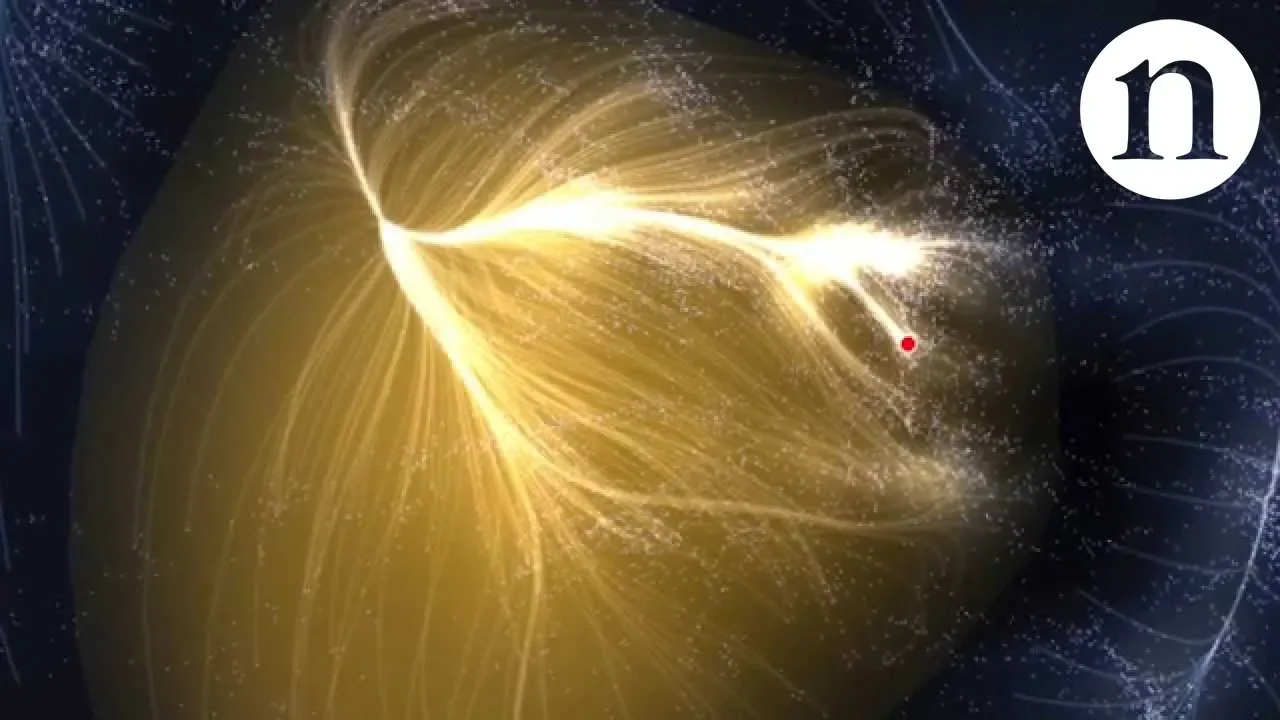
nature video
AI-assisted summary of Laniakea: Our home supercluster — original source. Check the original for full context.
Source published:
Key ideas
- Astronomers led by Brent Tully analyzed velocity data from over 8,000 galaxies, revealing that the Milky Way resides on the outer periphery of a newly mapped home supercluster named Laniakea. (0:02)
- By subtracting macroscopic cosmic expansion from galaxy velocities, the research team isolated local gravitational pulls to chart cosmic flow pathways across space. (0:02)
- The study establishes the first physically grounded boundary for superclusters by identifying cosmic watersheds, where gravitational flows shear apart toward competing attractors. (1:55)
- The previously defined local supercluster spanning 100 million light-years is merely an appendage of Laniakea, which is over 100 times larger and more massive. (1:55)
Detailed notes
## Background Published by the nature video channel on YouTube on September 3, 2014, this video accompanies research defining the boundaries of cosmic superclusters. According to the page description, a Hawaii-based research team developed a technique mapping the flow of galaxies across space, redefining our home supercluster as Laniakea—a Hawaiian term meaning 'immeasurable heaven.'
## TL;DR Astronomers have long struggled to delineate the boundaries of superclusters, the largest known structures in the universe. By analyzing the velocity and positions of over 8,000 nearby galaxies and subtracting cosmic expansion, a team led by Brent Tully mapped gravitational 'cosmic flows.' They discovered that the Milky Way resides on the periphery of a massive supercluster centered around the Great Attractor, which is over 100 times larger than the previously assumed local grouping. By identifying watershed-like divergence lines where galactic flows separate toward different gravitational basins, the team established a clear boundary for our home supercluster, named Laniakea.
## Atmosphere & style The presentation carries a calm, awe-inspiring, and scientifically rigorous tone typical of high-end educational documentaries. Visualizations of dynamic flow lines, glowing voids, and gravitational pathways lend a mesmerizing, almost ethereal quality to the vastness of the cosmos. As the narrative zooms from Earth's familiar coordinates out into the monumental scale of Laniakea, it evokes a profound sense of cosmic humility and mathematical beauty.
## Bulletin - [00:02](https://www.youtube.com/watch?v=rENyyRwxpHo&t=2s) Astronomers led by Brent Tully analyzed velocity data from over 8,000 galaxies, revealing that the Milky Way resides on the outer periphery of a newly mapped home supercluster named Laniakea. - [00:02](https://www.youtube.com/watch?v=rENyyRwxpHo&t=2s) By subtracting macroscopic cosmic expansion from galaxy velocities, the research team isolated local gravitational pulls to chart cosmic flow pathways across space. - [01:55](https://www.youtube.com/watch?v=rENyyRwxpHo&t=115s) The study establishes the first physically grounded boundary for superclusters by identifying cosmic watersheds, where gravitational flows shear apart toward competing attractors. - [01:55](https://www.youtube.com/watch?v=rENyyRwxpHo&t=115s) The previously defined local supercluster spanning 100 million light-years is merely an appendage of Laniakea, which is over 100 times larger and more massive.
## Key takeaways - [00:02](https://www.youtube.com/watch?v=rENyyRwxpHo&t=2s) The Milky Way is located in the distant outskirts of a massive, previously unrecognized galactic supercluster named Laniakea. - [00:02](https://www.youtube.com/watch?v=rENyyRwxpHo&t=2s) Astronomers cataloged the positions and spatial velocities of more than 8,000 neighboring galaxies to construct the cosmic map. - [00:02](https://www.youtube.com/watch?v=rENyyRwxpHo&t=2s) The large-scale Universe is structured as a cosmic web alternating between dense superclusters and near-empty dark voids. - [00:02](https://www.youtube.com/watch?v=rENyyRwxpHo&t=2s) Astronomers historically lacked an objective method to define where one supercluster ends and another begins. - [00:02](https://www.youtube.com/watch?v=rENyyRwxpHo&t=2s) Factoring out overall cosmic expansion enabled researchers to isolate local gravitational pull and track inward and outward cosmic flows. - [01:55](https://www.youtube.com/watch?v=rENyyRwxpHo&t=115s) The Great Attractor acts as the dominant gravitational focal point toward which the Milky Way and the majority of Laniakea's galaxies are drawn. - [01:55](https://www.youtube.com/watch?v=rENyyRwxpHo&t=115s) The well-studied Virgo Cluster and its surrounding 100-million-light-year structure form merely a minor appendage of the broader Laniakea architecture. - [01:55](https://www.youtube.com/watch?v=rENyyRwxpHo&t=115s) Laniakea is more than 100 times larger and more massive than the supercluster previously thought to house our galaxy. - [01:55](https://www.youtube.com/watch?v=rENyyRwxpHo&t=115s) Supercluster boundaries are defined analogously to terrestrial watersheds, marking lines of divergence where galaxy flows split toward adjacent structures like Perseus-Pisces. - [01:55](https://www.youtube.com/watch?v=rENyyRwxpHo&t=115s) The supercluster was named Laniakea, a Hawaiian term meaning 'immeasurable heaven', reflecting the immense scale of our cosmic home.
## Detailed walkthrough ### [00:02](https://www.youtube.com/watch?v=rENyyRwxpHo&t=2s) Earth's Cosmic Address and Mapping Galaxy Flows
The narrative opens by zooming out from our immediate planetary home: a small blue planet, the third rock orbiting a star called the Sun, which is itself just one of billions of stars inside the spiral galaxy known as the Milky Way. This raises a fundamental cosmological question: where exactly is the Milky Way located within the broader Universe? To answer this, a team of astronomers gathered velocity and positional data on more than 8,000 galaxies in our surrounding cosmic neighborhood, tracking their exact locations and their movement across space. Their analysis revealed for the very first time that the Milky Way is not an isolated system, but is nested in the furthest outer reaches and outskirts of a much larger galactic architecture: a supercluster named Laniakea.
The broader cosmos can be conceptualized as an intricate cosmic web of galaxies. Within this web, some vast regions sit almost entirely empty as dark voids, while others are densely packed with galaxies clustered together into superclusters. Although superclusters are the largest known structures in the Universe, astronomers have historically faced a major challenge when trying to establish where one structure ends and another begins, as the boundaries between them were poorly defined.
To resolve this boundary problem, a research team led by Brent Tully at the University of Hawaii analyzed the motions of nearby galaxies in unprecedented detail. While the Universe is expanding rapidly on a macroscopic scale, gravity counteracts this acceleration by pulling mass together locally. By mathematically subtracting cosmic expansion from their calculations, the researchers isolated the local gravitational influence, identifying which galaxies are being tugged toward us (visualized in blue) and which are being pulled away from us (visualized in red). This novel approach enabled the team to chart cosmic flows—the slow gravitational migration paths of galaxies—providing a brand-new method for mapping the true distribution of matter across space. As the narrator explains:
> “And for the first time, they've shown that the Milky Way is part of a much larger system of galaxies, a supercluster that they have named Laniakea.”
- Data on more than 8,000 surrounding galaxies was compiled to determine galactic positions and spatial motions. - Cosmic structures alternate between nearly empty dark voids and densely packed superclusters. - Cosmic expansion was factored out to reveal the net gravitational pull on galaxies, distinguishing those drifting inward (blue) from those drifting outward (red).
---
[01:55](https://www.youtube.com/watch?v=rENyyRwxpHo&t=115s) The Great Attractor, Cosmic Watersheds, and Defining Laniakea
Delving deeper into our home supercluster reveals that the majority of galaxies are being pulled toward a dense gravitational focal point known as the Great Attractor. The Milky Way is among the galaxies steadily sliding toward this dominant gravitational well. When visualizing each galaxy as a circle with motion vectors showing the direction of flow, the arrows clearly point toward this central attractor. Between our galaxy and the Great Attractor lies a relatively vacant area known as a blue void. Nearby sits the large, dense Virgo Cluster, whose massive galaxies have been cataloged and studied by Earth-based astronomers for centuries.
Historically, astronomers grouped the Milky Way and its local neighbors together with Virgo and nearly 100 other clusters into a supercluster spanning roughly 100 million light-years across. However, the Hawaii team's flow-mapping technique revealed that this entire familiar grouping was merely the tip of the iceberg—just an appendage of a vastly larger system more than 100 times larger and more massive than previously recognized.
```mermaid flowchart TD accTitle: Cosmic Watershed Boundary Model accDescr: Diagram showing how galactic flows diverge at a watershed line between Laniakea and the Perseus-Pisces supercluster.
subgraph CosmicBoundary["Cosmic Watershed Boundary"] Divergence["Divergence Line / Shear Zone"] end
subgraph LaniakeaSupercluster["Laniakea Supercluster (Black)"] GA["Great Attractor<br/>(Dense Gravitational Core)"] MilkyWay["Milky Way & Virgo Cluster<br/>(Outer Substructure)"] MilkyWay -->|"Galactic flow"| GA end
subgraph NeighborSupercluster["Perseus-Pisces Supercluster (Red)"] PPFlow["Perseus-Pisces Core"] PPGalaxies["Neighboring Galaxies"] PPGalaxies -->|"Galactic flow"| PPFlow end
Divergence -.->|"Separates flow inward"| LaniakeaSupercluster Divergence -.->|"Separates flow outward"| NeighborSupercluster ```
To establish clear, objective borders on this cosmic map, the researchers compared our home supercluster (depicted in black) with neighboring structures such as Perseus-Pisces (depicted in red). They identified supercluster boundaries at the exact points where galactic flows diverge, behaving identically to water dividing along a terrestrial watershed. At these boundaries, neighboring gravitational structures shear apart from one another, providing science with its first unambiguous, physically grounded definition of a supercluster. The team named this cosmic home "Laniakea," a Hawaiian term meaning "immeasurable heaven." The narrator underscores the breakthrough in cosmic mapping:
> “Scientists defined the boundary as the points where the flows of galaxies diverge, like water dividing at a watershed.”
- **The Great Attractor**: Acts as the dominant gravitational center drawing in the bulk of the supercluster's galaxies, including the Milky Way. - **Virgo Cluster**: Previously thought to be the core of our supercluster across a 100,000,000-light-year span, it is now understood to be an appendage of Laniakea, which is over 100 times larger and more massive. - **Watershed Concept**: Supercluster borders are defined dynamically along the lines of divergence where galaxy flows shear apart toward separate gravitational centers. - **Etymology**: The name *Laniakea* translates to "immeasurable heaven" in Hawaiian, describing our cosmic home that houses the Milky Way, the Sun, and Earth.
## Mentioned Milky Way, Laniakea, Brent Tully, University of Hawaii, Great Attractor, Virgo Cluster, Perseus-Pisces supercluster, Sun, Earth
## Video description Superclusters – regions of space that are densely packed with galaxies – are the biggest structures in the Universe. But scientists have struggled to define exactly where one supercluster ends and another begins. Now, a team based in Hawaii has come up with a new technique that maps the Universe according to the flow of galaxies across space. Redrawing the boundaries of the cosmic map, they redefine our home supercluster and name it Laniakea, which means ‘immeasurable heaven’ in Hawaiian.
Read the research paper: http://dx.doi.org/10.1038/nature13674 Read Nature's news story: http://www.nature.com/news/earth-s-new-address-solar-system-milky-way-laniakea-1.15819
Sign up for the Nature Briefing: An essential round-up of science news, opinion and analysis, free in your inbox every weekday. https://go.nature.com/371OcVF
[Source](https://www.youtube.com/watch?v=rENyyRwxpHo)