ForSea Eyes Eight-Year Payback on World's Largest Battery Ferry
Everything Electric CARS
Automated high-voltage robotic charging and shallow battery cycling enable continuous commercial ferry operations while yielding a 30% efficiency gain that recovers retrofit costs in eight years.
AI-assisted summary of 100% Electric Ferry Crossing | Fully Charged 4k — original source. Check the original for full context.
Source published:
Key ideas
- ForSea operates the world's largest retrofitted 100% battery-electric RoRo passenger and vehicle ferry between Helsingør, Denmark, and Helsingborg, Sweden. (1:04)
- Converting the route's two vessels eliminates roughly 28,000 metric tons of CO2 annually while delivering a 25% to 30% propulsion efficiency improvement over the previous diesel-electric setup. (2:56)
- The vessel carries a 4.16 MWh lithium-ion battery system across four top-deck containers, deliberately placed high up because the ship's former rail-ferry design provides sufficient stability while ensuring superior fire safety. (4:14)
- Turnaround times rely on automated quayside robotic arms that connect within 45 seconds, delivering 10.7 kV AC power during brief port stays of 5 to 9 minutes. (8:51)
Detailed notes
## Background Published on YouTube by Everything Electric CARS on May 14, 2019, this episode features host Robert Llewellyn documenting a 100% battery-electric ferry crossing between Helsingør, Denmark, and Helsingborg, Sweden. According to the video description, the heavily trafficked 4-kilometer maritime corridor handles millions of passengers and vehicles annually, operating up to 46 trips a day with rapid shore charging on both sides.
## TL;DR Host Robert Llewellyn meets with Senior Chief Engineer Christian Andersson aboard ForSea's retrofitted roll-on/roll-off vessel, recognized as the world's largest commercial ship converted to pure battery-electric propulsion. Powered by a 4.16 MWh top-deck lithium-ion battery system and four 1,500 kW azimuth thrusters, the ship achieves a 25% to 30% efficiency gain and cuts 28,000 tons of CO2 annually across two sister vessels. High-voltage port infrastructure pairs with an automated robotic charging arm that docks in 45 seconds to recharge the vessel during rapid 5- to 9-minute turnarounds. To endure roughly 17,000 crossings each year, the battery is managed conservatively within a 40% to 66% state-of-charge window, with the capital investment projected to break even in around eight years.
## Atmosphere & style The presentation is conversational, inquisitive, and technically grounded, pairing Robert Llewellyn's boyish enthusiasm with Christian Andersson's calm, matter-of-fact engineering pragmatism. A pervasive sense of wonder runs through the tour, heightened by the eerie, vibration-free silence of a massive vessel carrying heavy trucks and cars across open water without engine roar or exhaust fumes. It feels both like a casual travelogue and an eye-opening glimpse into heavy industrial decarbonization, proving that maritime electrification is already an operational reality rather than a speculative concept.
## Bulletin - [01:04](https://www.youtube.com/watch?v=rE_M1n-ClOA&t=64s) ForSea operates the world's largest retrofitted 100% battery-electric RoRo passenger and vehicle ferry between Helsingør, Denmark, and Helsingborg, Sweden. - [02:56](https://www.youtube.com/watch?v=rE_M1n-ClOA&t=176s) Converting the route's two vessels eliminates roughly 28,000 metric tons of CO2 annually while delivering a 25% to 30% propulsion efficiency improvement over the previous diesel-electric setup. - [04:14](https://www.youtube.com/watch?v=rE_M1n-ClOA&t=254s) The vessel carries a 4.16 MWh lithium-ion battery system across four top-deck containers, deliberately placed high up because the ship's former rail-ferry design provides sufficient stability while ensuring superior fire safety. - [08:51](https://www.youtube.com/watch?v=rE_M1n-ClOA&t=531s) Turnaround times rely on automated quayside robotic arms that connect within 45 seconds, delivering 10.7 kV AC power during brief port stays of 5 to 9 minutes.
## Key takeaways - [01:04](https://www.youtube.com/watch?v=rE_M1n-ClOA&t=64s) The 4 km crossing between Helsingør and Helsingborg operates around 46 times daily, requiring ultra-rapid turnaround and charging schedules. - [01:04](https://www.youtube.com/watch?v=rE_M1n-ClOA&t=64s) Shore-side charging supplies power at 10.7 kV AC and 600 A, stepped down onboard to 750 V AC before conversion to DC. - [01:04](https://www.youtube.com/watch?v=rE_M1n-ClOA&t=64s) Port charging windows are brief, lasting roughly 9 minutes on the Swedish shore and 5 minutes on the Danish shore. - [02:56](https://www.youtube.com/watch?v=rE_M1n-ClOA&t=176s) The retrofit delivers an estimated capital payback period of roughly eight years based on contemporary fuel savings, with at least 15 years of operational life remaining. - [04:14](https://www.youtube.com/watch?v=rE_M1n-ClOA&t=254s) The ship's 4.16 MWh battery system comprises 640 lithium-ion modules totaling approximately 280 metric tons mounted on the open top deck. - [04:14](https://www.youtube.com/watch?v=rE_M1n-ClOA&t=254s) Battery packs output 749 V to 800 V DC nominal, which custom DC-DC converters step up to a stable 1,000 V DC bus for propulsion. - [06:32](https://www.youtube.com/watch?v=rE_M1n-ClOA&t=392s) Propulsion is powered by four 1,500 kW azimuth thrusters totaling 6,000 kW, enabling 360-degree rotation and silent, vibration-free navigation. - [06:32](https://www.youtube.com/watch?v=rE_M1n-ClOA&t=392s) The ferry retains original diesel generators for backup redundancy, operating in pure battery, hybrid, or diesel modes. - [06:32](https://www.youtube.com/watch?v=rE_M1n-ClOA&t=392s) Electrification required extensive portside grid modernization, including dedicated medium-voltage switchgear and 10 kV breakers. - [08:51](https://www.youtube.com/watch?v=rE_M1n-ClOA&t=531s) Automated quayside robotic arms connect the high-voltage charger to the ferry within 45 seconds without manual intervention. - [08:51](https://www.youtube.com/watch?v=rE_M1n-ClOA&t=531s) Battery degradation is minimized across ~17,000 annual crossings by cycling a shallow 27% depth of discharge within a 40% to 66% state-of-charge band. - [08:51](https://www.youtube.com/watch?v=rE_M1n-ClOA&t=531s) While the battery holds enough capacity for 3.5 crossings without shore charging, conservative cycling targets a projected battery lifespan of at least five years.
## Detailed walkthrough ### [01:04](https://www.youtube.com/watch?v=rE_M1n-ClOA&t=64s) 100% Electric Ferry Across the Øresund Strait
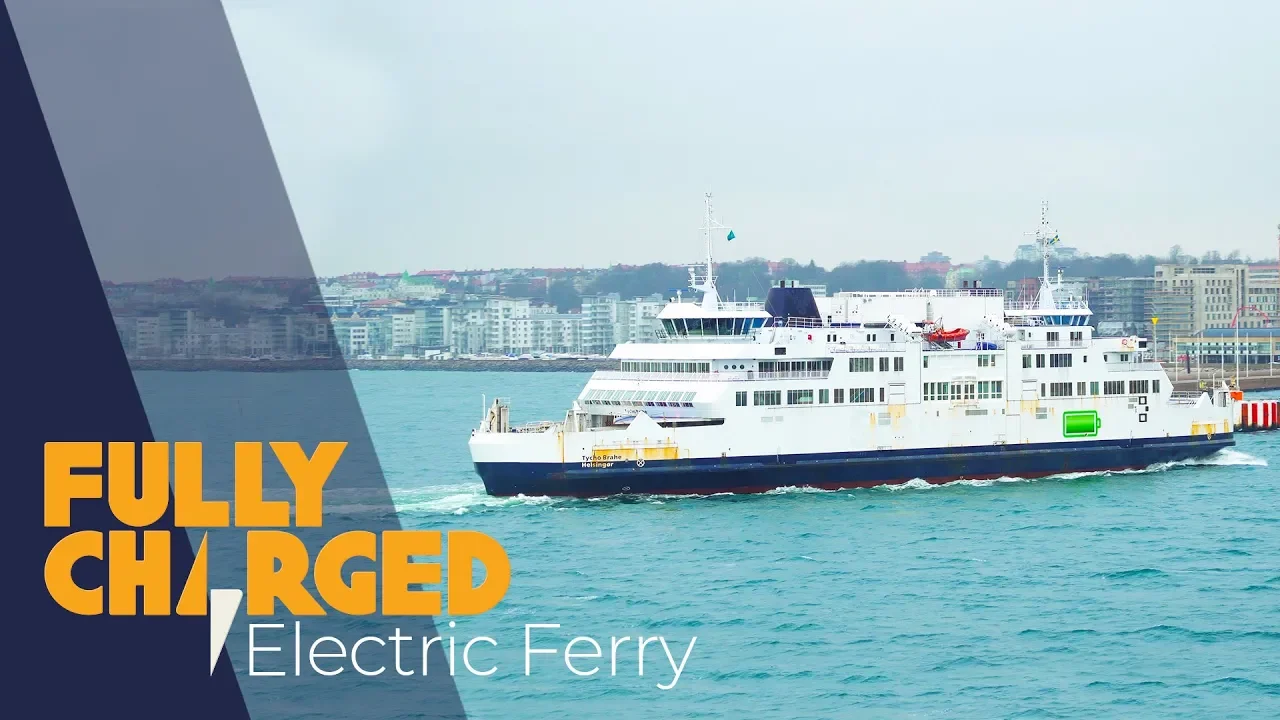
Robert Llewellyn opens the episode aboard a passenger and vehicle ferry making the crossing between Helsingør, Denmark, and Helsingborg, Sweden. Rather than spewing emissions from burning bunker fuel, this vessel operates on 100% battery power. Host Robert meets with Christian Andersson, Senior Chief Engineer at ForSea, who explains that converting the vessel was a major undertaking that took almost three years of planning and development before entering continuous service in November.
The route is an exceptionally busy one, completing approximately 46 single crossings every 24 hours over a distance of roughly four kilometers. The turnaround is relentless, requiring ultra-fast, high-power top-ups on both shores. Christian explains that the vessel charges at 10.7 kilovolts AC and 600 amperes. The charging process lasts about nine minutes on the Swedish side and around five minutes on the Danish side, drawing massive amounts of power through an onboard step-down transformer and converter system.
```mermaid flowchart LR accTitle: Ferry Charging and Power Distribution accDescr: Flow diagram showing port power step-down, conversion, and battery propulsion setup. subgraph Shore["Port Power"] A["Shore Grid<br/>10.7 kV AC / 600 A"] end subgraph Vessel["Onboard Power Train"] B["Charging Transformer<br/>750 V AC"] C["Inverter / Converter<br/>DC Conversion"] D["Lithium-ion Battery Banks<br/>4.16 MWh (749–800 V DC)"] E["DC-DC Step-Up<br/>1,000 V DC Bus"] F["4x Thruster Motors<br/>6,000 kW Total (4x 1,500 kW)"] end A -->|"Automated Robot Arm"| B B --> C C --> D D --> E E --> F ```
- **Route distance**: Approximately 4 kilometers (2.5 miles) across the strait between Denmark and Sweden. - **Crossing frequency**: Up to 46 single crossings every 24 hours (crossings every 15 minutes across the fleet). - **Shore charging rates**: 10.7 kV AC input at 600 amps. - **Port dwell/charge times**: ~9 minutes in Helsingborg (Sweden) and ~5 minutes in Helsingør (Denmark). - **Secondary transformer output**: Steps down the incoming AC power to approximately 750 volts AC before inverting to DC.
[02:56](https://www.youtube.com/watch?v=rE_M1n-ClOA&t=176s) Scale, Environmental Impact, and Retrofit Economics
Although observers might expect an all-electric vessel to be a small demonstration craft, the ferry is a massive commercial roll-on/roll-off (RoRo) ship loaded with heavy trucks and cars. It holds the title of the largest vessel in the world retrofitted to fully battery-electric propulsion. Christian underscores the environmental dividend: “In terms of CO2, we will save about 28,000 tons a year for the installation of the two ships, so it's a huge benefit for the local environment of course.”
In addition to removing direct exhaust emissions, the ship achieved an overall system efficiency gain of 25% to 30% compared to its previous diesel-electric drive train. Financially, Christian calculates that based on contemporary fuel prices, the capital investment will achieve full payback in approximately eight years. The company intends to operate the retrofitted vessel for at least 15 more years, unlocking significant operational savings once the investment is amortized.
- **Vessel status**: The world's largest ship converted to 100% battery propulsion. - **Emissions eliminated**: ~28,000 metric tons of CO2 saved annually across the two converted sister ships (*Tycho Brahe* and *Aurora*). - **Efficiency improvement**: 25% to 30% more efficient than the vessel's original diesel-electric propulsion configuration. - **Financial payback window**: Anticipated return on capital investment in approximately 8 years. - **Projected service life**: Intended to remain in commercial operation for at least 15 additional years post-retrofit.
[04:14](https://www.youtube.com/watch?v=rE_M1n-ClOA&t=254s) Battery System Architecture and Top-Deck Placement
Touring the vessel's upper levels, Christian opens the doors to the dedicated battery enclosures housing an enormous 4.16 MWh energy storage system. The installation contains 640 lithium-ion battery modules partitioned across four dedicated containers. Instead of placing the massive battery packs deep in the hull where heavy ballasts usually sit, they are located high on the vessel's top deck. Christian explains that because the vessel was originally constructed as a rail ferry, it possesses immense baseline stability; adding 280 metric tons of battery containers up top causes negligible impact on its center of gravity. Crucially, locating the batteries on the open upper deck provides superior emergency safety in the event of fire or thermal runaway.
Inside the battery house, coolant circuits constantly cycle through inlet and outlet piping to regulate cell temperatures. The battery cells are wired in serial strings of eight modules producing roughly 749 to 800 volts DC. Because the ship's propulsion thrusters demand 1,000 volts DC, custom DC-DC converters modulate and step the voltage up from 750–800 V to a stable 1,000 V bus.
- **Total onboard energy capacity**: 4.16 megawatt-hours (MWh). - **Pack configuration**: 640 lithium-ion battery modules organized across 4 top-deck containers. - **Added top-deck weight**: Roughly 280 metric tons. - **Internal voltage**: Serial strings of 8 modules yielding ~749 V to 800 V DC nominal. - **Thruster bus requirement**: Stepped up to 1,000 V DC via high-power DC-DC converters.
[06:32](https://www.youtube.com/watch?v=rE_M1n-ClOA&t=392s) Propulsion, Silent Operation, and Shore Infrastructure
Propulsion is handled by four azimuth thrusters—two at the bow and two at the stern—rated at 1,500 kW each, delivering a combined 6,000 kW (over 8,000 horsepower) of instant power. This omnidirectional thruster layout allows the ferry to spin 360 degrees effortlessly inside tight harbor basins. Robert is struck by the uncanny silence and complete lack of the customary diesel vibration: passengers simply look out the window and discover the vessel is moving at full speed without having heard or felt engines spooling up. For the engineering crew, abandoning the daily operation of noisy diesel engines has radically improved working conditions onboard.
The original diesel generators remain installed as a backup "take-me-home" redundancy. The vessel supports three operational modes: pure battery mode, hybrid mode, and diesel mode. In the event of shore-robot maintenance, the ship runs in hybrid mode, generating onboard diesel power solely to recharge the battery banks rather than driving the shafts directly.
Christian notes that transforming the ship was only half the technical challenge; ports on both sides lacked 10-kilovolt medium-voltage switchgear and high-capacity breakers, demanding substantial portside infrastructure investments. Christian highlights that while the technology works seamlessly, widespread maritime adoption requires significant grid and port infrastructure modernization across global shipping terminals.
- **Thruster configuration**: 4 azimuth thrusters (2 forward, 2 aft) of 1,500 kW each, totaling 6,000 kW (6 MW). - **Maneuverability**: Full 360-degree rotation in place. - **Operating modes**: Pure Battery (standard), Hybrid (charging batteries via generator), and Diesel backup. - **Port electrical upgrades**: Installation of dedicated medium-voltage substation infrastructure and 10 kV medium-voltage breakers in both Helsingborg and Helsingør.
[08:51](https://www.youtube.com/watch?v=rE_M1n-ClOA&t=531s) Automated Robotic Charging Arms and Battery Longevity Strategy
Because the vessel operates on rapid turnaround cycles where cars drive off and on within minutes, manual plug connections were ruled out. Instead, an automated laser-guided robotic arm on the quayside locates the vessel's receiver socket and plugs in within 45 seconds of the vehicle ramp dropping: “The most remarkable thing I guess is the charging system because we have such short turnaround in the port, so we need to have a very efficient charging system, so it's fully automated.” Charging initiates instantly without requiring manual intervention from crew members or shore workers.
Over the course of a year, the ferry logs around 17,000 individual crossings, accumulating an equivalent number of high-power charging cycles. To maximize cell life, the engineering team manages the battery pack conservatively. Although the battery packs could theoretically complete three and a half full round-trips on a single charge without plugging in, doing so would accelerate cell degradation. Instead, the pack is maintained within an optimal window, cycling through a shallow 27% depth of discharge per trip and keeping state-of-charge (SoC) strictly between 40% and 66%. Christian projects a minimum battery lifespan of five years under this strict cycling regime.
As the ferry glides smoothly into dock, Robert remarks on how quiet and effortless the trip was. Christian confirms that the project's success has attracted maritime shipping companies from around the globe eager to study their real-world electrification blueprint.
- **Robotic connection speed**: Fully autonomous connection in approximately 45 seconds. - **Annual crossings**: ~17,000 single crossings and docking charges per year. - **State-of-charge operating band**: Kept between 40% and 66% SoC during routine operation. - **Depth of discharge (DoD)**: ~27% per crossing cycle. - **Uncharged range buffer**: Up to 3.5 consecutive crossings possible on battery power alone if port charging is temporarily bypassed. - **Expected battery lifespan**: Projected at 5 years under current operational duty cycles.
## Notable quotes > [08:51](https://www.youtube.com/watch?v=rE_M1n-ClOA&t=531s) The most remarkable thing I guess is the charging system because we have such short turnaround in the port, so we need to have a very efficient charging system, so it's fully automated. — Christian Andersson
## Mentioned Christian Andersson, Robert Llewellyn, ForSea, Tesla Model 3, Tycho Brahe, Aurora, Helsingborg, Helsingør, Øresund Strait, Denmark, Sweden, Fully Charged, Everything Electric CARS
## Video description On our recent Tesla Model 3 test drive we crossed from Denmark to Sweden on a 100% battery electric ferry. The 4 kilometre crossing between Helsingborg in Sweden and Helsingør in Denmark doesn't seem that far, but this ferry is crossing up to 46 times a day, and charging for a few minutes each side. The route handles more than 7 million passengers and almost 2 million vehicles each year with crossings every 15 minutes.
More info: https://www.forseaferries.com/
We are only able to produce this channel thanks to the very generous donations from our Patreon supporters. If you would like to consider joining them, have a look at this: https://www.patreon.com/FullyChargedShow
[Source](https://www.youtube.com/watch?v=rE_M1n-ClOA)