Thomsonfly 757 Lands at Manchester on One Engine After Bird Strike
headintheclouds46
Flight crew manages an engine failure after bird ingestion during takeoff, holding over Wallasey before landing the Lanzarote-bound jet on a single engine at Manchester Airport.
AI-assisted summary of ThomsonFly 757 bird strike & flames captured on video — original source. Check the original for full context.
Source published:
Key ideas
- Thomsonfly flight 263 Hotel (Boeing 757 carrying 233 passengers bound for Lanzarote) suffered a bird strike and right-engine failure on rotation from Manchester Airport, prompting an immediate Mayday declaration. (0:20)
- Manchester departure Runway 06 Left was temporarily closed to operations after debris from the failed engine and the bird ingestion was discovered across the surface. (1:50)
- The crew declined an alternate diversion to Liverpool John Lennon Airport, electing to hold at Wallasey VOR at 3,500 feet to execute emergency checklists before executing an approach to Runway 06 Right. (1:50)
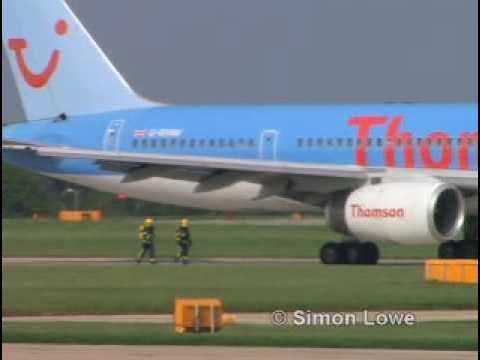
- Following a safe single-engine rollout, Manchester Airport fire appliances shadowed the aircraft and conducted an on-taxiway inspection of the landing gear, hot brakes, and disabled engine. (4:00)
- Operating heavily laden with fuel, the crew negotiated a non-stop single-engine taxi to the apron while ground control placed an aircraft tow tug on standby for tight turns and active runway crossings. (8:06)
Detailed notes
## Background Published on YouTube by headintheclouds46 (Simon Lowe) on May 2, 2007, this video documents Thomsonfly flight 263 Hotel suffering a bird strike into its number 2 engine during takeoff from Manchester Airport. The uploader's description notes that 233 passengers were on board the Lanzarote-bound Boeing 757 when a crow or corvid was ingested on rotation, commending the crew and air traffic controllers for their professional handling of the emergency.
## TL;DR Immediately following departure from Manchester Airport, the flight crew of a Thomsonfly Boeing 757 declares a Mayday after an engine failure caused by a bird strike. The pilots climb to 3,500 feet and establish a holding pattern at the Wallasey VOR to run emergency checklists while coordinating with Manchester Tower and Approach. Declining a diversion to Liverpool, the crew vectors back to Manchester for a safe single-engine landing on Runway 06 Right. After rolling out onto a parallel taxiway, the aircraft undergoes a physical brake and engine inspection by emergency fire crews before cautiously taxiing to the apron on its remaining operative engine with a tug standing by.
## Atmosphere & style The audio and situational dynamic convey a calm, highly disciplined, and textbook professionalism under immense pressure. Despite flames and severe damage to the engine, the flight deck crew and air traffic controllers communicate with steady, deliberate composure, methodically running through vectors, weather data, and safety checklists. There is a palpable sense of relief and meticulous coordination as the jet touches down safely, followed by careful, vigilant teamwork among the pilots, ground controllers, and escorting fire appliances.
## Bulletin - [00:20](https://www.youtube.com/watch?v=9KhZwsYtNDE&t=20s) Thomsonfly flight 263 Hotel (Boeing 757 carrying 233 passengers bound for Lanzarote) suffered a bird strike and right-engine failure on rotation from Manchester Airport, prompting an immediate Mayday declaration. - [01:50](https://www.youtube.com/watch?v=9KhZwsYtNDE&t=110s) Manchester departure Runway 06 Left was temporarily closed to operations after debris from the failed engine and the bird ingestion was discovered across the surface. - [01:50](https://www.youtube.com/watch?v=9KhZwsYtNDE&t=110s) The crew declined an alternate diversion to Liverpool John Lennon Airport, electing to hold at Wallasey VOR at 3,500 feet to execute emergency checklists before executing an approach to Runway 06 Right. - [04:00](https://www.youtube.com/watch?v=9KhZwsYtNDE&t=240s) Following a safe single-engine rollout, Manchester Airport fire appliances shadowed the aircraft and conducted an on-taxiway inspection of the landing gear, hot brakes, and disabled engine. - [08:06](https://www.youtube.com/watch?v=9KhZwsYtNDE&t=486s) Operating heavily laden with fuel, the crew negotiated a non-stop single-engine taxi to the apron while ground control placed an aircraft tow tug on standby for tight turns and active runway crossings.
## Key takeaways - [00:20](https://www.youtube.com/watch?v=9KhZwsYtNDE&t=20s) Thomsonfly flight 263 Hotel declared an emergency immediately after takeoff from Manchester following an uncontained right-engine failure. - [00:20](https://www.youtube.com/watch?v=9KhZwsYtNDE&t=20s) The crew established on the 084 radial inbound to the Wallasey VOR at 3,500 feet to stabilize the aircraft, run checklists, and determine an action plan. - [00:20](https://www.youtube.com/watch?v=9KhZwsYtNDE&t=20s) Manchester Tower offered an immediate visual return, radar vectors back to Manchester, or a diversion to Liverpool John Lennon Airport's Runway 09. - [01:50](https://www.youtube.com/watch?v=9KhZwsYtNDE&t=110s) The aircraft squawked emergency transponder code 7700 and coordinated an altimeter setting of QNH 1023 hPa with Manchester Approach. - [01:50](https://www.youtube.com/watch?v=9KhZwsYtNDE&t=110s) Runway 06 Left was closed due to debris shed by the stricken engine alongside bird remains found on the runway surface. - [01:50](https://www.youtube.com/watch?v=9KhZwsYtNDE&t=110s) The flight crew corroborated ground debris reports with cockpit visual observations and instrumentation, confirming a bird strike at rotation. - [01:50](https://www.youtube.com/watch?v=9KhZwsYtNDE&t=110s) Air traffic control vectored the 757 onto a heading of 135 degrees to intercept a 15-mile final approach for Runway 06 Right. - [01:50](https://www.youtube.com/watch?v=9KhZwsYtNDE&t=110s) An Airfield Full Emergency was activated, marshaling both on-airport fire services and local external authority response appliances. - [04:00](https://www.youtube.com/watch?v=9KhZwsYtNDE&t=240s) The crew planned to keep the operative left engine running post-landing to maintain self-propulsion and electrical power. - [04:00](https://www.youtube.com/watch?v=9KhZwsYtNDE&t=240s) Tower directed the pilot to roll past the initial high-speed exit to allow emergency tenders safe trailing separation during rollout. - [04:00](https://www.youtube.com/watch?v=9KhZwsYtNDE&t=240s) Airport fire tenders (Fire Yankee One, Fire Three, and Fire One) followed the rollout and halted the aircraft on the parallel taxiway for a thorough brake and airframe inspection. - [08:06](https://www.youtube.com/watch?v=9KhZwsYtNDE&t=486s) Single-engine taxi clearance was issued via taxiway Delta toward holding point Delta 1, escorted by emergency vehicles. - [08:06](https://www.youtube.com/watch?v=9KhZwsYtNDE&t=486s) High takeoff fuel weight intended for the flight to Lanzarote raised concerns about tight turns and starting/stopping momentum on a single engine. - [08:06](https://www.youtube.com/watch?v=9KhZwsYtNDE&t=486s) Ground control arranged an aircraft tug on standby to pull the jet across Runway 06 Left and through apron construction zones if single-engine maneuvering became untenable.
## Detailed walkthrough ### [00:20](https://www.youtube.com/watch?v=9KhZwsYtNDE&t=20s) Emergency Declaration and Routing to the Wallasey Hold
Immediately after departure from Manchester Airport, the flight crew of Thomsonfly flight 263 Hotel transmits an emergency call reporting that their Boeing 757 has suffered an engine failure. The pilot contacts Manchester Tower to outline their immediate flight path, explaining that the crew is tracking northwest to intercept the 084 radial inbound to the Wallasey (WAL) VOR beacon while climbing to an altitude of 3,500 feet to stabilize the aircraft, run checklists, and determine a plan of action. The Manchester controller acknowledges the emergency, reporting a surface wind of 070 degrees at 5 knots and advising that all runways are open should the crew require an immediate visual return or radar vectors to Runway 06 Left or 06 Right.
```mermaid flowchart TD accTitle: Emergency Flight Path and Landing Sequence accDescr: Flowchart showing the sequence of events from engine failure on departure to taxiing at Manchester Airport.
subgraph EmergencyDeparture["Departure & Holding"] A["Engine Failure on Takeoff (Bird Strike)"] --> B["Climb to 3,500 ft on 084 Radial to Wallasey"] B --> C["Establish Hold at Wallasey VOR"] end
subgraph ApproachLanding["Approach & Touchdown"] C --> D["Radar Vectors for Runway 06 Right"] D --> E["Touchdown & Controlled Rollout"] end
subgraph InspectionTaxi["Post-Landing Procedures"] E --> F["Vacate Runway onto Parallel Taxiway"] F --> G["External Brake & Airframe Inspection by Fire Crews"] G --> H["Single-Engine Non-Stop Taxi toward Stand"] end ```
The tower controller presents secondary alternatives to give the crew maximum flexibility, pointing out that Runway 09 at nearby Liverpool John Lennon Airport is fully open and available. After evaluating their situation, the crew indicates their clear preference to enter the hold at Wallasey to complete their operational preparations and then return directly to Manchester for an approach onto Runway 06 Right. The tower then coordinates a frequency transfer, offering the pilots either to remain on tower frequency or switch over to Manchester Approach on 121.350 MHz. Explaining their immediate strategy, the pilot notes: “We’d like to establish on the inbound radial 084 towards Wallasey, climb to 3 and a half thousand feet, and then we will advise you of our intentions.”
- Call sign: Thomson 263 Hotel (TOM263H) - Emergency status: Mayday declared due to an engine failure on departure - Assigned holding fix: Wallasey VOR (radial 084 inbound) - Target initial altitude: 3,500 feet - Initial surface wind at Manchester: 070° at 5 knots - Diversion alternative offered: Liverpool John Lennon Airport, Runway 09 - Initial frequency handoff: Manchester Approach on 121.350 MHz
---
[01:50](https://www.youtube.com/watch?v=9KhZwsYtNDE&t=110s) Manchester Approach, Bird Strike Confirmation, and Landing Setup
Checking in with Manchester Approach on 121.350 MHz while level at 3,500 feet inbound toward Wallasey, the crew is instructed to squawk 7700 on the transponder. The pilot confirms their flight profile, stating they intend to enter a left-hand holding pattern to prepare the aircraft and complete required emergency checklists for an approach to Runway 06 Right. Approach validates their clearance with the local altimeter setting (QNH 1023 hPa) and provides critical updates regarding conditions on the ground: departure Runway 06 Left has been closed because debris was shed onto the surface from the stricken engine.
Moments later, the flight crew confirms the origin of the failure, matching runway findings with what they experienced on the flight deck. Addressing the cause of the failure, the pilot informs ATC: “It looks like it may have been a bird strike; there’s bird debris on the runway as well, that concurs with what we saw out the window and the reaction we have in the engine.” Although the controller again provides standby diversion specifications for Liverpool—noting a landing distance available of 2,225 meters—the crew reiterates their settled decision to land on Manchester’s Runway 06 Right. Approach turns the jet onto a heading of 135 degrees to sequence them onto a 15-mile final approach. The crew confirms that while they foresee no structural issues clearing the runway, they require full emergency fire support and an on-scene visual brake inspection prior to taxiing to the apron.
- Transponder emergency code: Squawk 7700 - Altimeter setting (QNH): 1023 hPa - Runway status: Runway 06 Left closed due to bird and engine debris - Cause of engine failure: Confirmed bird strike ingestion on rotation - Alternate runway performance: Liverpool Runway 09 LDA cited as 2,225 meters - Vector for final approach: Right turn heading 135° to establish a 15-nautical-mile final for Runway 06 Right - Emergency readiness: Airfield Full Emergency declared with airport fire crews and external local authority appliances deployed
---
[04:00](https://www.youtube.com/watch?v=9KhZwsYtNDE&t=240s) Final Approach, Landing on Runway 06R, and Fire Crew Inspection
Established inbound on the instrument glideslope for Runway 06 Right, Thomson 263 Hotel contacts Manchester Tower and receives immediate clearance to land with calm surface winds. The pilot emphasizes to the tower that the aircraft’s left engine will remain operating throughout rollout and rollout exit. The controller instructs the flight to bypass the first high-speed turnout and take the second exit or later so emergency equipment can stage and approach safely. The Boeing 757 touches down smoothly, applies single-engine deceleration, and rolls past the initial exit before turning off the active runway onto the parallel taxiway.
Emergency response appliances—designated under call signs such as Fire Yankee One, Fire Three, and Fire One—enter Runway 06 Right behind the aircraft and shadow it onto the taxiway. Tower directs the aircraft to come to a halt at its convenience, allowing the fire crews to establish positions around the airframe. The lead fire tender requests that the pilots keep the jet stationary with parking brakes set so personnel can conduct a detailed external examination of the landing gear, tires, hot brakes, and the dead right engine before clearing the aircraft to taxi any further toward the terminal ramps.
Reflecting the crew’s careful operational planning, the pilot cautions the tower before touchdown: “The left engine will still be running; subject to that being okay we can vacate the runway.”
- Landing clearance: Runway 06 Right, surface winds calm - Landing rollout instructions: Bypass first exit, utilize second exit or later - Ground fire deployment: Manchester Airport Fire Service tenders (Fire Yankee One, Fire Three, Fire One) - Post-landing status: Left engine kept running; aircraft brought to a full stop on the parallel taxiway for physical inspection
---
[08:06](https://www.youtube.com/watch?v=9KhZwsYtNDE&t=486s) Single-Engine Taxi Coordination and Tug Contingency
With the external brake and airframe inspection successfully completed, the fire leader confirms to the crew that emergency appliances will escort the aircraft all the way to its assigned stand. The flight crew pauses for a couple of minutes to finish system checks before spooling up the remaining left engine to begin taxiing under their own power. Ground control instructs Thomson 263 Hotel to taxi via taxiway Delta and hold short of Runway 06 Left at holding point Delta 1.
Recognizing the handling characteristics of a heavy, fully fueled Boeing 757 operating on only one engine, the captain alerts the controllers that stopping and restarting momentum could be difficult and that tight turns on the airport taxiway network will be demanding. The controller advises that ground works are underway along the route but offers an aircraft tug on standby to tow the aircraft across Runway 06 Left and through the construction zones if maneuvering proves too hazardous. The crew expresses gratitude for the tug precaution, agreeing to attempt taxiing on the single engine while remaining fully prepared to stop if power or geometry issues arise. Emphasizing the operational challenge, the pilot states: “We’re still relatively heavy on this one engine, when we do get clearance to cross 06 Left, we will of course be requesting a non-stop taxi back to stand wherever that might be.”
- Clearance limit: Holding point Delta 1, hold short of Runway 06 Left - Taxi configuration: Single-engine taxi on the left engine with active fire escort - Aircraft operational weight: Heavy fuel load onboard intended for a flight to Lanzarote - Ground routing constraints: Airport works in progress along the apron taxiways creating sharp turns - Contingency measure: Tow tug placed on standby to take over maneuvering across Runway 06 Left if single-engine turns fail
## Mentioned Simon Lowe, Thomsonfly, Boeing 757, Manchester Airport, Liverpool John Lennon Airport, Wallasey VOR, Manchester Airport Fire Service, Lanzarote, Airbus A330, Antonov AN225, Flightlevel350.com, YouTube
## Video description To use this video in a broadcast or a commercial player please email me at my Youtube Simon Lowe account http://www.youtube.com/user/1970sPlaneSpotter?feature=watch
This incident was video recorded by Simon Lowe. 233 people where on board this jet bound for Lanzarote. The number 2 engine sucks in one bird (a crow or corvid) as the plane rotates off the runway.
T.V. news reports of two herons being sucked in are wrong.
Congratulations to the crew and air-traffic controllers for the calm and professional way they dealt with the situation. Please checkout more video's by me on Flightlevel350.com.
My new video's are here;
http://uk.youtube.com/user/1970sPlaneSpotter
Airbus A330 engine malfuntion and high speed rejected take off; http://youtu.be/PS1YAX70edc
Antonov AN225 video; http://youtu.be/iYF6fYteIq8
[Source](https://www.youtube.com/watch?v=9KhZwsYtNDE)