Janus Electric Retrofits Diesel Fleets With Swappable Battery Packs
Everything Electric CARS
Retrofitting existing rigs with swappable batteries is essential to hit net-zero targets because global manufacturers replace only 5% of the commercial fleet annually.
AI-assisted summary of This GIANT Electric Semi Can Swap Out Its Batteries! — original source. Check the original for full context.
Source published:
Key ideas
- Janus Trucks in Australia retrofits existing diesel semi-trucks into electric vehicles with a swappable battery system that enables pack replacements in under one minute, outpacing standard diesel refuelling. (0:00)
- The converted 97-tonne heavy prime mover utilizes a 720 hp (540 kW) electric drive paired with an automated 16-speed manual transmission, carrying double the weight rating of a Tesla Semi. (3:05)
- Operating expenses drop significantly from $1.00/km for diesel to roughly $0.60/km on grid power, and can drop to around $0.06/kWh when charging from on-site solar, alongside maintenance falling from 14-16 cents/km to under 4 cents/km. (7:32)
- By offering batteries under an 'Energy as a Service' model, fleet operators avoid high upfront battery costs and technology lock-in, with degraded packs (at 80% capacity) repurposed into static grid storage and backup power. (13:40)
Detailed notes
## Background Published on YouTube by Everything Electric CARS on March 8, 2023, this episode features Robert Llewellyn traveling to New South Wales, Australia, to examine how Janus Trucks converts diesel heavy goods vehicles into clean electric haulers. The video description highlights the project's massive scale, featuring over a million miles traveled, 620 kWh swappable batteries, a 540 kW powertrain, and a gross vehicle rating of 97 tonnes using a Battery-as-a-Service model.
## TL;DR Host Robert Llewellyn investigates Janus Trucks' innovative retrofit strategy, which transforms standard diesel prime movers into 97-tonne electric haulers capable of pulling two trailers. Instead of manufacturing new vehicles or relying on lengthy charging stops, Janus utilizes swappable 620 kWh battery packs that can be exchanged in under a minute and charged strategically during off-peak hours. The conversion dramatically undercuts diesel on running costs—reducing maintenance from 14–16 cents per kilometer to under 4 cents—while extending the service life of existing truck chassis to advance a circular economy. Batteries are leased via 'Battery as a Service' to insulate operators from technological obsolescence, with degraded packs transitioning seamlessly into second-life static grid storage.
## Atmosphere & style The presentation is energetic, grounded, and refreshingly practical, pairing Robert's genial, inquisitive enthusiasm with the no-nonsense engineering focus of Australian heavy haulage. Experiencing the cab ride feels genuinely revelatory as the clatter and heavy vibration of a 16-liter diesel engine give way to a smooth, quiet drive pulling commercial loads of sand. The overall mood is one of industrial optimism, portraying freight decarbonization not as a distant luxury concept, but as an immediate, commercially viable reality working on real roads today.
## Bulletin - [00:00](https://www.youtube.com/watch?v=9eYLtPSf7PY&t=0s) Janus Trucks in Australia retrofits existing diesel semi-trucks into electric vehicles with a swappable battery system that enables pack replacements in under one minute, outpacing standard diesel refuelling. - [03:05](https://www.youtube.com/watch?v=9eYLtPSf7PY&t=185s) The converted 97-tonne heavy prime mover utilizes a 720 hp (540 kW) electric drive paired with an automated 16-speed manual transmission, carrying double the weight rating of a Tesla Semi. - [07:32](https://www.youtube.com/watch?v=9eYLtPSf7PY&t=452s) Operating expenses drop significantly from $1.00/km for diesel to roughly $0.60/km on grid power, and can drop to around $0.06/kWh when charging from on-site solar, alongside maintenance falling from 14-16 cents/km to under 4 cents/km. - [13:40](https://www.youtube.com/watch?v=9eYLtPSf7PY&t=820s) By offering batteries under an 'Energy as a Service' model, fleet operators avoid high upfront battery costs and technology lock-in, with degraded packs (at 80% capacity) repurposed into static grid storage and backup power.
## Key takeaways - [00:00](https://www.youtube.com/watch?v=9eYLtPSf7PY&t=0s) Retrofitting diesel trucks with swappable batteries solves major drawbacks of heavy haulage, eliminating expensive diesel maintenance and long charging downtimes. - [01:39](https://www.youtube.com/watch?v=9eYLtPSf7PY&t=99s) Janus Trucks' conversion module matches the physical dimensions of standard 13-liter diesel engines, allowing retrofits across various Class 8 truck models. - [01:39](https://www.youtube.com/watch?v=9eYLtPSf7PY&t=99s) Battery swap stations double as stationary grid storage, absorbing off-peak or renewable energy to prevent sudden heavy charging loads on grid infrastructure. - [03:05](https://www.youtube.com/watch?v=9eYLtPSf7PY&t=185s) The 97-tonne rated converted truck retains an automated 16-speed manual gearbox to supply sufficient startup torque for hauling two full trailers without requiring a clutch. - [05:28](https://www.youtube.com/watch?v=9eYLtPSf7PY&t=328s) A typical configuration utilizes two 620 kWh swappable battery packs (weighing 2.08 tonnes each), achieving 400 to 600 kilometers of operational range. - [05:28](https://www.youtube.com/watch?v=9eYLtPSf7PY&t=328s) Despite substantial battery weight, stripping diesel engines, fuel tanks, and cooling gear means the finished electric truck is only 0.5 to 1.0 tonne heavier than its diesel predecessor. - [07:32](https://www.youtube.com/watch?v=9eYLtPSf7PY&t=452s) Transitioning Australia's truck fleet to domestic electric power addresses national security risks, reducing vulnerability from importing 95% of fuel with only 14 days of diesel reserves. - [08:51](https://www.youtube.com/watch?v=9eYLtPSf7PY&t=531s) Charging batteries strategically outside of daily peak demand windows (7–9 AM and 4–9 PM) optimizes existing grid assets and avoids costly transmission upgrades. - [09:34](https://www.youtube.com/watch?v=9eYLtPSf7PY&t=574s) Because global manufacturers can only produce about 5% of the vehicle fleet annually, retrofitting existing heavy trucks is essential to meet 2030 and 2050 zero-emission targets. - [09:34](https://www.youtube.com/watch?v=9eYLtPSf7PY&t=574s) Electric conversions extend the lifespan of existing gearboxes and chassis by eliminating the destructive vibrations, heat, and clutch shock loads of diesel engines. - [11:49](https://www.youtube.com/watch?v=9eYLtPSf7PY&t=709s) A three-stage regenerative braking system provides up to 2,800 Nm of torque and can feed up to 540 kW back into the battery, minimizing mechanical brake wear. - [11:49](https://www.youtube.com/watch?v=9eYLtPSf7PY&t=709s) Near-silent operation eliminates noise pollution, enabling transport operators to run 24-hour delivery routes through suburban areas bound by nighttime noise curfews. - [13:40](https://www.youtube.com/watch?v=9eYLtPSf7PY&t=820s) Truck conversions cost between $150,000 and $175,000 AUD, excluding batteries, which are leased as an ongoing service to insulate operators from battery obsolescence. - [13:40](https://www.youtube.com/watch?v=9eYLtPSf7PY&t=820s) Janus is deploying automated robotic stations designed to complete drive-in battery swaps in under 60 seconds. - [15:01](https://www.youtube.com/watch?v=9eYLtPSf7PY&t=901s) When truck batteries degrade to 80% capacity, they transition to second-life duties such as static grid support, FCAS, and replacing diesel backup generators.
## Detailed walkthrough ### [00:00](https://www.youtube.com/watch?v=9eYLtPSf7PY&t=0s) The Problem with Diesel and the Promise of Swappable Batteries
Robert Llewellyn opens the episode standing next to a massive 16-liter diesel engine, the kind that has powered heavy transport for the last 120 years. While acknowledging that this "good old-fashioned proper engineering" is incredibly reliable and lasts for hundreds of thousands of miles, he highlights its severe downsides: it is highly expensive to maintain, costs a fortune to fuel, and burns through hundreds of thousands of liters of toxic, imported fossil fuels.
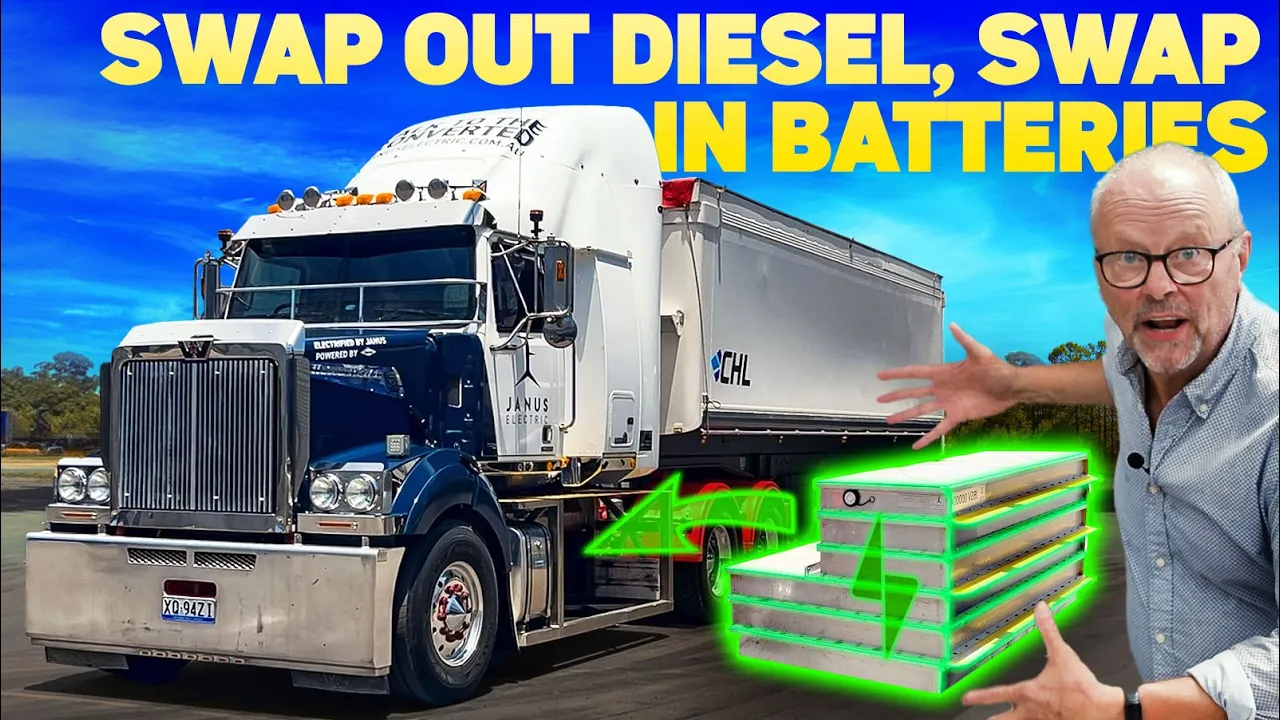
To solve this, Robert introduces a revolutionary alternative: swapping out the heavy diesel engine for an electric motor and a massive battery pack that can be swapped in under a minute. He points out the game-changing nature of this technology, explaining that it is actually quicker to swap the battery of an electric truck than it is to fill up a massive diesel tank. To see this in action, Robert travels to Janus Trucks in New South Wales, Australia.
- **Diesel Engine Size:** 16 liters, typical of heavy-duty Class 8 trucks. - **The Core Innovation:** Replacing the diesel engine with an electric motor and a swappable battery system. - **Swap Time:** Under one minute, making it faster than refuelling a standard diesel tank.
[01:39](https://www.youtube.com/watch?v=9eYLtPSf7PY&t=99s) The Janus Trucks Conversion Model
At Janus Trucks, the team explains that their business model is designed to remove the financial and operational barriers to heavy vehicle electrification. Rather than trying to become a truck manufacturer, Janus focuses on a conversion system that can "re-energize" any new or used truck in the world. Their conversion module is engineered to fit into the exact same physical envelope as a standard 13-liter diesel engine, meaning it can be retrofitted into any Class 8 or larger truck globally. Janus has already successfully converted five different makes and models.
The company hopes original equipment manufacturers (OEMs) will eventually adopt their exchangeable battery technology directly. This approach is highly beneficial for both fleet operators and the electrical grid. By utilizing battery swap stations, operators completely bypass range and charging anxiety—avoiding the "fallacy of fast charging" which requires vehicles to sit idle for up to six hours. Furthermore, these swap stations double as grid storage units, absorbing excess renewable energy and discharging it or using it to charge batteries when the grid is underutilized, rather than putting sudden, massive loads on the grid.
As one of the Janus representatives explains: > “We're going to make this simple, it's got to work effectively, it's got to work across all models, we don't want to be a truck manufacturer, we just want to re-energize them...”
```mermaid flowchart TD accTitle: Janus Trucks Battery Swap and Grid Integration accDescr: A flowchart showing how Janus swap stations interact with the electrical grid and electric trucks to optimize energy use.
subgraph Grid ["Electrical Grid & Renewables"] Solar["Solar & Wind Power"] -->|Off-Peak Generation| Station["Janus Charge Station (Storage)"] GridPower["Grid Power"] -->|Off-Peak Charging| Station end
subgraph Station ["Janus Charge Station (Storage)"] Batteries["Charged Batteries (620 kWh)"] end
subgraph Truck ["Electric Semi-Truck"] Depleted["Depleted Battery"] -->|1-Minute Swap| Station Batteries -->|Fresh Battery| ActiveTruck["Active Fleet Operation"] end ```
[03:05](https://www.youtube.com/watch?v=9eYLtPSf7PY&t=185s) Driving a 97-Tonne Electric Beast
Robert hops into the cab of a converted truck to experience driving it firsthand. The operation is remarkably simple: the driver puts a foot on the brake, selects "D" for drive, and the truck automatically selects third gear to set off without a clutch. Despite being electric, the truck still utilizes a gearbox because of its immense weight. Rated at 97 tonnes, this vehicle has double the capacity of a Tesla Semi and far exceeds the 44-tonne rating of electric Volvos. This massive rating allows the truck to tow two full trailers.
To handle these extreme loads, the truck uses an automatically shifting 16-speed manual gearbox. While electric cars do not need gearboxes, heavy trucks require immense torque at the wheels to start moving, especially on steep inclines. The truck features a 720-horsepower, 540 kW drive system that perfectly matches the power and torque characteristics of the 16-liter Volvo diesel engine it replaced. Because the electric motor allows for infinite control over RPM, the system can shift to neutral, speed-match, and change gears seamlessly without a clutch. Robert is particularly impressed to learn that this is not just an experimental prototype; it is in daily commercial use by a company delivering sand.
- **Gross Vehicle Mass Rating:** 97 tonnes (capable of towing two trailers). - **Powertrain:** 720 horsepower / 540 kW electric drive. - **Gearbox:** 16-speed automatically shifting manual gearbox (no clutch required). - **Comparison:** Double the weight capacity of a Tesla Semi (which is rated for standard US Class 8 limits) and more than double a Volvo electric truck (44 tonnes).
[05:28](https://www.youtube.com/watch?v=9eYLtPSf7PY&t=328s) Range, Efficiency, and Battery Specs
When Robert asks about the truck's range, the Janus team explains that it varies significantly based on topography, load weight, regenerative braking, rolling resistance (the number of axles on the ground), and aerodynamics. On average, the truck achieves a range of 400 to 600 kilometers, though heavy hill climbs with low tare weight on the return can drop it to around 300 kilometers. The truck consumes roughly 1.5 to 1.7 kWh per kilometer. Robert contrasts this with an efficient electric car, which gets about 7 to 8 kilometers per kilowatt-hour, highlighting the sheer scale of energy required for heavy transport.
The battery pack itself is a massive 620 kWh unit mounted where the diesel fuel tanks used to sit. This single pack contains the equivalent energy of about eight Tesla Model 3 batteries and weighs 2.08 tonnes. A second, identical pack is mounted on the opposite side of the truck. By removing the heavy diesel engine, fuel tanks, fuel, exhaust systems, and intercoolers, Janus strips about 3.5 tonnes of weight from the truck. Installing the Janus electric system adds about 4 tonnes back, making the converted electric truck only about half a ton to a ton heavier than its conventional diesel counterpart.
- **Battery Capacity:** 620 kWh per pack (with two packs total on the truck). - **Battery Pack Weight:** 2.08 tonnes per pack. - **Energy Consumption:** 1.5 to 1.7 kWh per kilometer. - **Weight Difference:** The electric conversion is only 0.5 to 1.0 tonne heavier than the original diesel configuration.
[07:32](https://www.youtube.com/watch?v=9eYLtPSf7PY&t=452s) Economics and Energy Sovereignty
The conversation shifts to the economics of running an electric semi-truck. The Janus team reveals that running the electric truck costs about 60 cents per kilometer when charging at standard Australian grid prices, compared to $1.00 per kilometer for a diesel truck at current fuel prices. However, if a fleet operator generates their own power—such as installing solar panels on warehouse roofs—the fuel cost drops dramatically to about 6 cents per kilowatt-hour, compared to the 25 to 26 cents charged by the grid.
Beyond individual fleet savings, this transition has massive implications for Australia's national security and energy sovereignty. The Janus representative points out a startling vulnerability: Australia imports 95% of its fuel and only has about 14 days of diesel supply in the country at any given time because there is physically not enough tank storage. Transitioning to electric trucks powered by Australia's abundant domestic renewable energy would eliminate this dependency on foreign oil tankers.
As the Janus representative notes: > “We import 95% of all of our fuel for this country... there's only about 14 days of diesel in this country at any one time because it's physically not the tank storage for it...”
[08:51](https://www.youtube.com/watch?v=9eYLtPSf7PY&t=531s) Smart Charging and Grid Integration
As they pull back into the charging station, a fresh battery is already waiting in the rack. The Janus team explains that swappable batteries allow operators to charge strategically. Instead of plugging in during peak hours and straining the grid, batteries can be charged when renewable energy production is at its highest or during off-peak hours when grid infrastructure is underutilized.
In Australia, grid demand peaks between 7:00 AM and 9:00 AM, and again from 4:00 PM to 9:00 PM. Outside of these windows, the electrical infrastructure is heavily underutilized. By charging swappable batteries during these off-peak times, Janus can utilize existing infrastructure more efficiently, avoiding the need for billions of dollars in grid upgrades.
- **Grid Peak Hours (Australia):** 7:00 AM – 9:00 AM and 4:00 PM – 9:00 PM. - **Grid Optimization:** Charging swappable batteries off-peak prevents grid overload and utilizes excess renewable energy.
[09:34](https://www.youtube.com/watch?v=9eYLtPSf7PY&t=574s) Circular Economy and Retrofitting Existing Fleets
The truck being showcased is an 11-year-old 2012 model that had already clocked 1.3 million kilometers before undergoing its electric conversion. This highlights a core philosophy of the project: utilizing existing infrastructure and assets to foster a true circular economy. Globally, original equipment manufacturers (OEMs) only have the capacity to manufacture about 5% of the total vehicle fleet annually. Because of this limitation, relying solely on new vehicle manufacturing makes reaching 2030 and 2050 zero-emission targets mathematically improbable. Retrofitting existing trucks bypasses the massive carbon debt associated with manufacturing entirely new heavy vehicles from scratch.
The average age of a prime mover globally is between 13 and 15 years. During this lifespan, a typical diesel truck undergoes two to three complete engine rebuilds, which are required every 800,000 to 1,000,000 kilometers (roughly 600,000 to 700,000 miles). Instead of performing another costly diesel engine rebuild, Janus Electric retrofits the vehicle with an electric motor. These electric motors are software-protected against over-stressing, temperature spikes, and power surges, giving them a multi-decade, multi-million-kilometer lifespan with virtually no user-serviceable parts. Furthermore, because the electric motor eliminates the high-frequency vibrations, heat, and clutch shock loads of a diesel engine, the lifespan of the existing gearbox is expected to more than double before needing to be re-raced.
As the speaker explains: > "If we're going to try and hit targets of 2030 and 2050 zero emissions, we've got to use what we've got."
- **Vehicle Age:** 11 years old (2012 model) with 1.3 million kilometers on the odometer prior to conversion. - **Global OEM Capacity:** Only 5% of the global fleet can be manufactured new each year. - **Average Prime Mover Lifespan:** 13 to 15 years, requiring diesel engine rebuilds every 800,000 to 1,000,000 kilometers. - **Gearbox Longevity:** Expected to double due to the elimination of reciprocating piston vibrations and clutch shock loads.
[11:49](https://www.youtube.com/watch?v=9eYLtPSf7PY&t=709s) Regenerative Braking, Maintenance Savings, and Community Benefits
Inside the cab, the only major modification is a digital screen that displays motor speed, the current gear, and the battery's state of charge. The driver can control the regenerative braking system using the truck's original three-stage engine brake switch, which offers light, medium, and high duty settings. At its highest setting, the system delivers 2,800 Newton-meters of regenerative torque. This is powerful enough to bring a fully loaded truck to a complete stop on a 10% to 15% downhill grade. For heavy trucks, regenerative braking is not just an energy-recovery feature; it is a safety necessity to assist the vehicle on long declines, capable of returning up to 540 kilowatts of power back into the battery pack.
The maintenance savings of switching from diesel to electric are substantial. A standard diesel truck operating metropolitan deliveries costs between 14 and 16 Australian cents per kilometer in maintenance alone, excluding the significant downtime of being off the road for six hours during a standard engine oil service. In contrast, the converted electric truck reduces maintenance costs to under 4 cents per kilometer. Beyond the balance sheet, the transition offers profound benefits to local communities by eliminating diesel exhaust and engine noise. This quiet operation allows transport companies to run 24-hour delivery cycles in suburban areas where diesel trucks are restricted by nighttime noise curfews.
The speaker emphasizes the dramatic reduction in operating costs: > "There's no engine oil to change on this, so we're looking at maintenance at below four cents a kilometer for an electric vehicle and you felt the regenerative braking room for a drop phenomenal you don't catch the brakes so you take that into equation you know it's just got so many benefits for the transport industry..."
- **Regenerative Torque:** Up to 2,800 Nm of torque, capable of returning 540 kW of energy to the battery. - **Diesel Maintenance Cost:** 14 to 16 cents per kilometer, plus six hours of downtime per major oil service. - **Electric Maintenance Cost:** Under 4 cents per kilometer. - **Community Impact:** Noise reduction enables 24-hour delivery windows in noise-sensitive residential zones.
[13:40](https://www.youtube.com/watch?v=9eYLtPSf7PY&t=820s) Conversion Costs, Battery as a Service, and Robotic Swapping
A standard truck conversion costs approximately $150,000 to $175,000 Australian dollars, depending on the specific vehicle type. Crucially, this price does not include the cost of the batteries. Janus Electric treats the batteries as "Energy as a Service" (or Battery as a Service). Because battery cell technology is evolving rapidly with billions of dollars in global R&D, fleet operators are advised against purchasing the batteries outright. By leasing the energy rather than owning the physical cells, transport companies avoid technology lock-in; as advanced new cell chemistries emerge, Janus Electric can simply package them into their standardized battery boxes.
To make the system even more competitive with diesel refuelling, Janus Electric is planning to roll out fully automated, robotic charge and change stations over the next 12 to 24 months. This infrastructure will reduce the battery swap time to under one minute. Under this operational flow, the truck drives into a dedicated bay, the driver steps out into a designated safety zone, and automated robots extract the depleted battery, place it onto a charging rack, and slide a fully charged pack into the side of the truck.
The speaker highlights the flexibility of their modular battery design: > "The beauty of our system is as a new cell chemistry comes available we just put in the box."
```mermaid flowchart TD accTitle: Janus Electric Battery Lifecycle and Swapping Flow accDescr: Flowchart illustrating the process of the sub-one-minute robotic battery swap and the subsequent transition of batteries to second-life grid storage.
subgraph Swapping ["Robotic Swap Process (Sub-1 Minute)"] A["Truck Enters Station"] --> B["Driver Exits to Safe Area"] B --> C["Robots Extract Depleted Battery"] C --> D["Robots Insert Fully Charged Battery"] D --> E["Driver Re-enters & Departs"] end
subgraph Charging ["Charging & Second-Life Lifecycle"] C --> F["Depleted Battery Placed on Rack"] F --> G["Charged via Grid (Optimal Rates)"] G --> D F -->|"Degrades to 80% Capacity"| H["Repurposed for Static Storage"] end ```
[15:01](https://www.youtube.com/watch?v=9eYLtPSf7PY&t=901s) Second-Life Batteries and Grid Support
When the swappable batteries eventually degrade to 80% of their original capacity, they are retired from heavy transport duties. However, their useful life is far from over. Because they maintain a stable, high-capacity state, these packs are transitioned into static energy storage systems. They can be deployed to support the electrical grid, participate in Frequency Control Ancillary Services (FCAS), or serve as backup power systems.
These second-life batteries present an environmentally friendly alternative to the diesel backup generators traditionally housed under hospitals and high-rise buildings to power emergency fire systems. Instead of burning diesel during an outage, these facilities can install repurposed truck batteries that quietly charge from the grid when power is cheap and clean, ready to discharge instantly when needed.
Regarding the transition of these batteries, the speaker notes: > "We use it as a good storage battery, we use it as static storage, it can be easily reutilized in other areas where we need to have static storage, grid support, FCAS, backup batteries."
- **Retirement Threshold:** Batteries are retired from trucks when they reach 80% capacity. - **Second-Life Applications:** Static grid support, FCAS, and emergency backup power. - **Diesel Replacement:** Ideal for replacing diesel backup generators in high-rises and hospitals.
## Notable quotes > [09:34](https://www.youtube.com/watch?v=9eYLtPSf7PY&t=574s) If we're going to try and hit targets of 2030 and 2050 zero emissions, we've got to use what we've got. — Janus Electric representative
## Mentioned Robert Llewellyn, Janus Trucks, Janus Electric, Everything Electric CARS, Fully Charged, Fully Charged LIVE, Tesla Semi, Tesla Model 3, Volvo, Frequency Control Ancillary Services (FCAS)
## Video description Over a million miles, 620 KWh of batteries, a 540 KW Drive and 97 tonnes. This is the episode jam packed with big electric trucks and even bigger numbers! Robert travelled to New South Wales, Australia to find out how Janus Trucks are giving diesel lorries an electric makeover with their pioneering swappable battery as a service system. Enjoy!
Get your tickets for Fully Charged LIVE in Sydney this March: https://au.fullycharged.live/
00:00 16 litre diesel engine... 00:50 Quicker than refuelling! 01:41 Convert every truck 03:06 Double the capacity of a Tesla Semi 05:28 Range? 06:43 620KWh! 07:32 Cheaper than a diesel? 08:51 Swappable batteries 09:59 Circular economy 11:49 Regen 12:41 Maintenance 13:40 Battery as a Service 14:25 Robotic Charging 15:01 End of life batteries
Visit our LIVE exhibitions in Australia, UK, USA, Canada & Europe: https://fullycharged.live/ Become a Patreon: https://www.patreon.com/fullychargedshow Become a YouTube member: use JOIN button above Subscribe to Fully Charged & the Everything Electric channelsSubscribe for episode alerts and the Fully Charged newsletter: https://fullycharged.show/zap-sign-up/ Visit: https://FullyCharged.Show Find us on Twitter: https://twitter.com/fullychargedshw Follow us on Instagram: https://instagram.com/fullychargedshow For Clean Energy and Home Tech take a look at the @EverythingElectricShow
#evs #cleanenergy #electriccar #truck #energystorage #energy #electricvehicles #battery #infrastructure #BatterySwapping #CircularEconomy #netzero #Australia
[Source](https://www.youtube.com/watch?v=9eYLtPSf7PY)