Stallman Urges Hackers to Defeat Proprietary Software by Sharing Code
BeatStock
Building a sufficient base of shared free software will allow developers to eliminate restrictive proprietary licenses while prioritizing communal aid over corporate profits.
AI-assisted summary of Richard Stallman Free software Song — original source. Check the original for full context.
Source published:
Key ideas
- Richard Stallman performs his 'Free Software Song' to advocate for communal code sharing and user freedom over proprietary models. (0:24)
- The song critiques proprietary software developers as 'hoarders' who sacrifice the ethical duty of helping their neighbors in exchange for monetary wealth. (0:24)
- The performance outlines an objective for the hacker community to generate sufficient free software to render restrictive proprietary licenses obsolete. (0:24)
Detailed notes
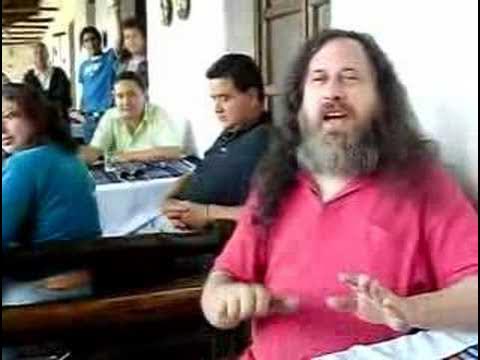
## Background Published on YouTube by the channel BeatStock on December 11, 2006, this video captures Richard Stallman in Ecuador singing his signature anthem. According to the description, the recording of Stallman performing the free software song was captured by Julian Coccia.
## TL;DR In this live performance, Richard Stallman delivers his anthem, the "Free Software Song," set to the melody of the Bulgarian folk tune "Sadi Moma." He calls upon the hacker community to share software openly, contrasting the ethics of mutual aid with proprietary software "hoarders" who accumulate wealth at the expense of helping their neighbors. Stallman projects a future where an abundance of community-driven code eliminates restrictive licenses for good, closing with an energetic repetition of the chorus.
## Atmosphere & style The recording possesses an earnest, grassroots folk-revival atmosphere, blending quirky ideological activism with the communal feel of a traditional protest sing-along. Stallman’s direct, rhythmic vocal delivery gives the performance an intimate yet resolute tone, treating software ethics with musical sincerity. The room responds with warmth and solidarity, concluding with appreciative cheers from the engaged audience.
## Bulletin - [00:24](https://www.youtube.com/watch?v=9sJUDx7iEJw&t=24s) Richard Stallman performs his 'Free Software Song' to advocate for communal code sharing and user freedom over proprietary models. - [00:24](https://www.youtube.com/watch?v=9sJUDx7iEJw&t=24s) The song critiques proprietary software developers as 'hoarders' who sacrifice the ethical duty of helping their neighbors in exchange for monetary wealth. - [00:24](https://www.youtube.com/watch?v=9sJUDx7iEJw&t=24s) The performance outlines an objective for the hacker community to generate sufficient free software to render restrictive proprietary licenses obsolete.
## Key takeaways - [00:24](https://www.youtube.com/watch?v=9sJUDx7iEJw&t=24s) Stallman uses folk music, adapted from the Bulgarian folk tune 'Sadi Moma', to communicate the ideological principles of the free software movement. - [00:24](https://www.youtube.com/watch?v=9sJUDx7iEJw&t=24s) The core anthem urges hackers to unite and share software as the fundamental path to freedom. - [00:24](https://www.youtube.com/watch?v=9sJUDx7iEJw&t=24s) The lyrics acknowledge that proprietary software restriction generates substantial financial profit for 'hoarders'. - [00:24](https://www.youtube.com/watch?v=9sJUDx7iEJw&t=24s) Accumulating wealth through software restriction is presented as an ethical failure because it blocks developers from assisting their neighbors. - [00:24](https://www.youtube.com/watch?v=9sJUDx7iEJw&t=24s) Community solidarity and mutual aid among users are prioritized over commercial incentives. - [00:24](https://www.youtube.com/watch?v=9sJUDx7iEJw&t=24s) The song identifies proprietary terms and restrictive agreements as 'dirty licenses' that harm the computing community. - [00:24](https://www.youtube.com/watch?v=9sJUDx7iEJw&t=24s) The long-term strategy articulated in the song relies on building a critical mass of freely available software. - [00:24](https://www.youtube.com/watch?v=9sJUDx7iEJw&t=24s) Establishing a self-sufficient ecosystem of free software is framed as the definitive mechanism to permanently eliminate restrictive licensing. - [00:24](https://www.youtube.com/watch?v=9sJUDx7iEJw&t=24s) The repeated chorus functions as a communal rallying cry, encouraging software users to embrace cooperative distribution.
## Detailed walkthrough ### [00:24](https://www.youtube.com/watch?v=9sJUDx7iEJw&t=24s) The Free Software Song
Richard Stallman performs his well-known anthem, the "Free Software Song" (sung to the melody of the Bulgarian folk tune "Sadi Moma"), leading an audience through a spirited vocal performance advocating software freedom and communal sharing. He opens by delivering the foundational chorus, singing directly to the community: “Join us now and share the software, you'll be free, hackers, you'll be free.” He repeats the opening refrain with rhythmic emphasis, setting an earnest, folk-revival tone that blends ideological activism with musical performance.
Moving into the verses, Stallman contrasts the financial incentives of proprietary software with the moral imperative of mutual aid among computer users. He acknowledges that commercial software restriction can lead to wealth, but points out the ethical compromise inherent in refusing to share code with others, singing: “Hoarders can get piles of money, that is true, hackers, that is true, but they cannot help their neighbors, that's not good, hackers, that's not good.” The lyrics emphasize community solidarity over financial gain, portraying proprietary restrictions as an obstacle to helping one's neighbor.
Stallman then projects a future where an independent, community-driven computing ecosystem renders restrictive terms obsolete, singing: “When we have enough free software at our call, hackers, at our call, we'll kick out those dirty licenses ever more, hackers, ever more.” He concludes the performance by cycling back through the celebratory chorus twice more, urging the listeners to participate in collective software sharing until bringing the song to a close amid appreciative cheers.
- The performance delivers the standard lyrics of Richard Stallman's "Free Software Song," written to inspire the hacker community to share code cooperatively. - The verses frame proprietary developers as "hoarders" who trade the ability to assist their neighbors for financial gain. - The ultimate goal articulated in the anthem is the total displacement of restrictive software licenses by building a sufficient foundation of freely available software.
## Notable quotes > [00:24](https://www.youtube.com/watch?v=9sJUDx7iEJw&t=24s) When we have enough free software at our call, hackers, at our call, we'll kick out those dirty licenses ever more, hackers, ever more. — Richard Stallman
> [00:24](https://www.youtube.com/watch?v=9sJUDx7iEJw&t=24s) Hoarders can get piles of money, that is true, hackers, that is true, but they cannot help their neighbors, that's not good, hackers, that's not good. — Richard Stallman
## Mentioned Richard Stallman, Free Software Song, Sadi Moma, Julian Coccia, Ecuador
## Video description Richard Stallman en Ecuador, cantando el temita, del free software, grabado por Julian Coccia.
[Source](https://www.youtube.com/watch?v=9sJUDx7iEJw)