Miegakure Bypasses Solid Barriers via Fourth Spatial Dimension Axis
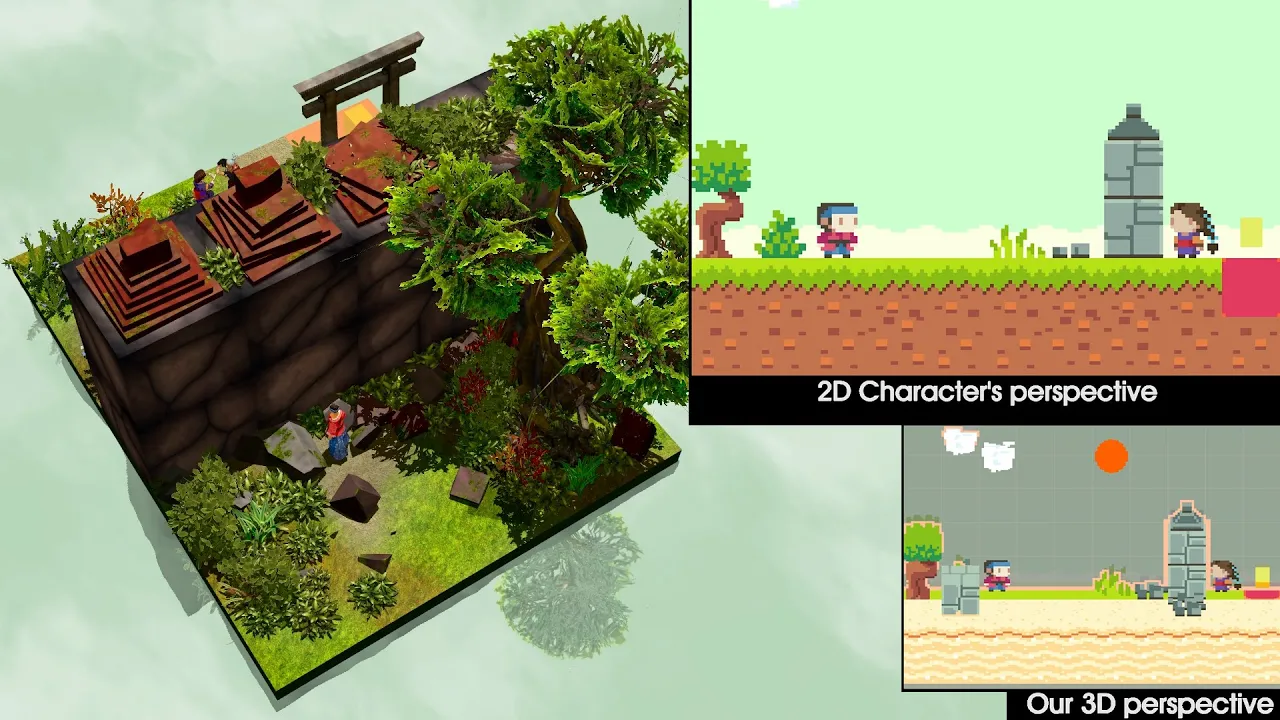
[mtbdesignworks {Miegakure, 4D Toys}]
Traversing barriers through higher dimensions does not penetrate solid matter, but circumvents obstacles by shifting along a perpendicular axis into parallel three-dimensional slices.
AI-assisted summary of How to walk through walls using the 4th Dimension [Miegakure: a 4D game] — original source. Check the original for full context.
Source published:
Key ideas
- Miegakure models a true fourth dimension of space rather than time, allowing players to navigate a mathematically correct 4D environment. (0:08)
- Walking 'through' a solid wall using a fourth spatial dimension is geometrically sidestepping around the obstacle along a perpendicular axis. (0:08)
- The apparent visual warping when rotating into higher dimensions is simply viewing cross-sectional slices of rigid objects, directly analogous to MRI scans. (1:41)
- By shifting into an adjacent 3D slice of space where an obstacle does not exist, a traveler can advance forward and step back to emerge on the obstacle's far side. (1:41)
Detailed notes
## Background Published by mtbdesignworks on YouTube on August 27, 2014, this video demonstrates the four-dimensional puzzle-platformer Miegakure. The description explains that the game models a true fourth dimension of space rather than time, showing how moving along this extra coordinate allows a player to bypass solid obstacles by walking around them in higher-dimensional space.
## TL;DR The video demonstrates how navigating a fourth spatial dimension allows a character to bypass an impassable wall in Miegakure. To explain this concept intuitively, the narrator constructs an analogy of a two-dimensional character facing a wall on a flat plane who sidesteps into the third dimension to walk around the barrier. Applying the same geometric principle to higher dimensions, rotating between cross-sections reveals adjacent 3D slices of the world, comparable to MRI scan layers. By stepping along the fourth coordinate axis where the obstacle does not exist, the player easily moves past the blockage and steps back into the original environment on the other side.
## Atmosphere & style The presentation carries a calm, cerebral, and methodical tone, resembling an interactive math lecture brought to life through elegant software. The narrator speaks with a gentle, patient clarity that demystifies mind-bending spatial concepts, guiding the viewer from intuitive Flatland analogies to complex 4D rotations. Watching the world shift and re-slice creates a quiet sense of wonder and intellectual revelation as an apparently impossible feat turns out to be simple geometry.
## Bulletin - [00:08](https://www.youtube.com/watch?v=9yW--eQaA2I&t=8s) Miegakure models a true fourth dimension of space rather than time, allowing players to navigate a mathematically correct 4D environment. - [00:08](https://www.youtube.com/watch?v=9yW--eQaA2I&t=8s) Walking 'through' a solid wall using a fourth spatial dimension is geometrically sidestepping around the obstacle along a perpendicular axis. - [01:41](https://www.youtube.com/watch?v=9yW--eQaA2I&t=101s) The apparent visual warping when rotating into higher dimensions is simply viewing cross-sectional slices of rigid objects, directly analogous to MRI scans. - [01:41](https://www.youtube.com/watch?v=9yW--eQaA2I&t=101s) By shifting into an adjacent 3D slice of space where an obstacle does not exist, a traveler can advance forward and step back to emerge on the obstacle's far side.
## Key takeaways - [00:08](https://www.youtube.com/watch?v=9yW--eQaA2I&t=8s) In Miegakure, the fourth dimension is a spatial coordinate rather than time, making the game effectively 5D if time is counted. - [00:08](https://www.youtube.com/watch?v=9yW--eQaA2I&t=8s) When confronted with an impassable wall in standard 3D space, turning into the fourth spatial dimension provides an alternative path. - [00:08](https://www.youtube.com/watch?v=9yW--eQaA2I&t=8s) Moving along the fourth axis replaces the blocking wall with an adjacent environment containing only rubble that extends into that dimension. - [00:08](https://www.youtube.com/watch?v=9yW--eQaA2I&t=8s) A lower-dimensional analogy of a 2D Flatland character illustrates how turning into a third spatial dimension allows bypassing an otherwise insurmountable 2D barrier. - [00:08](https://www.youtube.com/watch?v=9yW--eQaA2I&t=8s) Sidestepping into depth remaps standard planar movement controls to navigate along the third dimension. - [01:41](https://www.youtube.com/watch?v=9yW--eQaA2I&t=101s) To an observer confined to a lower dimension, objects appear to warp and deform during dimension rotation, though the higher-dimensional geometry remains entirely static. - [01:41](https://www.youtube.com/watch?v=9yW--eQaA2I&t=101s) Lower-dimensional perspectives of higher-dimensional objects function identically to planar cross-sections produced by MRI machines. - [01:41](https://www.youtube.com/watch?v=9yW--eQaA2I&t=101s) The same mathematical principles enable a 3D being to pivot controls along a fourth coordinate axis to enter an adjacent 3D cross-section. - [01:41](https://www.youtube.com/watch?v=9yW--eQaA2I&t=101s) Advancing forward in an adjacent 3D slice avoids the obstacle, after which rotating and stepping back returns the player to the original 3D world on the other side. - To an outside 3D observer, a person utilizing the fourth dimension would simply vanish and subsequently reappear on the other side of the wall.
## Detailed walkthrough ### [00:08](https://www.youtube.com/watch?v=9yW--eQaA2I&t=8s) The 4D Problem and the 2D Analogy
*Miegakure* is introduced as a four-dimensional game where space itself contains a fourth dimension, rather than treating time as the fourth coordinate. The central premise is demonstrating what it would genuinely look like if someone were able to navigate through a solid barrier using spatial movement along this extra dimension. In an opening scenario, the player encounters a massive wall: it is impossible to jump over it, and there is no way to walk around it within ordinary space. The narrator asks: “So I thought I would show what it would actually look like if you could walk through walls using the fourth dimension, and in the process explain what the fourth dimension is.” When the player turns to face along the fourth dimension, walks forward, and then turns back, the wall vanishes entirely, replaced by a mound of rubble resting in a desert environment.
To make this intuitive, the narrator steps back to examine a lower-dimensional analogy involving a flat, two-dimensional character facing a similar blockage on a 2D plane. In Flatland-style 2D space, the character cannot jump over the obstacle or walk around it. However, if the underlying reality is actually three-dimensional and the character is merely restricted to moving along a single plane, sidestepping into the third dimension becomes possible. By pressing a button to turn sideways into depth, left-and-right controls are remapped to navigate along the third dimension. Moving along this new axis and rotating back leaves the character in a parallel slice of the world where the barrier is gone, replaced only by fallen rubble that spilled into the third dimension, allowing effortless passage past the obstacle before turning sideways once more to re-enter the starting grass plane.
```mermaid flowchart TD accTitle: 2D to 3D Analogy Flow accDescr: Step-by-step process of a 2D character bypassing a barrier using a third spatial dimension. subgraph Initial["Initial Position"] A["Blocked by 2D wall"] --> B["Press button to turn sideways"] end subgraph ThirdDim["Third Dimension Shift"] B --> C["Move along 3rd dimension axis"] C --> D["Press button to face forward"] end subgraph Parallel["Parallel Plane"] D --> E["Wall disappears / Rubble visible"] E --> F["Walk safely past obstacle"] F --> G["Turn sideways & step back to original plane"] end ```
[01:41](https://www.youtube.com/watch?v=9yW--eQaA2I&t=101s) 2D Slices and Navigating 4D Space
Because the 2D character cannot directly visualize a full 3D environment, the visual transformation looks bizarre from an internal point of view. As the character turns sideways, the surrounding objects appear to warp and reshape dynamically. The narrator clarifies: “He might think the world is deforming, but it's just what it would look like if you took 2D slices of a 3D object, like images produced by an MRI machine, for example.” The reality itself remains rigid and static; only the cross-sectional angle of observation changes. When situated further along the third dimension within the desert slice, the tall wall is absent from view, leaving only the scattered rubble visible until the character shifts perspective sideways once more to bridge back into the grassy plane.
Returning to what the narrator terms “thicker problems,” the exact same mathematical logic applies to human beings if our universe possesses four spatial dimensions while our perception is restricted to a three-dimensional slice. By pressing a control button to pivot into the fourth dimension, standard spatial movement shifts along the fourth coordinate axis. Stepping forward in this orientation and toggling perspective back deposits the player into an adjacent 3D cross-section of the 4D world. In this adjacent space, the blocking wall is no longer present directly ahead—only rubble extending into the fourth dimension remains—permitting the character to walk straight forward past the obstacle. Pivoting once more into the fourth dimension and stepping back returns the character to their home 3D world on the other side of the obstacle. The narrator concludes: “And this is how you walk through walls using the fourth dimension.”
- The apparent deformation seen when rotating between dimensions is merely a sequence of planar cross-sections, identical to how an MRI scan visualizes a 3D organ slice-by-slice. - Moving through an obstacle in higher-dimensional geometry is technically not walking *through* the matter itself, but rather sidestepping *around* it via an axis perpendicular to standard 3D space.
## Mentioned Miegakure, Marc ten Bosch, mtbdesignworks, Flatland, 4D Toys, Steam, Patreon, Twitter
## Video description An explanation of how walking through walls would actually look like if you could move in 4D, using the 4D video-game Miegakure (http://miegakure.com) For more details, see this blog post: http://marctenbosch.com/news/2014/08/new-trailer-how-to-walk-through-walls-using-the-fourth-dimension
* We will make more videos explaining the fourth dimension using the game. Subscribe to the channel if you are interested!
* In this game the fourth dimension is not time, it is a fourth dimension of space. So if you count time the game is a 5D game. It is a correct representation of a fourth spatial dimension.
* Yeah it's actually "around" walls, not "through!"
* There are *infinitely* many 3D worlds stacked on top of each other, even if in the introductory Wall Level the ground texture makes it seem like there are only two. A more complex example is the shape at the beginning of the trailer, which is a true 4D shape called the 120 Cell, as explained here: http://marctenbosch.com/news/2014/04/what-is-that-shape-at-the-end-of-the-trailer-hd-screenshot/
* From the perspective of a regular 3D observer standing next to the wall the player character would suddenly disappear, and a few moments later reappear on the other side of the wall.
* See also: Flatland (https://en.wikipedia.org/wiki/Flatland)
⦿ Support us on Patreon: https://www.patreon.com/marctenbosch ⦿ Wishlist Miegakure on Steam: https://store.steampowered.com/app/355750/Miegakure ⦿ Buy 4D Toys on iOS: http://4dtoys.com/ios ⦿ Buy 4D Toys on Steam: http://4dtoys.com/steam ⦿ Mailing list: https://marctenbosch.com/mailing-lists ⦿ Blog: https://marctenbosch.com/news ⦿ Twitter: https://twitter.com/MiegakureGame
[Source](https://www.youtube.com/watch?v=9yW--eQaA2I)