uBeam $28 Million Phone Charger Faces Dead End on Sub-1% Efficiency
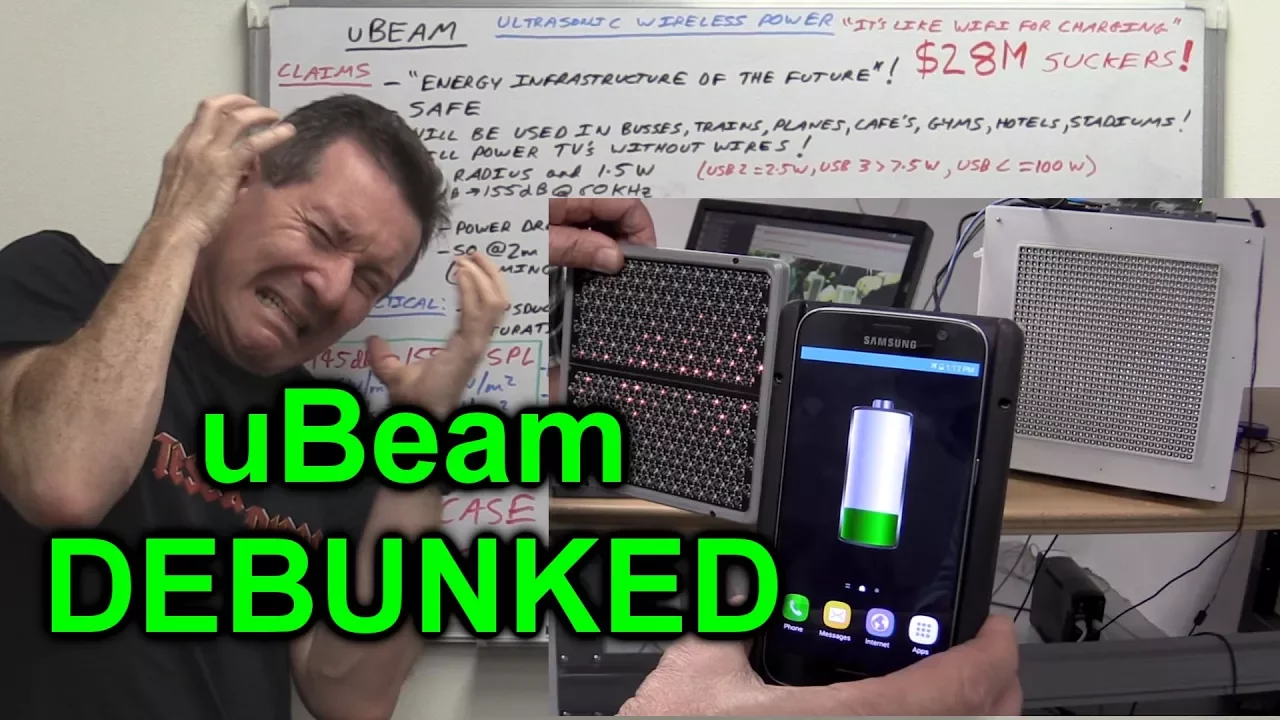
EEVblog #1001 - uBeam Ultrasonic Wireless Charging DEBUNKED! — EEVblog

EEVblog

Ultrasonic power transfer cannot succeed commercially because acoustic attenuation, regulatory exposure limits, and line-of-sight blockages reduce wall-to-battery efficiency below 1% while driving transmitter costs into the thousands.

AI-assisted summary of EEVblog #1001 - uBeam Ultrasonic Wireless Charging DEBUNKED! — original source. Check the original for full context.

Source published:

Key ideas

  • uBeam has raised over $28 million to develop an ultrasonic wireless charging system pitched as 'Wi-Fi for power,' despite physical limits that degrade wall-to-battery efficiency to single digits or under 1%. (0:09)
  • The system operates at 60 kHz and 145–155 dB SPL to deliver roughly 1.5 W across 4 meters, producing acoustic intensity up to 3,000 times higher than continuous exposure limits set around 110 dB SPL. (1:46)
  • Five major real-world constraints doom consumer adoption: regulatory energy efficiency rules, exorbitant transducer costs, thick receiver hardware, severe acoustic safety limits, and daily ergonomic line-of-sight obstruction. (6:53)
  • Prototype teardowns reveal separate hardware tracks—a fixed 1,100-transducer desktop array and a massive camera-steered basement rig—neither of which approaches commercial readiness against 5-dollar Qi induction chargers. (12:01)

Detailed notes

## Background Published by Dave Jones on the EEVblog YouTube channel on June 23, 2017, this video debunks the uBeam (later SonicEnergy) ultrasonic wireless phone charging technology. The show notes explain why ultrasonic power transfer will never be a practical consumer solution, spotlighting founder Meredith Perry's public remarks about engineers and highlighting commentary from former VP of Engineering Paul Reynolds.

## TL;DR Dave Jones systematically dismantles uBeam's claim of providing room-scale 'Wi-Fi for power' after the startup burned nearly $30 million in venture funding over five years. He analyzes the core physics, demonstrating that high-frequency acoustic attenuation, air saturation, and conversion losses restrict real-world efficiency to sub-1% trickle charging (1.5 W) while requiring unsafe 145–155 dB SPL sound levels. Evaluating actual prototype footage, Dave highlights five fatal flaws—efficiency regulations, exorbitant bill of materials, receiver bulk, safety thresholds, and routine line-of-sight blockage by hands or tables. Comparing the setup to cheap, efficient Qi inductive pads, he concludes the technology has a zero percent chance of commercial consumer viability and represents a total loss for investors.

## Atmosphere & style The presentation is energetic, scathing, and unapologetically technical, driven by Dave's classic whiteboard-style engineering skepticism and exasperation. Watching it feels like a reality check against venture-capital hype, alternating between meticulous mathematical breakdowns of decibel drop-offs and gleeful mockery of Silicon Valley hubris. The mood shifts from disbelief during clips of Meredith Perry dismissing engineering experts to grounded pragmatism as Dave points out the absurdity of bulky, multi-thousand-dollar prototypes failing basic daily use cases.

## Bulletin - [00:09](https://www.youtube.com/watch?v=A8dqzVlhFkA&t=9s) uBeam has raised over $28 million to develop an ultrasonic wireless charging system pitched as 'Wi-Fi for power,' despite physical limits that degrade wall-to-battery efficiency to single digits or under 1%. - [01:46](https://www.youtube.com/watch?v=A8dqzVlhFkA&t=106s) The system operates at 60 kHz and 145–155 dB SPL to deliver roughly 1.5 W across 4 meters, producing acoustic intensity up to 3,000 times higher than continuous exposure limits set around 110 dB SPL. - [06:53](https://www.youtube.com/watch?v=A8dqzVlhFkA&t=413s) Five major real-world constraints doom consumer adoption: regulatory energy efficiency rules, exorbitant transducer costs, thick receiver hardware, severe acoustic safety limits, and daily ergonomic line-of-sight obstruction. - [12:01](https://www.youtube.com/watch?v=A8dqzVlhFkA&t=721s) Prototype teardowns reveal separate hardware tracks—a fixed 1,100-transducer desktop array and a massive camera-steered basement rig—neither of which approaches commercial readiness against 5-dollar Qi induction chargers.

## Key takeaways - [00:09](https://www.youtube.com/watch?v=A8dqzVlhFkA&t=9s) uBeam raised roughly $28 million to $30 million over five years selling an ultrasonic wireless charging concept that engineers consider fundamentally impractical. - [01:46](https://www.youtube.com/watch?v=A8dqzVlhFkA&t=106s) Ultrasonic transmission in air drops approximately 3 dB per meter, discarding 50% of acoustic power at 1 meter and 75% at 2 meters under theoretical conditions alone. - [01:46](https://www.youtube.com/watch?v=A8dqzVlhFkA&t=106s) Delivering just 1.5 W at 4 meters requires sound pressure levels of 145 dB to 155 dB SPL at 60 kHz, causing acoustic air saturation and collapsing real-world efficiency below 1%. - [05:40](https://www.youtube.com/watch?v=A8dqzVlhFkA&t=340s) Founder Meredith Perry publicly dismissed technical experts and PhD engineers as narrow, linear thinkers whose objections could be outmaneuvered with a few hours of research. - [06:53](https://www.youtube.com/watch?v=A8dqzVlhFkA&t=413s) Sub-1% efficiency bars the technology from meeting international consumer efficiency mandates like Energy Star and Minimum Energy Performance Standards (MEPS). - [06:53](https://www.youtube.com/watch?v=A8dqzVlhFkA&t=413s) Equipping transmitters with hundreds of high-power transducers and receivers with roughly 100 elements creates an exorbitant bill of materials compared to mass-market electronics. - [06:53](https://www.youtube.com/watch?v=A8dqzVlhFkA&t=413s) Acoustic emissions at 145–155 dB SPL represent acoustic intensities up to 3,000 times higher than standard 110 dB SPL continuous exposure health limits. - [10:30](https://www.youtube.com/watch?v=A8dqzVlhFkA&t=630s) Everyday phone habits defeat the system entirely, as laying a phone on a desk, placing it in a pocket, or holding it naturally blocks the acoustic line of sight. - [10:30](https://www.youtube.com/watch?v=A8dqzVlhFkA&t=630s) Standard Qi inductive charging delivers upwards of 50% electrical efficiency and paper-thin coils for under $5 delivered, entirely outclassing acoustic hardware economics. - [12:01](https://www.youtube.com/watch?v=A8dqzVlhFkA&t=721s) Close analysis of USA Today footage exposes split laboratory prototypes: a desktop unit with 1,100 fixed transducers and an unwieldy basement beam-forming rig using optical tracking. - [13:28](https://www.youtube.com/watch?v=A8dqzVlhFkA&t=808s) Deploying commercial transmitter arrays in venues like cafes would cost thousands of dollars per unit, while public adoption of far cheaper Qi charging has already been slow. - [13:28](https://www.youtube.com/watch?v=A8dqzVlhFkA&t=808s) Refusal to pivot advanced acoustic beamforming research away from consumer smartphone charging into viable industrial, medical, or niche sensing applications rendered investor capital a total loss.

## Detailed walkthrough ### [00:09](https://www.youtube.com/watch?v=A8dqzVlhFkA&t=9s) The "Product of the Century" and the uBeam Hype

Dave introduces what he considers the frontrunner for the dubious "product of the century" award—beating out contenders like Batteriser and Solar Roadways through the sheer volume of capital invested and the fundamental absurdity of the underlying concept: uBeam. Having already debunked the concept on his blog two years prior, Dave points out that even uBeam's former vice president of engineering, Paul Reynolds, publicly dismantled the company's claims. Pitching itself as "Wi-Fi for charging," uBeam promises ultrasonic wireless power transfer that has lured investors into handing over $28 million for what Dave characterizes as an unworkable boondoggle.

The marketing pitch claims the technology is completely safe and envisions widespread deployment across buses, trains, airplanes, cafes, gyms, hotels, and sports stadiums. In promotional scenarios, users could sit in a massive stadium while their smartphones magically recharge through the air, or place flat-screen televisions in the middle of a room without any power cords. Dave dismisses these claims as relying on pure "pixie dust," noting that the gap between promotional hype and physical reality is staggering.

- **Capital Raised:** Over $28 million sucked in from venture investors. - **Promised Use Cases:** Wire-free power in public transport, cafes, stadiums, and untethered living room appliances.

---

[01:46](https://www.youtube.com/watch?v=A8dqzVlhFkA&t=106s) Physics, Sound Pressure Levels, and Severe Attenuation

After operating under tight secrecy for roughly five years, uBeam finally released limited technical figures: a 4-meter working radius delivering a paltry 1.5 watts of power to a phone receiver. Dave highlights that modern fast-charging protocols—particularly USB-C—render a 1.5 W trickle charge virtually obsolete. The system operates by emitting sound pressure levels between 145 dB SPL and 155 dB SPL at an ultrasonic frequency of 60 kHz. In air, acoustic power attenuates at approximately 3 dB per meter. Under purely theoretical conditions—assuming 100% transducer efficiency, perfect focusing, and zero acoustic nonlinearity—a 1-meter distance immediately forfeits 50% of the transmitted energy, dropping down to 25% efficiency at just 2 meters.

```mermaid flowchart LR accTitle: Ultrasonic Power Loss Flow accDescr: Diagram tracing electrical input power through acoustic air transmission to phone battery.

subgraph TX ["Transmitter Array"] A["Mains Power Input"] --> B["Ultrasonic Transducers<br/>(145–155 dB SPL @ 60 kHz)"] end

subgraph Medium ["Air Medium Losses"] B --> C["Acoustic Attenuation<br/>(~3 dB/m Drop)"] C --> D["Air Saturation &<br/>Non-linear Effects"] end

subgraph RX ["Receiver (Phone)"] D --> E["Piezo Transducers &<br/>Rectification"] E --> F["Trickle Output<br/>(~1.5 W @ 4 m, &lt;1% Overall)"] end ```

Dave acknowledges that the underlying engineering accomplishes some sophisticated phased-array beamforming. The transmitter can dynamically select specific aperture areas—yielding an estimated natural focal length of roughly 1.5 meters—and track the position of a receiver with approximately half a second of lag. However, achieving 1.5 W at a few meters does not break the laws of physics; it simply requires pumping massive acoustic power into the room while overall system efficiency collapses into the single digits or well below 1% in real-world environments. Ambient temperature, atmospheric pressure, relative humidity, and finite-amplitude acoustic saturation in the air prevent high sound pressure levels from propagating without extreme dissipation. As Dave puts it when assessing the fundamental physics:

> “This thing can work. You can charge a mobile phone using ultrasound at several meters. It is possible, but the efficiency is down in the single-digit percentage, and in practice, it's going to be possibly sub 1% efficient.”

- **Claimed Output:** 1.5 W charging rate (comparable to trickle charging). - **Operating Frequency & Volume:** 60 kHz at 145 dB to 155 dB SPL. - **Theoretical Attenuation:** ~3 dB/m drop in air (50% loss at 1 m, 75% loss at 2 m before transducer losses). - **Practical Limitations:** Acoustic saturation of air molecules, humidity, altitude, temperature variations, and ~0.5-second beamforming tracking lag.

---

[05:40](https://www.youtube.com/watch?v=A8dqzVlhFkA&t=340s) Meredith Perry's Rant on Engineers and Experts

Dave cuts directly to a conference presentation given by uBeam founder and CEO Meredith Perry, challenging viewers to endure all 15 minutes of her remarks regarding traditional engineering expertise. In the clip, Perry explains how she approached technical hurdles that seasoned specialists had declared impossible:

> “For each technological hurdle deemed insurmountable by the experts, I would spend just a few hours thinking about the problem from a variety of approaches. So, I was able to solve problems when the PhD experts couldn't with just a few hours of really simple research. Every single argument over why the technology couldn't work has been indisputably wrong. This taught me to be skeptical of experts. That expertise represented a narrow way of looking at things. Engineers are inherently linear thinkers and tend to take a very binary approach to solving problems. As a non-expert, I had an advantage because I could look at a problem from different angles because I just didn't know what was possible. By thinking outside the box, by thinking around corners, you can outthink the top thinkers. And now, 8 months later, I have four of the top ultrasonic engineers in the world working for me or working with me. It's going to work and it's going to be awesome. And I can't wait to give the middle finger and smile to all the engineers that criticized the crap out of me.”

---

[06:53](https://www.youtube.com/watch?v=A8dqzVlhFkA&t=413s) Why Ultrasonic Charging Fails: Efficiency, Cost, Size, Safety, and Usability

Transitioning to his whiteboard, Dave outlines five fatal, practical flaws that make ultrasonic consumer charging completely non-viable:

1. **Efficiency and Regulatory Non-Compliance:** At an estimated real-world wall-to-battery efficiency of less than 1% across a 4-meter room, the technology is worse than any competing charging standard by an order of magnitude. If adopted on a global scale, the wasted grid energy would be catastrophic. Furthermore, international energy efficiency mandates, such as Energy Star and Minimum Energy Performance Standards (MEPS), legally prohibit consumer power supplies and battery chargers that fail to meet strict standby and active efficiency minimums.

2. **Prohibitive Bill of Materials:** To generate acoustic pressure levels reaching 155 dB SPL, the transmitter requires hundreds of specialized ultrasonic transducers. A smartphone-sized receiver case would require roughly 100 transducers packed onto the back. While basic automotive ultrasonic parking sensors are manufactured in massive bulk, reliable high-output transducers still cost several dollars each in quantity. Dave remarks that no magical production facility is going to supply consumer-grade transducers capable of handling these power levels for pennies.

3. **Excessive Physical Bulk:** Five years of venture-backed development yielded a prototype receiver resembling a thick brick. Unlike flat Qi inductive wireless charging coils that integrate seamlessly behind modern smartphone glass, ultrasonic receiver arrays cannot be scaled down to ultra-thin form factors.

4. **Severe Safety and Regulatory Violations:** Most international workplace and public health standards set the recommended continuous exposure threshold for airborne ultrasound around 110 dB SPL. Sound pressure decibels use a logarithmic scale; generating 145 dB to 155 dB SPL means uBeam's emissions represent acoustic power intensities up to 3,000 times higher than recommended safe limits. Dave urges viewers not to be swayed by PR spin on the company's website that glosses over these exposure levels.

5. **Real-World Ergonomic Failure:** The back-of-a-napkin user experience immediately collapses under everyday human behavior. Users routinely place their phones face-up on tables or cafe counters, resting the device directly on the rear-facing transducer array and completely cutting off line-of-sight sound reception to deliver 0 watts. Furthermore, when individuals hold devices in their hands, their fingers wrap around the casing at oblique angles. In staged company demonstrations, presenters carefully suspend the receiver flat toward the transmitter with fingertips at the edges, avoiding the practical reality where human grip and natural orientation instantly obstruct the acoustic beam.

> “So, right there off the bat, this thing shouldn't have even made it past the first concept.”

[10:30](https://www.youtube.com/watch?v=A8dqzVlhFkA&t=630s) Practical Phone Usage and the Comparison with Qi Wireless Charging

The physical realities of everyday smartphone use pose an insurmountable obstacle to uBeam's acoustic charging scheme. When a phone is laid down on a surface, half of the potential transducer surface area on the back of the device is immediately obscured and lost. Worse still, real-world users do not leave their phones positioned in clear line of sight; they place their large, bulky modern phones into their pockets or bags, where acoustic beams cannot penetrate and the technology becomes completely useless. Dave emphasizes that these basic physical constraints should have killed the concept at the very beginning before any money was wasted: “There is right there off the bat it should not have been funded or made it off the back of a bloody napkin.”

```mermaid flowchart TD accTitle: Comparison of Qi Induction vs. uBeam Ultrasonic Charging accDescr: Diagram contrasting Qi charging's low cost and high efficiency against uBeam's high transducer complexity and poor efficiency.

subgraph Qi["Qi Inductive Charging"] Q1["Thin Copper Induction Coil"] --> Q2["Integrated Charge Controller"] Q2 --> Q3["Over 50% Efficiency"] Q3 --> Q4["Pads Cost ~$5 Delivered"] end

subgraph uBeam["uBeam Acoustic Charging"] U1["Massive Transducer Array (~1,100+ Elements)"] --> U2["Camera Tracking / Nvidia Jetson"] U2 --> U3["Huge Receiver Dongle / Brick"] U3 --> U4["Extremely Inefficient (<5-10%) & Multi-Thousand-Dollar Cost"] end ```

The technology makes even less sense when weighed against existing Qi inductive charging standards. Qi charging is already integrated directly into the vast majority of mainstream phones on the market. It offers electrical efficiencies upwards of 50 percent—an order of magnitude better than uBeam could ever achieve in its best-case scenario. Qi charging hardware is also remarkably thin and inexpensive; a complete Qi pad containing a slim induction coil and driver chip can be purchased on eBay for five dollars delivered straight to your door. Dave scoffs at the notion that uBeam could ever match these economics, pointing out that Willy Wonka’s transducer factory could never manufacture complex acoustic arrays anywhere near that price point or form factor, declaring uBeam the undisputed winner of the “dumbest idea ever” award.

- **Qi inductive charging efficiency:** Upwards of 50%, an order of magnitude higher than uBeam's theoretical ceiling. - **Qi hardware cost:** Under $5 delivered to your door via eBay for consumer pads. - **Hardware footprint:** A paper-thin copper coil and a standard controller IC versus hundreds of piezoelectric transducers and bulky electronics.

---

[12:01](https://www.youtube.com/watch?v=A8dqzVlhFkA&t=721s) Dissecting the USA Today Footage: Dual Prototypes and Bulky Hardware

Examining close-up video footage broadcast by USA Today, Dave breaks down the reality of uBeam's actual hardware prototypes. The footage reveals that uBeam relies on two completely separate prototype systems rather than a single unified product. The first is a compact desktop model covered with over 1,100 transducers on its face. However, this desktop unit does not actually perform any beam-forming; observing the pattern displayed on its lid reveals a fixed, static output rather than a dynamic acoustic beam steering toward a target.

The second system—located in a basement laboratory setting—is an enormous, sprawling mechanical rig responsible for testing beam-forming. To track devices in real time, this setup incorporates an optical camera paired with what appears to be an Nvidia Jetson processing board mounted above the array. While Dave acknowledges the raw engineering behind the acoustic technology as cool laboratory work, the hardware demonstrated on the receiving end is laughable: the phone requires an enormous, thick receiver brick attached to its back just to capture acoustic energy. The contrast between this massive, inefficient dual-prototype setup and the sleek promise made to investors underscores how unviable the commercial roadmap truly is.

- **Desktop prototype:** Array of approximately 1,100 transducers, non-beam-forming with fixed output. - **Basement prototype:** Giant array utilizing camera-based optical tracking powered by an Nvidia Jetson board. - **Receiver hardware:** An oversized, thick dongle/brick attached to the back of the smartphone.

---

[13:28](https://www.youtube.com/watch?v=A8dqzVlhFkA&t=808s) Venture Capital Burn and the Inevitable Commercial Dead End

After five years of development and nearly $30 million in venture capital funding, uBeam remains nowhere near delivering a practical product. The business model falls apart entirely when looking at real-world infrastructure costs. Dave draws a direct comparison to coffee shops like Starbucks: even with inexpensive Qi chargers that cost virtually nothing to embed into tables, widespread adoption across cafes and public venues has been remarkably sluggish. Installing a complex uBeam transmitter array onto a ceiling or wall would cost thousands of dollars per unit, yet provide a far worse user experience because a phone sitting flat on a table cannot even expose its rear transducers to the transmitter overhead.

Because consumers will never carry phones permanently tethered to massive transducer cases, uBeam has zero commercial viability for consumer wireless charging. Dave concludes that early investors have been completely fleeced and will never see a single cent of their capital returned. The only rational choice for the company years ago would have been to pivot its transducer technology toward specialized industrial, medical, or niche sensing applications rather than chasing consumer gadget charging. Because company leadership refused to give up the consumer illusion, the entire venture is dead in the water: “There's a zero zero percent chance. Not even a slight chance. Zero percent chance this will ever make it to market.”

- **Total funding burned:** Close to $30 million invested over approximately five years. - **Infrastructure barrier:** Ceiling-mounted transmitter arrays costing thousands of dollars each versus dirt-cheap Qi pads that venues like Starbucks still hesitate to deploy at scale. - **Line-of-sight failure:** Transmitters mounted above tables cannot reach phone-back transducers when phones rest flat on surfaces.

## Notable quotes > [01:46](https://www.youtube.com/watch?v=A8dqzVlhFkA&t=106s) You can charge a mobile phone using ultrasound at several meters. It is possible, but the efficiency is down in the single-digit percentage, and in practice, it's going to be possibly sub 1% efficient. — Dave Jones

> [05:40](https://www.youtube.com/watch?v=A8dqzVlhFkA&t=340s) Engineers are inherently linear thinkers and tend to take a very binary approach to solving problems. As a non-expert, I had an advantage because I could look at a problem from different angles because I just didn't know what was possible. — Meredith Perry

> [05:40](https://www.youtube.com/watch?v=A8dqzVlhFkA&t=340s) By thinking outside the box, by thinking around corners, you can outthink the top thinkers. — Meredith Perry

## Mentioned EEVblog, Dave Jones, uBeam, SonicEnergy, Meredith Perry, Paul Reynolds, Batteriser, Solar Roadways, Qi, Energy Star, Minimum Energy Performance Standards (MEPS), Nvidia Jetson, USA Today, Starbucks, eBay

## Video description Dave debunks the uBeam / SonicEnergy ultrasonic wireless phone charging technology and explains why this will NEVER be a practical solution. Also, Meredith Perry's rant on engineers and other experts. NOTE: This was split out from video #1000 for SEO reasons. There should be a debunking video of this searchable on Youtube. Some extra material has been added from video #1000 at the 11:58 mark

https://www.eevblog.com/forum/projects/the-ubeam-faq/

Paul Reynolds, former VP Engineering at uBeam! On Non-linearity: http://liesandstartuppr.blogspot.com.au/2016/05/acoustic-nonlinearity.html On why uBeam won't be practical: http://liesandstartuppr.blogspot.com.au/2017/06/arguing-point.html

I challenge you to watch all 15min of this: https://www.youtube.com/watch?v=ukgnU2aXM2c

USA Today video: https://www.youtube.com/watch?v=1c0kzTCRWU4

EEVblog Main Web Site: http://www.eevblog.com The 2nd EEVblog Channel: http://www.youtube.com/EEVblog2

Support the EEVblog through Patreon! http://www.patreon.com/eevblog

EEVblog Amazon Store (Dave gets a cut): http://astore.amazon.com/eevblogstore-20

T-Shirts: http://teespring.com/stores/eevblog #uBeam #SonicEnergy #Ultrasonic

[Source](https://www.youtube.com/watch?v=A8dqzVlhFkA)

中文简报

uBeam融资2800万美元的手机充电器因能效不足1%陷入绝境 超声波无线供电无法在商业上取得成功,因为声波衰减、法规暴露限制以及视线遮挡使电网到电池的端到端效率降至1%以下,同时还将发射端成本推高至数千美元。 在初创公司uBeam于五年内烧光近3000万美元风投资金后,Dave Jones系统性驳斥了其提供房间级“电力Wi-Fi”的主张。他分析了核心物理原理,指出高频声波衰减、空气饱和以及转换损耗将实际效率限制在不足1%的涓流充电(1.5瓦)水平,同时还需要达到145至155分贝声压级(dB SPL)的不安全声级。通过评估实际原型机的录像,Dave指出了五大致命缺陷——能效法规、高昂的物料清单成本、接收端体积庞大、安全阈值限制以及手或桌子等造成的日常视线遮挡。在将其与廉价、高效的Qi电磁感应充电板进行对比后,他得出结论,该技术在消费领域的商业可行性为零,对投资者而言意味着彻底损失。 尽管物理限制将从电网到电池的端到端效率降至个位数甚至1%以下,uBeam仍筹集了超过2800万美元来研发被宣传为“电力Wi-Fi”的超声波无线充电系统。 (0:09) 该系统在60 kHz和145至155分贝声压级(dB SPL)下工作,在4米距离上传输约1.5瓦功率,其产生的声强比110分贝声压级左右的持续暴露上限高出多达3000倍。 (1:46) 现实中的五大主要制约因素注定了消费级普及的失败:能效监管法规、过高的换能器成本、厚重的接收端硬件、严苛的声学安全限制,以及日常使用中人体工程学视线遮挡。 (6:53) 原型机拆解显示了不同的硬件研发路径——一个由1100个换能器组成的固定桌面阵列和一个由摄像头引导的庞大地下室装置,面对售价5美元的Qi电磁感应充电器,两者都远未达到商业就绪水平。 (12:01)

Reading summary

EEVblog's Dave Jones argues that uBeam's venture-backed ultrasonic wireless charging concept is commercially and physically non-viable due to extreme acoustic attenuation, poor efficiency, prohibitive manufacturing costs, and basic ergonomic failures. Severe Acoustic Attenuation and Low Efficiency (1:46) After operating under tight secrecy and raising over $28 million, uBeam disclosed technical figures claiming a 1.5-watt trickle charge over a 4-meter range using 60 kHz ultrasound at 145 to 155 dB SPL. Jones explains that acoustic energy naturally attenuates in air at roughly 3 dB per meter. Even assuming 100% transducer efficiency, half the transmitted energy is lost within the first meter and 75% at two meters, leaving estimated wall-to-battery efficiency in single-digit percentages or below 1% in real-world conditions. Environmental variables such as relative humidity, temperature, atmospheric pressure, and non-linear finite-amplitude acoustic saturation further degrade real-world propagation. Although the transmitter employs sophisticated phased-array beamforming with an estimated 1.5-meter focal length and roughly half a second of tracking lag, modern fast-charging standards like USB-C render a highly dissipated 1.5 W charge obsolete. Jones also points out that sub-1% efficiency faces legal obstacles under energy efficiency mandates such as Energy Star and Minimum Energy Performance Standards (MEPS). Founder Dismissal of Engineering Constraints (5:40) In a featured presentation clip, uBeam founder and CEO Meredith Perry asserted that non-experts hold an advantage because they can circumvent the narrow, linear thinking of PhD engineers. She claimed that she solved problems experts deemed impossible in just a few hours of research, adding that all arguments against the technology had been indisputably wrong. Jones uses Perry's remarks to highlight the contrast between venture-capital optimism and basic physical limitations. In his assessment, operating at 145 dB to 155 dB SPL also breaches safety conventions, noting that recommended continuous airborne ultrasound limits typically sit around 110 dB SPL. Because decibels scale logarithmically, uBeam's acoustic power output represents up to 3,000 times the recommended continuous threshold. High Hardware Costs and Practical Usability Flaws (6:53) A complete acoustic transmission setup requires high-output transmitter arrays and roughly 100 transducers packed onto a mobile receiver case. Jones notes that while automotive parking sensors are mass-produced, high-power transducers cannot be acquired for pennies, driving hardware costs to thousands of dollars. An analysis of broadcast footage from USA Today revealed that uBeam relied on two disjointed prototypes: a non-beamforming desktop array with about 1,100 transducers and an oversized basement rig using an optical camera and an Nvidia Jetson board to test beam tracking. At the device level, daily consumer habits fundamentally break acoustic charging. A user laying a phone face-up on a counter rests the device directly on its rear transducer array, severing line-of-sight reception and yielding zero power. Placing devices inside pockets or bags similarly blocks the acoustic beam, while handheld use often obscures the array with fingers. Company demonstrations avoided this reality by suspending devices flat toward transmitters with fingertips on the edges. Economic Realities Against Qi Inductive Standards (10:30) Jones contrasts the complex ultrasonic scheme with the established Qi inductive charging standard. Qi hardware relies on thin, inexpensive copper induction coils and driver integrated circuits costing under five dollars on consumer sites, while delivering electrical efficiencies exceeding 50%. Qi integration is already widespread across consumer smartphones without requiring bulky external accessories. By contrast, deploying uBeam requires multi-thousand-dollar ceiling or wall arrays. Given that commercial venues like Starbucks have been slow to deploy even inexpensive Qi pads into tables, expensive ceiling-mounted transmitters with obstructed line of sight to flat devices face severe economic hurdles. Jones contends that uBeam should have pivoted to industrial or medical sensing applications rather than pursuing consumer smartphone charging. Jones concludes that uBeam has a zero percent chance of ever bringing a practical consumer charging product to market, leaving early investors with no financial return after spending roughly $30 million over five years.

精炼阅读摘要

EEVblog主持人Dave指出,获得逾2800万美元风险投资的初创公司uBeam声称能通过空气超声波实现远距离手机无线充电,但在物理传播衰减、极低能效、高昂物料成本以及使用形态上存在根本性缺陷,商业化前景为零。 声学衰减与极低系统能效 (1:46) uBeam宣传所谓像Wi-Fi一样的无线电力传输,设想可在交通工具、咖啡馆及体育馆中为手机供电。然而其公布的技术参数显示,系统在60 kHz频率下产生145 dB至155 dB SPL的声压级,在4米工作半径内仅能向手机接收端输出约1.5瓦的涓流功率。在空气介质中,声波衰减率约为每米3 dB,仅理论传播损失就意味着1米处损失50%能量,2米处损失75%,同时还受限于空气分子的有限振幅声学饱和、环境温湿度与气压变化。 Dave表示,尽管系统采用相控阵波束成形技术进行定向发射和约0.5秒延迟的目标追踪,但实际从电网输入到手机电池的端到端效率在现实环境中低至个位数甚至低于1%。面对现代USB-C等通用快充协议,这种微弱的电量输出毫无竞争力,同时极低的能效也完全无法达到Energy Star和最低能源性能标准(MEPS)等法规对消费级电源转换效率的强制门槛。 超标安全隐患与高昂物料成本 (6:53) 国际上针对工作环境和公众的空气超声波持续暴露推荐安全上限通常在110 dB SPL左右。声压级以对数刻度计量,uBeam系统发射的145 dB至155 dB SPL意味着其声强超出推荐安全上限达3000倍,存在严重的合规障碍与健康风险。 在制造成本与形态方面,发射端需要装配数百乃至上千个专用超声波换能器,接收端手机背板也需要集成约100个换能器。尽管汽车倒车雷达等传感器能够廉价量产,但支持高功率声学转换的可靠元器件单价仍在数美元以上,使得整套硬件的物料成本(BOM)极为高昂。长达五年的研发最终仅换来形似厚重砖块的接收器原型,无法像成熟的扁平薄膜Qi电磁感应线圈那样被纤薄地内置于现代智能手机中。 日常人机工效与Qi标准的对比落差 (10:30) 该技术在真实使用场景中遭遇致命的人机工效冲突。智能手机依靠超声波供电必须保持严格的声波视距传输(line-of-sight),但用户日常习惯将手机背面朝下平放在桌上,或者直接将手机放入衣兜和背包中,这会导致朝向背面的换能器被完全遮蔽,接收功率降为0瓦。即使拿在手中,正常握持姿势也会遮挡声波路径,使得官方演示中指尖悬空对准发射阵列的理想姿势在现实中无法复现。 与现存的Qi电磁感应充电标准相比,uBeam处于绝对劣势。Qi充电已在主流手机中原生集成,端到端效率超过50%,比uBeam的极限水平高出一个数量级。市场上包含驱动芯片和线圈的完整Qi感应充电底座售价仅约5美元,而uBeam复杂的压电换能器阵列无论如何都无法压缩到相当的经济性和尺寸规格。 原型硬件脱节与商业化落空 (12:01) 来自USA Today的实测报道揭示,uBeam并未拿出成熟的一体化产品,而是依靠两套互不兼容的实验室原型。其一是正面密集排列约1100个换能器但仅能提供固定静态输出、缺乏动态波束成形能力的桌面模型;其二则是安置在地下实验室中、借助光学摄像头与Nvidia Jetson处理板进行追踪测试的庞大机械台架,配合的是挂在手机背面的笨重外接转换模块。 Dave指出,即便是在桌面上低成本铺设Qi底座,类似星巴克等公共场所的普及速度也极其缓慢;若要在天花板或墙壁上大规模安装造价数千美元的复杂超声发射阵列,商业回报完全不成立。创始人Meredith Perry曾公开宣称凭借数小时思考便攻克了博士专家认为不可逾越的难题并批评工程师思维僵化,但无视物理限制和市场规律最终导致近3000万美元风险投资化为泡影,公司也未曾转向工业或医疗传感等可行方向,彻底失去了进入消费市场的可能。 Dave断言uBeam消费级无线充电方案的商业化成功概率为零,投资者无法收回资金。该案例揭示了违背基础物理传播定律、无视人机工效现实与行业能效法规的盲目技术炒作最终面临的困境。

Source quotes

[1:46] Dave Jones: You can charge a mobile phone using ultrasound at several meters. It is possible, but the efficiency is down in the single-digit percentage, and in practice, it's going to be possibly sub 1% efficient. [5:40] Meredith Perry: Engineers are inherently linear thinkers and tend to take a very binary approach to solving problems. As a non-expert, I had an advantage because I could look at a problem from different angles because I just didn't know what was possible. [5:40] Meredith Perry: By thinking outside the box, by thinking around corners, you can outthink the top thinkers.

Original transcript

[0:09] Right, which product is going to win the [0:11] product of the century award [0:14] cuz century is only 17 years old. So, [0:18] well, there's a lot of contenders, isn't [0:19] there? You know, batterizers, solar [0:21] freaking roadways, and all sorts of [0:23] stuff, but this one I think takes the [0:25] cake. The sheer number of [0:28] the dollars that have been invested in [0:29] this and just the sheer ridiculousness [0:32] of the idea. Let's take a look, shall [0:34] we? [0:35] The winner is, drum roll, uBeam. Now, if [0:39] you haven't seen it, I've done a blog [0:41] post 2 years ago [0:43] debunking the uBeam concept, as have [0:46] many others, including the former vice [0:49] president of engineering at uBeam has [0:51] even debunked it. This is how bad it is. [0:53] Okay? Now, if you don't know what it is, [0:55] it is ultrasonic wireless power [0:57] transfer. It's like Wi-Fi for charging. [1:02] Woo! That gets all the investors juiced [1:04] up, doesn't it? Yeah. It's going to be [1:06] the energy infrastructure of the future. [1:09] Oh, by the way, 28 million bucks they [1:12] sucked out of the investors for this [1:14] boondoggle. Unbelievable. [1:16] They reckon it's safe. [1:19] They They reckon it can be used in [1:21] buses, trains, planes, cafes, gyms, [1:23] hotels, and stadiums. You can sit in a [1:26] stadium, if I had my phone, here it is, [1:28] sit in a stadium, and [1:31] big, huge stadium, and your phone [1:32] magically charges. [1:34] What's that? Yeah, [1:37] Unbelievable. And it will power TVs [1:39] without wires. You can sit TVs in the [1:41] middle of the room, and they just [1:42] magically work. [1:44] Pixie dust. Um, now, they were very [1:46] secretive for a couple of years, and [1:48] then they finally revealed some stats. [1:50] They've been working on this for like 5 [1:52] years, okay? And they finally said, "Oh, [1:55] we can do a 4-m radius." And at uh we [1:58] can charge a phone at 1.5 W. Yeah, [2:02] it's not nearly as good as USB can do, [2:04] especially USB-C these days. You can [2:07] wonder why anyone needs wireless [2:09] charging at all, really, with how fast [2:12] uh modern chargers can actually go. And [2:14] they released their specs for how much [2:16] what their transmit power is, 145 dB to [2:19] 155 dB at 60 kHz SPL, sound pressure [2:25] level. [2:26] Now, we'll talk about that in a minute. [2:28] Now, look, the power with ultrasound in [2:31] air, different mediums have different [2:33] things, it drops off with a square of [2:35] the distance, approximately, you know, [2:37] um 3 dB per meter. Nice round number. [2:40] That's actually what it kind of is in [2:42] air. So, it Even if you're a 1 m away, [2:46] just with the air alone, no other [2:47] losses, you lose 50%. It's only 50% [2:50] efficient. And so, at 2 m, the [2:52] efficiency is already 25% [2:55] right off the bat, before you start [2:57] including And that's assuming 100% [2:59] efficient transducers, no [3:00] nonlinearities, 100% focused. By the [3:03] way, um if you have if they've got an [3:06] array like this, it's actually slightly [3:08] bigger bit bigger than this, then they [3:10] can actually turn on only parts of it [3:12] and get a smaller aperture size, and [3:15] that will have a a better natural a [3:17] different natural focus distance. And I [3:19] believe with roughly the size of the [3:21] transmitter they've got, it's about [3:23] maybe a meter and a half guestimate is [3:26] the natural focus distance. So, that is [3:27] beam forming as well, so they can do [3:30] electronic beam forming to follow your [3:32] phone. So, they've got some very cool [3:34] tech, actually, to locate where your [3:36] phone is, and then beam form. It's about [3:39] a half-second lag, which you can see in [3:41] their video. A phone is a Granted, [3:44] they've got some cool tech. Um [3:46] but [3:47] let's just look I mean And well, [3:49] actually, let's not. This has to be [3:51] short. I could go into the numbers here. [3:54] 145 dB to 155 SPL is like uh gives We [3:58] can basically get maybe my estimate at a [4:01] meter, you know, 2 m you might Yeah, you [4:03] can get that 1.5 W. It's not a problem. [4:06] And there's two ways to analyze this. [4:08] One is with a continuous [4:11] uh a fixed transmit power, and the other [4:14] one is with a variable transmit power [4:16] where they change the size of that [4:18] transmit aperture and pump more energy [4:20] in to maintain 1.5 W at every distance, [4:25] for example. That's their figure. Um if [4:27] they could charge quicker, they'd be [4:29] boasting about it. But that's the best [4:30] they could boast, 1.5 W. It's It's [4:33] getting down towards trickle charging, [4:35] and it drops off with square of [4:36] distance, but it doesn't matter. This [4:38] thing? No. It does not violate the laws [4:41] of physics. Yeah, and yes, it does work. [4:45] This thing can work. You can charge a [4:47] mobile phone using ultrasound at several [4:50] meters. It is possible, but the [4:52] efficiency is down in the single-digit [4:55] percentage, and in practice, it's going [4:58] to be possibly sub 1% efficient. Because [5:02] things it's affected by temperature, [5:04] pressure, which is altitude, humidity. [5:06] There's non-linear effects. There's [5:08] saturation in the air because you're [5:10] pumping in so much pressure sound [5:13] pressure level that the atoms just [5:15] molecules just go [5:17] and they can't do it like the they just [5:20] die. They saturate. Poor little things. [5:22] And you know, you can't get You reach a [5:24] saturation point. Anyway, we could go [5:26] through the result It doesn't matter. [5:28] The numbers do not matter with this. [5:30] I'll show you a whole bunch of stuff [5:33] on another whiteboard where I've got [5:35] some major points that just blow this [5:37] thing right out of the water. Let's go. [5:40] And by the way, I'll link in a video of [5:42] the CEO of uBeam. [5:45] I [5:46] challenge you to try and sit through all [5:48] 15 minutes of it. It's really bad. Take [5:52] it away, Meredith. [5:54] For each technological hurdle deemed [5:56] insurmountable by the experts, I would [5:57] spend just a few hours thinking about [5:59] the problem from a variety of [6:00] approaches. So, I was able to solve [6:02] problems when the PhD experts couldn't [6:05] with just a few hours of really simple [6:07] research. Every single argument over why [6:09] the technology couldn't work has been [6:11] indisputably wrong. This taught me to be [6:13] skeptical of experts. That expertise [6:15] represented a narrow way of looking at [6:18] things. Engineers are inherently linear [6:20] thinkers and tend to take a very binary [6:22] approach to solving problems. As a [6:24] non-expert, I had an advantage because I [6:26] could look at a problem from different [6:28] angles because I just didn't know what [6:29] was possible. By thinking outside the [6:31] box, by thinking around corners, you can [6:33] outthink the top thinkers. And now, 8 [6:36] months later, I have four of the top [6:38] ultrasonic engineers in the world [6:39] working for me [6:41] or working with me. [6:43] It's going to work and it's going to be [6:44] awesome. And I can't wait to give the [6:47] middle finger and smile to all the [6:48] engineers that criticized the crap out [6:49] of me. [6:53] This is why UBeam it will never work or [6:56] any ultra-sonic charging technology, why [7:00] it's not practical. Let's go to number [7:02] one, the efficiency. It's going to be [7:04] bad. As I said, if it's 1% I'll eat my [7:07] tin foil hat at 4 m. Like, give me a [7:10] break. It's the worst efficiency [7:12] charging technology by an order of [7:14] magnitude on the market. Um, and [7:16] remember, it's going to be very bad for [7:18] the planet. If everyone implemented [7:20] this, [7:21] the planet would be screwed. Energy [7:22] usage, energy consumption is one of the [7:24] biggest problems we have on this planet. [7:26] You might know of the Energy Star [7:29] legislation where it's actually, uh, [7:31] against the law to sell products in some [7:33] countries that have aren't very [7:35] efficient chargers, mobile phones, and [7:37] things like that. They need a certain [7:39] standby power, they they a certain [7:40] efficiency, otherwise you're not allowed [7:42] to sell them. The MIPS regulations, all [7:44] that sort of stuff. So, right there off [7:45] the bat, [7:47] this thing shouldn't have even made it [7:49] past the first concept. It's just the [7:50] efficiency. Who's going to want this? [7:52] It's just ridiculous for the planet. [7:54] Unbelievable. Anyway, cost. The cost, [7:57] you need hundreds of these transducers [8:00] that can do the 145 to 155 dB SPL in [8:04] this thing, and for the transmitter, [8:06] hundreds and hundreds of them, and you [8:08] need maybe a hundred of them for a [8:10] phone-size thing. If We've got like a [8:13] hundred of these things on the back of a [8:15] phone. And these are already sold in [8:17] massive volume at several in for the [8:20] automotive industry, they're several [8:21] dollars each. Yeah, you might be able to [8:22] pick them up on AliExpress for like 50 [8:25] cents or something, but there's no way [8:27] that Willy Wonka's transducer factory is [8:29] going to churn out transducers of this, [8:32] uh, you know, capability and efficiency [8:34] anywhere near a practical [8:37] consumer cost. It's just ridiculous. You [8:39] need so many of them. Uh, and we'll [8:41] compare that with the competition in a [8:43] minute. Size. How thin can you make [8:46] these things? Really, you can't. Look at [8:48] their design. They've [8:50] spent five years on this, tens of [8:52] millions of dollars in development, and [8:53] they've got a brick, an actual a big [8:56] brick, which, um, they, you know, you [8:58] have to hold in a certain direction. [9:00] Like, it's got to be flat on to the [9:02] thing. There's a reason they hold it [9:03] like that. Crazy. Nobody's going to want [9:05] that. There's no way it's ever going to [9:07] get thin enough thinner than a Qi [9:09] charger that will look at. It's just [9:10] right off the bat there. [9:12] Uh, it's gone. And safety and legality. [9:16] Let's have a look at that. They on their [9:18] website, it's all about safety, and uh, [9:20] but most countries actually have either [9:23] legislation or recommended, uh, safe [9:26] levels of 110 dB SPL. So, you beam is up [9:30] to 3,000 times higher than what almost [9:34] every country recommends as a safe limit [9:38] for ultrasonics. And like [9:40] it's ridiculous. Don't let them convince [9:42] you otherwise on the website. It's just [9:43] and waffle. Now, five, and this [9:47] is the face palm. This is where it [9:49] should never have made it off the bloody [9:51] napkin. You come up with the idea, oh, [9:54] ultrasonic phone charging. Okay, let's [9:56] on the back of the napkin. Let's see how [9:57] pretty feasible this is. [9:59] People put and use phones face up on a [10:03] surface. So, you've got all your [10:05] receiver transducers on the back and in [10:07] a cafe, which is one of their big usage [10:10] scenarios, things not going to charge at [10:12] all, zero. It's ridiculous. And people [10:14] hold them in their hands at odd angles [10:17] like that. Once you tilt it like that, [10:19] you'll notice that they hold them in [10:20] their demo perfectly like that with [10:22] their fingers. Wow, of course it's going [10:25] to work. But when you people hold them [10:27] like that at angles and when the hands [10:30] on the back, you've lost half your [10:31] transducer area anyway. It's ridiculous. [10:34] And people store them in their bloody [10:36] pockets. Bloody modern huge phones. [10:38] Barely fits in my pocket. But they store [10:40] them in their pockets, their bags, where [10:41] it's absolutely useless. There is right [10:44] there off the bat it should not have [10:47] been funded or made it off the back of a [10:49] bloody napkin. It's just not a practical [10:53] uh charging environment. And let's [10:55] compare it with the competition, the Qi [10:57] charger. [10:58] My phone has a Qi charger already built [11:00] in, wireless charging. It's already [11:02] built in to most good lot of them phones [11:05] on the market. It's called uh Qi and [11:08] it's already built in and it's very [11:09] efficient, upwards of 50% efficient. [11:12] Pretty good, order of magnitude better [11:13] than Ubeam will ever be at its best. Uh [11:17] and it's cheap. You can buy one of the [11:19] charging pads for five bucks on eBay [11:22] delivered. Delivered to your home. Like [11:24] it's just there is no competition. [11:26] There's no way that Willy Wonka's [11:28] transducer factory is is to churn out [11:30] these things for anywhere near the cost [11:33] of what the Qi charger and the thinness [11:35] of a Qi charger with the coil in there, [11:37] a tiny little sliver of a coil, and uh [11:40] just the controller charger chip to go [11:42] with it. You've been there It's just [11:45] every one of these points is a [11:47] showstopper. It's just [11:50] dumbest idea ever. Anyway, that wins the [11:53] product of the [11:56] century, [11:57] decade, year, whatever. It's pretty [12:00] dumb. [12:01] And just a quick follow-up to this, I [12:02] just found a video from USA Today that [12:06] actually shows a close-up detail of the [12:08] real tech. Now, let's actually take a [12:10] look at it. I didn't realize this, but [12:11] they seem to have two different [12:13] prototypes. This one, look, there's over [12:15] at like 1,100 [12:17] transducers on there to transmit this [12:19] thing. Anyway, this one, this little [12:22] compact one, desktop one, does not seem [12:24] to be beam-forming. Check out the [12:25] pattern on the lid. It's just It's not [12:28] following at all. It's just outputting [12:31] like that. And then, down in the [12:33] basement here, is this gigantic beast. [12:36] Look at it. And this is their [12:38] beam-forming one. So, they've got two [12:40] different prototypes, and this is the [12:41] one that does all the tracking. You can [12:43] see the Nvidia Jetson, I think it is [12:46] bought up there, which is doing the [12:48] camera visual [12:50] tracking to actually track these phones. [12:52] How's it doing that? Is it like got an [12:53] infrared transmitter on there? I'm not [12:55] sure, but look at the size of the brick [12:57] they've got. It's absolutely huge. But, [12:59] a grand This is good tech. They're [13:01] actually, you know, it's it's really [13:02] cool tech, but they've got two different [13:04] prototypes there. So, that one, the [13:07] massive probably massively huge and [13:09] inefficient. Look at There's the size of [13:11] the brick. Wow. Wow. So, it's just [13:15] enormous. But, yeah, two different [13:16] types, the beam-forming one, and then [13:18] this, you know, dog and pony show [13:20] desktop one. So, yeah, they're just Even [13:24] if all of this [13:26] worked, they've just got no hope. So, [13:28] this is after almost 30 million bucks in [13:30] investment, 5 years or whatever it's [13:33] been now, and they're not even close to [13:36] making this practical. Not that it can [13:38] be practical, as I've explained, and the [13:41] Qi charger has been around forever. It [13:43] is dirt cheap. It's infinitely many [13:45] orders of magnitude cheaper to build a [13:48] Qi charger into a Starbucks coffee table [13:52] than it is to have this boondoggle a [13:54] transmitter up on the ceiling, on the [13:56] wall to just charge a couple of phones. [13:58] That cost thousands and thousands of [14:00] dollars at minimum just because of the [14:02] transmitters and all the tech, and even [14:04] it wouldn't work cuz the phone's sitting [14:05] on the table. Like, [14:08] And, you know, the Starbucks and all the [14:09] other cafes and stuff haven't even [14:12] implemented the cheap and simple Qi [14:14] chargers. So, if they haven't [14:15] implemented those yet, or on a very [14:17] small scale, [14:19] this thing has absolutely no chance. It [14:21] is dead in the water. These investors [14:23] have been sucked out of their money. [14:25] They'll never see a cent in return. If [14:27] they were the same [14:29] they would have been they should have [14:30] realized this years ago, and they should [14:32] have pivoted to some other niche tech [14:35] cuz they've got some cool tech, right? [14:37] And, no doubt they've got some, you [14:39] know, interesting stuff, but it's no use [14:42] for the application that they're talking [14:44] about, the wireless [14:45] consumer phone or other gadget charging. [14:48] It [14:49] There's a zero zero percent chance. Not [14:52] even a slight chance. Zero percent [14:53] chance this will ever make it to market. [14:56] They should have just pivoted like some [14:59] niche tech. Like, [15:01] unbelievable. But, no, they had a [15:03] vision.