Harvard Demo Forces Five Metronomes Into Lockstep via Mobile Base
Harvard Natural Sciences Lecture Demonstrations
Transferring lateral momentum across a rolling platform drives independent oscillators to synchronize their rhythm, a phase alignment that breaks down once the movable base is removed.
AI-assisted summary of Synchronization of Metronomes — original source. Check the original for full context.
Source published:
Key ideas
- Five mechanical metronomes calibrated to 176 bpm spontaneously synchronize when mounted on a mobile foam core board supported by cylindrical rollers. (0:00)
- Horizontal momentum from the swinging pendulums transfers directly into the movable base, establishing a mechanical feedback loop that aligns the oscillators' phases into lockstep. (0:00)
- Removing the rolling cans eliminates lateral platform movement, breaking the physical coupling and causing the metronomes to drift out of synchronization. (0:00)
- The experiment replicates student research by Bryan Daniels at Ohio Wesleyan University to demonstrate the principles of spontaneously coupled oscillators. (0:00)
Detailed notes
## Background Published on YouTube on June 8, 2010, by Harvard Natural Sciences Lecture Demonstrations, this video captures a physics experiment based on Bryan Daniels' student research setup at Ohio Wesleyan University. The description explains that five metronomes set to 176 bpm are placed on a foam core board atop rolling cans, allowing lateral motion to physically couple them into synchronization until the cans are removed.
## TL;DR Five mechanical metronomes calibrated to 176 beats per minute start ticking out of rhythm on a foam core board. Because the board rests on empty soda cans acting as rollers, the lateral momentum from each swinging pendulum is transferred back and forth across the base. This physical coupling nudges the separate oscillators until their discordant clatter resolves into a single synchronized beat, which begins to drift apart once the cans are removed and the board rests flat.
## Atmosphere & style The presentation is clinical, observational, and mesmerizingly hypnotic. An initial cacophony of erratic, competing clicks slowly transforms into a deeply satisfying, unified rhythmic pulse as the mechanical feedback takes hold. With virtually no spoken commentary beyond a brief off-camera coordination remark, the focus remains entirely on the tactile, acoustic tension between physical chaos and spontaneous order.
## Bulletin - [00:00](https://www.youtube.com/watch?v=Aaxw4zbULMs&t=0s) Five mechanical metronomes calibrated to 176 bpm spontaneously synchronize when mounted on a mobile foam core board supported by cylindrical rollers. - [00:00](https://www.youtube.com/watch?v=Aaxw4zbULMs&t=0s) Horizontal momentum from the swinging pendulums transfers directly into the movable base, establishing a mechanical feedback loop that aligns the oscillators' phases into lockstep. - [00:00](https://www.youtube.com/watch?v=Aaxw4zbULMs&t=0s) Removing the rolling cans eliminates lateral platform movement, breaking the physical coupling and causing the metronomes to drift out of synchronization. - [00:00](https://www.youtube.com/watch?v=Aaxw4zbULMs&t=0s) The experiment replicates student research by Bryan Daniels at Ohio Wesleyan University to demonstrate the principles of spontaneously coupled oscillators.
## Key takeaways - [00:00](https://www.youtube.com/watch?v=Aaxw4zbULMs&t=0s) The demonstration utilizes five mechanical metronomes individually calibrated to a tempo of 176 beats per minute. - [00:00](https://www.youtube.com/watch?v=Aaxw4zbULMs&t=0s) A lightweight foam core board serves as the shared physical platform for all five metronomes. - [00:00](https://www.youtube.com/watch?v=Aaxw4zbULMs&t=0s) Empty soda cans placed beneath the platform act as cylindrical rollers, allowing the board to shift freely from side to side. - [00:00](https://www.youtube.com/watch?v=Aaxw4zbULMs&t=0s) When started, the metronomes initially tick asynchronously, producing an irregular cacophony of mechanical clicks. - [00:00](https://www.youtube.com/watch?v=Aaxw4zbULMs&t=0s) Lateral momentum generated by the swinging pendulums transfers directly into the freely moving base board. - [00:00](https://www.youtube.com/watch?v=Aaxw4zbULMs&t=0s) The mobile base creates a mechanical feedback mechanism that exerts small lateral forces back onto each individual pendulum. - [00:00](https://www.youtube.com/watch?v=Aaxw4zbULMs&t=0s) Through continuous mutual mechanical influence, the phases of the five independent oscillators gradually align into a single synchronized beat. - [00:00](https://www.youtube.com/watch?v=Aaxw4zbULMs&t=0s) Removing the cylindrical rollers forces the board to rest flat and motionless on the rigid table surface. - [00:00](https://www.youtube.com/watch?v=Aaxw4zbULMs&t=0s) Restricting lateral base movement eliminates the physical coupling mechanism between the metronomes. - [00:00](https://www.youtube.com/watch?v=Aaxw4zbULMs&t=0s) Once mechanically decoupled, the metronomes begin to drift apart and lose their synchronized lockstep rhythm. - [00:00](https://www.youtube.com/watch?v=Aaxw4zbULMs&t=0s) The apparatus provides a tangible physical model for spontaneous synchronization across coupled oscillator systems.
## Detailed walkthrough ### [00:00](https://www.youtube.com/watch?v=Aaxw4zbULMs&t=0s) Physical Coupling and Synchronization of Metronomes
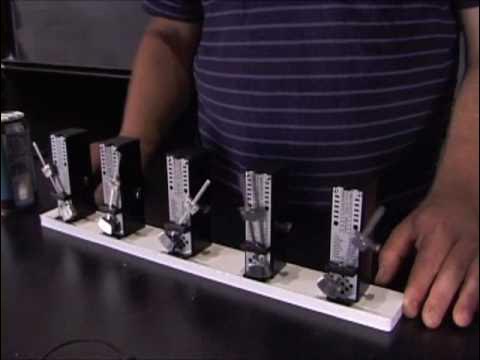
The demonstration begins with five mechanical metronomes arranged across a lightweight foam core board, each calibrated to a tempo of 176 beats per minute. In the room, a brief exchange occurs regarding the positioning of the apparatus, with someone noting, “No, I'll move it back.” The board rests atop empty soda cans acting as rollers, allowing it to freely shift from side to side across the table surface. As the metronomes tick simultaneously, their ticking sounds produce an initial cacophony of clicks and mechanical clatter.
Because the base is suspended on rollers rather than fixed rigidly in place, the lateral momentum generated by each swinging pendulum transfers directly into the foam core platform. This mechanical feedback allows the five separate oscillators to exert small physical forces on one another through the shifting base. Over time, the mutual influence nudges each pendulum's phase until their asynchronous clicking gradually resolves into a unified, synchronized beat. Once the coupling cans are pulled away and the board rests flat on the table, the mechanical link is broken, causing the metronomes to drift apart and lose their lockstep rhythm.
```mermaid flowchart TD accTitle: Metronome Coupling and Synchronization Process accDescr: Diagram illustrating how metronome momentum transfers through rollers to synchronize rhythms.
subgraph Coupled ["Mechanically Coupled State"] M["5 Metronomes (176 bpm)"] -->|"Swinging pendulums"| B["Foam Core Board"] B -->|"Transfers lateral momentum"| C["Cylindrical Cans (Rollers)"] C -->|"Feedback motion"| B B -->|"Phase alignment"| S["Synchronized Ticking"] end
subgraph Decoupled ["Decoupled State"] S -->|"Remove cans"| F["Board Fixed on Flat Table"] F --> D["Loss of Coupling & Phase Drift"] end ```
- **Apparatus Setup**: Five metronomes tuned to 176 bpm situated on a foam core board supported by cylindrical rolling cans. - **Mechanism**: The rolling base permits physical coupling through shared lateral kinetic energy, driving the pendulums to oscillate in phase. - **Decoupling Effect**: Removing the cans eliminates the freedom of horizontal movement, breaking the coupling mechanism and causing the metronomes to fall out of step.
## Mentioned Harvard Natural Sciences Lecture Demonstrations, Bryan Daniels, Ohio Wesleyan University
## Video description Five metronomes are set to 176 bpm and placed on a Foam Core board. When empty cans are placed underneath, the board is free to move from side to side and the metronomes are able to influence each other into synchronization. When the cans are removed the metronomes are no longer physically coupled and some of them begin to fall out of step.
Our demonstration is a copy of one that Bryan Daniels (Ohio Wesleyan University) made for his student research work: http://go.owu.edu/~physics/StudentResearch/2005/BryanDaniels/index.html
For more details on our setup see: http://sciencedemonstrations.fas.harvard.edu/presentations/synchronization-metronomes
[Source](https://www.youtube.com/watch?v=Aaxw4zbULMs)