Elon Musk on the Early Days of Tesla: Interview Part 1
Tesla Owners Silicon Valley
AI-assisted summary of Elon Musk on the Early Days of Tesla: Interview Part 1 — original source. Check the original for full context.
Source published:
Key ideas
- Musk explains that Tesla was founded on two flawed assumptions: that AC Propulsion's analog drivetrain could be directly licensed, and that it could drop into a Lotus Elise roller, whereas the Roadster ended up sharing only 4% to 5% of its parts. (49:52)
- Tesla's original Roadster manufacturing costs tracked at approximately $180,000 against an $85,000 retail target, prompting the board to unanimously fire CEO Martin Eberhard in July 2007. (25:33)
- During the 2008 financial crisis, Musk split his remaining $40 million liquid net worth equally between Tesla and SpaceX, risking the mutual collapse of both companies to keep each alive. (61:03)
- Tesla narrowly averted liquidation on December 24, 2008, by closing a $40 million convertible debt round at 6:00 PM to circumvent blocking efforts by VantagePoint Capital Partners. (63:27)
Detailed notes
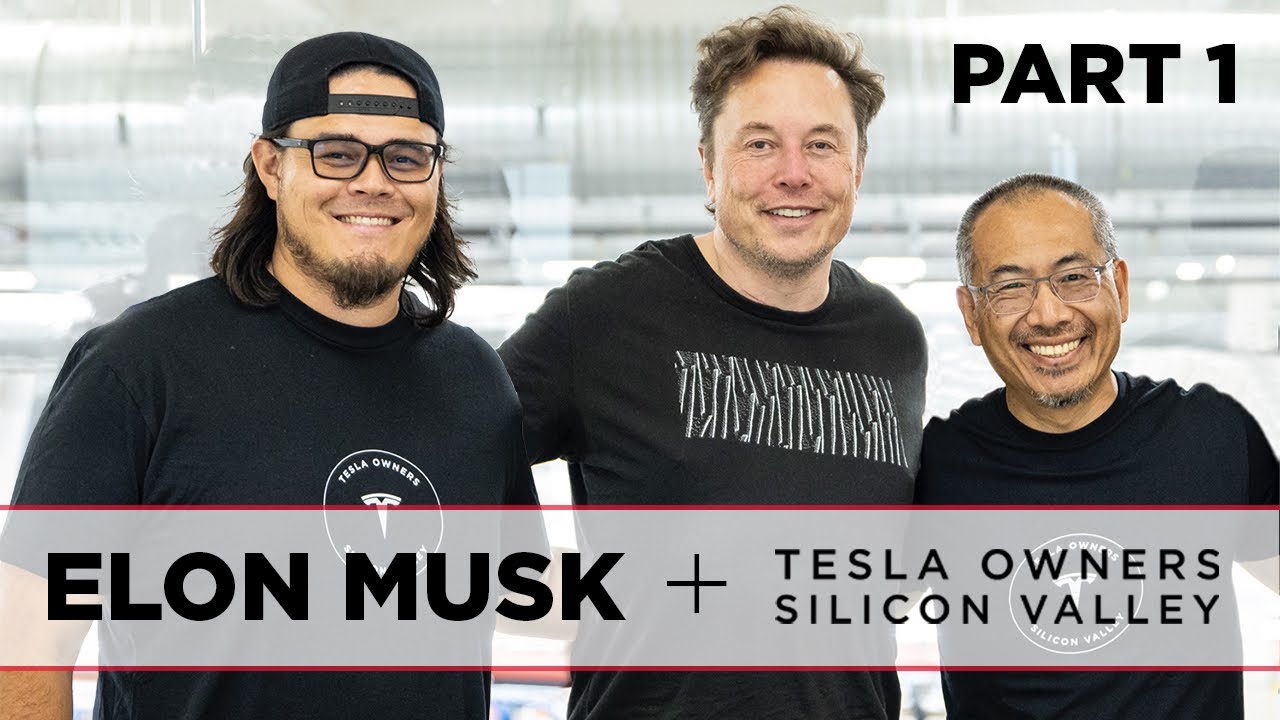
## Background This video was published on YouTube by the channel Tesla Owners Silicon Valley on June 3, 2022. It captures the first segment of a three-part interview filmed at Gigafactory Texas, featuring club President John, Vice President Kelvin Gee, and Ryan Levenson of The Kilowatts speaking with Elon Musk about the early days, founding controversies, and engineering struggles of Tesla.
## TL;DR Elon Musk recounts the origins of Tesla, disputing popular narratives about the company's founding and detailing his initial push for commercializing electric vehicles following AC Propulsion's tzero prototype. He explains how early structural assumptions—such as relying on Lotus Elise gliders and outsourcing battery packs to a barbecue manufacturer—proved catastrophic, forcing total in-house redesigns of the powertrain, electronics, and body tooling. Musk also details the ousting of Martin Eberhard over massive cost overruns and dishonesty, the brutal supply chain lessons learned during Roadster production, and the agonizing 2008 financial crisis where he split his remaining $40 million between Tesla and SpaceX before securing a down-to-the-wire Christmas Eve bridge round.
## Atmosphere & style The interview has an intimate, conversational, yet remarkably candid tone, with Musk speaking unreservedly and offering blunt, no-holds-barred assessments of early partners and near-death corporate crises. The dynamic between Musk and the hosts feels casual and reverent, giving Musk room to weave detailed physics explanations together with visceral war stories from factory floors and boardroom standoffs. Watching it feels like a raw retrospective through corporate survival trauma, shifting between wry humor, engineering pragmatism, and lingering exasperation over the chaotic decisions that brought Tesla within hours of liquidation.
## Bulletin - [49:52](https://www.youtube.com/watch?v=AeeeEDSekG8&t=2992s) Musk explains that Tesla was founded on two flawed assumptions: that AC Propulsion's analog drivetrain could be directly licensed, and that it could drop into a Lotus Elise roller, whereas the Roadster ended up sharing only 4% to 5% of its parts. - [25:33](https://www.youtube.com/watch?v=AeeeEDSekG8&t=1533s) Tesla's original Roadster manufacturing costs tracked at approximately $180,000 against an $85,000 retail target, prompting the board to unanimously fire CEO Martin Eberhard in July 2007. - [01:01:03](https://www.youtube.com/watch?v=AeeeEDSekG8&t=3663s) During the 2008 financial crisis, Musk split his remaining $40 million liquid net worth equally between Tesla and SpaceX, risking the mutual collapse of both companies to keep each alive. - [01:03:27](https://www.youtube.com/watch?v=AeeeEDSekG8&t=3807s) Tesla narrowly averted liquidation on December 24, 2008, by closing a $40 million convertible debt round at 6:00 PM to circumvent blocking efforts by VantagePoint Capital Partners.
## Key takeaways - [00:05](https://www.youtube.com/watch?v=AeeeEDSekG8&t=5s) Automotive manufacturing demands flawless execution across roughly 10,000 unique parts, where a single missing component—such as trunk carpeting trapped by an impound—can halt entire vehicle lines. - [01:54](https://www.youtube.com/watch?v=AeeeEDSekG8&t=114s) Musk views internal combustion engines as an inefficient historical anomaly that future generations will view similarly to external combustion steam locomotives. - [05:08](https://www.youtube.com/watch?v=AeeeEDSekG8&t=308s) Battery pack energy density governs passenger EV viability; pure silicon anodes offer massive charge capacity but rapidly disintegrate without blending into a carbon matrix. - [09:09](https://www.youtube.com/watch?v=AeeeEDSekG8&t=549s) Musk originally enrolled at Stanford in 1995 to research high-energy-density supercapacitors for EV transportation, but deferred his studies after realizing commercialization was economically unfeasible. - [15:05](https://www.youtube.com/watch?v=AeeeEDSekG8&t=905s) Musk rejects the narrative that he was merely a late outside investor, tracing Tesla's origins to driving the AC Propulsion tzero prototype with JB Straubel before encountering Eberhard and Tarpenning's empty shell entity. - [22:58](https://www.youtube.com/watch?v=AeeeEDSekG8&t=1378s) The Tesla Motors trademark was not originated by the founders, requiring Marc Tarpenning to wait on a Sacramento resident's doorstep until purchasing the rights for $75,000. - [25:33](https://www.youtube.com/watch?v=AeeeEDSekG8&t=1533s) Martin Eberhard was unanimously ousted by Tesla's board in July 2007 after an audit exposed that Roadster unit costs were $180,000 rather than the planned $85,000, combined with misrepresentations about vehicle readiness. - [34:53](https://www.youtube.com/watch?v=AeeeEDSekG8&t=2093s) Startup founders must have skin in the game; Musk's ethos stems from founding Zip2 on $100,000 in student debt, sharing one machine, running an unauthorized ethernet drop, and sleeping on the office floor. - [38:24](https://www.youtube.com/watch?v=AeeeEDSekG8&t=2304s) Musk identifies himself and JB Straubel as the only truly indispensable co-founders, noting that not a single employee followed Eberhard after his dismissal. - [43:08](https://www.youtube.com/watch?v=AeeeEDSekG8&t=2588s) Initial Roadster supply chains were structurally dysfunctional, involving an ocean-crossing circuit between Japan, a Thai barbecue factory assembling battery packs, Lotus in the UK, and California. - [43:08](https://www.youtube.com/watch?v=AeeeEDSekG8&t=2588s) Tesla burned through three iterations and $10 million trying to make a two-speed transmission work before Musk mandated shifting to an enlarged motor, larger inverters, and direct drive. - [49:52](https://www.youtube.com/watch?v=AeeeEDSekG8&t=2992s) Lotus Elise structural integration failed because the battery pack made the vehicle roughly 40% heavier, invalidating chassis dynamics and crash certification while forcing custom HVAC engineering. - [53:31](https://www.youtube.com/watch?v=AeeeEDSekG8&t=3211s) Tesla salvaged the Roadster program by relocating pack assembly in-house to the Bay Area and transferring body panel tooling to Sotira in France, whose staff delayed summer vacation to save the company. - [58:42](https://www.youtube.com/watch?v=AeeeEDSekG8&t=3522s) Battery safety focused on preventing single-cell thermal failures from propagating into domino-style pack runaway, solved via thermal isolation and internal liquid cooling conduits. - [01:01:03](https://www.youtube.com/watch?v=AeeeEDSekG8&t=3663s) In 2008, facing bankruptcy at both companies, Musk divided his last $40 million equally between SpaceX and Tesla, exhausting his entire fortune and leaving him without liquid reserves or a personal residence. - [01:03:27](https://www.youtube.com/watch?v=AeeeEDSekG8&t=3807s) A last-hour debt round structured on Christmas Eve 2008 bypassed VantagePoint Capital's veto and kept Tesla solvent with six months of operational runway.
## Detailed walkthrough ### [00:05](https://www.youtube.com/watch?v=AeeeEDSekG8&t=5s) The Fragility of Automotive Supply Chains
Elon Musk begins by describing the brutal mathematical reality of automotive manufacturing, where an automobile requires roughly 10,000 unique parts and the company must achieve a flawless record on every single one. Musk emphasizes:
> “Rental model where you've got like 10,000 unique things and you need to bat 10,000, yeah, not 99,999, yep, 10,000 got to be a home run every time, yes, and whoever is the least lucky—and I emphasize like unlucky—like it could be like a train derailed or there was a blizzard, there was this, you know, there was a wildfire, the utility shut down, you know, was, you name it, revolutions, there was a water shut down for some random reason, drug gang shootout, we had that one time.”
Expanding on the gang incident, Musk recounts a bizarre disruption from several years earlier that brought Model S production to a halt for three entire days. A freight delivery truck happened to be near a shootout and was impounded by authorities on a Friday. Because the impound yard remained closed through the weekend until Monday, Tesla could not access the cargo. The missing component was something as seemingly minor as trunk carpeting, but vehicles could not be delivered to customers with exposed internal sheet metal and wiring. When the interviewers note how wild the incident sounds, Musk points out that the complete list of real-world supply chain and internal manufacturing disruptions is “comedically long.”
- Automotive manufacturing requires 10,000 unique parts to align simultaneously; missing even one halts production. - Model S production was shut down for 3 days due to an impounded truck carrying trunk carpet following a nearby shootout.
---
[01:54](https://www.youtube.com/watch?v=AeeeEDSekG8&t=114s) Why Electric Vehicles: Internal Combustion as an Obsolete Anomaly
John and Kelvin Gee set the stage for the interview, explaining that they want to clear up common historical misconceptions surrounding the early days of Tesla and explore what initially inspired Musk to pursue electric vehicles. Musk smiles as he recalls an early date—or “semi-date”—at around age 20 with Christy Nicholson, who later wrote for *Scientific American*. During dinner, he spent much of the time obsessing over electric cars, asking her if she ever thought about them. When she replied that she did not think about them at all, Musk told her, “I think about them a lot.” Though the dinner conversation was eccentric, Musk notes they remain good friends to this day.
Musk explains that his focus on electric vehicles dates back to his high school years. To him, electric drive was always the obvious, natural way cars should operate, provided someone could overcome the constraint of range. When examined objectively, internal combustion engines appear shockingly convoluted: they ironically depend on an electric battery and an electric starter motor just to crank into operation, after which an intricate mechanical contraption must function continuously while wasting most of its fuel energy as excess heat and spewing toxic exhaust that requires complex catalytic treatment. Musk argues that history will judge gas cars the same way society views external combustion steam locomotives today:
> “And that's how they will view, the future will view internal combustion the same way external combustion is viewed today.”
```mermaid flowchart TD accTitle: Historical Progression of Vehicle Propulsion accDescr: Diagram contrasting external combustion, internal combustion, and electric drivetrains.
subgraph Past["Past Era"] A["External Combustion<br>(Steam Engine / Coal)"] A -->|"Viewed today as quaint & niche"| B["Internal Combustion Engine<br>(Gasoline / Diesel)"] end
subgraph Present["Transitional Era"] B -->|"Requires electric starter & battery"| C["Complex Mechanical Assembly"] C -->|"Majority of energy lost as heat"| D["Toxic Exhaust Gases"] end
subgraph Future["Modern & Future Era"] E["Electric Vehicles<br>(Battery / Solid-State Storage)"] E -->|"Key bottleneck to eliminate ICE"| F["Energy Density & Range"] end ```
---
[05:08](https://www.youtube.com/watch?v=AeeeEDSekG8&t=308s) The Physics of Battery Energy Density and Silicon Anodes
Delving into the core engineering physics, Musk explains that vehicle range is strictly bounded by the energy density of the electrochemical storage medium. He lays out the generational milestones in battery chemistry:
* **Lead-Acid:** Yields an optimistic range of roughly 70 to 80 miles in a passenger car. * **Nickel-Metal Hydride (NiMH):** Delivers roughly double the energy density of lead-acid, yielding about 160 miles of range for a comparable pack weight. * **Lithium-Ion:** Provides roughly four times the energy density of lead-acid even in standard formulations—enabling a 300-mile vehicle range—and can reach five times the density in advanced variants.
Musk details the structural tradeoffs required to push lithium-ion performance further. Achieving higher energy density requires introducing silicon into the anode because silicon dramatically increases charge storage capacity. However, silicon experiences massive volumetric expansion and contraction during charge and discharge cycles, leading to structural fracturing analogous to mud cracks drying in the sun. Pure silicon anodes rapidly pulverize themselves under cyclic strain. To mitigate this degradation, Tesla blends a modest amount of silicon into a predominantly carbon matrix:
> “So our highest energy density cells will use, I don't know, like 90% carbon, maybe 10% silicon, or something like that.”
While advanced chemical vapor deposition (CVD) methods can print precise silicon structures—similar to circuit board manufacturing—that accommodate expansion and yield 50% higher energy density, Musk notes the manufacturing costs remain prohibitive for consumer passenger cars, though the technology might eventually prove viable for long-range electric aviation.
---
[09:09](https://www.youtube.com/watch?v=AeeeEDSekG8&t=549s) Graduate Work at Stanford and Early Solid-State Capacitor Concepts
Addressing misconceptions that he stumbled into clean energy later in life, Musk emphasizes that he has been dedicated to vehicle electrification since his youth. In 1995, he enrolled for graduate studies at Stanford University in the Materials Science group specifically to work on the energy density problem for electric transportation under Professor William D. Nix. When Musk decided to defer his studies after just two days to capitalize on the nascent commercial internet boom, he visited Professor Nix to ask for a leave of absence:
> “He's the guy I spoke to and I said that I would, I'd like to put my studies on hold, but I will probably fail, so can I please come back if I fail or when I fail, and he's like, 'Sure, but I don't think I'm going to hear from you again,' and that was the last conversation I had with Bill Nix.”
Musk's original technical research thesis at Stanford did not rely on conventional chemical batteries. Instead, he intended to harness advanced semiconductor photolithography and microfabrication equipment—which benefited from tens of billions of dollars in annual chip-industry R&D—to fabricate high-surface-area solid-state supercapacitors. The goal was to achieve molecular-level structural precision and a high surface-area-to-volume ratio capable of providing an electric car with 200 miles of driving range.
[11:23](https://www.youtube.com/watch?v=AeeeEDSekG8&t=683s) Quantum Mechanics, Capacitors, and Leaving Stanford
Elon Musk reflects on the physical limits of energy storage, emphasizing how counterintuitive physics becomes at the subatomic level. When building an ultra-thin dielectric insulator for a high-performance capacitor, quantum mechanics intervenes: make the barrier too thin, and electrons simply tunnel across it. “Quantum mechanics is very weird,” Musk remarks, recalling that his final-year undergraduate quantum mechanics physics course was “harder than all of my other courses combined.”
Asked about his outlook on solid-state energy storage, Musk notes that while it is technically possible to build capacitors far superior to those currently available, molecular-level constraints make execution brutally difficult. He touches on graphene as a potential avenue toward achieving high energy density, though he is quick to add that he dislikes using the word because it is so frequently thrown around in hyped, nonsensical contexts. Constructing such a capacitor requires numerous layers using materials that offer both high electrical conductivity and an extremely low probability of electrons leaping across the insulator to prevent unacceptable leakage current.
```mermaid flowchart LR accTitle: Trade-off in High-Density Capacitor Design accDescr: Diagram illustrating the dilemma between minimizing dielectric thickness to increase capacity and preventing quantum tunneling leakage. subgraph Dielectric["Dielectric Layer Design"] A["Ultra-Thin Insulator"] --> B["High Energy Density Potential"] A --> C["Quantum Tunneling Triggered"] end subgraph Outcome["Physical Result"] C --> D["High Leakage Current"] D --> E["Commercially Infeasible"] end ```
Musk explains that while quantum phenomena like tunneling defy macroscopic intuition, the mathematical framework governing them is extraordinarily exact. Looking back at his original 1995 plan to pursue a Ph.D. at Stanford studying high-energy-density capacitors, he realized he risked spending years adding mere "leaves to the tree of knowledge" only to confirm that the concept, while technically fascinating, was economically dead on arrival:
> “One of the possible outcomes—strong possibility—would be, yeah, you spent all this time, this is technically something that would work, but it is commercially not feasible and a waste of time.”
Concluding that this dead-end would be deeply frustrating, he decided in 1995 to put his graduate studies on hold and focus on the internet, which he identified as one of the areas destined to have the most profound effect on the future of humanity.
[15:05](https://www.youtube.com/watch?v=AeeeEDSekG8&t=905s) The Genesis of Tesla and the AC Propulsion tzero
Addressing the widespread narrative that he merely arrived later as an outside investor in an already functioning company, Musk strongly rejects the claim. He attributes that misconception directly to Martin Eberhard, who Musk claims has spent years trying to claim sole founding credit. Musk pulls no punches regarding his personal and professional assessment of Eberhard:
> “The reason people think that is because Eberhard has engaged in a non-stop campaign to effectively gain sole credit for Tesla for himself, and he’s the worst person I have ever worked with, and that is saying something.”
Musk traces the true operational roots of Tesla back to a 2003 lunch meeting in El Segundo with JB Straubel. During their discussion on battery technology and how lithium-ion cells could finally unlock long-range electric transport, Straubel asked Musk if he had driven the AC Propulsion tzero. Musk had never heard of Eberhard at that stage. After arranging a test drive of the tzero, Musk was blown away by the vehicle's capabilities: roughly 250 miles of range, a zero-to-sixty acceleration time under four seconds, and a lightweight two-seat sports car profile, despite having no conventional doors.
Musk initially tried to purchase a tzero directly from AC Propulsion, but the company declined to build another unit. He then urged them to commercialize the platform, arguing that the public needed proof that an electric car could be genuinely compelling and viable. At the time, Musk was pouring long hours into SpaceX, which had not yet reached orbit and would not do so until 2008.
- The AC Propulsion tzero demonstrated 0–60 mph acceleration in roughly 4 seconds and an estimated range of 250 miles. - Musk offered to buy a tzero directly, but AC Propulsion was not interested in low-volume manufacturing. - SpaceX was simultaneously consuming Musk's attention as it worked toward its first orbital flight, which did not occur until 2008.
[17:48](https://www.youtube.com/watch?v=AeeeEDSekG8&t=1068s) From an Electric Scion to a Shell Corporation
To Musk’s disbelief, AC Propulsion did not want to pursue a dedicated sports car like the tzero; instead, they proposed converting a Toyota Scion into an electric vehicle. Musk argued vigorously against this from an economic standpoint. Because low-volume batteries and power electronics were extraordinarily expensive, converting an economy car would produce an electric Scion costing around $70,000 to $80,000—a product consumers would never buy. By contrast, a high-end electric sports car selling for $100,000 made economic sense, because sports car buyers were already accustomed to paying a premium.
Musk nevertheless offered to finance 10% of the electric Scion project if AC Propulsion could find outside investors for the remaining 90%. Only Musk and Google co-founder Sergey Brin agreed to put up money, causing the Scion concept to stall. Musk then emailed AC Propulsion’s Tom Gage, proposing to launch a dedicated company to commercialize the tzero technology. AC Propulsion responded that other parties were interested in the same idea and introduced Musk to a group consisting of Martin Eberhard, Marc Tarpenning, and Ian Wright.
When Musk met them, he discovered that no real company existed behind the paperwork:
> “There was an empty shell corporation that had zero value, and no employees, no offices, no designs, no intellectual property, no nothing, except the general idea basically of commercializing the tzero, which I had before meeting them.”
Musk stresses that had he never encountered them, he and Straubel would have simply founded the company themselves to commercialize the vehicle, ending up with virtually the exact same end product without the subsequent internal dysfunction.
- A converted electric Scion would have required an unpalatable $70,000–$80,000 price point due to low-volume powertrain costs. - Musk offered 10% funding for the Scion project, matched only by Sergey Brin, leading to the project's cancellation. - The pre-existing entity held no physical facilities, proprietary designs, or employees prior to Musk’s involvement.
[20:46](https://www.youtube.com/watch?v=AeeeEDSekG8&t=1246s) Early Co-Founder Friction and the Tesla Name
Musk explains that his financial contribution was merely the baseline requirement; far more critical was the actual work of turning a legal shell into an operational enterprise. Friction among the original group erupted within a year. Eberhard and Ian Wright clashed constantly, escalating their feud until they demanded that Musk choose between them:
> “Eberhard and Ian Wright could not stand each other and they made me pick which one would leave basically—they can’t both be in the same company so I have to pick one of them.”
Consulting with Straubel on the least damaging option, Musk decided they had to part ways with Wright and retain Eberhard. Musk laments that this early corporate infighting created needless toxicity, repeating that the single biggest mistake he would reverse if given a time machine would be ever getting involved with Eberhard in the first place, calling him someone who aggressively took credit for the achievements of others.
The conversation then turns to the origin of the company's identity. Musk begins recounting the history of the name "Tesla Motors," noting that the legal trademark for the moniker was originally owned by an outside third party rather than the company itself.
[22:58](https://www.youtube.com/watch?v=AeeeEDSekG8&t=1378s) Securing the Tesla Motors Trademark and Early Co-Founder Dynamics
Elon Musk details the origins of the name "Tesla Motors," debunking the idea that anyone in the founding group originally coined it. The trademark was already owned by an individual living near Sacramento who would not answer calls or respond to any outreach. Determined to secure the name, Musk sent Marc Tarpenning—Martin Eberhard's longtime friend and co-founder, whom Musk describes as a "super nice guy"—to sit on the trademark owner's doorstep and refuse to leave until an agreement was reached. They ultimately secured the rights for $75,000, which was a considerable sum at the time.
Musk also addresses the historical narrative surrounding Martin Eberhard, disputing the depiction of Eberhard as an under-resourced inventor pushed aside by a venture capitalist. Eberhard was older than Musk, had already run successful startups, and owned an expensive house in Woodside. Musk emphasizes that Eberhard had the financial means to match his investments but was simply unwilling to risk his own personal capital:
> “This is not like some poor inventor who gets crushed by big capitalist, which is the archetype that he tries to portray.”
Musk notes that he personally committed everything he had to the company, whereas Eberhard kept his own wealth protected. Looking back, Musk laments not pursuing an independent path with JB Straubel directly from their work on the AC Propulsion tzero prototype, which would have avoided years of boardroom conflict.
- The Tesla Motors trademark was purchased from a third party in the Sacramento area for $75,000 after Marc Tarpenning waited on his doorstep. - Eberhard owned a $10 million home in Woodside and possessed sufficient personal wealth to fund the company, but opted not to risk it. - Musk recruited JB Straubel to join the venture, though he later reflected that commercializing the tzero directly with Straubel alone would have been far less dramatic.
---
[25:33](https://www.youtube.com/watch?v=AeeeEDSekG8&t=1533s) The "Moral Error" and the Firing of Martin Eberhard
Musk reflects on what he calls his primary "moral error" in the early structure of Tesla: trying to "have my cake and eat it too." He was already occupied building SpaceX, but remained passionate about creating an electric car company. Because he disliked corporate administration and preferred focusing on product engineering, he believed he could delegate the CEO role to Eberhard while serving as the head of technology and vehicle design.
```mermaid flowchart TD accTitle: Tesla Early Leadership Transition accDescr: Progression from Martin Eberhard's firing to Elon Musk taking over as official CEO.
subgraph EarlyStructure["2004 - Mid 2007"] A["Elon Musk<br/>Product & Tech / Chairman"] B["Martin Eberhard<br/>Chief Executive Officer"] end
subgraph TheCrisis["July 2007 Board Action"] C["Cost Audit: Roadster costs $180k<br/>Retail price set at $85k"] D["Board votes unanimously to remove Eberhard"] end
subgraph InterimLeadership["Late 2007 - Mid 2008"] E["Interim CEO (Michael Marks)"] F["Ze'ev Drori appointed CEO<br/>Musk acts as de facto Co-CEO"] end
subgraph TotalCommitment["Late 2008"] G["Financial Crash & Internal Revolt"] H["Elon Musk invests all remaining capital<br/>Becomes official CEO"] end
EarlyStructure --> TheCrisis TheCrisis --> InterimLeadership InterimLeadership --> TotalCommitment ```
The arrangement imploded in mid-2007 over the actual production cost of the original Roadster. Tesla had targeted a retail price of around $85,000, but an outside audit brought to Musk by an incoming investor revealed that the actual cost of goods was running closer to $180,000 per car. Furthermore, the audit indicated that one-third of the vehicle worked, one-third was severely delayed, and one-third would never function at all. When Musk directly confronted Eberhard about the car's true unit cost, Eberhard claimed not to know, despite the auditor having already briefed him directly:
> “When he did bold-faced lie to me, I was like, that's it, you know, he can't be CEO anymore.”
In July 2007, the Tesla board voted unanimously to fire Eberhard as CEO, with even Eberhard’s own board appointees voting in favor of his removal.
- The target retail price for the first-generation Tesla Roadster was roughly $85,000, while the actual unit manufacturing cost was tracking at approximately $180,000. - Musk highlights that volume scaling cannot fix negative gross margins, comparing the Roadster's early dilemma to challenges faced by modern EV startups like Rivian. - Eberhard was removed as CEO by a unanimous board vote in July 2007, though he initially remained associated with the company in a non-executive capacity.
---
[28:44](https://www.youtube.com/watch?v=AeeeEDSekG8&t=1724s) Interim Leadership, Ze'ev Drori, and the 2008 Financial Meltdown
Following Eberhard’s ouster, Musk resisted stepping into the formal CEO position because he held majority ownership and already felt stretched thin. An interim CEO handled operations for a few months, during which Musk served as de facto CEO, teaching auto fundamentals to executive leadership. In late 2007, Tesla hired Ze'ev Drori—a technology entrepreneur and former Israeli paratrooper—as CEO. Musk respected Drori's fearlessness, but Drori had a semiconductor background rather than automotive experience, and his abrasive management style led to internal friction:
> “The only one who would the only one person who would agree to be CEO of Tesla was a guy who spent three years in the Israeli paratroopers and was afraid of nothing.”
By July 2008, the engineering team staged an internal revolt, threatening to quit en masse unless Drori was replaced. Musk pleaded with the staff to stay long enough to close an essential financing round led by Goldman Sachs. However, by September 2008, the Great Recession hit, Lehman Brothers and Bear Stearns collapsed, and prospective investment partners faced insolvency. With capital markets frozen, Musk realized no external funding would arrive. He told Drori that saving the company would require investing every cent of his own remaining money, meaning Musk had to assume the CEO role himself. Drori stepped aside, and Musk became official CEO in late 2008.
| Period | Leadership | Key Challenges & Events | |:--- |:--- |:--- | | **July 2007 – Late 2007** | Interim CEO / Elon Musk (de facto) | Discovery of massive cost overruns; search for an experienced auto executive yields no takers. | | **Late 2007 – Mid 2008** | Ze'ev Drori (CEO) / Elon Musk (co-CEO) | Culture clashes with engineering staff; engineering revolt threatens mass resignations. | | **Mid 2008 – Late 2008** | Elon Musk (official CEO) | 2008 financial crash; bridge round collapses; Musk commits entire net worth to prevent bankruptcy. |
Musk characterizes 2008 as a "nightmare year" and "the lowest of the lows." Alongside Tesla's imminent bankruptcy, SpaceX suffered its third consecutive rocket launch failure when they only had budget for three, and Musk was undergoing a painful divorce.
---
[34:09](https://www.youtube.com/watch?v=AeeeEDSekG8&t=2049s) The Myth of the "Finished Product" and Musk's Role as Chief Product Officer
Addressing public misconceptions that he joined Tesla as a hands-off financier who inherited a turnkey vehicle, Musk clarifies the division of responsibilities from the start. He was not an external venture capitalist who merely wrote a check; he operated as Chief Product Officer from day one, actively directing engineering, styling, and design decisions.
Musk explains that confusion often arises because the public rarely sees an early-stage investor who also functions as an active daily product architect. The financial investment was only one part of his involvement, while direct technical and vehicle design problem-solving consumed the bulk of his energy. Musk emphasizes that the Roadster was far from completed when he arrived, requiring extensive hands-on redesign and systems engineering before it could ever function as a viable commercial product.
[34:53](https://www.youtube.com/watch?v=AeeeEDSekG8&t=2093s) Founding Zip2 on Student Debt and Sleeping in the Office
Elon Musk reflects on the ethical principles behind financing startups, emphasizing that founders must have their own "skin in the game" rather than relying strictly on outside capital:
> “I believe in putting your own capital at stake if you're going to start a company. Like whatever the opposite of other people's money is, I think is the morally right thing to do. If you're not prepared to invest your money, then why should you ask others to invest theirs? It's not right.”
Musk explains that this conviction is why he heavily invested in Tesla. By contrast, when he started his first company, Zip2, he had virtually nothing to his name. In the summer of 1995, Musk put his graduate studies at Stanford on hold. Because he chose not to attend the quarter, he lost his access to student housing and forfeited his student stipend. He found himself with around $100,000 in student debt, only $2,000 in the bank, and a single computer. That summer, Musk personally wrote the very first maps, directions, and online White Pages and Yellow Pages ever seen on the internet. He bypassed traditional web server software entirely, simply reading port 80 directly in code to avoid the overhead of moving data between operating system processes.
The early operating conditions were intensely austere. His brother, Kimbal Musk, came down with roughly $5,000, which Musk describes as a massive upgrade for the fledgling operation. They rented a dingy, attic-style office that had a leaking roof, stained carpet, and pools of water on the floor, banking on the fact that it rarely rains in California. They bought a discounted rug and two futons, sleeping on the floor of the office and remaking the room every morning to look presentable for business visitors. Because they initially owned just one computer, the website could only run during the day; at night, Musk had to take the site down so he could use the machine to code. For internet access, Musk drilled a hole through the floorboards into the ceiling of an internet service provider operating on the floor below, dropping an ethernet cable through the ceiling tiles without any formal permits. The ISP agreed to give them a cheap connection if they plugged in directly, saving Zip2 the expense of purchasing a dedicated T1 line or Cisco routers. The brothers did not have an apartment, so they walked over to shower at the Palo Alto YMCA on Page Mill and El Camino Real and survived on meals from the local Jack in the Box.
- **Student Debt:** Exceeded $100,000 upon stepping away from Stanford in 1995. - **Starting Cash:** Elon had roughly $2,000; Kimbal contributed approximately $5,000. - **Office Setup:** Single attic room, discounted rug, two futons, and no dedicated apartment. - **Coding & Uptime:** Daytime server hosting; nighttime development on the same solo machine until a second computer was purchased. - **Connectivity:** Direct ethernet cable run through a drilled floor hole into an ISP suite below.
---
[38:24](https://www.youtube.com/watch?v=AeeeEDSekG8&t=2304s) The Tesla Co-Founders, Martin Eberhard, and the Test of Leadership
The conversation pivots to the early days of Tesla, specifically how the original founding team dispersed after the ouster of Martin Eberhard, and the ongoing roles of early leaders like JB Straubel and Ian Wright. Musk states that while it is fair to count five co-founders—Musk, JB Straubel, Martin Eberhard, Marc Tarpenning, and Ian Wright—because they were present when the company was effectively nothing, only two individuals were indispensable to building the enterprise:
> “The people that were like essential at the end of the day were JB and me. There would not be a successful Tesla otherwise; it would never even have gone into production.”
Musk points to the aftermath of Martin Eberhard's departure as undeniable evidence of leadership credibility. After being ousted, Eberhard received substantial financial compensation and attempted to start a new electric vehicle venture, but it failed. Musk highlights a telling metric in executive leadership: when a truly talented leader leaves, top employees consistently choose to follow them, yet not a single employee followed Eberhard out of Tesla:
> “If somebody's awesome, good people leave with them every time. Not one person left. That's a tell right there. You're trying to figure out the truth of something: who followed? Did no one follow? If he's a good guy and I'm the bad guy, why'd they all stay with me?”
Musk emphasizes that high-caliber engineers in Silicon Valley always have abundant options, easily commanding higher salaries with far less career risk at established giants like Apple. Those engineers stayed at Tesla under difficult circumstances out of genuine respect for the vision and execution. Today, Musk notes, Tesla and SpaceX consistently rank as the top two destinations for graduating engineering students.
Musk also clarifies the origin of the electric sports car concept, highlighting that foundational credit belongs to Tom Gage, Al Cocconi, and AC Propulsion for building the experimental tzero prototype. Musk criticizes Eberhard for acting as though the concept emerged entirely from his own mind while refusing to credit AC Propulsion. Both Musk and Eberhard had independently seen the tzero and decided to commercialize it after AC Propulsion declined to pursue mass manufacturing. Musk addresses Eberhard's contradictory public narratives regarding his involvement:
> “Eberhard blames me for a bunch of the issues with the car, saying the reason it was expensive was because Elon insisted on all these things about the car. It's like, okay, so if I was controlling the minutia of the product design, but I also had nothing to do with it, which one is it? I can't be blamed for micromanaging the design of the car, but also have nothing to do with it. These are incompatible.”
Musk notes that he agonized over every single detail of the Roadster’s design, to the extent that the ArtCenter College of Design in Pasadena awarded him an honorary doctorate specifically for his work on the vehicle.
---
[43:08](https://www.youtube.com/watch?v=AeeeEDSekG8&t=2588s) Catastrophic Supply Chain Choices and the Roadster Transmission Debacle
While Musk characterizes the core styling and vehicle concept of the original Tesla Roadster as compelling, he describes the operational and business decisions made under Martin Eberhard's watch as absolute disasters. The most egregious error was outsourcing the manufacturing of high-voltage lithium battery packs to a barbecue grill factory in Thailand. The supply chain spanned multiple oceans: battery cells manufactured in Japan were shipped to Thailand, assembled into packs by a barbecue manufacturer with zero lithium-ion experience, loaded onto container ships bound for the Lotus assembly facility in England to be married to the chassis, and finally shipped across the Atlantic and through the Panama Canal to California for final delivery.
```mermaid flowchart LR accTitle: Original Roadster Global Supply Chain accDescr: Diagram tracing battery and chassis parts across Japan, Thailand, the UK, and California.
subgraph CellSupply ["Japan"] A["Lithium Cells Produced"] end
subgraph PackAssembly ["Thailand"] B["Barbecue Factory<br>Pack Assembly"] end
subgraph VehicleAssembly ["England"] C["Lotus Plant<br>Glider Integration"] end
subgraph FinalDelivery ["California"] D["Initial Market Delivery<br>& Customer Acceptance"] end
A -->|"Ocean freight"| B B -->|"Ocean freight"| C C -->|"Ocean freight"| D ```
This fragile logistical loop took five to six months to complete. Any defect discovered in cell quality or pack assembly meant that up to half a year of in-transit inventory had to be scrapped and written off, which is precisely what occurred when the Thai factory proved incapable of assembling the packs reliably.
Compounding the battery disaster was the vehicle's powertrain design. Eberhard resisted modifying the physical dimensions of the motor or power electronics inherited from AC Propulsion, forcing the engineering team to rely on a complex two-speed manual transmission to achieve both low-end acceleration and top-end speed. Tesla burned through three separate two-speed gearbox iterations and wasted approximately $10 million in capital, only for every single transmission design to fail during durability testing. After firing Eberhard, Musk intervened to overhaul the powertrain architecture completely:
> “After we fired Martin, I said, we're just going to make the motor bigger and the Power Electronics bigger and get rid of the two-speed and just have direct drive... and you no longer have to have a clutch.”
The revised direct-drive configuration relied on a larger, more powerful motor, beefed-up power electronics, a single-speed RPM reduction gear, and a mechanical differential. However, before the single-speed system was ready for market, early production Roadsters had to be delivered with the flawed two-speed transmission locked permanently into first gear, limiting their top speed to roughly 65 mph and carrying a persistent risk of transmission seizure. The manufacturing headaches were further exacerbated by carbon-fiber exterior body panels, which Eberhard had outsourced to a supplier that was utterly incapable of manufacturing them to automotive tolerances.
- **Supply Chain Lead Time:** 5 to 6 months across Japan, Thailand, the United Kingdom, and the United States. - **Transmission Sunk Cost:** ~$10 million wasted trying to develop an operable two-speed transmission. - **Interim Roadster Limitation:** Earliest deliveries shipped with the two-speed transmission locked in first gear, restricting top speed to around 65 mph. - **Engineering Fix:** Scaled up motor torque and inverter capacity to transition to an RPM reducer and direct-drive configuration.
[46:47](https://www.youtube.com/watch?v=AeeeEDSekG8&t=2807s) Tooling Catastrophes and Re-Engineering the Roadster
During a visit to Lotus to review their top ten manufacturing risks, Elon Musk learned that Tesla’s carbon fiber body panel supplier was on the verge of total failure. Told point-blank, “Oh, your body panel supplier is going to fail,” Musk insisted on driving straight there on a Friday night to inspect the facility himself. What he found was an unmitigated disaster: the tooling and manufacturing processes were fundamentally flawed. Every single carbon fiber panel emerged deformed and had to be laboriously hand-massaged and reshaped just to fit vaguely onto the chassis. Even with extensive manual labor, the fitment was so terrible that you could literally slide your thumb straight into the gap around the trunk lid. Concluding that the supplier had a 0% chance of succeeding, Musk was forced to transfer body panel manufacturing to Sotira, a composite supplier based in France. Tesla personnel wound up camping out in France for months while the entire car body tooling was redesigned and rebuilt from scratch.
```mermaid flowchart TD accTitle: Roadster Component In-Sourcing and Re-Engineering accDescr: Flowchart illustrating how failed external suppliers forced Tesla to overhaul and in-source primary components. subgraph Failed["Failed External Assumptions"] A["Flawed Body Tooling<br/>(Supplier Bankruptcy)"] B["Analog AC Propulsion Tech<br/>& Transmission Failures"] C["Lotus Elise Platform<br/>(Too Small & Overweight)"] end
subgraph Rework["Emergency Redesign & Relocation"] D["Retooled Body at Sotira<br/>(France)"] E["In-House Battery & Inverter<br/>(San Carlos / Bay Area)"] F["Custom Digital Electronics<br/>& Single-Speed Gearbox"] end
subgraph Assembly["Final Assembly & Turnaround"] G["Assembly at Converted Ford Dealership<br/>(El Camino Real, Menlo Park)"] H["Achieved Viable Production & Positive Margins<br/>(Mid-2009)"] end
A --> D B --> E B --> F C --> D D --> G E --> G F --> G G --> H ```
At the same time, Musk completely overhauled the manufacturing topology for the remainder of the vehicle. Battery pack manufacturing was insourced and brought directly to the Bay Area—first San Carlos and later Menlo Park—while final assembly was moved to a former Ford dealership showroom on El Camino Real, an era captured in the documentary *Revenge of the Electric Car*. Tesla took direct control over building the motor, the power electronics, and the battery packs in-house so the engineering team could iterate rapidly on design reliability, safety, and unit cost. The original two-speed transmission had to be scrapped in favor of a single-speed design, and virtually every subsystem on the car had to be overhauled. This comprehensive re-engineering required recapitalizing the entire company, stretching the timeline by roughly two years—from mid-2007 to mid-2009—before Tesla could reach real, repeatable production.
- The original panel supplier produced only five car bodies before collapse; each required extensive hand-carving and still displayed massive gaps. - Musk insourced core powertrain components so Tesla could iterate fast: “Because design has to be safe, reliable, and not cost crazy money, or it doesn't matter.” - The production reboot took roughly two years (mid-2007 to mid-2009) to reach functional serial output.
---
[49:52](https://www.youtube.com/watch?v=AeeeEDSekG8&t=2992s) Two False Assumptions: The Lotus Elise and AC Propulsion
Reflecting on why the Roadster proved so agonizing to produce, Musk explained that Tesla had been founded on two fundamentally false assumptions. The first was the idea that Tesla could simply license drivetrain technology from AC Propulsion. The second was the belief that they could seamlessly drop that powertrain into an existing Lotus Elise roller and have Lotus handle all vehicle assembly, allowing Tesla to operate as an asset-light company of roughly 35 employees—an operating model that Martin Eberhard envisioned and that had originally sounded appealing to Musk given his own background in software.
```mermaid flowchart LR accTitle: The Two False Founding Assumptions accDescr: The two core assumptions of Tesla's founding and how engineering reality shattered both. subgraph Assumption1["Assumption 1: AC Propulsion Powertrain"] direction TB A1["Expectation: Drop-in tech"] --> B1["Reality: Analog electronics<br/>temperature-sensitive"] B1 --> C1["Outcome: In-house digital electronics & new motor"] end
subgraph Assumption2["Assumption 2: Lotus Elise Glider"] direction TB A2["Expectation: Off-the-shelf chassis"] --> B2["Reality: Battery pack made car ~40% heavier"] B2 --> C2["Outcome: Stretched chassis, invalidated crash tests & custom AC"] end ```
In reality, neither assumption held true. AC Propulsion’s technology relied heavily on analog power electronics that drifted wildly with ambient temperature: “Depending upon what temperature it was, your car would either work or not work, or certainly work very differently,” Musk recalled. Tesla had to abandon the design entirely, inventing their own digital power electronics and building a completely redesigned electric motor from scratch. Meanwhile, attempting to base the car on the Lotus Elise proved equally disastrous. Adding a massive lithium-ion battery pack made the vehicle roughly 40% heavier than an Elise, invalidating the vehicle's structural dynamics, suspension tuning, weight distribution, and crash-test certifications. The battery pack would not physically fit inside the original frame, forcing Tesla to stretch the chassis. Even the climate control had to be tossed out; the Elise used a mechanical, belt-driven air conditioning compressor powered by an internal combustion engine, necessitating an entirely custom electric AC system. In the end, the Roadster shared barely 4% to 5% of its parts with an Elise. Musk compared the blunder to attempting to construct a dream home on someone else's foundation:
> “So sort of like if you say like you have a particular home in mind, but instead of building that home on a fresh piece of ground, you take somebody else's home and stick what you want in it, and then you knock down everything except one wall and the basement... and then you try to build your dream home on with somebody else's foundation. It's like not a good idea, and more expensive than if you just did a clean sheet.”
---
[53:31](https://www.youtube.com/watch?v=AeeeEDSekG8&t=3211s) Hostage Dynamics with Lotus, Margins, and Sotira’s Sacrifice
When asked whether Tesla ever considered abandoning the Lotus relationship midway through development, Musk revealed that he had raised that exact possibility with Chief Technology Officer JB Straubel. However, Straubel pointed out that Tesla had no institutional knowledge about how to manufacture an entire car from the ground up, whereas a firm with a 50-year heritage like Lotus theoretically possessed the required automotive expertise. Yet because Lotus suffered from chronic financial distress, they routinely exploited Tesla’s dependency to stay solvent. Whenever Lotus hit a cash shortfall, they simply escalated tooling charges, engineering fees, or per-unit costs, knowing Tesla had no alternative manufacturing partner.
Despite this leverage, Tesla executed a ruthless supply-chain and component overhaul between 2007 and mid-2009. The team managed to slash vehicle production costs down from an unsustainable trajectory of roughly $180,000 per vehicle to approximately $80,000. Coupled with a retail price hike that raised average selling prices into the $110,000 to $120,000 range, Tesla hauled the vehicle into gross-margin profitability of around 25%, an outcome Musk described as “hellishly difficult.” The hosts joked that early Roadsters have proved to be appreciating assets, with host Ryan Levenson mentioning his own Roadster (#523 in electric blue). Musk recalled the unusual palette of early Roadsters, including a vibrant orange, that resulted from assembling cars virtually by hand.
Musk closed by emphasizing just how close the program came to complete failure before the transition to Sotira in France. Only five production Roadsters were ever assembled using the original supplier's defective tooling. When Sotira took over, production was still threatened by standard European summer factory closures. Musk personally addressed the French manufacturing workforce, delivering a stark ultimatum:
> “Can you guys please not go on vacation, because otherwise our company's going to die, essentially, with my speech in a nutshell.”
The French workers agreed to delay their holidays and put in grueling overtime to stamp out the redesigned body panels, saving Tesla from liquidation. Musk specifically praised Sotira's craftsmanship and commended early Tesla manufacturing leader Tim Watkins and CTO JB Straubel for their instrumental roles in rescuing the vehicle from collapse.
- Cost trajectory dropped from $180,000 down to around $80,000 per unit by mid-2009. - Average selling price adjusted to roughly $110,000–$120,000, establishing roughly 25% gross margins. - Exactly five production Roadsters were delivered with the initial supplier's hand-adjusted panels before switching to Sotira tooling. - Key contributors praised for saving the Roadster: the Sotira workforce, Tim Watkins, and JB Straubel.
[58:42](https://www.youtube.com/watch?v=AeeeEDSekG8&t=3522s) Taming Thermal Runaway: Battery Pack Engineering and Cooling
Addressing how early battery safety was conquered, Elon Musk points out that the real engineering breakthrough was not guaranteeing a lithium-ion cell would never catch fire, but ensuring that if a single cell caught fire, it would not trigger a cascading thermal runaway across the entire pack. Musk credits early core engineers like JB Straubel and Andrew Baglino for cracking this challenge. The physics presented a fundamental paradox: the pack required a medium that was thermally conductive to heat or cool the cells evenly, yet simultaneously electrically isolated to prevent catastrophic short circuits—two properties that rarely coexist naturally in materials.
In the initial Roadster packs, Tesla had not yet developed scalloped cooling tubes that contour tightly around the cylindrical cells; instead, they used simple straight cooling tubes. This resulted in very limited physical surface contact between the cells and the coolant channel. Despite the rudimentary geometry, iterative engineering enabled the team to make it functional without excessive drama. Tesla ultimately built the packs themselves in the San Francisco Bay Area—notoriously one of the most expensive manufacturing locations in the world—which Musk quips was still far cheaper than their disastrous attempt to outsource battery pack production to a barbecue manufacturing company in Thailand, because the in-house version actually worked. Musk notes that early pack designs were also flawed because they failed to properly account for structural crashworthiness during a severe vehicle collision.
- **Thermal runaway containment:** The core safety philosophy was isolating individual cell failures so a fire in one cell would not propagate like dominoes throughout the pack. - **Cooling architecture evolution:** Early Roadster packs relied on straight fluid tubes before Tesla transitioned to scalloped cooling ribbons that maximized thermal surface contact with the cells. - **In-house manufacturing:** Building the packs in the expensive Bay Area proved vastly more cost-effective than outsourcing to an overseas barbecue manufacturer because internal builds met actual operational and crash safety standards.
---
[01:01:03](https://www.youtube.com/watch?v=AeeeEDSekG8&t=3663s) Bankruptcy at the Door: Splitting the Last $40 Million
When asked whether bankruptcy was looming during those early years, Musk clarifies the timeline: bankruptcy was not an imminent threat prior to 2008 because he still had substantial personal capital from the sale of PayPal. However, once the 2008 global financial crisis struck and his liquid reserves dried up, bankruptcy stayed directly on Tesla's doorstep continuously from 2008 through 2012.
Musk describes 2008 as forcing one of the most agonizing decisions of his life. With roughly $40 million left in liquid net worth, he faced the choice of allocating all of his remaining capital to either Tesla or SpaceX to guarantee the survival of at least one enterprise, or splitting the funds between them and risking the outright failure of both:
> “It's not like just a company to me so it's sort of like if you got two kids like how could you really say okay we're going to let one kid starve you know so I was like I couldn't bring myself to say I'm going to you know definitely that company's going to die or definitely that company going to die so I ended up splitting the money and give the $20 million to Tesla and 20 million to SpaceX.”
Musk agonized over the reality that dividing the capital could prove to be a fatal mistake that killed both ventures simultaneously. The gamble narrowly paid off: SpaceX successfully reached orbit on its fourth Falcon 1 launch after three consecutive failures—a mission Musk affirms was SpaceX's absolute final chance before running out of money.
```mermaid flowchart TD accTitle: The 2008 Capital Allocation Dilemma accDescr: Flowchart illustrating Elon Musk splitting his remaining 40 million dollars equally between Tesla and SpaceX during the 2008 financial crisis.
subgraph Capital["Personal PayPal Capital"] Funds["~$40 Million Liquid Net Worth Remaining"] end
subgraph Allocation["The Capital Split"] Funds -->|"Allocated $20M"| TSLA["Tesla Motors"] Funds -->|"Allocated $20M"| SPX["SpaceX"] end
subgraph Survival["The Outcomes"] TSLA -->|"Closed matched debt round"| TSLA_Surv["Buys 6 Months Runway (Dec 2008)"] SPX -->|"Falcon 1 Flight 4 succeeds"| SPX_Surv["Reaches Orbit & Secures Survival"] end ```
---
[01:03:27](https://www.youtube.com/watch?v=AeeeEDSekG8&t=3807s) The Christmas Eve Financing and the VantagePoint Standoff
Tesla's survival in late 2008 culminated in a down-to-the-wire financing round that closed at 6:00 PM on December 24, 2008—the final hour of the last possible business day before the company would have bounced payroll and collapsed. Outside institutional capital had completely evaporated due to the recession and the simultaneous bankruptcies of automotive giants General Motors and Chrysler; Musk recalls cold-calling investors who reacted with outright anger that he would even pitch an electric vehicle startup in that climate. Consequently, the only willing participants were a select group of existing insiders, principally Antonio Gracias, Ira Ehrenpreis, and Steve Jurvetson.
The financing ran directly into hostile opposition from VantagePoint Capital Partners and its managing partner, Alan Salzman. Musk accuses Salzman of executing a calculated scheme to bankrupt Tesla intentionally:
> “Salsman and VantagePoint, little known fact, wanted to deliberately tried to bankrupt Tesla in December of 2008 with a nefarious plan being it would go bankrupt, then they would zero out the equity and recap the company and own the whole thing.”
Musk lambasts the strategy as both unethical and remarkably foolish, explaining that allowing an automotive company to declare bankruptcy permanently destroys consumer trust and causes automotive suppliers to cut off parts shipments entirely.
Because VantagePoint possessed contractual rights to block any new equity financing round, Tesla's supportive investors devised an intricate legal workaround: they structured the deal as convertible debt rather than equity. This created substantial internal friction for the venture capital firms, whose institutional charters strictly restricted them to equity investments, forcing the partners to lobby their own investment committees for an emergency exemption. The participating insiders agreed to match Musk's personal $20 million contribution with another $20 million, providing a combined $40 million lifeline that gave Tesla just six months of operational runway. By the end of 2008, Musk had exhausted his entire fortune; with his ex-wife retaining their house amid their divorce, he was left with zero personal liquidity and had to borrow money from friends to pay basic living expenses and rent.
## Notable quotes > [34:53](https://www.youtube.com/watch?v=AeeeEDSekG8&t=2093s) I believe in putting your own capital at stake if you're going to start a company. Like whatever the opposite of other people's money is, I think is the morally right thing to do. — Elon Musk
> [38:24](https://www.youtube.com/watch?v=AeeeEDSekG8&t=2304s) If somebody's awesome, good people leave with them every time. — Elon Musk
## Mentioned AC Propulsion, AC Propulsion tzero, Alan Salzman, Al Cocconi, Andrew Baglino, Antonio Gracias, Apple, ArtCenter College of Design, Bear Stearns, Christy Nicholson, Chrysler, Falcon 1, General Motors, Goldman Sachs, Google, Ian Wright, Ira Ehrenpreis, JB Straubel, John, Kelvin Gee, Kimbal Musk, Lehman Brothers, Lotus, Lotus Elise, Marc Tarpenning, Martin Eberhard, Michael Marks, PayPal, Revenge of the Electric Car, Rivian, Ryan Levenson, Scientific American, Sergey Brin, Sotira, SpaceX, Stanford University, Steve Jurvetson, Tesla Model S, Tesla Motors, Tesla Roadster, The Kilowatts, Tim Watkins, Tom Gage, Toyota Scion, VantagePoint Capital Partners, William D. Nix, Ze'ev Drori, Zip2
## Video description This is the first segment of a three-part series in which our club President John, Club Vice President Kelvin Gee, and Ryan Levenson from The Kilowatts got to sit down with Elon Musk at Gigafactory Texas. In part 1, we primarily discuss the early days of Tesla and in parts 2 and 3, we get to learn a little more about Elon himself.
0:00 - Understanding Supply Chain 1:54 - Introduction 2:21 - Why Electric Vehicles 9:09 - Studying Energy Storage at Stanford 15:05 - Who Founded Tesla 34:10 - Founding Zip2 38:24 - Tesla Founder Departures 49:52 - Roadster Engineering 1:01:03 - Funding Tesla
Produced by @KLWTTS
If you are available on July 29-30, 2023 the largest Tesla community event is in San Luis Obispo, California, join us: http://Www.teslatakeover.com/
#tesla #model3 #modely #elonmusk #interview #models #modelx #tsla
[Source](https://www.youtube.com/watch?v=AeeeEDSekG8)