Cupertino Mandate Forces Apple to Build More Parking Than Office
Vox
Arbitrary municipal parking minimums inflate the cost of housing and everyday goods while destroying urban walkability, requiring cities to deregulate off-street parking and price curb spaces dynamically.
AI-assisted summary of The high cost of free parking — original source. Check the original for full context.
Source published:
Key ideas
- The United States maintains an estimated 8 parking spaces for every car on the road, consuming land equivalent to the entire state of West Virginia and up to 30% of American city area. (0:00)
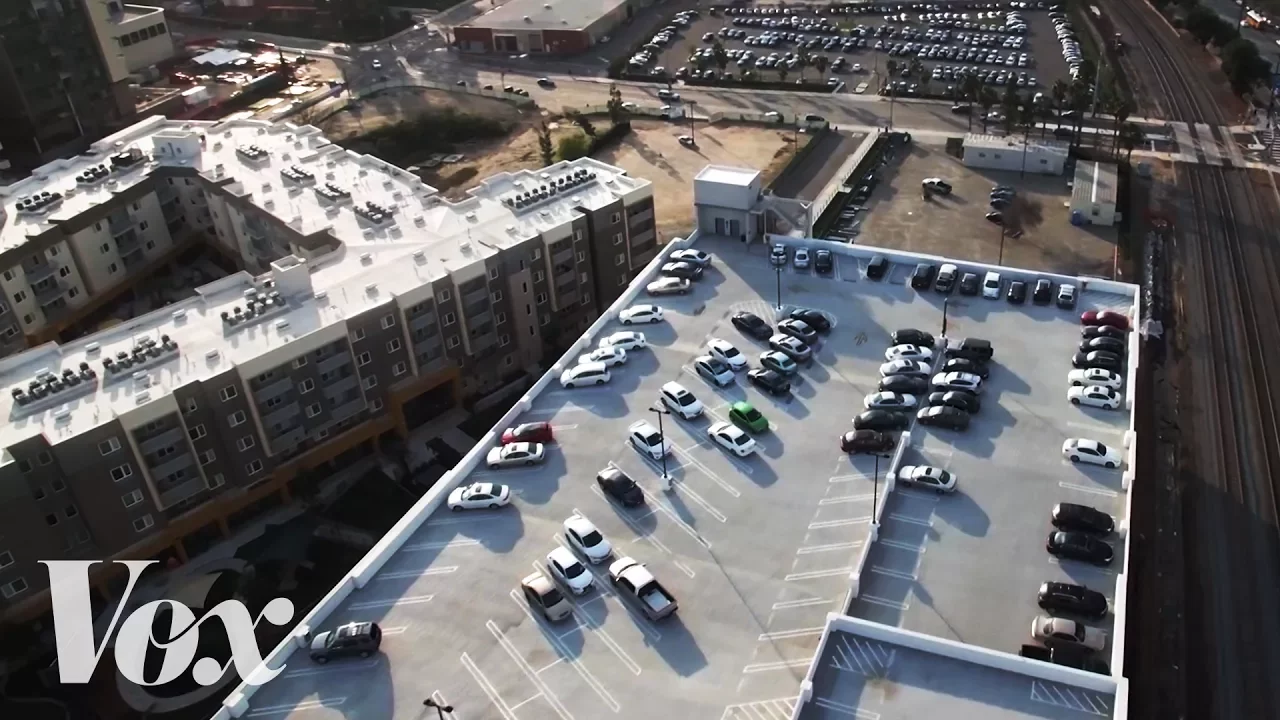
- Apple's circular Cupertino campus includes more floor space dedicated to parking structures than to the office ring itself due to a municipal requirement mandating 11,000 parking spaces. (0:00)
- Mandatory parking minimums were popularized after World War II to shift the financial burden of managing vehicle storage away from municipal budgets and onto private developers. (1:15)
- Urban planning professor Donald Shoup outlines a three-part solution to repair urban land use: abolish parking minimums, price street curb spots to leave 1-2 open spaces per block, and return meter revenues directly to metered districts. (5:08)
Detailed notes
## Background Published on YouTube by Vox on July 19, 2017, this video explores how hidden municipal parking regulations damage American cities. Created with insight from Mobility Lab's Will Chilton and Paul Mackie, as well as urban planning professor Donald Shoup, the piece examines the unintended economic and architectural costs of post-WWII mandatory parking minimums.
## TL;DR Across the United States, an estimated eight parking spaces exist for every car, occupying land area equivalent to the state of West Virginia due to post-WWII mandatory parking minimums. Urban planning professor Donald Shoup explains that these arbitrary ratios act like economic 'pseudoscience,' forcing developers to construct massive asphalt footprints that inflate consumer prices, undermine walkability, and prevent dense housing construction. Because drivers rarely pay the true cost directly, the expense of parking is hidden inside higher rents, taxes, and retail prices. To fix this crisis, Shoup proposes a three-part solution: abolishing parking minimums, pricing street parking dynamically to ensure one or two vacancies per block, and reinvesting meter revenues directly back into neighborhood public services.
## Atmosphere & style The video maintains Vox's signature sharp, analytical, and highly accessible explanatory tone, blending clean graphic visualizations with engaging historical footage. Donald Shoup serves as an authoritative yet wry guide, puncturing modern planning dogmas with dry humor, colorful analogies comparing parking rules to medical bloodletting, and an exhausted charm at the end of his presentation. The narrative arc moves effectively from eye-opening disbelief at the sheer scale of American parking to an empowering, pragmatic blueprint for urban reform.
## Bulletin - [00:00](https://www.youtube.com/watch?v=Akm7ik-H_7U&t=0s) The United States maintains an estimated 8 parking spaces for every car on the road, consuming land equivalent to the entire state of West Virginia and up to 30% of American city area. - [00:00](https://www.youtube.com/watch?v=Akm7ik-H_7U&t=0s) Apple's circular Cupertino campus includes more floor space dedicated to parking structures than to the office ring itself due to a municipal requirement mandating 11,000 parking spaces. - [01:15](https://www.youtube.com/watch?v=Akm7ik-H_7U&t=75s) Mandatory parking minimums were popularized after World War II to shift the financial burden of managing vehicle storage away from municipal budgets and onto private developers. - [05:08](https://www.youtube.com/watch?v=Akm7ik-H_7U&t=308s) Urban planning professor Donald Shoup outlines a three-part solution to repair urban land use: abolish parking minimums, price street curb spots to leave 1-2 open spaces per block, and return meter revenues directly to metered districts.
## Key takeaways - [00:00](https://www.youtube.com/watch?v=Akm7ik-H_7U&t=0s) Apple's iconic Cupertino headquarters was mandated by the city to build 11,000 parking stalls, resulting in parking garages that exceed the floor area of the main office building. - [00:00](https://www.youtube.com/watch?v=Akm7ik-H_7U&t=0s) Parking infrastructure occupies up to 30% of the land area in American cities, totaling roughly the size of West Virginia. - [01:15](https://www.youtube.com/watch?v=Akm7ik-H_7U&t=75s) Before the invention of the parking meter in 1935, American cities lacked pricing mechanisms to ration congested street curb space. - [01:15](https://www.youtube.com/watch?v=Akm7ik-H_7U&t=75s) Early parking meter vendors encouraged municipal adoption by providing hardware for free, recouping costs through initial coin receipts, and staging half-street trials to demonstrate turnover. - [01:15](https://www.youtube.com/watch?v=Akm7ik-H_7U&t=75s) Cities widely adopted off-street parking minimums after World War II to avoid paying for municipal parking facilities while attempting to clear curb congestion. - [03:20](https://www.youtube.com/watch?v=Akm7ik-H_7U&t=200s) Parking minimums rely on pseudo-scientific ratios establishing stalls per square foot, hospital bassinets, golf holes, or gallons of water in a public pool. - [03:20](https://www.youtube.com/watch?v=Akm7ik-H_7U&t=200s) Because an average parking stall and drive aisle consumes roughly 330 square feet, standard minimums require parking lots as large as, or multiple times larger than, the buildings they serve. - [03:20](https://www.youtube.com/watch?v=Akm7ik-H_7U&t=200s) 'Free' parking is financed invisibly through higher prices on consumer goods, inflated residential rents, and municipal tax burdens borne by drivers and non-drivers alike. - [05:08](https://www.youtube.com/watch?v=Akm7ik-H_7U&t=308s) Rigid parking mandates make historic, walkable urban centers like Paris, Amsterdam, and Manhattan illegal to build today. - [05:08](https://www.youtube.com/watch?v=Akm7ik-H_7U&t=308s) Abolishing minimum parking requirements allows developers and the market to decide parking allocation while freeing urban land for housing. - [05:08](https://www.youtube.com/watch?v=Akm7ik-H_7U&t=308s) Dynamic on-street pricing should adjust to ensure one or two parking spots remain open on every block at all times. - [05:08](https://www.youtube.com/watch?v=Akm7ik-H_7U&t=308s) Earmarking meter revenues specifically for local public services and infrastructure on the metered street builds public support for paid parking.
## Detailed walkthrough ### [00:00](https://www.youtube.com/watch?v=Akm7ik-H_7U&t=0s) The Scale of American Parking and Apple’s Mandated Garage
Four months before his death in 2011, Steve Jobs made his final public appearance to pitch the design for Apple’s new circular campus in Cupertino, California. Jobs presented a grand architectural vision where 12,000 employees would be housed under a single roof, replacing vast expanses of existing asphalt with lush greenery. Reflecting on the transformation, Jobs remarked, “The overall feeling of the place is gonna be a zillion times better than it is now, with all the asphalt. so we’d like to plant a lot of trees including some apricot orchards…” However, Jobs left out a critical detail: the planned parking structures for the site contained more total floor space than the iconic office ring itself. That massive parking footprint was not Apple’s idea; it was mandated by the city of Cupertino, which required 11,000 parking spaces for the development.
Cupertino’s mandate exemplifies a nationwide reality. Across the United States, parking infrastructure dominates the built environment to an astonishing degree, actively subsidizing and driving automotive dependency.
- America contains an estimated 8 parking spaces for every single car on the road. - Parking lots and structures cover up to 30% of American cities. - Collectively, American parking infrastructure takes up roughly as much land area as the entire state of West Virginia.
[01:15](https://www.youtube.com/watch?v=Akm7ik-H_7U&t=75s) The Dual Inventions: Parking Meters and Mandatory Minimums
In the 1920s and 1930s, American curbs became completely overwhelmed by the influx of automobiles. Because municipal authorities had no dynamic pricing mechanisms, curbing demand was impossible until the parking meter was invented in 1935. Donald Shoup, an urban planning professor at UCLA who specializes in the economics of parking, explains: “If you look at pictures of the American cities around 1920 and 1930, all of the curbs are just completely filled with parked cars. And they couldn’t use prices to manage demand because the parking meter wasn’t even invented until 1935.” Parking meter manufacturers popularized their product through clever sales tactics: they installed meters for free, collected the initial coin revenue for about six months until the hardware was paid off, and then handed all future revenue to the city. To prove their effectiveness, vendors often installed meters on only one side of a congested street so officials could see the immediate contrast in turnover and availability.
Alongside the meter, cities invented off-street parking requirements—commonly known as mandatory parking minimums. Following World War II and the rapid onset of suburbanization, cities scrambled to prevent street crowding without spending municipal funds. Forcing developers to build parking shifted the capital costs off city budgets, causing minimum parking rules to sweep the nation faster than almost any other planning trend. Shoup points out: “Off street parking requirements really spread throughout the United States faster than really any other urban planning invention. And they arose partly because of the lack of management of on-street parking. If you can’t manage the on street parking properly, you need off street parking requirements or everybody will say ‘how did you let this building be built when there’s not enough parking.’”
```mermaid flowchart TD accTitle: Evolution of Urban Parking Management accDescr: Historical progression from early curb congestion to meters and mandatory off-street minimums.
subgraph EarlyCrisis["1920s-1930s Congestion"] A["Rapid Auto Growth"] --> B["Curbs Overwhelmed"] B --> C["No Price Mechanism to Ration Space"] end
subgraph DualSolutions["Mid-Century Interventions"] C --> D["Invention 1: Parking Meters (1935)<br/>Priced Curb Demand"] C --> E["Invention 2: Parking Minimums<br/>Shifted Supply Burden to Developers"] end
subgraph ModernResult["Suburban Sprawl"] E --> F["Vast Asphalt Footprints"] F --> G["Lower Density & Car Reliance"] end ```
[03:20](https://www.youtube.com/watch?v=Akm7ik-H_7U&t=200s) The Pseudoscience and Hidden Costs of Parking Minimums
Mandatory parking rules establish ratios dictating a specific number of parking stalls per 1,000 square feet of building space, calibrated to specific land uses. These ratios often reach absurd granular standards, establishing spaces per bassinet in maternity wards, per hole on a golf course, per thousand gallons of water in a public swimming pool, or arbitrary counts for funeral homes. Because an average parking space requires roughly 330 square feet—accounting for both the stall itself and the maneuvering drive aisles—a rule requiring 3 spots per 1,000 square feet results in a parking lot identical in size to the building it serves. For restaurants, requirements often jump to 10 spots per 1,000 square feet, producing a parking lot more than three times the size of the dining establishment. Shoup likens the methodology of setting these numbers to historical medical malpractice: “Planners don’t have any training in how to set them, and there’s really no way to say how much parking every building needs, so there’s a pseudoscience that has grown up, like blood letting, which was a major form of medical treatment for a couple thousand years, and that’s just like parking requirements today.”
These requirements impose enormous hidden financial burdens. When developers cannot provide mandated parking on-site, cities levy in-lieu fees running tens of thousands of dollars per missing stall, often making new construction financially impossible. The public perceives parking as free, but the expense is merely diffused into everyday goods, rents, and local taxes. Shoup emphasizes: “We pay for the free parking that we demand in every role that we have in life other than as a driver. As a tax payer, as a resident, as a shopper. And just because you pay nothing for parking at the parking lot of the grocery store doesn’t mean the cost goes away. It’s still there. It’s just that the driver isn’t paying for it.”
- Stall footprint: ~330 sq ft per stall (including access aisles). - Retail/office ratio (3 spots / 1,000 sq ft): Parking area equals 100% of building floor area. - Restaurant ratio (10 spots / 1,000 sq ft): Parking area equals over 300% of building floor area.
[05:08](https://www.youtube.com/watch?v=Akm7ik-H_7U&t=308s) Urban Consequences and Donald Shoup’s Three-Point Fix
By forcing developments to include vast seas of asphalt, parking minimums depress urban density, push buildings far apart, destroy walkability, and induce further driving and congestion. Beloved dense, walkable cities such as Paris, Amsterdam, Washington, D.C., and New York City could never have been constructed under modern suburban parking mandates. Shoup laments the misallocation of prime urban real estate: “This is the most valuable land on earth. Land is expensive for housing but its free for parking. And you wonder why we have a problem?” However, this misallocation presents a major opportunity: underused parking lots can be reclaimed and redeveloped into much-needed housing.
```mermaid flowchart LR accTitle: Donald Shoup Three-Point Policy Reform accDescr: Three core recommendations to fix municipal parking policy.
subgraph Step1["Deregulate"] A["Abolish Mandatory<br/>Parking Minimums"] end
subgraph Step2["Price Curb Space"] B["Price On-Street Parking Dynamically<br/>Target: 1-2 Open Spots per Block"] end
subgraph Step3["Reinvest Revenue"] C["Dedicate Meter Revenue to<br/>Local Public Services on Metered Blocks"] end
A --> B --> C ```
To reverse these structural failures, Shoup condenses his landmark 800-page treatise into three straightforward policy reforms:
1. **Eliminate off-street parking minimums:** Let the market, rather than arbitrary city mandates, decide how much parking each development requires. 2. **Implement dynamic curb pricing:** Price street spaces to match demand, fluctuating by location and time of day to keep one or two spots open on every block. Shoup summarizes this rule: “Charge the right price for on-street parking, by which I mean the lowest price the city can charge and still have one or two open spaces on every block. So nobody can say there's a shortage of parking.” 3. **Reinvest parking revenues locally:** Dedicate meter revenues directly back to public services and infrastructure enhancements on the metered streets themselves, building public and political support for paid parking. After delivering his core recommendations, Shoup quips, “Well I'm worn out.”
## Notable quotes > [03:20](https://www.youtube.com/watch?v=Akm7ik-H_7U&t=200s) We pay for the free parking that we demand in every role that we have in life other than as a driver. As a tax payer, as a resident, as a shopper. — Donald Shoup
> [05:08](https://www.youtube.com/watch?v=Akm7ik-H_7U&t=308s) Charge the right price for on-street parking, by which I mean the lowest price the city can charge and still have one or two open spaces on every block. — Donald Shoup
> [01:15](https://www.youtube.com/watch?v=Akm7ik-H_7U&t=75s) Off street parking requirements really spread throughout the United States faster than really any other urban planning invention. And they arose partly because of the lack of management of on-street parking. — Donald Shoup
## Mentioned Steve Jobs, Donald Shoup, Apple, Cupertino, California, UCLA, Mobility Lab, Paris, Amsterdam, Washington, D.C., New York City, West Virginia, The High Cost of Free Parking
## Video description Hidden parking rules hurt our cities. Will Chilton and Paul Mackie of Mobility Lab explain.
Subscribe to our channel! http://goo.gl/0bsAjO
The cities we live in are shaped by the way we get around them. Over the past 60 years, with more and more people opting to drive cars, the need for parking spaces has increased with the boom in driving. To accommodate that demand early on, cities and towns started requiring developers to include parking with their new buildings after World War II. These policies, known as mandatory parking minimums, set precise standards for parking spaces for each building. And these parking spaces don't come cheap.
To learn much more on free parking's affect on cities, Donald Shoup's book is here: https://www.amazon.com/High-Cost-Free-Parking-Updated/dp/193236496X
And Mobility Lab, who helped make this video, covers many more issues around infrastructure is here: https://mobilitylab.org/
Vox.com is a news website that helps you cut through the noise and understand what's really driving the events in the headlines. Check out http://www.vox.com to get up to speed on everything from Kurdistan to the Kim Kardashian app.
Check out our full video catalog: http://goo.gl/IZONyE Follow Vox on Twitter: http://goo.gl/XFrZ5H Or on Facebook: http://goo.gl/U2g06o
[Source](https://www.youtube.com/watch?v=Akm7ik-H_7U)