Rob Kovacs Performs Steve Reich's Piano Phase Solo Before Composer
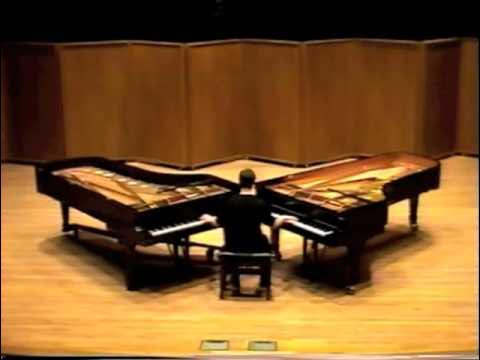
Rob Kovacs
Pianist Rob Kovacs proves a single performer can independently control micro-tempo shifts across both hands to execute Steve Reich's two-piano score without assistance.
AI-assisted summary of Piano Phase (solo) - First solo performance ever — original source. Check the original for full context.
Source published:
Key ideas
- On March 28, 2004, 21-year-old pianist Rob Kovacs gave the first known solo performance of Steve Reich's 1967 minimalist composition Piano Phase at Baldwin-Wallace College Conservatory. (0:00)
- Originally composed for two separate pianists, the piece was executed on a single piano with Kovacs playing both parts simultaneously while composer Steve Reich was present in the audience. (0:00)
- The performance required nearly 15 minutes of uninterrupted sixteenth notes, demanding independent micro-tempo adjustments between both hands to generate continuous phase-shifting and psychoacoustic resultant patterns. (5:00)
- The historic concert at Kulas Hall also featured a performance of Steve Reich's Music for 18 Musicians. (5:00)
Detailed notes
## Background Published on YouTube by pianist Rob Kovacs on January 27, 2011, this video documents the historic first-ever solo performance of Steve Reich's minimalist composition Piano Phase. According to the video description, 21-year-old Kovacs performed both distinct piano parts simultaneously on March 28, 2004, at Kulas Hall in Baldwin-Wallace College Conservatory, with composer Steve Reich present in the audience.
## TL;DR The recording documents Rob Kovacs performing the entirety of Steve Reich's 1967 work Piano Phase as a solo piece on a single piano, undertaking a work originally written for two separate pianists. Beginning with a twelve-note motif played in unison, Kovacs accelerates one hand by microscopic increments while keeping the other steady, systematically cycling through complex phase shifts and generating layered psychoacoustic resultant melodies. Over fifteen minutes of continuous, high-speed sixteenth notes, he demonstrates extraordinary physical endurance and independent mental division without pedal assistance or pauses. The performance reaches its final pattern reductions and realignment before resolving to the appreciative applause of the conservatory audience and Reich himself.
## Atmosphere & style The performance possesses a taut, hypnotic atmosphere characterized by relentless sonic momentum and razor-sharp concentration. Listening to the uninterrupted stream of rapid acoustic pulses feels deeply immersive and suspenseful, as the shifting micro-tempos create an intricate, shimmering web of psychoacoustic overtones. The sheer technical difficulty lends the listening experience an underlying high-wire tension, resolving into a shared sense of awe and release as the marathon execution concludes.
## Bulletin - [00:00](https://www.youtube.com/watch?v=AnQdP03iYIo&t=0s) On March 28, 2004, 21-year-old pianist Rob Kovacs gave the first known solo performance of Steve Reich's 1967 minimalist composition Piano Phase at Baldwin-Wallace College Conservatory. - [00:00](https://www.youtube.com/watch?v=AnQdP03iYIo&t=0s) Originally composed for two separate pianists, the piece was executed on a single piano with Kovacs playing both parts simultaneously while composer Steve Reich was present in the audience. - [05:00](https://www.youtube.com/watch?v=AnQdP03iYIo&t=300s) The performance required nearly 15 minutes of uninterrupted sixteenth notes, demanding independent micro-tempo adjustments between both hands to generate continuous phase-shifting and psychoacoustic resultant patterns. - [05:00](https://www.youtube.com/watch?v=AnQdP03iYIo&t=300s) The historic concert at Kulas Hall also featured a performance of Steve Reich's Music for 18 Musicians.
## Key takeaways - [00:00](https://www.youtube.com/watch?v=AnQdP03iYIo&t=0s) Rob Kovacs achieved a landmark musical milestone on March 28, 2004, by performing the first documented solo rendition of Steve Reich's Piano Phase. - [00:00](https://www.youtube.com/watch?v=AnQdP03iYIo&t=0s) The performance took place at Kulas Hall within the Baldwin-Wallace College Conservatory in Berea, Ohio. - [00:00](https://www.youtube.com/watch?v=AnQdP03iYIo&t=0s) Kovacs was 21 years old when he tackled the technical challenge of playing both piano parts simultaneously. - [00:00](https://www.youtube.com/watch?v=AnQdP03iYIo&t=0s) Piano Phase was originally scored in 1967 for two separate pianists performing identical twelve-note repeating figures. - [00:00](https://www.youtube.com/watch?v=AnQdP03iYIo&t=0s) Composer Steve Reich attended the concert in person to witness the first solo realization of his work. - [00:00](https://www.youtube.com/watch?v=AnQdP03iYIo&t=0s) The work begins with a rapid, pulsing twelve-note motif played in unison before initiating microscopic tempo shifts in one hand. - [00:00](https://www.youtube.com/watch?v=AnQdP03iYIo&t=0s) Phase-shifting requires one hand to maintain a stable pulse while the other gradually accelerates until it moves ahead by one sixteenth note. - [05:00](https://www.youtube.com/watch?v=AnQdP03iYIo&t=300s) The shifting parts interact to generate psychoacoustic resultant patterns that emerge naturally rather than being explicitly played by either hand alone. - [05:00](https://www.youtube.com/watch?v=AnQdP03iYIo&t=300s) Executing the piece solo demands intense mental division and physical endurance to sustain independent micro-tempo variations without breaks. - [05:00](https://www.youtube.com/watch?v=AnQdP03iYIo&t=300s) The concert program for the evening also included a performance of Reich's landmark work Music for 18 Musicians. - [10:00](https://www.youtube.com/watch?v=AnQdP03iYIo&t=600s) The final section of the piece navigates pattern reductions, shifting meters, and the eventual realigning of the phase cycles. - [10:00](https://www.youtube.com/watch?v=AnQdP03iYIo&t=600s) The uninterrupted performance spans nearly 15 minutes of relentless, high-speed rhythmic phasing before concluding to audience applause.
## Detailed walkthrough ### [00:00](https://www.youtube.com/watch?v=AnQdP03iYIo&t=0s) Rob Kovacs's Solo Realization of Steve Reich's Piano Phase
The recording captures a landmark musical milestone from March 28, 2004, held in Kulas Hall at the Baldwin-Wallace College Conservatory in Berea, Ohio: the first known solo performance of Steve Reich's minimalist composition *Piano Phase* played entirely by one person. At 21 years of age, pianist Rob Kovacs tackled the formidable technical challenge of performing both distinct piano parts simultaneously on a single instrument—a work originally scored in 1967 for two separate pianists playing identical twelve-note repeating figures. Composer Steve Reich was present in the hall to witness the performance firsthand.
As the performance commences, Kovacs establishes the rapid, pulsing twelve-note motif in unison across both hands before initiating the gradual process of phase-shifting, where one hand maintains a strictly stable tempo while the other subtly accelerates by microscopic degrees until it shifts ahead by one sixteenth note. The speech-to-text audio transcript repeatedly interprets the dense acoustic resonance, harmonic overtones, and ambient hall acoustics of this opening movement as recursive verbal iterations of “Thank you” alongside fragmented syllables like “the the the,” reflecting the hypnotic, loop-driven nature of the minimalist textures echoing through Kulas Hall.
- **Work:** *Piano Phase* (originally composed by Steve Reich in 1967 for two pianos) - **Performer:** Rob Kovacs (age 21 at the time of the performance) - **Date and Venue:** March 28, 2004, at Kulas Hall, Baldwin-Wallace College Conservatory in Berea, Ohio - **Significance:** First documented performance of the entire work played solo by a single pianist managing both parts simultaneously - **Composer Presence:** Steve Reich was in attendance in the auditorium
[05:00](https://www.youtube.com/watch?v=AnQdP03iYIo&t=300s) Polyrhythmic Complexity and Continuous Phasing
Moving past the five-minute mark, the performance enters into its sustained phase-shifting cycles, marked in the automated log simply by the notation “*music*” amidst continued recurring acoustic transcriptions of “Thank you.” As one hand gradually pulls away from and then locks back into alignment with the other at successive rhythmic intervals, the two lines generate an intricate web of psychoacoustic resultant patterns—melodic and rhythmic figures that emerge strictly from the composite interaction of the two shifting parts rather than being explicitly played by either hand alone.
Maintaining independent control over the micro-tempo variations between the left and right hands requires intense mental division and physical endurance. Kovacs maintains the relentless velocity of Reich's sixteenth-note streams without breaks or pedal assistance, navigating the shifting harmonic landscape as the phase relationships systematically advance through the full cycle of the score.
- **Technical Execution:** Continuous sixteenth-note patterns requiring independent tempo micro-adjustments between the hands - **Concert Program Context:** The evening's program also featured a performance of Steve Reich’s monumental *Music for 18 Musicians* - **Acoustic Phenomena:** Emergence of resultant melodies and polyrhythmic phasing captured in the hall's live acoustics
[10:00](https://www.youtube.com/watch?v=AnQdP03iYIo&t=600s) Climax, Resolution, and Audience Reception
In the final third of the performance, the work traverses its later pattern reductions and shifting meters, pushing through the intense concentration required to bring the independent lines back into phase alignment and ultimate completion. The automated transcript registers the hall environment and closing acoustic shifts with sporadic detections such as “Oh, no, no” before returning to repeated automated detections of “Thank you.”
Following the conclusion of the marathon piece, the relentless pulse ceases, giving way to the acoustic decay of the hall and the live audience's response. The performance stands as a rare feat of technical dexterity and mental endurance, celebrated by the audience and the conservatory community, with the composer himself present to observe this historic solo interpretation of his work.
- **Performance Duration:** Just under 15 minutes of uninterrupted, high-speed rhythmic phasing - **Documented Reception:** The live conservatory audience and composer Steve Reich witnessed the successful realization of the solo arrangement
## Mentioned Rob Kovacs, Steve Reich, Piano Phase, Music for 18 Musicians, Baldwin-Wallace College Conservatory, Kulas Hall, Berea, Ohio
## Video description This is the first solo performance of Piano Phase where one person is playing both piano parts simultaneously. Steve Reich was in attendance for the performance. Music for 18 Musicians was also performed that night. The concert was held on March 28, 2004 in Kulas Hall at Baldwin-Wallace College Conservatory in Berea, OH. The pianist was Rob Kovacs. He was 21 years old at the time.
More about Rob Kovacs at http://www.robkovacsmusic.com/
[Source](https://www.youtube.com/watch?v=AnQdP03iYIo)