Tsukuba Team Renders Mid-Air Plasma Holograms via Femtosecond Lasers
Yoichi Ochiai
Switching from nanosecond to ultrafast femtosecond pulses eliminates thermal and acoustic hazards, enabling touchable aerial plasma displays for everyday environments.
AI-assisted summary of Fairy Lights in Femtoseconds: Tangible Holographic Plasma (SIGGRAPH) — original source. Check the original for full context.
Source published:
Key ideas
- Researchers demonstrated 'Fairy Lights in Femtoseconds', an aerial and volumetric display system that renders true 3D graphics in mid-air using focused femtosecond laser pulses without screens, mist, or fog. (0:08)
- Transitioning from nanosecond to ultrafast femtosecond pulses significantly reduces acoustic shock and thermal damage, producing a safer, quieter plasma capable of tangible interaction. (0:08)
- The optical setup integrates a spatial light modulator (SLM) to dynamically adjust phase profiles and interference, rendering complex 3D holographic fields directly in ambient air. (1:10)
- The experimental workspace occupies a 1 cm³ volume and supports spatiotemporal resolutions ranging from 4,000 up to 200,000 dots per second depending on the laser source used.
Detailed notes
## Background This video was published on YouTube by Yoichi Ochiai on June 22, 2015, presenting research conducted in collaboration with researchers from the University of Tsukuba, Utsunomiya University, Nagoya Institute of Technology, The University of Tokyo, and Sony CSL for ACM SIGGRAPH 2015. According to the description, it introduces "Fairy Lights in Femtoseconds," a method for rendering aerial and volumetric graphics in mid-air using focused femtosecond lasers and computational holographic fields.
## TL;DR The presentation demonstrates a system that projects aerial 3D graphics by exciting ambient air into laser-induced plasma without screens, fog, or physical matter. By transitioning from traditional nanosecond lasers to femtosecond pulses, the technology substantially reduces acoustic noise and physical danger, making plasma interaction safer for humans. Using spatial light modulators (SLMs) to sculpt computational holographic fields, the platform generates complex volumetric light points. The research establishes foundational optical principles, hardware setups, safety assessments, and scalability frameworks to bring tangible plasma-based volumetric displays into everyday interactive environments.
## Atmosphere & style The presentation carries a precise, serene, and academic tone, balancing rigorous optical physics with a sense of futuristic wonder. The narration is measured and objective, calmly detailing laser breakdown thresholds and spatial light modulation while tiny points of luminous plasma sparkle silently in mid-air. Watching the demonstrations feels almost surreal, as the quiet, glowing aerial forms replace the loud, concussive bursts historically associated with laser-induced breakdown, conveying a calm and calculated leap toward tangible science fiction.
## Bulletin - [00:08](https://www.youtube.com/watch?v=AoWi10YVmfE&t=8s) Researchers demonstrated 'Fairy Lights in Femtoseconds', an aerial and volumetric display system that renders true 3D graphics in mid-air using focused femtosecond laser pulses without screens, mist, or fog. - [00:08](https://www.youtube.com/watch?v=AoWi10YVmfE&t=8s) Transitioning from nanosecond to ultrafast femtosecond pulses significantly reduces acoustic shock and thermal damage, producing a safer, quieter plasma capable of tangible interaction. - [01:10](https://www.youtube.com/watch?v=AoWi10YVmfE&t=70s) The optical setup integrates a spatial light modulator (SLM) to dynamically adjust phase profiles and interference, rendering complex 3D holographic fields directly in ambient air. - The experimental workspace occupies a 1 cm³ volume and supports spatiotemporal resolutions ranging from 4,000 up to 200,000 dots per second depending on the laser source used.
## Key takeaways - [00:08](https://www.youtube.com/watch?v=AoWi10YVmfE&t=8s) 'Fairy Lights in Femtoseconds' renders aerial and volumetric graphics directly into ambient air without requiring physical projection substrates, fog, or screens. - [00:08](https://www.youtube.com/watch?v=AoWi10YVmfE&t=8s) The system excites ambient air molecules at precise 3D coordinates using high-intensity focused laser energy to generate visible laser-induced plasma. - [00:08](https://www.youtube.com/watch?v=AoWi10YVmfE&t=8s) Ultrafast femtosecond pulses yield plasma discharges that are significantly quieter and safer than previous nanosecond laser-induced breakdown methods. - [00:08](https://www.youtube.com/watch?v=AoWi10YVmfE&t=8s) The dramatic reduction in thermal and acoustic hazard enables tangible, touchable volumetric graphics suitable for daily life and interactive applications. - [01:10](https://www.youtube.com/watch?v=AoWi10YVmfE&t=70s) Holographic graphics generation relies on a Spatial Light Modulator (SLM) to dynamically alter laser beam phase profiles via optical interference. - [01:10](https://www.youtube.com/watch?v=AoWi10YVmfE&t=70s) Computational holographic field control allows for complex spatial light distribution instead of relying solely on sequential mechanical beam steering. - Tested laser sources included a 30-100 fs laser firing up to 1,000 pulses/sec at 7 mJ and a 269 fs laser firing up to 200,000 pulses/sec at 50 µJ. - The system verified volumetric rendering spatiotemporal resolutions reaching 4,000 and 200,000 dots per second across the respective laser configurations. - The operational workspace and holograms occupy up to 1 cm³, with potential for scaling depending on optical devices and setup configurations. - The underlying principles extend beyond air plasma to other physical rendering media, such as fluorescence and microbubbles in solid or liquid materials. - [01:10](https://www.youtube.com/watch?v=AoWi10YVmfE&t=70s) The study defines an experimental and theoretical design framework addressing laser breakdown thresholds, safety margins, and scalability for plasma-based 3D displays.
## Detailed walkthrough ### [00:08](https://www.youtube.com/watch?v=AoWi10YVmfE&t=8s) Aerial Graphics and Quieter, Safer Femtosecond Laser Plasma
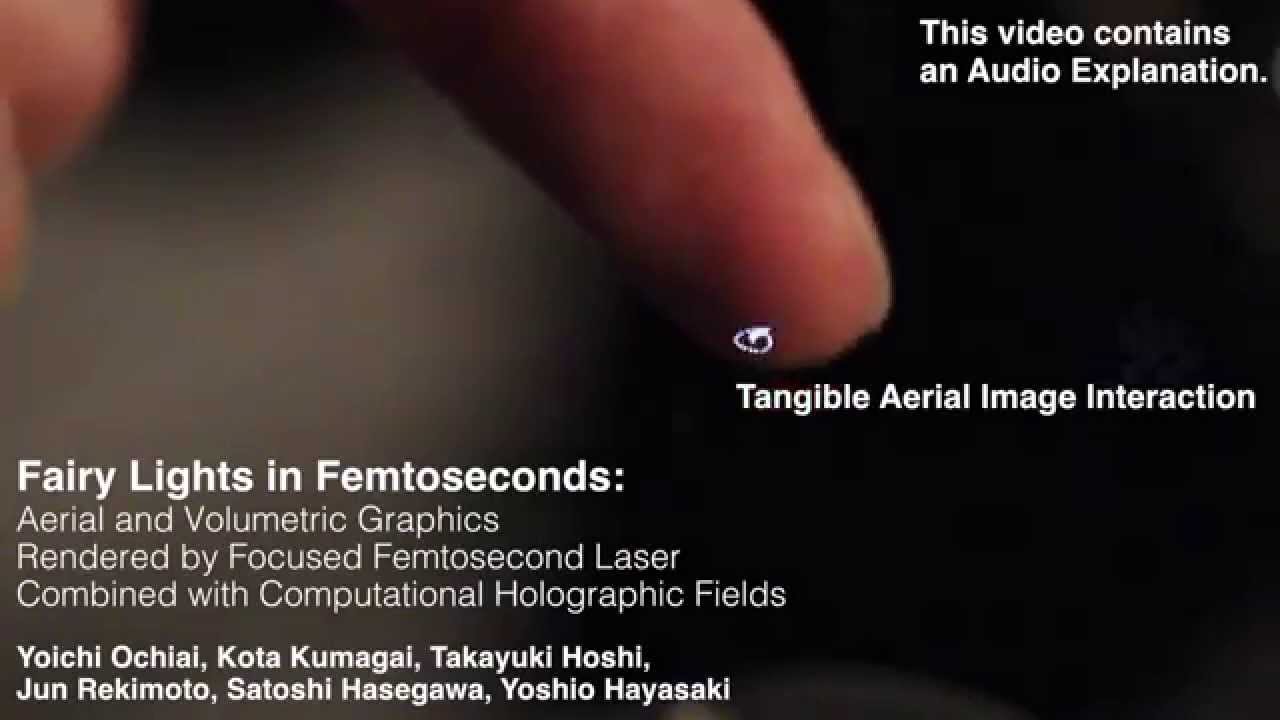
The project introduces *Fairy Lights in Femtoseconds*, a rendering technique designed to cast aerial and volumetric graphics directly into the air using focused femtosecond lasers paired with computational holographic fields. By concentrating high-intensity laser energy at precise three-dimensional coordinates, the system excites ambient air to produce laser-induced plasma. This plasma emits visible points of light in mid-air completely free of physical screens, fog, or external projection matter.
A central motivation for shifting from traditional nanosecond lasers to femtosecond pulses is human safety and environmental impact. Because femtosecond pulses deliver energy over extraordinarily brief timeframes, the resulting plasma discharge creates a substantially safer and quieter physical interaction. The narrator notes the practical promise of this shift, explaining, “Daily life applications can be explored because plasma induced by a femtosecond laser is quieter and safer than that by a nanosecond laser.” This reduction in thermal and acoustic shock makes interactive, tangible mid-air plasma displays viable for real-world user environments.
```mermaid flowchart LR accTitle: Femtosecond Laser Aerial Plasma Rendering accDescr: Diagram illustrating how computational holographic fields and femtosecond laser pulses generate safe aerial plasma graphics in ambient air.
subgraph OpticalControl ["Holographic Control"] SLM["Spatial Light Modulator (SLM)"] -->|"Phase modulation & interference"| FocusedBeam["Focused Femtosecond Laser"] end
subgraph Emission ["Air Breakdown"] FocusedBeam -->|"Focal excitation"| Plasma["Laser-Induced Plasma"] Plasma --> Display["Volumetric Aerial Graphics"] end ```
- Aerial volumetric graphics are rendered in open air without requiring physical projection substrates or matter. - Plasma generation utilizing femtosecond lasers significantly lowers acoustic noise and physical danger compared to previous nanosecond laser-induced breakdown systems.
[01:10](https://www.youtube.com/watch?v=AoWi10YVmfE&t=70s) Spatial Light Modulation and Roadmap for Tangible Volumetric Displays
To manipulate light across three-dimensional coordinates, the optical engine incorporates a spatial light modulator (SLM). The SLM dynamically shifts the phase profiles of the incoming laser beams, leveraging optical interference to distribute light into complex spatial patterns rather than relying solely on sequential mechanical steering. As the narrator explains, “Our results led to calmer and safer plasma generation that can be incorporated into our daily lives.” This integration allows the system to achieve safe, high-resolution, and geometrically diverse volumetric graphics suitable for interactive displays.
The presentation also outlines the systematic design framework and experimental evaluation of the technology:
1. **Principles and Design Parameters**: Establishing the fundamental optical physics, breakdown thresholds, and spatiotemporal constraints governing femtosecond laser-based volumetric displays. 2. **Experimental Setup**: Introducing the engineered optical assembly, including the SLM phase-modulation architecture and beam path. 3. **Application Scenarios**: Exploring tangible 3D display concepts and direct user interaction spaces. 4. **Validation and Scalability**: Conducting detailed experiments evaluating plasma generation fidelity, human safety margins, laser beam control, operational limitations, and volumetric scalability.
Reflecting on the contribution to interactive graphics, the narrator emphasizes, “We believe that this study fills the gaps in design space of plasma-based 3D displays that were left unresolved by previous studies.” By combining computational holography with ultrafast laser pulses, the system establishes a new baseline for rendering touchable volumetric interfaces in everyday environments.
## Notable quotes > [00:08](https://www.youtube.com/watch?v=AoWi10YVmfE&t=8s) Daily life applications can be explored because plasma induced by a femtosecond laser is quieter and safer than that by a nanosecond laser.
## Mentioned Yoichi Ochiai, Kota Kumagai, Takayuki Hoshi, Jun Rekimoto, Satoshi Hasegawa, Yoshio Hayasaki, University of Tsukuba, Utsunomiya University, Nagoya Institute of Technology, The University of Tokyo, Sony CSL, ACM SIGGRAPH 2015, Spatial Light Modulator (SLM)
## Video description Fairy Lights in Femtoseconds: Aerial and Volumetric Graphics Rendered by Focused Femtosecond Laser Combined with Computational Holographic Fields Yoichi Ochiai*, Kota Kumagai**, Takayuki Hoshi***, Jun Rekimoto****, Satoshi Hasegawa**, and Yoshio Hayasaki** *University of Tsukuba ** Utsunomiya University ***Nagoya Institute of Technology **** The University of Tokyo and Sony CSL
project page: http://digitalnature.slis.tsukuba.ac.jp/2015/06/fairy-lights-in-femtoseconds/
Abstract We present a method of rendering aerial and volumetric graphics using femtosecond lasers. A high-intensity laser excites a physical matter to emit light at an arbitrary 3D position. Popular applications can then be explored especially since plasma induced by a femtosecond laser is safer than that generated by a nanosecond laser. There are two methods of rendering graphics with a femtosecond laser in air: Producing holograms using spatial light modulation technology, and scanning of a laser beam by a galvano mirror. The holograms and workspace of the system proposed here occupy a volume of up to 1 cm^3; however, this size is scalable depending on the optical devices and their setup. This paper provides details of the principles, system setup, and experimental evaluation, and discussions on scalability, design space, and applications of this system. We tested two laser sources: an adjustable (30-100 fs) laser which projects up to 1,000 pulses per second at energy up to 7 mJ per pulse, and a 269-fs laser which projects up to 200,000 pulses per second at an energy up to 50 ¹J per pulse. We confirmed that the spatiotemporal resolution of volumetric displays, implemented with these laser sources, is 4,000 and 200,000 dots per second. Although we focus on laser-induced plasma in air, the discussion presented here is also applicable to other rendering principles such as fluorescence and microbubble in solid/liquid materials.
Yoichi Ochiai, Kota Kumagai, Takayuki Hoshi, Jun Rekimoto, Satoshi Hasegawa, Yoshio Hayasaki, Fairy Lights in Femtoseconds: Aerial and Volumetric Graphics Rendered by Focused Femtosecond Laser Combined with Computational Holographic Fields, http://arxiv.org/abs/1506.06668 (ArXiv Preprint: *Submitted to ACM Transactions on Graphics (via Acceptance with major revision in ACM SIGGRAPH 2015)
Yoichi Ochiai, Kota Kumagai, Takayuki Hoshi, Jun Rekimoto, Satoshi Hasegawa, and Yoshio Hayasaki: Fairy Lights in Femtoseconds: Aerial and Volumetric Graphics Rendered by Focused Femtosecond Laser Combined with Computational Holographic Fields, Proc. ACM SIGGRAPH 2015, Emerging Technologies, accepted, Los Angeles, California (USA), 9-13 Aug., 2015. [Demo]
Yoichi Ochiai, Kota Kumagai, Takayuki Hoshi, Jun Rekimoto, Satoshi Hasegawa, and Yoshio Hayasaki: Fairy Lights in Femtoseconds: Aerial and Volumetric Graphics Rendered by Focused Femtosecond Laser Combined with Computational Holographic Fields, Proc. ACM SIGGRAPH 2015, Posters, accepted, Los Angeles, California (USA), 9-13 Aug., 2015. [Poster]
Yoichi Ochiai, Kota Kumagai, Takayuki Hoshi, Jun Rekimoto, Satoshi Hasegawa, and Yoshio Hayasaki: Fairy Lights in Femtoseconds: Aerial and Volumetric Graphics Rendered by Focused Femtosecond Laser Combined with Computational Holographic Fields, Proc. ACM SIGGRAPH 2015, Talks, accepted, Los Angeles, California (USA), 9-13 Aug., 2015.
[Source](https://www.youtube.com/watch?v=AoWi10YVmfE)