Waymo Deploys Driverless Fleet on Public Roads via Custom Sensors
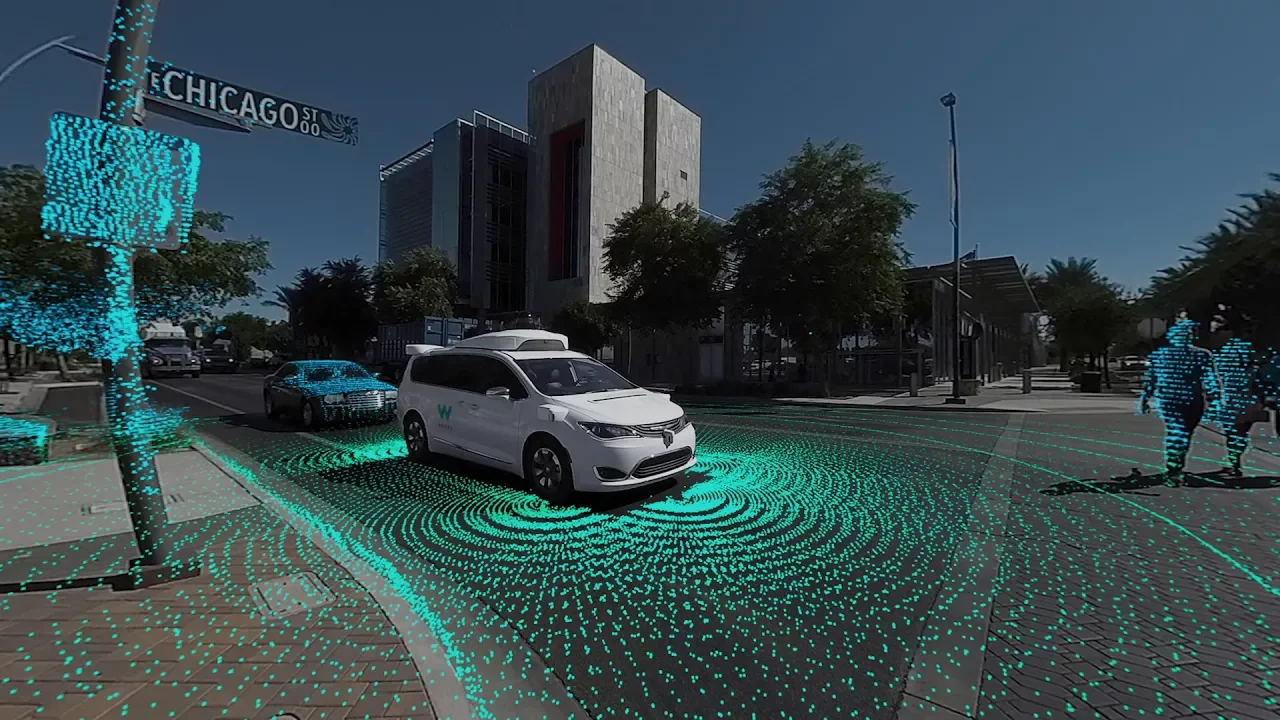
Waymo
Waymo fuses custom sensor data with millions of miles of driving experience to predict road hazards three football fields away and make driverless rides feel entirely ordinary.
AI-assisted summary of Waymo 360° Experience: A Fully Autonomous Driving Journey — original source. Check the original for full context.
Source published:
Key ideas
- Originating from Google's 2009 self-driving initiative, Waymo deploys proprietary, custom-built hardware rather than off-the-shelf automotive parts on public roads. (0:08)
- The vehicle's sensor suite fuses LiDAR, radar, and cameras to maintain a 360-degree field of view tracking obstacles up to three football fields away. (1:00)
- Behavioral prediction models trained on millions of real-world miles allow the car to anticipate movements of pedestrians and cyclists and provide safe passing clearance. (1:00)
- The driverless passenger cabin features an empty front seat and real-time visualization screens, engineered to make advanced autonomous transit feel routine and ordinary. (2:21)
Detailed notes
## Background Published by Waymo on YouTube on February 28, 2018, this 360-degree interactive video invites viewers into an autonomous journey built from real-world footage and telemetry. The description highlights Waymo's evolution from the 2009 Google self-driving car project into a fleet operating on public roads, offering an immersive look through the vehicle's perception system.
## TL;DR The video outlines how Waymo's custom-built autonomous technology safely navigates public roads using an integrated suite of LiDAR, radar, and high-resolution cameras. Incoming sensor data is fused in real time to locate the car, track obstacles up to three football fields away, and predict the actions of nearby pedestrians, cyclists, and vehicles. Powered by millions of miles of real-world driving experience, the system prioritizes passenger comfort and external safety before transitioning viewers inside the cabin, where an empty driver's seat and real-time visualization displays demonstrate how advanced computation transforms an extraordinary ride into a calm, ordinary journey.
## Atmosphere & style The presentation carries a calm, assured, and technologically sophisticated tone, guided by a steady and welcoming narration that demystifies futuristic engineering. Visually and experientially, watching the steering wheel turn on its own while layered 360-degree point clouds map surrounding streets evokes a sense of quiet wonder and safety. The progression moves smoothly from intricate data visualization to a serene cabin interior, purposefully reassuring viewers that riding without a human driver is smooth, relaxing, and entirely normal.
## Bulletin - [00:08](https://www.youtube.com/watch?v=B8R148hFxPw&t=8s) Originating from Google's 2009 self-driving initiative, Waymo deploys proprietary, custom-built hardware rather than off-the-shelf automotive parts on public roads. - [01:00](https://www.youtube.com/watch?v=B8R148hFxPw&t=60s) The vehicle's sensor suite fuses LiDAR, radar, and cameras to maintain a 360-degree field of view tracking obstacles up to three football fields away. - [01:00](https://www.youtube.com/watch?v=B8R148hFxPw&t=60s) Behavioral prediction models trained on millions of real-world miles allow the car to anticipate movements of pedestrians and cyclists and provide safe passing clearance. - [02:21](https://www.youtube.com/watch?v=B8R148hFxPw&t=141s) The driverless passenger cabin features an empty front seat and real-time visualization screens, engineered to make advanced autonomous transit feel routine and ordinary.
## Key takeaways - [00:08](https://www.youtube.com/watch?v=B8R148hFxPw&t=8s) Waymo began development as the Google self-driving car project in 2009 before launching fully autonomous public fleet operations. - [00:08](https://www.youtube.com/watch?v=B8R148hFxPw&t=8s) The autonomous platform relies on proprietary hardware built from the ground up rather than third-party automotive equipment. - [00:08](https://www.youtube.com/watch?v=B8R148hFxPw&t=8s) LiDAR sensors emit millions of laser pulses every second to build a detailed 3D spatial representation of the surrounding environment. - [00:08](https://www.youtube.com/watch?v=B8R148hFxPw&t=8s) Onboard radar directly calculates the distance and instantaneous velocity of surrounding objects. - [00:08](https://www.youtube.com/watch?v=B8R148hFxPw&t=8s) High-resolution cameras capture essential visual context that laser sensors miss, such as distinguishing traffic signal states. - [01:00](https://www.youtube.com/watch?v=B8R148hFxPw&t=60s) Sensor data is fused within a fraction of a second to continuously calculate vehicle lane placement and orientation. - [01:00](https://www.youtube.com/watch?v=B8R148hFxPw&t=60s) Waymo's perception stack identifies and tracks objects across a 360-degree perimeter extending up to three football fields away. - [01:00](https://www.youtube.com/watch?v=B8R148hFxPw&t=60s) The system continuously computes predictive behavioral models for nearby vehicles, cyclists, and pedestrians. - [01:00](https://www.youtube.com/watch?v=B8R148hFxPw&t=60s) Operational decision-making is reinforced by millions of autonomous miles driven across real-world urban streetscapes. - [01:00](https://www.youtube.com/watch?v=B8R148hFxPw&t=60s) Path planning prioritizes passenger comfort and provides sufficient buffer space to ensure surrounding road users feel safe and at ease. - [02:21](https://www.youtube.com/watch?v=B8R148hFxPw&t=141s) The passenger cabin operates without a human driver present, featuring an autonomously rotating steering wheel and an empty driver's seat. - [02:21](https://www.youtube.com/watch?v=B8R148hFxPw&t=141s) In-cabin passenger displays stream real-time visual representations of the route and detected road entities. - [02:21](https://www.youtube.com/watch?v=B8R148hFxPw&t=141s) Waymo's core design goal is to deliver an uneventful journey where complex perception and planning make an extraordinary ride feel ordinary.
## Detailed walkthrough ### [00:08](https://www.youtube.com/watch?v=B8R148hFxPw&t=8s) The Origins of Waymo and the Sensor Suite
Waymo traces its roots back to 2009, when the team initially began developing self-driving vehicles as the Google self-driving car project. Today operating independently under the name Waymo, the company deploys fully autonomous vehicles directly onto public roads. The narrator explains that the system does not rely on off-the-shelf automotive parts, noting that “They use a range of technology we've built from the ground up to understand the world around them and get you where you need to go.” Viewers are invited into the interactive 360-degree perspective to observe firsthand how the autonomous hardware maps and navigates complex environments.
The vehicle’s perception system relies on three complementary sensor technologies working simultaneously to capture an uninterrupted 360-degree field of view: - **LiDAR:** Emits millions of laser beams every second to generate a comprehensive, highly detailed three-dimensional spatial representation of surrounding surroundings. - **Radar:** Measures the exact distance to surrounding objects as well as their instantaneous velocity. - **High-Resolution Cameras:** Captures visual details in the driving environment that light sensors cannot interpret alone, such as determining whether a traffic light is red or green.
[01:00](https://www.youtube.com/watch?v=B8R148hFxPw&t=60s) Real-Time Perception, Prediction, and Experience
```mermaid flowchart LR accTitle: Waymo Autonomous Decision Pipeline accDescr: Sensor inputs feed into real-time fusion and prediction before calculating vehicle navigation.
subgraph SENSORS["Perception Sensors"] L["LiDAR"] R["Radar"] C["Cameras"] end
subgraph PROCESSING["Sense & Predict"] F["Data Fusion & Localization"] P["Behavior Prediction<br/>(Up to 3 Football Fields)"] end
subgraph ACTION["Control"] Plan["Path Planning & Comfort"] end
L --> F R --> F C --> F F --> P P --> Plan ```
Once raw sensor streams are captured, the vehicle fuses all incoming data within a fraction of a second to pinpoint its precise lane position and orientation. Beyond merely recognizing objects directly visible to human eyes, the vehicle’s sensor suite detects and monitors obstacles up to three football fields away in every direction. The system identifies surrounding actors—including cars, cyclists, and pedestrians—and continuously calculates probabilistic models of what each entity might do next.
Underpinning this rapid sensory calculation is extensive real-world exposure. The narrator emphasizes the role of historical learning in handling unpredictability, observing that “What makes everything you can see right now possible is experience.” Having logged millions of autonomous miles across complicated urban streetscapes, the system learns from every single mile driven. In a live driving scenario, the system demonstrates this balance of caution and spatial awareness by carving out ample clearance for an adjacent bicyclist to pedal past while simultaneously tracking a pedestrian walking along the sidewalk. The narrator points out that “And when it comes to making decisions, this is a good example of how Waymo doesn't just take into account your safety, it also makes sure that both you, and the people around you feel secure and at ease.”
[02:21](https://www.youtube.com/watch?v=B8R148hFxPw&t=141s) Stepping Inside: The Fully Autonomous Passenger Experience
Transitioning from the technical data feed to the passenger cabin, the tour invites the viewer to experience the interior of a fully driverless vehicle. The cabin provides immediately noticeable visual contrasts to conventional motoring: the steering wheel turns autonomously, and the driver’s seat is entirely vacant. In place of a human chauffeur, passenger-facing display screens render an intuitive, real-time visualization of what the vehicle’s sensors detect along the planned travel route.
Despite the novelty of an empty front seat, the vehicle is calibrated to deliver a smooth and conventional ride quality. The goal of the engineering stack is not to draw attention to itself, but to fade seamlessly into the background. As the narrator summarizes, “All this technology, which allows Waymo to see, identify, predict and plan should make an extraordinary ride feel completely ordinary.” Ultimately, the complex real-time computation exists to provide an uneventful journey from point A to point B, leaving riders free to simply sit back, unwind, and enjoy the travel experience.
## Notable quotes > [02:21](https://www.youtube.com/watch?v=B8R148hFxPw&t=141s) All this technology, which allows Waymo to see, identify, predict and plan should make an extraordinary ride feel completely ordinary. — Narrator
> [01:00](https://www.youtube.com/watch?v=B8R148hFxPw&t=60s) Waymo doesn't just take into account your safety, it also makes sure that both you, and the people around you feel secure and at ease. — Narrator
## Mentioned Waymo, Google, Google self-driving car project, Waymo Driver, YouTube, Google Cardboard, Google Daydream View, Twitter, Instagram, LinkedIn, Facebook
## Video description Waymo began as the Google self-driving car project in 2009. Today, we have the world’s only fleet equipped with fully autonomous-driving cars on public roads. Step into our 360° video and take control of the camera to see through the “eyes” of our car. Then, be one of the first in the world to take a ride with Waymo.
This film was built using footage and real-time data from an actual trip on city streets. Learn more about how it was made: https://medium.com/waymo/recreating-the-self-driving-experience-the-making-of-the-waymo-360-37a80466af49
Here’s how to explore the video in 360°: - On mobile, move your phone around to explore in all directions. - On desktop, use your mouse to drag the video around your screen. - If you have Cardboard, tap the Cardboard icon in the bottom right of the YouTube player, insert your phone into Cardboard, and look around. If you have Google Daydream View, just place your phone into the headset.
About Waymo: Waymo is an autonomous driving technology company with a mission to make it safe and easy for people and things to move around. With the Waymo Driver, we can improve the world’s mobility while saving thousands of lives.
Connect with Waymo: We're hiring: https://waymo.com/joinus/ Follow Waymo on Twitter: https://twitter.com/waymo Follow Waymo on Instagram: https://www.instagram.com/waymo Follow Waymo on LinkedIn: https://www.linkedin.com/company/waymo Like Waymo on Facebook: https://www.facebook.com/Waymo/
[Source](https://www.youtube.com/watch?v=B8R148hFxPw)