Manley Map Shows Automated Surveys Drive Surge in Asteroid Finds
Scott Manley
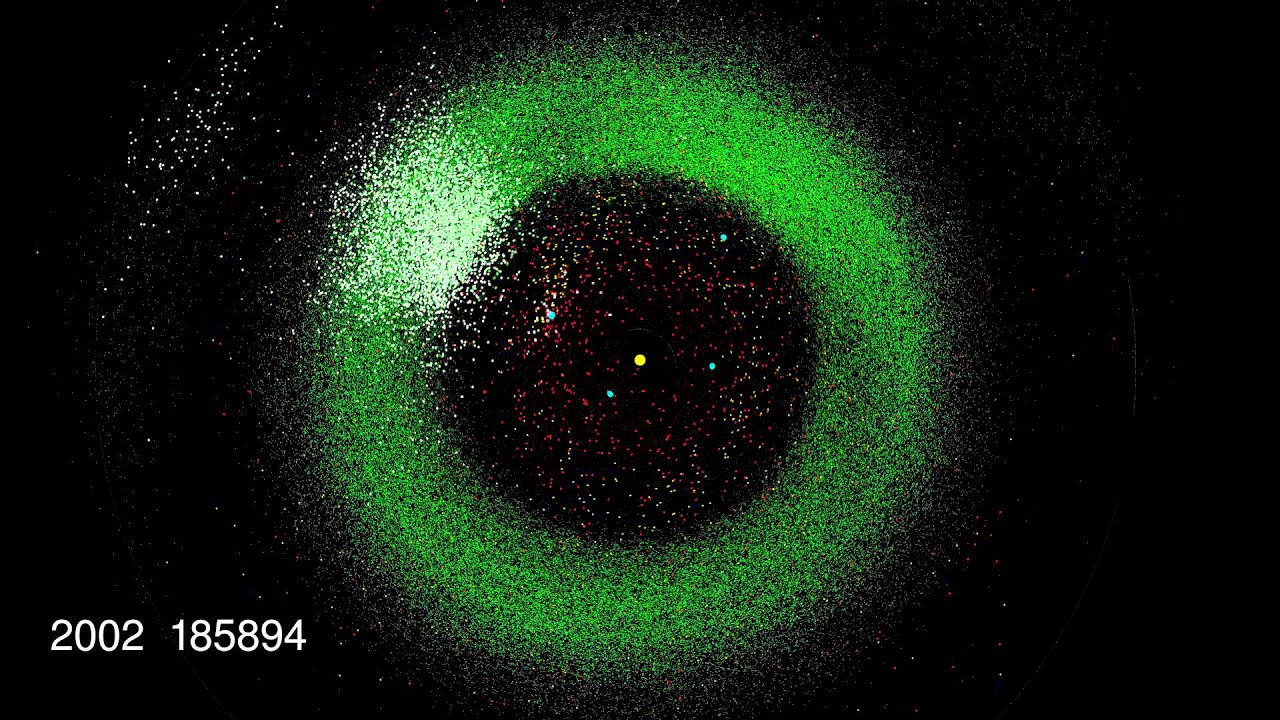
Dedicated automated sky survey programs deployed since the late 1990s drove a dramatic surge in detection rates, filling the inner solar system with tracked orbital paths by 2015.
AI-assisted summary of Asteroid Discovery - 1970-2015 - 8K resolution — original source. Check the original for full context.
Source published:
Key ideas
- Scott Manley presents an updated 8K resolution visualization illustrating the progressive discovery and mapping of asteroids in the solar system between 1970 and 2015. (0:00)
- The visualization documents a dramatic acceleration in mapped minor planets and near-Earth objects from the late 1990s through 2015, driven by automated digital sky surveys. (3:11)
- The entire production relies on visual data progression paired with Kevin MacLeod's instrumental track 'Thinking Out Loud' rather than spoken narration. (0:00)
Detailed notes
## Background Published on YouTube by Scott Manley on September 24, 2015, this video presents an updated 8K resolution rendering of his well-known asteroid discovery visualization. The video description identifies it as the latest edition of the project and attributes the accompanying music to Kevin MacLeod's 'Thinking Out Loud'.
## TL;DR The video offers an instrumental visual chronicle detailing the discovery and orbital mapping of solar system asteroids from 1970 through 2015. Beginning with the relatively slow, manual detection of minor planets and near-Earth objects in the earlier decades, the time-lapse visually tracks the gradual populating of the inner solar system. As the timeline reaches the late 1990s and advances toward 2015, the discovery rate surges dramatically due to automated digital sky surveys. The sequence concludes with a dense, comprehensive structural overview of tracked bodies filling the asteroid belt and crossing planetary orbits.
## Atmosphere & style Lacking any spoken narration, the video possesses a hypnotic, contemplative quality driven entirely by Kevin MacLeod's steady musical score and the continuous flow of data points. Watching the solar system evolve from a vast, mostly empty expanse into an intricate, teeming cloud of orbits creates a compelling sense of scientific momentum and discovery. The mood builds from quiet, deliberate observation into an awe-inspiring visual crescendo as decades of accumulated astronomical data illuminate the screen.
## Bulletin - [00:00](https://www.youtube.com/watch?v=BKKg4lZ_o-Y&t=0s) Scott Manley presents an updated 8K resolution visualization illustrating the progressive discovery and mapping of asteroids in the solar system between 1970 and 2015. - [03:11](https://www.youtube.com/watch?v=BKKg4lZ_o-Y&t=191s) The visualization documents a dramatic acceleration in mapped minor planets and near-Earth objects from the late 1990s through 2015, driven by automated digital sky surveys. - [00:00](https://www.youtube.com/watch?v=BKKg4lZ_o-Y&t=0s) The entire production relies on visual data progression paired with Kevin MacLeod's instrumental track 'Thinking Out Loud' rather than spoken narration.
## Key takeaways - [00:00](https://www.youtube.com/watch?v=BKKg4lZ_o-Y&t=0s) The video provides an 8K visual time-lapse chronicle of solar system asteroid discoveries spanning from 1970 to 2015. - [00:00](https://www.youtube.com/watch?v=BKKg4lZ_o-Y&t=0s) The presentation is completely non-verbal, using the instrumental track 'Thinking Out Loud' by Kevin MacLeod to pace the data animation. - [00:00](https://www.youtube.com/watch?v=BKKg4lZ_o-Y&t=0s) Initial decades of the timeline show a slow, steady discovery rate prior to the deployment of automated digital sky survey technology. - [00:00](https://www.youtube.com/watch?v=BKKg4lZ_o-Y&t=0s) Mapped orbital trajectories gradually populate the inner solar system as the timeline moves forward from 1970. - [03:11](https://www.youtube.com/watch?v=BKKg4lZ_o-Y&t=191s) Discovery rates expand dramatically as the time-lapse reaches the late 1990s, the 2000s, and up through 2015. - [03:11](https://www.youtube.com/watch?v=BKKg4lZ_o-Y&t=191s) The surge in mapped bodies reflects the impact of dedicated digital sky survey programs cataloging small solar system objects. - [03:11](https://www.youtube.com/watch?v=BKKg4lZ_o-Y&t=191s) The visualization demonstrates the dense population of tracked bodies occupying the main asteroid belt and intersecting planetary orbits. - [03:11](https://www.youtube.com/watch?v=BKKg4lZ_o-Y&t=191s) The animation concludes by presenting a comprehensive structural overview of all known asteroids tracked across the solar system as of 2015.
## Detailed walkthrough ### [00:00](https://www.youtube.com/watch?v=BKKg4lZ_o-Y&t=0s) Visualizing Asteroid Discoveries (1970–2015)
The video presents Scott Manley’s 8K resolution visual chronicle tracking the discovery and mapping of asteroids in the solar system from 1970 through 2015. Rather than featuring a spoken lecture or verbal commentary, the entire sequence is driven visually alongside the instrumental track "Thinking Out Loud" by Kevin MacLeod (via Incompetech.com).
The opening minutes progress through the early decades of the timeline, mapping out the slow, steady detection of minor planets and near-Earth objects prior to the advent of automated digital sky surveys. The automated transcription registers only musical score playback throughout this initial span, capturing the rhythm of the visual data time-lapse as the inner solar system gradually populates with mapped orbital trajectories.
- Video release: An updated high-resolution (8K) rendering of Scott Manley's long-running asteroid discovery visualization. - Soundtrack: "Thinking Out Loud" by Kevin MacLeod (ISRC: USUAN1100043).
[03:11:00](https://www.youtube.com/watch?v=BKKg4lZ_o-Y&t=11460s) Modern Sky Surveys and Visual Crescendo
As the visualization advances past the three-minute mark into the late 1990s, 2000s, and 2015, the rate of asteroid discoveries accelerates dramatically, reflecting the deployment of dedicated automated survey programs. The audio continues to be dominated by Kevin MacLeod's score, with the speech-to-text system registering sporadic vocalizations or audio artifacts ("news," "oh," "this is," "great," "so," and "you") against the musical progression.
The animation illustrates the sheer density of tracked bodies filling the asteroid belt and crossing planetary orbits by 2015, culminating in a complete structural view of known objects across the solar system before concluding at the five-minute mark.
## Mentioned Scott Manley, Kevin MacLeod, Thinking Out Loud, Incompetech.com
## Video description The latest version of this famous video.
Music is 'Thinking Out Loud' by Kevin Macleod, Incompetech.com http://incompetech.com/music/royalty-free/index.html?isrc=USUAN1100043
[Source](https://www.youtube.com/watch?v=BKKg4lZ_o-Y)