Mark Rober Lands Eggs From 100,000 Feet Using Mars Entry Hardware
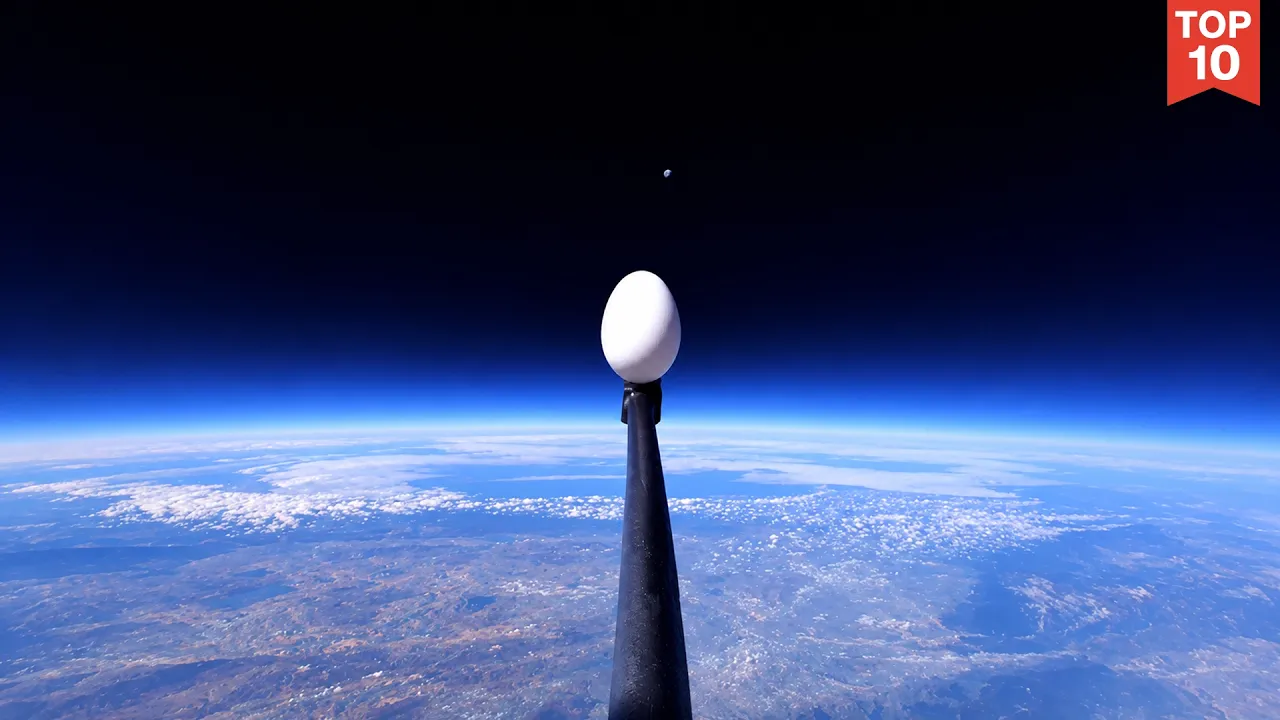
Egg Drop From Space — Mark Rober

Mark Rober

The three-year project succeeded only after abandoning precision fin steering in favor of NASA-style staged aerobraking and an autonomous emergency jettison that saved the payload when the balloon unzipped.

AI-assisted summary of Egg Drop From Space — original source. Check the original for full context.

Source published:

Key ideas

  • Mark Rober completed a three-year engineering project dropping a raw egg from the stratosphere (over 100,000 feet) to establish a future-proof world record without building-height limitations. (0:00)
  • Following an FAA and missile guidance warning from Mars rover chief engineer Dr. Adam Steltzner, the team abandoned autonomous fin-guided mattress targeting in favor of Mars entry, descent, and landing architectures. (10:33)
  • At 100,000 feet, the zero-pressure balloon's termination cord twisted and unzipped prematurely, but an autonomous 20,000-foot abort sequence successfully saved the primary payload. (21:30)
  • Both the primary rocket capsule and a redundant beach ball payload survived atmospheric descent and impact with zero cracked eggs, confirmed on-site by NASA engineer Al Chen. (23:17)

Detailed notes

## Background Published on YouTube by Mark Rober on November 25, 2022, this video documents a three-year endeavor to create a future-proof world record egg drop from the upper atmosphere. The description jokes about attempting the feat on Mars next year while promoting his CrunchLabs toy subscription, highlighting test footage from collaborator Joe Barnard, and thanking Night Crew Labs for their high-altitude balloon assistance.

## TL;DR Mark Rober sets out to perform an ultimate egg drop from the edge of space using an unpowered rocket designed to break Mach 1 before ejecting an egg onto a ground mattress. After multiple low-altitude tests in Gridley fail due to inverted guidance code, aerodynamic death spirals, and the realization from NASA engineer Adam Steltzner that terminal guidance to a mattress mimics an illegal guided missile, the team completely re-engineers the project with Mars landing heritage. Relocating to the desert, they deploy a zero-pressure balloon carrying a staging rocket with parachutes, airbags, and internal heaters, alongside a redundant shock-absorbing beach ball. When twisted rigging accidentally triggers the balloon's self-destruct rip-cord at 100,000 feet, an autonomous abort sequence successfully ejects the payload at 20,000 feet, delivering two perfectly intact eggs to the desert floor.

## Atmosphere & style The video blends Mark Rober's trademark energetic, educational showmanship with an unusually vulnerable and exhausting emotional arc. Early scenes carry an upbeat, playful maker-lab enthusiasm between Mark and rocketry partner Joe Barnard, but repeated hardware disasters, costly scrubs, and high-altitude crashes introduce real anxiety, financial strain, and personal demoralization. The storytelling shifts between accessible physics lessons and high-tension aerospace drama, culminating in a pulse-pounding recovery sequence across the desert that resolves in joyous, hard-earned triumph alongside NASA flight controller Al Chen.

## Bulletin - [00:00](https://www.youtube.com/watch?v=BYVZh5kqaFg&t=0s) Mark Rober completed a three-year engineering project dropping a raw egg from the stratosphere (over 100,000 feet) to establish a future-proof world record without building-height limitations. - [10:33](https://www.youtube.com/watch?v=BYVZh5kqaFg&t=633s) Following an FAA and missile guidance warning from Mars rover chief engineer Dr. Adam Steltzner, the team abandoned autonomous fin-guided mattress targeting in favor of Mars entry, descent, and landing architectures. - [21:30](https://www.youtube.com/watch?v=BYVZh5kqaFg&t=1290s) At 100,000 feet, the zero-pressure balloon's termination cord twisted and unzipped prematurely, but an autonomous 20,000-foot abort sequence successfully saved the primary payload. - [23:17](https://www.youtube.com/watch?v=BYVZh5kqaFg&t=1397s) Both the primary rocket capsule and a redundant beach ball payload survived atmospheric descent and impact with zero cracked eggs, confirmed on-site by NASA engineer Al Chen.

## Key takeaways - [00:00](https://www.youtube.com/watch?v=BYVZh5kqaFg&t=0s) The project was designed to bypass physical skyscraper height limits by launching the egg into the stratosphere via high-altitude balloon. - [01:11](https://www.youtube.com/watch?v=BYVZh5kqaFg&t=71s) Ground cannon tests confirmed that an unpadded egg can survive an 83 mph impact into a mattress, exceeding its natural 75 mph terminal velocity. - [02:08](https://www.youtube.com/watch?v=BYVZh5kqaFg&t=128s) Mark Rober partnered with BPS.space creator Joe Barnard to handle rocket flight dynamics, telemetry, and autonomous fin steering. - [03:28](https://www.youtube.com/watch?v=BYVZh5kqaFg&t=208s) Pre-flight pad checks failed when metallic tracking tape placed directly over the GPS antenna triggered a premature egg ejection on the ground. - [04:54](https://www.youtube.com/watch?v=BYVZh5kqaFg&t=294s) A single inverted negative sign in the guidance software loop caused the fins to command reverse pitch, sending the first low-altitude test flight into an uncontrollable death spiral. - [07:35](https://www.youtube.com/watch?v=BYVZh5kqaFg&t=455s) High-altitude balloon targeting relies on data from over 1,000 global weather stations that launch radiosonde-equipped balloons twice daily at 00:00 and 12:00 UTC. - [10:33](https://www.youtube.com/watch?v=BYVZh5kqaFg&t=633s) Dr. Adam Steltzner warned that autonomously steering a payload down to a mattress from the stratosphere essentially constituted building an illegal precision-guided missile under federal law. - [10:33](https://www.youtube.com/watch?v=BYVZh5kqaFg&t=633s) The team redesigned the mission profile around Mars EDL heritage, utilizing atmospheric separation, Curiosity rover parachute nylon, and Spirit/Opportunity-inspired landing airbags. - [13:32](https://www.youtube.com/watch?v=BYVZh5kqaFg&t=812s) The first desert attempt was scrubbed when integration revealed the rocket joint lacked lateral bending stiffness to withstand Mach speeds, forcing a delicate helium deflating procedure. - [17:00](https://www.youtube.com/watch?v=BYVZh5kqaFg&t=1020s) Redesign improvements included a rigid structural joint sleeve, closed-loop thermal heaters to stop eggs from freezing in vacuum, and a redundant beach ball drop system. - [21:30](https://www.youtube.com/watch?v=BYVZh5kqaFg&t=1290s) A 10-minute payload spin during ascent inadvertently tightened the balloon's self-destruct rip cord, causing the zero-pressure balloon to unzip and plummet at 100,000 feet. - [23:17](https://www.youtube.com/watch?v=BYVZh5kqaFg&t=1397s) An autonomous sensor failsafe triggered at 20,000 feet, jettisoning the capsule from falling rocket debris and allowing its parachute to deploy successfully. - [23:17](https://www.youtube.com/watch?v=BYVZh5kqaFg&t=1397s) Both the high-tech rocket payload and the redundant beach ball recovered from the desert with their raw eggs completely intact. - [25:15](https://www.youtube.com/watch?v=BYVZh5kqaFg&t=1515s) Mark linked the project's trial-and-error design cycle to CrunchLabs Build Box kits designed to teach kids practical engineering resilience.

## Detailed walkthrough ### [00:00](https://www.youtube.com/watch?v=BYVZh5kqaFg&t=0s) Future-Proofing the World Record Egg Drop

The classic school egg drop competition challenges students to construct a protective apparatus that prevents a delicate, raw egg from shattering when dropped from extreme heights. While Mark Rober initially considered staging his drop from the world's tallest skyscraper, human architecture is a moving target that would inevitably render such an accomplishment obsolete. To establish an unassailable, future-proof world record, Mark resolved to bypass architectural feats altogether and drop an egg directly from outer space. Drawing on his engineering background landing spacecraft on Mars, he expected the project to be technically feasible, yet the three-year endeavor evolved into an overwhelming challenge. As Mark Rober reflects on the ambition and toll of the project, “But what I didn't know is this would be the most physically, financially, and mentally draining video I would ever attempt.”

```mermaid flowchart TD accTitle: Egg Drop Flight Profile accDescr: Sequence of the planned space drop from high-altitude balloon release down to mattress impact. subgraph Ascent ["Ascent Phase"] A["High-Altitude Balloon"] -->|"Lifts rocket to outer space"| B["Thermal Fairing Oven"] end subgraph Descent ["Descent & Guidance"] B -->|"Jettisons fairing"| C["Gravity Acceleration"] C -->|"Breaks Mach 1"| D["Autonomous Fin Guidance"] end subgraph Recovery ["Landing Phase"] D -->|"Releases egg at 300 ft"| E["Egg Free Fall at 75 mph"] E -->|"Impacts target"| F["Landing Mattress"] end ```

The flight architecture relies entirely on gravity and aerodynamics rather than propulsion. A custom rocket carrying the egg inside a heated thermal fairing is hoisted into the upper stratosphere by a high-altitude weather balloon. Upon release, the rocket falls back toward Earth, accelerating past Mach 1 to break the sound barrier. During descent, an onboard flight computer actively manipulates four motorized rear fins to guide the craft along a calculated glide path toward a ground target. At roughly 300 feet above the surface, the nose mechanism releases the egg into a clean free fall, allowing it to drop independently onto a specialized landing mattress placed in the target zone.

- Planned peak speed: Supersonic descent exceeding Mach 1 under gravitational acceleration alone. - Egg release point: 300 feet above the ground. - Primary landing target: An oversized mattress situated in an open recovery field.

---

[01:11](https://www.youtube.com/watch?v=BYVZh5kqaFg&t=71s) Terminal Velocity and the Mattress Proof of Concept

Before constructing high-altitude hardware, the engineering team had to determine whether an unpadded egg falling out of the sky could survive impact on a mattress. Falling objects do not accelerate indefinitely; they reach terminal velocity once the downward pull of gravity equals the upward aerodynamic drag of colliding air molecules. While an adult human's terminal velocity is approximately 120 miles per hour, an egg's lighter mass and shape cap its terminal falling speed at 75 miles per hour.

Unable to convince building managers or corporate legal teams to let them hurl raw eggs off skyscrapers onto mattresses below, Mark improvised a high-velocity ground test rig to simulate the impact. The test mechanism launched an egg directly into the landing cushion at 83 miles per hour—well above its natural free-fall limit. Upon retrieving the egg, the shell remained completely intact without hairline cracks. Evaluating the baseline test, Mark Rober says, “So our mattress will protect an egg even if it's traveling faster than its terminal velocity.”

---

[02:08](https://www.youtube.com/watch?v=BYVZh5kqaFg&t=128s) The Gridley Test Site and Division of Labor

The project relocated to the agricultural community of Gridley, California—the same rural location where Mark previously staged his elephant toothpaste world record. To prepare for an eventual space descent, the team scheduled a low-altitude flight characterization test from 10,000 feet to evaluate aerodynamic steering and descent dynamics. Mark partnered with Joe Barnard, the self-taught aerospace developer behind the channel BPS.space, who gained acclaim in the maker community by achieving propulsive, vertical model-rocket landings reminiscent of SpaceX Falcon boosters.

Joe assumed control of the rocket's flight dynamics, designing the telemetry, flight computer, and four actuated tail fins required to navigate toward the landing zone. Mark took charge of the payload bay: engineering a heated thermal enclosure to keep the egg from freezing solid during the frigid balloon ascent, breakaway fairing doors, and a mechanical release system to eject the egg just above the ground. In the middle of an open field, they arranged an enormous array of mattresses designed to give the guided rocket a forgiving target. Looking over the mounting logistical variables, Mark Rober remarks, “What could possibly go wrong besides like 4,000 things?”

- Division of responsibilities: Joe Barnard led avionics, telemetry, and steering fins; Mark Rober built the payload bay, heating enclosure, and egg release servo mechanism. - Primary test objective: 10,000-foot drop characterization to validate fin-based flight steering before committing resources to an orbital-edge balloon launch.

---

[03:28](https://www.youtube.com/watch?v=BYVZh5kqaFg&t=208s) Sourcing the Supersonic Egg and Dumb Failure Number One

To procure an authentic test egg, Mark visited a local Gridley farm coop, gingerly navigating squawking, pecking hens to extract a fresh egg from a nesting box. Celebrating the pickup, Mark proclaimed the hen's contribution as the first egg in history destined to fly supersonic at Mach 1. The team then assembled at 4:00 AM the following morning to take advantage of dead-calm atmospheric conditions before ground winds kicked up.

During final pad checks, the team added an improvised strip of metallic tracking streamer to the rear airframe so observers on the ground could spot the rocket against the sky. Joe ran through the redundant systems built into the avionics, noting dual leads, dual igniters, and twin servos on the fairing. Joe Barnard proudly emphasizes their precautions right before everything goes sideways: “No dumb failures.”

Moments later, the pad experienced its first failure. While carrying the suspended vehicle to the balloon, the flight computer's GPS malfunctioned, triggered the premature release sequence, and unexpectedly ejected the egg straight onto the dirt. The scrub forced them to vent the balloon's costly helium charge—a disappointment Mark softened by taking deep hits of the gas to deliver high-pitched commentary. Back in the workshop, diagnostic logs revealed that the metallic tracking streamer had been taped directly over the rocket's GPS antenna. The resulting signal interference corrupted the velocity math in the computer, tricking the firmware into reading an active drop sequence and dumping the egg.

---

[04:54](https://www.youtube.com/watch?v=BYVZh5kqaFg&t=294s) Flight Attempt One: The Rogue Negative Sign and Death Spiral

The following morning brought calmer winds but temperatures 20 degrees colder, leaving the mattress landing array stiff and partially frozen. Having replaced the metallic tracking streamer with non-conductive plastic film, Mark transported the armed rocket out to the balloon release site, and ground control successfully sent the stack into the air. Visual tracking held steady through early ascent, but telemetry quickly exposed an operational problem: the balloon's lift rate was significantly lower than pre-flight calculations had estimated.

```mermaid flowchart LR accTitle: Flight One Anomaly Flow accDescr: Sequence of errors during the first 10,000-foot flight test leading to the death spiral and fix. A["Slow Balloon Ascent"] --> B["Wind Drifts Stack Far South"] B --> C["Manual Ejection Triggered"] C --> D["Fins Command Reverse Pitch"] D --> E["Uncontrolled Death Spiral"] E --> F["Rocket Ground Crash"] F --> G["Code Review: Fix Single Negative Sign"] ```

Pushed along by upper-level winds while climbing too slowly, the craft drifted far to the south of its intended release window. Seeing the vehicle wander off its ascent profile, Joe Barnard warns, “We're already south, and we're only halfway up.” Recognizing that the unpowered rocket lacked the glide ratio to fight crosswinds back to the mattress, the team issued a manual drop command.

The moment the rocket decoupled, the active guidance fins failed to stabilize its heading. Instead of pitching toward the coordinates, the control surfaces violently induced a rapid spin, sending the vehicle into an uncontrolled death spiral. The rocket slammed into the ground at high speed. Mark and Joe tracked down the wreckage in an open pasture—briefly interrupted by Mark chasing a flock of resting birds across the grass. At the crash site, they found the release chute extended and the egg bay empty, proving the mechanical release had fired before impact. Joe reviewed the telemetry logs and onboard firmware that evening and discovered a single rogue negative sign in the control loop code: the guidance software had been commanding the control fins in reverse, exponentially amplifying roll rather than correcting it.

- Flight failure root cause: An inverted sign in the flight software control algorithm drove the fins hard-over into an uncontrollable spiral. - Positive takeaway: The physical payload mechanism and mechanical egg ejection chute operated as intended prior to ground impact.

---

[07:35](https://www.youtube.com/watch?v=BYVZh5kqaFg&t=455s) The Final Gridley Attempt and Atmospheric Drift Science

With replacement components and balloon supplies exhausted, the team faced their absolute final opportunity to validate the flight system at low altitude. A failure here would terminate the project, as an unproven control package could not be trusted on an ascent to space. Mark set up at the mattress site, knowing the entire program hinged on the next forty minutes. Looking around at the massive landing zone, Mark Rober says, “I'm standing in the middle of the world's largest mattress where hopefully the egg will be landing in like 45 minutes.”

Targeting a stationary landing pad using an unpowered balloon ascent requires meticulous wind profiling. High-altitude balloons cannot steer actively; their horizontal drift is dictated entirely by the wind speed and direction within every atmospheric layer they climb through. To place a balloon directly over a target at 10,000 feet, technicians model the forecasted wind shears and select a launch site miles upwind, allowing ambient currents to carry the rig over the target at drop altitude.

Predictive drift models rely on an international meteorology network. Twice every day, at precisely noon and midnight London time (UTC), technicians at more than one thousand designated stations worldwide release weather balloons simultaneously. Each balloon carries a specialized instrument package called a radiosonde, transmitting live altitude, pressure, humidity, and temperature data to construct the atmospheric profile required for flight planning.

- Global sounding frequency: Twice daily at 00:00 and 12:00 UTC across more than 1,000 stations. - Primary sounding payload: Radiosondes measuring atmospheric pressure, temperature, altitude, and drift vectors.

[09:15](https://www.youtube.com/watch?v=BYVZh5kqaFg&t=555s) The Third Attempt and the Weather Balloon Fleet

Mark explains the broader science behind their launch method: roughly 2,000 massive weather balloons are released across the globe every day. They measure atmospheric temperature and wind, continuously transmitting that data back to ground supercomputers, which makes modern weather forecasting remarkably accurate. Once they reach high altitudes, the balloons burst and plummet to Earth, prompting hobbyists to hunt them down by their transmitted signals.

On their third test launch, the team releases the rocket directly within the target drop zone. Tracking telemetry in real time, Joe calls out the dropping altitude:

``` Joe: "400." Joe: "Altitude 98 meters." ```

Mark screams with excitement as the payload slams into the ground nearby, exclaiming, “That was exhilarating.” While the rocket managed to steer slightly in the right direction and landed far closer to the target than previous tries, the egg did not survive. When Joe locates the impact point and inspects the cargo, he delivers the verdict: “I mean, it's not not cracked.”

[10:33](https://www.youtube.com/watch?v=BYVZh5kqaFg&t=633s) The Adam Steltzner Reality Check and the Mars Architecture Pivot

With three consecutive failures, Mark realizes they need outside expertise and calls up his former colleague Dr. Adam Steltzner—a Caltech PhD holder, the lead engineer famous for the Curiosity Mars rover's sky crane landing, and Chief Engineer for both the Perseverance rover and the Mars Sample Return mission.

After hearing Mark explain their setup—guiding an egg down from space to hit a mattress in a small town—Adam cuts straight through the fantasy: “And you're doing terminal guidance to something about the size of a house. How are you gonna do that? How do you do that? I mean, I know how you physically do that. How do you not get busted by the FAA?” He drives the point home even more bluntly: “Dude, there are thousands of people who have done this before, and they are sworn by federal law not to say a single [beep] word to you.” Mark acknowledges that by attempting to hit a mattress autonomously from the stratosphere, they were essentially building an illegal precision-guided missile—and publishing a how-to tutorial on YouTube would carry massive legal and ethical risks.

Following Adam's advice on atmospheric heating and staged deceleration, the team completely discards their old architecture and moves the test to an open desert. They redesign the flight system from scratch over several months, adopting the proven entry, descent, and landing profile of Mars missions:

```mermaid flowchart TD accTitle: Desert Egg Drop Architecture accDescr: Sequence showing how the redesigned rocket ascends by balloon, achieves supersonic descent, stages, aerobreaks, deploys parachutes, and cushions the landing.

subgraph Ascent ["Ascent Phase"] A["Zero-Pressure Weather Balloon"] --> B["High-Altitude Release"] end

subgraph Supersonic ["Supersonic Descent"] B --> C["Heavy Rocket with Fixed Fins\n(Hits Supersonic Speeds)"] end

subgraph Staging ["Atmospheric Staging & Aerobraking"] C --> D["Mid-Descent Separation of Aft Body"] D --> E["Lighter Forward Payload Naturally Aerobreaks"] end

subgraph Landing ["Terminal Deceleration & Impact"] E --> F["Deploy Parachute (Curiosity Nylon)"] F --> G["Jettison Nose Cone"] G --> H["Inflate Airbags (Spirit/Opportunity Heritage)"] end ```

To execute this architecture, the new rocket features rigid, non-moving fins and is engineered to be three times as long and four times as heavy as the prior prototype to guarantee supersonic velocity on re-entry. Halfway down, the vehicle separates from its heavy aft section, radically shedding weight so the forward payload naturally aerobrakes to a lower terminal velocity. It then deploys a parachute cut and sewn from an authentic spare nylon swatch from the Curiosity rover's actual 80-panel landing parachute, followed by jettisoning the nose cone to expose impact-absorbing airbags modeled on the Spirit and Opportunity Mars Exploration Rovers.

[13:32](https://www.youtube.com/watch?v=BYVZh5kqaFg&t=812s) The Desert Scrub and the Integration Failure

The night before the launch, the team works late into the night at their desert hotel finalizing hardware for the three-year passion project. Mark reflects that despite all the preparation, “it was the laws of physics that would ultimately determine our fate.” Early the next morning, the launch crew from Night Crew Labs begins inflating a specialized zero-pressure balloon using four large helium tanks. Unlike common closed latex balloons that burst at peak altitude, zero-pressure balloons are open at the bottom to equalize internal and external pressure, allowing them to stay aloft indefinitely, carry heavier payloads, and float higher. When terminating the flight, an operator sends a radio command that pulls an integrated tear-line string down the side, splitting the plastic envelope open like a zipper.

An hour into inflation, the operation hits a catastrophic snag. Because the balloon film is extraordinarily thin and delicate—requiring handlers to wear gloves to prevent micro-abrasions—Mark is forced to call an immediate halt to the fill:

> “Hey, dude, I got bad news. We have to scrub, start taking the helium out of the balloon.”

Joe had built the aft propulsion/fin assembly while Mark's shop handled the forward payload and airbag module. While both halves had been independently verified, they had not been mechanically mated until the launch field that morning. Under handling, Mark discovers a massive structural flaw: the joint between the two sections possessed plenty of tension and compression strength along its axis, but lacked the lateral stiffness needed to counter bending moments.

> “The problem is this is so long and heavy, as soon as it wiggles, it's going to want to bend. Great tension compression. But this happening at Mach Two is... that's not gonna work out.”

Because large zero-pressure balloons are in extremely short supply—this was the only balloon of its class they could source for at least a month—they are forced to painstakingly reverse the pumping process to extract the helium, praying the delicate material does not tear during packing. Mark calls the scrub an absolute personal low point: “The integration of two independent systems is such a classic failure point in engineering. I was crushed, I had missed this, and financial concerns aside, I felt like I had just let everyone down.”

[17:00](https://www.youtube.com/watch?v=BYVZh5kqaFg&t=1020s) Resiliency and the Four Engineering Upgrades

Turning the defeat into a teachable moment, Mark points out that failing is simply discovering one more way not to do something. He connects this resilient engineering mindset directly to his educational kit company, CrunchLabs, where kids build hands-on mechanical toys via the monthly Build Box.

To eliminate every point of failure for their final desert launch attempt, Mark and his engineering team commit to four major redesign priorities:

- **Structural Sheath Joint and Pyrotechnic Staging:** Replacing the flexible connection with a rigid structural sleeve designed to absorb lateral bending moments, paired with an autonomous black-powder separation charge to sever the two rocket halves at altitude. - **Thermal Vacuum Egg Protection:** Testing raw eggs inside vacuum and sub-zero thermal chambers, which revealed that during the two-hour ascent to space, extreme cold and zero atmospheric pressure freeze and crack eggs without active protection; they installed closed-loop heaters inside the payload core. - **Space-Grade Hardware Redundancy:** Emulating NASA planetary mission design principles—where hardware cannot be serviced after launch—by adding backup systems across critical flight channels, drawing on Mark's personal experience designing the Curiosity rover's sample manipulation arm hardware.

[18:27](https://www.youtube.com/watch?v=BYVZh5kqaFg&t=1107s) Redundant Solutions and Terminal Velocity Drop Tests

Drawing on NASA's principle of engineering redundancy—such as the Mars rover belly having two identical doors leading to the exact same compartment in case one ever fails—the team devised a radically simple backup plan. They created a custom, two-foot-wide beach ball stuffed with packing materials and a second egg, trailing a 20-foot streamer off the back. Designed to drop like a rock without any parachutes, complex release mechanisms, or autonomous timing sequences, Mark Rober explained: “This would be our redundant yet I would argue kind of boring second chance opportunity to land a safe egg.”

To validate both descent vehicles before heading back into the field, they transported the setups to a local crane yard to simulate impacts at their calculated terminal velocities. Releasing the beach ball first from the crane produced an audible sigh of relief when the interior egg remained completely intact. They followed with the rocket payload's final landing configuration, where the custom rover parachute deployed and held up under load, confirming the airbags and shock-absorbing systems were finally ready.

- The redundant system utilized a custom 2-foot beach ball packed with cushioning and a 20-foot drag streamer. - Drop tests at the crane yard verified terminal velocity survival for both the beach ball and the rocket parachute assembly.

[19:31](https://www.youtube.com/watch?v=BYVZh5kqaFg&t=1171s) The Fifth Desert Launch and Al Chen's Arrival

After enduring four failed launch campaigns over three long years, the crew set off on the six-hour drive back into the desert, feeling cautiously optimistic. They were immediately greeted by two encouraging developments. First, they verified the structural integrity of their zero-pressure balloon. Because these thin balloons are impossible to source quickly and even light handling can stress the film and cause micro-tears, they had to reuse the fragile unit from the prior attempt. Mark obsessively monitored a hanging fish scale measuring the balloon's lift: “The force reading is 37.6 kilograms of buoyancy force pulling this up. Importantly, it's not changing. If it were changing and going down, that means we would have a leak.”

The second morale boost came in the person of NASA engineer Al Chen, Rober's longtime friend and good-luck charm, famous for announcing Curiosity's touchdown with the historic words: “Touchdown confirmed we're safe on Mars.” Chen was brought in so that if the drop succeeded, he would deliver the official call. With all pre-flight checklists cleared, the ground crew counted down from three and released the balloon. The balloon ascended smoothly at the exact predicted climb rate, taking about two hours to reach float altitude. Once it passed 30,000 feet, Mark and the team packed into chase vehicles to begin the 45-minute drive toward the downrange landing area.

```mermaid flowchart TD accTitle: Desert Launch and Tracking Flow accDescr: Sequence of events from pre-flight balloon checks through ascent to 100,000 feet. subgraph PreLaunch ["Pre-Launch Verification"] A["Buoyancy Scale Check: 37.6 kg holding steady"] --> B["Al Chen Arrives as Mission Flight Controller"] end subgraph Ascent ["Ascent Milestones"] B --> C["Liftoff: Zero-pressure balloon ascends"] C --> D["30,000 ft: Chase vehicles depart for landing zone"] D --> E["100,000 ft (19 miles): Visual sighting from ground"] end ```

[21:30](https://www.youtube.com/watch?v=BYVZh5kqaFg&t=1290s) Catastrophe at 100,000 Feet: The Self-Destruct Unzip

While tracking the balloon from the road, the team hit a major altitude milestone as the telemetry crossed 100,000 feet—over 19 miles high and roughly two and a half times the cruising altitude of a commercial airliner. Looking through binoculars, they could plainly see the balloon expanded against the dark sky. The celebration was cut short when Joe noticed through his optics that the balloon suddenly seemed to shrink and vanish, moments before the tracking team called in the bad news: the balloon had plummeted 30,000 feet in just two minutes.

While zero-pressure balloons are not supposed to burst like latex balloons, telemetry revealed an unforeseen mechanical chain reaction. Over a ten-minute span, the suspended rocket and beach ball had steadily spun relative to the balloon overhead. This rotation twisted the suspension rigging tighter and tighter until the cord pulled down on the emergency flight-termination lanyard. As Mark recounted: “It pulled down on the balloon string that is designed to essentially unzip and destroy itself.” Without having ever triggered the command to release either egg vehicle, the entire tangled assembly began falling toward Earth at 150 miles per hour.

```mermaid flowchart TD accTitle: In-Flight Failure and Autonomous Abort accDescr: Mechanics of the balloon failure followed by autonomous payload separation. subgraph Failure ["100,000 ft: Inadvertent Termination"] F1["Rocket and Beach Ball spin under balloon"] --> F2["Rigging twists self-destruct lanyard tight"] F2 --> F3["Rip-line pulled: Balloon unzips"] F3 --> F4["Tangled mass plummets at 150 mph"] end subgraph Abort ["20,000 ft: Autonomous Recovery"] F4 --> A1["Autonomous sensor detects 20,000 ft threshold"] A1 --> A2["Payload forcibly ejects from tangled rocket"] A2 --> A3["Orange parachute deploys and cushions impact"] end ```

[23:17](https://www.youtube.com/watch?v=BYVZh5kqaFg&t=1397s) Desert Recovery: Two for Two from Space

Mark described the frantic drive toward the crash coordinates as their "Apollo 13 moment." Survival depended entirely on an automated failsafe programmed into the rocket: if the core payload could autonomously jettison itself from the descending wreckage once it crossed 20,000 feet, it could still deploy its orange parachute and cushion the egg with its airbags. Arriving in the desert about two miles out from the coordinates, the crew began combing the terrain on foot until they spotted the parachute resting alone on the desert floor, proving the autonomous separation logic had fired perfectly mid-descent.

Crowding around the capsule, Mark wiped away dirt to peek through the viewport, unsure whether the egg inside had survived the violent abort. Carefully unscrewing the capsule hatch, they pulled out an intact, uncracked egg that was noticeably warm from the journey. Al Chen made the official call: “Touchdown confirmed. We're safe on earth.” To complete the sweep, they hiked out to find the redundant beach ball, which had also impacted cleanly. Opening its packaging revealed that its egg was equally pristine, securing a perfect two-for-two success after three years of attempts. Reflecting on the journey, Mark noted that while plans rarely execute cleanly, engineering tenacity and learning from failure can overcome almost anything.

- The primary payload autonomously ejected from the falling debris at 20,000 feet, deploying its orange parachute. - Both the primary space capsule egg and the backup beach ball egg survived terminal velocity impacts with zero cracks. - NASA's Al Chen delivered the mission's official landing confirmation call in the field: “Touchdown confirmed. We're safe on earth.”

[25:15](https://www.youtube.com/watch?v=BYVZh5kqaFg&t=1515s) CrunchLabs Build Box and Engineering Mindset

Connecting the multi-year egg drop project back to everyday engineering, Mark highlighted that hands-on failure and troubleshooting are the best ways to learn physics. He introduced the CrunchLabs Build Box, a monthly subscription service delivering hands-on engineering kits directly to households. Each monthly box is paired with an exclusive video where Mark guides subscribers through the assembly and explains the underlying physics principles, focusing on building practical problem-solving skills and resilience.

Rober showcased several upcoming build projects, including an ultra-accurate rapid-fire disc launcher, a mechanical linkage drawing machine, and a Rube Goldberg-style catapult launcher. He also shared details about the physical CrunchLabs facility where the projects are engineered, which features a tennis ball cannon, the world's longest Hot Wheels track, and a massive foam pit. Monthly box recipients also have the chance to find a platinum ticket, granting winners and their families an all-expenses trip to tour CrunchLabs and build inventions alongside Mark and his design team.

- Mark highlighted the educational philosophy of the program: “You're basically unlocking your own personal Mark Rober video every month where you learn a new engineering principle that will have you not just building like an engineer, but more importantly thinking like an engineer.” - Featured kit examples included a rapid-fire disc launcher, a linkage-driven drawing machine, and a chain-reaction catapult. - Monthly kits include a chance to discover a platinum ticket for a family visit to the CrunchLabs facility.

## Notable quotes > [13:32](https://www.youtube.com/watch?v=BYVZh5kqaFg&t=812s) The integration of two independent systems is such a classic failure point in engineering. — Mark Rober

## Mentioned Mark Rober, Joe Barnard, Adam Steltzner, Al Chen, BPS.space, Night Crew Labs, CrunchLabs, Curiosity rover, Perseverance rover, Mars Sample Return mission, Spirit and Opportunity rovers, NASA, FAA, Caltech, Gridley, California

## Video description Next year we’re doing this on Mars.

Get your CrunchLabs Toys today: https://crunchlabs.com/ToysYT

You should also go subscribe to the Crunchlabs YouTube channel cause we’ve got some bangers in the pipeline- https://www.youtube.com/crunchlabs

You can check out Joe’s video that goes into some more detail about the testing here- https://youtu.be/5tQ6OTJdhns

Shout out to my friends at Night Crew Labs who did all the high altitude balloon work. You can hire them too! Learn more at: www.nightcrewlabs.com

Also thanks to these folks for providing some of the music in the video:

Laura Shigihara - https://www.youtube.com/supershigi Ponder - https://youtube.com/@Pondermusic Andrew Applepie - https://soundcloud.com/andrewapplepie Blue Wednesday - https://soundcloud.com/bluewednesday

NO PURCHASE NECESSARY. Promotion starts on 1/1/2023 & ends on 12/31/23, subject to monthly entry deadlines. Open to legal residents of the 50 U.S. & D.C., 18+. 1 prize per month: each month is its own separate promotion. For the first 2-3 months, winner may be notified via phone call instead of winning game piece. If a monthly prize is unclaimed/forfeited, it will be awarded via 2nd chance drawing. See Official Rules at crunchlabs.com/sweepstakes for full details on eligibility requirements, how to enter, free method of entry, prize claim procedure, prize description and limitations. Void where prohibited.

[Source](https://www.youtube.com/watch?v=BYVZh5kqaFg)

中文简报

马克·罗伯利用火星着陆硬件实现10万英尺高空扔鸡蛋 这项历时三年的项目在放弃精确舵面转向、转而采用类似NASA的分段气动减速技术后才取得成功;当气球撕裂时,自主紧急抛投系统挽救了有效载荷。 马克·罗伯试图从太空边缘进行终极“高空扔鸡蛋”实验,最初计划使用无动力火箭突破1马赫,再将鸡蛋弹射至地面的床垫上。在格里德利进行的多次低空测试中,由于导引代码倒置、气动死亡螺旋,以及NASA工程师亚当·施特尔茨纳指出引导飞向床垫的操作涉嫌违规制造制导导弹,团队彻底重构了方案,转而借鉴火星着陆技术。转移至沙漠后,他们放飞了一个零压气球,携带配备降落伞、安全气囊和内部加热器的分级火箭,以及一个作为备用减震方案的沙滩球。在10万英尺高度,扭曲的绳索意外触发了气球自毁拉绳,但自主中止程序在2万英尺处成功弹射有效载荷,最终将两枚完好无损的鸡蛋送达沙漠地面。 马克·罗伯完成了一项为期三年的工程项目,从平流层(超过10万英尺高空)投放生鸡蛋,以建立一项不受建筑物高度限制、面向未来的世界纪录。 (0:00) 在收到火星探测器总工程师亚当·施特尔茨纳博士关于FAA和导弹制导的相关警告后,团队放弃了利用舵面自主制导瞄准床垫的方案,转而采用火星进入、下降和着陆(EDL)架构。 (10:33) 在10万英尺高度,零压气球的中止绳索发生缠绕并过早撕裂气球,但一套在2万英尺启动的自主中止程序成功挽救了主载荷。 (21:30) 主火箭舱和备用的沙滩球载荷均在大气层下降和撞击中幸存,且鸡蛋均未破裂,现场由NASA工程师陈艾伦(Al Chen)确认。 (23:17)

Reading summary

Former NASA engineer Mark Rober spent three years attempting to create an unassailable world-record egg drop from the stratosphere, transforming an initial concept that mimicked precision missiles into a Mars-rover-inspired atmospheric descent architecture. Initial Supersonic Concept and Early Failures (0:00) Rober initially set out to drop an unpadded raw egg from outer space into an array of mattresses on the ground, bypassing architectural drop records. While ground rig testing confirmed that an unpadded egg could survive mattress impact at 83 miles per hour—exceeding its 75 mph terminal velocity—low-altitude 10,000-foot trials in Gridley, California, exposed severe design flaws. Partnering with aerospace maker Joe Barnard, early tests suffered from metallic tape blocking the GPS antenna, an inverted sign in the flight code that spun the rocket out of control, and complex atmospheric drift that caused test payloads to miss the mattress array and break upon ground impact. Regulatory Hurdles and Mars-Heritage Redesign (10:33) Following consecutive failures, Rober consulted Dr. Adam Steltzner, Chief Engineer for the Mars Perseverance rover. Steltzner warned that attempting autonomous terminal guidance to steer an egg onto a house-sized mattress risked violating federal laws governing precision-guided weapons and FAA airspace rules. Consequently, the team abandoned the guided mattress approach and relocated to an open desert, adopting planetary entry, descent, and landing techniques. Atmospheric Staging and Hardware Redundancy The revised vehicle utilized a heavy rocket body with fixed fins designed to plunge at supersonic speeds, aerobreak by staging away its aft section, and land using shock-absorbing airbags and a parachute cut from spare Curiosity rover nylon. To survive the extreme environment, the egg bay incorporated internal heaters to prevent freezing during balloon ascent. Adopting NASA's core philosophy of redundancy, the team also deployed a secondary, non-mechanical backup vehicle: a cushioned two-foot beach ball with a 20-foot drag streamer. Mid-Flight Catastrophe and Autonomous Recovery (21:30) During the final launch, a reused zero-pressure balloon lifted the dual payload toward float altitude. At 100,000 feet, the suspension assembly twisted beneath the balloon, inadvertently yanking the emergency flight-termination rip cord and causing the balloon to unzip and plunge at 150 miles per hour. An autonomous failsafe logic saved the mission: detecting the 20,000-foot altitude threshold during the fall, the primary capsule forcibly separated from the debris, inflated its airbags, and deployed its parachute. Both the primary capsule and the backup beach ball were recovered in the desert with their eggs completely intact. The three-year endeavor ultimately validated the effectiveness of NASA-style redundant engineering and autonomous abort programming over rigid precision targeting, though the final success relied on mid-air contingency systems after a structural failure in the primary lift platform.

精炼阅读摘要

前NASA工程师Mark Rober历时三年发起从平流层空投生鸡蛋的极限挑战,试图建立无法被更高摩天大楼超越的世界纪录。在经历硬件信号屏蔽、飞控代码反转以及面临制造非法制导武器的法律红线后,团队全面移植火星探测器的降落减速架构与双重冗余方案,最终在气球意外撕裂的坠落事故中依靠自主应急系统成功让两枚生鸡蛋完好着陆。 物理极限验证与精确制导构想的挫败 (1:11) 在方案初期,团队首先验证鸡蛋落地能否依靠缓冲存活。自由落体受空气阻力制约存在终端速度,成年人约为每小时120英里,而轻质蛋体由于质量与外形限制仅为75英里。地面冲击测试将生鸡蛋以83英里(超终端速度)发射至床垫阵列,证实了外壳不破损的可行性。随后,Mark Rober与航空航天创作者Joe Barnard在加州Gridley农区展开一万英尺低空测试,但接连遭遇严重故障:用于肉眼追踪的金属反光条遮挡了GPS天线,导致飞控误判速度提前抛蛋;紧接着的试飞中,飞控代码出现一个负号反转,导致尾翼反向修正,将火箭推入剧烈失控的死亡螺旋并撞毁于地面。 更为根本的危机在于系统可行性与法律边界。团队原设想由气球升空、依靠四片可动尾翼自主滑翔并在离地300英尺将蛋投至床垫。前NASA好奇号与毅力号火星车首席工程师Adam Steltzner博士明确警告,从平流层主动精确制导撞击房屋大小的固定目标,本质上等同于研制受联邦法律严格管制的军用精确制导导弹,在公开网络发布技术细节具有严重的违法与伦理风险,该方案随即被全盘废除。 全面转向火星降落架构与系统级冗余 (10:33) 移师开阔沙漠后,团队彻底弃用主动制导撞击床垫的原案,全面采用经验证的火星进入、下降与着陆(EDL)工程模型。新型火箭采用固定尾翼,长度与重量增至旧原型的三倍与四倍以确保重返大气层突破超音速;下降中途通过黑火药分离沉重尾段进行气动减速,再展开由好奇号备用降落伞尼龙材料剪裁缝制的减速伞,并在抛离整流罩后弹出仿照勇气号与机遇号火星车气囊的缓冲充气包。为抵抗两小时平流层爬升过程中的极度严寒与近乎真空环境,核心载荷舱加装了闭环电加热器。 在经历前后舱段因横向抗弯刚度不足导致的发射中止后,团队加装了刚性结构护套套筒以吸收弯矩。与此同时,团队遵循NASA极端冗余原则打造了一个极简备份:一个两英尺宽、塞满缓冲料并拖带20英尺减速飘带的定制沙滩球,内置第二枚鸡蛋,无需任何电子机械机构仅靠纯被动阻力降落。吊车终端速度跌落试验证实沙滩球与主降落伞系统均能保护内部鸡蛋免于破裂。 十万英尺高空意外撕裂与自主应急生还 (21:30) 在第五次沙漠发射中,团队使用悬挂秤确认了零压气球37.6千克的稳定浮力,并邀请曾宣布好奇号成功着陆的名言播报者Al Chen担任现场控制员。气球在两小时内平稳爬升至100,000英尺(约19英里),约为民航客机巡航高度两倍半。然而在浮空高度,悬吊的火箭与沙滩球在无动力状态下持续旋转,导致吊索相互绞紧并最终强行拽动了紧急自毁拉绳。这根类似拉链的自毁线瞬间撕裂了脆弱的超薄塑料囊体,导致整个未解耦的组合体以每小时150英里的速度向地面坠毁。 关键时刻,火箭内置的20,000英尺自主应急程序发挥了作用。当传感器检测到残骸坠过两万英尺高度阈值时,控制系统强制将主载荷舱从缠绕的残骸中弹射分离,成功展开橙色降落伞并激活缓冲气囊。地面搜救队在沙漠深处寻获了主舱与沙滩球:主舱鸡蛋在加热装置保护下温热且毫发无损,沙滩球内的备用鸡蛋同样完好无缺。Al Chen随即正式宣布双蛋安全着陆,达成了历经三年挫折后的二发二中。 失败驱动的工程韧性与CrunchLabs教育 (25:15) Mark Rober总结指出,工程中的每一次失败都是排除一种不可行方案的必经之路,严谨面对物理法则并保持韧性才是解决工程难题的基石。他将源自NASA航天工程的排障思路与设计逻辑延伸至其创立的CrunchLabs教育平台,通过每月递送的Build Box机械套件引导青少年亲手组装连发飞盘发射器、连杆绘图机及投石机等装置,旨在让学习者在亲身试错中建立工程直觉与物理法则认知。 Mark Rober的太空空投生鸡蛋项目表明,即使是看似纯娱乐性质的物理极限挑战,一旦跨越至极端物理环境,也必须面对与航天防务工程相同的材料力学、气动控制及法律合规约束。尽管最终升空因意外拉脱自毁线打乱了既定的超音速滑翔测试流程,但航天级的多级应急逻辑与极端冗余备份成功抵御了系统崩溃,印证了系统冗余与容错架构在极端未知环境中的决定性价值。

Detailed notes — zh

## Background 该视频由知名科普博主 Mark Rober 于 2022 年 11 月 25 日发布在 YouTube 平台。视频简介中,Mark 幽默地宣称“明年我们要在火星上做这个”,并向观众推荐了他的 CrunchLabs 玩具订阅盒与高空气球合作伙伴 Night Crew Labs,同时附带了关于测试细节与背景音乐的致谢及抽奖规则说明。 ## TL;DR 为了创下一项不可超越的“高空掷蛋”世界纪录,前 NASA 工程师 Mark Rober 携手火箭爱好者 Joe 启动了长达三年的太空丢鸡蛋挑战。他们最初尝试用火箭制导将鸡蛋精准投射到农田床垫上,却接连遭遇 GPS 干扰、代码负号错误以及法律与技术上的双重阻碍。在 NASA 专家的建议下,团队彻底重构方案,借鉴好奇号火星车的着陆架构,改用零压气球将火箭运至 10 万英尺太空边缘,并设计了结合减速伞、缓冲气囊的主载荷以及纯被动的沙滩排球双重冗余方案。最终,即便气球在高空意外自毁并以 150 英里/小时狂暴下坠,机载应急逃逸逻辑成功在 2 万英尺高度弹伞脱困,两枚生鸡蛋奇迹般完好无损地软着陆于荒漠。 ## Atmosphere & style 整个视频洋溢着 Mark Rober 标志性的硬核极客幽默与跌宕起伏的工程叙事,将看似无厘头的疯狂构想包裹在极其严谨的科学探索之中。镜头真实记录了面对数次惨烈炸机、现场临时取消任务以及十万英尺高空意外自毁时的窒息与挫败感,但随后又被团队绝不服输的坚韧迅速点燃。当荒漠中那顶见证过火星历史的橙色降落伞迎风绽放、NASA 专家郑重宣告鸡蛋完好生还时,强烈的戏剧张力与工程浪漫瞬间爆发,带给观众极具感染力的震撼与情感共鸣。 ## Bulletin - [21:11](https://www.youtube.com/watch?v=BYVZh5kqaFg&t=1271s) Mark Rober 历时三年、历经五次尝试,成功将生鸡蛋通过零压气球送至 100,000 英尺(约 30.5 公里)的太空边缘并使其安全完好着陆,创下极限高空掷蛋纪录。 - [10:54](https://www.youtube.com/watch?v=BYVZh5kqaFg&t=654s) 原定利用自主控制舵面将火箭精准引导至地面床垫的方案,因涉嫌触犯精确制导导弹相关联邦法规及严峻的安全风险而被迫彻底放弃,系统转而借鉴 NASA 火星漫游车的减速降落架构。 - [21:11](https://www.youtube.com/watch?v=BYVZh5kqaFg&t=1271s) 最终发射时,气球在十万英尺高空因载荷持续旋转缠绕拉绳而意外触发自毁装置,导致整体以 150 mph 的高速俯冲下坠,所幸两套独立自主逃逸系统在 20,000 英尺成功触发并救回两枚鸡蛋。 - [00:00](https://www.youtube.com/watch?v=BYVZh5kqaFg&t=0s) 项目测试验证了生鸡蛋的自由落体终端速度上限仅为约 75 mph,并在地面弹射实测中证明 83 mph 冲向床垫时鸡蛋仍可完好无损。 ## Key takeaways - [00:00](https://www.youtube.com/watch?v=BYVZh5kqaFg&t=0s) 生鸡蛋自由落体终端速度约为 75 mph(120 km/h),由于空气阻力与重力形成动态平衡,高速撞击合适缓冲介质(如床垫)在物理上是可行的。 - [02:08](https://www.youtube.com/watch?v=BYVZh5kqaFg&t=128s) 首次低空测试因临时粘贴在火箭尾部的金属反光飘带屏蔽了 GPS 天线,导致飞控电脑解算速度异常,在地面提前触发误抛程序。 - [05:05](https://www.youtube.com/watch?v=BYVZh5kqaFg&t=305s) 第二次低空试飞遭遇飞控核心算法中的正负号颠倒错误,使火箭尾翼在倾斜时产生正反馈推力,直接陷入致命的死亡螺旋坠地。 - [08:24](https://www.youtube.com/watch?v=BYVZh5kqaFg&t=504s) 全球 1000 多个气象站每天在格林尼治时间 12:00 与 00:00 同步释放挂载无线电探空仪的气球,为高空轨迹逆推提供了关键的矢量风场数据库。 - [10:54](https://www.youtube.com/watch?v=BYVZh5kqaFg&t=654s) NASA 毅力号总工程师 Adam Steltzner 警告,研制从高空精准命中床垫的自主火箭本质上属于精确制导武器,受联邦法律严格限制且存在重大安全隐患。 - [11:52](https://www.youtube.com/watch?v=BYVZh5kqaFg&t=712s) 团队将降落方案从精确命中床垫转向沙漠软着陆,借鉴好奇号火星漫游车的大气进入技术,采用两级火箭分离、真实火星测试织布降落伞及缓冲气囊。 - [13:32](https://www.youtube.com/watch?v=BYVZh5kqaFg&t=812s) 沙漠初次发射时因前后舱段在发射当天早晨才首次机械整合,导致长重结构缺乏足够的横向抗弯刚度,面临超音速断裂风险而被迫现场抽氦取消。 - [16:17](https://www.youtube.com/watch?v=BYVZh5kqaFg&t=977s) 针对多系统整合失效的教训,团队重构了护套式黑火药分离机构、完成了严苛的太空低温真空保温舱测试,并引入关键子系统双重冗余。 - [18:27](https://www.youtube.com/watch?v=BYVZh5kqaFg&t=1107s) 团队设计了无电控展开、纯靠被动充气结构吸收冲击的沙滩排球作为冗余备份载荷,并在起重机极限下落测试中与主伞降系统一并获得验证。 - [21:11](https://www.youtube.com/watch?v=BYVZh5kqaFg&t=1271s) 发射升空至十万英尺后,载荷长达 10 分钟的自转将安全绳过度绞紧,提前扯动拉链式缝合线触发了零压气球的高空意外自毁。 - [23:05](https://www.youtube.com/watch?v=BYVZh5kqaFg&t=1385s) 预设的 20,000 英尺应急冗余逻辑力挽狂澜,有效载荷成功自主脱离残骸并弹出火星降落伞,主客两枚鸡蛋经由 NASA 工程师现场开箱确认均毫发无损。 ## Detailed walkthrough ### [00:00](https://www.youtube.com/watch?v=BYVZh5kqaFg&t=0s) 太空丢鸡蛋构想与物理测算 在学校常见的“高空掷蛋”(Egg Drop)比赛中,核心目标通常是打造一套防护结构,让生鸡蛋从尽可能高的地方落下而不破裂。Mark Rober 最初构想从全球最高的人造建筑上投掷鸡蛋,但他随即意识到,人类总在建造更高的摩天大楼。为了彻底“一劳永逸”地锁定这项世界纪录,他决定把高度直接拉到极限——送入外太空。他原以为凭借自己在 NASA 工作时将探测器着陆到其他星球的工程经验,拿下这项纪录易如反掌,却未曾料到这竟成了他做过的项目中最令人筋疲力竭、耗费巨资且折磨心智的一次挑战。 整个任务的技术设想非常大胆:首先将一枚生鸡蛋固定在火箭前部,再通过探空气球将其运送至外太空;到达指定高度后,气球释放火箭;火箭仅凭重力加速下坠,速度将突破一马赫(Mach 1,超越音速);下落过程中,火箭尾部的四片舵面会自主调整偏转,引导其朝向地面预设的目标精准飞行;在距离地面仅 300 英尺(约 91 米)的高度,火箭机械机构释放鸡蛋,让鸡蛋以自由落体状态砸向地面铺设的床垫。 为了验证这项计划的可行性,Mark 与团队像真正的工程师一样,把庞大的系统工程拆解成细分步骤,第一步就是计算鸡蛋的“终端速度”(Terminal Velocity)。当物体下落时,地球对其施加的重力与下落速度加快所遇到的空气分子阻力达到动态平衡,物体便不再继续加速,此时的速度即为终端速度。人体下落的终端速度大约是 120 英里/小时(约 193 公里/小时),而经过简单测算,一枚鸡蛋的终端速度上限仅为 75 英里/小时(约 120 公里/小时)。由于找不到任何高楼的法务部门愿意批准“往楼下床垫扔鸡蛋”的实验,团队只能自行制作弹射装置进行地面撞击测试。测试结果显示,以 83 英里/小时(约 133.5 公里/小时)高速冲向床垫的生鸡蛋完好无损,表面连一丝裂纹都没有,证实了床垫方案在物理层面的可行性。 ```mermaid flowchart TD accTitle: 太空丢鸡蛋任务概念流程图 accDescr: 展示探空气球携火箭升空、脱离俯冲、舵面姿态控制至最后抛蛋着陆的全流程 subgraph Launch["上升与分离"] A["探空气球挂载火箭升空"] --> B["进入太空边缘释放火箭"] end subgraph Descent["无动力俯冲引导"] B --> C["纯重力加速突破音速 (Mach 1)"] C --> D["尾翼可动舵面自主导航纠偏"] end subgraph Landing["终末释放"] D --> E["距地 300 英尺机械机构脱开"] E --> F["生鸡蛋以终端速度落于地面目标床垫"] end ``` - 人体自由落体终端速度:约 120 mph(193 km/h) - 鸡蛋自由落体终端速度:约 75 mph(120 km/h) - 首次床垫撞击测试速度:实测达到 83 mph,鸡蛋完好无损 --- ### [02:08](https://www.youtube.com/watch?v=BYVZh5kqaFg&t=128s) 团队集结与初试:致命的“低级失误” 验证了减震介质后,团队转战加利福尼亚州的小农镇格里德利(Gridley)——这里正是 Mark 之前打破“大象牙膏”世界纪录的场地。团队在农田中央布置了极度宽大的“世界最大床垫矩阵”,以留出足够的着陆容错空间。负责火箭控制的是知名航天科普频道 BPS.space 的创作者 Joe。Joe 是一名非科班出身、完全靠自学掌握火箭工程的硬核极客,曾历时七年独立研发出类似 SpaceX 垂直着陆技术的模型火箭。在本次项目中,二人分工明确:Joe 全权负责火箭尾翼偏转与自主制导算法,确保火箭能够飞向床垫;Mark 则负责载荷舱系统,设计了一套在升空低温环境中为鸡蛋保温的微型电热炉,以及到设定高度自动抛离外壳、释放鸡蛋的机械联动机构。 在正式挑战太空前,他们决定先在 10,000 英尺(约 3048 米)高度进行一次低空“飞行特性表征测试”(Flight Characterization Test),检验舵面在纯重力下坠状态下的气动控制力。在出发前,Mark 幽默地感慨: > “What could possibly go wrong besides like 4,000 things?”(除了大概会有四千种翻车可能之外,还能出什么差错呢?) 他们从当地农场找来了一枚刚生下不久的生鸡蛋,Mark 调侃这是宇宙有史以来第一只即将超越音速的“超音速母鸡之卵”。 次日凌晨 4:00,全员在微风条件下进行发射前准备。Joe 信心十足地盘点各系统的冗余设计,包括双重引线、双重电点火头以及整流罩上的双伺服舵机,豪言绝不会出现“低级故障”(No dumb failures)。然而打脸来得极其迅速:就在团队刚准备撤离时,GPS 系统突然报错,紧接着火箭内部的机械机构误判状态,直接在地面将鸡蛋“啪嗒”一声给“拉”了出来(pooped it out)。发射只得紧急取消(Scrub),气球内的昂贵氦气也不得不就地放掉。Mark 顺势吸入氦气,用滑稽的尖细嗓音苦中作乐。事后排查发现,问题出在他们临发射前为了便于地面肉眼追踪而在火箭尾部临时黏贴的一根金属飘带——这根金属飘带紧贴尾部的 GPS 天线,严重干扰了信号接收,导致飞控电脑误算了下落速度,提前触发了释放程序。 - 格里德利(Gridley):项目测试农田基地,具备广阔空域与开阔落点 - 分工机制:Joe 负责飞控计算机、尾翼可动舵面与自主制导系统;Mark 负责热控舱段、整流罩分离与鸡蛋抛出机构 - 首测取消原因:后加的金属反光飘带屏蔽了尾部 GPS 天线,飞控电脑因速度解算异常引发误抛 --- ### [05:05](https://www.youtube.com/watch?v=BYVZh5kqaFg&t=305s) 首飞失控:负号错误引发的“死亡螺旋” 次日清晨,团队重振旗鼓,将金属飘带替换为塑料飘带。当天虽无风,但气温骤降了 20 华氏度,导致地面充当缓冲的床垫变得有些僵硬。气球升空后,意想不到的偏差再次浮现:由于气球上升速率显著慢于理论预期,随着中高空风层吹拂,整个气球系统还未爬升到预设高度便被严重吹向南方。眼看已经偏离预定弹道过远,光凭火箭自重下落和舵面微调根本无法弥补过大的横向位移,团队只能按下地面指令,在半空中强行手动切断挂绳释放火箭。 脱离气球后,灾难接踵而至。尾部的主动偏转舵面非但没有修正姿态,反而疯狂反向打舵,直接将火箭推入极度暴力的“死亡螺旋”(Death Spiral),以极高速度垂直砸向地面。虽然事后通过 GPS 坐标在远处的草丛中找到了残骸,且残骸确认释放机构和减速小伞在空中成功弹开,但失控尾旋暴露出算法的致命缺陷。Joe 连夜调取飞行黑匣子数据、慢动作录像并逐行审查飞控固件,最终抓出了罪魁祸首:核心控制代码中竟有一个孤立的“正负号写反了”(rogue negative sign)。这个小小的逻辑颠倒导致舵面在感知到倾斜时不仅没有反向修正,反而顺着误差全力顺推,导致姿态完全发散。 此时,备用零件和高空气球已全部消耗殆尽,团队只剩下最后一次尝试的机会。如果连 10,000 英尺的受控滑翔都做不到,直面外太空更是无稽之谈。站在巨大的床垫矩阵上,Mark 坦言一切只能孤注一掷: > “If we couldn't land the egg on a mattress from 10,000 feet up, we wouldn't have any hope of pulling it off, coming all the way down from space.”(如果我们连从一万英尺高空把鸡蛋落到床垫上都办不到,那就更别指望能从太空边缘一路落下来顺利完成了。) - 气球爬升异常:上升速率低于预期,导致水平漂移量超出舵面最大纠偏范围 - 飞控死机症结:控制代码中一行关键参数的正负号(negative sign)写反,引发正反馈死循环与失控尾旋 - 备用资源现状:备用气球与零配件已彻底告罄,第三次测试为最后决战 --- ### [08:24](https://www.youtube.com/watch?v=BYVZh5kqaFg&t=504s) 探空气球漂移预测与全球探空仪网络 为了确保在不同天气和风向条件下,高空气球在到达 10,000 英尺脱离点时能精准飘浮到地面床垫阵列的正上方,团队每一次试飞都需要根据当天的气象预报逆推并变换农田里具体的放飞经纬度。Mark 借此深入解释了无动力探空气球甚至热气球如何实现轨迹预测与空间定位的科学原理:人类虽然无法直接在空中给气球安装方向盘,但现代计算机能够精准掌握从地表一直到高层大气每一层海拔高度的风速与风向。只要将气球自身的恒定上升速率与各高度层的气流矢量相叠加,就能精确规划出气球随风漂移的三维航迹,反推出地面发射坐标。 而这套精准的高空气象风场数据,背后依靠的是全球气象学界极其庞大、严谨的日常协同机制。每天在格林尼治时间(伦敦时间)的中午 12:00 和午夜 0:00 这两个完全相同的绝对时间节点,全球分布在各个国家和地区的 1000 多个官方气象站点,都会有专职人员同步向天空释放一枚相同的探空气球。这些气球下方均挂载着名为“无线电探空仪”(Radiosonde)的专用仪器盒,在升空过程中持续不间断地实时回传当地各个高度层的大气压力、环境温度、相对湿度以及由 GPS 解算得出的精准风向与风速,构筑起全球天气预报与航空航天任务不可或缺的大气数据库。 - 漂移控制逻辑:气球本身无法转向,需根据各海拔高度的已知风向风速矢量,反向计算起飞坐标 - 全球放飞网络:全球 1000+ 气象观测站 - 严格同步时间:伦敦时间(UTC)每天 12:00 与 00:00 整点放飞 - 探空气球核心机载设备:无线电探空仪(Radiosonde),负责实时下传高度、气压、温湿度及三维风速风向数据 ### [09:15](https://www.youtube.com/watch?v=BYVZh5kqaFg&t=555s) 第三次试飞落败与严峻的现实 全世界每天有大约 2,000 个大型气象气球被释放升空,用于收集温度和风速等数据并回传至地面超级计算机,这也是现代天气预测如此精准的原因;这些气球最终都会在高空爆裂并坠落地面,甚至有人以此为爱好专门在野外追踪搜寻这些残骸。 Mark Rober 团队在第三次试飞中迎来了转机:气球正好在预设的目标投放区上空释放了火箭。在地面人员紧张追踪高度数据的同时,火箭坠落带来的呼啸声让全场屏息以待。坠地后,团队不仅比以往任何一次都更接近落点,甚至成功微调了火箭的俯冲航向。然而,当 Joe 赶到坠毁现场时,最初竟找不到鸡蛋;几经翻找后,他们确认了鸡蛋的状态——正如 Joe 所无奈总结的:“我的意思是,它并不是没碎(I mean, it's not not cracked.)。” 连续三次尝试均告失败,团队距离目标依然十分遥远。Mark 意识到单凭现有方案无法解决问题,决定向老朋友——加州理工学院(Caltech)博士、曾任 NASA 好奇号(Curiosity)火星车降落团队核心成员、现任毅力号(Perseverance)及火星样本返回任务总工程师的 Adam Steltzner 求助。 ### [10:54](https://www.youtube.com/watch?v=BYVZh5kqaFg&t=654s) 专家当头棒喝:不能造一枚精确制导导弹 听完 Mark 的整套设想后,Adam 敏锐地指出了该计划在工程与法律层面的致命缺陷。如果团队试图让一枚从太空坠落的高速火箭精准命中一栋房子大小的床垫,那本质上就是在研制一枚精确制导导弹。Adam 毫不留情地直言:“哥们,以前有几千人都干过这个,但联邦法律规定他们发过誓,连一个(哔——)字都不能跟你讲(Dude, there are thousands of people who have done this before, and they are sworn by federal law not to say a single (beep) word to you.)。” 这一记当头棒喝点醒了 Mark: - 能够解决高空精确制导难题的专业人士,受法律约束绝不能提供帮助; - 就算团队自己攻克了制导技术,将详细制作教程公开发布在 YouTube 上的道德与安全风险也极其严重; - 高空下落的气动加热也是一个不可忽视的严峻问题。 因此,团队果断放弃了在小镇精准降落在床垫上的计划,决定将着陆场转移至广袤无人的沙漠,彻底重构整个工程架构。 ```mermaid flowchart TD accTitle: 系统重构与降落架构图 accDescr: 展示从气象气球释放到沙漠缓冲着陆的完整两阶段减速流程 subgraph Phase1["第一阶段:超音速自由落体"] A["零压气象气球携带升空"] --> B["高空释放两阶段重型火箭"] B --> C["达到超音速(突破音障)"] end subgraph Phase2["第二阶段:减速与气囊着陆"] C --> D["分离火箭后段(抛弃大部分配重)"] D --> E["轻量化前体自然气动减速"] E --> F["部署橙色火星测试降落伞"] F --> G["抛离整流罩,弹出缓冲气囊"] G --> H["沙漠地面安全着陆"] end ``` ### [11:52](https://www.youtube.com/watch?v=BYVZh5kqaFg&t=712s) 借鉴火星漫游车方案与“幸运降落伞” Mark 和团队彻底废弃了原有的机械可动翼设计,转而耗费数月时间打造了一套深度借鉴 NASA 好奇号降落系统的全新方案。既然这套逻辑能把火星车送上火星,用来在地球上降落一颗鸡蛋也理应行得通。 新系统的核心改进包括: - **重型火箭体**:采用固定翼设计,火箭长度变为原来的三倍,重量增加到四倍,确保在下落途中能加速至超音速。 - **两阶段气动分离**:在突破音障后的半空中,火箭后半段与前半段主动分离,如同火星探测器抛离巡航级。极大地减轻自重后,前半段通过自然气动阻力将速度降至更低的新终端速度。 - **降落伞与缓冲气囊**:减速后先开伞,随后抛离头部整流罩,释放出类似勇气号(Spirit)和机遇号(Opportunity)使用的缓冲气囊包裹住鸡蛋。 这具降落伞本身有着极高规格的纪念意义:Mark 离开 NASA 时,同事赠送给他一块长方形的尼龙布,那正是好奇号火星车降落伞在世界最大风洞进行最终测试时所用的 80 个矩形织块之一。经过测量、剪裁与缝纫,这块见证过航天历史的橙色降落伞被改造成了本次任务的减速伞。 ### [13:32](https://www.youtube.com/watch?v=BYVZh5kqaFg&t=812s) 沙漠发射日的突发危机:发射取消 数月的筹划与准备在沙漠发射当天迎来了终极检验。负责放飞气球的团队清晨便抵达现场,开始为零压气象气球(Zero-pressure balloon)充气。这种气球相比普通气象气球载重更大、能飞得更高,底部敞口以平衡内外气压而绝不爆炸,回收时只需下拉缝在侧面的绳子像拉链一样拉开自毁即可。但其材料极其薄脆娇贵,必须戴手套小心操作。 正当团队用了约一个小时、消耗了现场四罐巨大氦气罐进行充气时,Mark 却发现了一个致命的设计疏忽,不得不沉痛地下令中止任务:“发射取消。他们遇到了一些今天无法解决的问题,所以我们正在把气球里的氦气抽出来,改天再试(Launch scrubbed. They had some issues that I guess they can't resolve by today, so we're sucking out the helium from the balloon and trying for another day, so.)。” 现场人员震惊不已,而问题的症结在于系统整合: - Joe 负责火箭的后半部分,Mark 团队负责前半部分及着陆系统; - 双方各自对所属模块进行了无数次独立测试,但直到发射当天早晨,两套系统才首次进行机械连接整合; - 该结构在拉伸与受压方向上表现稳固,但整体又长又重,在横向弯曲刚度上严重不足,一旦在两倍音速(Mach 2)下产生剧烈摆动,连接处会瞬间折断。 全球同规格的气球屈指可数,未来一个月内他们根本拿不到备用气球,团队只能小心翼翼地把氦气抽出回收,极力避免损伤这具极其娇贵的气球薄膜。 ### [16:17](https://www.youtube.com/watch?v=BYVZh5kqaFg&t=977s) 失败的教训与四大工程改进 这次发射取消让 Mark 陷入了巨大的自责与低谷。独立系统的整合失败是工程界最典型的翻车点,不仅面临巨大的经济损失,还让驱车六小时赶来现场加油的亲友与全体团队大失所望。但 Mark 坚信失败是工程学习中必经的台阶:“挫折固然让人痛苦得要命,但这实际上只是学会了又一种行不通的方法(They can sting like crazy, but it's really just a process to learn one more way not to do a thing.)。” 为了将这种“像工程师一样思考”和坚韧解决问题的理念传递给更多孩子,Mark 创立了玩具公司 CrunchLabs,通过每月寄送的 Build Box 玩具盒子结合物理教学视频,带领孩子们动手解决工程难题。 针对这次彻底的失败,Mark 制定了四项严谨的工程改进步骤,全力确保最终发射万无一失: - **护套式连接与黑火药分离**:重新设计两级连接机构,采用能承受剧烈弯矩的护套结构,并在预定高度利用黑火药爆炸电荷实现自主分离。 - **保温舱与真空温控测试**:针对生鸡蛋进行真空和低温环境测试。太空边缘处于极度严寒且近乎真空,气球爬升的两个小时足以将鸡蛋彻底冻结裂开;团队在舱内加装了加热器并验证了保温效果。 - **引入双重冗余系统**:效仿 NASA 深空探测器无法现场维修的原则,为关键机构配备备用方案(正如好奇号接收机械臂土壤样本的硬件一样,确保任一单点故障都不会导致任务全盘崩溃)。 ### [18:27](https://www.youtube.com/watch?v=BYVZh5kqaFg&t=1107s) 冗余备份方案与起重机终极坠落测试 在航天工程中,冗余设计至关重要——如同火星探测器腹部的采样舱门一样,即使设置两道通往同一位置的舱门,也是为了防止其中一道发生故障。团队针对太空摔鸡蛋也制定了极具冗余性的备用方案:制作一个两英尺宽的定制沙滩排球,里面塞入包裹着缓冲包装材料的第二枚生鸡蛋,尾部拖着一条 20 英尺长的飘带。这一方案追求极致的纯粹与简单,没有降落伞需要展开,没有自主定时触发序列,也没有任何复杂的机械装置。Mark Rober 戏称:“This would be our redundant yet I would argue kind of boring second chance opportunity to land a safe egg.”(这将是我们的冗余备份,尽管我认为它有点无趣,但确实是保住一枚完好鸡蛋的第二次机会。) 为了验证这两种方案在真实终端速度下的抗冲击能力,团队前往当地一家起重机堆场进行极限高空坠落测试。首先测试的是沙滩排球备用方案,排球从高空砸地后剧烈弹跳,内部的鸡蛋完好无损。紧接着,团队测试了火箭着陆有效载荷的最终着陆配置——包含安全气囊与火星探测器降落伞的组合系统。测试结果极为理想,降落伞完美展开并承载住冲击力,鸡蛋毫发无损,这让整个团队对即将到来的沙漠实战充满底气。 - **沙滩球规格**:直径 2 英尺(约 61 厘米),配备 20 英尺(约 6.1 米)长飘带以维持下落姿态。 - **机械特点**:零展开机构、无电控时序、完全依靠被动缓冲材料与充气结构吸收冲击。 - **实测验证**:起重机终极速度测试中,沙滩球缓冲与火箭气囊降落伞双双测试成功。 --- ### [19:24](https://www.youtube.com/watch?v=BYVZh5kqaFg&t=1164s) 重返沙漠:第五次发射与关键浮力检测 经历四次失败并吸取了大量教训后,团队驱车 6 个小时再次深入沙漠,Mark Rober 满怀希望这会是最后一次尝试。刚到现场,团队就接连迎来了两个巨大的好消息。第一个好消息与至关重要的超轻零压气球(Zero-pressure balloon)有关:由于现场根本没有备用气球可供更换,他们不得不冒险复用上一场发射使用过的旧气球。零压气球极其脆弱,轻微的触摸就会造成应力集中并形成撕裂隐患。Mark 屏住呼吸,死死盯着测力计上的示数:“The force reading is 37.6 kilograms of buoyancy force. pulling this up. Importantly, it's not changing. If it were changing and going down, that means we would have a leak. But it's holding steady at 37.6. That's a big deal.”(拉力读数显示浮力为 37.6 公斤。最重要的是,读数没有任何变化。如果读数变小且持续下降,说明气球漏气了。但它稳稳停在 37.6 公斤,这太关键了。) 第二个好消息是 Mark 的好友兼“活体幸运符”Al Chen 亲临现场。Al Chen 是 NASA 喷气推进实验室(JPL)毅力号火星车进入、下降与着陆(EDL)团队负责人,当年在火星着陆指挥控制中心里喊出传世名句的正是他。如果这次实验成功,将由 Al Chen 亲自进行官方着陆确认。在经历长达三年的反复折磨与紧锣密鼓的准备后,团队进入最后的倒计时:“三、二、一,发射!”气球伴随着昂扬的音乐平稳腾空,上升速率完全符合理论模型,这意味着气球没有任何泄漏,胜利的曙光终于出现。 ```mermaid flowchart TD accTitle: 零压气球上升与异常解体流程图 accDescr: 展示气球从正常上升、旋转绞线到意外自毁下坠的全过程 subgraph AscentPhase ["上升阶段"] A["充气浮力检测<br/>37.6 kg 恒定无泄漏"] --> B["点火升空<br/>耗时约 2 小时爬升"] B --> C["达到 100,000 英尺<br/>约为民航客机巡航高度 2.5 倍"] end subgraph FailurePhase ["空中故障阶段"] C --> D["气球与载荷相对旋转持续约 10 分钟"] D --> E["安全绳过度绞紧<br/>意外触发气球自毁拉链线"] E --> F["气球空中解体<br/>整体以 150 mph 速度失控坠落"] end ``` --- ### [21:11](https://www.youtube.com/watch?v=BYVZh5kqaFg&t=1271s) 十万英尺高空的致命意外:旋转自毁 零压气球升空到达 30,000 英尺后,团队立即驾车启程,赶往约 45 分钟车程外的预测落点区域。路上一切遥测指标均显示“全系统正常”(All systems nominal)。途中车辆行驶速度逐渐超过了气球的漂移速度,他们便靠边停车,此时气球正好迎来了里程碑式的飞行高度——100,000 英尺(约 30.5 公里,即 19 英里高空,是普通民航客机飞行高度的 2.5 倍以上)。在地表极目远眺,膨胀巨大的白色气球甚至能直接用肉眼看清。 然而喜悦仅维持了片刻,拿着双筒望远镜观察的 Joe 突然打破了平静,发出了令人心碎的喊话:“It looked really big, and then it looked really small.”(它刚才看着非常大,接着突然变得很小。)地面追踪团队紧接着打来催命般的通报电话,证实载荷在短短两分钟内暴跌了 30,000 英尺。理论上零压气球是绝不会爆裂的,但回放与分析揭开了残酷的真相:在升空悬停期间,火箭和沙滩球载荷相对于气球主体持续旋转了整整 10 分钟,导致连接自毁装置的防撕裂拉绳被越缠越紧。绳索最终受力拉扯,直接提前触发了气球用于任务结束时拉开气囊缝合线的自毁机械装置。 火箭和沙滩排球尚未获得分离指令,整个系统就连同报废的气球残骸以 150 英里/小时(约 241 公里/小时)的高速向下俯冲。如果以这种速度直接撞击地面,两枚鸡蛋都必碎无疑。 --- ### [23:05](https://www.youtube.com/watch?v=BYVZh5kqaFg&t=1385s) “阿波罗 13 号时刻”与奇迹生还 驱车赶往坠机地点的路上,车厢内弥漫着死一般的沉寂,所有的希望全押在最后的自主冗余系统上。Mark Rober 将其称为他们的“阿波罗 13 号时刻”(Apollo 13 moment)。系统在软件中设定了底线保护逻辑:即便主控系统瘫痪,只要有效载荷下坠至 20,000 英尺高度,必须能自动自主脱离扭结成团的气球火箭残骸,并自动弹出那顶标志性的橙色火星探测器降落伞,最后利用微型安全气囊软着陆。 车队抵达坠毁坐标附近,只能徒步踏入荒漠寻找残骸。突然,远方的黄沙中闪现出一抹鲜艳的橙色。赶到现场后大家震惊地发现,火箭有效载荷竟然独立停留在地面上,降落伞完好充气展开!随后的车载监控录像印证了奇迹:在海拔 20,000 英尺的剧烈下坠混沌中,分离系统按预设逻辑果断切断连接,自主弹射出舱并成功开伞。 在全场屏息凝神注视下,Al Chen 戴上手套拧开密封窗盖,取出了被隔热保护包覆的生鸡蛋。蛋壳温热光滑,没有任何裂缝。Al Chen 郑重宣布:“Touchdown confirmed. We're safe on earth.”(确认触地,我们在地球安全着陆。) 几分钟后,团队又在不远处找到了纯依靠被动防震的沙滩排球备份装置。拉开拉链剥开层层填充物,第二枚鸡蛋同样完好无损。两发全中!历时整整三年、五次大规模发射攻关的极限工程挑战终于圆满收官。 - **坠落极限速度**:绞死下坠时达到 150 mph(约 241 km/h)。 - **自主逃逸高度**:20,000 英尺(约 6,096 米)高度传感器触发应急抛离与开伞程序。 - **最终战绩**:主载荷与沙滩排球两套系统均实现 100% 鸡蛋无损着陆(“Two for two”)。 --- ### [25:15](https://www.youtube.com/watch?v=BYVZh5kqaFg&t=1515s) 工程师思维与 CrunchLabs 创客工坊 走在沙漠的归途上,手里捧着两枚完好的鸡蛋,Mark Rober 感慨道:现实生活中的事情极少会完全按照计划展开,但只要能从失败中汲取教训,再加持一点坚韧不拔的毅力,人类既能创造出登陆火星的精密漫游机器人,也能完成从太空边缘摔鸡蛋并保其完好的疯狂壮举。 为了让观众不再只是隔着屏幕被动观看,而是能像在沙漠现场排除故障、装配火箭一样亲手感受工程的魅力,Mark 正式介绍了由他创立的教育订阅产品——CrunchLabs Build Box。每月订购的用户都会收到一套硬核机械玩具套件,并伴随 Mark 亲自录制的物理与工程教学视频,带孩子从原理层面理解齿轮、杠杆与势能。他强调,这不仅是拼装玩具,更是为了培养像工程师一样思考的坚韧品格与解决实际问题的能力。 - **代表性套件展示**:超高精准度连发飞盘发射器(Rapid fire disc launcher)、纯连杆驱动绘图机(Linkage powered drawing machine)、鲁布·戈德堡式投石弹射机(Rube Goldberg style catapult launcher)。 - **白金锦鲤大奖**:CrunchLabs 真实研发中心配备有网球加农炮、世界上最长的风火轮(Hot Wheels)轨道以及海绵池。每月在开箱时找到“白金门票”(Platinum ticket)的家庭,将获邀前往 CrunchLabs 总部与 Mark Rober 团队共度一天并亲手制作酷炫发明。 - **节日特惠**:访问 crunchlabs.com 参与年度订阅计划可享受节日专属的“买十送二”(两月免费)福利。 ## Notable quotes > [05:05](https://www.youtube.com/watch?v=BYVZh5kqaFg&t=305s) If we couldn't land the egg on a mattress from 10,000 feet up, we wouldn't have any hope of pulling it off, coming all the way down from space. — Mark Rober ## Mentioned Mark Rober, Joe, Adam Steltzner, Al Chen, NASA, JPL, BPS.space, CrunchLabs, Night Crew Labs, SpaceX, Curiosity, Perseverance, Spirit, Opportunity, Apollo 13, Hot Wheels, Laura Shigihara, Ponder, Andrew Applepie, Blue Wednesday ## Video description Next year we’re doing this on Mars. Get your CrunchLabs Toys today: https://crunchlabs.com/ToysYT You should also go subscribe to the Crunchlabs YouTube channel cause we’ve got some bangers in the pipeline- https://www.youtube.com/crunchlabs You can check out Joe’s video that goes into some more detail about the testing here- https://youtu.be/5tQ6OTJdhns Shout out to my friends at Night Crew Labs who did all the high altitude balloon work. You can hire them too! Learn more at: www.nightcrewlabs.com Also thanks to these folks for providing some of the music in the video: Laura Shigihara - https://www.youtube.com/supershigi Ponder - https://youtube.com/@Pondermusic Andrew Applepie - https://soundcloud.com/andrewapplepie Blue Wednesday - https://soundcloud.com/bluewednesday NO PURCHASE NECESSARY. Promotion starts on 1/1/2023 & ends on 12/31/23, subject to monthly entry deadlines. Open to legal residents of the 50 U.S. & D.C., 18+. 1 prize per month: each month is its own separate promotion. For the first 2-3 months, winner may be notified via phone call instead of winning game piece. If a monthly prize is unclaimed/forfeited, it will be awarded via 2nd chance drawing. See Official Rules at crunchlabs.com/sweepstakes for full details on eligibility requirements, how to enter, free method of entry, prize claim procedure, prize description and limitations. Void where prohibited. [Source](https://www.youtube.com/watch?v=BYVZh5kqaFg)

Source quotes

[5:05] Mark Rober: If we couldn't land the egg on a mattress from 10,000 feet up, we wouldn't have any hope of pulling it off, coming all the way down from space.

Source quotes

[13:32] Mark Rober: The integration of two independent systems is such a classic failure point in engineering.

Original transcript

[0:00] - This is space, and this is an egg [0:02] moments before I attempted the world's highest egg drop. [0:05] Now in an egg drop competition, [0:06] in case you never had the chance [0:07] to do it yourself in school, [0:09] the goal is to build a contraption [0:10] that can protect a raw egg from breaking [0:12] when dropped from the tallest height possible. [0:14] So my original plan was to drop an egg [0:16] in a contraption I built from the world's tallest building, [0:19] but humans are always building taller buildings. [0:21] So if I really wanted to future proof this record, [0:24] I realized I would need to go all the way to the top [0:26] and straight to outer space. [0:28] And when I started on this journey three years ago, [0:30] I knew if I could draw on my experience [0:32] of landing stuff on other planets, [0:34] I would be guaranteed the record. [0:35] But what I didn't know is this would be the most physically, [0:38] financially, and mentally draining video [0:41] I would ever attempt. [0:42] But first, let me just explain what I was thinking. [0:44] The plan was to clamp an egg to the front of a rocket, [0:47] then attach that rocket to a weather balloon [0:49] and take it up to space. [0:50] Once there, the weather balloon would release it, [0:52] and just by using gravity only, [0:54] the rocket would eventually accelerate past Mach One, [0:57] breaking the speed of sound, [0:58] and then it would autonomously adjust [1:01] the four fins on the back [1:02] to steer itself to the target location, [1:03] and then at 300 feet above the ground, [1:04] it would release the egg, [1:06] which would free fall onto a mattress [1:07] that we'd placed on the ground. [1:09] And that all seemed pretty straightforward. [1:11] So like any good engineers would, [1:13] we broke the problem down into smaller steps, starting first [1:16] with calculating the terminal velocity of an egg. [1:19] And by terminal velocity, [1:20] I mean that any object including humans, [1:22] have a maximum speed at which they fall [1:25] once the force of earth pulling you towards it [1:27] balances with the pushback force [1:28] from bumping into more and more air molecules [1:30] as you start to fall faster. [1:32] For humans that max speed is about 120 miles per hour. [1:35] And after doing some simple math for an egg, [1:37] it tops out at 75 miles per hour. [1:39] So to make sure the egg wouldn't break [1:41] if we dropped it onto a mattress at its terminal velocity, [1:43] we ran our first test. [1:44] And since we couldn't find a tall enough building [1:46] whose lawyers would agree [1:47] to let us throw an egg off the side and onto a mattress, [1:50] we had to improvise a bit. [1:54] - 83. [1:57] - Yes, check the egg, no cracks. [2:00] So our mattress will protect an egg [2:02] even if it's traveling faster than its terminal velocity. [2:06] That's a good start. [2:08] The next step in our DIY space program [2:10] was to head back to my friends [2:12] in the small farming town of Gridley, California, [2:14] which is the place where he broke [2:15] the elephant toothpaste world record, [2:16] where the plan was to set out a target mattress [2:18] for the egg to land on in the middle of a field [2:20] with a little bit of margin built in just in case. [2:23] - All right, so we've got the smoke charge back here [2:25] so that as we're like coming down from the sky, [2:28] we wanna be able to pick it out. [2:29] This is the computer. [2:30] Here's the fins. [2:31] - This, by the way, is Joe, [2:33] and he has a fascinating channel called BPS Space. [2:35] And what makes him especially cool is he didn't go to school [2:38] for any kind of engineering degree. [2:40] He's all self-taught, [2:41] and recently even landed a launched rocket SpaceX style [2:44] after seven years of trying. [2:46] Joe was in charge of tracking and guiding the rocket [2:48] to the mattress using these movable tail fins. [2:51] Whereas I was in charge of the payload. [2:52] In other words, [2:54] how we would keep the egg from freezing on the way up [2:55] in a little oven with heaters, [2:56] which would break away before we dropped, [2:58] along with the the mechanisms to release the egg itself. [3:00] Release the egg! [3:02] And the purpose of this first trip to Gridley [3:04] was a flight characterization test. [3:06] Basically before we spent all the time and money [3:08] taking the balloon all the way up to space, [3:10] we were here just to do a low altitude test at 10,000 feet [3:13] just to prove to ourselves we could steer the rocket [3:16] using the fins. [3:17] We're setting all sorts of world records out here. [3:19] World's largest mattress, fastest egg. [3:21] - [Joe] Yep. [3:23] - Tallest egg drop. [3:24] What could possibly go wrong besides like 4,000 things? [3:28] And so with everything more or less in place [3:30] and ready to go, all we needed now was an official egg, [3:33] which thankfully Gridley has in abundance. [3:36] Hi. [3:37] I'm sorry. [3:38] This is terrifying. (chicken squawking) [3:41] Okay, okay. [3:43] Okay, nope, nope, nope. [3:45] Hey. [3:47] (chicken squawking) [3:50] The precious egg. [3:52] In the history of our universe, [3:53] this is the first chicken that's ever laid an egg [3:57] that will go faster than the speed of sound, [3:59] supersonic Mach One. [4:01] Thank you. (chicken squawking) [4:03] I'm sorry, I'm leaving. [4:04] Congratulations. [4:05] So the next morning we got up at 4:00 AM [4:06] when the winds would be the most calm [4:08] to run through all our final pre-launch preparations. [4:11] Loading up our lovely egg. [4:12] Including the last minute decision [4:14] to add a metallic streamer to the back of the rocket [4:16] to make it easier to visually track. [4:18] - We've got redundancy all over the place here. [4:20] We've got redundant leads, redundant igniters. [4:22] Mark has two servos on the fairing. [4:25] No dumb failures. [4:26] - And that's exactly when we had our first dumb failure. [4:29] All right. (Mark screaming) [4:32] - [Joe] The GPS is mad. [4:33] - Ah, we gotta scrub the launch. [4:35] We were just walking back, [4:36] I hear the egg go ploop, and it pooped it out. [4:39] And scrubbing the launch meant [4:40] we unfortunately had to release [4:42] all the helium out of the balloon, [4:44] which is an opportunity I'm not gonna let just pass on by. [4:47] Hello, wow, that's so cool! (all laughing) [4:50] And back at home base, [4:51] we ran some tests that confirmed our hypothesis [4:53] that since the GPS unit was right at the back of the rocket, [4:56] the last minute edition of the metallic streamer [4:58] was interfering with the GPS signal. [5:00] And that messed up the rocket's math [5:02] in calculating its speed. [5:03] So it thought it was time to release the egg. [5:05] So early the next morning, we were back at it [5:07] with a few modifications. [5:08] The most important being [5:09] swapping the metallic tracking streamer [5:11] with one made from plastic. [5:13] The good news is there's hardly any wind today. [5:16] Bad news, it's about 20 degrees colder, [5:18] which means our mattresses are kind of frozen. [5:21] Nevertheless, we pushed forward. [5:23] Don't trip, Mark. [5:25] As I very carefully delivered the rockets [5:27] to the new balloon launch site. [5:29] - Send it. [5:30] - [Mark] Send it, baby. [5:31] We'll send it. [5:32] (dramatic music) [5:40] - It's happening. [5:42] - Should we see it? [5:43] Oh, yeah, yeah, I see it, I see it, I see it. [5:46] (Mark laughing) [5:48] (dramatic music) [5:50] - Oh, there it is. [5:53] - [Mark] And while the whole thing looked really cool. [5:54] - [Joe] So we might be in trouble. [5:57] We quickly realized the balloon was rising [5:59] at a slower rate than we anticipated. [6:01] We're already south, and we're only halfway up. [6:03] Which totally threw off the predicted trajectory. [6:06] And so after a few more minutes, [6:07] we decided to manually drop the rocket because we were [6:10] already way too far off course [6:11] for the rocket to make up the lateral distance [6:13] to the mattress using just the fins and gravity. [6:16] Three, two, one, clicked. [6:18] (wind rushing) [6:23] - Oh boy, that's not good. [6:24] - And that's when we encountered [6:25] the second problem of the day [6:27] as the fins actively forced the rocket [6:29] into an uncontrolled death spiral. [6:31] Altitude is 1400 coming down fast. [6:40] (rocket crashing) [6:42] - Well, it landed somewhere. [6:43] - Check the mattress just in case. [6:45] And since we have the GPS coordinates of the rocket, [6:47] we headed out to track it down. [6:49] The real question is what's the status of the egg. [6:52] - Mark, I think I might have some bad news for you. [6:54] - At which point we stumbled on an entire field [6:56] of sitting birds, which is another opportunity [6:59] I'm not gonna let just pass on by. [7:06] - [Joe] That's a chute man. [7:09] - [Mark] Is that a chute? [7:09] - [Joe] There's no egg. [7:10] - The egg did release. [7:11] The fact that this is out means the egg did come out, [7:12] so that's good. [7:13] But despite that silver lining, [7:15] the movable fins seemed to be actually forcing the rocket [7:17] into that tailspin, [7:18] which was surprising because Joe had definitely run through [7:21] a lot of analysis and testing before coming here. [7:23] So after conducting a thorough review of the footage [7:26] and firmware, he was able to locate and fix [7:28] a single rogue negative sign in the code [7:31] that seemed to be causing all the control issues, [7:33] which meant we were ready to give this one final try. [7:37] We had run out of spare parts and spare weather balloons, [7:40] so regardless of outcome, this would be the final attempt. [7:43] If we couldn't land the egg on a mattress [7:45] from 10,000 feet up, [7:47] we wouldn't have any hope of pulling it off, [7:49] coming all the way down from space. [7:51] Phenomenal. [7:52] That's nerdy space talk [7:53] for everything is exactly as expected. [7:56] I'm standing in the middle of the world's largest mattress [8:00] where hopefully the egg will be landing in like 45 minutes. [8:05] Otherwise, we're pivoting, [8:06] and my new video's world's largest mattress. [8:10] - So I'm arming the rocket right now. [8:12] - The last step. [8:14] All right, old girl, you're in for a ride. [8:16] - [All] Three, two, one. [8:19] - [Mark] Let her ride, baby. [8:21] Yee haw! [8:23] (upbeat music) [8:24] - [Joe] Looking good so far, we're at 500 meters. [8:27] - [Mark] Now in order for the balloon [8:28] to hit the target mattress for each launch, [8:30] we'd started from different spots around Gridley, [8:32] which raises an interesting question [8:34] maybe you've wondered yourself, [8:35] how do big balloons like hot air balloons steer themselves [8:39] or I guess even just know where they're going to land? [8:41] And the answer is computers know the wind direction [8:44] and speed at every height as you go up. [8:46] So on a given day, [8:47] if these are the predicted wind directions and speeds, [8:49] we would need to launch here [8:51] to be directly above the mattress [8:52] when we got to 10,000 feet. [8:54] But how we know all this information is the fascinating part [8:56] because every day it's someone's job [8:59] to launch two balloons like this into the sky [9:01] at noon and midnight London time. [9:04] But this is done in over a thousand locations [9:07] all around the world at those same two exact moments. [9:10] And these balloons all have something [9:12] called a radiosonde attached to them [9:14] that measures things like altitude, pressure, [9:15] temperature, and wind, [9:17] and then they transmit the information [9:18] back to the ground stations, [9:20] which gets fed into supercomputers. [9:22] And that's the reason weather and wind predictions [9:24] can be so accurate. [9:25] So 2000 of these massive weather balloons go up every day, [9:29] and then eventually pop and just land somewhere. [9:31] And since they're transmitting a signal, [9:33] some folks make a hobby [9:34] out of just trying to track 'em down. [9:36] - [Joe] How close are we to the drop point? [9:38] - [Mark] Balloon release? [9:39] - [Joe] Balloon release. [9:40] - That's it. [9:42] And this time we were releasing [9:43] right in the target drop zone, [9:44] which was good news on one hand, [9:45] but it raised some new challenges on the other. [9:48] - [Man] Where is it? [9:51] - [Man] Grab a chair! [9:55] - [Joe] 400. [9:56] - [Mark] Grab a chair. (all laughing) [9:59] See something? [10:03] - [Joe] Altitude 98 meters. [10:06] (Mark screaming) [10:09] I think we're down. [10:11] - Everyone okay? [10:13] That was exhilarating. [10:15] So we were much closer this time, [10:17] and we even managed to steer the rocket [10:18] in the right direction just slightly. [10:20] - [Joe] We found it. [10:24] - [Mark] Egg? [10:25] - No egg. [10:26] - [Mark] No egg? [10:27] - [Joe] Wait a minute. (Mark gasping) [10:28] - [Mark] it's the egg. [10:30] - [Joe] It's the egg. [10:31] - [Mark] Oh, did it crack? [10:32] - I mean, it's not not cracked. [10:33] - So after three failed attempts, [10:35] we still seemed pretty far off from where we needed to be, [10:38] which meant it was time for the ultimate phone a friend [10:40] with my buddy Adam Steltzner, [10:41] who you might recognize as this guy [10:43] from when we landed Curiosity on Mars. [10:45] - [Radio Operator] Touchdown confirmed. [10:47] We're safe on Mars. [10:48] - [Mark] He has a PhD from Caltech, [10:49] and he's also the Chief Engineer for Perseverance [10:52] and Mars sample return. [10:54] And so after explaining to Adam what we were trying to do, [10:56] he immediately spotted a fatal flaw in our brilliant plan. [11:00] - And you're doing terminal guidance [11:01] to something about the size of a house. [11:04] How are you gonna do that? [11:05] How do you do that? [11:06] I mean, I know how you physically do that. [11:09] How do you not get busted by the FAA? [11:11] - [Mark] In other words, we were basically attempting [11:13] to make a precision guided missile. [11:15] - Dude, there are thousands of people [11:16] who have done this before, and they are sworn by federal law [11:19] not to say a single (beep) word to you. [11:22] - [Mark] And to be fair, he raised a good point. [11:24] The people who could help us actually can't. [11:27] And even if we figured it out ourselves, [11:28] the ethics of just slapping that how to video up on YouTube [11:32] are questionable at best. [11:33] And so after a fruitful discussion with Adam. [11:35] - But we release at about the height, [11:38] and then we do a lobbing, [11:39] the thing you start to worry about is heating. [11:41] You might wanna start with a two-stage thing. [11:43] - [Mark] We decided to pivot [11:44] and instead of a precision guided egg landing [11:46] on a mattress in a small town, [11:48] we would set our sights [11:48] on a much more general egg landing target [11:51] by heading out to the desert. [11:52] But as part of of the pivot, [11:53] we completely scrapped our old design [11:55] and spent a couple months designing and building [11:57] a new system that borrowed heavily [11:59] from the Curiosity landing [12:01] because we figured if it could safely put a rover on Mars, [12:03] it could safely land an egg on Earth. [12:05] So we would still go to space on a weather balloon, [12:07] but this time the rocket would have fins that didn't move, [12:09] and it would be three times as long and four times as heavy [12:13] to guarantee we would get the egg [12:14] to supersonic speeds on the way down. [12:16] Then just like NASA separates the cruise stage [12:18] in the upper atmosphere and then uses arrow breaking [12:21] to dissipate a bunch of the energy and speed, [12:23] we would separate from the back half of the rocket [12:25] about halfway down [12:26] after we'd already broken the sound barrier. [12:28] And because the system now weighed much less, [12:30] it would naturally arrow break [12:32] and reduce its speed to the new lowered terminal velocity. [12:35] Then on Mars, the next step is the parachute deploy, [12:38] followed by the heat shield separation. [12:40] And we would follow in kind by launching our own parachute [12:43] and then release our own nose cone, [12:45] which would then expose our set of cushioning airbags, [12:48] as you can see here, [12:50] which we borrowed from the Spirit and Opportunity landings. [12:53] It was intentionally ambitious and extremely complicated, [12:56] but after a couple months [12:57] of complete redesigning and building, [12:59] we found ourselves in the desert [13:01] feeling cautiously optimistic. [13:03] And that was due in part to our lucky orange parachute [13:06] because when I left NASA, [13:07] my friends gave me this rectangular piece of nylon. [13:09] And for scale, that's the exact same rectangle here. [13:12] That's part of the parachute, [13:13] the Curiosity rover used to land. [13:15] So that piece of parachute [13:17] is actually one of the 80 rectangles you see here [13:19] as they were running the final tests [13:21] in the world's largest wind tunnel. [13:23] And so it only felt fitting that after some scribing, [13:26] a bit of cutting and a little sewing, [13:29] it had nobley repurposed itself for the new mission. [13:32] So as the sun went down back at the hotel, [13:34] we worked late into the night on final preparations. [13:37] This was an idea and a passion project [13:40] three years in the making. [13:42] And it took a staggering amount of work [13:44] even to get us to this point. [13:46] We had thought and prepared for so many things [13:49] that could go wrong. [13:50] And while I was feeling optimistic, [13:51] I knew at the end of the day it was the laws of physics [13:54] that would ultimately determine our fate. [13:58] So early the next morning, [13:59] the crew in charge of the balloon got to the launch site [14:02] to start filling it up. [14:03] And this balloon looks a little different than the others [14:05] because it's a zero pressure weather balloon. [14:07] The advantage these have over a typical weather balloon [14:09] is they can go higher up into space, carry more weight, [14:12] and they're open on the bottom, [14:14] which means they equalize to the pressure, [14:16] and it's impossible for them to pop. [14:18] So when you want it to come down, [14:19] you send a signal that will pull down on a string [14:21] that's sewn into the side of the balloon, [14:23] and it opens like a zipper and self-destructs. [14:25] The downside is they're incredibly lightweight [14:28] and so thin and delicate, [14:29] you have to be really careful and touch it with gloves. [14:32] And they were about an hour into filling it [14:33] with the four massive tanks of helium we had on hand [14:36] when we made a gut wrenching discovery. [14:43] Hey, dude, I got bad news. [14:47] We have to scrub, [14:48] start taking the helium out of the balloon. [14:55] - Launch scrubbed. [14:57] They had some issues [14:59] that I guess they can't resolve by today, [15:01] so we're sucking out the helium from the balloon [15:06] and trying for another day, so. [15:12] - So, no? [15:13] - No, yep. [15:14] - What are you talking about? [15:16] Are you serious? [15:17] - [Man] That's what it sounds like. [15:18] - [Mark] Now for context, [15:19] Joe was in charge of this part of the rocket, [15:21] and me and my team were in charge of all of this. [15:23] And while we'd each tested our individual systems [15:26] ad nauseum, it wasn't until that morning [15:29] that we were able to test [15:30] the integration of the two systems together. [15:32] And when we did, it became immediately clear to me [15:35] I had made a critical oversight. [15:37] So tension compression, this is great. [15:40] It's holding onto that thing fantastically. [15:43] The problem is this is so long and heavy, [15:45] as soon as it wiggles, it's going to want to bend. [15:48] Great tension compression. [15:50] But this happening at Mach Two is. [15:53] - That's not gonna work out. [15:57] - There's no other balloons in the world of this size [16:00] that we can get access to. [16:01] This is the only one for like another month. [16:04] We're trying to save this one [16:05] so we could hopefully reuse it, [16:06] But any slight little damage, [16:08] you touch it in the wrong spot, [16:10] and now that's an imperfection. [16:12] that may actually be a failure point for a future mission. [16:15] (dramatic music) [16:17] And this was an absolute low point for me. [16:19] The integration of two independent systems [16:21] is such a classic failure point in engineering. [16:24] I was crushed, I had missed this, [16:27] and financial concerns aside, [16:28] I felt like I had just let everyone down, [16:31] not just my team and the rest of the crew helping out, [16:34] but all the other folks, [16:36] some of whom drove six hours to come out and watch as well. [16:40] But that's the thing with failures. [16:42] They can sting like crazy, [16:44] but it's really just a process [16:45] to learn one more way, not to do a thing. [16:48] And so even as I sat there feeling pretty bad, [16:51] like any good engineer, [16:52] I was already coming up with a list [16:54] of all the things we were going to fix [16:56] to get back out here and try this dang thing one more time. [17:00] And this principle of resiliency [17:01] is something I think can be learned. [17:03] In fact, I believe this so much, [17:05] I started a toy company called CrunchLabs [17:07] with the express goal of helping kids [17:10] think like an engineer. [17:11] So with the Build Box, not only do you get a super fun toy [17:14] that you put together every month, [17:15] but you do it alongside me [17:16] while I teach you all the juicy physics of how it works. [17:19] We're right there in the trenches [17:21] building and succeeding together, [17:23] so the principles really sink in. [17:25] So if you're a kid and you're looking for something [17:27] to put at the top of your Christmas wishlist [17:29] or you wanna gift it to someone else, [17:30] so you can be the household hero, [17:32] just head to crunchlabs.com [17:34] or use the link in the video description. [17:36] Now as far as my plan to bounce back from my own failure, [17:39] we did four things to really get serious [17:41] and stack the dice in our favor for the final launch. [17:44] First of all, we fixed the connection point [17:46] with more of a sheath design [17:47] that could handle the bending moment, [17:48] and then then at the right altitude, [17:51] it would autonomously separate the two halves [17:52] with a black powder charge. [17:53] Second, we ran some vacuum and temperature tests [17:56] on a raw egg. [17:57] There's no air pressure, [17:58] and it's really, really cold in space. [18:00] So if you don't do something to protect the egg [18:02] for the two hours, it takes the balloon to get up to space. [18:04] It will freeze and crack the egg every time. [18:07] So we tested some heaters in our egg chamber [18:09] and proved that they keep the egg warm enough. [18:12] Third, we built redundancy into our system. [18:14] When NASA sends something to Mars, [18:16] they can't go there to fix it, so it just has to work. [18:19] And for that reason, a lot of critical systems have backups. [18:22] Even the part of my own hardware in Curiosity [18:24] that accepted a dirt sample from the arm [18:27] into the belly of the rover had two doors [18:29] that opened to the exact same place [18:31] in case one of the doors ever stopped working. [18:34] In our case redundancy meant [18:35] making a two foot wide custom beach ball [18:37] that we would stuff with a second egg [18:39] surrounded in packing materials. [18:41] With a 20 foot streamer on the back, [18:43] we would just drop like a rock. [18:44] It would be dead simple. [18:46] No parachutes to deploy, [18:48] no autonomous timing sequences and no fancy mechanisms. [18:51] This would be our redundant [18:53] yet I would argue kind of boring second chance opportunity [18:56] to land a safe egg. [18:58] And fourth and finally, [18:59] we went to a local crane yard to test both our solutions [19:02] at their respective terminal velocities. [19:04] Starting first with the beach ball. [19:06] Come on baby. [19:08] Oh, she's alive. [19:12] And after that we tested the final landing configuration [19:16] of the rocket. [19:16] Oh yeah, oh yeah. [19:20] By the way, the actual rover parachute held perfectly. [19:23] (lips smacking) [19:24] And so after all that, [19:26] we made the six hour trek back to the desert [19:28] for what I was really, really hoping would be the last time. [19:31] Hey guys. [19:33] After four failed attempts, we had learned so much, [19:36] which left me feeling cautiously optimistic. [19:39] And right outta the gate we got two bits [19:41] of really good news. [19:42] The first relates to [19:42] that super delicate zero pressure balloon we had to reuse [19:45] from the last launch [19:46] because there was no possible way to get a replacement, [19:49] just barely touching the balloon leaves it stressed [19:51] and creates a weak point for it to tear. [19:53] So I was obsessively checking the fish scale reading [19:56] that would give us the verdict. [19:58] The force reading is 37.6 kilograms of buoyancy force. [20:03] pulling this up. [20:04] Importantly, it's not changing. [20:07] If it were changing and going down, [20:08] that means we would have a leak. [20:10] But it's holding steady at 37.6. [20:13] That's a big deal. [20:14] And the second piece of good news [20:15] is my buddy and warm-blooded, good luck charm [20:18] Al Chen had arrived. [20:19] You might recognize Al as the other guy here with Adam, [20:22] and he's the one who actually said this. [20:24] - [Al] Touchdown confirmed we're safe on Mars. [20:26] (NASA Engineers cheering) [20:28] - If we were successful, [20:29] he'd be the one to make the official call. [20:31] And so after all the requisite last minute preparations [20:34] and three long years, here we go girl, [20:36] it was finally time for liftoff. [20:40] Ready? [20:41] Three, two, one. [20:43] (uplifting music) [20:53] And everything was looking good. [20:55] The balloon ascent rate was just what we predicted. [20:58] And that meant we for sure didn't have a leak, [21:00] and things were finally breaking our way. [21:03] Is that how it's supposed to look? [21:05] - [Joe] Yeah. [21:06] And it takes about two hours to get all the way up to space. [21:08] Whoa. [21:11] So once the balloon hit 30,000 feet, [21:12] we decided to hop in the car [21:13] so we could drive over to the predicted landing spot [21:15] about 45 minutes away. [21:17] So far it's all systems nominal. [21:20] Balloon's in the air. [21:21] It's ascending at the right rate. [21:23] We've passed some critical threshold points, [21:26] and we're still in the game. [21:28] Fifth time is the charm as they say. [21:30] And we eventually started outrunning the balloon in the car, [21:33] so we pulled over for a bit [21:34] as we reached an important altitude milestone [21:37] of 100,000 feet. [21:38] - [Man] I would say over a hundred, no leaks. [21:41] (crew cheering) [21:42] - Over a hundred. [21:43] That's 19 miles up and two and a half times higher [21:45] than a typical commercial plane flies. [21:47] And because the balloon expands so large as it rises, [21:49] we realized we could actually even spot it from the ground, [21:53] which was awesome. [21:54] Oh yeah, no, I see it, yeah. [21:56] Dude, that's totally it. [21:58] What wasn't awesome was when moments later, [22:01] Joe, while looking through the binoculars [22:03] made this gut wrenching observation. [22:06] - [Joe] It looked really big, [22:07] and then it looked really small. [22:08] - [Man] You saw it small. [22:09] - [Joe] Yeah, it like, it seems to be smaller. [22:12] - But it's just weird [22:12] that it would just completely disappear, [22:14] - [Mark] Which was followed by a devastating call [22:17] from the balloon tracking team. [22:18] - It dropped within the last two minutes. [22:20] - [Joe] That's 30,000 feet over the last, however. [22:23] So it's just popped. [22:24] - But these don't pop. [22:25] There's zero pressure. [22:27] And that's true. [22:28] They don't pop, but unbeknownst to us, [22:30] while we were looking at it from the ground, [22:32] the rocket and beach ball [22:33] had been spinning around and around relative to the balloon [22:36] for about 10 minutes. [22:37] This meant the cord that attaches to the string, [22:40] that self-destructs, the balloon [22:41] was getting wrapped around tighter and tighter [22:43] until it was so tight. [22:45] It pulled down on the balloon string [22:47] that is designed to essentially unzip and destroy itself. [22:51] And so before we even had the chance to release the rocket [22:53] and beach ball from the balloon, [22:54] it all started coming down in one big tangled heap [22:57] at 150 miles per hour, [22:59] which is way faster than the eggs could survive. [23:03] Well, let's start driving. [23:05] And as we drove over, [23:06] all I could think about [23:07] was how our fate would rest solely in the hands [23:09] of the redundant systems we'd put in place. [23:12] - We think it's probably about two miles up that way. [23:17] - [Mark] This was our Apollo 13 moment. [23:20] If our payload could autonomously jettison itself [23:22] from the tangled rocket balloon mess at 20,000 feet, [23:25] then it would be able to deploy our lucky orange parachute [23:28] and land the egg safely on its airbags. [23:30] And as we parked, we knew what was done was done. [23:33] There was nothing left to do, [23:34] but go on a hunt to find the wreckage and reveal our fate. [23:39] I see something orange that looks like a rover parachute. [23:44] Okay, we've got a thing. [23:48] And seeing the payload all by itself was a huge deal [23:50] because it meant it had actually autonomously ejected itself [23:54] from the mangled weather balloon mess at 20,000 feet. [23:57] And later when we checked the footage, [23:59] this is exactly what it confirmed. [24:01] And while that was incredible news, [24:03] I knew by this point not to get my hopes up. [24:05] I mean, so let's look through the window. [24:07] A little bit of dirt. [24:08] What do you see. [24:10] - Pretty good. [24:11] Definitely touched down, but. [24:11] - Touchdown confirmed whether or not we're safe on Earth [24:13] is TBD, right? [24:14] - Let's check it out to be sure. [24:15] - Oh man. [24:17] (upbeat music) [24:22] - Touchdown confirmed. [24:24] We're safe on earth. [24:24] - We're safe on earth. [24:28] That is a hot egg. [24:31] This was in space, and now it's on earth, [24:33] and it's not broken. [24:34] After that, we tracked down the beach ball, [24:36] which as far as I was concerned, [24:37] was just extra credit at this point. [24:40] This is the backup, the simple solution. [24:42] The true engineer's solution here. [24:47] - Oh my God, touchdown confirmed. [24:49] Look at that. [24:50] We're safe on earth. [24:50] - We are safe on earth. [24:52] Two for two, baby. [24:54] Two for two. [24:56] And as we walked away with two uncracked eggs in hand, [24:58] I was reminded that in life things rarely unfold [25:01] how we think they will. [25:03] But by learning from your failures, [25:04] coupled with a bit of tenacity, [25:06] us humans can accomplish a feat as incredible [25:08] as the world's smartest martian robots, [25:11] or as ridiculous as the world's tallest egg drop. [25:15] You know what would be cool? [25:17] Because like I hope you learned something [25:19] by watching this video, [25:20] but how much more would you have learned [25:22] if you were out there in the desert with me [25:24] helping to like troubleshoot and put the rocket together? [25:27] Well, I got great news for you [25:29] cause I got the next best thing, [25:30] and it's called the CrunchLabs Build Box. [25:34] It's a toy that gets delivered [25:35] right to your doorstep every month, [25:36] and then we build it together [25:38] while I teach you all the juicy physics [25:40] that make it work. [25:40] You're basically unlocking [25:42] your own personal Mark Rober video every month [25:44] where you learn a new engineering principle [25:46] that will have you not just building like an engineer, [25:48] but more importantly thinking like an engineer. [25:51] So you develop that resilience [25:53] and those problem solving skills. [25:55] And by the way, don't go slipping [25:57] on just how cool the toys we'll be building together [26:00] actually are. (Toy clicking) [26:02] Like this insanely accurate, rapid fire disc launcher [26:06] or this linkage powered drawing machine, [26:08] or this Rube Goldberg style catapult launcher [26:10] that will leave you feeling [26:11] like you just landed your own dang egg from space. [26:14] And I should mention that CrunchLabs is a real place. [26:16] It's where we design all these boxes, [26:18] and it's got a tennis ball cannon [26:20] and the world's longest Hot Wheels track [26:22] and a foam pit and a bunch of other cool inventions. [26:25] And each month when you open your box [26:27] that comes in the mail, [26:28] you have a chance to find the platinum ticket. [26:30] And if your box has it, [26:31] that means you and your family get to come out [26:33] and visit me and my team for a day, [26:35] and we'll build some cool stuff together. [26:37] So if you wanna embark on this yearlong journey with me [26:39] and make a sad Christmas tree like this, [26:41] a happy Christmas tree, [26:43] just go to Crunchlabs.com or use the link [26:46] in the video description [26:47] where we're giving away two months free [26:49] as a holiday special.