Rosling Rebuffs Green Austerity as Washing Machines Fuel Literacy
TED
Rich nations lack the moral standing to preach energy restraint to developing populations, whose democratic voters will inevitably demand the power grids needed to replace manual wash labor with education.
AI-assisted summary of The magic washing machine | Hans Rosling — original source. Check the original for full context.
Source published:
Key ideas
- Out of the world's 7 billion people, only 2 billion have access to washing machines, leaving 5 billion to wash laundry manually by hand. (1:35)
- Global energy consumption stands at 12 units, with the wealthiest 1 billion people consuming half of it, while the poorest 2 billion share less than a single unit. (4:48)
- Rosling's informal survey of environmentally conscious students revealed that while some avoided using cars, none were willing to hand-wash their own bedsheets or jeans. (4:03)
- Economic growth in emerging economies, rather than population expansion in the poorest tiers, will drive the projected surge in global energy demand to 22 units by 2050. (4:48)
Detailed notes
## Background Published on YouTube by TED on March 21, 2011, this talk features Hans Rosling arguing that the washing machine was the greatest invention of the industrial revolution. According to the page description, Rosling utilizes newly designed graphics from Gapminder to show how electricity and economic development turn grueling wash days into intellectual opportunities for reading.
## TL;DR Rosling divides the world's population into distinct economic tiers—from those cooking over open fires to the wealthy living above the 'air line'—to show that five billion people still lack washing machines and wash laundry by hand. Challenging environmental arguments against universal adoption, he demonstrates that even hardcore green advocates refuse to hand-wash their own clothes, meaning emerging nations cannot be denied the technology. As economic growth and democracy inevitably drive billions across the 'wash line,' global energy demand will surge, necessitating green energy innovation rather than Western hypocrisy. Ultimately, Rosling reveals that the true miracle of the washing machine was not clean clothes, but the gift of time that allowed his mother to take him to the library, fostering literacy and education.
## Atmosphere & style The presentation is animated, charismatic, and emotionally rich, driven by Rosling's signature blend of energetic showmanship and statistical clarity. He balances humorous physical storytelling—such as reenacting his grandmother's awe before the laundry machine window—with sharp, challenging interrogations of his audience's lifestyle hypocrisies. The talk transitions from playful data presentation into a deeply poignant, heartfelt tribute to human progress, leaving the audience inspired by the profound link between basic industrial machines and human enlightenment.
## Bulletin - [01:35](https://www.youtube.com/watch?v=BZoKfap4g4w&t=95s) Out of the world's 7 billion people, only 2 billion have access to washing machines, leaving 5 billion to wash laundry manually by hand. - [04:48](https://www.youtube.com/watch?v=BZoKfap4g4w&t=288s) Global energy consumption stands at 12 units, with the wealthiest 1 billion people consuming half of it, while the poorest 2 billion share less than a single unit. - [04:03](https://www.youtube.com/watch?v=BZoKfap4g4w&t=243s) Rosling's informal survey of environmentally conscious students revealed that while some avoided using cars, none were willing to hand-wash their own bedsheets or jeans. - [04:48](https://www.youtube.com/watch?v=BZoKfap4g4w&t=288s) Economic growth in emerging economies, rather than population expansion in the poorest tiers, will drive the projected surge in global energy demand to 22 units by 2050.
## Key takeaways - [00:15](https://www.youtube.com/watch?v=BZoKfap4g4w&t=15s) Rosling recalls the profound impact of his family's first washing machine, viewed by his grandmother as a life-changing miracle after decades of washing by hand for seven children. - [01:35](https://www.youtube.com/watch?v=BZoKfap4g4w&t=95s) Global consumption divides humanity into distinct tiers: the wealthiest 'air people' (> $80/day), 'wash people' (> $40/day), 'bulb people' with basic electricity, and 'fire people' living in extreme poverty (< $2/day). - [01:35](https://www.youtube.com/watch?v=BZoKfap4g4w&t=95s) The burden of manual laundry disproportionately affects women in developing nations, who spend hours hauling water and scrubbing clothes. - [04:03](https://www.youtube.com/watch?v=BZoKfap4g4w&t=243s) Hardcore environmentalists who advocate against appliance adoption in the developing world are unwilling to give up washing machines themselves. - [04:03](https://www.youtube.com/watch?v=BZoKfap4g4w&t=243s) Telling women in developing nations to forgo washing machines on environmental grounds is hypocritical when wealthy populations maintain high-consumption lifestyles. - [04:48](https://www.youtube.com/watch?v=BZoKfap4g4w&t=288s) The richest one-seventh of the global population consumes 50% of the world's energy. - [04:48](https://www.youtube.com/watch?v=BZoKfap4g4w&t=288s) Population growth among the poorest two billion adds negligible energy demand until their communities gain access to electricity. - [04:48](https://www.youtube.com/watch?v=BZoKfap4g4w&t=288s) Future increases in energy consumption will be primarily driven by emerging economies crossing the wash line and air line. - [04:48](https://www.youtube.com/watch?v=BZoKfap4g4w&t=288s) Rosling argues that democratic choice naturally leads citizens to vote for leaders who provide basic infrastructure and electricity, as seen in Brazil. - [07:49](https://www.youtube.com/watch?v=BZoKfap4g4w&t=469s) The true magic of the washing machine is the liberation of human time, transforming physical drudgery into opportunities for reading, education, and intellectual development. - [07:49](https://www.youtube.com/watch?v=BZoKfap4g4w&t=469s) Rosling credits industrialization, steel mills, and power stations with enabling human progress and granting ordinary people time to read books.
## Detailed walkthrough ### [00:15](https://www.youtube.com/watch?v=BZoKfap4g4w&t=15s) The Arrival of the Miracle Machine
Hans Rosling recounts a formative childhood memory from when he was only four years old: the day his mother loaded a washing machine for the very first time. His parents had saved money for years to afford the appliance. When the machine arrived, the occasion was so monumental that even his grandmother was invited to witness its inaugural run. Having spent her entire life heating water over firewood and washing clothes by hand for seven children, Rosling's grandmother was intensely eager to see electricity take over the burden.
When Rosling's mother loaded the laundry and closed the door, his grandmother intervened, insisting on initiating the cycle herself: “Grandma said, 'No, no, no, no! Let me! Let me push the button!'” Once the cycle began, she asked for a chair, sat directly in front of the window, and watched the entire wash program from start to finish. “To my grandmother, the washing machine was a miracle.”
[01:35](https://www.youtube.com/watch?v=BZoKfap4g4w&t=95s) From the Poverty Line to the "Air Line"
Rosling shifts to modern global inequality, noting that while people in wealthy countries like Sweden take for granted homes filled with unnamable appliances and flying machines that transport them anywhere, billions of people still heat wash water and cook over open flames. Looking at the world's seven billion people, two billion live below the poverty line on less than two dollars a day. At the top, one billion people live above what Rosling calls the “air line,” spending more than 80 dollars a day on consumption.
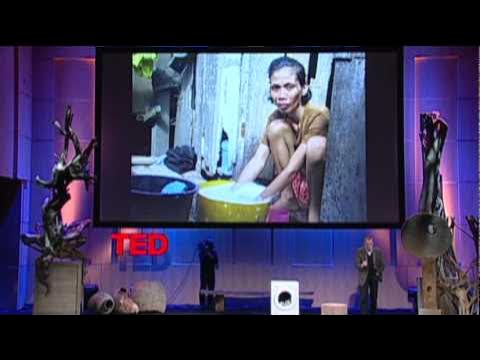
Examining market data for the remaining four billion people who occupy the middle tiers, Rosling discovered that the washing machine has crossed down past the air line: an additional one billion people live above what he terms the “wash line,” spending over 40 dollars a day. This means that two billion people worldwide have access to washing machines, while the remaining five billion must still clean their clothes manually. This labor disproportionately falls on women, who spend hours every week hauling water from distant streams or carrying heavy bundles of laundry to waterways for minimal productivity, sharing the exact same desire his grandmother had two generations earlier in Sweden.
```mermaid flowchart TD accTitle: Global Population by Consumption Lines accDescr: Stratification of the seven billion world population categorized by Rosling based on daily consumption and appliance access.
subgraph HighConsumption["Rich World (1 Billion)"] A["Above the 'Air Line'<br/>Spend > $80/day<br/>Access to flying machines and full home automation"] end
subgraph MidConsumption["Emerging Economies (4 Billion)"] B["Above the 'Wash Line' (1 Billion)<br/>Spend > $40/day<br/>Access to washing machines"] C["Bulb People (3 Billion)<br/>Have electricity and lightbulbs<br/>Wash laundry by hand"] end
subgraph LowConsumption["Extreme Poverty (2 Billion)"] D["Below the Poverty Line<br/>Spend < $2/day<br/>Cook and heat water on firewood"] end
A --> B B --> C C --> D ```
- **Global population distribution across consumption thresholds:** - **1 billion “Air people”**: Consume over $80 per day; own diverse household machines and use commercial flights. - **1 billion “Wash people”**: Consume over $40 per day; own washing machines. - **3 billion “Bulb people”**: Have access to electricity and electric light, but wash clothes by hand. - **2 billion “Fire people”**: Live below the poverty line on under $2 per day; heat water and cook over open wood fires.
[04:03](https://www.youtube.com/watch?v=BZoKfap4g4w&t=243s) The Green Dilemma and Student Hypocrisy
When speaking to environmentally conscious university audiences, Rosling frequently encounters the argument that global resources cannot sustain a world where everyone owns cars and washing machines. He challenges the students' moral authority on the subject by highlighting their own lifestyle choices.
Over the span of two years, Rosling conducted an experiment with his students, asking how many of them avoided using cars; several proudly raised their hands. However, when he followed up by asking how many hand-washed their own bedsheets and pairs of jeans, not a single hand was raised. The lesson was immediate and uncompromising: “Even the hardcore in the green movement use washing machines.” Because nobody who has access to a washing machine is willing to give it up, Rosling argues it is untenable to tell women performing back-breaking manual labor in developing countries that they must go without one.
[04:48](https://www.youtube.com/watch?v=BZoKfap4g4w&t=288s) Energy Arithmetic, Future Projections, and Democracy
To address concerns regarding energy and sustainability, Rosling breaks global consumption into standard units of fossil fuel energy (oil, coal, and gas). Across the entire world, humanity consumes 12 energy units. The richest one billion people—one-seventh of the global population—consume six of those units, meaning half of the world's energy is consumed by the wealthiest tier. The one billion people at the wash line use two units, the three billion with basic electricity use one unit each (three total), and the two billion poorest people share less than one unit combined.
Projecting forward to 2050 based on population and economic trends, Rosling notes that while population growth will occur primarily among the poorest due to high child mortality and birth rates, that growth barely shifts global energy consumption. The true surge will be driven by economic growth in emerging economies—which he dubs “the New East.” As millions cross the wash line and jump the air line, total global energy demand could climb to 22 units, with the richest still using the lion's share. Rosling stresses that while climate change is a severe reality requiring green energy innovation and greater efficiency, rich nations have no moral standing to preach restraint: “But until they have the same energy consumption per person, they shouldn't give advice to others -- what to do and what not to do.”
Rosling connects this drive directly to political self-determination, pointing to Brazil. A woman living in a Rio favela desires a washing machine just as much as anyone else, which led her to support the energy minister who brought electricity to her community. That minister, Dilma Rousseff, was subsequently elected president. As Rosling puts it: “If you have democracy, people will vote for washing machines.”
| Population Tier | Current Headcount | Current Energy Units Used | Projected 2050 Dynamic | |:--- |:--- |:--- |:--- | | **Air Line (Old West / Richest)** | 1 billion | 6 units | Continues high consumption; needs green tech and energy efficiency | | **Emerging Economies ("New East")** | 1 billion | 2 units | Drives economic growth; jumps the air line to match Western consumption | | **Basic Electricity Tier ("Bulb")** | 3 billion | 3 units (1 each) | Acquires washing machines; energy consumption doubles | | **Poverty Tier ("Fire")** | 2 billion | < 1 unit | Population grows, but adds negligible energy demand until electrified | | **Total Global Consumption** | **7 billion** | **12 units** | **Projected expansion to 22 units** |
[07:49](https://www.youtube.com/watch?v=BZoKfap4g4w&t=469s) The Real Magic: Books and Industrialization
Rosling reveals the central thesis of the talk: what actually makes the washing machine magical. On the day his family first used the machine, his mother explained the real transformation. With the laundry loaded and the appliance taking over the physical labor, she took young Hans by the hand and said, “Now, Hans. We have loaded the laundry. The machine will make the work. And now we can go to the library.”
The time formerly devoured by hand-scrubbing and boiling water was converted directly into intellectual life. Rosling describes how books emerged from the machine: his mother read him children's books, taught him the ABCs—which he credits with launching his career as a professor—while also finding the hours to learn English as a foreign language and read countless novels. Rosling concludes with an impassioned, humorous defense of modern industrial progress: “And what we said, my mother and me, 'Thank you, industrialization. Thank you, steel mill. Thank you, power station. And thank you, chemical processing industry that gave us time to read books.'”
## Notable quotes > [04:48](https://www.youtube.com/watch?v=BZoKfap4g4w&t=288s) If you have democracy, people will vote for washing machines. — Hans Rosling
> [07:49](https://www.youtube.com/watch?v=BZoKfap4g4w&t=469s) Thank you, industrialization. Thank you, steel mill. Thank you, power station. And thank you, chemical processing industry that gave us time to read books. — Hans Rosling
> [04:03](https://www.youtube.com/watch?v=BZoKfap4g4w&t=243s) Even the hardcore in the green movement use washing machines. — Hans Rosling
## Mentioned Hans Rosling, TED, Gapminder, Sweden, Dilma Rousseff, Brazil, Rio de Janeiro
## Video description http://www.ted.com What was the greatest invention of the industrial revolution? Hans Rosling makes the case for the washing machine. With newly designed graphics from Gapminder, Rosling shows us the magic that pops up when economic growth and electricity turn a boring wash day into an intellectual day of reading. TODAY: From 11:30am-1:30pm EDT, Hans Rosling will be answering questions in TED Conversations. Pop over!
[Source](https://www.youtube.com/watch?v=BZoKfap4g4w)