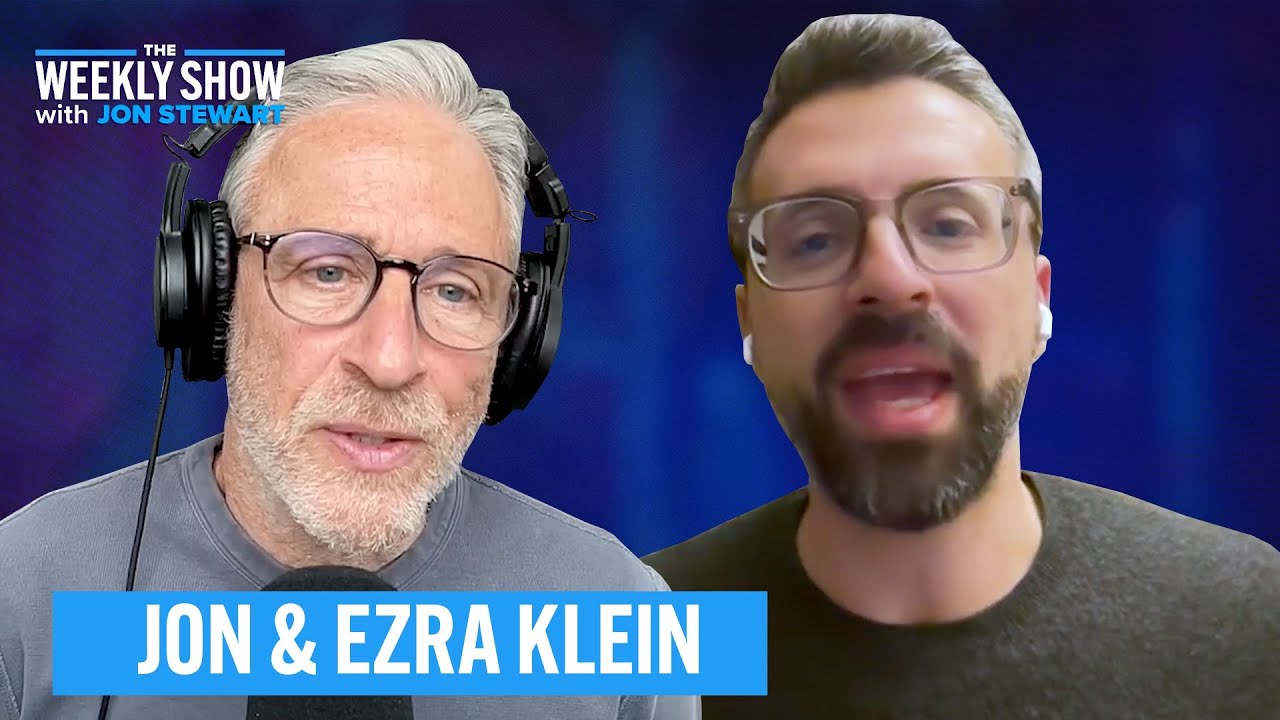
Ezra Klein argues that modern American governance is paralyzed between a conservative movement seeking to dismantle the state and a progressive establishment unable to physically build or deliver on its promises. (39:27)
Despite $42 billion allocated under the 2021 Infrastructure Investment and Jobs Act for rural broadband, complex 14-stage regulatory requirements resulted in only 3 out of 56 states and territories receiving final approval to access funds by late 2024, with zero cables laid. (15:25)
Procedural bloat, dubbed 'everything-bagel liberalism,' frequently burdens major legislative priorities like the CHIPS Act with competing social mandates, driving up compliance costs and sidelining smaller firms. (22:55)
Klein warns that Democrats must actively reclaim institutional reform, cautioning that prolonged delivery timelines and public sector inaction fuel support for disruptive alternatives like DOGE. (55:48)
Detailed notes
## Background
Published on YouTube by The Weekly Show with Jon Stewart on March 27, 2025, this episode features host Jon Stewart sitting down with Ezra Klein, co-author of 'Abundance' and host of 'The Ezra Klein Show'. The discussion focuses on why turning progressive policy ambitions into physical reality has become paralyzed by procedural bureaucracy and how institutional reform can help government effectively deliver for the public.
## TL;DR
Jon Stewart and Ezra Klein examine the institutional gridlock paralyzing modern progressive governance, contrasting the federal government's ability to distribute cash with its inability to build physical infrastructure like rural broadband, clean energy, and affordable housing. Klein explains concepts like 'everything-bagel liberalism' and 'checkism,' illustrating how well-intentioned compliance rules, stakeholder veto points, and excessive procedural caution inadvertently crush nimble execution and delay vital projects for years. Stewart and Klein highlight alternative models—such as the PACT Act's expedited rollout and rapid post-disaster bridge reconstructions under emergency waivers—to argue that liberals must reclaim state capacity and bureaucratic discretion. Ultimately, they warn that if Democrats fail to actively reform their own administrative red tape, disaffected voters will turn to destructive anti-government alternatives like DOGE.
## Atmosphere & style
The conversation is intellectually rigorous, passionate, and laced with biting comedic exasperation. Stewart moves between satirical disbelief and raw indignation—at points rendered practically speechless as Klein methodically breaks down a grueling 14-stage bureaucratic obstacle course. Klein delivers an urgent, analytical critique of his own political tribe, creating a dynamic that feels less like partisan punditry and more like an incisive, candid post-mortem driven by shared civic frustration.
## Bulletin
- [39:27](https://www.youtube.com/watch?v=NcZxaFfxloo&t=2367s) Ezra Klein argues that modern American governance is paralyzed between a conservative movement seeking to dismantle the state and a progressive establishment unable to physically build or deliver on its promises.
- [15:25](https://www.youtube.com/watch?v=NcZxaFfxloo&t=925s) Despite $42 billion allocated under the 2021 Infrastructure Investment and Jobs Act for rural broadband, complex 14-stage regulatory requirements resulted in only 3 out of 56 states and territories receiving final approval to access funds by late 2024, with zero cables laid.
- [22:55](https://www.youtube.com/watch?v=NcZxaFfxloo&t=1375s) Procedural bloat, dubbed 'everything-bagel liberalism,' frequently burdens major legislative priorities like the CHIPS Act with competing social mandates, driving up compliance costs and sidelining smaller firms.
- [55:48](https://www.youtube.com/watch?v=NcZxaFfxloo&t=3348s) Klein warns that Democrats must actively reclaim institutional reform, cautioning that prolonged delivery timelines and public sector inaction fuel support for disruptive alternatives like DOGE.
## Key takeaways
- [08:40](https://www.youtube.com/watch?v=NcZxaFfxloo&t=520s) Progressive deep-blue areas often exhibit a paradox of being symbolically liberal while remaining operationally conservative, using zoning and regulatory hurdles to block necessary housing and transit.
- [13:50](https://www.youtube.com/watch?v=NcZxaFfxloo&t=830s) Barack Obama's signature legislative wins centered on legal and regulatory frameworks, whereas Joe Biden's physical infrastructure agenda exposed systemic paralysis in governmental execution.
- [15:25](https://www.youtube.com/watch?v=NcZxaFfxloo&t=925s) Federal broadband deployment under the Infrastructure Act stalled across a 14-stage administrative process spanning mapping disputes, public challenges, and layered planning requirements.
- [19:56](https://www.youtube.com/watch?v=NcZxaFfxloo&t=1196s) Historical initiatives like the Works Progress Administration and Medicare delivered real-world results within months, contrasting sharply with modern multi-year bureaucratic rollouts.
- [22:55](https://www.youtube.com/watch?v=NcZxaFfxloo&t=1375s) 'Everything-bagel liberalism' overburdens core legislative priorities by attaching auxiliary social goals, favoring well-capitalized corporations over smaller, nimble contractors.
- [26:08](https://www.youtube.com/watch?v=NcZxaFfxloo&t=1568s) Statutory public participation mechanisms are frequently captured by entrenched incumbent interests, such as affluent homeowners, rather than the intended working-class beneficiaries.
- [37:17](https://www.youtube.com/watch?v=NcZxaFfxloo&t=2237s) The PACT Act serves as a counter-model to administrative gridlock, using presumptive coverage and swift internal VA hiring to deliver healthcare without overwhelming backlogs.
- [39:27](https://www.youtube.com/watch?v=NcZxaFfxloo&t=2367s) Extended timelines between legislative passage and tangible delivery sever the psychological feedback loop that enables voters to experience the benefits of liberal democracy.
- [43:24](https://www.youtube.com/watch?v=NcZxaFfxloo&t=2604s) While the federal government excels at capital distribution via direct tax credits and checks, it struggles with direct procurement, construction, and physical infrastructure coordination.
- [51:45](https://www.youtube.com/watch?v=NcZxaFfxloo&t=3105s) The doctrine of 'checkism' mistakenly measures legislative success by the amount of money appropriated rather than physical structures built or tangible services delivered.
- [51:45](https://www.youtube.com/watch?v=NcZxaFfxloo&t=3105s) 1970s-era environmental statutes like NEPA established a heavily litigious governance model that empowers private parties to stall public transit and clean energy initiatives.
- [55:48](https://www.youtube.com/watch?v=NcZxaFfxloo&t=3348s) Failing to spearhead effective civil service reform leaves a vacuum that invites destructive anti-government alternatives such as the Department of Government Efficiency (DOGE).
- [01:00:56](https://www.youtube.com/watch?v=NcZxaFfxloo&t=3656s) Allied progressive stakeholders and trade unions frequently act as veto points, blocking cost-effective innovations such as modular housing construction.
- [01:00:56](https://www.youtube.com/watch?v=NcZxaFfxloo&t=3656s) Governors frequently bypass standard procurement rules with emergency declarations to rebuild infrastructure quickly, demonstrating that regular regulatory processes are excessively restrictive.
- [01:07:55](https://www.youtube.com/watch?v=NcZxaFfxloo&t=4075s) The extensive compliance architecture designed to prevent waste, fraud, and abuse has itself become an enormous source of institutional waste and delay.
- [01:10:37](https://www.youtube.com/watch?v=NcZxaFfxloo&t=4237s) Governments must restore professional discretion to civil servants and adopt outcome-focused urgency to solve slow-moving emergencies like housing shortages and climate change.
## Detailed walkthrough
### [00:00](https://www.youtube.com/watch?v=NcZxaFfxloo&t=0s) Cold Open: The Bureaucratic Maze of Grant Applications
The episode kicks off mid-conversation with Jon Stewart and Ezra Klein marveling at the absurd administrative hurdles embedded in federal programs. Stewart asks whether an initial proposal emerged from an initial five-million-dollar planning fund, only for Klein to wonder where the five-year action plan fit into that equation. Stewart vents his exasperation over the impenetrable federal acronyms, asking what the hell was applied for in the Notice of Funding Opportunity:
> “Forget NOFO. Mofo.” — Jon Stewart
The absurdity of requiring multi-year action plans before any construction can even begin sets the tone for the entire discussion on how progressive ambitions are paralyzed by process.
[00:23](https://www.youtube.com/watch?v=NcZxaFfxloo&t=23s) Group Chats, Leaked Plans, and Donald Trump's Tactical Ignorance
Stewart welcomes listeners to *The Weekly Show* (taped Wednesday, March 26, 2025), opening with a comedic riff on recent national security leaks involving unsecure high-level messaging chains. He points out that this exact chaos is why he avoids group chats altogether, imagining a massive chat room with 16 to 18 people—including Defense Secretary Pete Hegseth, National Security Advisor Michael Waltz, military generals, and an *Atlantic* journalist. Stewart jokes that receiving non-stop thumbs-up, bicep arm, fist pump, and fire emojis would drive anyone crazy:
> “The notifications alone would make me want to launch missiles.” — Jon Stewart
Stewart then mocks Donald Trump’s predictable reflex when confronted with scandals like classified chatter on unsecure platforms or questionable deportation orders. Trump immediately retreats into an exaggerated, *Goodfellas*-style denial, claiming he operates only via payphones or passing notes:
> “I didn't sign it. I don't even know what a pen is. I don't have a pen. I don't use writing. I don't have hands. How could I have done it?” — Jon Stewart
Beyond the comedy, Stewart expresses genuine anger at the arrogant mindset reflected in the leaked texts. The messages reveal a dismissive attitude toward European allies—complaining that Europe is full of freeloaders who do nothing for America, completely ignoring that allied nations sent their troops to fight and die in post-9/11 wars over events that didn’t happen to them. He ridicules the administration's fantasy that firing a handful of cruise missiles at the Houthis will instantly fix global shipping disruptions:
- Saudis spent years carrying out extensive bombardments and naval blockades against the Houthis without breaking them.
- American foreign policy repeats a 30-to-40-year cycle of believing dropping a few cruise missiles in places like Libya solves structural geopolitical problems.
- Washington's posture assumes that “Daddy’s home” to save the day through performative strikes rather than enduring strategy.
[05:44](https://www.youtube.com/watch?v=NcZxaFfxloo&t=344s) Introducing Ezra Klein: The "Timothée Chalamet of the Book World"
Stewart introduces Ezra Klein, host of *The Ezra Klein Show* on *The New York Times* and co-author (with Derek Thompson) of *Abundance*. Stewart praises the book for being self-critical and diving into the mechanical plumbing of governance rather than offering vague polemics. Welcoming Klein, Stewart jokes that Klein’s ubiquitous press tour makes him look like “the Timothée Chalamet of the book world.”
Klein admits that while writing a book usually entails years of quiet misery and regretting ever taking on the project, the response to *Abundance* has been uniquely energizing. He observes a peculiar truth about modern political publishing:
> “I think the way you know your book is doing well is the number of people who haven't read it, who have developed a strong opinion on it.” — Ezra Klein
Klein explains that books function as cultural anchors that unlock conversations society is already desperate to have. Just as Jonathan Haidt's *The Anxious Generation* formalized an ongoing unease around smartphones in schools, *Abundance*—alongside recent works like Marc Dunkelman’s *Why Nothing Works* and Yoni Appelbaum’s *Stuck*—articulates a broader cultural frustration with why American institutions are gridlocked.
[08:40](https://www.youtube.com/watch?v=NcZxaFfxloo&t=520s) Symbolically Liberal, Operationally Conservative: The California Paradox
Stewart asks when the work behind *Abundance* actually began. Klein traces its roots to his 2021 essay, "The Economic Mistake the Left is Finally Confronting," as well as earlier reporting on his home state of California.
```mermaid
flowchart TD
accTitle: The Operational Ideology Paradox
accDescr: A comparison contrasting traditional national politics with modern progressive governance.
subgraph National["Traditional National Dynamic"]
A["Symbolically Conservative<br>(Freedom, Rugged Individualism, Bootstraps)"] -->|Demands| B["Operationally Liberal<br>('Keep hands off my Medicare')"]
end
subgraph California["California Progressive Dynamic"]
C["Symbolically Liberal<br>('Kindness is everything', 'Science is real')"] -->|Governs Via| D["Operationally Conservative<br>(Single-Family Zoning, Anti-Development Rules)"]
end
```
Klein contrasts a classic political science concept with the current reality in deep-blue areas:
* **The traditional national paradox:** Americans have long been characterized as "symbolically conservative and operationally liberal." They cheer for conservative slogans about personal responsibility and individual freedom, yet fiercely defend public programs, summarized by the famous Tea Party sign: "Keep the government's hands off my Medicare."
* **The blue-state paradox:** In deep-blue jurisdictions like California, the dynamic completely flips into being "symbolically liberal and operationally conservative." Affluent progressive neighborhoods display welcoming signs declaring that "kindness is everything," "no human being is illegal," "we believe in science," and "hate has no home here"—while the very same communities enforce rigid single-family zoning rules and regulatory barriers that block new housing, prevent transit construction, and exclude the vulnerable people their rhetoric claims to welcome.
[10:17](https://www.youtube.com/watch?v=NcZxaFfxloo&t=617s) Symbolic Liberalism vs. Physical Change
Ezra Klein traces the roots of his thinking to observing California, particularly San Francisco and Los Angeles. In San Francisco, despite omnipresent Black Lives Matter lawn signs and public affirmations of progressive values, the Black population had dropped in census after census, and the working class was consistently priced out. Ezra argues that this dynamic exposes a core liberal contradiction: an eagerness to profess progressive values symbolically alongside an intense unwillingness to allow the actual physical changes required to instantiate those values in daily life. People support reforms only if they inconvenience an abstract rich third party, never if they affect their own neighborhood.
Jon Stewart sums up the contradiction: liberals love having a virtuous value system on social media handles, but operationally refuse to let that value system anywhere near their backyards. Ezra references a piece he wrote on the agonizing hurdles to building affordable housing in Los Angeles, summarizing the prevailing local sentiment: “When do we want affordable housing? Now. Where do we want it? Definitely somewhere else.” That disconnect in California began to mirror the national challenge during the Biden presidency when trillions in funding were allocated for green energy and physical infrastructure.
[12:00](https://www.youtube.com/watch?v=NcZxaFfxloo&t=720s) Rethinking the Democratic Playbook
Jon points out that Ezra’s argument arrives at an opportune time, as the Democratic Party faces confusion and chaos regarding its governing philosophy and blueprint. With the realization that traditional Democratic methods may be obsolete, the ideas in *Abundance* provide a potential cornerstone for rebuilding. Ezra agrees, though he cautions that the book does not seek to replace the entire liberal agenda, noting that progressives have many good ideas.
Addressing book reviews, Ezra jokes about the human tendency to read a text through personal political biases rather than on its own merits: “There's a funny—reviews have a real quality of, we read the book not as a book is but as we are.” When a book strays from a reviewer's exact policy wishlist, the reviewer suddenly finds fault with the entire project. Despite the good ideas in theory, Ezra stresses the bottom-line reality confronting modern liberalism: “Look, man, it didn't work.”
[13:50](https://www.youtube.com/watch?v=NcZxaFfxloo&t=830s) Obama’s Regulatory Wins vs. Biden’s Physical Ambitions
To understand where Democratic governance stalled, Ezra contrasts the legislative output of Barack Obama with Joe Biden. President Obama’s signature achievements—most notably the Affordable Care Act and the Dodd-Frank financial reforms—were primarily regulatory and legal structures. Bank capital requirements and insurance rules are etched onto paper; they do not require digging up earth or building things in the physical world.
By contrast, the Biden administration—rooted in the “Scranton Joe” and “Lunchpail Joe” brand—centered its domestic policy on physical construction: green energy, grid transmission lines, electric vehicle charging networks, and rural broadband. Jon quips that they didn't just want to build, they wanted to "Build Back Better," prompting Ezra to look back ruefully at the peak optimism of early 2021. Yet that optimistic legislative push exposed the systemic paralysis of the progressive governing model when applied to the material world.
```mermaid
flowchart TD
accTitle: Obama vs Biden Liberal Governance Model
accDescr: Diagram contrasting Obama's paper-based regulatory victories with Biden's physical-world infrastructure push.
subgraph Obama["Obama Administration: Regulatory Liberalism"]
direction TB
O1["Affordable Care Act"]
O2["Dodd-Frank Regulations"]
O3["Etched on paper & regulatory code"]
O1 --- O2 --- O3
end
subgraph Biden["Biden Administration: Physical Liberalism"]
direction TB
B1["EV Charger Network ($7.5B)"]
B2["Rural Broadband ($42B)"]
B3["Green Energy & Grid Transmission"]
B1 --- B2 --- B3
end
Obama -.->|"Shift from regulatory rules to physical construction"| Biden
```
[15:25](https://www.youtube.com/watch?v=NcZxaFfxloo&t=925s) The Missing Song: How a Law Becomes Reality
Ezra highlights two glaring examples of federal construction programs passed early in Biden’s term:
- **$7.5 billion** dedicated to building a nationwide network of electric vehicle chargers.
- **$42 billion** allocated through the Infrastructure Investment and Jobs Act (end of 2021) for rural broadband.
By the end of Biden’s four-year term, virtually nothing had been physically built under these programs due to deeply baroque internal processes. Ezra observes that while Americans grew up learning from *Schoolhouse Rock* how a bill becomes a law on Capitol Hill, there is no accompanying song explaining how a law becomes reality: “We don't have the song about how the law becomes reality—how the law becomes a series of implementation rules, then a notice of Funding Opportunity. Then there's a comment period. Then there's a challenge period for the comments. Then there's a series of court cases.”
In the case of rural broadband, the Commerce Department instituted an exhaustive 14-stage process. First, federal agencies had to map out every single underserved region in the country, followed by public challenge periods over the accuracy of the maps. Across 56 states and territories attempting to apply for the funds since late 2021, only three jurisdictions had even managed to reach the end of the bureaucratic approval process by late 2024. As Ezra clarifies to a stunned Stewart, reaching the end of the process did not mean actual broadband cables were in the ground; it only meant those three states were finally approved to receive the cash to begin.
[17:55](https://www.youtube.com/watch?v=NcZxaFfxloo&t=1075s) Teasing Apart the Bottlenecks: The 14-Stage Maze
Jon asks Ezra to diagnose the underlying causes behind these failures. He questions whether the primary culprit is local NIMBYism and state bureaucracy, endless litigation, or an ideological "everything-bagel" impulse where a project cannot be approved unless it simultaneously solves every social problem—mandating carbon neutrality, small business quotas, and contracts reserved specifically for disabled contractors.
While Ezra searches his notes to read the exact 14 steps managed by the National Telecommunications and Information Administration (NTIA), Jon jokes about Ezra's co-author Derek Thompson. Jon remarks that Derek looks around 17 years old and appears on screen like an enthusiastic intern, telling Ezra he needs to grow a beard because his youthful visage is distracting to a grizzled veteran. Jon then slips into a hushed golf-announcer whisper as Ezra tracks down the bureaucratic paperwork to explain step one of the NTIA rollout.
[19:56](https://www.youtube.com/watch?v=NcZxaFfxloo&t=1196s) The Bureaucratic Gauntlet Begins: 180 Days Just to Announce Funding
Ezra Klein begins laying out the administrative timeline under the National Telecommunications and Information Administration (NTIA) to demonstrate why rural broadband deployment took years to materialize. Under the statute, Step 1 requires the NTIA to issue a Notice of Funding Opportunity (NOFO) within 180 days. Klein contrasts this six-month ramp-up with major historical precedents: during the New Deal, as highlighted in reporting by Harold Meyerson, the Works Progress Administration (WPA) was already putting people to work within that timeframe, and when the federal government enacted Medicare in the 1960s, citizens received Medicare cards just one year after passage. By modern standards, government now spends half a year merely informing eligible entities that they may apply for federal grants.
```mermaid
flowchart TD
accTitle: Rural Broadband Initial Grant Administration Process
accDescr: Flowchart showing the four initial statutory steps undertaken by the NTIA to award planning grants for broadband.
subgraph FederalLevel["Federal Agency (NTIA)"]
A["Step 1: NTIA issues Notice of Funding Opportunity (NOFO)<br/>(within 180 days)"]
D["Step 4: NTIA reviews, approves, and awards planning grants"]
end
subgraph StateLevel["State Applicants (56 Total)"]
B["Step 2: States submit Letter of Intent"]
C["Step 3: States request up to $5M in planning grants"]
end
A --> B
B --> C
C --> D
```
Jon Stewart and Klein emphasize that the frustration with these timelines is not an indictment of the civil servants themselves. With the Department of Government Efficiency (DOGE) currently demonizing federal workers as malicious actors, Stewart points out that frontline bureaucrats are simply executing mandates dictated to them by Congress: “These are just hard-working, smart people trying to do the right thing by what's been legislated.” Klein concurs, citing Jen Pahlka’s book *Recoding America*, and argues that government recruits exceptionally talented personnel only to trap them in labyrinthine structural constraints. Klein notes that his breakdown is based directly on congressional testimony delivered on March 4, 2025, by Sarah Morris from the Department of Commerce, reflecting the official post-Biden administration assessment.
- **Step 1:** The NTIA must write and publish a Notice of Funding Opportunity (NOFO) within 180 days of enactment.
- **Step 2:** Interested states submit a formal letter of intent (all 56 eligible states and territories completed this step).
- **Step 3:** States apply for up to $5 million each in initial planning grants.
- **Step 4:** The NTIA reviews, approves, and awards the planning grants—funding intended solely for planning, not for laying any physical broadband infrastructure.
[22:55](https://www.youtube.com/watch?v=NcZxaFfxloo&t=1375s) "Everything-Bagel Liberalism" and the Bloat of Federal Grant Applications
Addressing Stewart's question about what consumes the 180 days between statutory passage and the release of a NOFO, Klein explains that drafting the document becomes weighed down by competing social objectives. Klein terms this phenomenon “everything-bagel liberalism”—the impulse to lard a single legislative project with so many progressive priorities that, like the bagel in the movie *Everything Everywhere All at Once*, it collapses into a black hole. Drawing from his analysis of the NOFO developed for the CHIPS and Science Act, Klein explains how federal grants intended to lure semiconductor manufacturing plants back from Taiwan, South Korea, and China were encumbered with requirements asking applicants to explain how they would attract more women to the construction trades, establish seven-step subcategorization plans to diversify subcontractor supply chains, and build on-site childcare facilities at fabrication plants.
While Klein supports these social goals in isolation, he stresses the paradox of spending over $30 billion to overcome the high cost of domestic manufacturing while simultaneously using the application guidelines to mandate practices that make building far more expensive. Stewart observes that stacking heavy compliance costs onto grant applications systematically boxes out smaller, nimble local businesses that lack dedicated compliance departments: “You are excluding an enormous amount of the American economy in terms of building things, by laying on compliance costs that would drive most companies into the ground.” While acknowledging this barrier applies broadly, Klein notes that semiconductor fabs require massive corporate scale regardless, but the same dynamic appears throughout modern liberal rulemaking.
- Over $30 billion was allocated under the CHIPS and Science Act to make semiconductor manufacturing economically viable in the United States.
- Typical modern NOFO guidelines mandate detailed workforce standards, equity benchmarks, subcontracting distribution strategies, and on-site facilities like childcare.
- These regulatory conditions become mandatory prerequisites for applicants before any funding can be awarded.
[26:08](https://www.youtube.com/watch?v=NcZxaFfxloo&t=1568s) The Closed Loop of Regulatory Capture and Citizen Participation
Klein and Stewart discuss why federal legislation consistently accumulates layers of bureaucratic friction. Once a high-profile bill passes Congress, public and media scrutiny largely evaporates. In that quiet aftermath, specialized interest groups and coalition partners lobby executive agencies to embed their specific wish lists into administrative regulations, guidance documents, and NOFO standards. Klein points out that while liberal coalitions add workforce, equity, and labor rules, Republicans engage in the exact same behavior with fossil fuel and corporate interests: “There is a lot of bad stuff that happens after a bill passes, in part because most of the system stops paying attention.”
Stewart adds that because members of Congress operate under severe time and staffing constraints, lobbyists and corporate trade groups effectively draft complex portions of the legislation and follow-on rules themselves. Klein connects this dynamic to a broader structural flaw explored in his book *Abundance*: procedural mechanisms created with good intentions to expand citizen participation—such as public notice-and-comment periods and community planning sessions—frequently backfire. Instead of giving a voice to average citizens or future beneficiaries, these time-consuming administrative venues are disproportionately captured by incumbent interests, such as nearby homeowners organizing against an affordable housing development, while the families who would benefit from the new housing are absent from the room. Returning to the broadband timeline, Klein notes that even after completing the letter of intent and requesting up to $5 million for planning, states remain stuck in NTIA's internal review and award cycle before actual deployment can even be contemplated.
[29:07](https://www.youtube.com/watch?v=NcZxaFfxloo&t=1747s) The Endless Loop of Mapping and Challenging
Ezra Klein walks Jon Stewart through the multi-stage administrative labyrinth established for the federal rural broadband program. Having already navigated Notices of Funding Opportunity (NOFOs), letters of intent, and planning grants, states are then mandated to draft and submit a five-year action plan. However, before the National Telecommunications and Information Administration (NTIA) can allocate funds, the Federal Communications Commission (FCC) must first publish broadband data maps detailing unserved areas—and states must be granted a formal window to challenge those maps for accuracy. Klein highlights the circular absurdity: the federal government maps where subsidies are needed, opens a challenge period for states, and then NTIA relies on those contested FCC maps to determine allocations.
```mermaid
flowchart TD
accTitle: BEAD Mapping and Proposal Funnel
accDescr: Flowchart illustrating the recursive 14-step BEAD administrative process and the steep drop-off of eligible jurisdictions.
subgraph Phase1["Phase 1: Planning & Federal Mapping"]
A["5-Year Action Plan Submitted"] --> B["FCC Publishes Broadband Maps"]
B --> C["States Challenge FCC Maps"]
C --> D["NTIA Allocates Based on Maps"]
end
subgraph Phase2["Phase 2: State Proposals & Local Maps"]
D --> E["Step 8: States Submit Initial Proposal"]
E --> F["Step 9: NTIA Reviews & Approves Proposal"]
F --> G["Step 10: States Publish Own Maps"]
G --> H["Public Challenges to State Maps"]
H --> I["Step 11: NTIA Approves Final Maps<br>(47 of 56 Left)"]
end
subgraph Phase3["Phase 3: Subgranting & Final Review"]
I --> J["Step 12: Competitive Subgranting<br>(30 of 56 Left)"]
J --> K["Step 13: Submit Final Proposal<br>(3 of 56 Left)"]
K --> L["Step 14: NTIA Approves Final Proposal<br>(3 of 56 Left)"]
end
```
Stewart reacts with mounting incredulity, remarking that if someone wanted to engineer a machine specifically designed to prevent rural communities from ever obtaining high-speed internet, they could not have done a better job. He jokes that Elon Musk will have implanted brain chips into every citizen before fiber-optic cables are ever laid in the ground, a point Klein notes is effectively coming true as Starlink steps into the vacuum. Stewart expresses sheer bewilderment at the stacking of redundant proposals, wondering how a five-year action plan differs from an initial proposal, or what the initial planning grants were even meant to produce. “This is not how Republicans handicapped a liberal bill,” Ezra Klein stresses. “This is a bill passed by Democrats with a regulatory structure written by a Democratic administration.”
- Three years into the broadband deployment effort, all 56 participating states and territories had managed to advance through the first five steps.
- Step 8 requires states to submit an "initial proposal" to the NTIA, which must then be reviewed and approved under Step 9.
- Under Step 10, states are required to create and publish their own broadband maps and allow public, environmental, and industry groups to challenge those maps.
[33:04](https://www.youtube.com/watch?v=NcZxaFfxloo&t=1984s) The Attrition of States and the "Finish Line" Hearing
Klein details how the procedural burden begins to weed out jurisdictions as the requirements compound. Under Step 11, the NTIA must review and approve the results of challenges brought against the state maps. At that milestone, nine jurisdictions drop out, reducing the field to 47 of 56. Stewart groans that his hair was dark and he had “the bone density of a stainless steel” when the process began, pointing out that between 90-day waiting windows, 120-day review processes, and lengthy public comment periods, the administration baked roughly two and a half years of pure waiting time into the framework before any physical labor could possibly commence.
The drop-off accelerates precipitously once the process moves toward execution. Under Step 12, states must execute a competitive subgranting process to choose broadband providers—a requirement that trims the pool down to just 30 jurisdictions. Step 13 demands the submission of a "final proposal" to the NTIA, collapsing the remaining participants down to a mere three jurisdictions. Step 14 tasks the NTIA with reviewing and approving those final proposals, leaving only three of the original 56 applicants cleared. Klein notes the tragic comedy of reading congressional testimony from March 4, 2025, in which a well-meaning Commerce Department official faced the House Committee on Energy and Commerce's Communications and Technology subcommittee at a hostile hearing titled *Fixing Biden's Broadband Blunder*. In their prepared remarks, the official earnestly asserted in bold type: “In summary: states are nearly at the finish line. To stop their progress now, or worse, to make them go backwards, would be a stick in the spokes of the most promising broadband deployment plans we have ever seen.”
- House subcommittee oversight hearing: March 4, 2025, before the House Energy and Commerce Subcommittee on Communications and Technology (*Fixing Biden's Broadband Blunder*).
- Step 11 (Approval of challenged maps): 47 out of 56 jurisdictions survived.
- Step 12 (Competitive subgranting process): 30 out of 56 jurisdictions completed.
- Steps 13 & 14 (Submission and final NTIA approval of proposals): Only 3 out of 56 jurisdictions made it through.
[37:17](https://www.youtube.com/watch?v=NcZxaFfxloo&t=2237s) A Contrast in Governance: The PACT Act vs. Bureaucratic Paralysis
Left practically speechless by the sheer scale of self-inflicted procedural sabotage, Stewart remarks, “It's A, far worse than I could have imagined. But the fact that they amputated their own legs on this is what's so stunning.” To balance the picture, he offers an example of government capacity operating at its best: the passage and implementation of the Sergeant First Class Heath Robinson Honoring our Promise to Address Comprehensive Toxics (PACT) Act. Stewart explains how veterans who had suffered severe illnesses from toxic exposure near military burn pits were granted presumptive healthcare coverage under the Department of Veterans Affairs (VA).
Stewart recalls that congressional committees effectively let advocates and Veteran Service Organizations (VSOs) draft the legislation directly. When fiscal conservatives and Republican lawmakers objected that a massive influx of dying veterans would overburden the VA and cause catastrophic wait times, the VA defied expectations: within six months, the agency assembled an internal capacity plan, hired necessary personnel, and rolled out services seamlessly without hospital delays. However, Stewart laments the subsequent political cycle where, upon taking power, Republicans moved to slash and fire those newly hired workers, demonstrating the dual tragedy of American policy delivery: a progressive tendency toward self-paralyzing administrative bloat on one side, and an opposing conservative impulse toward dismantling functional public services on the other.
- The PACT Act granted presumptive VA healthcare and benefits to veterans suffering from illnesses caused by burn pit toxin exposures.
- The VA devised and executed a hiring and capacity plan in roughly six months, helping hundreds of thousands of sick veterans without creating hospital backlogs.
- Stewart notes that despite the VA program's documented success, incoming conservative leadership immediately targeted the new administrative and medical staff for firing.
[39:27](https://www.youtube.com/watch?v=NcZxaFfxloo&t=2367s) The Two Parties and the Stretched Timeline of Liberal Democracy
Jon Stewart and Ezra Klein frame the core dysfunction of modern American politics as a choice between two bad extremes: a conservative party determined to make government fail, and a progressive party incapable of making it work. Klein challenges the common excuse offered by Biden administration figures—such as National Security Advisor Jake Sullivan writing in *The Washington Post*, and California Governor Gavin Newsom—that modern political trouble stems from four-year election cycles clashing with policy agendas designed for multi-decade horizons. Stewart scoffs at this rationale, joking that voters cannot reasonably expect "Methuselah" to manage their affairs. Klein argues that this fatalism is a deliberate self-deception: modern liberals have willingly built regulatory and procedural labyrinths that stretch liberal democracy's timelines out like taffy, destroying the tangible connection voters need between voting for public programs and feeling their benefits.
```mermaid
flowchart TD
accTitle: The Timeline Problem in Policy Implementation
accDescr: Historical versus modern implementation timelines showing the delay in voter benefits.
subgraph Past["Past Implementation"]
LBJ["1965: Medicare Enacted"] -->|"1 Year"| MedCards["1966: Cards in Hands"]
end
subgraph Present["Modern Implementation"]
ACA["2010: Affordable Care Act"] -->|"4 Years"| ACAIn["2014: Coverage Takes Effect"]
IIJA["2021: Infrastructure Bill"] -->|"6 Years"| Roads["Mid-2027: Construction Completes"]
IRA["2022: Inflation Reduction Act"] -->|"3+ Years"| DrugPrices["2026: Agreed Price Reductions"]
end
```
Klein and Stewart highlight historical and international counterexamples showing that democracies do not have to move at a glacial pace. Lyndon B. Johnson delivered physical Medicare cards to American seniors within one single year of signing the legislation into law in 1965. By contrast, the Affordable Care Act required four years before its major provisions took effect, and the Biden administration's Medicare prescription drug price negotiations—widely considered one of its most popular accomplishments—required over three years merely to agree on initial prices. Stewart points out that democratic nations in Western Europe consistently build infrastructure faster and cheaper despite strong labor protections, joking about Spain's high-speed rail network: "They nap. Ezra, they nap! Spain is building it. But yet, between 3 o'clock and 5 o'clock, they're all asleep." Klein adds that while California spent years failing to lay 500 miles of high-speed track, China laid 23,000 miles.
- “We are caught between a party that wants to make government fail and a party that does not make government work.” — Ezra Klein
- “The reason this really matters is that if you stretch the timeline of liberal democracy like taffy—so it gets longer and longer and longer—what you've broken is the fundamental way people can feel that they benefit from liberal democracy.” — Ezra Klein
- Under the Infrastructure Investment and Jobs Act passed in 2021, the vast majority of funded road projects carrying firm completion targets are scheduled for completion in mid-2027.
---
[43:24](https://www.youtube.com/watch?v=NcZxaFfxloo&t=2604s) Learned Helplessness and What the State Can Still Do
Klein argues that liberal governance suffers from an institutional culture of "learned helplessness" rather than an intentional ideological handicap. Reflecting on a conversation with *Pod Save America* co-host Jon Favreau, Klein notes that the 2009 American Recovery and Reinvestment Act promised an "infrastructure of the future" anchored by three marquee priorities: high-speed rail, an integrated smart electric grid, and an interoperable national electronic health records network. In practice, the administration went zero for three. Stewart notes that federal agencies could not even manage internal IT compatibility, pointing out that the Department of Defense and the Department of Veterans Affairs spent a decade failing to get their computer systems to talk to one another.
Despite physical infrastructure failures, Klein stresses that the American federal government remains exceptionally effective at moving capital. When operating as an engine of social insurance through tax-and-transfer mechanisms—such as the Earned Income Tax Credit (EITC), the expanded Child Tax Credit, and the rapid dispersal of stimulus checks during the COVID-19 pandemic—the Internal Revenue Service demonstrated remarkable operational capacity. Both Stewart and Klein argue that this track record proves government capability is real when policies rely on direct distribution rather than procedural review.
- “One of the things I'm trying to shake people on with this book is that Democrats, liberals—people who believe in government—have entered into a kind of learned helplessness about how government works, as if the way they have ended up doing it—I call this a culture. It's not an ideology. The culture of how Democrats govern has become like this.” — Ezra Klein
- “And Jon's like, well, 0 for 3.” — Ezra Klein on Jon Favreau's assessment of Obama's 2009 stimulus goals.
- Direct-cash social safety net programs demonstrate that state machinery can execute complex nationwide interventions when spared multi-tiered procedural veto points.
---
[45:16](https://www.youtube.com/watch?v=NcZxaFfxloo&t=2716s) Capitalism, Public Goods, and Defending the Progressive Vision
Stewart addresses potential listener cynicism, asking how either of them can remain believers in government action when faced with continuous state failures. Klein rejects the conservative critique that regulatory skepticism should push progressives into the Republican Party. Pointing to Texas's prolific housing construction, Klein explains that deregulation without public ambition merely yields dirty air, climate collapse, and a total absence of civic infrastructure. Furthermore, genuine achievements do occur: the Inflation Reduction Act triggered an unprecedented surge in domestic solar, clean tech, and battery manufacturing, while the ACA ultimately extended health coverage to tens of millions of citizens despite its clumsy rollout.
```mermaid
flowchart LR
accTitle: The Role of Government as a Check on Capitalism
accDescr: Capitalism generates wealth and collateral damage while government provides checks and public goods.
Cap["Amoral Capitalism"] -->|"Generates"| Wealth["Wealth & Innovation"]
Cap -->|"Creates"| Harm["Collateral Damage & Neglect"]
Gov["Functioning Government"] -->|"Regulates"| Harm
Gov -->|"Builds"| PublicGoods["Non-Market Goods (e.g., Libraries, Rail)"]
```
Stewart and Klein analyze why private markets alone cannot build a humane society. Stewart characterizes capitalism as an unmatched wealth generator that inevitably creates collateral damage, whether through calculated extraction, unpriced externalities, or political capture. Klein adds that capitalism is not intentionally evil, but fundamentally amoral—an impersonal dynamic, much like a great white shark, that will gladly sacrifice human welfare for quarterly returns and entirely ignore essential public goods that lack a profit incentive. Klein observes that basic civic institutions like public libraries could never be founded under pure market incentives today, underscoring why an effective, functioning public sector is an indispensable counterweight.
- “Are you asking me why, in my fury, that we are not building the liberal future I think we deserve? The just, humane, green future? Why don't, instead, embrace a vision of a future that I think sucks?” — Ezra Klein
- “Government is the only influence that is large enough to provide a check or a balance to that kind of rapacious or destructive wealth building, right? If that isn't functioning appropriately, that is my anger.” — Jon Stewart
- “Capitalism is an impersonal force. It is not immoral. It is not moral. It is amoral.” — Ezra Klein
[49:18](https://www.youtube.com/watch?v=NcZxaFfxloo&t=2958s) Why Liberals Should Be Furious About Government Failure
Ezra Klein and Jon Stewart discuss the nature of capitalism, noting that the private sector is fundamentally incapable of providing basic public utilities on its own. Klein explains that capitalism is never going to build a public library, not out of malice, but simply because that is not its purpose: “It's like asking a great white shark to scramble you some eggs, you know? It's not what a great white shark does.” Stewart jokes that he would definitely tune in if MrBeast put a great white shark scrambling eggs on YouTube.
Turning to the left's critique of the system, Klein argues that while conservatives actively celebrate state breakdowns because they provide immediate political ammunition to weaponize against Democrats, progressives should have the exact opposite reaction. When the public sector breaks down, it destroys the very foundation of the progressive vision. Looking at stalled initiatives like high-speed rail, the bungled rural broadband initiative, and the agonizingly slow pace of modern public infrastructure compared to historical achievements, Klein emphasizes that liberals are failing to confront their own self-inflicted barriers:
> “If you are a liberal, or you're on the left, you should be rip shit about government failure because it is striking at your project.”
Klein points to Alexandria Ocasio-Cortez’s ambitious public housing proposal as an illustrative example. While AOC rightfully recognized that the housing shortage cannot be left purely to NIMBYs and market forces, federal law has made it functionally illegal for the federal government to build public housing directly. Decades of heavy self-regulation, procedural hurdles, and layered standards have paralyzed state capacity. Klein notes that other countries manage public housing exceptionally well—pointing out that approximately 80% of Singapore's population lives in social housing—yet the American state has regulated itself into total immobility.
[51:45](https://www.youtube.com/watch?v=NcZxaFfxloo&t=3105s) The "Checkism" Fallacy and Looking in the Mirror
Klein argues that liberals suffer from a major blind spot: they can easily spot when Republicans stand in the way of their agenda, but they refuse to examine the roadblocks created by their own governance. This is why his book deliberately analyzes governance failures in deep-blue bastions like California and New York, where Republicans hold zero political power and cannot serve as scapegoats. If progressives want to pass sweeping initiatives like Bernie Sanders’s or AOC’s Green New Deal, the existing legal framework simply will not permit it. Klein notes there are no legal mechanisms currently in place that allow the state to build green infrastructure at scale—most notably the cross-country transmission lines required to transport clean power from where it is generated to where it is consumed.
```mermaid
flowchart TD
accTitle: Checkism vs Abundance Governance
accDescr: Diagram contrasting the progressive focus on spending inputs with the abundance focus on physical outputs.
subgraph Checkism["The Input-Driven Trap ('Checkism')"]
A["Focus on Price Tag ($300B vs $900B)"] --> B["Layered Standards & Procedural Hurdles"]
B --> C["Endless Lawsuits & Bureaucratic Gridlock"]
C --> D["Massive Outlays with Zero Tangible Output"]
end
subgraph Abundance["The Abundance Agenda Focus"]
E["Ask Core Question: What do we need more of?"] --> F["Deregulate the State / Modernize Laws"]
F --> G["Shield Priority Projects from Veto Points"]
G --> H["Deliver Built Real-World Assets (Trains, Broadband, Power Lines)"]
end
```
Klein criticizes what economist Noah Smith calls "checkism"—the bad habit on the left of measuring legislative ambition solely by the estimated dollar amount attached to a bill, celebrating a $300 billion or $900 billion price tag rather than concrete results. Pouring vast sums into projects like California high-speed rail means nothing if no tracks are laid and no citizens are served. Instead of falling back on rigid ideological categories—where Republicans call for deregulation and Democrats demand more spending—Klein argues that liberals must rethink government power:
> “What do we need more of? And why is it so hard to get it? That's the whole thing that we just don't ask well.”
- Noah Smith’s concept of "checkism" describes treating the size of an appropriated budget as the measure of success rather than evaluating delivered physical infrastructure.
- In California, Governor Gavin Newsom inherited a deeply dysfunctional high-speed rail project and truncated its original Los Angeles-to-San Francisco scope to Merced-to-Bakersfield due to astronomical costs and lack of execution capability.
- In private discussions about Klein's book, Newsom agreed with the critique, emphasizing that the state simply cannot build under the crushing volume of environmental litigation.
- Unlike European governance models that rely on direct administrative decisions, the American system relies heavily on private litigation to restrain government action, shaped by 1970s Richard Nixon-era legislation such as the National Environmental Policy Act (NEPA), the Endangered Species Act, and the creation of the Environmental Protection Agency (EPA).
[55:48](https://www.youtube.com/watch?v=NcZxaFfxloo&t=3348s) Owning Government Reform: From Obama to Trump
Stewart steps back to examine the core problem of public trust. When progressives argue for a $500 billion program funded by taxes on billionaires, everyday citizens are skeptical because they have not experienced direct, tangible value from federal spending in decades. Meanwhile, Republicans sweep in with a scythe, hacking programs under the guise of efficiency without caring about actual value either. Stewart asks whether Democrats must first prove basic competence and demonstrate direct value before pitching massive new expenditures.
Klein responds by asserting that Democrats must reclaim the mantle of administrative reform, warning that leaving the issue unaddressed invites destructive alternatives:
> “Democrats have to be the party that owns government reform. One thing is, if they don't, then what you're going to get is something like DOGE, which is the destruction of the government under the guise of reform.”
Klein emphasizes that the politics of reform is one of the most decisive forces in modern presidential campaigns, serving as a reliable predictor of election outcomes:
- In 2008, Barack Obama did not primarily run on post-racialism; he ran as a good-government reformer promising to kick out the special interests and lobbyists who were dividing the country and ruining politics.
- In 2016, Donald Trump capitalized on the reform mandate by adopting the “Drain the swamp” slogan, successfully casting Hillary Clinton as the embodiment of the entrenched status quo who spent decades in Washington taking speaking fees from Goldman Sachs.
- While Democrats often assume they represent change because they propose massive spending plans, voters view the defense of existing, broken bureaucratic processes as defending the status quo. To win, Democrats must prove they are willing to fundamentally change how the government operates.
[58:37](https://www.youtube.com/watch?v=NcZxaFfxloo&t=3517s) The Failure to Run on Reform and "Taxes Are High, but I Get Nothing"
Ezra Klein and Jon Stewart trace how the Democratic Party drifted away from running on aggressive government reform. Klein notes that while Joe Biden campaigned on making government function and trusting science, he never positioned himself as a reformer. In 2024, Kamala Harris faced the awkward burden of running as an incumbent-adjacent figure who defended existing institutions rather than pledging to fix them. Klein contrasts this with Bill Clinton’s era of “reinventing government,” when Al Gore went on David Letterman to ridicule $400 Pentagon ashtrays and Cass Sunstein drafted regulatory streamlining frameworks behind the scenes.
Klein emphasizes that the underlying grievance among ordinary citizens in blue regions is not anti-tax conservatism, but a total breakdown of value. Speaking from his experience living in California and New York, Klein points out that residents are frustrated by a system where high taxes yield no tangible returns: “It's that my taxes are too high, and I get nothing.” Stewart fiercely agrees, pointing to landmark progressive achievements like the Affordable Care Act. Rather than receiving straightforward healthcare in exchange for their taxes, citizens are handed a subsidy ticket to navigate a private insurance maze, only to be told at the counter what care they cannot receive. Stewart compares this dynamic to an education study showing that how people naturally learn is the exact opposite of how schools teach. In Stewart's view, modern government too often acts as an extractive trough for private industry rather than an effective public servant.
[01:00:56](https://www.youtube.com/watch?v=NcZxaFfxloo&t=3656s) The Progressive Blind Spot: Saying No to Allies and Idealism
Klein nudges Stewart into an uncomfortable realization, pointing out that liberals are comfortable demonizing big business, but blind to the obstacles created by progressive constituencies. When government projects stall—such as the 14-stage rural broadband rollout—it is rarely corporate malfeasance at fault. Instead, the inertia stems from an inability to say "no" to friendly stakeholders, whether it is neighborhood homeowners blocking affordable housing, environmental reviewers, or well-intentioned advocates demanding extensive subcontractor diversity mandates inside funding notices (NOFOs). Because these asks come from allies with noble intentions, bureaucrats find it impossible to turn them down, bloating costs and paralyzing construction timelines.
```mermaid
flowchart TD
accTitle: Progressive Permitting vs Emergency Fast-Track
accDescr: Comparison showing how regular progressive regulatory processes drag out timelines versus emergency waivers that accelerate construction.
subgraph Standard["Standard Procurement (12 to 24 Months)"]
A["Allied Group Mandates & Subcontractor Rules"] --> B["Environmental Review & Public Comment"]
B --> C["Competitive Bids & Union Disputes"]
C --> D["Lengthy Litigations & Stalled Builds"]
end
subgraph Emergency["Emergency Fast-Track (12 Days)"]
E["Governor Emergency Declaration"] --> F["Wipe Out Procurement & Review Steps"]
F --> G["Draft Existing Contractors On-Site"]
G --> H["24/7 Union Labor Delivers Project"]
end
```
To illustrate the friction inside the progressive coalition, Klein cites examples of infrastructure and housing projects:
* **Modular Affordable Housing in San Francisco:** A project managed to build units for roughly $400,000 each—half the typical timeline and cost—by utilizing factory-built modular housing. Construction trade unions fought ruthlessly to kill the development because it bypassed traditional on-site trades, even though the modular factory itself was union-operated. The development only survived because it was financed with private capital rather than state funds tied to municipal veto points.
* **The I-95 Bridge Rebuild in Pennsylvania:** After a fuel tanker crashed and collapsed an Interstate 95 bridge in Philadelphia, initial estimates projected a shutdown lasting at least 12 months. Instead, Governor Josh Shapiro issued an emergency declaration that suspended regular procurement and environmental reviews. Transportation officials immediately reassigned two contractors who were already doing routine maintenance nearby—one to demolition and one to reconstruction. Backed by round-the-clock union labor, the bridge reopened in just 12 days, bypassing a normal bidding process that takes 12 to 24 months before work even starts.
[01:05:00](https://www.youtube.com/watch?v=NcZxaFfxloo&t=3900s) Empowering Bureaucrats and the Cost of Lost Discretion
Stewart invokes Philip K. Howard's book *The Death of Common Sense*, arguing that excessive procedural rules have stripped leaders and regulators of personal judgment, turning the bureaucracy into a rigid, self-perpetuating machine. While society once mobilized a moonshot or a Manhattan Project, public management today treats civil servants with suspicion. Klein strongly rejects the idea that government workers are simply lazy—a narrative popularized by figures like Elon Musk seeking wholesale firings—arguing instead that civil servants are trapped in an adversarial, miserable workplace where they are denied all professional autonomy.
Klein calls for real civil service reform that makes hiring, managing, and firing easier while restoring individual discretion, arguing: “No system of government works, at some basic level, if you have so little trust in it that you won't allow people to make decisions.” Referencing Jen Pahlka's work, Klein points to Los Angeles's multi-billion-dollar homelessness bond measure, which produced only a handful of housing units at an exorbitant cost of $700,000 per door. He quotes Heidi Marston, the former head of LA's homeless services authority who resigned in protest over bureaucratic gridlock: “I had a billion dollars. And if you had just allowed me to spend it, I could have really done something with it.”
[01:07:55](https://www.youtube.com/watch?v=NcZxaFfxloo&t=4075s) The Affordable Housing Trap and the Fear of Waste, Fraud, and Abuse
Ezra Klein details how the system attempts to build affordable housing by having public taxpayer money merely “seed” a project rather than pay to construct it outright. Project organizers are expected to leverage public funds by cobbling together four or five additional funding streams. Because private Wall Street firms like Blackstone are not handing over capital for affordable developments, administrators end up chaining together specialized subsidies: one tax credit program for homeless veterans with rigid programmatic mandates, another pot of money for survivors of domestic abuse, and so forth. While framed in modern finance terms as saving money by leveraging public dollars, this process creates immense delays and friction. Klein recounts speaking with Ron Galperin, the former Los Angeles City Controller, who admitted that even as the official charged with safeguarding municipal funds, the process was unworkable. Galperin told Klein that trying to demonstrate cost-savings slowed projects down so drastically that the added timeline and bureaucratic layering ended up costing as much as the money they claimed to save. Klein emphasizes that the missing element was trust in civil servants: instead of giving them room to run, handing them funds, and holding them accountable through regular elections if voters are dissatisfied with the mayor, the system subjects them to endless audits and public grilling.
```mermaid
flowchart TD
accTitle: The Affordable Housing Financing Trap
accDescr: Flowchart contrasting fragmented upfront compliance with direct civil servant execution.
subgraph CurrentSystem["Current Fragmented Model"]
A["Public 'Seed' Funding"] --> B["Cobble Fragmented Grants<br/>(Veterans, Abuse Survivors)"]
B --> C["Complex Compliance Mandates<br/>& Continuous Audits"]
C --> D["Severe Delays & Added Costs"]
end
subgraph ProposedModel["Proposed High-Trust Model"]
E["Direct Funding"] --> F["Empowered Civil Servants"]
F --> G["Rapid Construction"]
G --> H["Democratic Accountability<br/>via Mayoral Elections"]
end
```
Jon Stewart connects this dilemma to the paralysis surrounding waste, fraud, and abuse. He observes that policymakers are so petrified of potential misuse that the preventative mechanisms themselves become a massive engine of waste. Klein agrees and notes that Elon Musk often repeats a line on the right arguing that at a certain point, incompetence or waste becomes indistinguishable from fraud. While Klein rejects Musk’s analysis and his desire to torch public agencies to privatize them, he acknowledges that the current operational reality has indeed made government excruciatingly inefficient.
- As Ezra Klein puts it regarding the proper role of government managers: “We're going to treat you like you're good at what you fucking do.”
- Jon Stewart highlights the self-defeating nature of defensive governance: “The waste, fraud, and abuse of the system that is there to prevent waste, fraud, and abuse is waste, fraud, and abuse.”
[01:10:37](https://www.youtube.com/watch?v=NcZxaFfxloo&t=4237s) Flipping the Model: Outcomes Over Process
Stewart offers a structural solution: invert the relationship between service delivery and fraud prevention. Rather than subjecting every recipient to an adversarial process upfront, government should streamline initial access and shift enforcement strictly to the back end. Using the Department of Veterans Affairs as an example, Stewart argues that forcing 97% of veterans through an exhausting bureaucratic maze just to weed out the 3% attempting to exploit benefits drains massive resources and costs human lives. A simpler front end paired with sharp, targeted back-end enforcement would revolutionize agency performance. Klein summarizes this operational philosophy concisely, emphasizing that modern liberal legalism has created a self-protective apparatus where government considers itself legitimate only if it has covered every flank against litigation and checked every procedural box.
- On the true metric for assessing public institutions, Ezra Klein states: “The measure of government is the people it helps, not the processes it follows.”
- Klein identifies the cultural shift progressives must adopt from outside disruptors: “The only thing I wish liberals would learn from Musk is this kind of relentlessness of the middle—not lawlessness.”
- Klein notes that under liberal legalism, the system acts as if government is legitimate only “if it can show that, at every point, it checked every single box.”
[01:12:37](https://www.youtube.com/watch?v=NcZxaFfxloo&t=4357s) Emergency Declarations and the Absurdity of Normal Rules
Stewart brings up the incoming Trump administration’s reliance on obscure historical emergency powers—ranging from the Alien Enemies Act to centuries-old territorial statutes—to circumvent standard legislative and administrative hurdles for routine policy goals. He asks whether progressives have something to learn from using executive authorities to cut through procedural paralysis. Klein points out that Democrats have consistently used similar tactics, pointing to Barack Obama’s executive actions on immigration and Joe Biden’s student loan initiatives, which creatively applied broad statutory phrasing or public health provisions.
Klein highlights how Democratic governors frequently celebrate when emergency declarations allow them to bypass ordinary red tape to complete major infrastructure projects. He notes Pennsylvania Governor Josh Shapiro’s rapid repair of Interstate 95, Maryland Governor Wes Moore’s disaster responses, and California Governor Gavin Newsom rebuilding the damaged Interstate 10 in just ten days rather than twelve. Klein points out the paradox: if governors build their political brand on the speed of emergency responses, it is an indictment of the standard non-emergency playbook. The public loves seeing functional, rapid delivery, yet governments reserve that speed strictly for disasters. When Stewart notes that every personal crisis feels like an emergency to the person suffering through it, Klein explains that the book argues emergencies can be slow-moving crises as well—such as climate change—and should be approached with the same procedural urgency.
- Highlighting the contradiction in state leadership, Ezra Klein argues: “The amount I am hearing governors—and, as you said, at the federal level, too, you see this—brag about what they can do when something triggers the emergency rules should actually make people really rethink the non-emergency rules because, also, the public likes seeing things done fast.”
- On expanding the definition of crisis, Klein observes: “Emergencies are not just crises that happen fast. They are also crises that happen slow.”
[01:15:44](https://www.youtube.com/watch?v=NcZxaFfxloo&t=4544s) Wrap-Up and Parting Banter
The conversation concludes with Stewart and Klein reflecting warmly on the interview. Stewart jokes that Klein has permanently rewired his brain, noting that he will never hear the insult "mofo" again without thinking of a NOFO (Notice of Funding Opportunity). Klein laughs, replying that planting that association was his goal all along. Stewart plugs Klein’s podcast, *The Ezra Klein Show* at *The New York Times*, and his book *Abundance*, teasing Klein by calling co-author Derek Thompson an "11-year-old prodigy." Klein laughs off the teasing, and the two exchange promises to keep in touch and add each other to their ongoing group chats before signing off.
[01:16:36](https://www.youtube.com/watch?v=NcZxaFfxloo&t=4596s) Jon Stewart’s Post-Interview Reflections and Sign-Off
After wrapping up with Ezra Klein, Jon Stewart breathes an audible sigh of relief and admits to feeling utterly drained from the sheer density of the conversation. Marveling at the overwhelming volume of granular information and policy specifics that Klein carries around in his head, Stewart jokes that it is entirely understandable why his guest had to pause to Google a couple of obscure details mid-stream. More than anything, the discussion over the bureaucratic logjam surrounding the rural broadband rollout left an indelible impression on him. Stewart remarks on how eye-opening it was to hear about the intricate obstacles standing between federal funding and actual infrastructure, noting that the reality of public administration proved far more convoluted than most citizens realize.
Reflecting on the deeper implications of the discussion, Stewart recommends Klein's book, *Abundance*, emphasizing that it provides a critical framework for reconsidering how liberal policy is translated into reality. He sees the work as an essential starting point for diagnosing institutional dysfunction and designing a more capable, delivery-oriented model of governance. With the episode running well over time, Stewart moves swiftly through the show's sign-off, thanking the listeners and acknowledging the production team that put the episode together.
- “I will never take Wi-Fi for granted ever again, knowing the 14-step program that has been put in place just to get to the starting line,” said Jon Stewart.
- Stewart urges listeners to read *Abundance*, observing: “It really does give an awful lot to think about as far as—you know, there's an opportunity for the next iteration of what that type of governance will look like.”
- Production credits listed at the close of the broadcast include lead producer Lauren Walker; producer Brittany Mehmedovic; video editor and engineer Rob Vitolo; audio editor and engineer Nicole Boyce; researcher and associate producer Jillian Speer; and executive producers Chris McShane and Katie Gray.
- *The Weekly Show with Jon Stewart* is a Comedy Central podcast produced by Paramount Audio and Busboy Productions.
## Notable quotes
> [39:27](https://www.youtube.com/watch?v=NcZxaFfxloo&t=2367s) We are caught between a party that wants to make government fail and a party that does not make government work. — Ezra Klein
> [01:10:37](https://www.youtube.com/watch?v=NcZxaFfxloo&t=4237s) The measure of government is the people it helps, not the processes it follows. — Ezra Klein
> [01:07:55](https://www.youtube.com/watch?v=NcZxaFfxloo&t=4075s) The waste, fraud, and abuse of the system that is there to prevent waste, fraud, and abuse is waste, fraud, and abuse. — Jon Stewart
> [49:18](https://www.youtube.com/watch?v=NcZxaFfxloo&t=2958s) If you are a liberal, or you're on the left, you should be rip shit about government failure because it is striking at your project. — Ezra Klein
> [01:05:00](https://www.youtube.com/watch?v=NcZxaFfxloo&t=3900s) No system of government works, at some basic level, if you have so little trust in it that you won't allow people to make decisions. — Ezra Klein
> [01:12:37](https://www.youtube.com/watch?v=NcZxaFfxloo&t=4357s) Emergencies are not just crises that happen fast. They are also crises that happen slow. — Ezra Klein
> [45:16](https://www.youtube.com/watch?v=NcZxaFfxloo&t=2716s) Capitalism is an impersonal force. It is not immoral. It is not moral. It is amoral. — Ezra Klein
## Mentioned
Jon Stewart, Ezra Klein, Derek Thompson, Pete Hegseth, Michael Waltz, Donald Trump, Jonathan Haidt, Marc Dunkelman, Yoni Appelbaum, Harold Meyerson, Jen Pahlka, Sarah Morris, Elon Musk, Jake Sullivan, Gavin Newsom, Barack Obama, Joe Biden, Jon Favreau, Alexandria Ocasio-Cortez, Bernie Sanders, Noah Smith, Richard Nixon, Hillary Clinton, Kamala Harris, Bill Clinton, Al Gore, Cass Sunstein, Josh Shapiro, Philip K. Howard, Heidi Marston, Ron Galperin, Wes Moore, The New York Times, The Ezra Klein Show, Abundance, The Anxious Generation, Why Nothing Works, Stuck, Recoding America, The Death of Common Sense, Pod Save America, Affordable Care Act, Dodd-Frank Wall Street Reform and Consumer Protection Act, Infrastructure Investment and Jobs Act, CHIPS and Science Act, Inflation Reduction Act, PACT Act, American Recovery and Reinvestment Act, National Environmental Policy Act (NEPA), Endangered Species Act, Alien Enemies Act, Works Progress Administration, National Telecommunications and Information Administration, Federal Communications Commission, Department of Commerce, Department of Veterans Affairs, Department of Defense, Environmental Protection Agency (EPA), Internal Revenue Service (IRS), House Committee on Energy and Commerce, DOGE (Department of Government Efficiency), Starlink, Blackstone
## Video description
As Democrats struggle to define the future they want to create, we're joined by Ezra Klein, host of The New York Times podcast "The Ezra Klein Show" and co-author of "Abundance," to examine why turning progressive visions into reality has become so difficult. We explore how good intentions have created obstacles, how empowering officials can streamline government, and what could be achieved without bureaucratic constraints.
0:00 - Intro
5:44 - Ezra Klein Joins
8:40 - When Ezra Started Working on "Abundance"
12:20 - Is the Democratic Playbook Obsolete?
13:50 - The Difference Between the Biden & Obama Administrations
16:30 - Why Rural Broadband Did Not Happen (How the Biden Administration Passed Their Own Bills)
37:17 - Jon Is Speechless
39:20 - A Party that Wants to Make Government Fail Vs. A Party that Doesn't Make Government Work
45:20 - There Are More Efficient Ways To Pass Laws
48:15 - Liberals Should Be Livid About Government Failure
57:05 - Democrats Have to be the Party that Owns Government Reform
1:11:34 - The Measure of Government is the People it Helps
1:13:50 - Emergency Rules Vs. Non-Emergency Rules
1:16:37 - Breaking Down the Discussion
Subscribe to The Weekly Show:
https://www.youtube.com/@WeeklyShowPodcast?sub_confirmation=1
Follow The Weekly Show:
X: https://www.x.com/weeklyshowpod
Instagram: https://www.instagram.com/weeklyshowpodcast/
TikTok: https://www.tiktok.com/@weeklyshowpodcast
Watch full episodes of The Weekly Show: https://www.youtube.com/playlist?list=PLIti_J5fVo4IiJWQluYFpz-DbWOF0mK3o
About The Weekly Show:
On Mondays, Jon Stewart hosts The Daily Show, but on Thursdays he hosts The Weekly Show — A podcast featuring in- depth conversations with special guests that explores the biggest threats to our democracy. Also hear from producers and friends of the show who discuss the latest headlines, what’s on their minds, and more!
The Weekly Show with Jon Stewart releases new episodes every Thursday wherever you get your podcasts & full episode is available on YouTube, Fridays at 9AM ET.
与埃兹拉·克莱恩探讨:为何我们无法拥有美好的事物 | The Weekly Show
乔恩·斯图尔特与埃兹拉·克莱恩深入探讨了导致现代进步主义治理陷入瘫痪的体制僵局,将联邦政府直接发放现金的能力与其在乡村宽带、清洁能源和经济适用房等实体基础设施建设上的无能进行了对比。克莱恩阐释了“百吉饼自由主义”和“支票主义”等概念,说明初衷良好的合规规则、利益相关者的否决权以及过度的程序审慎,如何无意中扼杀了敏捷的执行力,导致关键项目延误数年。斯图尔特与克莱恩列举了替代模式——例如《PACT法案》的加速推行以及在紧急豁免下灾后迅速重建桥梁的案例——以论证自由派必须重塑国家能力与官僚自主权。他们最终警告,如果民主党人不主动改革自身的行政繁文缛节,心怀不满的选民将转向诸如“政府效率部”(DOGE)等具有破坏性的反政府替代选项。
埃兹拉·克莱恩指出,现代美国治理陷入了保守派运动试图瓦解国家机器与进步派建制派无法切实建设或兑现承诺之间的两难僵局。 (39:27)
尽管2021年《基础设施投资与就业法案》为乡村宽带拨款420亿美元,但繁复的14阶段监管要求导致截至2024年底,56个州和属地中仅有3个获得了动用资金的最终批准,且尚未铺设任何线缆。 (15:25)
被称为“百吉饼自由主义”的程序膨胀,频繁使诸如《芯片法案》等重大优先立法背负相互冲突的社会附加条款,从而推高了合规成本并排挤了小型企业。 (22:55)
克莱恩警告称,民主党人必须主动重拾体制改革,并警示漫长的交付周期和公共部门的无所作为正在助长对DOGE等颠覆性替代方案的支持。 (55:48)
Source quotes
[39:27] Ezra Klein: We are caught between a party that wants to make government fail and a party that does not make government work.
[70:37] Ezra Klein: The measure of government is the people it helps, not the processes it follows.
[67:55] Jon Stewart: The waste, fraud, and abuse of the system that is there to prevent waste, fraud, and abuse is waste, fraud, and abuse.
[49:18] Ezra Klein: If you are a liberal, or you're on the left, you should be rip shit about government failure because it is striking at your project.
[65:00] Ezra Klein: No system of government works, at some basic level, if you have so little trust in it that you won't allow people to make decisions.
[72:37] Ezra Klein: Emergencies are not just crises that happen fast. They are also crises that happen slow.
[45:16] Ezra Klein: Capitalism is an impersonal force. It is not immoral. It is not moral. It is amoral.
Original transcript
[0:00] JON STEWART: Is that the
result of their $5 million
[0:02] planning fund, this
initial proposal.
[0:04] EZRA KLEIN: I assume, but then
what was the five-year plan?
[0:06] JON STEWART: And what the
fuck did they apply for?
[0:08] What was their NOFO?
[0:09] God.
[0:10] EZRA KLEIN: If the
five-year action plan
[0:12] isn't the initial
proposal, then what's
[0:14] the five-year action plan?
JON STEWART: Forget NOFO.
[0:16] Mofo.
[0:17] These are mother--
[0:18] [THEME MUSIC PLAYING]
[0:23] Hey, everybody.
[0:25] Welcome to The
Weekly Show podcast.
[0:27] My name is Jon Stewart.
[0:28] We are taping this on
Wednesday, March 26.
[0:30] You'll probably get
it Thursday, March 27.
[0:33] Who knows what will be
revealed in the secretive group
[0:40] chats of our nation's
most powerful
[0:42] people between now and then?
[0:44] Perhaps lunch orders-- an egg
salad with onions and celery
[0:50] on a nice pumpernickel.
[0:52] Perhaps that's the
order that went around.
[0:54] I've got to stand up on this
situation for just one moment.
[1:00] A, this is why I
don't do group chats.
[1:04] They're so fucking
annoying-- not even
[1:06] when you're,
obviously, planning
[1:08] on bombing another country.
[1:11] But just in this sense, I think
their group chat must have had,
[1:14] what, Pete Hegseth and
the Department of Defense,
[1:16] and the national
security advisor,
[1:17] Waltz, and generals and a
journalist from The Atlantic.
[1:23] There must have been
16 or 18 people.
[1:27] The notifications
alone would make
[1:31] me want to launch missiles.
[1:34] Every fucking thumbs-up
emoji, or bicep arm,
[1:40] and fist pump, and fire,
and every little-- you
[1:44] got that, right?
[1:45] I agree.
[1:46] And your phone-- ding,
ding, ding, ding, ding.
[1:51] I would have thrown my
phone out the window.
[1:54] It's maddening.
[1:56] There's got to be--
[1:57] four people on a chat room or
whatever they call them-- text
[2:02] chain, all that other shit.
[2:06] (LAUGHING) Really?
[2:07] And Donald Trump.
[2:08] Like, this is when he is
at his best-- when he gets
[2:11] that quick-onset dementia.
[2:14] Anytime he gets caught in a
situation that would require
[2:17] some accountability, he
immediately goes into the "I
[2:21] don't even have a text--
[2:24] I've never heard about it.
[2:26] This is the first
I've heard about it."
[2:28] You know, they
confronted him on it.
[2:30] There's classified information
going on-- text exchange.
[2:32] And it's not secure.
[2:34] They're on fucking Snapchat
or wherever they're on.
[2:36] And they've got a
journalist on there.
[2:38] And he's like, I don't
know what you're talking--
[2:39] hey, man, that's not me.
[2:41] I do everything
Goodfellas style.
[2:43] I go outside.
[2:44] I go to the phone booth.
[2:45] I talk to one person on the
phone, or we pass notes.
[2:48] I don't do any of
that kind of stuff.
[2:51] He did the same with, I
think, the deportation orders,
[2:52] you know.
[2:54] These deportation orders
that the Justice Department
[2:56] says that they were legal.
[2:57] Oh, well, whoever did them
is in a lot of trouble,
[3:01] and I'll make sure to
talk to them about it
[3:03] if I ever figure it out.
[3:04] I didn't sign it.
[3:05] I don't even know
what a pen is.
[3:06] I don't have a pen.
[3:08] I don't use writing.
[3:09] I don't have hands.
[3:10] How could I have done it?
[3:13] It really is just a remarkable
game of, hey, man, wasn't me.
[3:20] And the one thing nobody's
actually really talked about
[3:22] is the crazy arrogance in this
text chain and confidence--
[3:28] this whole, like, fuck Europe,
fuck these freeloaders-- like,
[3:32] all these countries.
[3:33] What did they ever do for us
other than sign up to go fight
[3:37] in a war that we
started over an event
[3:40] that didn't happen to them?
[3:42] Fuck them.
[3:44] I mean, it's just the most
myopic, selfish, arrogant--
[3:51] and then this whole idea--
[3:52] I guess we gotta bail
these fuckers out again.
[3:55] By what?
Bombing the Houthis?
[3:58] How many years are we going
to be bombing the Houthis?
[4:01] You didn't solve anything.
[4:05] Maybe the new attacks on
shipping in 2023 or 2024--
[4:09] maybe they'll chill that
out for a little bit.
[4:11] But, I mean, the Saudis have
bombed the shit out of them.
[4:14] They did a blockade
against them.
[4:17] They're acting like, OK,
finally, Daddy's home,
[4:22] and he's going to throw a
couple of missiles at them,
[4:24] and that'll cure everything.
[4:25] Like that hasn't been the
solution to everything
[4:28] we've been doing over
these past 30, 40 years.
[4:32] We'll just throw a few
cruise missiles into Libya.
[4:34] That should fix it.
[4:36] God.
[4:38] It's just-- man--
[4:41] arrogance.
[4:43] Here's what I like about the
show we're going to do today.
[4:46] Today, we're going to be
talking about Ezra Klein.
[4:48] And I love his podcast,
and I always learn a ton.
[4:53] But he's written
a book that has
[4:55] angered some people on the left
because it is self-critical.
[4:59] It is looking at the things
that the left can do to maybe
[5:04] improve their case for people.
[5:05] And it couldn't be more timely.
[5:06] And people are
talking about it.
[5:08] And I'm happy to have
him on because I think
[5:11] it is a fascinating--
and the beauty of it
[5:14] is in the specificity of it.
[5:16] This is not some
broad polemic about--
[5:19] this is a deep and
interesting dive
[5:22] into just the mechanics and
guts of how a government
[5:27] accomplishes something.
[5:28] And it's really--
for me, at least--
[5:32] for somebody who, you know,
loves this kind of stuff--
[5:35] is fascinating.
[5:36] So I'm going to get
to him, and we'll
[5:39] get this thing damn started.
[5:41] [MUSIC PLAYING]
[5:44] We're so excited to
have this gentleman
[5:47] as a guest on the program.
[5:48] We're going to
get right to him.
[5:49] New York Times podcast host
of The Ezra Klein Show,
[5:53] co-author of Abundance
with Derek Thompson,
[5:56] staff writer at The
Atlantic, it's Ezra Klein.
[5:57] Ezra!
[5:58] EZRA KLEIN: Jon!
[6:00] JON STEWART: Man, I feel like
this book-- first of all,
[6:03] congratulations on the book.
[6:04] EZRA KLEIN: Thank you.
[6:05] JON STEWART: A
fabulous reception.
[6:07] People are really
interested in it.
[6:08] I think there's a real thirst
for this kind of a blueprint
[6:13] and the type of things.
[6:15] But I have to tell you.
[6:16] The first thing
that pops to mind
[6:17] is you are like the Timothée
Chalamet of the book world
[6:20] right now.
[6:21] This press tour--
[6:22] EZRA KLEIN: [LAUGHS]
[6:23] JON STEWART: --it is
the complete unknown
[6:26] of economic blueprints
for a path forward.
[6:30] EZRA KLEIN: I am mostly
following this analogy.
[6:32] JON STEWART: His press
tour was ubiquitous.
[6:34] Are you pleased with
the way that this
[6:37] has entered the world--
[6:38] it has entered the chat?
[6:39] EZRA KLEIN: Oh, man.
[6:40] I'm, like, beside myself--
[6:42] thrilled, right?
[6:43] Look, you write a book,
and you spend years on it.
[6:48] And mostly, you spend
those years wishing you had
[6:50] not decided to write a book.
[6:51] That is the story
of both of my books.
[6:53] JON STEWART: [LAUGHS]
EZRA KLEIN: Right?
[6:54] I signed the book.
[6:55] I'm like, oh, no, I have
to write this thing.
[6:57] And I spend a year being
like, I had a good life.
[7:00] I didn't need to
do this to myself.
[7:03] JON STEWART: So just a
lot of self-reflection
[7:05] on, why did I undertake this?
[7:07] EZRA KLEIN: Yeah, it's
a lot of rumination.
[7:11] And then what you
want is for that thing
[7:14] you put all this time and
energy into to not just slip
[7:16] soundlessly beneath the waves.
[7:18] This is different, though.
[7:20] I've never-- I mean, I have
people write books on my show.
[7:23] I'm pretty familiar with
the book-publishing process.
[7:26] I think the way you know
your book is doing well
[7:28] is the number of people
who haven't read it,
[7:30] who have developed a
strong opinion on it.
[7:31] JON STEWART: [LAUGHS]
I don't get Severance!
[7:35] Have you watched it?
I have not watched it.
[7:37] EZRA KLEIN: Right?
[7:38] What you're trying to
create with the book is
[7:40] a discourse-generating
object, right?
[7:43] Some subset of people
are reading the book.
[7:45] More will read the book,
hopefully, over time.
[7:47] But it has become a huge
object of argumentation
[7:51] for people who
haven't read the book.
[7:52] And in a weird way, I
think that's a big part
[7:54] of what books do.
[7:56] They are artifacts that
ground a conversation
[7:58] people already want to have.
[7:59] They are an excuse
for people to begin
[8:02] thinking about something
and debating something.
[8:04] You know, The Anxious
Generation by John Hite,
[8:06] I think, was a version of that.
[8:08] It wasn't like nobody had
thought of-- maybe having
[8:11] all these phones in schools
are bad before he wrote that,
[8:14] but it created a structured
way to have that debate.
[8:17] And I think this
has, to our delight,
[8:20] along with some other books--
[8:21] Marc Dunkelman's Why Nothing
Works, Yoni Appelbaum's Stuck.
[8:24] There's a kind of moment here
that people are apprehending
[8:27] in different ways.
[8:28] And, yeah, I mean, to write
a book that people care
[8:30] about in the year
of our Lord, 2025--
[8:32] like, what a goddamn gift.
JON STEWART: A book.
[8:34] A book?
[8:35] What is-- is that a podcast
that you turn manually?
[8:38] What is a book?
EZRA KLEIN: [LAUGHS]
[8:39] JON STEWART: But it's
fascinating to me.
[8:42] When did you start
this project?
[8:44] Three years ago?
[8:45] Two years ago?
[8:46] EZRA KLEIN: It's honestly hard
to say when it really started.
[8:49] The piece I write that I
think kicks this off in a way
[8:52] is in 2021.
[8:54] And it's called "The
Economic Mistake the Left
[8:56] is Finally Confronting."
[8:58] But I can also see a lot
of early threads of it
[9:02] in some earlier pieces I write
about California in the couple
[9:04] of years before that.
[9:05] I have a piece--
[9:06] I forget what that piece is
called, but where I make this--
[9:09] this can be like when
I said orthogonal
[9:11] to you on my podcast.
[9:12] JON STEWART: [LAUGHS]
[9:14] EZRA KLEIN: But I make
this point that I always
[9:16] really liked, which
is that there's
[9:19] an old political-science idea
that gets talked about all
[9:21] the time, which the political
science version of it,
[9:24] is that Americans are
symbolically conservative
[9:27] and operationally liberal.
[9:28] And the version
of it people know
[9:30] is the Tea Party
person with the sign
[9:32] that said, keep
the government's
[9:34] hands off my Medicare.
[9:35] And the idea is Americans often
like, in national politics,
[9:39] talking like conservatives.
[9:40] They like the rhetoric of
personal responsibility,
[9:42] and freedom, and so on.
[9:43] JON STEWART: Right Bootstraps.
EZRA KLEIN: Yeah.
[9:45] And then they want Medicare,
and Medicaid, and spending
[9:47] on social insurance.
[9:48] And I had this realization for
a bunch of different reasons--
[9:51] I was living in California,
where I'm also from,
[9:53] so I know that state very well.
[9:54] And I love it.
[9:55] And I'm talking to you from it.
[9:57] But that in a lot
of California,
[9:59] the politics were symbolically
liberal and operationally
[10:02] conservative-- that you
had all these yard signs,
[10:05] like kindness is everything.
[10:06] No human being is illegal.
[10:08] We believe in science.
[10:09] JON STEWART: Hate
has no home here.
[10:10] EZRA KLEIN: Hate
has no home here.
[10:11] And it was all in yards zoned
for single-family housing--
[10:16] JON STEWART: [LAUGHS]
[10:17] EZRA KLEIN: --where the working
class had been driven out
[10:19] of the city, where, at
least in San Francisco,
[10:21] the Black population,
for all the BLM stickers,
[10:24] had been going down in census
after census after census.
[10:28] And at the core of that
was an unwillingness
[10:31] to let things change--
[10:34] the willingness
to symbolically--
[10:35] JON STEWART: Sure.
[10:36] EZRA KLEIN: --state your
liberal values was very high.
[10:39] But the willingness
to instantiate them--
[10:41] in change, that
might mean something
[10:43] for you personally-- not mean
you tax some other rich guy,
[10:47] but for you personally
was very, very limited.
[10:50] And so so, you know,
it was something
[10:52] I've been trying to work
through around what was going
[10:55] on in California and then
over the Biden administration
[10:58] as I began to think
about what was going
[10:59] to be required to build
all this green energy we
[11:01] were funding.
[11:03] I began to see some resonances
across these two projects.
[11:08] So, yeah, early 2020s to now.
[11:11] JON STEWART: But
it's this disconnect
[11:13] between we have a value
system that we espouse--
[11:17] certainly on Facebook or
in our Twitter handles--
[11:21] and yet, operationally, we can
never live up to this value
[11:25] system because you really
don't want that value system
[11:28] anywhere near your house.
[11:30] EZRA KLEIN: Yes.
[11:31] I have this line at
one of the pieces.
[11:32] I did this piece at--
[11:34] it's actually
partially in the book,
[11:36] about what it takes to
build affordable housing
[11:39] in Los Angeles, right?
[11:40] The housing that all of us on
the left, in theory, agree on.
[11:43] What do we do when we
trigger that public money?
[11:46] And there's a line
in there that's
[11:47] like, the politics
of this are, when
[11:49] do we want affordable housing?
[11:50] Now.
[11:51] Where do we want it?
[11:52] Definitely somewhere else.
[11:54] Not right here.
[11:55] JON STEWART: [LAUGHS]
Somewhere down the road.
[11:56] The crazy thing to me is that
the moment that it drops--
[12:00] because it's this really
interesting theory of there's
[12:02] this absurdity at the heart of
some of the liberal idealism
[12:07] that comes in-- the difficulty
of making it actionable because
[12:12] of liberal resistance
to some of it--
[12:15] forgetting about regulation or
various things that go into it.
[12:19] But nobody a few years ago
is really thinking about--
[12:23] that The Democratic
playbook might be obsolete.
[12:28] It drops in this moment
when there is such confusion
[12:35] and chaos as to the
direction, or the foundation,
[12:38] or the blueprint.
[12:40] What you're starting to conjure
before any of all this "Project
[12:45] 2025 becomes evident" is maybe
a building block for that,
[12:50] some kind of cornerstone.
[12:52] And do you think that's
part of why this has
[12:55] generated such an interest?
[12:59] EZRA KLEIN: I do.
[13:00] And I want to say very
clearly, because I do think
[13:02] sometimes people
get this piece of it
[13:04] wrong, not the
only cornerstone.
[13:05] JON STEWART: Sure.
[13:06] EZRA KLEIN: There's a
lot in the liberal agenda
[13:07] that we're just not trying
to edit here, right?
[13:09] My view is that liberals
have a lot of good ideas.
[13:12] And I've covered many
of them over the years.
[13:14] JON STEWART: Are you suggesting
you've been criticized
[13:16] for not including
everything that could
[13:18] ever possibly be a wish list?
[13:21] EZRA KLEIN: There's a
funny-- reviews have
[13:22] a real quality of, we read
the book not as a book is
[13:25] but as we are.
[13:27] And I am sure I have
done this as a reviewer,
[13:29] but there is-- sometimes,
I'll read reviews
[13:31] and I know who's writing them.
[13:32] And it's like this
beautiful thing
[13:34] where it's like, this book is
great, great, great, great.
[13:38] And then right
here, it diverges
[13:39] from my personal politics.
[13:40] And that part
isn't great at all.
[13:41] I have some real problems.
[13:42] JON STEWART: [LAUGHS]
[13:43] EZRA KLEIN: So there's a lot in
the liberal agenda that works
[13:47] and we get right.
[13:49] But I think there is a--
[13:53] look, man, it didn't work.
[13:55] Right?
[13:56] JON STEWART: Right.
[13:57] EZRA KLEIN: There was a theory
of the Biden administration.
[13:58] And that was a
couple of things.
[14:00] But what were the Biden
Administration's-- at least
[14:02] in terms of what it was able
to pass, what were its major--
[14:05] what differentiated
it-- maybe is the best
[14:07] way to say this-- than Obama?
[14:08] JON STEWART: Green
energy, baby--
[14:10] green energy and investment.
[14:11] EZRA KLEIN: Green energy
and infrastructure.
[14:12] JON STEWART: Sure.
[14:13] EZRA KLEIN: This was a
building liberalism, right?
[14:14] JON STEWART: Yes.
[14:15] EZRA KLEIN: The main
achievements of Obama--
[14:18] if you go down and
list them, you'll
[14:20] say the Affordable Care Act.
[14:21] You'll say the
Dodd-Frank regulations.
[14:23] It'll be a bunch of
things like that.
[14:25] And what's interesting
about those
[14:26] is that they are all
etched into regulation.
[14:29] They didn't require a lot to
happen in the physical world.
[14:33] Right?
[14:34] Bank capital requirements
does not require the laying
[14:36] of a lot of transmission line.
[14:38] But Biden-- it
wasn't like that.
[14:41] You know, Lunchpail
Joe, Scranton Joe--
[14:43] they had an agenda.
[14:45] I mean, they lost
a lot of their care
[14:46] agenda because of Manchin.
JON STEWART: Right.
[14:47] EZRA KLEIN: But they
had then an agenda
[14:49] that was very much
about building--
[14:51] building rural broadband.
[14:52] JON STEWART: Maybe
even back better.
[14:54] They didn't want to
just build it, Ezra.
[14:56] They wanted it back better.
EZRA KLEIN: Maybe.
[14:58] Oh, wow.
[14:59] Man, there's something about
throwing me back to that moment
[15:05] that hurts at this moment.
JON STEWART: [LAUGHS]
[15:06] EZRA KLEIN: Right?
Like, the optimism.
[15:10] It was a simpler time.
[15:12] JON STEWART: It
was a simpler time.
[15:13] But you make the point in
the book, which I think
[15:15] is really interesting, that
that moment of optimism
[15:21] actually crystallized in
some ways the failure.
[15:25] EZRA KLEIN: Yes.
[15:26] JON STEWART: And you make
it very stark in terms of--
[15:30] for instance, the
Chargers, which I think
[15:32] is a great example.
[15:33] EZRA KLEIN: So, right.
[15:34] So, liberals pass $7.5 billion
for a nationwide network
[15:38] of electric vehicle chargers.
[15:41] We also get $42 billion--
[15:43] and this is a big
thing they tout a lot--
[15:45] to do rural broadband.
[15:47] There's a lot of parts
of this country that are
[15:48] not hooked up to broadband.
[15:50] And in both cases--
[15:51] and these were passed early
in the administration,
[15:53] particularly the rural
broadband money--
[15:55] it by the end of
the administration--
[15:57] by the election, by the time
I'm fact checking the book--
[16:00] they just have not happened.
[16:02] And you look into why.
[16:04] And we did look into why.
[16:05] And what you get
are these incredibly
[16:08] Baroque internal processes.
[16:09] I'll focus on rural
broadband for a minute
[16:11] here because that
one was a good idea.
[16:14] JON STEWART: Still a good idea.
[16:15] EZRA KLEIN: And they liked it.
[16:16] That was the one--
they went around.
[16:18] When they talked about
the infrastructure bill,
[16:19] they were like, roads
and rural broadband.
[16:22] And if you look into what
happened, they created--
[16:26] not in the bill, but
this is really important.
[16:29] We have this whole little
Schoolhouse Rock song about,
[16:31] like, how a bill becomes a law,
and it's sitting on the steps--
[16:33] JON STEWART: I'm not going
to ask you to sing it, Ezra.
[16:35] EZRA KLEIN: I've
been practicing.
[16:37] JON STEWART: [LAUGHS]
[16:38] EZRA KLEIN: I have
been practicing.
[16:40] We don't have the song about
how the law becomes reality--
[16:46] how the law becomes a series
of implementation rules,
[16:49] then a notice of
Funding Opportunity.
[16:52] Then there's a comment period.
JON STEWART: [LAUGHS]
[16:54] EZRA KLEIN: Then
there's a challenge
[16:55] period for the comments.
[16:57] Then there's a series
of court cases.
[16:59] And so, for rural broadband,
for instance, what you end up
[17:02] having is a 14-stage process.
[17:05] There's a period where the
Commerce Department needs
[17:09] to draw up a map of which
parts of the country
[17:11] don't have the right
amount of broadband.
[17:13] And then there's a
challenge period on the map.
[17:15] And da da da da.
And da da da da.
[17:16] And 56 states and jurisdictions
try to apply for this money.
[17:22] And, again, this passes
at the end of 2021.
[17:23] They have time.
[17:25] By the end of 2024,
three have gotten
[17:30] to the end of the process.
[17:31] They were trying.
[17:32] JON STEWART: Three--
three of these 56?
[17:35] EZRA KLEIN: Yes.
[17:36] JON STEWART: End of the
process, meaning they've
[17:38] actioned it, they've built
it, or now they've got the--
[17:41] EZRA KLEIN: Oh,
no, of course not.
[17:42] I didn't mean they
built it, Jon.
[17:43] Sorry, I was so--
[17:44] I confused you.
JON STEWART: Oh, dear god.
[17:46] EZRA KLEIN: They
just got to the point
[17:47] where, in theory, they could
get the money to build it.
[17:50] JON STEWART: They had been
approved for the money.
[17:52] EZRA KLEIN: Yes.
[17:53] Yes, basically.
[17:55] JON STEWART: How many
of these obstacles
[17:56] are-- let's try and tease
it out a little bit,
[17:58] because I think the more
specific you get here, Ezra,
[18:01] I think the more helpful it is
for everybody to understand.
[18:04] EZRA KLEIN: And I
will say, in the book,
[18:06] we try to get-- not on
this particular issue,
[18:07] but we get very specific
on how these things work.
[18:10] JON STEWART: You're very
granular, and it's fascinating.
[18:12] So, I want to tease
out how much of this
[18:15] is also local and state issue.
[18:19] How much of this is litigation.
[18:22] How much of this is kind of
the liberal instinct of nothing
[18:26] can get--
[18:27] you can't solve anything unless
it also solves everything,
[18:32] meaning it also has
to be carbon neutral
[18:34] and hire only
disabled contractors
[18:38] and also small businesses.
[18:39] You know.
[18:41] What is the percentage
of this that
[18:43] really affects what you
think is a blueprint
[18:47] forward for Democrats?
[18:49] And what is other
kind of noise?
[18:51] EZRA KLEIN: I'm
trying to see if I
[18:52] can pull up where I actually
have, to get granular with you.
[18:55] JON STEWART: Right.
[18:56] EZRA KLEIN: Somewhere I
have from Derek the actual--
[18:58] JON STEWART: Derek, by
the way, the co-author--
[19:00] EZRA KLEIN: Yes.
JON STEWART: --who should--
[19:02] and, again, this is not in
any way a criticism-- grow
[19:06] a beard because it really--
[19:07] he does in the
interviews appear to be
[19:11] your enthusiastic intern.
[19:13] He looks 17.
[19:14] EZRA KLEIN: I will
neither laugh at this
[19:18] nor agree with it.
[19:19] Derek is a beautiful man.
[19:20] JON STEWART: [LAUGHS]
[19:21] EZRA KLEIN: It was
sometimes distracting for me
[19:22] in the writing of this book.
[19:24] And he is currently
perfect in every way.
[19:26] JON STEWART: His
youthful visage,
[19:28] I find, a little
bit distracting
[19:31] as a grizzled veteran.
[19:33] EZRA KLEIN: Ah, here it is.
Perfect.
[19:34] JON STEWART: All
right, here we go.
[19:35] Ezra's googling as we speak.
[19:37] And he's pulling it up.
[19:39] I'm going to do this
like a golf announcer.
[19:40] Ezra Klein.
[19:42] He is coming up
on the 18th green.
[19:45] He is pulling up.
Examples
[19:47] EZRA KLEIN: OK, the issue--
[19:48] action number one.
[19:49] JON STEWART: Yeah.
[19:50] EZRA KLEIN: This is all running
through the NTIA, the National
[19:56] Telecommunications
and Information
[19:57] Administration, which I
know you're all big fans of.
[20:00] JON STEWART: Sure.
[20:01] They've done fabulous work.
[20:02] EZRA KLEIN: Yes.
[20:03] So step one is the
NTIA must issue NOFO--
[20:06] a Notice of Funding
Opportunity-- within 180 days.
[20:09] I want to note, by the
way, that within 180 days
[20:11] is already kind of
something interesting
[20:13] here because you look
at, say, the Works
[20:16] Progress Administration.
[20:17] JON STEWART: Uh huh.
WPA-- what is that, the 30s?
[20:19] EZRA KLEIN: Yeah,
the New Deal, right?
[20:21] And Harold Meyerson
has a great piece
[20:22] on this back from the 2010s.
[20:24] And that was employing
people by then.
[20:27] I mean, 180 days is--
[20:29] I could do some
quick math here.
[20:31] It's about half a year.
[20:32] JON STEWART: The 180 days
is just them notifying.
[20:34] They have to notify
people that there
[20:36] might be this opportunity.
EZRA KLEIN: Yes.
[20:38] Medicare-- when we passed
Medicare in this country,
[20:41] it gave people Medicare
cards one year later.
[20:44] So we are taking half a year
here just to tell people
[20:48] that there is going
to be an opportunity
[20:51] to apply for grants.
[20:52] JON STEWART: And I hate to
even break this down even
[20:54] further because this is just--
[20:56] EZRA KLEIN: I'm so
glad we're doing this.
[20:57] This is my shit, man.
[20:58] This is like-- I didn't
expect we'd go here.
[21:00] JON STEWART: Ezra, I think
it's so important for people,
[21:02] though, to really get
an understanding of just
[21:05] what is the bureaucracy.
[21:07] It's this faceless thing.
[21:09] Right now at DOGE, it's
demonized as though the people
[21:12] that are running
the bureaucracy
[21:14] are the evil ones, like they're
just executing what they've
[21:17] been told to do by Congress.
[21:19] These are just
hard-working, smart people
[21:21] trying to do the right thing
by what's been legislated.
[21:26] EZRA KLEIN: I want to say,
this is a big part of the book.
[21:28] We talk a lot about how hard
it is to be a civil servant.
[21:33] We get incredibly
talented people
[21:35] to come into the government.
[21:36] Then we make it incredibly
hard for them to do their jobs.
[21:39] I'm a huge fan of this
book by Jen Pahlka called
[21:42] Recoding America, which--
[21:43] JON STEWART: Absolutely.
[21:44] EZRA KLEIN: It absolutely shows
like how the bodies are buried
[21:46] and how frustrating this is.
[21:47] But OK, so what I'm reading off
of here is testimony that was
[21:51] offered by Sarah
Morris, who was
[21:53] part of the Commerce Department
to Congress in March 4th--
[21:58] on March 4, 2025.
[22:00] So everything I
am telling you is
[22:02] valid post-Biden
Administration, right?
[22:05] March 4, 2025.
[22:06] OK, so we have to issue the
Notice of Funding Opportunity
[22:09] within 180 days.
[22:10] That's step one.
[22:11] Step 2, which all 56 state
applicants completed,
[22:16] is states who want
to participate must
[22:18] submit a letter of intent.
[22:20] After they do that, they can
submit a request for up to $5
[22:24] million in planning grants.
[22:26] Then the NTIA-- step 4--
[22:28] has to review, and
approve, and award,
[22:32] again, planning
grants-- not broadband
[22:35] grants, planning grants.
[22:36] JON STEWART: And it's
still at the NTIA.
[22:38] It's still at the
first step of the.
[22:40] EZRA KLEIN: Yes.
[22:41] JON STEWART: Just
out of curiosity,
[22:42] what is the half a year?
[22:45] What's going on in the 180 days
between when this is passed
[22:50] as legislation and when
they're going to notify people
[22:53] it's been passed, and
it's an opportunity?
[22:55] EZRA KLEIN: So the NOFO is
being-- the Notice of Funding
[22:57] Opportunity is being written.
[22:59] And in the book, I actually
spent a lot of time
[23:02] on the Notice of
Funding Opportunity
[23:04] for the CHIPS and Science
Act because that's
[23:05] not a small thing.
[23:06] And I don't have the NOFO
for this in front of me.
[23:08] But the Notice of
Funding Opportunity--
[23:09] JON STEWART: NOFO.
[23:10] EZRA KLEIN: --for
the grants that
[23:11] will go to semiconductor
factories-- or, I'm sorry,
[23:15] manufacturers to locate
semiconductor fabs,
[23:17] as they're called, in America.
[23:19] That NOFO was long.
[23:22] I read it.
[23:23] And it is just full of stuff.
[23:25] Look, I call this
everything-bagel liberalism--
[23:28] the tendency-- like,
an everything bagel,
[23:29] you put a little bit of stuff
on the bagel, and it's great.
[23:31] And you put too much-- and if
you saw the movie Everything,
[23:34] Everywhere, All at Once,
it becomes a black hole
[23:36] from which nothing can escape.
[23:37] So Notice of Funding
Opportunities
[23:39] can make a project
very complicated.
[23:41] When CHIPS and Science passed,
I, a naive and idealistic
[23:45] policy reporter,
thought, oh, good,
[23:47] we're going to give a bunch
of semiconductor companies
[23:50] money to locate
their plants here.
[23:52] And then I read the
NOFO because somebody
[23:53] alerted me to it.
[23:54] And there's a part that's
like, in your application,
[23:59] explain how you are
going to attract
[24:01] more women into the
construction industry--
[24:03] JON STEWART: [GROANS]
[24:04] EZRA KLEIN: --which is
a totally fine goal.
[24:06] But does the Taiwanese
semiconductor
[24:09] manufacturing corporation
know a lot about that?
[24:12] Or how are you
going to diversify
[24:14] your subcontractor chains?
[24:15] And there's a
seven-step process.
[24:17] And one idea is maybe
you can break deliveries
[24:20] into smaller subcategories.
[24:22] It's all this stuff.
[24:23] JON STEWART: This is
for your application.
[24:25] EZRA KLEIN: Yeah, this
is for your application.
[24:27] There's a thing about
showing your plans
[24:30] to put child care on site in
the factories, which, again--
[24:35] I want child care.
[24:36] It's great.
[24:37] But you're trying to do
something really hard.
[24:40] We have lost semiconductor
manufacturing to Taiwan,
[24:44] to South Korea, to, at
a lower level, China.
[24:47] And we are trying
to get it back.
[24:49] And one reason
we've lost it is we
[24:51] made it very
expensive to do here.
[24:52] And so now we're putting
more than $30 billion
[24:55] to make it cheaper to do here.
[24:56] And in the NOFO, to get people
to apply for the $30-plus
[25:00] billion, we are putting in a
bunch of things that are going
[25:02] to make it more expensive.
[25:03] And they're going to make
it harder to do the thing.
[25:05] Eventually, that money
did go out, I want to say.
[25:07] But, you know, we'll
see how it works out.
[25:09] JON STEWART: And
also, by the way,
[25:10] going to make it impossible--
[25:12] impossible-- for anyone other
than larger corporations
[25:16] to comply because
the expense that
[25:19] it would take for smaller, more
agile, more local businesses--
[25:26] they would not
have the manpower,
[25:29] the financial resources.
[25:30] You are excluding an enormous
amount of the American economy
[25:36] in terms of building
things, by laying
[25:38] on compliance costs
that would drive most
[25:42] companies into the ground.
[25:43] EZRA KLEIN: Yes.
[25:44] That is very true.
[25:45] I will say, on the
semiconductors,
[25:46] you don't have a lot of small
semiconductor manufacturing.
[25:48] JON STEWART: Right,
but in other areas.
[25:49] EZRA KLEIN: --in general,
what you were saying
[25:50] is completely right.
[25:51] OK, back to rural broadband.
[25:53] So, the NOFO that comes out
can have a lot of things in it
[25:56] that you wouldn't expect.
[25:57] It's going to try to achieve
a lot of different goals.
[26:00] What are the
workforce standards?
[26:01] What are the equity standards?
[26:03] What are the
subcontractor approaches?
[26:04] JON STEWART: Meaning
you can't apply
[26:05] unless you live up to those?
[26:07] EZRA KLEIN: Yes.
JON STEWART: OK.
[26:08] EZRA KLEIN: This is
what's going to have
[26:09] to be in your application.
[26:10] They are setting out a series--
[26:12] you might think that,
basically, what they're setting
[26:14] out is, here's
how to persuade us
[26:15] you are going to be the best
at building whatever we're
[26:17] trying to get you to build.
[26:18] Again, I don't have this
NOFO in front of me,
[26:20] so I don't want to say things
that may not be true about it.
[26:23] But having read other
reporting on this,
[26:25] my sense is all this stuff
was in the NOFO because--
[26:27] and I have a bunch of
examples in the book.
[26:29] It's all in every
liberal bill now, right?
[26:31] They pass bills, and
then in the process
[26:34] where the different interest
groups and players can come in
[26:38] and shape how the bills are
turned into regulations,
[26:41] and grants, and so
on, that's where
[26:43] it's much easier to say yes
to all these other members
[26:45] of your coalition.
[26:46] And by the way, it's not like
Republicans are great here.
[26:49] It's just their circling
interest groups are, like,
[26:53] the oil companies and so on.
[26:55] There is a lot
of bad stuff that
[26:57] happens after a bill passes, in
part because most of the system
[27:01] stops paying attention.
[27:02] When we're fighting about it in
Congress, there are reporters.
[27:05] There are members of Congress.
[27:06] There's a lot going on.
[27:07] The regulatory process,
which is very, very
[27:10] powerful and important,
does not have
[27:11] that level of attention on it.
[27:12] It's more complicated.
It's slower.
[27:13] It's annoying.
[27:15] There's less conflict.
[27:16] OK.
[27:17] JON STEWART: I'll give
you something else, Ezra.
[27:18] EZRA KLEIN: Yeah, please.
[27:20] JON STEWART: This, I think,
is also an important part
[27:21] of the process.
[27:22] Congresspeople are very busy.
[27:25] And so the space between
what they have the capacity
[27:31] to do to delineate these
things versus what lobbyists
[27:35] in these industries have
to do-- in other words,
[27:38] a lot of what's in these wish
lists are industry wish lists.
[27:44] The lobbyists who
have the time--
[27:46] industry is writing a lot
of what's in these bills.
[27:50] EZRA KLEIN: Yes.
[27:51] Yeah.
[27:52] And this goes to
something that we
[27:53] talk about throughout the
book because it affects
[27:56] housing and everything else.
[27:57] It happens at the local level.
[27:59] We have created, with
all good intention,
[28:03] a lot of processes
meant to expand
[28:05] the role of citizen voice.
[28:07] You know, regulatory
notice and comment
[28:09] periods are, in
theory, something
[28:11] that anybody can show up to.
[28:13] But how many regulatory
notice and comment periods
[28:15] have you shown up to?
[28:16] Possibly, actually,
you specifically--
[28:18] JON STEWART: I actually
have gone to a few.
[28:19] EZRA KLEIN: You've
shown up to a couple?
[28:21] But you're--
[28:22] JON STEWART: But I
know how it works.
[28:23] EZRA KLEIN: --a
special flower, right?
[28:24] JON STEWART: Yes.
[28:25] EZRA KLEIN: So, these
things get captured.
[28:26] Who knows when the planning
meeting is happening?
[28:29] It's the people who
have houses down
[28:32] the block from the potential
affordable housing complex.
[28:38] It's not the people who
might benefit from living
[28:40] in that complex in the future.
[28:42] All right, so the NTIA must
issue a NOFO within 180 days.
[28:46] States who want to
participate must
[28:47] submit their letter of intent.
[28:50] Step three, they can
request up to $5 million
[28:52] in planning grants.
[28:53] JON STEWART: Just planning.
[28:54] EZRA KLEIN: Just planning.
[28:55] Step four, the requests
are reviewed, approved,
[29:00] and awarded by the NTIA.
[29:02] Then--
[29:03] JON STEWART: How long is step
four, by just out of curiosity?
[29:04] EZRA KLEIN: I
actually don't know.
[29:05] It's a great question.
[29:06] JON STEWART: OK.
[29:07] EZRA KLEIN: This process
we are talking about,
[29:09] which, currently, all 56--
[29:12] three years later, all
56 applicants had passed
[29:16] through at least step five.
[29:19] It took more than three
years, so it's a long time.
[29:21] States must submit a
five-year action plan.
[29:23] JON STEWART: Oh, my god.
[29:24] EZRA KLEIN: So the
state's got go back,
[29:25] and they think about how
they're going to do this.
[29:27] And they don't just say,
OK, thank you for the money.
[29:30] We're going to spend
it, and you can
[29:31] see how It worked out later.
[29:33] We're like, here's our
five-year action plan.
[29:35] Then the FCC must publish
the broadband data maps
[29:42] before NTIA allocates funds.
[29:44] So, this one is, I think,
a little funny, at least.
[29:48] So these maps, right?
[29:49] This is supposed to
show you where you
[29:51] don't have enough broadband.
[29:52] But it then says
in parentheses,
[29:54] "and states needed
opportunities to challenge
[29:57] map for accuracy."
[29:58] JON STEWART: [LAUGHS]
[29:59] EZRA KLEIN: So, having done the
NOFO, the letters of intent,
[30:02] the request for
planning grants,
[30:04] then the review, approval
and awarding of the planning
[30:08] grants, then the five-year
action plans-- in between that,
[30:11] the federal government
has to put forward
[30:13] a map saying where it thinks we
need rural broadband subsidies.
[30:17] And then, of course,
the states need
[30:19] an opportunity to challenge
the map for accuracy.
[30:23] And you can imagine this
doesn't all happen in, like,
[30:24] a day.
[30:26] OK.
JON STEWART: Oh, my god.
[30:27] EZRA KLEIN: So then the NTIA--
[30:29] step 7-- has to
use the FCC maps
[30:31] to make allocation decisions.
[30:33] Then, having already done
their letter of intent,
[30:36] their request for planning
grants-- it's hard even
[30:38] to talk about this, man.
[30:39] JON STEWART: Ezra,
I just want to say,
[30:41] if you were going to design a
machine that would keep people
[30:47] from getting broadband--
[30:48] EZRA KLEIN: Yes.
[30:49] JON STEWART: If you were to
design a machine that would--
[30:52] it's almost as though they have
designed this to make sure that
[30:55] people in rural areas never--
[30:58] by the time this is
around, Musk will already
[31:02] have the chips in our brains.
[31:04] We won't even need it.
[31:05] EZRA KLEIN: Well,
that literally
[31:06] is happening, by the way.
[31:07] By the time this could
have gotten off the ground,
[31:08] Musk is taking it
over for Starlink.
[31:09] JON STEWART: Right.
EZRA KLEIN: OK.
[31:11] Step 7 is NTIA must
use the FCC maps
[31:14] that were already challenged
for allocation decisions.
[31:17] Then, having
submitted all this--
[31:19] I think this one is
actually quite amazing--
[31:21] having submitted their
five-year plans or letters
[31:23] of intent, step
8 is states must
[31:26] submit an initial proposal--
[31:30] an initial proposal--
to the NTIA.
[31:32] Then--
[31:34] JON STEWART: Is that the
result of their $5 million
[31:36] planning fund, this
initial proposal?
[31:37] EZRA KLEIN: I assume, but then
what was the five-year plan?
[31:40] JON STEWART: And what the
fuck did they apply for?
[31:42] What was their NOFO?
[31:44] EZRA KLEIN: Like, if the
five-year action plan
[31:46] isn't the initial
proposal, then what's
[31:47] the five-year action plan?
OK.
[31:48] JON STEWART: Forget NOFO.
[31:49] Mofo.
[31:51] These are
motherfuckers, these--
[31:53] this is crazy.
[31:54] EZRA KLEIN: Step 9--
[31:56] NTIA must review and approve
each state's-- again--
[31:59] initial proposal.
[32:01] By my read, we
have had at least
[32:03] two initial proposals here,
but that's a different issue.
[32:05] JON STEWART: Oh, my god.
[32:06] EZRA KLEIN: Step 10, states
must publish their own map
[32:10] and allow internal
challenges to their own map.
[32:13] So the government
has published a map.
[32:15] They have invited the
states to challenge the map.
[32:18] Then states have submitted
initial proposals,
[32:21] and they then have to
publish their own map
[32:23] and allow challenges.
[32:24] JON STEWART: Wait,
who's challenging it
[32:25] within the state?
[32:27] EZRA KLEIN: Well,
organized interest
[32:28] groups, environmental groups.
[32:30] I don't know who specifically.
JON STEWART: Oh, my god.
[32:31] EZRA KLEIN: But
literally anybody.
[32:32] JON STEWART: Right.
[32:33] EZRA KLEIN: I want to say
something because it's
[32:34] very important I say this.
[32:35] This is the Biden
Administration's
[32:38] process for its own bill.
[32:39] They wanted this to happen.
[32:41] This is how liberal
government works now.
[32:43] JON STEWART: This is something
they instituted for this bill.
[32:48] EZRA KLEIN: For their bill.
[32:49] JON STEWART: They wanted this.
[32:51] EZRA KLEIN: It's so
important to say this.
[32:53] This is not how Republicans
handicapped a liberal bill.
[32:56] This is a bill
passed by Democrats
[32:59] with a regulatory
structure written by
[33:01] a Democratic administration.
OK.
[33:03] JON STEWART: Right.
[33:04] EZRA KLEIN: So the thing I'm
looking at-- it tells me,
[33:06] as of March of 2025,
how many of the players
[33:09] had gone through everything.
[33:10] So until what I
just said, states
[33:13] must publish their own
map and allow challenges.
[33:15] Three years plus into
this, all 56 had done that.
[33:18] But now you begin to
see players falling out.
[33:20] Step 11-- the NTIA must review
and improve the challenge
[33:27] results and the final map.
[33:28] So the NTIA has
put forward a map.
[33:30] The states have
challenged that map.
[33:32] Then the states have
put forward their maps,
[33:33] had other challenges.
[33:34] And now the NTIA must review
and approve the challenges
[33:38] to the state maps.
[33:39] OK, at this point,
it's 47 of the 56.
[33:43] So we've just lost
nine of the applicants.
[33:46] JON STEWART: My hair was dark
when we started this process.
[33:49] EZRA KLEIN: [LAUGHS]
[33:50] JON STEWART: I was a
young, healthy man.
[33:53] I had the bone density
of a stainless steel.
[33:57] EZRA KLEIN: Your
VO2 max was amazing.
[34:00] JON STEWART: I didn't
need any supplements.
[34:03] And by the way, I
want to make sure
[34:04] that everybody
understands-- each
[34:05] one of these steps, I'm sure--
[34:08] and pardon me if I'm
being presumptive here--
[34:11] or presumptuous.
[34:13] Each one of these steps
has an amount of time--
[34:16] EZRA KLEIN: Yes.
[34:18] JON STEWART: --that
they write into it.
[34:19] So, in other words,
it's a 90-day waiting
[34:22] period for these challenges.
[34:24] It's a 120-day review process.
[34:28] There's already, without
anybody even submitting
[34:33] anything, that they could
have seen on a macro level,
[34:37] two and a half
years of nothingness
[34:40] built into the plan.
[34:42] EZRA KLEIN: Yes.
[34:43] I mean, I can't say
because I haven't looked
[34:45] at every regulation here.
[34:47] But yes.
JON STEWART: I feel confident.
[34:48] EZRA KLEIN: Yes, yes, yes.
[34:49] JON STEWART: I feel
confident knowing what
[34:50] the public comment times are.
[34:53] Like, you always have
90 days, 120 days.
[34:56] They have a 30-day
review process.
[34:57] They have an 800-day--
[34:59] you know, it's all of this.
[35:00] EZRA KLEIN: So, remember,
we've now lost in the--
[35:03] oh, by the way, this whole
thing I'm looking at--
[35:05] this testimony-- this is
a member of the Commerce
[35:09] Department who is part of this,
coming to testify in March 4,
[35:13] 2025, before the House
Committee on Energy
[35:15] and Commerce, their
subcommittee on communications
[35:18] and technology, in a
hearing called Fixing
[35:23] Biden's Broadband Blunder.
[35:24] JON STEWART: Oh, my god.
[35:25] EZRA KLEIN: So this is somebody
trying to defend what they're
[35:28] doing to a Republican
Congress is trying
[35:30] to take their money away.
[35:32] So I just want to
note that because it's
[35:34] interesting for them, what
gets said, ultimately.
[35:36] OK, we've done
step 11, NTIA must
[35:40] review and approve challenge
results and final map.
[35:42] We've lost nine of the
applicants at that point.
[35:46] Step 12-- states must run
a competitive
[35:50] subgranting process.
[35:52] JON STEWART: Oh,
my fucking god.
[35:55] At step 12?
[35:57] After all this has been done?
[35:58] EZRA KLEIN: Yeah.
[35:59] None of that could have
happened along the way here.
[36:01] We have now lost
17 more applicants.
[36:05] So now, 30 of 56 have
completed step 12.
[36:09] Step 13-- states must
submit a final proposal.
[36:14] All the proposals
weren't enough to NTIA.
[36:16] Now that goes to three of 56.
[36:19] So we've gone in the
last couple of steps
[36:21] from 56 had gotten to
this point to three of 56.
[36:25] Step 14--
JON STEWART: [GROANS]
[36:26] EZRA KLEIN: --the NTIA
must review and approve
[36:29] the state's final proposal.
[36:32] And that is three of
the 56 jurisdictions.
[36:34] And states are there.
[36:36] And then I will
just tell you, Jon,
[36:38] because it will break your
heart, as it breaks mine--
[36:40] as this very, I am certain,
hardworking and well-meaning
[36:44] public servant stares down a
hostile Republican Congress
[36:48] that is peppering them with
questions, the next line,
[36:51] which is in bold, says, "In
summary, colon, states are
[36:57] nearly at the finish line."
[37:00] And it says, "to stop their
progress now, or worse,
[37:04] to make them go backwards,
would be a stick in the spokes
[37:07] of the most promising
broadband deployment
[37:09] plans we have ever seen."
[37:13] End scene.
[37:17] JON STEWART: I'm speechless.
[37:18] Honestly.
[37:19] It's A, far worse than
I could have imagined.
[37:25] But the fact that they
amputated their own legs
[37:29] on this is what's so stunning.
[37:32] Just for fairness' sake, I'll
give you the flip side of that,
[37:35] which is the PACT Act, right?
[37:37] EZRA KLEIN: I'm
going to say to you,
[37:38] as you said to me about
orthogonal, what's a PACT Act?
[37:40] JON STEWART: Oh, I'm sorry,
I'm sorry, I'm sorry.
[37:42] It's--
[37:43] EZRA KLEIN: You
Washington types.
[37:45] JON STEWART: Burn
Pit Bill, where
[37:47] soldiers who had been exposed
to toxins, who had slept
[37:50] near there, were getting all
these illnesses, for the VA
[37:53] to cover them presumptively
for these other illnesses.
[37:55] It took, you know, a few years.
[37:58] They let us write it.
[37:59] They literally-- the committee
in Congress was like,
[38:02] could you guys write that?
[38:03] So, with the help of some
people and all the VSOs,
[38:07] they wrote this bill that
would cover all these veterans.
[38:11] Then it went through
House Veterans
[38:15] Affairs, Senate Veterans
Affairs, put together.
[38:17] They come up with this bill.
[38:18] The big Republican complaint
was, once they realized
[38:22] they were going to get strong
armed on having to help
[38:24] veterans who were sick--
[38:27] really?-- was-- well, geez,
all these new people that are
[38:32] dying, isn't that going
to flood our hospitals
[38:35] at the VA and create
a lot of lag times
[38:40] for people getting in there?
[38:42] So the VA, to their credit, in
a very short amount of time,
[38:45] came up with an action plan
about what they would need
[38:49] to do to hire people
to create the capacity
[38:54] so it wouldn't have that.
[38:55] They implemented it.
[38:56] They did it within six months.
[38:58] They put it all together.
[39:00] Hundreds of
thousands of veterans
[39:03] were helped because of that.
[39:05] The lag times didn't happen.
[39:08] And it worked.
[39:09] It's working.
[39:10] And what did the
Republicans do?
[39:12] The first thing they
did when they came in,
[39:14] is they fired all those people.
[39:17] EZRA KLEIN: Mhm.
[39:18] JON STEWART: So
understand there
[39:19] are two sides to this coin.
[39:22] There is this incredibly
frustrating, over-complicated
[39:27] Rube Goldberg
machine that keeps
[39:28] people from getting broadband.
[39:30] And then on the flip side is a
group of legislators who don't
[39:34] want to give you anything.
[39:36] EZRA KLEIN: We are caught
between a party that wants
[39:40] to make government
fail and a party that
[39:42] does not make government work.
[39:44] That is my very simple
version of politics.
[39:47] JON STEWART: Yeah.
[39:48] EZRA KLEIN: Look, I want
to give a different-- not
[39:51] a different, but a
take on why this is
[39:53] such a problem for a minute.
[39:55] There's a line from Jake
Sullivan, I think it was.
[39:59] Fact check me, but I'm
pretty sure it was him.
[40:01] And it was one of the
Biden retrospective pieces,
[40:03] I believe, in The
Washington Post.
[40:04] And he said, look, the
problem here is elections
[40:09] happen in four years.
[40:11] And Joe Biden's policy agenda
is measured in decades.
[40:16] JON STEWART: [LAUGHS]
It's epochal.
[40:19] You can't expect
Methuselah to get in there.
[40:23] EZRA KLEIN: But I've heard
this in different ways
[40:25] from a bunch of people.
[40:26] Gavin Newsom said a version of
it to me when I was on his show
[40:28] that I just taped
the other day.
[40:30] And I want to say two
things about this.
[40:32] What actually upsets me the
most about the way liberals
[40:36] govern is that they excuse
it all away like this.
[40:40] I mean, it's such a shame.
[40:41] Election cycles are short.
[40:42] We can't do
anything about that.
[40:44] JON STEWART: We
only had four years.
[40:45] EZRA KLEIN: We
are choosing this.
[40:47] All those things I just
read to you are chosen.
[40:50] JON STEWART: Yeah.
[40:51] EZRA KLEIN: There is
nothing in the history
[40:52] of this country that
would say that we
[40:54] can't figure out how to put--
[40:56] like, you probably got
broadband set up in your house.
[40:57] Did it take you four years?
[40:59] JON STEWART: They did give
us some times that they
[41:00] said they would be over.
[41:02] It did take a while.
[41:04] EZRA KLEIN: The problem
with getting into this mode,
[41:07] where you've persuaded
yourself that,
[41:10] for the government to
do anything, it's going
[41:13] to be a 6-to-10-year timeline.
[41:14] Like the infrastructure bill--
most of the road projects that
[41:17] have a completion date, have
a completion date in mid-2027
[41:21] for a bill passed in 2021.
[41:22] So, except for being annoyed
that there is construction,
[41:25] nobody's going to
feel that anything
[41:26] good was done for them.
[41:28] And the reason
this really matters
[41:29] is that if you stretch the
timeline of liberal democracy
[41:34] like taffy--
[41:35] so it gets longer and
longer and longer--
[41:38] what you've broken is
the fundamental way
[41:41] people can feel that they
benefit from liberal democracy.
[41:45] And it would be one
thing if there was just
[41:48] no other way to do it, right?
[41:50] But you look at the
history of this country.
[41:52] I mentioned earlier, when
Lyndon Johnson passed Medicare,
[41:54] it gave people a
Medicare card in a year.
[41:57] The Affordable Care
Act took four years.
[42:00] Negotiating down the prices
of a limited number of drugs
[42:04] under Medicare,
which is arguably
[42:06] the most popular policy the
Biden Administration passed--
[42:10] more than three years, just
to agree on the prices.
[42:13] So they couldn't
run on anything.
[42:15] JON STEWART: And by the
way, just the idea that
[42:17] the government, the largest
customer to drug companies--
[42:21] the same people that give
those drug companies subsidies
[42:24] and billions of dollars--
[42:25] can't just go in there
and go, and by the way,
[42:29] give us 20% off this shit
because it's so much cheaper
[42:34] in every other country.
[42:35] It's not even just a
question of liberal democracy
[42:37] writ large.
[42:39] It's, you can look at
democracies around the world--
[42:43] Western democracies--
that build
[42:44] shit faster,
cheaper, and better.
[42:48] It's unconscionable.
[42:50] EZRA KLEIN: I always say, in
the time it took California
[42:52] to not build 500 miles
of high-speed rail,
[42:55] China built 23,000 miles
of high-speed rail.
[42:58] JON STEWART:
State-run Capitalism
[42:59] is hard to match it to.
[43:00] EZRA KLEIN: Europe has it too.
JON STEWART: Yes.
[43:02] That would be my point.
[43:03] EZRA KLEIN: You know,
like, Spain builds it.
[43:04] And we have this
joke in the book.
[43:06] It's like, they
have a government.
[43:07] We checked.
[43:08] They have higher union
density than we do.
[43:10] JON STEWART: They nap.
[43:11] Ezra, they nap!
[43:12] Spain is building it.
[43:14] But yet, between 3 o'clock and
5 o'clock, they're all asleep.
[43:19] EZRA KLEIN: [LAUGHS]
[43:20] JON STEWART: How
is that possible?
[43:24] EZRA KLEIN: One of the things
I'm trying to shake people
[43:26] on with this book is that
Democrats, liberals--
[43:29] people who believe
in government--
[43:31] have entered into a kind of
learned helplessness about
[43:34] how government
works, as if the way
[43:37] they have ended up doing it--
[43:38] I call this a culture.
[43:39] It's not an ideology.
[43:40] The culture of how Democrats
govern has become like this.
[43:45] I was talking to Jon
Favreau the other day
[43:47] of Pod Save America.
[43:48] We were doing an event.
[43:49] And I will yell
about high-speed rail
[43:53] forever in California.
[43:54] But high-speed rail was one
of three headline projects out
[43:58] of the stimulus in
2009, because they
[44:00] had the whole part where
they were just trying to pump
[44:02] money into the economy.
[44:03] But then they had this
idea of the infrastructure
[44:05] of the future.
[44:06] And the three they
always talked about
[44:07] were high-speed rail,
that Obama talked about,
[44:11] a smart grid, and
a national network
[44:15] of interoperable electronic
healthcare records.
[44:17] JON STEWART: [LAUGHS]
[44:18] EZRA KLEIN: And I said this.
[44:19] And like Jon's
like, well, 0 for 3.
[44:24] JON STEWART: They couldn't get
the computers at the Department
[44:27] of Defense to talk
to the computers
[44:30] at the Department of Veterans
Affairs for 10 years.
[44:34] EZRA KLEIN: Yeah.
[44:35] So the idea that they get all
the private computers to talk.
[44:37] But we keep failing
at getting--
[44:40] we're good at moving
money around, right?
[44:42] If we tell you we're going
to do social insurance,
[44:44] we're going to expand the
Earned Income Tax Credit,
[44:46] you're going to get a
bigger child tax credit--
[44:48] the IRS, which Musk
and Trump are gutting,
[44:51] was, actually, in a
million different ways,
[44:53] a model of efficiency.
JON STEWART: Right.
[44:54] EZRA KLEIN: What it has
been able to do in terms
[44:55] of like building out a tax and
transfer state that was never
[44:59] actually designed to
run-- and particularly
[45:01] what it did during
COVID-- is, for whatever
[45:04] failures are there,
actually quite remarkable.
[45:06] JON STEWART: The fact
that they got checks out
[45:07] to people in the amount of time
that they got them out there,
[45:10] and they distributed
those funds efficiently.
[45:12] It can work, but it doesn't.
[45:16] And I have to tell you--
so, some people may
[45:18] listen to this conversation.
[45:20] And they may go,
well, how the fuck are
[45:23] you two still believers
in a government
[45:27] that accomplishes things?
[45:28] And I think, for me, it's
the question of because we're
[45:31] doing it wrong.
[45:32] This is not the method by
which to accomplish things.
[45:37] And I have examples
of doing it right.
[45:40] EZRA KLEIN: Yes.
[45:41] JON STEWART: And if you have
analogs that can show you
[45:43] that that can be
done, then it still
[45:46] fills you with perhaps
misguided idealism
[45:49] or a misguided optimism.
[45:52] But I know it can be done
because it's been done.
[45:55] EZRA KLEIN: Well, I'll
say a couple things here,
[45:57] because it is easy to get
so focused on failures,
[45:58] you don't see
successes, as you said.
[46:00] So, one is I do get this--
[46:03] well, if you hate government
regulations so much,
[46:05] and you think Texas is
building housing so well, why
[46:08] aren't you just a Republican?
[46:09] It's like, are
you asking me why,
[46:11] in my fury, that we are not
building the liberal future
[46:14] I think we deserve?
[46:16] The just, humane, green future?
[46:18] Why don't, instead, embrace
a vision of a future
[46:20] that I think sucks?
[46:22] A future where I'm
choking on dirty air,
[46:24] and the world is
in a heat trap,
[46:26] and nobody's even trying
to build high-speed rail?
[46:28] That's your big
question for me?
[46:30] Like, that's your gotcha?
[46:31] Yeah.
[46:32] I'm Allied with
the people trying
[46:33] to create a vision
of the future
[46:36] that I think is a good one.
[46:37] And two, look, it's not
that nothing ever happens.
[46:40] It happens too slowly.
[46:41] But in fact, the
Inflation Reduction Act
[46:44] has set off a huge boom in
building solar and
[46:47] battery manufacturing.
[46:49] It could be happening
faster if we had better
[46:51] laws for building things.
[46:52] But it is happening.
[46:54] The Affordable Care
Act took four years
[46:55] to deliver health
insurance to people,
[46:57] but people have the
health insurance now.
[46:59] And if we had never
passed that bill,
[47:01] they wouldn't have
the health insurance.
[47:02] And what's fucking Donald
Trump trying to do?
[47:04] He's trying to gut Medicaid.
[47:05] JON STEWART: Right.
[47:06] EZRA KLEIN: So,
yeah, government
[47:07] does do some things just fine.
[47:09] JON STEWART: There
are differences.
[47:10] But I think that's where--
[47:12] where do people on the
left get angry at you?
[47:14] Because what I find is--
[47:17] I can tend to be critical about
those delays because of my fear
[47:23] that it puts the entire idea
that government can be a force
[47:30] to ease some of the struggles.
[47:32] Look, the operating system
that we've chosen to use
[47:36] is capitalism.
[47:37] And it generates wealth better
than any of these other systems
[47:40] that has been operated.
[47:41] But there's no question there's
collateral damage, sometimes
[47:44] by design, sometimes by
externalities, sometimes
[47:48] by the idea that, as money
begins to accumulate, well,
[47:51] then people can rig
the system more easily.
[47:54] Government is the only
influence that is large enough
[47:59] to provide a check or
a balance to that kind
[48:02] of rapacious or destructive
wealth building, right?
[48:07] If that isn't functioning
appropriately,
[48:11] that is my anger.
[48:13] How do they criticize
you for criticizing that,
[48:17] if that is not too convoluted?
[48:20] EZRA KLEIN: I want to
be kind to criticisms
[48:22] here, some of which I think are
well-founded, and some of which
[48:24] are not.
[48:26] I guess here's
what I would say.
[48:29] One, I just really want to
co-sign what you just said
[48:32] and add one thing to it, which
is that part of the problems
[48:35] of capitalism are
that it is rapacious,
[48:38] that it will ship its own
mother off onto an ice floe
[48:42] to make a buck.
[48:44] It just doesn't know.
It's impersonal.
[48:46] Capitalism is an
impersonal force.
[48:49] It is not immoral.
[48:50] It is not moral.
[48:51] It is amoral.
[48:52] JON STEWART: Right.
[48:53] It's like being mad at
a great white shark.
[48:54] EZRA KLEIN: It's something.
Yeah.
[48:55] JON STEWART: Yeah.
[48:57] EZRA KLEIN: And so
there are things it does
[48:58] that create collateral damage.
[48:59] And then there are
things that just doesn't
[49:01] do, because those
things are not connected
[49:04] to a profit motive at all.
[49:06] There is a huge amount
of public good provision.
[49:09] Capitalism-- I mean,
can you imagine
[49:12] creating the libraries today?
[49:14] The public libraries?
[49:15] Of course, capitalism
creates bookstores.
[49:18] It's never going to
create a library.
[49:21] JON STEWART: Right.
Public utility.
[49:22] EZRA KLEIN: Not because it's
rapacious and terrible-- just
[49:25] because it's not what it does.
[49:27] It's like asking a great
white shark to scramble
[49:29] you some eggs, you know?
[49:30] It's not what a great
white shark does
[49:32] JON STEWART: Oh, boy.
[49:33] That would be a show
I would watch, though,
[49:34] if that was on YouTube.
[49:36] I think Mr. Beast
could probably
[49:37] make that happen for us.
[49:38] EZRA KLEIN: [LAUGHS] So, that's
one thing about capitalism.
[49:41] But then the other thing
about the critique on the left
[49:44] is that I genuinely believe
that nobody should be angrier--
[49:51] like, conservatives are
delighted by
[49:53] government failure.
[49:55] You could see in the
cards, like, ooh,
[49:57] another government failure
to run on, to attack you on,
[50:00] to weaponize.
[50:02] If you are a liberal,
or you're on the left,
[50:05] you should be rip shit
about government failure
[50:08] because it is striking
at your project.
[50:11] You should be rip shit about
high-speed rail, rip shit
[50:14] about the rural broadband
initiative, rip shit about how
[50:17] long everything
has taken compared
[50:19] to what it took in the past.
[50:20] If you look at--
like, AOC came out
[50:24] with a really big,
ambitious public housing
[50:27] bill a couple of years ago,
where she was saying, look,
[50:29] the people who are
all out there saying--
[50:30] the NIMBYs, et cetera, saying,
we don't have enough housing,
[50:32] they're right.
[50:33] But let's do a lot of it
through public housing.
[50:35] And people don't know
this, but one of the things
[50:37] we've regulated very heavily--
[50:39] and that's partially why
some of these projects
[50:40] are so broke--
[50:42] is we've regulated the
government very heavily.
[50:44] When people talk
about deregulation,
[50:46] they think of the market.
[50:47] For me, I have to think
of the need to deregulate
[50:49] the government itself.
[50:50] But it was made
functionally illegal
[50:52] for the federal government
to build public housing.
[50:55] It really can't do it.
JON STEWART: Right.
[50:56] EZRA KLEIN: But in order for it
to build public housing well,
[50:58] you would have to make a lot
of changes to how it builds,
[51:02] all across the board, because
it layers so many standards.
[51:05] I mean, look at that
rural broadband process.
[51:07] You're not going to fix
the housing problem with--
[51:11] like, if that's what they came
up with for rural broadband,
[51:13] just fucking imagine what
a nationwide public housing
[51:17] project would look like.
[51:19] But other countries do it.
[51:20] Singapore-- I
think, what is it?
[51:22] 80% of people live in some
kind of social housing there?
[51:25] There are countries that
do a lot of this well.
[51:27] And one thing I
think that the left--
[51:30] and for that matter,
liberals-- often just
[51:32] don't pay enough attention to
is what stands in between them
[51:36] and their agenda that is not
Republicans because they can
[51:40] really see when Republicans
stand between them
[51:42] and their agenda.
[51:43] And Republicans often do.
[51:45] But one reason a
bunch of this book
[51:46] is focused on governance
failures in California,
[51:48] and New York, and
places like that
[51:50] is because these are places
where Republicans hold
[51:52] no power, so you
can't say, oh, if only
[51:54] the mean Republicans will let
us do it, we'd get it done.
[51:57] JON STEWART: Boy,
that's a good point.
[51:58] EZRA KLEIN: You're actually
left looking in the mirror,
[52:00] thinking, why haven't
I made my own bed here?
[52:03] And if you want to do what AOC
and Bernie Sanders want to do--
[52:09] if you want to do a Green
New Deal of the size
[52:12] of their Green New deals--
[52:13] we just flatly do
not have the laws
[52:16] that will allow you to build
that much green infrastructure.
[52:20] And we definitely--
nobody disagrees.
[52:24] We definitely don't have the
fucking laws that will let you
[52:27] lay down transmission
lines across the country
[52:29] to get all that new clean
energy you're generating
[52:32] to the places it needs to go.
[52:33] And if we don't have those
laws, then your bill will fail.
[52:37] One thing that
liberals get very--
[52:38] and leftists get very
stuck on is the price tag.
[52:41] The economist Noah Smith
calls this chekism,
[52:44] where it's like, we
sort of judge how
[52:46] good or ambitious legislation
is on how big the estimated
[52:51] price tag on it is.
[52:52] It's like, we got $300
billion for green energy.
[52:55] I mean, good, but that
was bullshit compared
[52:57] to my $900 billion plan.
[52:58] JON STEWART: Right, right.
[52:59] EZRA KLEIN: But money--
[53:01] look, you could
spend a lot of money
[53:03] on California high-speed rail
and build nothing, right?
[53:05] Money isn't the end goal here.
[53:08] It's, particularly when
you're building things,
[53:11] built infrastructure, right?
[53:12] It's the number of
people hooked up
[53:13] to rural broadband, et cetera.
[53:15] Our provocation in the book--
[53:17] what we're telling all
these stories for--
[53:19] is not to come down on one
set of policy solutions,
[53:23] because, honestly, the
problem in transmission lines
[53:26] is different than
the one in housing.
[53:28] The problem in housing is
different than the one in
[53:30] supply of health care, right?
[53:31] There's all these things here--
[53:32] but is to force
try to get people
[53:35] to ask a question much
more regularly than we do,
[53:37] which is simply this.
[53:38] This is the whole book
boiled down to one question.
[53:41] What do we need more of?
[53:44] And why is it so
hard to get it?
[53:46] That's the whole thing that
we just don't ask well.
[53:50] And I think some of the
criticism that isn't as strong
[53:53] comes from a
tendency that we all
[53:55] have to just group certain
means into ideological buckets.
[53:59] Deregulation-- that's
the thing Republicans do.
[54:02] Spending money,
that's the thing--
[54:03] JON STEWART: We did
that in finance,
[54:05] and look what it did
to the world economy.
[54:06] Right.
[54:07] EZRA KLEIN: --that's the
thing Democrats do, right?
[54:08] Critiquing government
Republicans do
[54:10] critiquing government, right?
[54:11] Thinking the private sector
can solve some things--
[54:13] that's the thing Democrats do.
[54:15] But sometimes, you
need to flip it, right?
[54:17] A bunch of the things
we're talking about here--
[54:19] like, I want to deregulate the
government enough that it can
[54:21] build high-speed rail itself.
[54:23] So I am trying to make a
much stronger government.
[54:26] And it just kind of
scrambles people's
[54:28] ideological categories a bit.
[54:30] So I just did this podcast
with Governor Newsom.
[54:32] And we were talking
about high-speed rail,
[54:33] which, like, he
walked into office,
[54:35] and it was already fucked.
[54:36] And he's the one who
came in and said,
[54:38] we are going to shrink this
from LA to SF, which we
[54:41] have no money and
no capability to do,
[54:43] to Merced to Bakersfield.
[54:45] And you can
critique him for not
[54:47] scrapping it because I'm not
sure Merced to Bakersfield
[54:49] is worth doing.
[54:50] But the thing that I
was talking with him--
[54:52] because the book is very
critical of California
[54:55] governance, and he was,
very interestingly to me,
[54:59] positive on the critique.
[55:00] He was like, this is right.
[55:01] This is what's going wrong.
[55:03] But what he said is,
look, we cannot build
[55:06] under this level of lawsuit.
[55:08] JON STEWART: He put it
in the litigation terms.
[55:10] EZRA KLEIN: Well,
that's a big part of it.
[55:12] One difference between the way
we do government in America
[55:14] and the way they
do it in Europe
[55:16] is we restrain government
through litigation here.
[55:18] A huge amount of the bills
passed by both liberals
[55:21] and-- you know, I
mean, there were sort
[55:23] of liberal-ish
Republicans then, too--
[55:24] but a lot of the bills-- the
big environmental bills--
[55:26] were passed by Nixon.
[55:28] The EPA was created by Nixon.
[55:31] The National
Environmental Policy Act,
[55:32] the Endangered Species Act--
[55:34] That's all Nixon's stuff.
[55:35] But it's done with Democrats.
[55:37] JON STEWART: And a
lot of it is also,
[55:38] to be fair, state and local.
[55:40] Even without the federal
government intervention,
[55:42] state and local
zoning restrictions,
[55:45] environmental law-- all
these different things--
[55:47] are also there.
[55:48] Ezra, I want to
ask you, what do
[55:50] you think about even stepping
back a bit further than that,
[55:54] which is, we're talking a
little bit about the priorities
[55:58] of a more progressive agenda--
[55:59] the things that
they want to build.
[56:02] Is there even a
more basic step that
[56:04] needs to be addressed first?
[56:06] Because one of the
issues that I think
[56:09] afflicts maybe more progressive
policies, which is we
[56:13] need $500 billion
to build this.
[56:16] We need to tax billionaires
to get the money to do this.
[56:20] But the public does not
trust that that money will
[56:24] be attached to a value
that directly impacts
[56:29] their lives, because
they haven't seen it
[56:30] for a couple of decades or so.
[56:34] And on the flip side,
the Republicans come in
[56:37] with a scythe, and
they're chopping
[56:40] it in the name of efficiency
but, again, with no eye
[56:44] to value.
[56:46] Do Democrats have to almost
take even a step further back
[56:51] and simplify the case for
value and making that case
[56:59] to people-- and competence?
[57:00] EZRA KLEIN: Let me say this one
as clearly as I possibly can.
[57:04] Democrats have to be the party
that owns government reform.
[57:07] JON STEWART: Right.
[57:08] EZRA KLEIN: One thing is, if
they don't, then what you're
[57:10] going to get is something
like DOGE, which
[57:12] is the destruction
of the government
[57:14] under the guise of reform.
[57:16] But, two, the
politics of reform--
[57:19] it is one of the most
powerful streams of politics
[57:22] that exists in American life.
[57:23] I think if you just go
back over recent elections,
[57:26] you can basically predict
the winner, just on who
[57:29] owns the politics of reform.
[57:32] So, Obama runs as a good
government reformer.
[57:35] I mean, people forget
this now about him,
[57:37] but his big pitch was
not post-racialism.
[57:40] It was--
[57:41] JON STEWART: Yes, we can.
[57:42] EZRA KLEIN: --the special
interests and the lobbyists,
[57:44] they're dicing us up
into red and blue.
[57:47] And they're fooling
us, and they're
[57:49] fucking up our politics.
[57:50] We're going to get
them out of here,
[57:52] and we're going to have
a government for you.
[57:53] Obama was very much a reformer.
[57:55] Trump, in his own way, in
2016, he runs as a reformer.
[58:01] JON STEWART: Sure.
[58:02] EZRA KLEIN: Drain the
swamp is a reform line.
[58:04] And Hillary Clinton
is very much--
[58:06] she's been in
Washington forever.
[58:07] She took all this money
from Goldman Sachs, right?
[58:09] She embodies--
[58:11] JON STEWART: Status quo.
[58:12] EZRA KLEIN: The status quo.
[58:13] People always say
status quo and change.
[58:15] And I think this is a place
where Democrats often don't
[58:17] want to see part of what that
implies because they're like,
[58:19] we're not the status quo.
[58:21] We have all these big projects,
just as you're saying,
[58:23] Jon, to give people money.
[58:25] But status quo is also
about this question of,
[58:28] will you change the
way the thing works?
[58:30] JON STEWART: Yes.
[58:31] EZRA KLEIN: So Trump
runs as a reformer.
[58:32] In 2020, in a way,
during the pandemic,
[58:35] when the Trump Administration
is fucking up government
[58:37] left and right, I
wouldn't really say Biden
[58:39] runs on an agenda of reform.
[58:41] But he does run on agenda of
trying to make government work,
[58:43] and believe science,
and things like that.
[58:45] JON STEWART: And we were in a
very unusual moment in 2020.
[58:48] EZRA KLEIN: And
then in 2024, Harris
[58:50] has this very unusual
problem of running
[58:53] as sort of the incumbent
but not the incumbent.
[58:56] She runs as the defender
of the institutions,
[58:59] not the reformer of that.
JON STEWART: That's right.
[59:00] EZRA KLEIN: The politics
of government reform--
[59:02] like, Bill Clinton ran
on government reform--
[59:04] reinventing government.
[59:05] Al Gore on with
David Letterman,
[59:07] talking about how expensive
the ashtray at the Pentagon.
[59:10] JON STEWART: Cass
Sunstein in the back room
[59:11] writing on the thing.
[59:13] EZRA KLEIN: So the politics
of reform are very important.
[59:15] But it also reminds
me of something else.
[59:18] Look, you live in a relatively
high-tax, liberal state.
[59:21] I lived in California, and
then I now live in New York.
[59:24] I hear a lot of people complain
about taxes, but I never--
[59:26] what I don't primarily
hear them say
[59:29] is just that my
taxes are too high.
[59:32] It's that my taxes are too
high, and I get nothing.
[59:36] JON STEWART: That's everything.
[59:37] That's everything.
[59:40] That is the exact crux of
what we're talking about.
[59:44] And it even-- when we talk
about the great examples
[59:49] of Democratic
revolutionary legislation
[59:52] over the past 20 years-- even
when you talk about the ACA.
[59:55] I pay a lot of taxes.
[59:56] Oh, so you get health care?
[59:58] Well, no.
[60:00] I get maybe a stipend
that'll buy me insurance.
[60:03] Oh, so the insurance
is health care?
[60:05] Well, no, it's actually,
like, a ticket,
[60:08] and you have to go up to the
counter, and they'll say,
[60:11] well, yes, you can have a
little bit of health care,
[60:14] but you can't have
this health care.
[60:16] There is a disconnect.
[60:18] It reminds me of the
education conversation.
[60:19] There was once a sort
of-- it went viral.
[60:22] It was a list of the 10
ways that people learn best.
[60:25] And then they put the 10
ways that things are taught,
[60:29] and they were exactly
contradictory of how things--
[60:33] We have designed a system
that is, in many ways,
[60:38] government has just become
the trough for big business
[60:44] to come in and give
nothing away, only extract.
[60:49] And I think nobody
has demonstrated
[60:52] to people in recent times that
it doesn't have to be that way.
[60:56] EZRA KLEIN: OK, but
I want to do the one
[60:58] uncomfortable thing here--
[60:59] JON STEWART: Please.
[61:00] EZRA KLEIN: --because I
want to say, yes, and.
[61:03] Are
JON STEWART: We improv?
[61:05] We're improving this bad boy.
[61:07] EZRA KLEIN: We're improving.
We're improving.
[61:08] JON STEWART: Bring it.
[61:09] EZRA KLEIN: Liberals
are really comfortable
[61:11] when the government-- when
the enemy is big business.
[61:14] And it often is.
[61:15] JON STEWART: Yes.
[61:16] EZRA KLEIN: But in a lot of
what we are talking about--
[61:18] that 14-stage rural broadband
thing I just went through--
[61:21] that wasn't business.
[61:23] JON STEWART: That's
a good point.
[61:25] EZRA KLEIN: Well,
I bring this up
[61:26] because we're actually
pretty comfortable saying no
[61:30] in some cases--
[61:31] not as many as would be ideal--
[61:34] to business.
[61:35] We have a politics of that.
[61:37] What we have a lot
more trouble saying no
[61:39] to is ourselves, our allies--
[61:41] or, if you're in a
local government,
[61:44] a bunch of homeowners who never
want the affordable housing.
[61:47] JON STEWART: Our idealism.
[61:48] EZRA KLEIN: Yeah, and
sometimes our idealism, right?
[61:50] You can imagine, if I unwound
those NOFOs and everything,
[61:54] how all the things
that get in there--
[61:56] the subcontractor, diversity
requirements, and everything--
[61:59] for the people in the
room, it's like, I
[62:01] don't want to say no to that.
[62:02] The people asking for
that are good people.
[62:03] They're our friends.
[62:05] They're trying to do
something good in the world.
[62:07] And all the things
that are making all
[62:09] the building more expensive.
[62:11] Look, there's a big--
[62:12] I report on this
affordable housing
[62:15] project in San Francisco.
[62:17] And it has an interesting
fight tucked inside of it.
[62:19] It has a lot of
interesting fights in it.
[62:21] You should read the book.
[62:22] JON STEWART: Was that the
one where they bought--
[62:23] every unit cost,
like, $400,000?
[62:26] EZRA KLEIN: Yeah,
instead of the double
[62:27] that it usually costs, which
it still sounds like a lot.
[62:30] But it was finished for half
the cost and half the time.
[62:33] JON STEWART: That's right.
[62:34] EZRA KLEIN: And one
of the big reasons
[62:35] is that they use modular
housing construction--
[62:37] offsite-factory-built housing.
[62:39] First affordable housing to do
that, either in San Francisco
[62:42] or in, to my
knowledge, California--
[62:44] though I'd want to fact check
that, but I think that's right.
[62:46] Anyway, there's a big fight
with the unions on that.
[62:49] But it's interesting because
it's a fight in two directions.
[62:52] You have the construction
trades who try like hell
[62:57] to kill that project.
[62:59] And the only reason
they can't kill it
[63:00] is that it uses
private sector money.
[63:03] But the factory that was
doing the modular housing
[63:05] construction was unionized.
[63:08] So there is a union benefiting
on the other side of this, too.
[63:11] But you get into these local
political power fights, which
[63:15] are-- you know,
I know California
[63:16] politics really well, and
it's really significant there.
[63:19] And it's not that you can't
work with some of your allies.
[63:23] I tell at some length
the story of Josh Shapiro
[63:25] rebuilding the I-95
bridge in 12 days,
[63:27] as opposed to 12 to 24 months.
[63:29] JON STEWART: 10 years, yeah.
[63:30] EZRA KLEIN: And he does
that with union labor.
[63:32] But those unions
are working 24/7.
[63:35] And what he also does is put
down an emergency declaration
[63:39] that wipes out all
these other procurement,
[63:41] and environmental
review, and contracting--
[63:44] JON STEWART: The 14 steps.
[63:46] It takes away the
Al-Anon 14 steps.
[63:49] EZRA KLEIN: It's actually
a great counter example
[63:51] because here's something.
[63:52] So, this tanker rolls
over, catches on fire,
[63:55] and the bridge falls down.
[63:57] And this is one of
the major arteries
[63:59] of the Northeast Corridor.
[64:00] So it's a huge problem.
[64:02] And the first day
Shapiro comes out--
[64:05] Governor Shapiro-- and says,
look, this is a huge disaster,
[64:09] and people are going
to need to be patient.
[64:11] This is very likely to take 12
or more months to reconstruct.
[64:15] But they wipe out
all the rules.
[64:17] And what the Department of
Transportation had does,
[64:20] is he goes-- and remember
all that stuff we
[64:22] just did with rural broadband.
[64:24] He goes that day.
[64:25] And on the bridge
nearby, working
[64:28] on just normal
maintenance projects
[64:30] that had already been in play,
are two different contractors.
[64:34] And he basically
grabs one and says,
[64:36] you're the demolition guys now.
[64:38] And he grabs another and
says, you're the rebuild guys.
[64:40] JON STEWART: Oh, leadership.
[64:41] EZRA KLEIN: And the
contractors are on the job
[64:44] at the end of the first day.
[64:46] And I talked to him.
It's in the book.
[64:48] And I say. how long would
that normally have taken?
[64:50] He said, under our
normal process,
[64:52] with the bids, and the
challenges to the bids,
[64:54] and et cetera, it takes
12 to 24 months to do
[64:57] the build and contracting.
[64:59] JON STEWART: Just to
get ready to start.
[65:00] I think, ultimately,
the point is this--
[65:03] I look at government as we
need to use it to harness
[65:08] the power of business,
not let citizens
[65:12] be exploited by the
rapaciousness of business.
[65:16] And they are two very
different things.
[65:19] That is not to say
you're anti-business,
[65:21] but it's to suggest
that you have
[65:23] to be some kind of a
bulwark against those kinds
[65:30] of instincts that
they have there.
[65:32] And that is the way--
[65:34] Do you remember, there
was a book called--
[65:36] shit-- The Death
of Common Sense?
[65:40] Does that ring a bell to you?
[65:41] EZRA KLEIN: That
sounds like a book.
[65:42] JON STEWART: Howard,
who wrote about--
[65:44] it's not that we don't
necessarily have, you know,
[65:47] regulations thing.
[65:48] It's that we don't interpret
them with any common sense.
[65:51] We don't allow
leadership, whether it's
[65:53] within the judiciary, or
whether it's in the regulatory.
[65:56] That we allow the bureaucracy
of it to become almost sentient
[66:03] and forget that it's a tool.
[66:06] And I almost wonder-- you
know, you talked earlier
[66:08] about what man is capable of.
[66:10] We put somebody on the moon.
[66:13] Maybe we need a kind of
bureaucratic moonshot--
[66:17] a Manhattan Project.
[66:18] EZRA KLEIN: We have begun--
[66:20] it's such a absolute fucking
shame what we've done.
[66:23] We have made bureaucrat
into this dirty word.
[66:26] But we've done it by
making the job miserable.
[66:29] JON STEWART: Because it's
adversarial in many respects.
[66:31] EZRA KLEIN: It's adversarial.
[66:32] We don't give
them any latitude.
[66:36] So Elon Musk wants to fire
all the bureaucrats, right?
[66:39] Thinks are all lazy
and non-productive.
[66:41] I wanted before this,
and I want now, to have
[66:43] genuine civil service reform.
[66:45] I want it to be easier
to hire, easier to fire,
[66:47] easier to manage.
[66:48] I want them less
bound by rules.
[66:50] I want to trust
their discretion.
[66:52] No system of government
works, at some basic level--
[66:56] JON STEWART: No
system of anything.
[66:57] EZRA KLEIN: --if you have
so little trust in it
[66:59] that you won't allow
people to make decisions.
[67:01] It just doesn't.
[67:02] This is a big part
of Jen Pahlka's book.
[67:04] I have, again, a really
pretty interesting interview
[67:07] that's in the book about-- this
part's about LA public housing.
[67:11] So in LA, they pass
this bond measure
[67:12] more than a billion dollars
to build public housing
[67:15] in whatever it was.
[67:16] Six years later, when
I'm writing, they built--
[67:18] I don't know-- a
couple thousand units.
[67:20] And many of them were,
like, $700,000 per unit.
[67:22] And it was like, why?
[67:24] I ended up talking
to a woman named
[67:25] Heidi Marston, who had been
running the homelessness
[67:28] services in LA.
[67:30] And she had quit
written this letter
[67:33] about why she was quitting.
[67:35] And she said something
I think about a lot.
[67:37] She was like, I had
a billion dollars.
[67:40] And if you had just
allowed me to spend it,
[67:44] I could have really
done something with it.
[67:46] JON STEWART: Oh, it's
fucking heartbreaking.
[67:48] EZRA KLEIN: And
I'll just give you
[67:49] an example from this project.
[67:50] So we passed this bond measure.
[67:52] And what we do in
the bond measure
[67:55] is we put in rule
regulation or whatever.
[67:59] But you're basically supposed
to use the public taxpayer
[68:02] money to seed the project--
[68:04] not to build it--
[68:05] to seed it.
[68:06] And then you're
supposed to cobble
[68:07] together, like, five more
sources of funding to build it.
[68:10] And the idea was that this is
going to save taxpayer money.
[68:14] We're going to leverage
taxpayer money, right?
[68:15] A great word from finance.
[68:17] What it ends up
doing is making it
[68:20] really, really, really
difficult to finance a project.
[68:22] And you're getting-- I mean,
it's affordable housing, right?
[68:24] So it's not like Blackstone
is giving you the money.
[68:27] So you're like, here's
a tax credit program
[68:30] to house homeless veterans.
[68:31] But then I need to, like, put
in these particular things
[68:33] for homeless veterans.
[68:34] And I need to find them.
[68:35] And here's another thing for
survivors of domestic abuse.
[68:38] And I get some money from that.
[68:40] And I was talking to people
who work on affordable housing.
[68:42] And they all said
the same thing.
[68:43] And I talked to the
LA comptroller, a guy
[68:45] at that time named
Ron Galperin.
[68:47] And what he said
to me was, look,
[68:49] you would think I'd be
all in favor of this.
[68:51] I'm the person
watching LA's money.
[68:53] And I am telling you, this was
absolutely insane because how
[68:57] much we slowed everything down
as we were trying to show we
[69:01] were saving taxpayer money--
[69:03] we added that much
cost just in what
[69:06] we were adding to the project.
[69:07] JON STEWART: Right.
[69:08] EZRA KLEIN: And we and
we made it not happen,
[69:10] and we slowed it
down, and whatever.
[69:11] And I want to say, at the core
of this we were never doing,
[69:15] was trusting the
civil servants--
[69:19] giving them the room to run,
giving them money, saying,
[69:22] you spend it.
[69:23] And we're not going
to audit you 27 times,
[69:25] and run you in front of a
keyring, and yell at you.
[69:28] We're going to treat
you like you're
[69:29] good at what you fucking do.
[69:31] And we're going
to let you do it.
[69:33] And if the public doesn't like
how this is all being managed,
[69:35] they can vote the mayor
out in the next election.
[69:38] JON STEWART: Here's the
final pitch, Ezra, because I
[69:39] think that is dead on.
[69:41] And it reminds me
of something that--
[69:43] what happens is they're
so afraid of waste, fraud,
[69:48] and abuse, which are
very legitimate things
[69:50] to be concerned about, that
they build into the system
[69:53] waste fraud, and abuse.
[69:55] EZRA KLEIN: Yes.
[69:56] JON STEWART: That the waste,
fraud, and abuse of the system
[69:59] that is there to prevent
waste, fraud, and abuse
[70:02] is waste, fraud, and abuse.
[70:03] I know we're going
down a rabbit hole.
[70:05] EZRA KLEIN: And, you know, Elon
Musk is saying this right now.
[70:07] He keeps saying this.
[70:08] He says, at a certain
point, waste is
[70:10] indistinguishable from fraud.
[70:12] Incompetence is
indistinguishable from fraud.
[70:14] It's a line he keeps
using on the right.
[70:16] And I don't like
it because I think
[70:18] it totally misunderstands
the problem,
[70:20] and his solution is terrible.
[70:21] But his point on
a certain level--
[70:24] that the way we are
running the government
[70:26] has made the government
incredibly wasteful--
[70:28] JON STEWART: Right.
[70:29] But they're doing it because
Republicans are so mistrustful.
[70:33] EZRA KLEIN: Right.
[70:34] But then he wants to light the
whole fucking thing on fire
[70:36] and privatize it.
[70:37] JON STEWART: So here's
the flip side of it.
[70:40] Make government programs more
accessible, less adversarial.
[70:46] You would streamline
all of those processes
[70:49] and then, on the back
end, build in a more
[70:52] robust fraud enforcement.
[70:55] So in other words, you flip it.
[70:56] I can tell you this,
at the VA, that would
[70:59] transform that organization.
[71:01] If they didn't, in their search
for the 3% of those that were
[71:07] abusing the system,
force 97% of the people
[71:11] into this hellish
labyrinth, they would save
[71:15] a shit ton of money on that.
[71:17] They would save a
shit ton of lives
[71:19] and just have more
robust, streamlined fraud
[71:23] enforcement on the back end.
[71:25] It's just a simple flip
of how we're viewing it.
[71:29] And I think it
would be profound.
[71:31] EZRA KLEIN: Yeah, I'll
say it even simpler.
[71:33] The measure of government
is the people it helps,
[71:35] not the processes it follows.
[71:37] JON STEWART: Boom.
EZRA KLEIN: That's it.
[71:38] JON STEWART: Bars.
Bars!
[71:39] Ezra Klein.
[71:40] EZRA KLEIN: If you just
really kept that in mind--
[71:42] if that was your only
governing model, and you
[71:45] just said to yourself--
[71:48] the only thing I wish
liberals would learn from Musk
[71:52] is this kind of
relentlessness of the middle--
[71:54] not lawlessness.
[71:55] And you're going to have
to change a bunch of laws
[71:56] to do the kind of government
you and I want to see happen.
[71:59] But this recognition
that, in the middle,
[72:01] you might make a
lot of people upset.
[72:03] You're going to say
no to a lot of people.
[72:04] It's going to be
politically painful.
[72:06] And it's going to be worth it
if you achieve the hard thing
[72:08] you're trying to achieve.
[72:09] The measure of government
is outcomes, not process.
[72:11] And we treat
government-- and, again,
[72:14] whole section on
the book in this--
[72:15] liberal legalism has
evolved in a way where it
[72:18] believes government
is legitimate based
[72:19] on the processes it follows--
[72:21] that it is legitimate and
also, by the way, protected
[72:24] from adversarial lawsuit, if it
can show that, at every point,
[72:27] it checked every single box.
[72:29] JON STEWART: Yeah.
[72:30] It's so self-protective.
[72:31] Yeah, yeah, yeah.
[72:32] EZRA KLEIN: And the
point of government
[72:34] is not to check the boxes.
[72:35] It's to help the people.
[72:36] JON STEWART: It's to
get the shit out there.
[72:37] One other thing I wanted to
ask you about-- what I'm seeing
[72:40] in the Trump Administration
is that they've got historians
[72:44] and legal scholars combing
through the history
[72:46] of this country, finding
whatever Byzantine
[72:50] or abstract emergency power.
[72:52] It's the Illegal Enemies Act.
[72:54] It's the-- oh, we use
this once in 1813,
[72:58] trying to get some Native
tribes off of land.
[73:01] They're using powers
that have been
[73:03] granted under emergencies to do
sort of day-to-day
[73:08] governance things.
[73:10] And I don't like
it, but is there
[73:14] anything to be
learned from this
[73:17] for people who
have more liberal
[73:19] aims and progressive aims?
[73:21] EZRA KLEIN: There very much is.
[73:22] And I do want to
say, to be fair,
[73:24] that Democrats do this, too.
[73:25] If you look at things
like Obama's immigration
[73:28] executive actions--
[73:29] if you look at things like
the student loan actions--
[73:31] Democrats are actually pretty
good at this move as well.
[73:34] You go, and you
find a sort of--
[73:36] JON STEWART: Emergency power.
[73:37] EZRA KLEIN: --vaguely
written word in a law, right?
[73:39] Like, yeah, we had something
to deal with public health,
[73:42] and now you're using it
to change immigration law.
[73:44] OK, but an interesting thing
that I noticed while reporting
[73:48] a case studies here--
[73:49] and then I have this
whole thing about Josh
[73:51] Shapiro and the N95.
[73:52] And he uses an
emergency declaration.
[73:53] JON STEWART: Mhm.
[73:55] EZRA KLEIN: This also happens
around a recent disaster
[73:58] in Maryland with Wes Moore.
[74:00] And then I was talking with
Gavin Newsom on his podcast.
[74:03] He's like, you talked
about the I-95.
[74:04] What about the I-10?
[74:05] We did that in 10 days.
[74:07] It wasn't even 12 days.
[74:08] And we were talking--
JON STEWART: Oh, my god.
[74:10] EZRA KLEIN: I was like,
if you guys are all
[74:11] so proud of the
outcomes you get--
[74:13] and now they're doing rapid
rebuilding under emergency
[74:16] declarations after the fires--
[74:18] if you guys are all so
proud of what you can
[74:21] do under these
emergency authorities
[74:23] that wipe away all
of this process,
[74:26] and you can get these things
done fast, and people like it--
[74:29] I mean, this is the
fundamental basis on which
[74:32] a lot of Shapiro's
political renown is built.
[74:35] He's not known so much
for policies as he is
[74:39] for getting things done fast.
[74:40] His whole line
is get shit done.
[74:43] Well, then what
does that say about
[74:45] the non-emergency procedures?
[74:49] When emergencies happen
to me, I typically
[74:51] am not happy about them.
[74:53] I don't like it.
I don't like it.
[74:54] I don't like what
happens after it.
[74:55] I don't like what
happens during it.
[74:57] I'm not saying they
like the emergencies.
[74:58] They don't.
[74:59] But the amount I am
hearing governors--
[75:02] and, as you said, at
the federal level, too,
[75:04] you see this-- brag about what
they can do when something
[75:07] triggers the emergency rules--
[75:08] JON STEWART: That's right.
[75:09] EZRA KLEIN: --should
actually make people really
[75:10] rethink the non-emergency
rules because, also, the public
[75:13] likes seeing things done fast.
[75:16] They're impressed.
Look at that.
[75:17] Government rebuilt
this in 12 days.
[75:20] That shit's amazing.
[75:22] People like it when
their government works.
[75:23] JON STEWART: And they don't
realize, Ezra, every problem
[75:26] is an emergency to someone.
[75:28] EZRA KLEIN: Yes, I have a
line like this in the book,
[75:30] that emergencies are not
just crises that happen fast.
[75:34] They are also crises
that happen slow.
[75:36] Climate change is an emergency.
[75:38] It's actually a much bigger
deal than part of a bridge
[75:40] fell down.
[75:42] We are not treating it as one.
[75:44] JON STEWART: Ezra
Klein, fantastic.
[75:47] EZRA KLEIN: Jon,
I've loved this.
[75:48] This has been one of my
favorite interviews by far.
[75:50] Thank you.
[75:51] JON STEWART: I
will never say mofo
[75:53] again without thinking NOFO.
[75:55] EZRA KLEIN: [LAUGHS]
[75:56] JON STEWART: That's what
you've implanted into my brain.
[75:58] EZRA KLEIN: I've
incepted this in you.
[76:00] That's the memetic
endpoint of this.
[76:02] JON STEWART: I
really appreciate
[76:03] you spending the time.
[76:04] Congratulations
on all the things.
[76:05] It's Ezra Klein.
[76:06] New York Times podcast,
The Ezra Klein Show,
[76:08] co-author of Abundance with
11-year-old Derek Thompson,
[76:11] who is a prodigy.
[76:14] EZRA KLEIN: (LAUGHING)
Derek Thompson.
[76:15] I can't get on
board with this man.
[76:17] JON STEWART: [LAUGHS] Please
come back and talk again.
[76:21] Add me to your group chats.
[76:24] EZRA KLEIN: I will.
[76:25] I will add you to our "we're
going to bomb Jon Stewart--"
[76:27] JON STEWART: There you go.
[76:28] EZRA KLEIN: You'll be there.
[76:29] JON STEWART: Ezra, pleasure.
[76:30] I hope to get a chance
to talk to you soon.
[76:31] EZRA KLEIN: Thank you, man.
Me too.
[76:33] [MUSIC PLAYING]
[76:36] JON STEWART: Man,
I'm exhausted.
[76:39] I just spent an hour and a half
in that dude's head, and I'm--
[76:42] the amount of information,
the amount of specificity.
[76:45] No wonder he had to
google a couple of things.
[76:47] But wow.
[76:51] I will never take Wi-Fi
for granted ever again,
[76:57] knowing the 14-step program
that has been put in place just
[77:02] to get to the starting line.
[77:05] For me, that will
ultimately be the takeaway.
[77:12] But really appreciated
the gentleman
[77:16] coming on and explaining
all those various things.
[77:18] And get the book.
[77:20] It's called Abundance, and it
really does give an awful lot
[77:24] to think about as far as--
[77:26] you know, there's
an opportunity
[77:28] for the next iteration of
what that type of governance
[77:32] will look like.
[77:33] And I think this is a great
start in picking that apart.
[77:36] But anyway, thanks,
everybody, for listening.
[77:39] We went long, so we're
going to rush things out.
[77:44] As always, thank our lead
producer, Lauren Walker,
[77:46] producer, Brittany Mehmedovic,
video editor and engineer,
[77:48] Rob Vitolo, audio editor
and engineer, Nicole Boyce,
[77:51] researcher and
associate producer,
[77:52] Jillian Speer, and our
executive producers,
[77:55] Chris McShane and Katie Gray.
[77:57] And I am Jon Stewart and
we will see you next week.
[78:01] [MUSIC PLAYING]
[78:03] The Weekly Show
with Jon Stewart
[78:04] is a Comedy Central podcast
that's produced by Paramount
[78:07] Audio and Busboy Productions.